
What is executive protection? It's the question many Australian event organisers ask when a business leader, performer or VIP is due to arrive at a crowded venue and the existing security plan already looks complete. The practical answer starts before the principal reaches the kerb. It includes the route, arrival zone, access points, staff briefings, communications, privacy controls and the handover between private personnel, venue management and police.
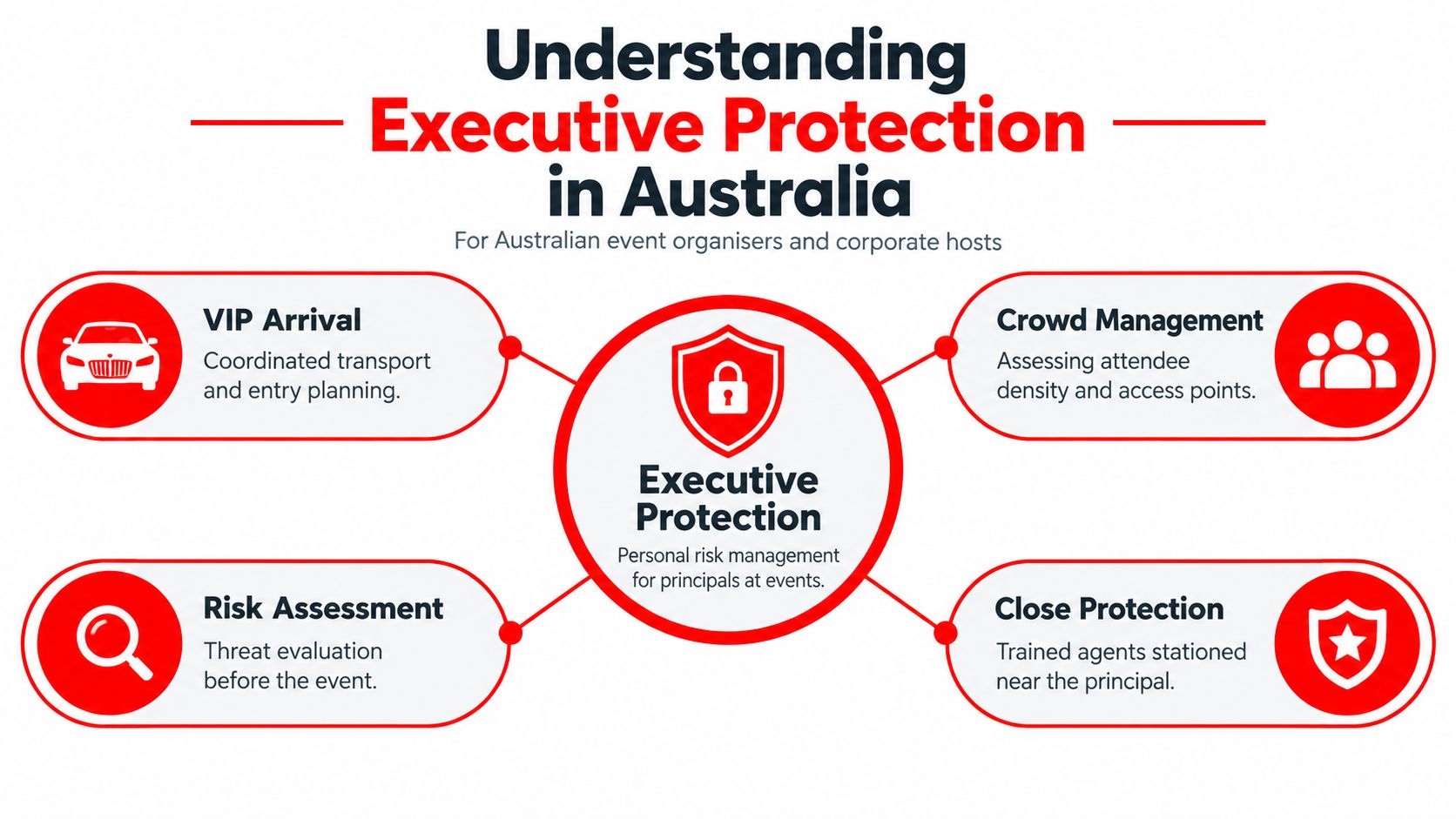
Understanding Executive Protection in Australia
A festival organiser may have competent crowd controllers at every gate, yet still lack a plan for a high-profile guest arriving through a public loading area. A corporate host may have a driver, a schedule and a reception desk, but no agreed response if an unfamiliar person begins following the executive between sessions. These gaps rarely look dramatic during planning. They become operational problems when people, vehicles and information converge.
Executive protection is the planned prevention of harm to a high-profile individual, such as a business leader, public official, performer or other VIP. It combines threat assessment, route and venue planning, protective surveillance, access control, secure transport, communications and close personal protection. In Australia, it sits inside a wider private-security framework shaped by state and territory licensing systems rather than one single national licence, as outlined by the Australian Institute of Criminology's review of private security.
Protection starts before the visible detail
The familiar image of a bodyguard in a suit is only one part of the service. A protection lead might review the principal's public itinerary, identify arrival and departure options, check backstage or hotel interfaces, coordinate with the venue manager and set a fallback movement plan. The close-protection officer then works within that design, observing behaviour, managing proximity and helping the principal move without unnecessary disruption.
Australia's private-security workforce also shows why executive protection shouldn't be treated as an informal occupation. The AIC recorded 52,768 full-time security workers and 44,898 police officers in 2006, making the private-security workforce approximately 17.5% larger at that time. The review identified bodyguarding as one activity considered for nationally consistent licensing alongside general guarding, crowd and venue control, dog guarding, firearms guarding, monitoring-centre operations and training.
Practical rule: A protection plan should answer how the principal enters, moves, pauses, leaves and receives help, not merely who stands nearby.
The strongest baseline is simple. Executive protection is personal risk management integrated with the event's wider safety system. It should be discreet when discretion supports the principal, visible when visibility deters a problem, and proportionate to the assessed risk.
The Risk-Management Model Behind Executive Protection
Professional protection begins with a decision, not a uniform. The Australian Government's Protective Security Policy Framework guidance describes a risk-based process: identify threats and vulnerabilities, apply proportionate controls, assess residual risk, then accept that risk within the organisation's tolerance or introduce further controls.
That model changes the question from “How many guards do we need?” to “What can expose this person, where could it happen, and which control reduces that exposure?” A well-known executive with a predictable public schedule may require stronger information discipline and movement planning, while a private corporate guest at a controlled venue may need a lighter, discreet arrangement.
The operating cycle
A practical event cycle has distinct outputs:
Pre-event assessment: Review the principal, event profile, public information, venue history, transport arrangements and known concerns. Stalking and harassment deserve early attention, because the risk may develop through repeated unwanted contact rather than a single dramatic incident.
Movement mapping: Mark arrival lanes, parking, lifts, backstage rooms, green rooms, hospitality areas, accommodation interfaces and public-facing points. For each location, identify who controls access and what happens if the planned route closes.
Communications planning: Establish approved radio channels, contact points, plain-language escalation terms and a backup method if the primary system fails. The principal's staff should know what information they need to share and what they must keep restricted.
Control selection: Use access control, surveillance, secure transport, staff coordination, protective presence or evacuation procedures according to the risk. The PSPF supports additional training for personnel in specialist or high-risk positions, which is why generic event staffing isn't a substitute for trained protection personnel.
Reassessment and reporting: Conditions change when timings move, crowds build, weather affects access or a new concern appears online. The team should record decisions, incidents, handovers and unresolved issues after the event.
Why proportion matters
Over-protection can make a principal feel isolated, expose their status unnecessarily or interfere with normal hospitality. Under-planning leaves staff improvising at the exact moment they need clear authority. The useful middle ground is a flexible plan with defined thresholds, so personnel can increase, reduce or redirect controls without waiting for confusion to spread.
Licensing and Legal Requirements Across Australian States
Australia doesn't have one nationwide executive-protection licence that automatically covers every deployment. Licensing depends on the jurisdiction, the activity and the way the officer is engaged. The ASIAL 2024 national licensing report recorded 162,535 individual security licence holders and 13,055 licensed security businesses at 31 December 2023. It also records bodyguard permissions separately within the wider security workforce.
What organisers should verify
In Queensland, bodyguard work sits under the bodyguard function of a Class 1 security licence. Applicants must be at least 18, prove identity, provide fingerprints, pass a criminal-history check and complete the required training. Queensland permits a restricted licence for a person training to become a bodyguard under supervision, but the function doesn't authorise firearms, handcuffs or batons. The Queensland application page lists a $47.35 criminal-history check fee in the stated circumstance and a $113.30 mandatory fingerprinting fee for an original application, so organisers should rely on current regulator information when checking costs.
Victoria Police treats bodyguard work as a regulated private-security activity. The licence should show the actual bodyguard activity, rather than relying on a generic “security guard” description. Victoria also provides a special-event pathway for eligible interstate professionals working temporarily in the state.
NSW and the ACT require the same disciplined approach to verification. Confirm the relevant state or territory authority, licence activity, expiry date, provider details and any interstate recognition or temporary permit before the first shift. A Queensland licence shouldn't be assumed to authorise work in Victoria, NSW or the ACT without the applicable recognition or permit process.
| Jurisdiction | Licence class | Key requirements | Interstate recognition |
|---|---|---|---|
| Queensland | Class 1, bodyguard function | Identity, fingerprints, criminal-history check, approved training and permitted equipment limits | Transfer through mutual recognition or a temporary interstate permit may apply |
| Victoria | Private security licence with bodyguard activity | Apply for the stated activity, with possible fingerprinting and approved identification requirements | Special-event pathway may apply to eligible interstate personnel |
| NSW | State-regulated security licence | Verify the applicable close-protection or equivalent activity and current status | Confirm recognition or temporary work arrangements before deployment |
| ACT | Territory-regulated security arrangements | Check the relevant licence, activity and provider authority | Confirm territory requirements for interstate personnel |
Organisers building compliance training for supervisors may also learn about VideoLearningAI as a way to structure repeatable staff learning, but training content shouldn't replace regulator checks. Before deployment, request licence evidence, bodyguard function details, training status, employer or provider information and permitted equipment confirmation.
How Protection Teams Integrate With Event Security
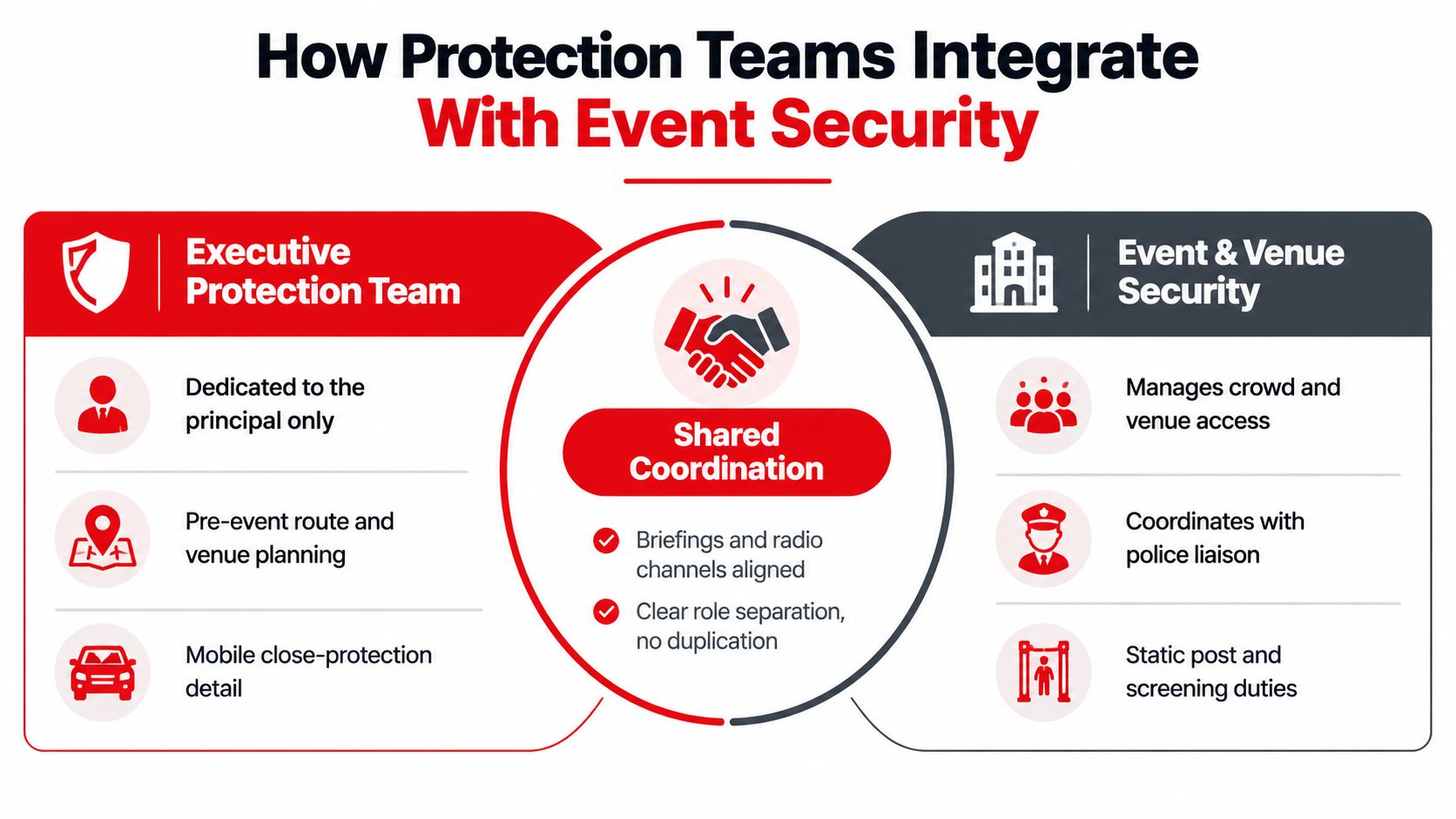
Executive protection and event security have different primary responsibilities. The protection team safeguards a specific principal and itinerary. The organiser and venue team manage whole-site safety, access procedures, crowd movement and visitor experience. Police retain statutory powers and responsibilities that private personnel don't possess.
Victoria's crowded-places guidance states that owners and operators have primary responsibility for mitigating risks at crowded places. The ACT's 2026 Floriade declaration illustrates why private protection can't replace public authority. The 2025 festival attracted 519,413 attendees, more than 40% from interstate, and expected 2026 attendance was 500,000 to 600,000. The declaration enables police search and crowd-management powers that private personnel do not possess.
Separate roles, shared decisions
| Function | Primary responsibility | Typical handover |
|---|---|---|
| Executive protection | Principal movement, personal safety, advance planning and discreet observation | Protection lead to event control or venue manager |
| Event and venue security | Screening, crowd management, access points and site procedures | Security supervisor to organiser or venue control |
| Police | Statutory powers, public-order response and emergency coordination | Police liaison to event control and emergency services |
The distinction matters during arrivals. A protection officer may identify a safer route for the principal, while venue staff manage the gate and police liaison confirms traffic or public-order arrangements. If each group understands its authority, the principal can move efficiently without creating a second, competing security system.
More visible guards aren't automatically better. Duplicated searches can frustrate guests, conflicting radio instructions can delay an evacuation and unclear command can cause personnel to assume someone else is handling a threat. The effective controls are advance liaison, a written movement plan, defined emergency triggers, agreed handovers and privacy-conscious information sharing.
Shared coordination works when everyone knows who owns the decision.
For crowded arrivals, vehicle planning must be site-specific. NSW Police hostile-vehicle mitigation guidance recommends assessing vehicle size and weight, site vulnerabilities, possible attack paths and achievable speeds. The plan should state permitted vehicles, credential checks, barrier locations, pedestrian separation, emergency access, driver communications and a fallback arrival point.
Tailoring Protection Solutions for Events and Venues
A corporate function in a hotel doesn't need the same deployment as a festival with multiple public entrances. The first may need advance route work, a discreet close-protection officer and controlled lift access. The second could require a coordinated package involving static guards, gatehouse control, vehicle patrols, K9 handlers, venue liaison and a mobile detail for the principal.
A practical deployment might begin with a risk assessment that identifies the executive's arrival time, public exposure, staff access and transport route. The provider can then match personnel to the environment rather than placing the same visible resource everywhere. A K9 unit may support perimeter or entry operations, while close protection remains focused on the individual. Covert operations may suit a principal who wants normal interaction with guests, whereas a visible detail may help deter interference around a stage or vehicle.
A field-ready operating pattern
Before doors open, the protection lead confirms the arrival lane, parking position, internal route, holding room and departure trigger with the venue manager. The event supervisor confirms the public access plan, radio contacts and escalation process. Staff receive only the information they need, protecting the principal's itinerary without leaving frontline personnel unaware of the relevant movement window.
During the event, communication and customer service matter as much as physical positioning. A good officer can redirect a guest without provoking embarrassment, explain a temporary restriction to venue staff and report changing conditions clearly. That approach supports a safe, welcoming atmosphere while meeting current state security and RSA requirements.
GM GROUP Services provides one example of this integrated model, combining VIP and bodyguard protection with vehicle patrols, risk assessments, monitoring and event-security capabilities under an operational plan. Its wider services include static guards, K9 units and handlers, covert operations, gatehouse control, loss prevention, emergency response and reporting across NSW, Victoria, Queensland and the ACT.
When Your Organisation Should Engage Executive Protection
Executive protection adds value when a person's profile, movements or circumstances create a risk that ordinary venue controls don't address. That may involve a high-profile chief executive, a visiting performer, a public-facing founder, a VIP guest at a conference or a principal dealing with persistent unwanted attention.
The risk doesn't need to look dramatic. The ABS reports that 1 in 5 Australian women, about 2 million people, and 1 in 15 men, about 653,400 people, have experienced stalking since age 15 in its crime and justice statistics. For an executive or performer, early protection work can involve documenting incidents, reducing public schedule exposure, controlling family routine information, coordinating with police and setting a clear escalation threshold.
Questions worth answering early
- Who is the principal? Consider public profile, role, travel pattern, family exposure, known disputes and the consequences of disruption.
- Where will exposure occur? Map transport, hotels, backstage areas, green rooms, entrances, media points, staff corridors and public meet-and-greet areas.
- What does the existing team already control? Identify venue security, police liaison, traffic management, emergency medical arrangements and the event control room.
- What would a failure affect? The impact may involve personal safety, business continuity, reputation, schedule integrity or the safety of nearby guests.
- What evidence should a provider supply? Check the licence activity, jurisdiction, expiry, assigned personnel, supervisor, insurance and written operating plan.
Transport deserves its own conversation. A principal who travels frequently may benefit from a secure movement plan that addresses departure privacy, vehicle access and schedule flexibility. Organisations arranging business aviation can also review practical guidance on flying private for business, then give the protection provider enough itinerary detail to assess ground movements without distributing unnecessary personal information.
The decision isn't “guards or no guards”. It's whether the principal's risk can be managed proportionately through planning, information discipline, venue integration, secure transport and trained personnel.
Frequently Asked Questions About Executive Protection
Is executive protection just a bodyguard?
No. A bodyguard may provide close personal protection, but the wider service includes threat assessment, route planning, venue coordination, communications, access control and reassessment. The officer should work within the event's operating plan rather than act as a separate security authority.
Can a protection team manage a medical emergency?
The team can support evacuation, protect the principal's privacy, communicate with event control and coordinate access for medical responders. The medical response itself should follow the venue's emergency plan and the qualifications of the responding personnel.
What if the principal has mobility or medical needs?
Raise those needs during the advance assessment. The team can review accessible routes, lift access, rest points, vehicle positioning, medication privacy and contingency movement options with the venue and relevant staff.
Will protection disrupt the guest experience?
It can if the command structure is unclear or personnel use unnecessary visibility. A proportionate plan can remain discreet, preserve normal hospitality and still provide a clear response when conditions change.
How are event costs structured?
Providers commonly scope costs around personnel, hours, travel, planning, vehicles, specialist resources and the complexity of the venue. Ask for a written scope that separates core duties from contingencies, rather than choosing solely on the lowest hourly rate.
Does weather or a changed schedule affect the plan?
Yes. Rain can alter arrival surfaces, crowd behaviour and vehicle access, while a delayed appearance can change staffing and public exposure. The protection lead should maintain a live fallback plan and communicate changes through the agreed event-control process.
GM GROUP Services offers licensed VIP and personal protection, risk assessments, vehicle patrols, event security and coordinated support for corporate functions, festivals and venues across NSW, Victoria, Queensland and the ACT. To plan a proportionate executive-protection solution around your principal, venue and existing security team, visit GM GROUP Services.
Discover more from GM Group Services
Subscribe to get the latest posts sent to your email.