
Violence prevention strategies start with a hard reality. In Australia, 13% of people aged 18+ experienced physical or threatened physical assault in the previous 12 months, and 7.3% experienced sexual violence according to reporting cited in this Australian violence prevention analysis.
For venue operators, event organisers, hospitality managers, builders, retailers, and corporate employers, that shouldn't lead to panic. It should lead to planning. Violence is a risk category you can assess, control, monitor, and reduce.
The mistake I still see too often is treating prevention as a synonym for “put more guards on the door”. That's a partial response, not a system. Good violence prevention strategies combine site design, staffing, policy, reporting, escalation, supervision, and post-incident review. They protect people first, but they also protect operations, licences, reputation, and staff confidence.
The Urgent Need for Proactive Violence Prevention Strategies
The old model was simple. Wait for trouble, then respond.
That model fails in real venues.
A bar in Melbourne doesn't only have a door problem. It has queue pressure, intoxication management, blind spots near amenities, conflict at the smoking area, and transport friction when patrons leave. A festival in regional NSW doesn't only have a perimeter problem. It has entry surges, roaming anti-social behaviour, poor lighting between activity zones, and communication gaps between security, organisers, and medical teams.

What proactive control looks like
Proactive violence prevention strategies focus on stopping incidents early, shrinking the chance of escalation, and making sure staff know exactly what to do when behaviour changes.
That usually means:
- Identifying high-risk moments: entry periods, last drinks, bump-out, shift change, contractor arrival, cash movement, and isolated work.
- Designing out obvious triggers: bottlenecks, dark walkways, unmanaged queues, poor sightlines, and confusing exits.
- Giving staff simple response rules: who intervenes, who observes, who calls police, who records, and who supports affected persons.
- Building review into operations: every incident, threat, and near miss tells you something useful if you capture it properly.
More guards can improve response capacity. They won't fix a bad layout, weak supervision, or inconsistent policy enforcement.
What works and what usually doesn't
A practical prevention system accepts trade-offs. Tight entry controls can improve safety but slow patron flow. Strong RSA enforcement can reduce aggression but create refusal flashpoints if supervisors don't back staff. Visible patrols can deter misconduct but may feel heavy-handed if the venue's customer service approach is poor.
The right answer is rarely one control. It's a layered mix.
The operators who manage violence best don't rely on instinct alone. They set standards, train to those standards, and keep adjusting based on what's happening on site.
Why Modern Violence Prevention Is a Public Health Issue
Australia's current approach to prevention is shaped by the public health model, which treats violence as preventable by identifying risk and protective factors, testing interventions, and scaling what works, as outlined by the World Health Organization's violence prevention framework.
That sounds academic until you apply it on the ground.
Think about fire safety. No competent operator says, “We've got one extinguisher, so we're covered.” They use alarms, exits, drills, wardens, signage, maintenance, and evacuation plans. Violence prevention strategies work the same way. A single control point is fragile. A layered system is resilient.
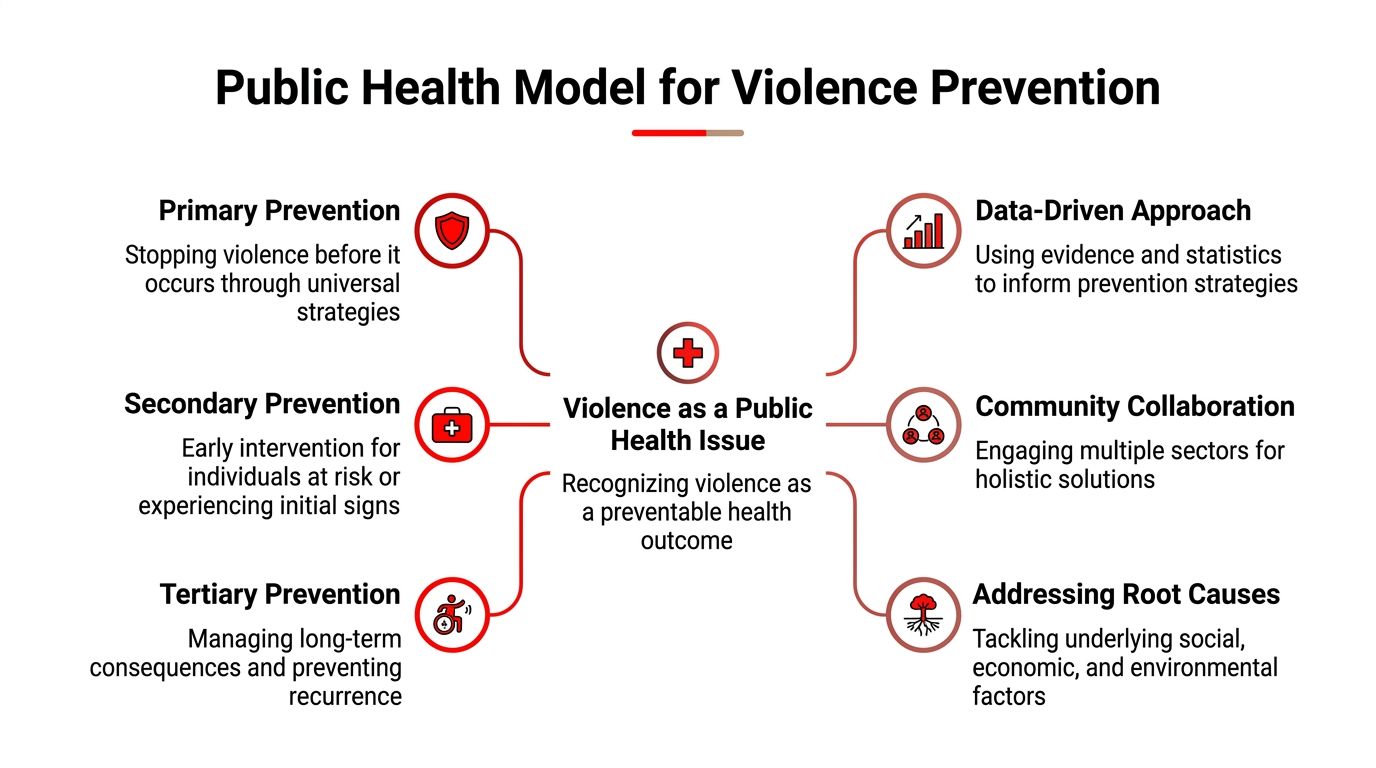
The shift from reaction to prevention
Under a public health approach, operators don't just ask, “How do we remove a violent person?” They ask better questions:
- Who is involved most often
- What behaviours appear first
- Where incidents cluster
- When the pattern changes
- How escalation usually happens
That “who, what, where, when, and how” approach matters because it turns vague concern into usable operational intelligence. If incidents repeatedly start at external queuing points, near bars, in amenities corridors, or during pack-down, you don't need a generic security uplift. You need targeted controls in those places and at those times.
Why this matters for Australian venues and worksites
In practical terms, the public health model pushes operators to combine people, environment, and policy.
That means:
- People controls: trained supervisors, de-escalation capability, clear authority lines, and bystander action.
- Environmental controls: lighting, line of sight, zoning, entry design, barriers, and safe exits.
- Policy controls: refusal procedures, incident escalation rules, reporting pathways, and consistent enforcement.
Practical rule: If your only prevention measure is a physical security presence, you don't have a prevention strategy. You have a response resource.
This model also recognises aftermath. Staff exposed to aggression, threats, or traumatic incidents may need support beyond a debrief. Where someone's struggling after an incident, it may help them to get help for trauma and PTSD through a qualified counselling service.
Understanding Your Legal and Regulatory Obligations
Violence prevention strategies aren't optional from a compliance perspective. If you operate a venue, event, workplace, or public-facing site, your baseline duty is to provide a safe environment so far as reasonably practicable. The exact legal framework varies across jurisdictions, but the operating principle is consistent. If a foreseeable risk exists, you're expected to assess it and control it.
WHS and duty of care in practice
For most operators, the legal test isn't whether you can guarantee nothing bad will ever happen. You can't. The test is whether you identified foreseeable risks and took sensible, documented action to reduce them.
That includes issues such as:
- Known conflict points: entrances, bars, loading docks, smoking areas, amenities, car parks, and isolated work zones.
- Known behavioural risks: intoxication, ejections, domestic disputes entering the site, disgruntled visitors, and aggressive customers.
- Known operational gaps: poor radio coverage, unclear escalation authority, no written incident process, or inadequate supervision.
If an incident occurs and there's no risk assessment, no site instructions, no training record, and no review history, your position becomes weak very quickly.
Liquor, occupancy, and site compliance
Licensed venues carry extra operational pressure. Responsible service obligations, patron behaviour management, and the condition of the premises all intersect. A refusal of service that's lawful and necessary can still turn volatile if the handoff between bar staff, floor supervisors, and security is clumsy.
Physical access and building design also matter. If exits are confusing, corridors create conflict points, or accessible navigation hasn't been considered properly, safety can deteriorate fast under stress. For operators reviewing the broader property side of compliance, Waymap's building compliance article is a useful reference point.
Compliance is the floor, not the ceiling
Legal compliance gives you the minimum acceptable standard. Good operators go further because compliance alone doesn't run a safe Friday night, a major festival, or a contentious site shutdown.
Use this quick lens when reviewing your current position:
| Area | Weak position | Strong position |
|---|---|---|
| Risk assessment | Generic and outdated | Site-specific and reviewed |
| Staff instructions | Verbal only | Written and accessible |
| Incident management | Ad hoc | Defined escalation pathway |
| Training | Induction only | Role-based refreshers |
| Records | Incomplete | Consistent reporting and follow-up |
The operators who stay out of trouble usually do one thing well. They document what they expect, then they enforce it consistently.
Implementing Effective Violence Prevention Strategies Step by Step
The strongest evidence supports treating violence as a systems problem and applying evidence-based technical packages that combine programs, policies, environmental design, and evaluation. Those packages are built around measurable controls such as improved monitoring and enforcement of organisational policies, and they recognise that community-level conditions like the physical environment and alcohol outlet density shape risk, as discussed in this technical review of violence prevention frameworks.
For operators, that translates into a disciplined build process.
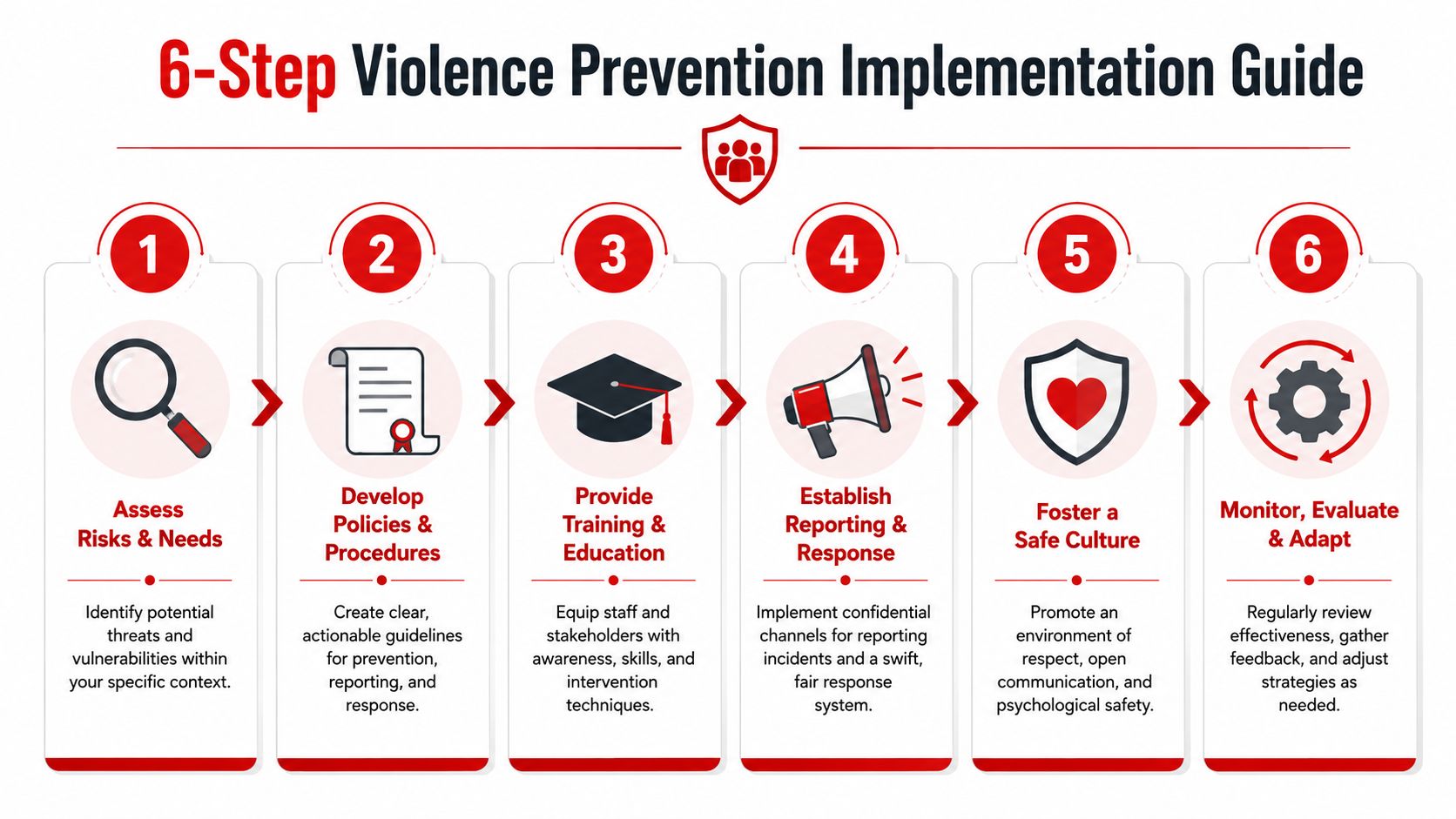
Step 1 Assess the actual risk
Start with your site, not a template.
Walk the venue or worksite at the times risk is highest. A hospitality venue should be reviewed during service, not only in daylight before opening. A construction site should be reviewed during access changeovers, deliveries, and after-hours conditions.
Look for:
- Pressure points: queue compression, congestion at bars, gate rushes, and contractor bottlenecks.
- Isolation points: amenities corridors, stairwells, external walkways, and cash office routes.
- Trigger points: service refusals, ticket disputes, denied access, and intoxication management.
Step 2 Fix the environment before it fixes you
The most effective prevention is often developmental and environmental. Evidence indicates that changing monitoring in unsafe areas and improving the social and physical environment through consistently enforced policies, bystander intervention, and de-escalation can reduce harassment and other violence outcomes, according to this violence prevention technical package summary.
That matters because poor layout keeps creating the same incident.
Examples include:
- Improving line of sight: remove visual barriers near queues, entries, and pinch points.
- Separating functions: don't force smokers, re-entry patrons, taxis, and ejected persons through the same narrow zone.
- Controlling transitions: use barriers, rope lines, and managed exits so crowd movement stays orderly.
A bad floor plan creates repeat conflict. Staff end up dealing with the same behaviour in the same place every weekend.
Step 3 Match staffing to risk, not budget alone
A common mistake is treating staffing as a simple numbers exercise. It's not just headcount. It's placement, competence, authority, and supervision.
A strong deployment plan usually clarifies:
- Who manages entry
- Who roves
- Who responds to refusals and removals
- Who records incidents
- Who makes escalation decisions
For a corporate event, that might mean a polished front-of-house presence with one senior responder. For a nightclub, it may require experienced floor staff and tight supervisor control around the bar and exit routes.
Step 4 Write de-escalation into the job
Telling staff to “use common sense” is not a protocol.
Your violence prevention strategies should define early intervention cues, safe positioning, verbal techniques, withdrawal points, and escalation triggers. Staff should know when to continue engagement, when to call a supervisor, when to isolate an area, and when police or emergency services are required.
Useful site instructions often cover:
- Approach: one lead communicator, one support observer.
- Language: calm, direct, respectful, and non-provocative.
- Spacing: avoid crowding, cornering, or unnecessary touch.
- Handover: clear transfer from floor staff to supervisor or security lead.
Step 5 Use monitoring that supports action
Monitoring isn't only CCTV. It includes patrol patterns, radio discipline, supervisor visibility, and the quality of information passed between teams.
A good control room feed is wasted if no one owns response. Likewise, body-worn notes, gate logs, and incident registers are only useful when they identify patterns that lead to change.
Step 6 Build a reporting and review loop
The final step is where many operators go soft. An incident gets handled, everyone goes home, and nothing changes.
Review every meaningful incident, threat, and near miss. Ask what failed first. Was it environment, staffing, communication, policy, or supervision? Then close the loop with an action, an owner, and a date for review.
Practical Examples for Your Industry
Violence prevention strategies only work when they fit the setting. The framework stays consistent. The controls change.
Music festival in NSW
A festival environment is dynamic. Crowd mood can shift quickly with weather, alcohol, queue delays, artist set changes, or transport issues at the end of the night.
A workable setup usually includes controlled entry lanes, visible roaming teams, protected back-of-house access, and clean radio channels between security, operations, and medical. If K9 units are used, they need a clear role and a clear boundary. They're not a substitute for entry design, queue management, or capable supervisors.
A practical weak point is exit. If patrons leave into poor lighting, transport confusion, and unmanaged conflict between groups, the risk shifts off the main site.
Busy CBD bar in Victoria
In a CBD bar, the flashpoint is rarely one dramatic incident. It's the build-up. Patron density rises. Service slows. A refusal occurs. Friends intervene badly. Staff lose line of sight near the amenities or smoking area.
The best controls are operationally boring, and that's exactly why they work:
- Tight RSA practice: refusals are consistent and supported by supervisors.
- Density management: staff don't allow one area to become a pressure cooker.
- Door and floor coordination: entry, roaming, and exit teams communicate before a removal, not after.
- Safe departure planning: staff watch the handoff from venue to street and transport areas.
Good venues manage the whole patron journey, not just the doorway.
Construction site in Queensland
Construction violence risk often gets underestimated because managers focus on theft, trespass, and asset loss. Those matter, but so do worker disputes, aggressive visitors, after-hours confrontations, and lone-worker exposure.
A sound plan may include controlled gatehouse access, contractor sign-in discipline, after-hours patrols, lighting around plant and storage areas, and a clear process for dealing with terminated or disgruntled persons attempting to re-enter the site.
The point isn't to make the site feel hostile. It's to remove ambiguity about who belongs there and how conflict is handled.
Corporate office in the ACT
Corporate sites usually need a softer touch, but the prevention work is just as real. Visitor access, reception procedures, executive movement, and emergency communication all need structure.
If a former employee, angry client, or unstable visitor arrives, reception staff shouldn't be improvising. They need a script, a panic pathway, a supervisor contact, and a protected space to move people if behaviour changes.
Measuring Success Beyond Zero Incidents
“Zero incidents” sounds good in a report, but it can hide weak reporting, poor staff confidence, or simple luck.
Better violence prevention strategies are measured through controls and behaviours you can observe. That aligns with the evidence base, which supports measurable controls such as improved monitoring and enforcement of organisational policies, and recognises that conditions like the physical environment and alcohol availability shape risk.
What to watch instead
A healthier measurement set includes:
- Reporting quality: are staff documenting threats, harassment, refusals, and near misses properly?
- Pattern visibility: can management identify repeat locations, times, and triggers?
- Policy consistency: are supervisors enforcing the same standards every shift?
- Operational confidence: do staff escalate early instead of waiting until behaviour deteriorates?
One useful sign of improvement is that reporting often becomes more active before serious incidents reduce. That usually means staff trust the process and believe management will act.
The business case is broader than security
Good prevention supports retention, customer comfort, and brand stability. A venue that feels controlled without feeling oppressive tends to keep better staff and attract steadier trade. A worksite with clear escalation pathways reduces confusion when tensions rise. A corporate event with professional access control protects both safety and reputation.
What matters is whether your environment is becoming more predictable, more manageable, and less dependent on heroics.
Frequently Asked Questions
Are violence prevention strategies expensive
They can be. So can a serious incident.
The wrong way to think about cost is comparing a prevention plan to doing nothing. A more accurate comparison is between structured prevention and the operational damage caused by assaults, staff injury, venue disruption, complaints, licensing issues, reputational harm, and management time spent in reactive cleanup. Start with the highest-risk settings and the most obvious control gaps.
Can we handle this in-house or do we need specialists
That depends on your risk profile.
If your site has low complexity, stable occupancy, limited public access, and experienced managers, an internal team may handle parts of the plan well. If you run licensed venues, large events, construction compounds, VIP functions, or sites with a history of aggression, specialist support is usually the safer choice. The dividing line is simple. If your staff are likely to face confrontation, removal decisions, crowd pressure, or after-hours risk, you need people with the right licensing, training, and supervision.
What's the single most important measure
A proper risk assessment.
Not because paperwork solves anything, but because every good decision flows from it. Without a site-specific assessment, operators tend to overinvest in visible measures and underinvest in the controls that reduce risk. The best violence prevention strategies are layered, but the first layer is always understanding where your real exposure sits.
If you need customized support with venue, event, workplace, or site security planning, GM GROUP Services provides licensed, fit-for-purpose protection across NSW, VIC, QLD and the ACT. Their team supports risk assessments, venue and event security, patrols, gatehouse control, K9 operations, VIP protection, monitoring, and responsive on-site coverage built to address the conditions of Australian commercial environments.
SEO title: 5 Essential Violence Prevention Strategies Your Venue Needs
SEO meta description: Violence prevention strategies for Australian venues, events, workplaces and sites. Learn practical, evidence-based steps to reduce risk and improve safety.
Suggested URL: /violence-prevention-strategies
Discover more from GM Group Services
Subscribe to get the latest posts sent to your email.