
Vendor security assessment starts before a contractor arrives at your venue, festival, retail site or construction project. It starts when someone decides what that supplier can access, which services could fail, and who carries the risk if something goes wrong. A questionnaire sitting in procurement files won't protect a crowded event if a subcontractor still has an active credential, a payment provider can't explain its incident process, or a security contractor changes personnel without telling you.
The practical answer is a lifecycle process. Screen the supplier, verify evidence, observe operations, write enforceable obligations into the contract, and reassess when the relationship changes. That approach is more demanding than collecting a policy document, but it gives operations, procurement and management a defensible record of how supplier risk is controlled.
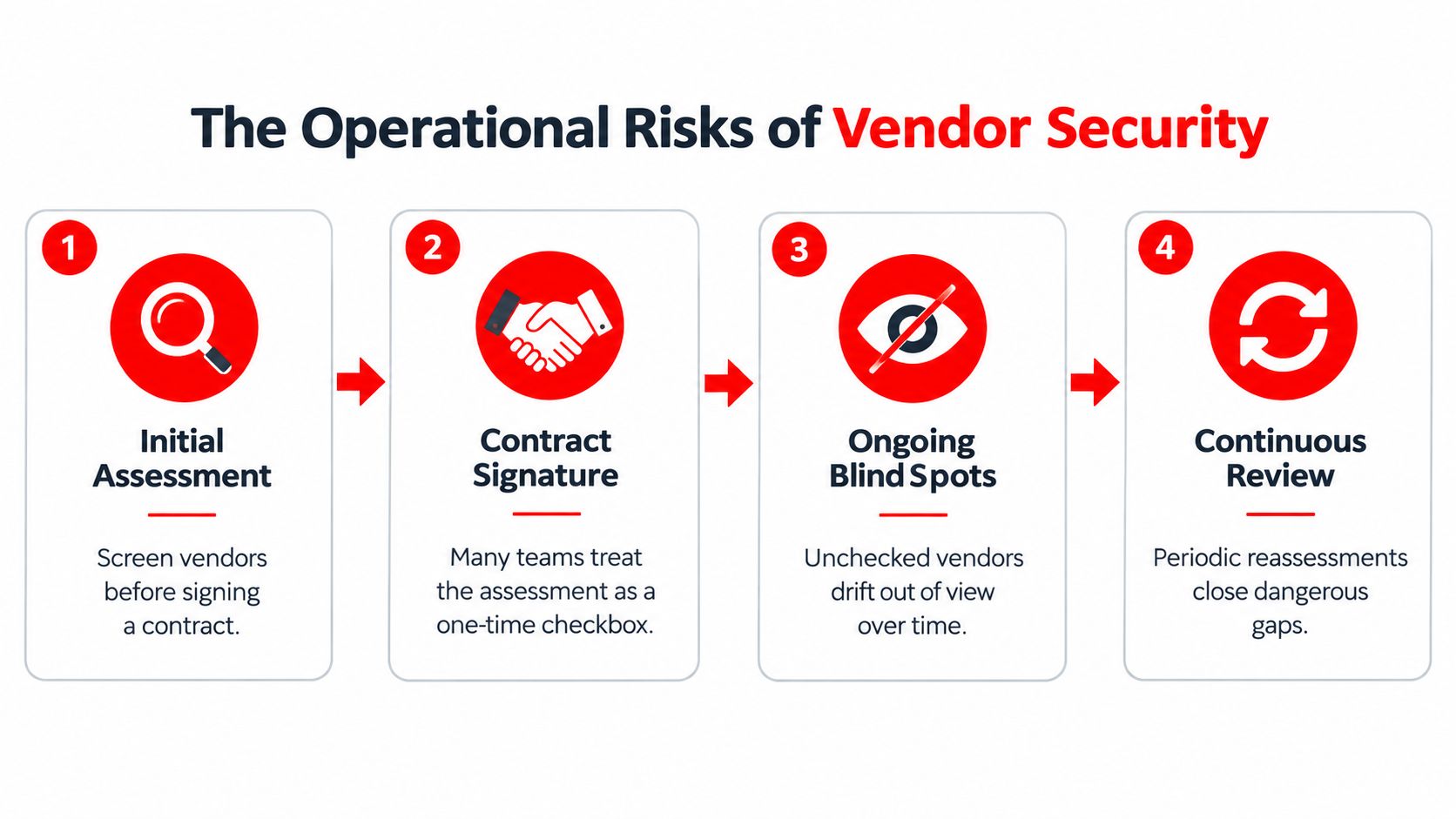
The Operational Risks of Vendor Security
A supplier may never appear in your internal staff directory, yet still handle personal information, enter restricted areas, operate technology or influence whether your site opens safely. A ticketing provider can connect to registration data. A monitoring contractor may view CCTV. A temporary guard force can control access to staff areas, loading docks and emergency routes. A cleaning company may receive keys or work after hours.
The Australian National Audit Office reported more than 67,500 cybercrimes reported to the Australian Cyber Security Centre during the 2020–21 financial year, an increase of 13% from the previous year. The same audit highlighted malicious cyber activity affecting contractors holding government information, showing why an organisation's exposure extends beyond its own systems and employees. The ANAO audit report provides the historical rationale for treating supplier controls as part of the organisation's security perimeter.
Why the one-time check fails
The standard failure pattern is familiar. Procurement sends a questionnaire, the vendor returns policies and insurance documents, someone records an approval, and the file disappears until renewal. That process may establish what the supplier says it does, but it doesn't show whether the supplier still does it after staff turnover, a new subcontractor, a system change or an incident.
A supply-chain attack can begin with the compromise of a supplier and then move towards that supplier's customers, as explained in Australian Signals Directorate guidance. The risk isn't limited to a software provider. It can involve any contractor with a path into information, facilities, systems or operational processes.
Practical rule: Treat every supplier relationship as a chain of access and dependency, not as a single company name on a purchase order.
For an event organiser, the chain might include the primary security contractor, rostering platform, radio provider, uniform supplier and subcontracted guards. For a venue, it might include access-control maintenance, payment systems, cleaning, IT support and alarm monitoring. Each dependency needs an owner, a defined access boundary and a response expectation.
Build the lifecycle into operations
A defensible process has four connected stages:
- Before engagement: Map the service, access, information, subcontractors and operational consequences before selection.
- During selection: Compare evidence against minimum requirements and reject suppliers whose risk can't be reduced to an acceptable level.
- At mobilisation: Confirm identities, permissions, training, escalation contacts, equipment and site procedures before the first shift.
- Throughout the relationship: Monitor performance, investigate exceptions and reassess after material change.
This is also why practical guidance on managing contractor cyber threats can be useful alongside formal procurement controls. The key question isn't whether a vendor appears reputable. It's whether you can verify the controls that protect your patrons, workers, information and continuity when conditions change.
Defining Scope and Risk Criteria
Don't send the same questionnaire to every supplier. Start by creating a complete inventory of vendors, services, subcontractors and dependencies, then classify each relationship according to the access it receives and the harm a failure could cause.
A uniformed static guard who receives a shift brief and has no system access presents a different risk from a ticketing platform processing attendee information. A cleaning contractor working in public areas differs from a provider maintaining CCTV, access-control systems or payment infrastructure. The assessment should reflect those differences.
Map access before asking questions
For each supplier, record:
- Information access: Personal information, staff records, visitor details, incident reports or commercially sensitive material.
- Technology access: User accounts, privileged accounts, remote support, CCTV, access-control, payment or communications systems.
- Physical access: Offices, control rooms, storage areas, loading docks, plant rooms, construction compounds or restricted event zones.
- Operational dependency: The consequence if the service is unavailable, delayed, manipulated or withdrawn during a live operation.
- Supply-chain dependency: Subcontractors, manufacturers, distributors, technology partners and temporary personnel involved in delivery.
The Australian Signals Directorate recommends starting cyber-supply-chain risk activities at the earliest procurement stage and says suppliers assessed as high risk shouldn't be used. Its procurement and outsourcing guidance also supports reviewing each supplier, manufacturer, distributor and retailer for the additional security risk they create. The ASD procurement and outsourcing guidance.pdf) is particularly relevant when a vendor's service reaches beyond the immediate contractor.
Use tiers that change the depth of review
A basic tier can cover suppliers with limited access and low operational impact. Confirm identity, licences where relevant, insurance, contact details, training expectations and incident escalation.
A higher tier should apply where the vendor handles personal information, operates critical technology, holds privileged access, controls a sensitive area or supports a service that can't easily be replaced during an event. Request stronger evidence, involve the system or site owner, review subcontractors and define conditions for approval.
Commonwealth procurement rules require relevant entities to consider and manage procurement security risk, including cyber-security risk, under the Protective Security Policy Framework. The practical lesson for private organisations is straightforward: document the risk created by the supplier, decide who is best placed to control it, and record the treatment in the evaluation file or contract. The Commonwealth Procurement Rules also support a clear risk-owner matrix rather than vague shared responsibility.
A low price isn't a low-risk decision if the supplier can open a gate, access a database or stop a critical operation.
The Essential Vendor Documentation Checklist
Evidence should answer a practical question: Can this supplier perform the agreed service safely in our environment, including when people, systems or conditions change? A polished policy doesn't answer that on its own.
Start with the basics, but don't finish there. Confirm the vendor's legal identity, relevant licences, insurance, key contacts, service scope and list of subcontractors. Then match the evidence to the supplier's actual access. A guard contractor should explain personnel vetting, induction, supervision, incident reporting and shift handover. A technology supplier should explain identity management, vulnerability handling, logging, backup, continuity and secure offboarding.
Request evidence that reflects real work
Build the file around evidence categories rather than a generic compliance declaration:
- Governance: Risk register, security policies, named control owners and review records.
- People: Recruitment checks, training records, access approval and removal processes, and supervision arrangements.
- Technology: Access-control design, authentication controls, vulnerability-management records, monitoring and change procedures.
- Incidents: Incident history, escalation process, customer notification steps, investigation cooperation and evidence preservation.
- Continuity: Business continuity plans, fallback arrangements, recovery responsibilities and critical-service dependencies.
- Subcontractors: Current subcontractor list, approval process, flow-down obligations and evidence that the vendor checks its own suppliers.
- Data handling: Collection, storage, retention, access, return and deletion arrangements.
The Office of the Australian Information Commissioner recorded 532 data-breach notifications in the January to June 2025 reporting period. Malicious or criminal attacks represented 59%, or 308 notifications, while human error represented 37%, or 193 notifications. The average number of individuals affected by cyber incidents was just over 10,000, according to the OAIC's latest notifiable data breach statistics. That combination reinforces the need to test both technical safeguards and human processes.
Ask the vendor to demonstrate, rather than merely describe, how a worker's access is removed, how an incident is escalated and how information is deleted at the end of an engagement. For a festival, request the process for replacing a staff member mid-event. For a construction site, ask how access changes when the site layout, project phase or subcontractor team changes.
Separate documents from capability
Insurance certificates and certifications may help establish a baseline, but they don't prove that the controls operate during a busy shift. Look for dates, owners, test results, exceptions, corrective actions and evidence of follow-through.
Mark a response incomplete when the vendor can't identify who owns a material risk, how subcontractors are checked or what happens if a critical service fails. The Australian Government's Commonwealth Supplier Code of Conduct expects suppliers to manage risks connected with security, significant events, health and safety, governance and supply-chain dependencies. It also supports allocating risk to the party best placed to manage it, rather than pushing responsibility down the chain without control.
Conducting the On-Site Evaluation
A document can say that staff understand emergency procedures. An on-site evaluation shows whether they can act when the radio is busy, the crowd is moving and the plan no longer matches the situation.
At a music festival, observe the entry queue, bag-check process, radio discipline and handover between supervisors. Ask a guard to explain what happens when a patron is refused entry, a gate becomes congested or an emergency route is obstructed. Check whether the supervisor can identify who escalates the issue and whether the incident is recorded while the event is running.

Test the environment, not the presentation
A corporate venue requires a different walk-through. Follow the path from reception to meeting rooms, server areas, loading docks and staff-only spaces. Check whether temporary badges are issued, whether access logs reflect activity in real time and whether staff challenge unfamiliar people appropriately.
In a hotel, bar or club, look at the interaction between security staff, hospitality workers and visitors. A technically correct procedure can still fail if guards don't communicate clearly with venue staff or escalate incidents too late. Observe how the contractor manages an intoxicated patron, a lost item, a staff-only door or a request from someone claiming to be a manager.
Construction sites change quickly. Inspect gatehouse controls, visitor records, key storage, plant areas, lighting, fencing and shift handover. Then ask what happens when a subcontractor arrives without the expected identification, when a gate is damaged or when a worker's access needs to be withdrawn.
Walk the route a supplier controls. You'll find gaps faster by following a credential, visitor or incident through the real site than by reading another generic assurance statement.
Bring the evidence pack, but don't turn the visit into a staged audit. Compare the written process with what supervisors and frontline workers know. Record observations, responsible owners and corrective actions while details are fresh.
For technology-heavy suppliers, a structured assurance model can help organise evidence, control ownership and review activity. A useful overview of that approach is the SOC2Auditors SOC 2 software guide, but a SOC 2 report or similar document should support your assessment rather than replace site-specific testing.
Scoring and Decision Matrix
Subjective approval creates a predictable problem. A familiar supplier may receive the benefit of the doubt, while a smaller vendor with clearer evidence may face more scrutiny. Use a decision matrix that makes the risk discussion visible and separates security findings from price, convenience and personal relationships.
Australian benchmark data demonstrates why confidence alone isn't enough. A 2024 Australia-focused survey reported that 45% of organisations had experienced a vendor breach since beginning the relationship, while 64% of respondents expressed confidence that vendors complied with applicable standards. The same survey found that only 17% rated visibility into vendor risk as very strong and 60% reported having a formal third-party-risk policy. These figures appear in the Australia edition of State of Trust.
Score what can change the outcome
Score each supplier against factors that reflect your environment. For example:
| Criterion | Evidence to assess | Decision question |
|---|---|---|
| Information handling | Data map, retention, access and deletion | Can the supplier protect and return the information? |
| System access | Account design, privileged access and monitoring | Can access be limited, reviewed and removed? |
| Physical access | Site controls, identity checks and supervision | Can the supplier protect restricted areas? |
| Incident response | Contacts, escalation, notification and exercises | Can the vendor support a live response? |
| Subcontractor visibility | Register, approval process and flow-down terms | Do you know who else performs the service? |
| Continuity | Fallback plan, dependencies and recovery roles | Can the critical service continue or fail safely? |
Use a scale that distinguishes complete evidence, partial evidence, unresolved exceptions and unacceptable risk. Weight information handling and privileged access more heavily when the vendor connects to personal data or operational systems. Weight physical access and supervision more heavily for a guard, gatehouse or site-services contractor.
Make exceptions explicit
A supplier shouldn't pass because its average score looks acceptable if one critical control is missing. Set approval conditions for unresolved findings, name the owner who accepts residual risk and specify the deadline for remediation.
The Australian survey also reported that organisations spent an average of five hours per week assessing and reviewing vendor risk, while 42% had terminated a vendor because of security concerns. Those figures support a focused model. Spend the most review time on suppliers whose failure would affect people, personal information, critical systems or live operations.
For a practical comparison of evidence-based vendor scoring for procurement, focus on the principle rather than the score itself. A number is useful only when the underlying evidence, assumptions, exceptions and decision owner remain visible.
Contract Clauses and SLAs
An assessment finding has little value if the contract doesn't require the supplier to maintain the control. Procurement, legal, security and operations should convert material findings into obligations that a manager can monitor and a customer can enforce.
At minimum, the contract should identify the services, systems, information, sites and subcontractors in scope. It should define access limitations, security responsibilities, audit or assurance rights, vulnerability notification, incident notification, cooperation duties, data handling, continuity expectations and secure offboarding.
Write clauses for the moment of failure
A useful incident clause should answer operational questions without forcing teams to negotiate during an emergency:
- Who is the named contact outside business hours?
- What event must the vendor report?
- How quickly must the initial notification occur?
- What information must the first report contain?
- Who preserves logs, records and other evidence?
- Who contacts affected people, regulators or other parties?
- How does the vendor continue critical services safely?
- When must the vendor provide updates and a corrective-action plan?
Don't rely on a clause that says the supplier will maintain “industry-standard security”. Specify measurable requirements, such as maintaining approved access controls, notifying the customer of material vulnerabilities, obtaining approval for critical subcontractors and providing evidence of remediation.
A Queensland Auditor-General review found that only 2 of 36 contracts examined required third parties to report cybersecurity incidents and vulnerabilities. The finding is detailed in the Queensland Audit Office review of third-party cyber-security risks. It exposes a practical weakness: organisations may collect security documents while leaving the most important response duty out of the agreement.
Link security to remedies
The contract should allow review, remediation and escalation when the supplier misses a control. For material failures, include suspension of access, a corrective-action requirement and termination rights where appropriate.
Commonwealth procurement guidance says contracts should include provisions allowing termination for a material breach, including breaches of confidentiality and security requirements. The Commonwealth procurement policy note provides a useful model for making security a contractual commitment rather than a general promise.
For a venue, this might mean suspending a ticketing integration after an unresolved access-control failure. For a construction project, it could mean removing a subcontractor from site after a serious identity or key-management breach. The contract should also require secure return or destruction of information, removal of accounts and confirmation that access has ended.
Monitoring and Re-Assessment Cadence
A vendor security assessment becomes useful when it creates an active record, not a completed questionnaire. Assign an owner, track open findings, record evidence dates and monitor whether the supplier still matches the service and access originally approved.
Commonwealth data shows why this needs attention. In 2024, 74% of entities reported performing supply-chain risk assessments for applications, ICT equipment and services, meaning 26% did not report doing so. In 2025, the figure was 70%, according to the Commonwealth Cyber Security Posture in 2025, down from the 74% reported for 2024 in the Commonwealth Cyber Security Posture 2024 report.
Define reassessment triggers
Don't wait for an annual calendar reminder when a material change happens. Reassess after:
- Access changes: The supplier receives new system, data, site or privileged access.
- Personnel changes: Key supervisors leave, staff turnover increases or new temporary teams are deployed.
- Subcontracting: A new subcontractor, technology provider or downstream dependency enters the chain.
- Service changes: The vendor introduces a new platform, changes data handling or modifies a critical process.
- Incidents: The supplier experiences a serious security, privacy, safety or operational event.
- Site changes: The work moves to a new venue, construction phase, retail location or event environment.
- Control concerns: Evidence expires, corrective actions become overdue or performance declines.
Track practical indicators such as current evidence for critical vendors, overdue corrective actions, incident-notification performance, privileged-access review completion, subcontractor visibility and secure-offboarding completion.
A supplier is approved for a defined service and access profile. When either changes, the approval needs to change with it.
FAQ's
Is a vendor questionnaire enough
No. A questionnaire is a useful starting point, but it records answers rather than proving capability. Validate important responses through documents, interviews, demonstrations, site observations, contract commitments and follow-up evidence.
Who should own a vendor security assessment
Procurement can coordinate the process, but the owner of the affected information, system, site or operation should help decide the risk. Security, legal, privacy, IT, venue management and event operations may each own part of the decision.
Should every vendor receive the same review
No. Apply a proportionate process. A supplier with limited access and low operational impact may need basic screening, while a provider handling personal information, payment systems, CCTV, access control or critical operations needs deeper evidence and ongoing monitoring.
When should a vendor be reassessed
Reassess when access, personnel, subcontractors, services, sites or risk conditions change, and after a serious incident. High-impact suppliers should also have scheduled reviews so that evidence doesn't expire.
GM GROUP Services helps Australian events, venues, businesses and construction sites turn supplier risk controls into practical operating procedures through custom risk assessments, site supervision, reporting and security services. Visit GM GROUP Services to discuss a fit-for-purpose approach for your people, property, information and live operations.
Discover more from GM Group Services
Subscribe to get the latest posts sent to your email.