
Security incident management breaks down fastest when the plan looks perfect on paper but the room is full of stressed people, radios are crackling, and nobody can agree who speaks first. That's the true test in venues and events, where a small delay at entry, in the control room, or in the back office can snowball into a crowd issue, a safety problem, or a reportable incident before the shift lead has even finished the first phone call.
The gap isn't usually policy. It's execution. A good team keeps detection, escalation, communication, and documentation moving together, even when the incident is messy and the facts are incomplete.
Why Security Incident Management Matters for Australian Venues
A festival supervisor in Queensland can have six people describing the same problem in different ways while the radio traffic is already saturated and the duty manager is deciding whether to pause admissions. In that moment, the failure is rarely a lack of policy. It is the space between the policy and the people who have to act under pressure. A corporate event in Sydney can look calm for a simple reason, the team already knows who classifies the issue, who owns the response, and who records the outcome.
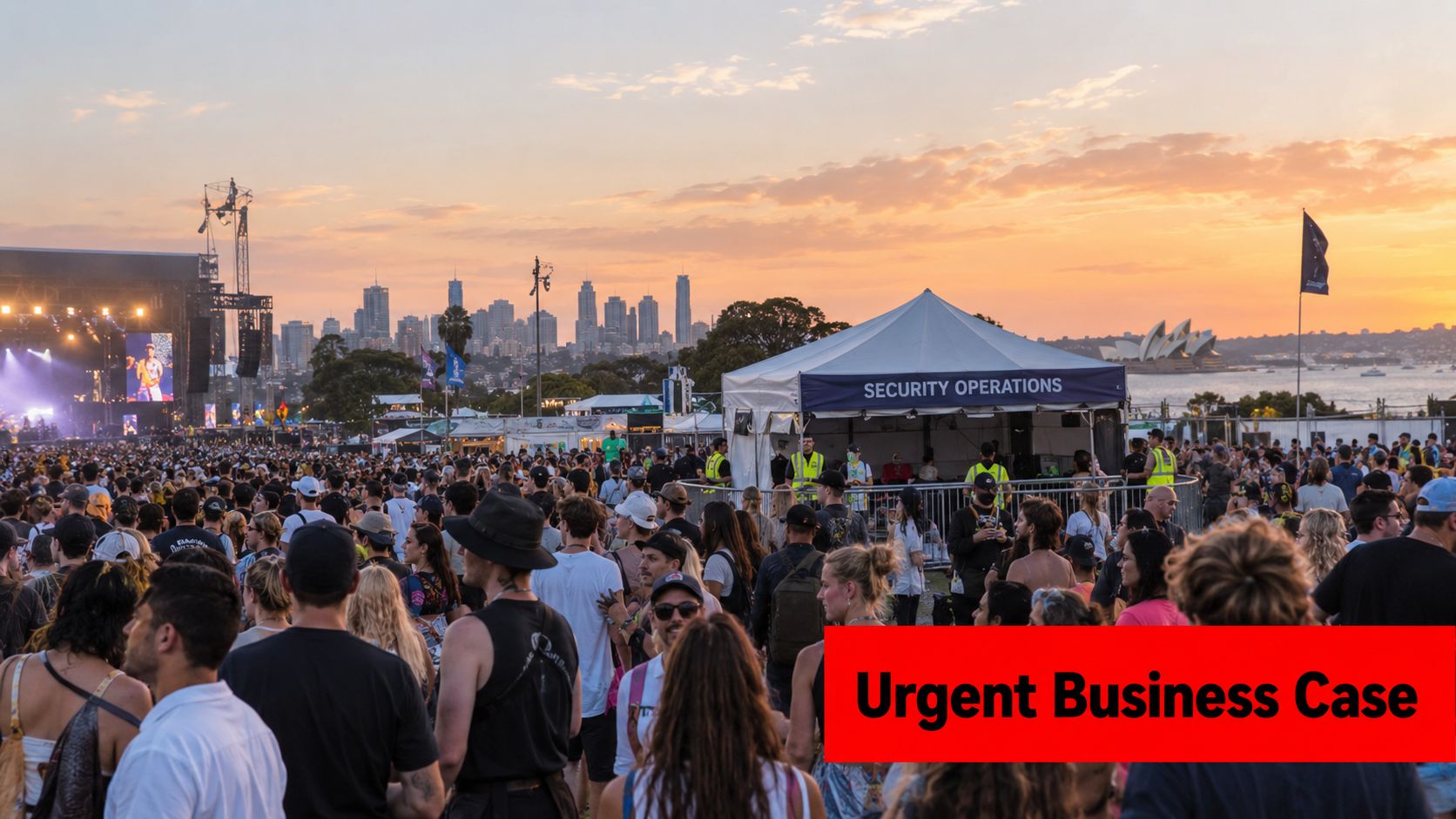
Security incident management matters because venues do not just manage people, they manage pressure, visibility, and liability at the same time. The Australian Bureau of Statistics found that 22% of businesses experienced a cyber security attack in 2021–22, up from 8% in 2019–20, and among impacted businesses 34% lost time managing the incident, 18% experienced downtime, and 17% reported reduced staff productivity ABS cyber security incident release. On the ground, that usually shows up as delayed service, distracted staff, and a venue team that is now dealing with both the incident and its fallout.
Cyber and physical incidents now overlap
Modern venues cannot treat “security” and “IT” as separate problems. A payment-system issue, a radio failure, an access-control problem, or a hostile person at the gate can all drive the same operational decision, and they often happen at the worst possible time.
The Commonwealth Cyber Security Posture report showed that 75% of entities had a cyber security strategy in 2024, 89% had centralised logging, and 74% performed supply chain risk assessments ACSC Commonwealth Cyber Security Posture 2024. Those controls matter, but the operational test is sharper. The same report also showed that only 32% said they reported at least half of the incidents they observed to ASD in 2024.
That reporting gap is the clearest warning sign. A venue can have good cameras, good guards, and good software, yet still fail if people do not know when an event moves from “watch it” to “escalate it now.” In a high-stress environment, structured security incident management cuts hesitation, and that hesitation is often the difference between containment and escalation.
Practical rule: if the team cannot say who owns the next decision in one sentence, the incident is already drifting.
Detecting and Assessing Security Incidents Effectively
Detection gets easier when staff are trained to notice patterns instead of waiting for certainty. Entry staff, supervisors, bar managers, and operations teams all need to recognise the early signs of trouble, because the first signal is often a mix of behaviour, timing, and small system failures rather than one obvious alarm. A person pacing repeatedly near a restricted entrance, a radio channel going quiet at the wrong moment, or a sudden mismatch between what's happening on the floor and what the control room thinks is happening all deserve attention.
Teach staff to assess before they argue
The first assessment question should be simple, is this minor, contained, or escalating. That keeps people from wasting time on debate when they should be gathering facts. Australian Government guidance for cyber incidents asks organisations to record the incident date, discovery date, description, and response actions, which is a useful reminder that assessment is really a documentation discipline as much as a security one Australian cyber security incident guidance.
For venues, the same logic applies to physical incidents. Staff should capture three things immediately, what was seen, who saw it, and what changed after intervention. If the answer to any of those is unclear, the issue needs a supervisor, not a shrug.
Build redundancy into observation
Single points of failure are a common reason incidents are missed. If only one person is watching the CCTV wall, or only one supervisor can decide whether to escalate, detection becomes fragile the moment that person is busy, distracted, or off the floor. A better model is layered awareness, where front-of-house staff, security, and management each own a different slice of observation.
If the guard at the gate notices it first, that doesn't mean the gate owns the incident. It means the gate starts the chain.
A useful operational habit is to run quick “what changed” checks at fixed points in the shift, especially during arrivals, intermissions, and egress. That doesn't need to be complicated. It needs to be consistent, because consistency catches drift before drift becomes a crisis.
Building an Effective Escalation Matrix for Security Incidents
A strong escalation matrix removes guesswork. A weak one sends every issue through the same channel, which is how small disturbances clog the system and serious threats get delayed behind routine noise. The matrix should distinguish between what front-line staff can handle, what needs the incident commander, and what must go straight to senior management or external authorities.
Compare the response levels
At the lowest level, front-line staff deal with routine issues, queue disputes, minor intoxication, or a locked door that's discovered before anyone is exposed to risk. The next level belongs to the incident commander, who coordinates resources, checks whether the problem is spreading, and decides whether the issue needs a formal log or external callout. Senior management steps in when the consequences touch business continuity, regulatory exposure, or public safety.
That structure matters because real incidents don't stay neat. A hostile patron at a venue entrance can become a crowd-management issue, then a police matter, then a communications problem if staff start telling different stories to different people. If the matrix is written properly, the team can move through those stages without reinventing the response each time.
Match the authority to the jurisdiction
In New South Wales, Victoria, Queensland, and the ACT, the right external contact depends on severity, location, and whether the incident is physical, cyber, or both. NSW Government cyber guidance requires agencies to report all cyber incidents to Cyber Security NSW through the Cyber Portal within 24 hours of detection and classification NSW Cyber Security Policy 2026-2027. That kind of deadline rewards speed of classification, not overthinking.
For practical escalation design, many teams also use an external guide for triggers, ownership, and record handling, and one useful reference is escalation triggers and chain of custody. The value of that kind of resource is simple, it reinforces the same lesson venue teams learn the hard way, escalation is not just a phone call, it's a controlled handoff.
Keep cyber escalation inside the same workflow
Physical and cyber incidents should share the same decision tree wherever possible. A credential compromise that affects door access, bookings, or CCTV is still a security incident, and it shouldn't disappear into a separate IT queue. The matrix should make it obvious when a technical alert becomes an operational incident, because the venue can't manage the floor and the network as if they were separate businesses.
Defining Roles and Responsibilities During Incidents
Role confusion is one of the fastest ways to waste time. When everyone is “helping”, nobody is accountable, and critical actions get duplicated or skipped. The incident commander should coordinate, not micromanage, while operations staff focus on their assigned tasks and keep the facts moving upward.
Make every role narrow enough to be usable
The best incident teams use narrow, named responsibilities. A first responder observes, contains, and reports. The incident commander decides priorities, assigns tasks, and keeps the log moving. Senior management handles authority, external communication, and business trade-offs.
That split matters most when the event runs long or the venue is under strain. At a small corporate function, one supervisor might own both coordination and escalation. At a large festival, those same duties need to be separated, or the supervisor becomes a bottleneck while incidents continue to unfold on the floor.
Train backups, not just primary holders
If one person is the only contact for every call, every update, and every decision, the whole response depends on their availability and concentration. That's risky in a noisy environment with shift changes, radio failures, and competing priorities. A distributed model works better, because one person can coordinate with police, another can brief the client, and another can keep the incident record current.
The most reliable teams don't ask one person to carry the whole incident. They make sure each role can survive a handover.
Regular drills matter here because people learn their part by doing it under pressure, even simulated pressure. The goal isn't theatrical realism. It's role familiarity, so staff don't freeze when the problem they've only seen in a document shows up at the gate.
Managing Communications and Documentation
An incident can look controlled on the floor while the response is already drifting. Radio calls get noisy, handovers get vague, and people start acting on assumptions. Clear communication keeps the team aligned in real time. Good documentation protects the venue later, when someone asks who knew what, when they knew it, and what they did next.
Keep messages short and controlled
During an active incident, staff should keep updates short and factual. State the situation, the action taken, and the next check-in point. Leave out speculation until the facts improve.
The same discipline applies to clients, attendees, regulators, and police. Say what is confirmed, say what is being done, and avoid promising an outcome you cannot guarantee. Once a message is sent, it becomes part of the record and part of the venue's credibility.
Document as you go, not afterwards
A live incident log should capture the timeline, the action taken, the person who took it, and the reason for the decision. NSW licensed security operations also need incident registers under clause 34 of the Security Industry Regulation 2016, and each incident report must be kept for at least three years NSW Police incident registers fact sheet. The minimum record set includes the date and time, location, detailed description, identities or descriptions of people involved, injuries, and the name, licence number, and signature of the person recording it.
That record is not created for paperwork's sake. It makes later review possible and gives the organisation a chronological account that holds up if a regulator, insurer, client, or court asks what happened. In a venue or event setting, memory fades fast once the pressure drops. A contemporaneous log is the difference between a response that can be explained and one that has to be reconstructed after the fact.
Good documentation protects the response team from memory gaps. Bad documentation forces people to defend decisions they can't prove they made.
Conducting Post-Incident Reviews and Improvement Cycles
A post-incident review should feel like a systems check, not a blame session. If the conversation turns into a hunt for one person to punish, the organisation loses the key lesson, which is usually buried in process gaps, unclear roles, or poor handover practice. The best reviews are calm, factual, and specific about what changed, what didn't, and what still needs fixing.
Review the sequence, not the personalities
The most useful question is not “who made the mistake”, it's “where did the process stop working”. That could be a delayed escalation, an unclear radio message, a log that wasn't updated in time, or a supervisor who lacked authority to act. Once the failure point is clear, the team can fix the control instead of just criticising the person.
A strong review also checks whether the event was handled the same way the last similar incident was handled. If the answers differ wildly, the organisation probably lacks a stable operating model. If the answers are consistent, the team can improve one piece at a time instead of relearning the whole process after every shift.
Turn lessons into repeatable changes
The review only matters if the outcome becomes an action item with an owner. That can mean rewriting the escalation matrix, improving radio discipline, changing handover templates, or adjusting who signs off on external notifications. Without ownership, the lesson disappears into a file and the same failure returns at the next busy event.

The best improvement cycles are boring in the right way. They reduce surprises, shorten handovers, and give staff a better script for the next incident.
Navigating State and Territory Compliance Requirements
A festival supervisor in Queensland faces different reporting timelines than one in Sydney. The incident workflow needs local branching, because the handoff that works in one jurisdiction can fail in another if the notification path, evidence log, or escalation trigger is wrong.
Use one workflow with jurisdiction-specific triggers
NSW Government cyber policy requires cyber incidents to be reported through the Cyber Portal within 24 hours of detection and classification. NSW licensed security operations also need incident registers kept for at least three years, with specific record fields captured for each event.
For Commonwealth environments, the true risk is the gap between policy and practice. Some organisations still miss the step that proves the process works, even when the control set looks complete on paper. The issue in a venue is usually not whether a rule exists. It is whether the supervisor on shift can act on it under pressure.
Keep the compliance checklist local
A useful operating model for multi-site teams is simple.
- New South Wales: align cyber reporting to the 24-hour rule, maintain incident registers, and make sure the log captures the required record fields.
- Victoria: keep the incident workflow tied to local site security and safety duties, with clear responsibility for escalation and documentation.
- Queensland: make sure venue and event staff know which incidents require immediate external notification, and who has authority to make that call.
- Australian Capital Territory: maintain a local reporting path that supervisors can use under pressure, not only in training.
The best test is practical. A floor supervisor should be able to use the process without searching through a policy binder or waiting for someone else to interpret it. If they can, the site is ready enough to respond. If they cannot, the document exists, but the response does not.
GM GROUP Services supports venues, events, and businesses that need licensed security teams, incident reporting systems, and practical on-site supervision across NSW, Victoria, Queensland, and the ACT. If you are tightening your own security incident management process, GM GROUP Services can help you build a response model that fits the way your site operates.
Discover more from GM Group Services
Subscribe to get the latest posts sent to your email.