
Only 10% of Australian councils actively monitored their CCTV systems, either during business hours or around the clock. That figure proves the central point: installing cameras doesn't create a functioning security control room unless trained people, defined procedures and reliable response capabilities sit behind the screens.
A practical control room turns scattered signals into decisions. Operators assess live video, alarms, access events and radio traffic, verify what matters, contact the right responder and preserve an accurate record. For venues, festivals, construction sites, retailers and corporate facilities across NSW, Victoria, Queensland and the ACT, the real investment isn't the camera count. It's the operational system that makes each alert useful.
What Is a Security Control Room
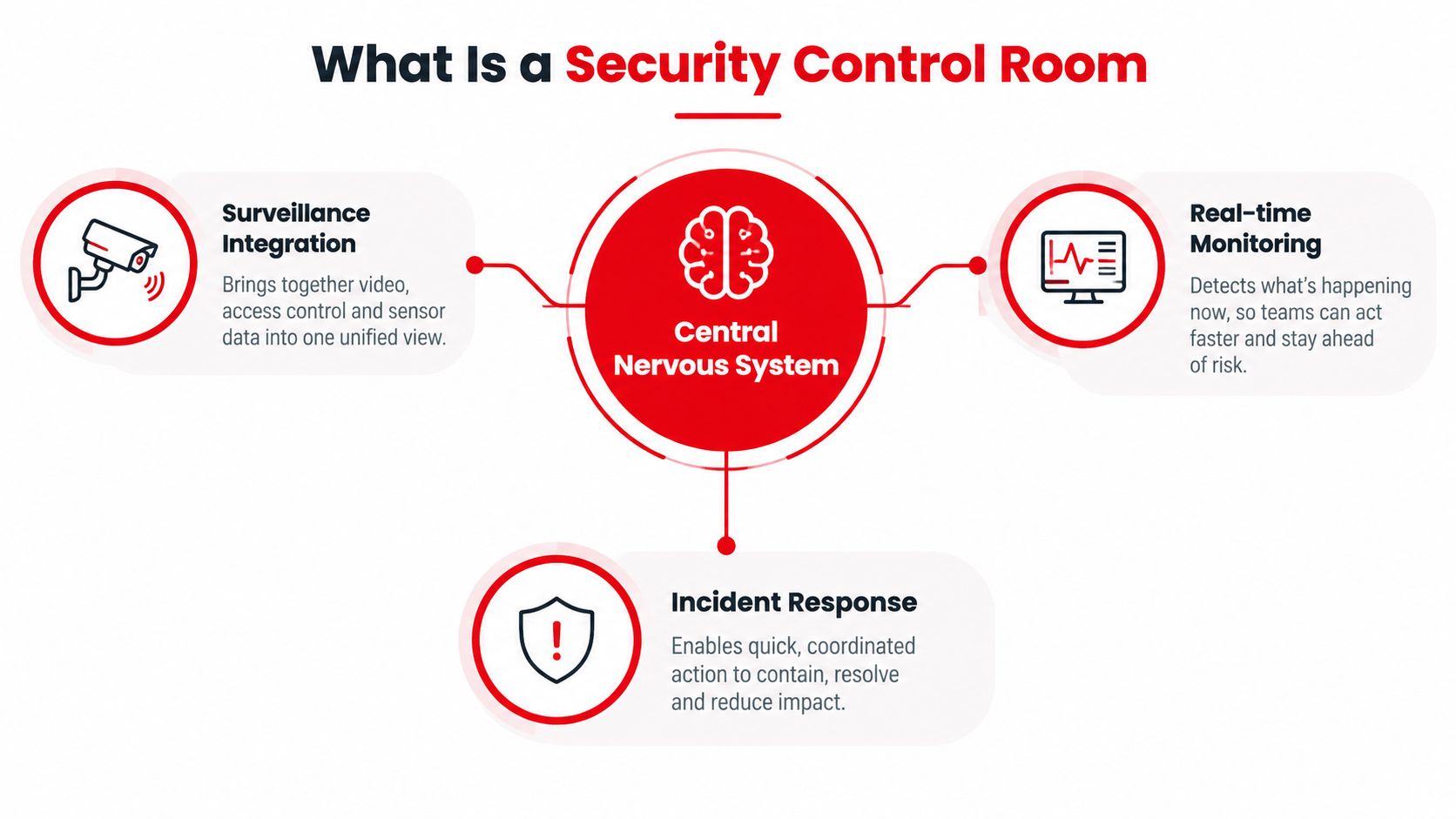
A security control room is a central operating point where people receive security information, assess incidents and coordinate action. It may serve one site, such as a hotel or construction project, or support a wider security operation through back-to-base monitoring. In either case, its value comes from the workflow between detection and response, not from the physical presence of screens.
The Australian Institute of Criminology found that 61% of councils with a main CCTV system reported that it wasn't monitored, while only 10% actively monitored systems during business hours or around the clock (Australian Institute of Criminology CCTV survey). Camera coverage and live operational monitoring are therefore different controls. Recorded footage can support an investigation, but it won't verify a developing disturbance, guide a guard or call emergency services at the right moment.
The operating model matters more than the room
A functional room connects:
- Surveillance: CCTV, video analytics and recorded footage.
- Detection: intrusion, fire, duress and access-control alarms.
- Communication: radios, telephones, intercoms and emergency channels.
- Response: guards, mobile patrols, site management, police and emergency services.
- Evidence: incident notes, synchronised timestamps, exported footage and dispatch records.
An operator should be able to move from an alarm to the relevant camera, verify the event, identify the location, contact the nominated responder and document the outcome without relying on memory or improvised decisions. For organisations comparing operating models, information about real-time security monitoring for properties can help clarify how remote supervision differs from a site-based control room.
The strongest design starts with purpose. A festival room may prioritise crowd movement, gates and medical incidents. A construction room may focus on perimeter breaches, plant access and after-hours alarms. A hospitality venue needs rapid verification of fights, duress activations and restricted-area access. The room should be built around those decisions, with technology selected to support them.
Core Components of a Security Control Room
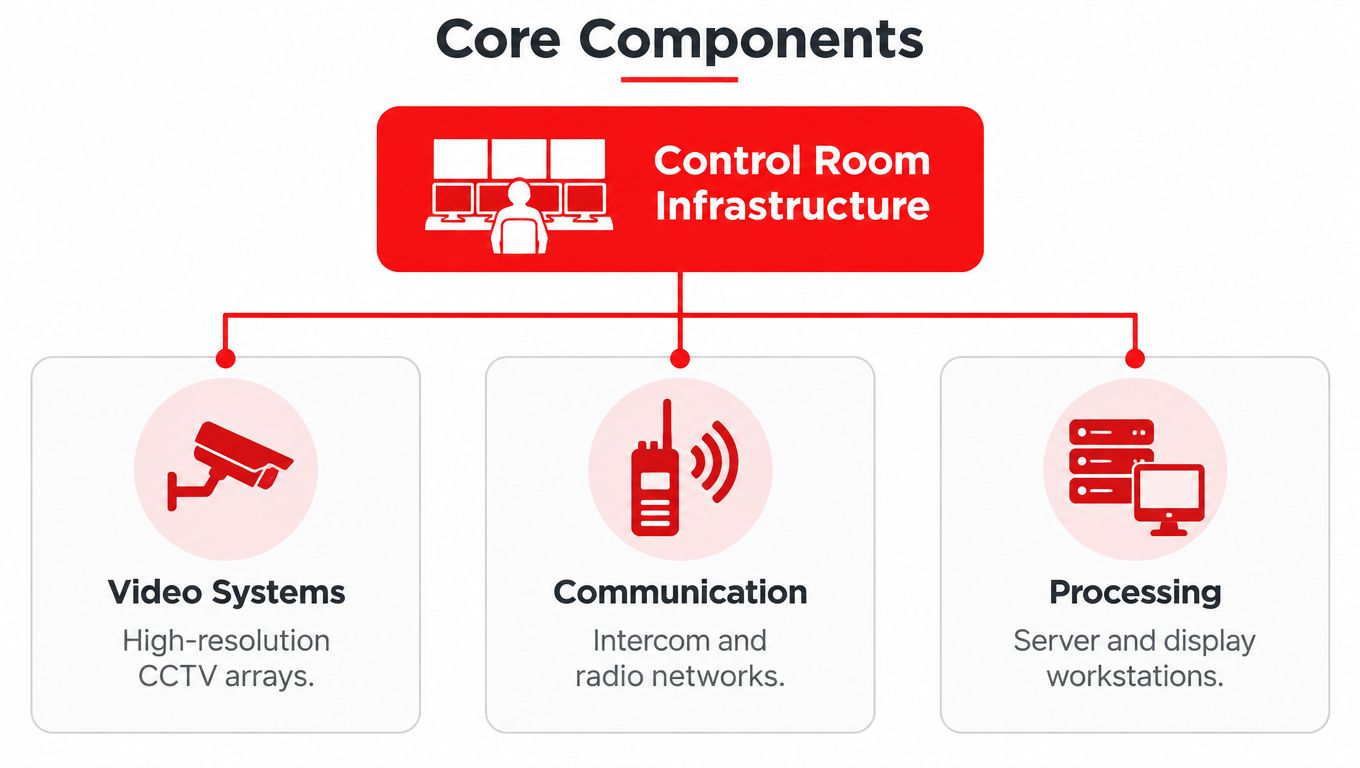
A security control room needs more than a video wall. It needs a dependable chain from input, interpretation and communication to action. If one part fails, the operator may receive an alert without enough context, see an image without a communication path or record an incident without preserving usable evidence.
The Australian Institute of Criminology identifies the number of operator monitors and the volume of recorded data as critical design considerations, while noting that monitoring can improve crime-detection effectiveness but is expensive (AIC control-room guidance). More feeds and more storage create more workload, so the correct question isn't how many cameras a site can install. It's how many priority events an operator can identify and manage during peak activity.
Build the technology around decisions
| Component | Practical function | What can go wrong |
|---|---|---|
| Video systems | Provide live views, playback and priority coverage for entrances, cash points, loading areas, perimeters and crowd zones. | Operators receive too many low-value views and miss a relevant event. |
| Alarm inputs | Bring together access control, duress, fire, intrusion and sensor events. | An alarm arrives without a location, severity or verification instruction. |
| Communications | Connect operators with guards, supervisors, venue managers and emergency services. | Responders receive incomplete information or use incompatible channels. |
| Processing and storage | Support video management, event timelines, user permissions and evidence retention. | Footage is difficult to locate, export or protect from unauthorised access. |
| Resilience | Preserve essential functions during power, network, device or staffing failures. | The room appears operational but cannot verify or dispatch during an outage. |
Avoid the camera-count trap
Operators need a priority map, not an indiscriminate grid. A fixed view of a high-risk entrance may require continuous attention, while a low-risk corridor could rely on recording and event-triggered review. Alarm zones should be named consistently, and every camera should have a clear purpose in the incident plan.
Designers should also account for peak conditions, such as crowd ingress, venue closing, construction shift changes or a major alarm event. A room that works during a quiet afternoon may become unusable when several alerts arrive together. Test the display layout, radio coverage, storage process and escalation path under that pressure before declaring the system ready.
Operational Workflows and Procedures
Operators shouldn't have to invent a response while an incident is unfolding. A standard operating procedure should make the next action obvious, while leaving enough judgement for unusual situations.
The national vocational framework expects operators to interpret alarms, coordinate an appropriate response, confirm responder availability, provide complete and timely information, monitor attendance and determine whether specialist or backup resources are needed (Australian security-services competency material). That sequence turns an alert into managed action.
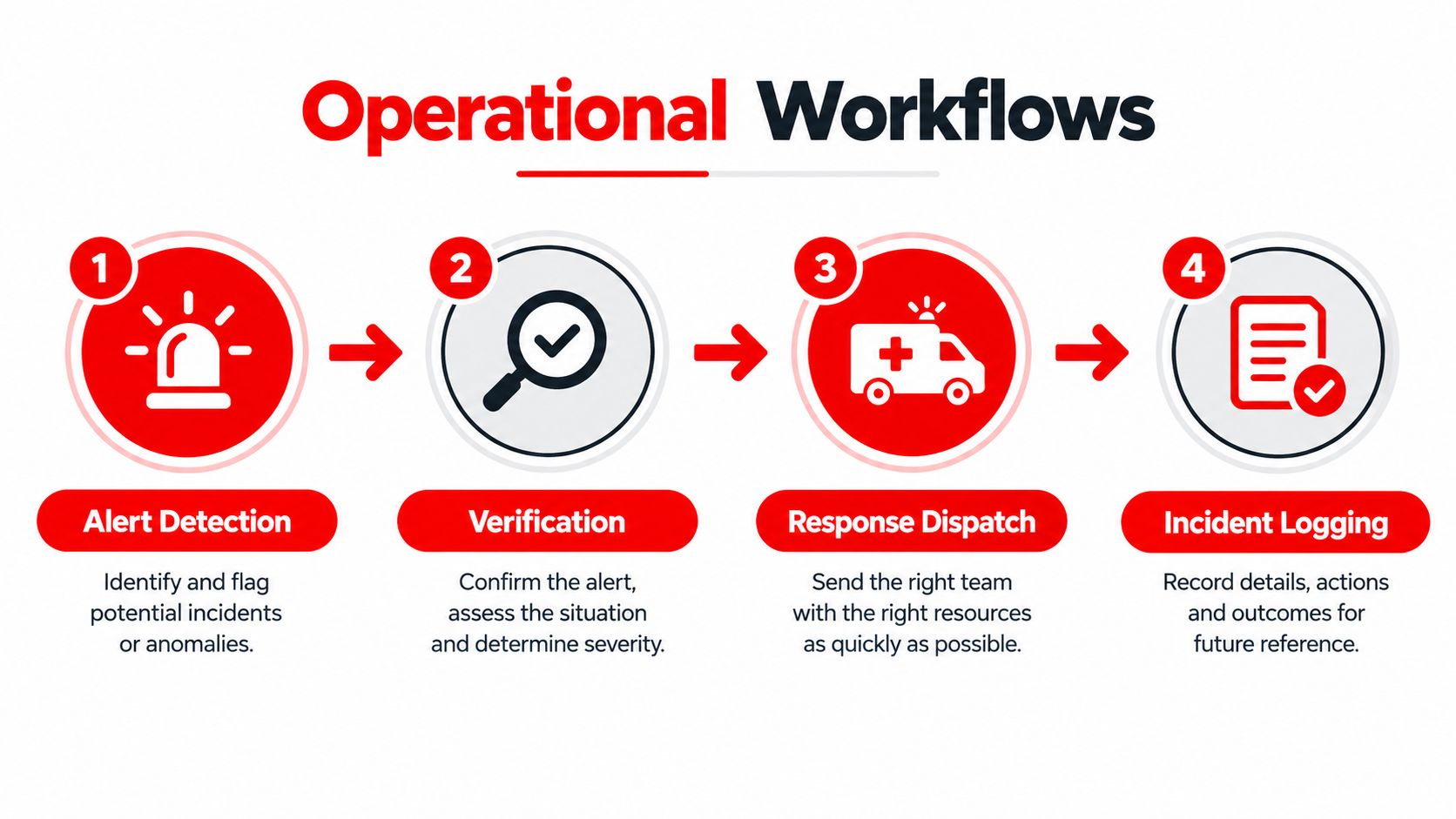
Use a four-stage incident flow
- Detect the alert. Record the alarm source, time, zone and initial system status. For a radio report, capture the caller's location and the immediate risk.
- Verify the event. Bring the associated camera to the main display, check nearby views, contact a guard or use a second information source. Verification should reduce uncertainty, not delay an urgent response.
- Dispatch the right resource. Apply the site's severity matrix. A medical emergency, active violence, fire indication and suspicious access event won't follow the same pathway.
- Log and close the incident. Record dispatch, responder arrival, actions taken, resolution and evidence preserved. A closed event should show why the response ended.
Every alarm or observed incident should connect to a response matrix covering incident category, severity, verification steps, nominated contact, dispatch priority, required information, welfare escalation and closure evidence. A manager reviewing the log should be able to reconstruct the event without asking the original operator to explain missing steps.
A useful procedure also defines handover standards. The outgoing operator should identify open events, pending callbacks, equipment faults and any footage placed on hold. The incoming operator should acknowledge those items, test communication channels where required and accept responsibility in the record. Teams wanting a broader operational framework can use the F1Group SecOps guide as a reference point when reviewing procedures.
Practical rule: If an operator can't state who responds, what information they receive and how closure is proved, the alarm procedure isn't finished.
Staffing and Security Roles
Technology supports the team, but people make the decisions. A control room can have reliable feeds and still fail if nobody owns verification, dispatch, supervision or evidence handling.
Operator versus supervisor
The control room operator watches priority systems, assesses alarms, communicates with field staff and records incidents. The role is active, not passive. NSW Police describes a control-room operator as a Class 1A security officer, with duties that can include working control-room shifts, physically responding to alarms, maintaining site security or requesting onsite guards to respond to an alarm or security breach (NSW Police control-room guidance).
A supervisor manages competing priorities. They allocate resources, authorise higher-level escalation, support an operator during a complex event and check that logs and handovers are complete. On a large event, the supervisor may coordinate with the event controller, police liaison, medical lead and venue management rather than handling every camera view personally.
Match people to the response
| Role | Primary responsibility | Useful test |
|---|---|---|
| Operator | Detect, verify, communicate and document. | Can they follow the response matrix without guessing? |
| Supervisor | Prioritise, support, escalate and review. | Can they manage simultaneous incidents and staffing gaps? |
| Field responder | Attend safely, report conditions and take approved action. | Do they receive location, risk and access information before arrival? |
| Client or venue liaison | Make operational decisions affecting closure, evacuation or business continuity. | Are they reachable and authorised to decide? |
| Technical support | Restore cameras, alarms, communications and recording. | Are faults logged with an interim control? |
Training should include alarm interpretation, radio discipline, privacy, welfare, conflict escalation and evidence preservation. Shift handovers deserve the same attention. The related national competency framework includes checking equipment, cross-checking information between monitoring systems, interpreting alarms, deploying field staff, updating security databases and completing change-of-shift documentation.
Staffing decisions should reflect workload and risk. A room may use continuous live observation for critical zones, event-triggered review for others and mobile response for physical verification. That approach is often more dependable than placing one operator in front of an oversized camera grid and hoping concentration will compensate for excessive demand.
Security Control Room Setup for Different Venues
A control room for a festival shouldn't be copied from a corporate office. The underlying principles stay consistent, but the priority zones, responder locations and communications plan change with the site.
Festival and event operations
At a festival, the room should see gates, crowd pinch points, stages, medical posts, vehicle access and restricted production areas. The operator's job isn't to watch every person. It's to identify developing congestion, lost children, fights, medical requests, unauthorised access and changes in crowd behaviour, then direct the appropriate team.
The Australian open-street CCTV experience shows how systems developed from isolated recording equipment into coordinated situational awareness. An observational study of the Gold Coast control room recorded 181 incidents over 100 hours, averaging approximately 1.81 observed incidents per hour (Australian Institute of Criminology open-street CCTV review). The lesson for event promoters is operational triage. The room needs incident categories, radio discipline and a clear link to security, medical and emergency coordination.
Construction and industrial sites
A construction setup normally prioritises the perimeter, gates, plant areas, material storage, temporary offices and hazardous zones. Access-control events should connect to nearby cameras, especially after hours. If a door alarm activates, the operator should verify the location, check the associated view, contact the nominated site response team and document whether the event was authorised, false or suspicious.
The control room also needs a fault process. A failed camera covering a gate should create a temporary control, such as a guard check, lighting adjustment or access restriction, rather than disappearing into a maintenance queue. Construction managers should review the arrangement whenever the site layout, shift pattern or access route changes.
Hospitality and retail venues
Bars, clubs, hotels, restaurants and retail sites need fast handling of duress, fights, theft, restricted-area access and welfare concerns. Operators should know where supervisors, guards and managers are positioned, which incidents require police contact and how footage is preserved without casual copying.
For each venue, draw a simple operating map. Mark priority cameras, alarms, responder locations, radio channels, emergency exits, welfare escalation points and the person who can authorise closure or evacuation. The best setup is the one staff can operate under pressure, not the one with the largest display.
Compliance and Incident Reporting
A control room that gathers personal information must be governed as carefully as it is staffed. Privacy isn't paperwork added after installation. It affects camera placement, signage, user permissions, footage release and deletion.
The Office of the Australian Information Commissioner states that surveillance-collected personal information must comply with the Australian Privacy Principles. Where the Privacy Act 1988 applies, organisations generally need to notify people before recording them, keep recorded information secure and destroy or de-identify it when it's no longer needed (OAIC guidance on security cameras). State and territory surveillance laws may also apply.
Treat footage as controlled evidence
A practical policy should specify:
- Notice: Place visible CCTV signage before people enter monitored areas.
- Access: Restrict live and recorded footage to authorised users with individual permissions.
- Release: Require an approved request and record disclosures to police, insurers, regulators or legal representatives.
- Retention: Define why footage is kept, when it is deleted and how an investigation places relevant material on hold.
- Audit: Review access logs, exports, incidents and system permissions.
Incident reports should distinguish observed facts from assumptions. Record the time, location, camera or alarm source, people notified, response actions, injuries or damage reported, footage preserved and final disposition. Keep original footage intact and create a working copy when review or sharing is necessary.
This discipline protects more than an investigation. It helps managers identify recurring false alarms, coverage gaps, delayed dispatch and unclear responsibilities. Teams reviewing their broader preparedness may also find Blowfish Technology's incident response guide useful when aligning security events with wider incident-management processes.
Frequently Asked Questions
Is a security control room the same as a monitoring centre?
Not necessarily. NSW Police describes a control room as usually operating within a particular site, using CCTV, internal alarms and other security devices to monitor daily operations and initiate or request a physical response. A monitoring centre may supervise signals remotely across sites. Define the location, licensing requirements and response obligation in writing.
Do we need live monitoring for every camera?
No. Live monitoring is most useful where a timely decision can prevent harm, direct a response or protect a critical area. Other views may rely on continuous recording, alarms and mobile verification. The choice should follow risk, responder availability, privacy and workload, not a blanket promise to watch everything.
What should happen when nobody is watching?
Use layered controls. An Australian health-service CCTV policy recommends continuous recording with at least seven days of archived footage where continuous monitoring of higher-risk areas isn't possible, along with nearby fixed duress alarms, a physical response to activation, clear signage and regular effectiveness reviews (Western Australia health-service CCTV policy). Adapt that approach to the site's risks and applicable obligations.
How should an operator be assessed?
Test alarm verification, radio communication, escalation, responder tracking, evidence preservation and shift handover. A successful drill should produce a complete timeline and identify any equipment, staffing or procedure failure.
Who can operate the service?
Check licensing, training, supervision, privacy processes, technical resilience and the provider's ability to dispatch a physical response. For sites needing integrated CCTV, alarm, access-control and back-to-base support, GM GROUP Services provides security control room and monitoring capabilities across event, venue and business environments.
GM GROUP Services can assess your site, event or venue and match control-room monitoring with licensed guards, mobile response, access control and incident reporting. Visit GM GROUP Services to discuss a practical security operation built around your actual risks, staffing and response requirements.
Discover more from GM Group Services
Subscribe to get the latest posts sent to your email.