
Safety and security start with the same question: what could harm people, property or the operation, and what will the team do before that risk becomes an incident? A festival crowd can become difficult to manage quickly, a bar dispute can draw staff into danger, and a technical failure can leave an entrance without a reliable way to verify who should be inside.
The strongest venue plans don't rely on visible guards alone. They combine environmental controls, trained personnel, access discipline, incident reporting, cyber continuity and state-based licensing checks. The following five keys provide a practical framework for event organisers, hospitality operators, retailers and site managers across Australia.
Why Confusing Safety and Security Creates Venue Gaps
A festival crowd starts pressing towards a barrier. Near the bar, a patron becomes verbally aggressive. At the entrance, a staff member notices a suspicious bag. It's tempting to treat all three situations as one security problem, but each requires a different first response.
Safety concerns accidental or environment-related harm, including overcrowding, poor lighting, fire hazards, blocked exits, slips and falls. Security concerns deliberate threats, such as unauthorised access, theft, violence and targeted disruption. The two overlap, but they aren't interchangeable. A crowded walkway may be a safety hazard before anyone intends to cause harm. A person forcing entry is a security issue even when no injury has occurred.
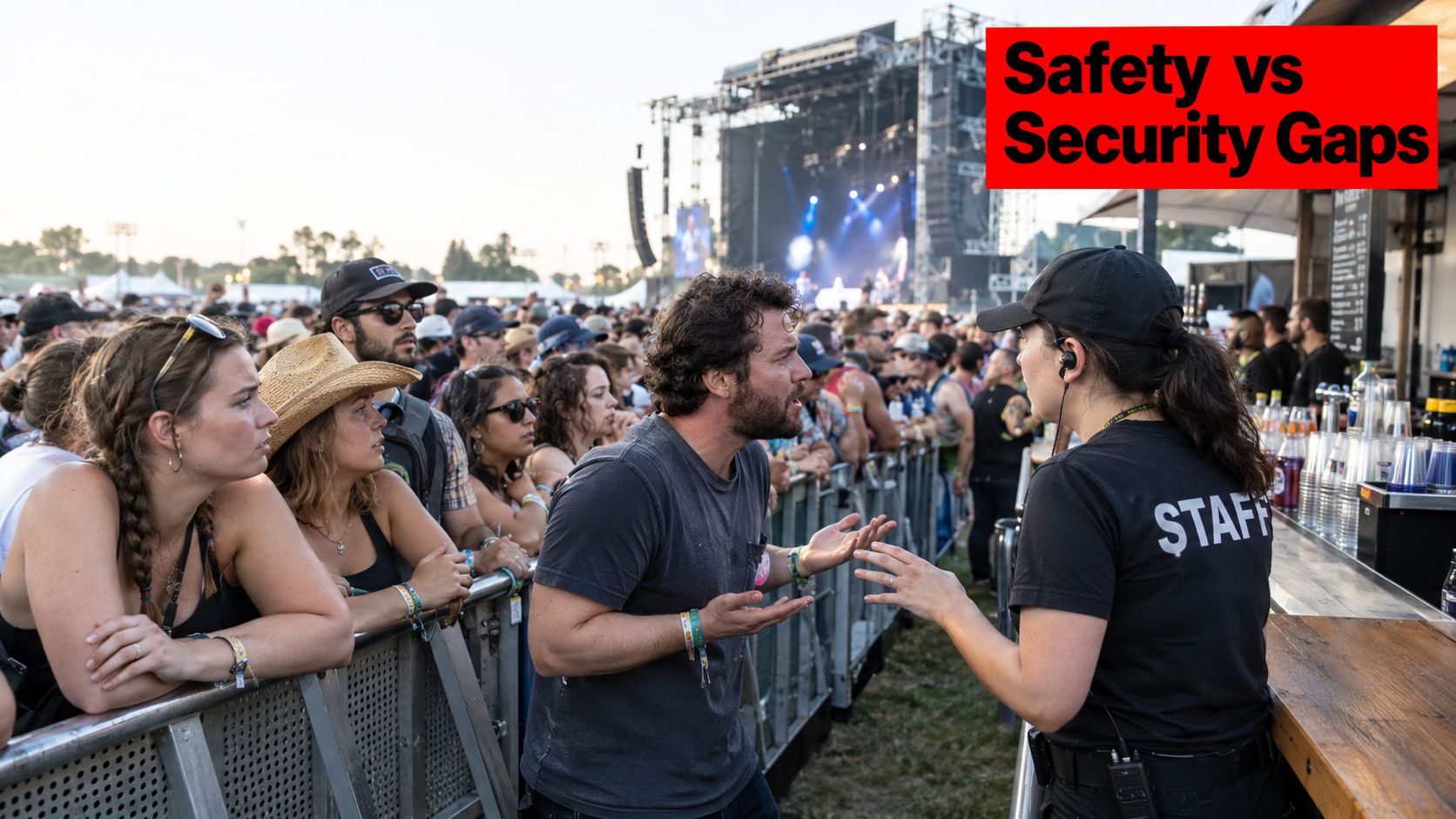
Separate the hazard from the intention
Confusion usually produces one of two failures. Operators may over-invest in visible guarding while leaving lighting, pedestrian flow or emergency access unresolved. Alternatively, they may focus on general venue safety while failing to control restricted doors, staff credentials or aggressive behaviour.
A practical response begins by assigning ownership:
- Crowd pressure: The event controller checks capacity, barriers, movement routes and emergency access.
- Aggressive behaviour: Supervisors assess the behaviour, separate people where appropriate and escalate without provoking further conflict.
- Suspicious items: Staff preserve distance, prevent unnecessary handling and activate the venue's escalation procedure.
Practical rule: A uniform at the door doesn't compensate for a blocked exit, poor radio coverage or an unclear evacuation decision.
The distinction matters because safety and security controls must work together. The barrier needs a physical design that reduces crowd pressure, staff need a way to report early warning signs, and security personnel need authority to act before a situation reaches the emergency threshold. That is the difference between a venue that looks protected and one that is operationally prepared.
Understanding Safety and Security Differences in Australian Venues
The need for coordinated safety and security is reflected in Australia's reported risk environment. Police recorded 79,624 assault victims nationwide in 2024, an increase of 4% from the previous year, according to the Australian Bureau of Statistics recorded-crime data. The data measures victims recorded by police, not every incident that occurs, but it remains a relevant indicator for venues, events and other public-facing businesses.
State and territory patterns varied considerably. South Australia recorded 23,374 assault victims, representing a 7% increase over the previous year, while another jurisdiction recorded 2,482 victims, a 6% decline, with its rate falling from 563 to 519 victims per 100,000 people. A national figure can establish context, but it can't replace a local assessment of venue layout, patron profile, transport access, trading conditions or previous incidents.
Different sites produce different exposures
Construction and industrial sites add hazards that don't resemble a festival entrance. In 2024, 188 workers died from traumatic injuries while working, producing a national fatality rate of 1.3 deaths per 100,000 workers, according to Safe Work Australia's latest key statistics. Queensland recorded 53 worker fatalities and New South Wales recorded 48. Construction accounted for 37 deaths, or 20% of all worker fatalities.
Vehicle incidents caused 42% of worker deaths, while falls from height accounted for 13%. Machinery operators and drivers had the highest proportion of fatalities at 32%, with a fatality rate of 6.7 deaths per 100,000 workers, more than five times the overall national rate. On these sites, security means more than stopping trespassers. Gatehouse procedures, vehicle separation, contractor control, exclusion zones and emergency communication are safety-critical controls.
Layer the controls around the pathway
The 2024–25 victimisation estimates also support separating risk pathways. They recorded 1,801.9 physical-assault victims and 2,113.4 face-to-face threatened-assault victims per 100,000 people aged 15 years or over, alongside 1,827.5 break-ins per 100,000 households and 2,198.4 thefts from motor vehicles per 100,000 households, as reported in the Productivity Commission's police-services data.
Those risks need different controls. Human-interaction risks call for trained observation, de-escalation and escalation pathways. Property risks call for lighting, controlled access, secure storage, patrol verification and surveillance review. Measuring only guard hours hides whether the team verified alarms quickly, reduced repeat incidents, closed corrective actions or identified access exceptions.
How to Conduct a Practical Risk Assessment for Events and Venues
A useful assessment starts with the site, not a generic template. Walk the venue during the conditions in which it will operate, then separate each risk by asset, attack pathway, consequence and likelihood. A public entrance, cash office, loading dock, backstage room and plant area shouldn't receive the same control just because they're all on the same property.
Use a five-step site process
- Walk the site. Trace public, staff, contractor and emergency routes. Check lighting, blind spots, radio coverage, queue space, vehicle movement and access to restricted areas.
- Identify hazards and threats. Record both accidental hazards, such as unstable barriers, and intentional threats, such as tailgating, theft or targeted aggression.
- Rate likelihood and consequence. Give priority to risks that could cause serious harm, disrupt the event or expose people repeatedly. Avoid treating every low-level issue as a reason for excessive deployment.
- Select proportional controls. Match the control to the pathway. Use credentialled access and audit trails for sensitive rooms, patrol verification for perimeter areas, CCTV review triggers for incidents and tested emergency communications for escalation.
- Review and sign off. Assign an owner, due date and verification method for every corrective action. Recheck the plan after layout changes, supplier changes or significant incidents.
A festival with a vulnerable backstage entrance may need stronger credential checks rather than more people at the main gate. A construction site with frequent plant movement may gain more from a controlled delivery schedule and a separated pedestrian route than from an extra perimeter patrol. The correct answer depends on the consequence and the weakness being controlled.
| Risk Category | Example Threats | Proportional Controls |
|---|---|---|
| Crowd and public areas | Crushing pressure, disputes, blocked routes | Barriers, trained observation, lighting, capacity and escalation procedures |
| Restricted rooms | Unauthorised entry, theft, tampering | Credentialled access, audit trails, door checks and controlled keys |
| Perimeter and loading areas | Trespass, theft, vehicle conflict | Patrol verification, lighting, gatehouse control and exclusion zones |
| Digital systems | Ticketing outage, fake messages, disabled monitoring | Manual fallback, verified communications and system override rules |
| Staff and contractor conduct | Unreported aggression, poor handover, unclear authority | Briefings, reporting standards, supervision and corrective-action tracking |
A risk assessment earns its place when it changes a decision, not when it fills a folder.
Event organisers also need to consider operational details that sit outside traditional venue planning. For example, a multilingual event may require clearer signage, interpreter support or different communication arrangements for contractors and attendees. A resource on event and conference interpreting examples from Translators USA can help planners think through where language access affects instructions, incident reporting and emergency communication.
Measure what tells you whether the control worked. Useful indicators include response time, alarm-to-verification time, incident recurrence, access exceptions and corrective-action closure. Counting guard hours may confirm that someone was rostered, but it won't show whether the right person was watching the right area or whether the site learned from the last event.
Integrating Cyber and Physical Safety Risks at Venues
A ticketing outage can create a queue problem. A compromised staff-messaging account can spread a false evacuation instruction. A failed CCTV network can remove the information needed to verify a dispute. These are cyber incidents with direct physical, operational and reputational consequences.
The Australian Institute of Criminology's 2025 cybercrime research found that nearly half of surveyed Australians had experienced some form of cybercrime in the preceding 12 months. For venue operators, the issue isn't whether to build an enterprise cyber programme. It's deciding which safety-critical functions must continue when ticketing, access control, cameras, payment systems, social accounts or staff communications aren't available.
Create a manual fallback before the event
The continuity plan should name the person who can authorise a move to manual procedures. Staff shouldn't debate that decision while queues grow or radios stop working.
Keep the following ready:
- Printed contacts: Include venue management, emergency services, suppliers, supervisors and key contractors.
- Offline validation: Define how staff will verify credentials or tickets when electronic systems are unavailable.
- Radio fallback: Confirm spare radios, channels, charging arrangements and a plain-language emergency call process.
- Override rules: Document who can activate, isolate or manually control access systems.
- CCTV handling: Record retention, export and breach-escalation steps before footage is needed.
- Verified messaging: Use pre-agreed channels and approval contacts for website, email and social-media updates.
- Evidence preservation: Protect logs, footage, messages and access records after an incident.
A simple tabletop exercise can expose weak assumptions. Ask what happens if electronic ticket validation fails at the busiest entry, the staff group chat is compromised, or a fake cancellation message reaches attendees. The exercise should end with named owners and practical fixes, not a general instruction to “improve cybersecurity”.
Cyber and physical teams also need a shared vocabulary. The control-room operator must know when a system fault becomes a crowd-safety issue, while the event manager must understand which evidence should not be overwritten during recovery. That coordination is often more valuable than adding another isolated technology layer.
State Licensing Requirements for Security Operations in Australia
Security compliance is jurisdiction-specific, and the company that supplies a team isn't the only thing an operator must check. Individual authorisation, role category, training status and liquor-related credentials can all affect whether a person may lawfully perform a shift.
New South Wales
In New South Wales, security workers need the appropriate Class 1 or Class 2 security operative licence. Service NSW and the NSW Security Industry Act set conditions that include age, citizenship, residency or specified visa status, fit-and-proper-person requirements, approved training and competence for the proposed activity.
Match the planned duty to the authorised class. Crowd control, patrols and access control shouldn't be assigned on the assumption that any security licence covers every activity. A roster shows who was scheduled, but it isn't proof of current eligibility unless the operator retains licence verification.
Queensland
Queensland requires a security firm licence when security services are provided for payment or reward, including subcontracted work. Every supplied worker must hold a licence for the type of work performed, and Queensland's security-firm licensing guidance notes that certain recorded disqualifying convictions within the previous 10 years can prevent approval.
For unarmed officers, Queensland also requires applicants to be at least 18, provide identity evidence, have fingerprints taken by police, pass a criminal-history check and complete the required training. A person may work while training only under a restricted licence and supervision by a fully licensed provider, so confirm that status before deployment. A last-minute replacement needs the same check as the original worker.
Australian Capital Territory
The ACT distinguishes between master, employee, trainer and temporary licences. Applicants must complete applicable training and meet suitability requirements. Access Canberra's security-industry licensing information states that certain recent offending can block approval, including specified offences involving violence, dishonesty or theft, firearms or other weapons, and some drug offences.
Security employees at liquor-licensed premises must also hold a current Responsible Service of Alcohol certificate under the Liquor Act 2010. Keep a register of licence and RSA checks, confirm expiry dates before each roster and verify replacements before they enter a licensed area.
Operators comparing requirements across countries should avoid assuming that one jurisdiction's rules transfer to another. For broader context on how regulated security questions are assessed elsewhere, this overview of the legality of Neon 54 in Canada illustrates why licensing, safety and fair-play considerations need to be checked locally.
Why Lower Reported Incidents May Not Mean Safer Venues
A quieter incident log can indicate improvement, but it can also indicate that staff have stopped reporting. Safe Work Australia reports more than 1 million work-related violence incidents experienced by Australians, while only about 46% of workplace-violence incidents recorded in the ABS Personal Safety Survey were formally reported as workplace or on-the-job incidents, according to its work-related violence and aggression data.
That gap matters in accommodation and food services, transport and retail. It applies directly to pubs, clubs, festivals, hotels and shopping centres, where casual and young workers may hesitate to report a customer, supervisor or colleague. Staff may also classify harassment, threats, intoxication-related aggression and near misses inconsistently.
Log behaviour before it becomes an assault
A useful reporting culture doesn't ask employees to predict the future. It asks them to record observable behaviour and the response taken:
- Repeated unwanted contact with staff or customers.
- Threatening language, intimidation or blocking a person's movement.
- Attempts to enter staff-only areas or bypass a queue.
- Escalating intoxication, harassment or fixation on a particular person.
- A near miss involving a weapon-like object, thrown item or physical confrontation.
- A supervisor's decision to remove, separate, monitor or escalate the person.
Managers then need a consistent triage process. Intoxication may require responsible-service action and support. Harassment may require victim protection and removal of the aggressor. A mental-health crisis may require a different welfare response. Targeted violence indicators may need immediate escalation. Staff shouldn't be expected to diagnose people, but they must know what behaviour requires a supervisor.
Protect the reporter from retaliation, restrict sensitive information to people who need it and give workers feedback about what happened next. Security, management, police and emergency services can coordinate more effectively when records describe behaviour, time, location, witnesses and actions without unnecessary personal details.
A reduction in reports is not a safety target unless you can show that reporting confidence and response quality remained strong.
Review incident categories regularly. If staff only record completed assaults, management loses the early-warning information needed to adjust staffing, layout, lighting, service practices or customer communication.
Essential Safety and Security Policies for Venue Operators
Policies work when they tell people exactly what to do, who decides and what evidence must be kept. A practical venue standard should cover five areas.
Fit-for-purpose deployment means matching personnel to the environment. A crowd-control specialist, a gatehouse officer, a covert loss-prevention operative and a K9 handler have different functions. Assigning people by availability rather than risk creates gaps that a larger roster won't necessarily solve.
Training and supervision must continue beyond induction. Supervisors should test radio use, check posts, observe interactions and review handovers. Licensed personnel still need site-specific knowledge, clear authority and feedback on performance.
Communication and customer service are security controls. Staff who explain boundaries calmly can prevent a queue dispute from becoming a confrontation. Briefings should cover language, escalation triggers, vulnerable patrons, responsible-service procedures and who can authorise removal or closure of an area.
Incident reporting and escalation should use one accessible process. Record the time, location, behaviour, people involved, action taken, evidence available and follow-up owner. A manager should know when to contact emergency services, preserve footage, notify the client or activate a business-continuity plan.
Documentation and compliance closes the loop. Retain licence checks, RSA verification where relevant, roster evidence, contractor details, briefings, incident reports and corrective-action records. For venues requiring coordinated guarding, patrols or monitoring, GM GROUP Services provides licensed security personnel, K9 units, vehicle patrols, gatehouse control, incident response and risk assessments across NSW, Victoria, Queensland and the ACT.
Review the policy after significant events, serious incidents, material layout changes, supplier changes or relevant legislative updates. A policy that exists only in a tender document won't protect people on the night.
Frequently Asked Questions About Venue Safety and Security
How can we verify a replacement security worker?
Check the individual's current licence, not only the supplier's company credentials. Confirm that the licence class matches the assigned duty, check restricted status and supervising-provider details where Queensland training arrangements apply, verify RSA status for ACT liquor-licensed work, and retain the evidence before the worker starts.
What if we can't afford extensive electronic monitoring?
Prioritise controls that remove obvious weaknesses. Improve lighting, control the most exposed access point, secure keys, establish visible patrol checks, provide tested radios and give supervisors a clear escalation pathway. A disciplined manual process is more useful than an expensive system nobody reviews.
What should happen after a serious incident?
Protect people first, then preserve footage, access records, radio logs and relevant messages. Coordinate with emergency services, use one verified source for public communication, avoid speculation on social media and check in with affected staff. Record corrective actions while details are fresh.
How often should we review the plan?
Review it after every significant event, after any serious incident and whenever the venue layout, crowd size, operating model or legislation changes. Also review the plan when a new contractor, access system or communication channel changes the way people respond.
GM GROUP Services can help organisers and venue operators assess site risks, verify operational requirements and deploy licensed personnel across events, hospitality, retail and construction environments. Visit GM GROUP Services to discuss a fit-for-purpose safety and security plan for your next operation.
Discover more from GM Group Services
Subscribe to get the latest posts sent to your email.