
SEO Title: Red Badge Security Pay Rate 5 Defining Factors You Should Know
URL: /red-badge-security-pay-rate
SEO Meta Description: Red Badge security pay rate in Australia isn't publicly disclosed. Learn the award rates, pay factors, budgeting basics, and what job seekers and clients should check.
Red Badge security pay rate is a search term people use when they're trying to answer a very practical question. Am I being offered a fair wage, or am I budgeting this event properly?
That question usually comes up in two situations. A guard is comparing job ads and wants a straight number. Or an organiser is reviewing a security quote and wants to know why one provider costs more than another.
In Australia, chasing a single Red Badge figure won't give you a reliable answer. The reason is simple. Publicly available Red Badge pay information is tied to New Zealand, not Australia. For Australian roles, the legal starting point is the Security Services Industry Award (MA00016), and that's what determines the minimum framework for rates, loadings, and classifications.
Demystifying the Red Badge Security Pay Rate in Australia
If you've searched for the Red Badge security pay rate, you've probably seen figures that look specific enough to trust. The problem is that most of those figures are drawn from New Zealand salary data, worker discussions, and review platforms. They can be useful for context, but they don't answer the Australian pay question.
It is critical to note that no specific Australian pay data for Red Badge Security exists in public sources; all available salary information originates from their New Zealand operations. Therefore, for any Australian security role, the official Security Services Industry Award (MA00016) must be used as the primary data source and legal benchmark.
Why the search term creates confusion
A company name in a pay search makes people assume there's one published number for all markets. That's rarely how security labour works. In Australia, pay is shaped by award classification, employment type, day of week, site risk, licensing requirements, and the actual duties on shift.
That matters whether you're taking a job or buying a service. A static gatehouse shift on a weekday doesn't price the same way as a late-night licensed venue, a public holiday festival, or a specialist deployment with extra compliance requirements.
Practical rule: In Australia, start with the award, then assess the role. Don't start with an overseas company salary estimate and work backwards.
What readers should use instead
For job seekers, the right question is: what award level applies to this role, and what loadings apply to this shift?
For clients, the better question is: what type of guard do I need, and what does the award require for those hours?
That same principle applies across adjacent safety-critical roles too. If you're comparing regulated workforces and how qualifications shape employability, browsing Radiation protection worker positions is a useful reminder that specialist compliance often matters as much as the headline hourly rate.
The Foundation Australian Security Award Rates
A new guard asks why one company is offering one hourly figure and another is quoting something different for what sounds like the same job. A client asks why a Sunday event quote jumps so sharply compared with a weekday static shift. In Australia, the starting point for both questions is the same. The Security Services Industry Award (MA000016) sets the minimum pay framework that sits under security labour.
That matters because the original "Red Badge" search term points people toward New Zealand company information. In Australia, the baseline is not a single brand's pay table. It is the award, then the role, then the shift conditions.
How classification changes the rate
Two things usually set the floor. The worker's classification level and the time the shift is worked.
Earlier in the article, the public source used for sample figures showed that a Level One casual security guard attracts a lower base casual rate than a Level Five casual guard, and that Sunday rates are materially higher than standard weekday daytime rates. That is the right way to read the market. The award recognises both skill level and penalty conditions.
In practice, a Level One role usually covers more straightforward guarding duties with closer direction. A Level Five role sits higher because the work can involve broader responsibility, stronger judgement, site leadership, or specialist capability. If a client wants a guard who can manage incidents with less supervision, coordinate staff on site, or carry a more senior operational role, the wage base rises before any company margin is added.
Sample casual security award rates
The verified source cited earlier in the article published sample weekday daytime and Sunday casual rates for Level One and Level Five guards. To avoid repeating that external source URL, the table below uses the same figures already introduced and keeps the other cells general where no verified figure was cited in this section.
| Security Level | Mon-Fri Rate | Saturday Rate | Sunday Rate | Public Holiday Rate |
|---|---|---|---|---|
| Level One Casual | $27.85 | Award loading applies | $50.13 | Award loading applies |
| Level Five Casual | $30.59 | Award loading applies | $55.06 | Award loading applies |
What this means in real operations
Inexperienced buyers often get tripped up. They look at one hourly charge and treat it as a universal market rate.
Operationally, quoting is more disciplined than that. A weekday concierge-style post with stable hours is built on a different labour cost from a Sunday festival gate, and both sit below a senior supervisory deployment where the provider needs stronger personnel on roster. Same industry. Different award settings. Different risk profile.
A cheap quote can still become an expensive mistake. If the rostered classification is too low for the duties, if penalty rates have been glossed over, or if supervision has been stripped out to force the number down, the problem usually shows up on shift.
Where people get caught out
Job seekers often focus on the headline casual rate and miss the bigger picture. A slightly lower hourly rate in a steady roster can produce better weekly income than a higher casual rate with patchy shifts. Licence type, experience, penalties, travel, and hours all matter.
Clients make a different error. They compare providers without checking whether both quotes assume the same award level, the same shift timings, and the same supervision model.
The practical test is simple. Ask what classification the role is being costed at, what penalties apply to the hours, and whether the duties match the grade being quoted. That is how Australian security pay is worked out in the market.
5 Key Factors That Increase a Security Guard Pay Rate
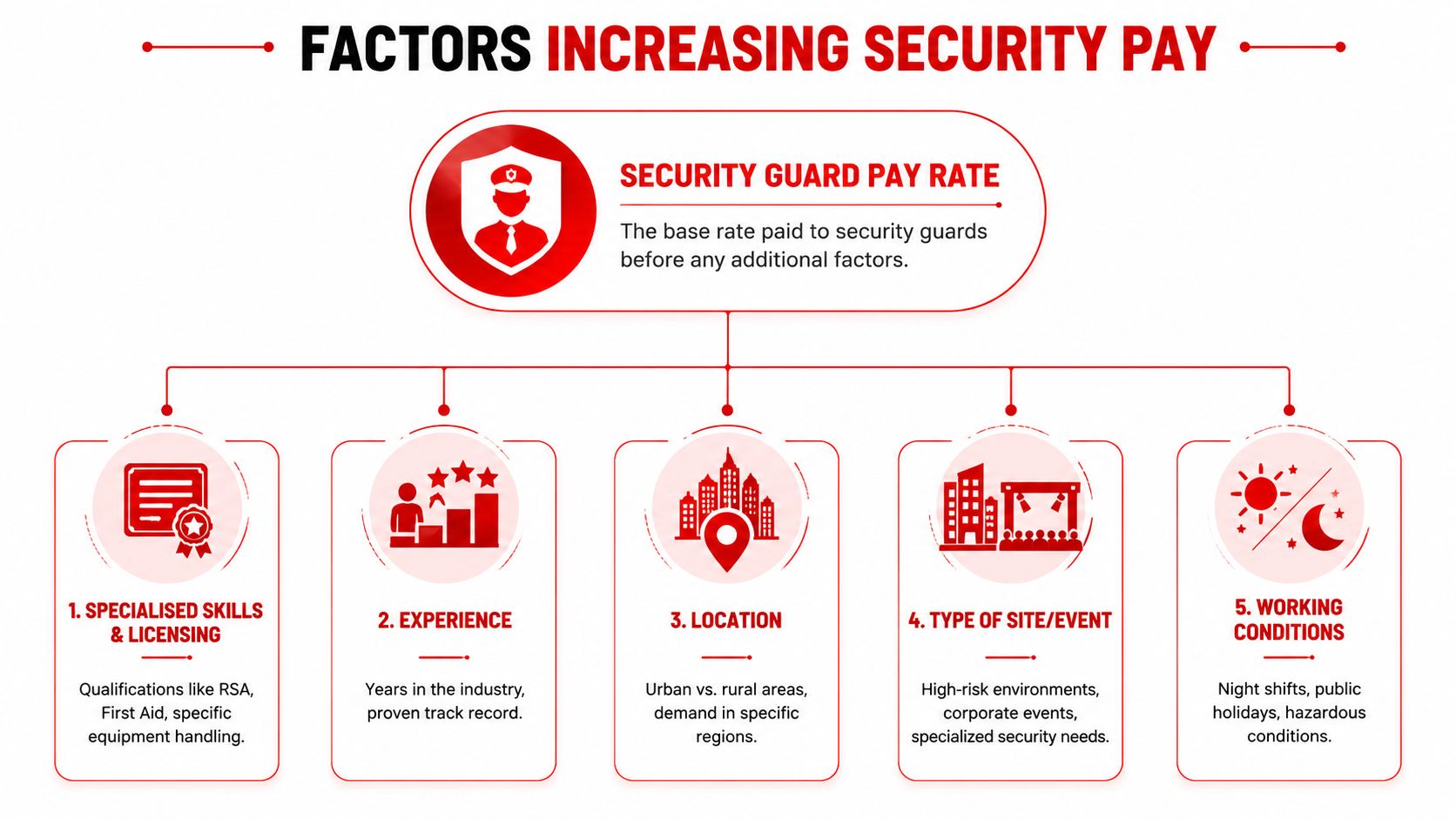
The Red Badge security pay rate question gets more useful when you stop looking for one number and start looking at what moves a rate up. In real operations, five factors usually matter most.
Licensing and extra qualifications
Extra qualifications don't always create an automatic allowance in Australia, but they do increase a guard's value in the roster. A venue may require RSA. A site may prefer first aid. A particular deployment may need a more experienced crowd controller or a handler with specialist capability.
New Zealand data gives a useful example of how licensing can directly affect pay. Red Badge workers with a Certificate of Approval (COA) receive minimum wage plus an extra $0.50 per hour, plus an 8% holiday pay supplement, based on worker discussion documented in this Wellington thread. The Australian system isn't the same, but the operational logic is familiar. Verified qualifications make a worker deployable on more jobs.
Actionable insight: if you hold a required licence or certificate, make sure it is recorded correctly in your onboarding documents and roster profile. If the business doesn't know you're qualified, you won't be allocated the higher-value work.
Experience and trust on shift
Years in the industry matter, but not in the abstract. What matters is whether a supervisor can trust you with a difficult gate, a conflict-heavy queue line, a retail loss-prevention brief, or a solo after-hours patrol.
An experienced guard usually creates less management drag. They need less prompting, escalate correctly, write cleaner incident notes, and handle patrons with more control. That doesn't always show up as a separate line item on a payslip, but it absolutely influences who gets better assignments.
Location and labour pressure
Rates shift with local conditions. Metro venues, major event corridors, and hard-to-staff locations create different roster pressures. If a provider struggles to cover a site reliably, labour costs rise.
This doesn't mean every city pays the same for the same shift type. It means supply, travel, transport, and local demand can all affect what an employer has to offer to secure dependable staff.
Site and event type
Not all security work is equal. A concierge-style corporate lobby needs presentation, communication, and consistency. A late-night entertainment precinct needs stronger conflict management and better fatigue resilience. A major festival needs layered staffing, queue control, emergency coordination, and supervisor depth.
A common client mistake is to ask for "just security" without defining the environment. The environment is the job.
- Low-complexity sites: Straightforward access control or observation roles usually sit lower on the complexity scale.
- Licensed venues: Patron behaviour, RSA interactions, and refusal management can make the work harder and more selective.
- High-profile events: Bigger crowds and tighter timelines often require stronger team structure and closer supervision.
Better guards don't just stand there. They reduce friction at entry points, spot problems early, and stop small issues from becoming reportable incidents.
Timing and working conditions
This is the simplest factor and often the most expensive. Nights, weekends, Sundays, and public holidays cost more. So do rough conditions, difficult access, and roles with unusual fatigue or exposure demands.
For organisers, the practical move is to schedule with eyes open. If the event footprint can be shortened without reducing safety, that can reduce total labour hours. If it can't, the budget needs to match the operating window.
How to Budget for Event Security A Practical Example
A Sunday event in Sydney is where weak budgeting shows up fast. Gates open late, queues build, one supervisor is trying to cover too much ground, and the organiser realises the cheapest quote did not include the hours around the event itself.
A practical event scenario
Take a one-day music event with alcohol service, multiple entry points, bag checks, perimeter patrols, and a required supervisor on shift. The right budget starts with the operating plan, not with a headline hourly number copied from a New Zealand search result for Red Badge.
That distinction matters. Red Badge is a New Zealand company, and its published salary discussions do not set Australian pay. In Australia, the legal starting point is the Security Services Industry Award, then the actual cost moves based on classification, timing, site conditions, and the provider's compliance overhead.
For a Sunday event, the award base is already higher than a standard weekday shift, as noted earlier. That gives both clients and job seekers a useful reality check. If a quote or job offer looks too low for Sunday event work, it usually is.
Building the budget properly
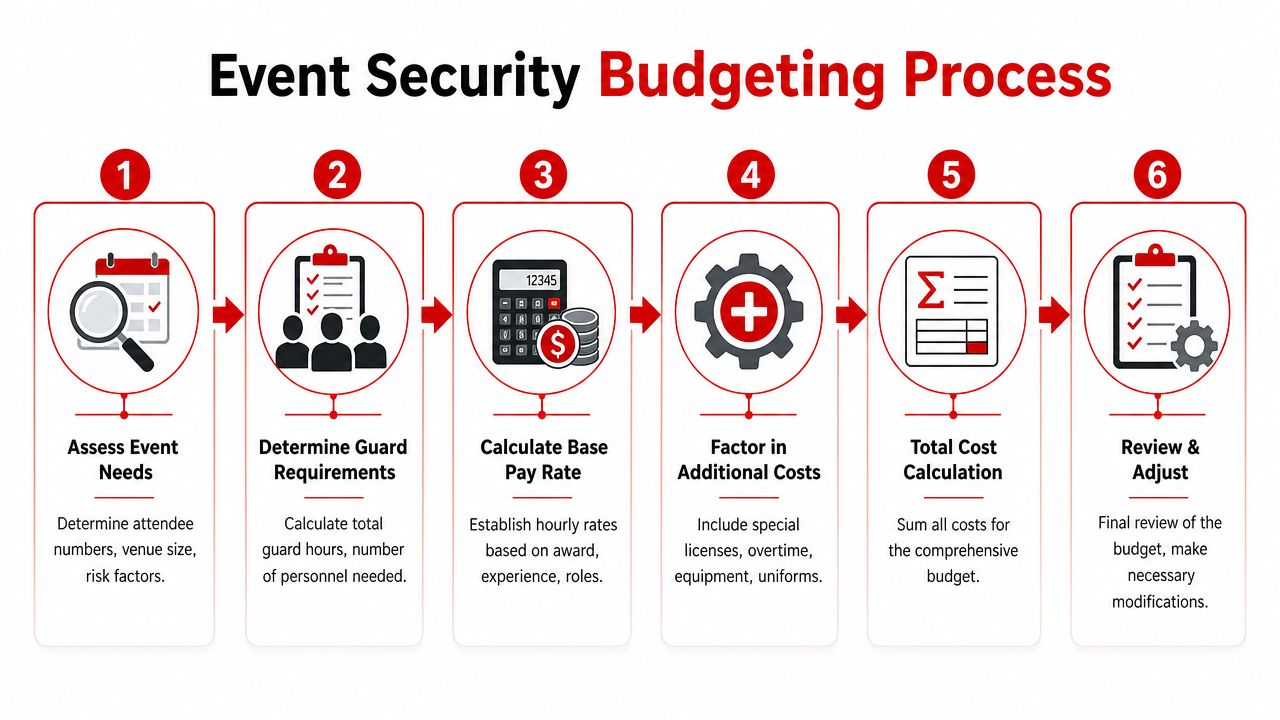
A workable event budget is built in layers:
Map the deployment
List each post separately. Entry screening, roaming floor staff, perimeter coverage, exit control, and supervision are different jobs. If they are blended into one line item, the scope is usually wrong.Assign the correct award level
Pay should match the actual duties performed. A provider who prices everything at the lowest level may win the job on paper and then struggle to staff it properly.Count all paid hours
Include pre-start briefings, early arrival for setup, active event time, meal break relief, incident handover, and bump-out. Clients often budget only for the public-facing hours and miss the labour around them.Add on-costs and operating overhead
The guard's pay rate is only one part of the invoice. Superannuation, workers compensation, public liability, uniforms, licensing checks, payroll, rostering, supervision, and after-hours management all sit on top of the award minimum.Stress-test the roster
Ask a simple question. If two guards call in sick on the day, does the provider have depth to replace them quickly? A very cheap quote often leaves no room for proper contingency.
A useful cross-check for organisers
New Zealand salary data can still be useful if you treat it carefully. Aggregated Glassdoor data for Red Badge in New Zealand estimates average pay at $29 per hour, translating to about $59,500 annually, with some professionals reporting earnings up to $65,000 per year, based on 36 salary records in this Glassdoor salary page.
Use that only as market context for a different country. Do not use it to set an Australian event budget. Australian security pricing has to be built from Australian award obligations and the actual conditions on your site.
If a provider cannot explain the staffing mix, award basis, shift timing, and overhead behind the final number, the quote is not ready for approval.
What works and what doesn't
What works is a line-by-line budget tied to the run sheet and venue plan. That gives you room to reduce unnecessary posts, shorten inactive coverage periods, or increase supervision where the risk sits.
What fails is buying on hourly price alone. In event work, under-scoped security usually appears as slow ingress, poor bag check discipline, weak incident documentation, or guards being shifted into roles they were not briefed or selected for.
Ask every provider to explain three things in plain English. What award level sits under each role, how many total paid hours are included, and who is supervising the team on the day. That is the practical difference between a usable quote and a number that falls apart once patrons arrive.
Navigating Your Security Career and Pay Rate
If you're applying for work and searching the Red Badge security pay rate, the best use of that search isn't to memorise one figure. It's to learn how to test whether the offer in front of you makes sense.
Good security workers increase their earnings over time by becoming easier to deploy, safer to roster, and more trusted in difficult environments. Employers notice that quickly.
How to assess a job offer
Start with the basics:
- Check the classification: Ask what level the role is paid under and what the core duties are.
- Confirm the shift pattern: Weekend, Sunday, and public holiday work can materially change what the job is worth.
- Clarify the venue type: A quiet retail site and a licensed late-night venue are different jobs, even if the title is similar.
If the employer can't explain those three points clearly, slow down before accepting.
Compliance red flags
The security industry has solid operators and weak ones. You can usually tell the difference in the hiring process.
Watch for these warning signs:
- Cash-in-hand language: If someone talks around payroll, leave.
- Vague licensing questions: A reputable employer checks your licence status carefully.
- No mention of super or onboarding paperwork: That's a problem, not an oversight.
- Loose role descriptions: If the company can't define the site or duties, the roster may be disorganised.
A proper employer doesn't just fill shifts. They document licences, confirm site requirements, issue instructions, and manage compliance.
How to raise your value
The biggest pay jumps usually don't come from arguing harder. They come from becoming eligible for better assignments.
That means building a profile that includes dependable attendance, clean reporting, calm communication, and the right role-specific credentials. In practice, the guards who move up are the ones supervisors trust with the jobs that can go wrong fast.
For Australian workers, one common question is whether RSA leads to more money. The short answer is that it may improve access to better assignments, but it isn't always a separate guaranteed premium. That's why you should ask how the employer uses RSA-qualified staff in rostering, not just whether the certificate exists on file.
A security career improves when you stop thinking like a casual extra and start thinking like a reliable operator the roster team wants to keep.
Actionable insight: keep your licences current, save copies of all credentials, and track the kinds of shifts you've handled well. When you apply for the next role, specific experience beats generic claims every time.
Answering Your Top Questions on Security Pay Rates
Does Red Badge have a public Australian pay rate?
No public Australian Red Badge pay rate is available in the selected public sources. The company-specific salary information that is publicly visible comes from New Zealand operations, not Australia. For Australian roles, use the award as the legal minimum benchmark and treat any overseas company data as context only.
Does RSA automatically increase pay?
Not always. A common point of confusion for Australian security staff is whether RSA certification provides a pay bonus. Reviews and industry discussions show ambiguity, as it's often a prerequisite for a role rather than an automatic pay bump, though it can make a candidate eligible for stronger assignments, as noted in Indeed pay and benefits reviews relating to Red Badge.
In practical terms, RSA often works like a gatekeeper. Without it, you may miss venue work. With it, you may access more shifts, but not necessarily a separate line-item allowance.
Why is the client charge-out rate higher than the guard's pay rate?
Because the wage is only one part of the operating cost. A legitimate provider also carries superannuation, insurance, payroll administration, recruitment, rostering, training, uniform costs, supervision, and compliance overhead.
Clients sometimes compare the guard's hourly wage with the billed hourly rate and assume the gap is pure margin. It isn't. In a compliant business, that gap covers the machinery required to deploy trained staff legally and reliably.
Are there any company-specific New Zealand figures worth knowing?
Yes, if you're looking for context rather than an Australian benchmark. Public New Zealand data indicates that Glassdoor lists Security Guard salaries at Red Badge in the $44,000 to $51,000 annual range, with some guards earning up to $51,000, according to this Red Badge company salary page on Glassdoor New Zealand.
Separate New Zealand role data also shows retail security officers starting at $24 per hour for night shifts on the North Shore, based on this role listing summary on Zeil. Useful context, yes. Australian pay benchmark, no.
What should a job seeker do if the offered rate feels unclear?
Ask direct questions. What classification applies? Is the role casual or permanent? What shifts will you work? Are there venue-specific prerequisites? If the answers stay vague, keep looking.
What should a client ask before accepting a quote?
Ask for the staffing mix, the supervision model, the shift assumptions, and whether the role types match the event risk. A professional quote should stand up to those questions.
If you're planning security for an event, venue, retail site, or project and want a compliant, clearly scoped deployment, speak with GM GROUP Services. Their team works across NSW, VIC, QLD and the ACT, matching the right guard capability to the site, the risk profile, and the operational brief so you can budget properly and staff with confidence.
Discover more from GM Group Services
Subscribe to get the latest posts sent to your email.