
Mobile security patrol services are often sold on a simple promise: more visible patrols mean better protection. That advice is incomplete. A vehicle that passes a gate at fixed hourly intervals may look reassuring, yet still leave a predictable gap, miss a developing crowd problem or arrive without the information needed to act safely.
A useful patrol program is not measured by movement alone. It combines intelligence gathering, risk-based deployment, response, deterrence and reassurance, with clear licensing controls and evidence that each activity occurred. That matters across Australian festivals, venues, retail centres, construction sites and industrial properties, where a patrol vehicle is one layer in a broader operating system.
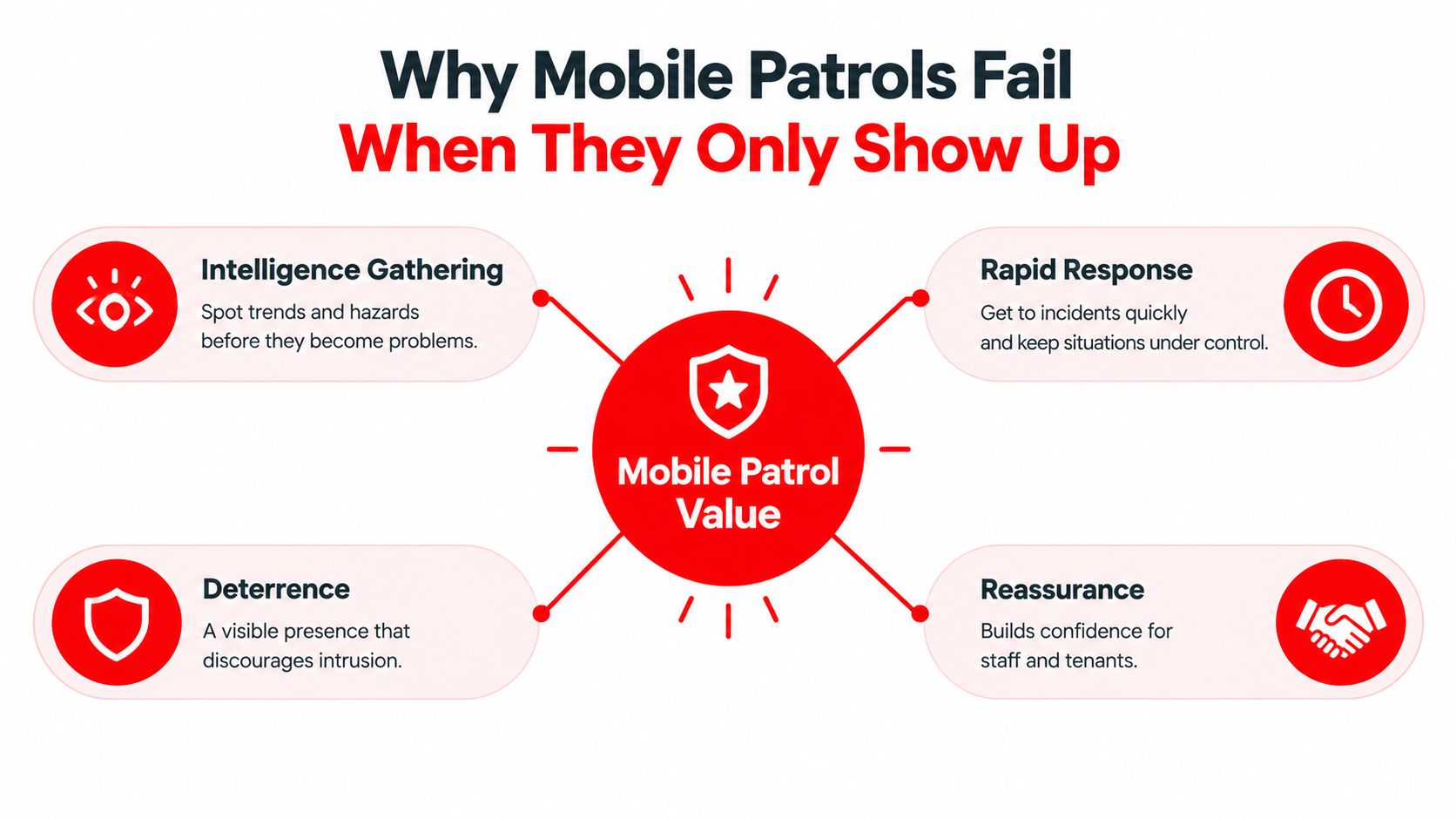
Why Mobile Patrols Fail When They Only Show Up
A patrol that merely appears on schedule can become theatre. Staff see the vehicle, the client receives a completed log, but nobody can explain whether the route addressed the locations and time windows where incidents occurred. Predictability can also help an offender avoid observation between visits.
Australian mobile patrol work is not an informal add-on to guarding. The Australian occupation profile for Security Officers and Guards identifies Mobile Patrol Officer as a specialisation of Security Officer. The broader occupation includes patrolling and guarding commercial and industrial property. Jobs and Skills Australia reports approximately 66,800 people employed as Security Officers and Guards, with a 22% part-time share, a 17% female share, a median age of 39, median weekly earnings of $1,818, and annual employment growth of about 2,600 workers. These figures describe the wider occupation, not mobile patrols alone, but they show that patrol operations sit within an established national workforce.
Frequency is not the same as coverage
The Australian Institute of Criminology's review of event security found that crowd density, alcohol availability, venue characteristics, event type, patron demographics, layout and prior incidents affect the level of crowd control required. Its research included approximately 50 interviews across Victoria, New South Wales and Western Australia with police, regulators, local government, security providers, venues and researchers. The AIC review supports a risk-based approach, not a universal guard-to-patron formula.
For a festival, that may mean concentrating vehicle patrols around transport interfaces, car parks, queues and alcohol-service areas during ingress, egress and peak intoxication periods. For a construction site, the priority may be perimeter integrity, gates, plant storage and alarm attendance after hours. The route should change when incident logs, CCTV observations or supervisor reports show that the risk has moved.
Practical rule: Ask what evidence determines the route, not simply how often the vehicle visits.
A sound program uses scheduled checks where certainty matters, randomised spot checks where predictability creates exposure, and foot patrols where a vehicle cannot inspect the relevant space properly. Officers record observations, verify conditions and escalate according to agreed thresholds. That turns mobile security patrol services into a risk-control and response layer, rather than a moving logo.
What Mobile Security Patrol Services Actually Are
A mobile patrol officer checks premises, detects unauthorised entry, attends alarms and identifies conditions that need action. Depending on the contract, the officer may inspect gates, loading areas, perimeter fencing, locks, lighting, plant, public approaches and restricted zones, then report findings to a supervisor or control room.
The correct format depends on the risk.
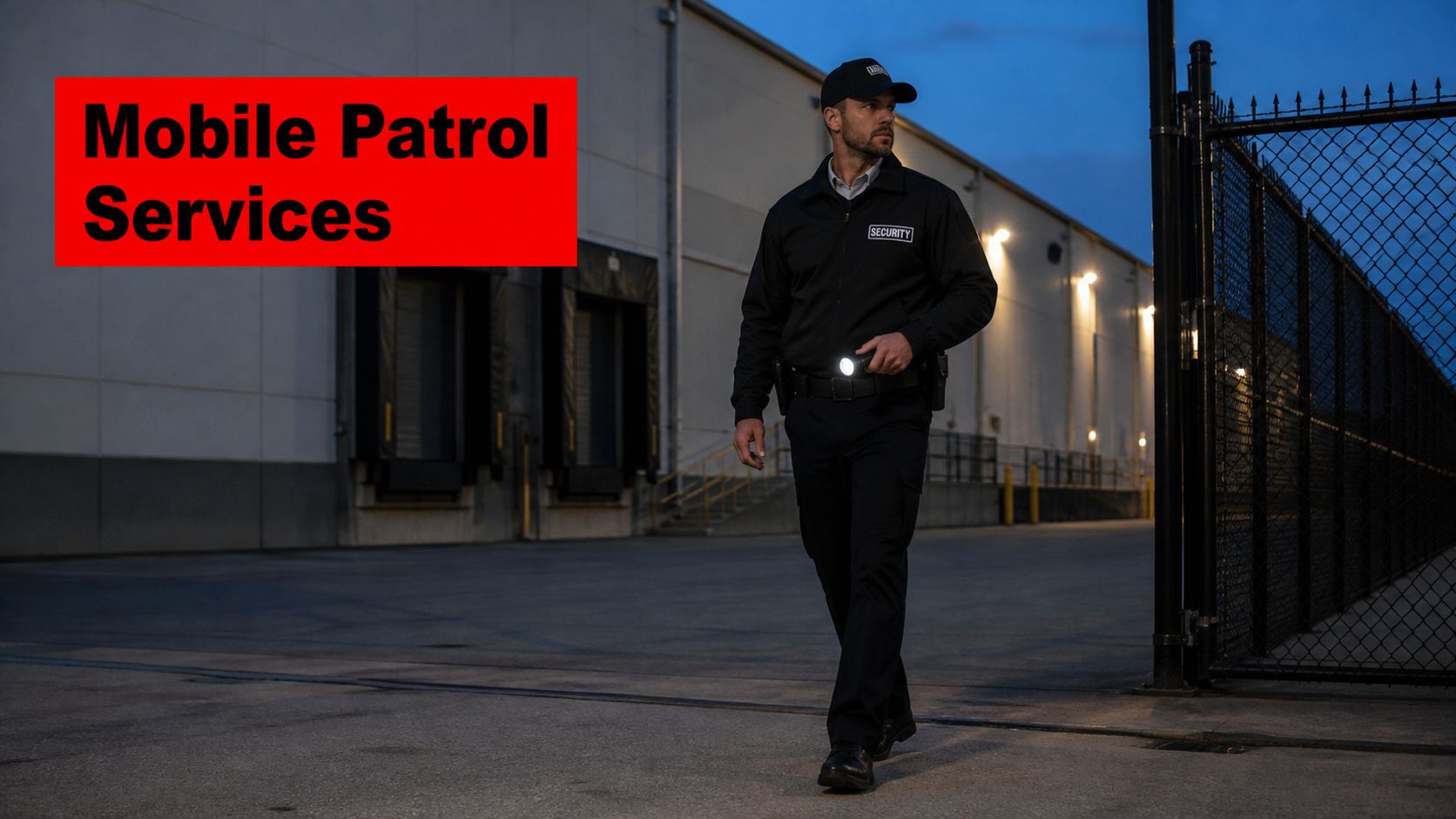
Scheduled and randomised patrols serve different purposes
Scheduled patrols suit tasks that must happen at a known point, such as an after-hours lock-up, a documented gate inspection or a handover before a venue opens. They make staffing and accountability easier.
Randomised patrols are useful where an offender could learn a circuit. A construction site might receive planned perimeter inspections combined with unpredictable spot checks near storage compounds and temporary fencing. Randomisation shouldn't become disorder. Supervisors still need defined zones, escalation rules and a way to confirm that priority checkpoints were covered.
Vehicle, foot and K9 deployment
A vehicle provides broad-area coverage and can reach dispersed gates, car parks and perimeter roads efficiently. It is less useful inside a dense crowd, along narrow pedestrian approaches or in a venue where the relevant warning signs are conversational rather than visual.
Foot patrols create closer contact with staff, tenants and visitors. They can inspect queues, observe behaviour, identify a blocked exit or notice a welfare concern that a passing vehicle would miss. They also take longer to move across a large industrial boundary.
K9 units add a specialised detection capability, but they aren't a universal upgrade. A trained dog and handler may support perimeter searches, crowd movement monitoring or a response to specific narcotics concerns. The client must define the lawful purpose, handler responsibilities, welfare requirements and handover process before deployment.
Physical controls should also connect with digital ones. Businesses reviewing the relationship between premises protection, access controls and cyber risk may find managed IT security for growing businesses useful, particularly where cameras, alarms and operational systems share information.
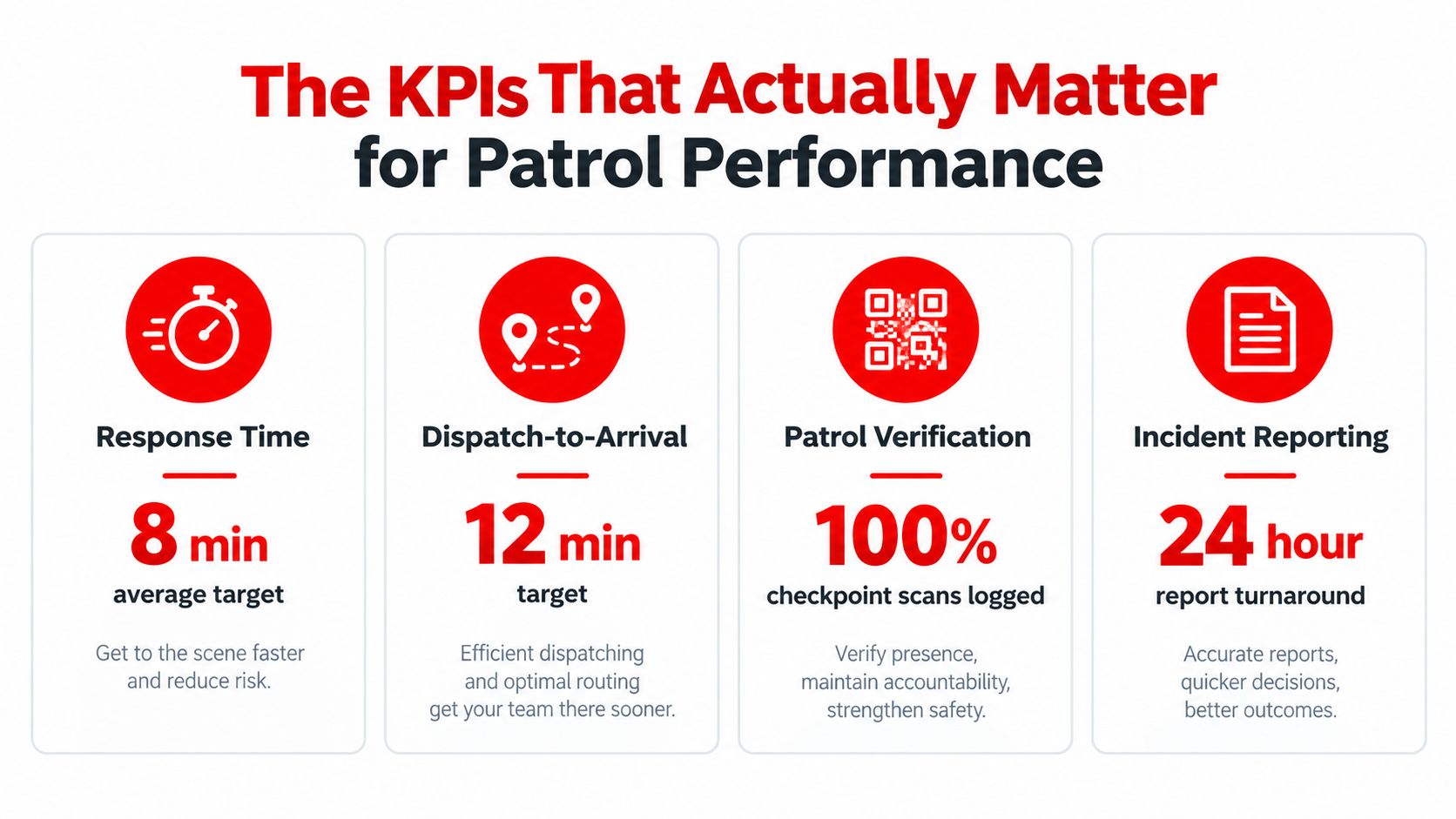
The KPIs That Matter for Patrol Performance
A high patrol count can still mask weak protection. Procurement should assess whether officers identified the right conditions, reached incidents within the agreed service level, recorded what happened and supplied supervisors with information that improves the next deployment.
The AIC risk-based model gives that assessment useful context. Patrol value depends on where and when coverage operates, including crowd density, alcohol service, ingress, egress and previous incidents. A fast response at a low-risk location cannot offset an unmonitored high-risk zone.
Measure the full response chain
Record separate timestamps instead of relying on one broad “response time” measure:
- Detection to dispatch: When did the officer, alarm system, CCTV operator or staff member identify the issue, and when did a supervisor assign the response?
- Dispatch to arrival: How long did the assigned unit take to reach the agreed access point?
- Arrival to intervention: Did the officer verify the concern, make the area safe, request support or escalate to police and emergency services?
- Report completion: When did the client receive a clear record of the location, observations, actions and outstanding tasks?
These measures expose operational bottlenecks. A provider may dispatch quickly, yet lose time because the officer lacks gate access, the route is unclear or radio coverage fails.
Verify presence and quality
Checkpoint scans, GPS-supported records, photographs where lawful and supervisor review can confirm that a patrol occurred. They do not establish whether it delivered useful observation. A gate scan cannot show that an officer inspected the fence line, recognised a warning sign or reported a hazard accurately.
Set the reporting cadence to match the site. A festival may need live incident escalation and an end-of-shift summary. A construction manager may require recurring reports on completed checks, damaged fencing, lighting faults, trespass indicators and unresolved actions.
A useful contract measures the full detection-to-intervention chain, with timestamps at each stage.
Review results by location, time window, incident type and outcome. If problems cluster around a car park after egress, redirect resources there. If repeated alarm call-outs prove false, investigate the alarm configuration while preserving genuine response. If a checkpoint is regularly missed, fix the route or access problem before assigning blame to the patrol officer.
Matching Patrol Types to Events, Venues and Sites
The right configuration depends on geography, people, assets and the kind of observation required. A multi-stage festival needs movement through public spaces and transport approaches. A warehouse needs perimeter and access checks. A bar may need a static team at the entrance, with a vehicle available for surrounding streets and closing procedures.
| Patrol Type | Coverage Scale | Deterrence Profile | Best Fit Environment | K9 Integration |
|---|---|---|---|---|
| Foot patrol | Localised, detailed coverage | Personal and highly visible | Queues, venues, retail areas and pedestrian approaches | Suitable where a trained handler can operate safely |
| Vehicle patrol | Broad or dispersed coverage | Strong perimeter and after-hours visibility | Construction sites, industrial property, car parks and multiple premises | Suitable for mobile perimeter checks and planned searches |
| Scheduled circuit | Defined checkpoints and predictable service windows | Reassuring and accountable | Lock-ups, gate inspections, alarm attendance and routine checks | Can be added to specific scheduled tasks |
| Randomised circuit | Flexible coverage with less predictability | Useful against opportunistic trespass and theft | Construction compounds, retail perimeters and distributed assets | Can support targeted detection windows |
| K9-integrated deployment | Focused specialist coverage | High-impact presence where appropriate | Events, perimeter integrity and defined detection concerns | Requires licensed handlers, clear scope and welfare controls |
Choose for the observation problem
A vehicle is usually the practical starting point for a large site, but it shouldn't be asked to do a foot patrol's job. If the risk involves people moving through a queue, poor interactions at a bar or a welfare concern near a transport interchange, an officer on foot may produce better intelligence and reassurance.
The same principle applies to K9 deployment. A dog may improve detection capability in a defined operation, but the handler still needs communication skills, a lawful brief and a clear escalation route. Adding a K9 unit without defining the task can increase complexity without improving the control.
Clients should also consider how patrol activity fits with fixed guards, CCTV, access control and emergency procedures. A practical compliance guide for venue operators can help venue teams think through the wider relationship between security systems, crowd movement and operational controls.
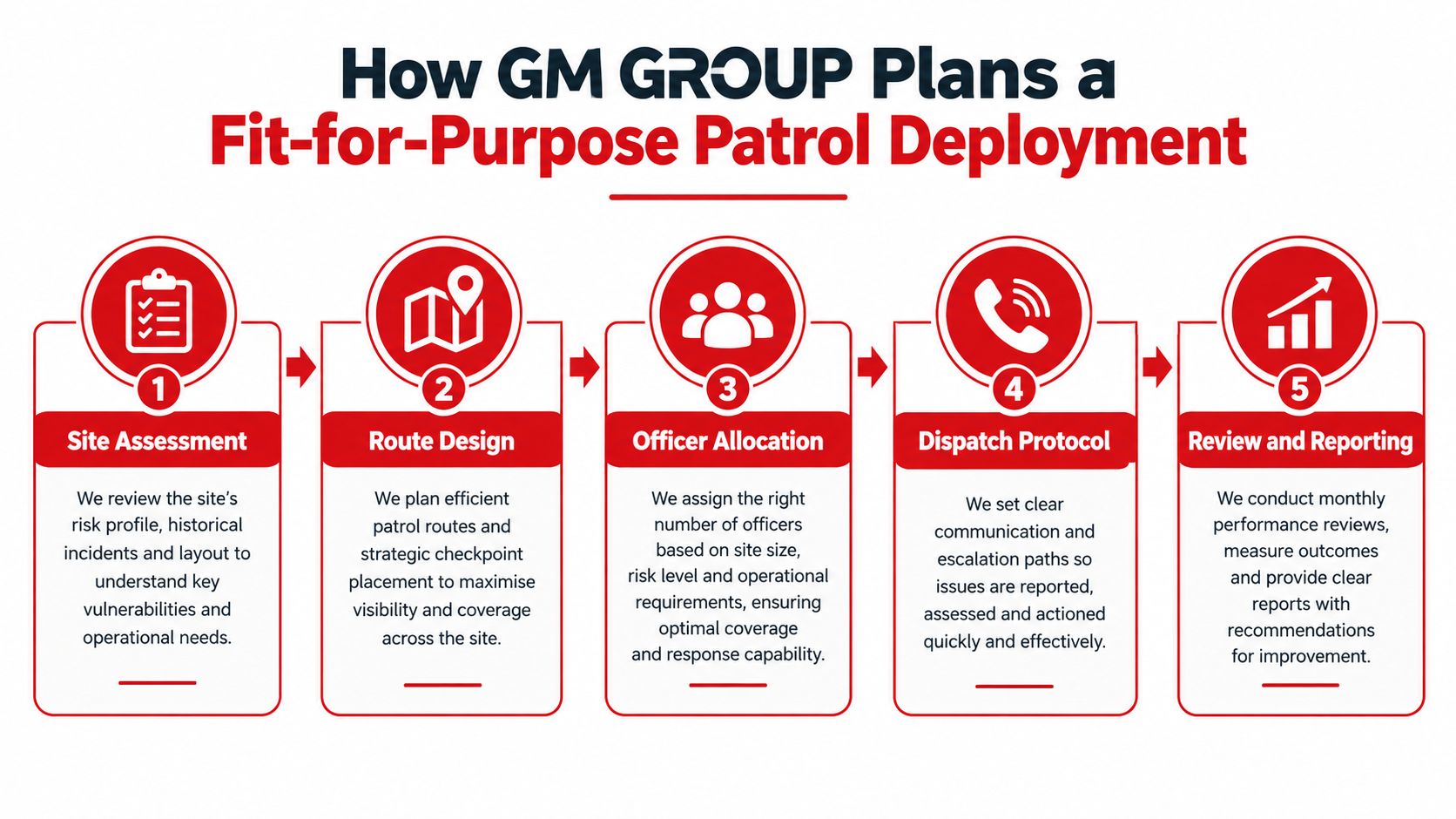
How GM GROUP Plans a Fit-for-Purpose Patrol Deployment
A workable deployment begins with the site, not a standard package. GM GROUP Services operates across NSW, Victoria, Queensland and the ACT, and its vehicle patrol service can be specified alongside static guards, K9 handlers, CCTV processes, gatehouse control, monitoring and emergency response. The provider should still be judged against the same operational questions as any other contractor.
Example one, a multi-stage NSW festival
Start with a map that marks stages, gates, car parks, transport interfaces, bars, staff compounds, first-aid points and pedestrian bottlenecks. Divide the site into risk zones, then assign vehicle routes to areas where distance matters and foot officers to areas where interaction and observation matter more.
During ingress, patrol activity may focus on external approaches and queue conditions. During the event, supervisors can redirect units towards crowd compression, conflict indicators or emerging hazards. During egress, car parks and transport routes often need more attention than the stage perimeter.
CCTV operators and patrol officers should use a shared escalation process. An officer can verify a concern reported on camera, while the control room correlates field observations with available CCTV and environmental information. A NSW Government project at Sydney Olympic Park is developing a de-identified platform combining CCTV, environmental data and social-media information to provide real-time updates on crowd safety risks and visitor sentiment. The NSW case study describes a project, not a published performance benchmark, so clients should measure their own detection-to-dispatch and dispatch-to-arrival results.
Example two, a Queensland construction project
A construction plan begins with perimeter roads, temporary fencing, plant storage, fuel or materials areas, site offices and access gates. The vehicle completes documented checks, while randomised spot checks break an easy-to-learn pattern. An alarm attendance tier should state what happens after a gate alarm, a camera alert or a worker welfare concern.
Supervisors verify completed checkpoints and review incident logs for repeat issues. A broken light should become a maintenance action, not just another line in a patrol report. An unsecured gate should trigger escalation, owner notification and a follow-up check.
K9 deployment can be rostered for defined periods when the risk assessment supports it. The handler needs the same route briefing as vehicle officers, plus clear boundaries around searches, crowd interaction and escalation. Monthly performance reviews should examine unresolved actions, repeated locations, missed checks and response-chain timestamps, rather than only counting patrol visits.
Licensing and Compliance Across NSW VIC QLD and the ACT
Licensing is a purchasing control. A uniform, vehicle and confident presentation don't prove that an officer is authorised for the assigned activity.
Queensland
Queensland distinguishes between dog patrol security officer, unarmed security officer and monitoring security officer categories. A provider working there needs the appropriate Queensland authority. An interstate or New Zealand licence holder may apply for mutual recognition or a temporary interstate permit for short-term work, but an interstate credential alone isn't enough.
Queensland applicants must verify identity with 100 points of certified identification, provide two recent passport photographs and an appropriately witnessed statutory declaration. Fingerprints must be taken in Queensland when transferring a licence, even if they were supplied elsewhere. Confirm the officer's category before assigning patrol duties.
Victoria
Victoria requires a current Victorian private security licence or registration, or an eligible Temporary Visitor Permit. The permit route applies to people who ordinarily live in another Australian state or territory, hold a current interstate licence for the relevant activity and attend Victoria temporarily for a special event.
Victoria Police requires applicants to be at least 18, satisfy identity and suitability requirements, complete approved training for each activity and provide fingerprints. New applicants generally provide 100 points of certified identification. Applicants who lived in another country for more than 12 months during the previous 10 years since turning 16 may need certified international police checks. Victoria Police's private security information and its application reference material set out the relevant controls. Armed work requires a current firearms licence as well as the private security licence.
NSW and the ACT
NSW and the ACT maintain their own security licensing requirements. Don't assume a home-state licence transfers automatically. For every state, request evidence of current authority, match the licence activity to the rostered role, confirm training and renewal monitoring, and require notification if personnel change or become ineligible.
Keep licence details in the site security file. Link access cards to the approved roster where practical, confirm the supervisor's team before a major event and record any separate firearms authorisation. This creates an auditable pre-deployment check without turning the client into the licensing authority.
GM GROUP Services provides vehicle patrols, static guards, K9 units, monitoring, emergency response and risk assessments across NSW, Victoria, Queensland and the ACT. For a patrol plan built around your site risks, licensing requirements and reporting needs, contact GM GROUP Services to discuss the locations, peak windows and escalation rules that matter to your operation.
Discover more from GM Group Services
Subscribe to get the latest posts sent to your email.