
Integrated security solutions help businesses protect people, property and operations without forcing guards, cameras, access systems and compliance tasks into separate silos. For an event promoter, venue manager or site supervisor, the practical test is simple: when something changes quickly, can every relevant person see it, understand it and act on it?
Australian operations add another layer. Security staff may need state-specific licences, event workers may need RSA credentials, technical installers can fall under different licensing rules, and cyber incidents can trigger reporting obligations. The strongest security plan therefore connects people, technology and procedures with the regulatory requirements that govern the site.
Why Integrated Security Solutions Matter for Events and Venues
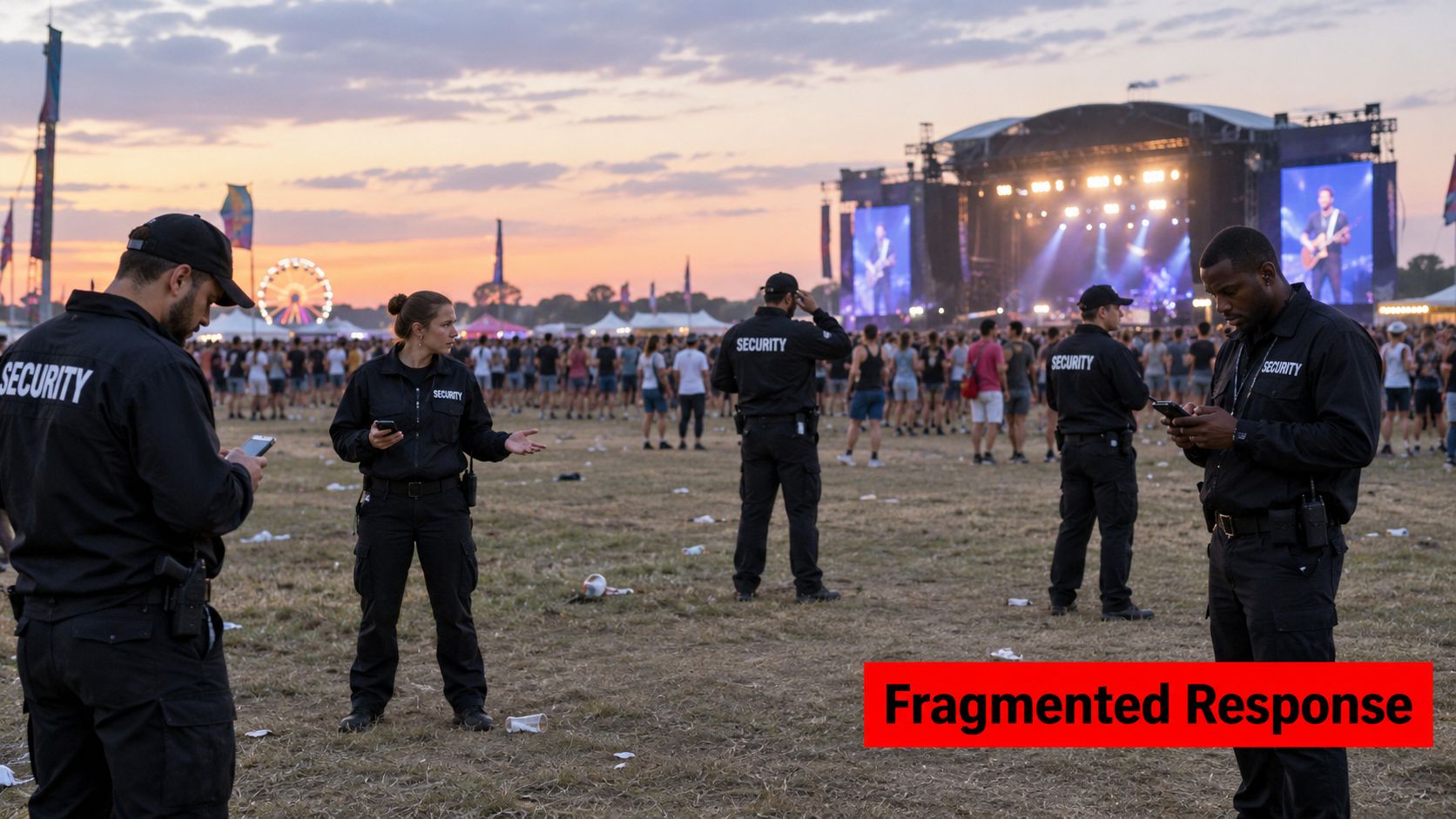
A festival can look organised at the gate and still be operating with fragmented security behind the scenes. Static guards may be watching entry lanes while the access control team uses a separate system. A mobile patrol may be working on another radio channel from the back-to-base monitoring centre. Meanwhile, staff assigned to a licensed bar might have the required RSA certification, but a contractor transferred from another state may not hold the local security authority needed for the role.
That separation creates avoidable uncertainty. A guard who spots a developing crowd issue may not know whether the monitoring operator has already received an alarm. The control room may see an access event without knowing which supervisor is closest. An event manager may discover a licensing gap only after deployment has begun.
Integrated security solutions give those teams one operating model. The aim isn't to put every function into one piece of software. It's to make sure that guards, supervisors, access control, surveillance, alarms, monitoring and escalation procedures support the same plan.
Fragmentation creates compliance risk
Australia's private security industry moved from minimal oversight to formal state and territory licensing during the 1980s and 1990s. New South Wales introduced the Security (Protection) Industry Act in 1985, Queensland followed with the Security Providers Act in 1993, South Australia and the Northern Territory adopted regulation in 1995, Western Australia in 1996, and the NSW Security Industry Act 1997 commenced on 1 July 1998. The Australian Institute of Criminology's account of security industry regulation explains how this history shaped compulsory training, criminal-history checks, disqualifying offences and licensing systems.
That history still matters for operators across NSW, Victoria, Queensland and the ACT. A provider must understand the operational brief and the jurisdiction in which each worker will perform the activity. A group of guards, a monitoring centre and an access system aren't integrated if the people using them aren't legally cleared and properly briefed.
Practical rule: Treat licensing and credential verification as part of the security design, not as paperwork completed after the roster is built.
Understanding the Three Pillars of Integrated Security
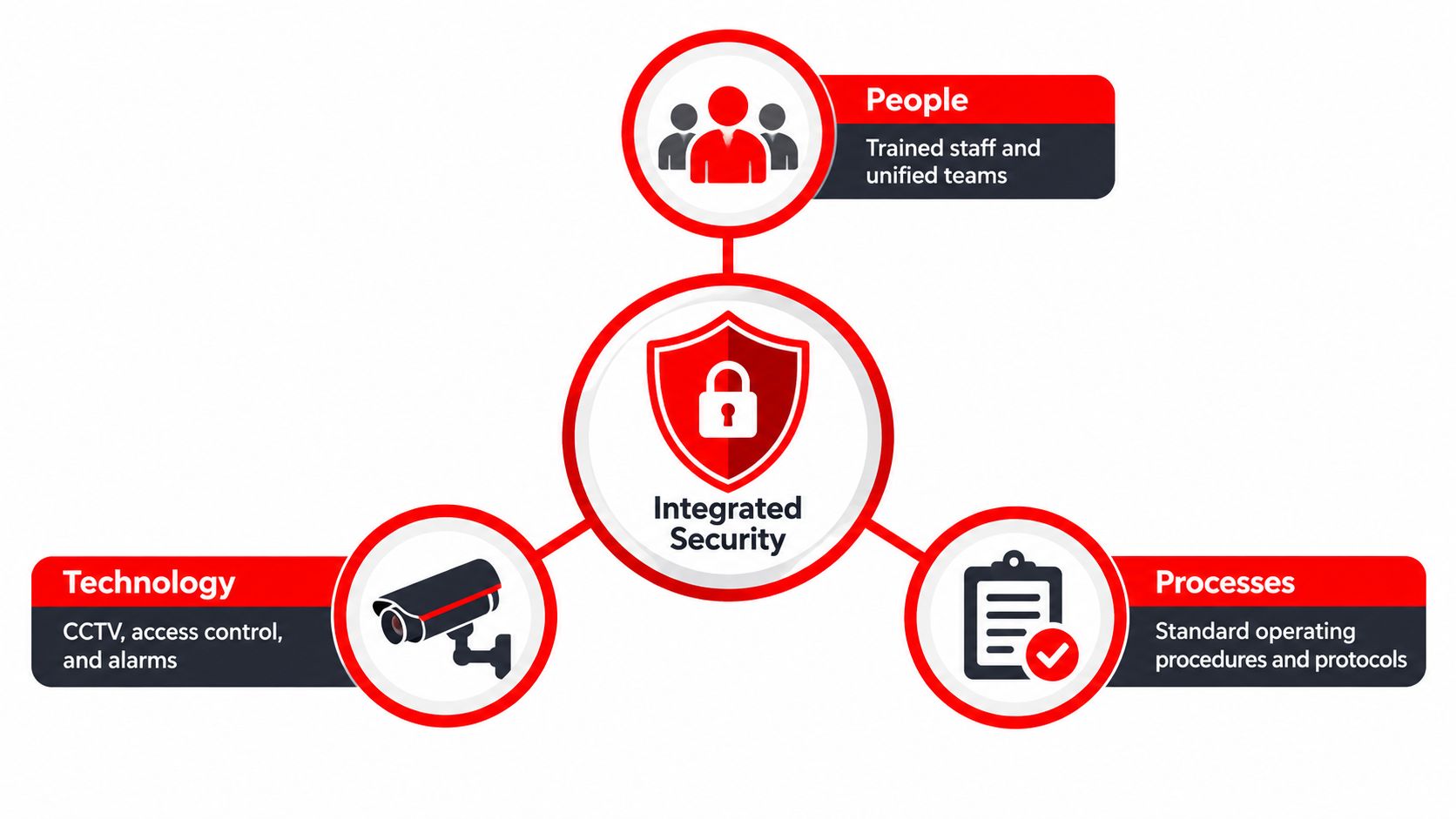
A reliable deployment joins people, technology and processes. Remove one pillar and the remaining two become less useful. A camera can't coordinate a response by itself, and a well-trained guard can't manage an access system without the right information and authority.
People make the system operational
People include static guards, crowd controllers, patrol officers, K9 handlers, VIP protection specialists, supervisors and monitoring operators. Each person needs a defined role, a communication path and the licence or registration required for that work in the relevant state.
For a festival, the supervisor might assign crowd controllers to entry points, patrol officers to perimeter routes and a monitoring operator to the control room. The important detail is the handoff. If access control identifies an invalid credential, the operator must know which team responds, what information the team receives and how the incident is recorded.
Technology creates shared visibility
Technology can include CCTV, access control, alarms, intercoms, identity systems, back-to-base monitoring and incident management tools. The Australian Government Architecture security standard says security measures should integrate with existing infrastructure to provide layered security, supporting a model in which access control, cameras, alarms and identity systems work together rather than sitting as isolated point tools. The Australian Government information asset security standard provides the relevant architecture context.
Technology should answer practical questions. Who entered? Which door generated the alert? Who is nearest? Has a supervisor acknowledged the event? What evidence needs to be retained?
Processes turn information into action
Processes include incident response, radio protocols, credential checks, contractor onboarding, escalation rules and post-incident reporting. A venue might connect a forced-door alert to a camera view, a control-room notification and a supervisor dispatch. That sequence only works when the operating procedure defines what happens next.
The right test isn't whether systems are connected on a diagram. It's whether a trained person can follow the response without guessing.
Key Benefits of Integrated Security Solutions for Australian Businesses
The commercial case for integration is expanding alongside the Australian security market. Independent estimates place the market at about US$4.60 billion in 2024, with a projection of roughly US$12.44 billion by 2035. Another outlook projects US$7.71 billion by 2030 and an 8.8% CAGR from 2025 to 2030. These projections are set out in the Australia security market growth analysis, and they reflect demand across security systems, services and managed models.
The figures don't prove that every business needs a single platform. They do show why buyers increasingly expect providers to coordinate physical protection, monitoring and technical controls.
Four operational gains
- Better situational awareness: Supervisors can combine reports from guards, access events, CCTV and monitoring rather than asking separate teams to reconstruct what happened.
- More controlled response: A documented escalation path reduces uncertainty when a crowd issue, alarm or unauthorised entry develops.
- Simpler compliance management: A single deployment plan can record licence checks, RSA requirements, contractor details and incident documentation.
- Less duplicated effort: Businesses can identify overlapping patrols, unstaffed handoff points and technology that adds alerts without improving decisions.
Integration now supports incident readiness
The Australian Cyber Security Centre reported that on 30 May 2025, the government introduced mandatory ransomware reporting for businesses with annual turnovers of $3 million or more and for critical-infrastructure entities. The Australian Cyber Security Centre annual cyber threat report explains the reporting context.
A physical security deployment can't replace cyber controls, but it can support incident logging, evidence preservation, escalation and communication. Home Affairs also describes minimum all-hazards standards for industry participants under the TSA Act, including cyber security. That makes integration a governance issue as well as a convenience issue.
Typical Components of an Integrated Security Deployment
A complete deployment begins with the site risk, not a catalogue of services. A festival may need crowd controllers, gate teams, patrols, monitoring and emergency escalation. A construction site may place greater emphasis on gatehouse control, access records, perimeter patrols and after-hours alarm response.
| Component | Events & Festivals | Hospitality Venues | Construction Sites | Retail & Corporates |
|---|---|---|---|---|
| Static guards | Entry lanes, backstage areas and crowd zones | Door supervision and patron safety | Site entrance and restricted areas | Reception, floor presence and deterrence |
| K9 units | Detection support and perimeter coverage | Targeted reassurance for busy periods | Perimeter checks and asset protection | Specialist screening where risk justifies it |
| Vehicle patrols | Car parks, perimeter routes and remote zones | Multiple venues or late-night checks | Large sites and materials storage | Retail centres, offices and distributed assets |
| Back-to-base monitoring | Alarm coordination and control-room support | After-hours alarm response | Intrusion alerts and escalation | CCTV, alarms and remote oversight |
| Access control | Credentials, staff gates and contractor entry | Staff-only areas and restricted rooms | Workers, vehicles and delivery records | Visitors, employees and sensitive areas |
Build the handover properly
Alarm transmission deserves particular attention. The AS/NZS 2201.5 monitoring approach uses a graded monitoring centre, and multipath transmission over IP and cellular can reduce reliance on a single transport path. The Australian access control and alarm monitoring guidance also highlights the need to document door schedules, addressing, credentials and access-review procedures in the handover pack.
That documentation is what makes the system maintainable after installation. Without it, a venue may have working equipment but no reliable record of how access permissions, alerts or service responsibilities should be managed.
Match the component to the environment
A guard post isn't interchangeable with a patrol, and a camera isn't a substitute for a trained response. Businesses assessing their wider physical security for enterprises should compare the required coverage, response responsibility, evidence needs and operating hours before selecting a bundle.
The strongest plan may use several components, but each must have a defined purpose. More devices and more staff won't fix unclear ownership.
Implementation Considerations Across Australian States
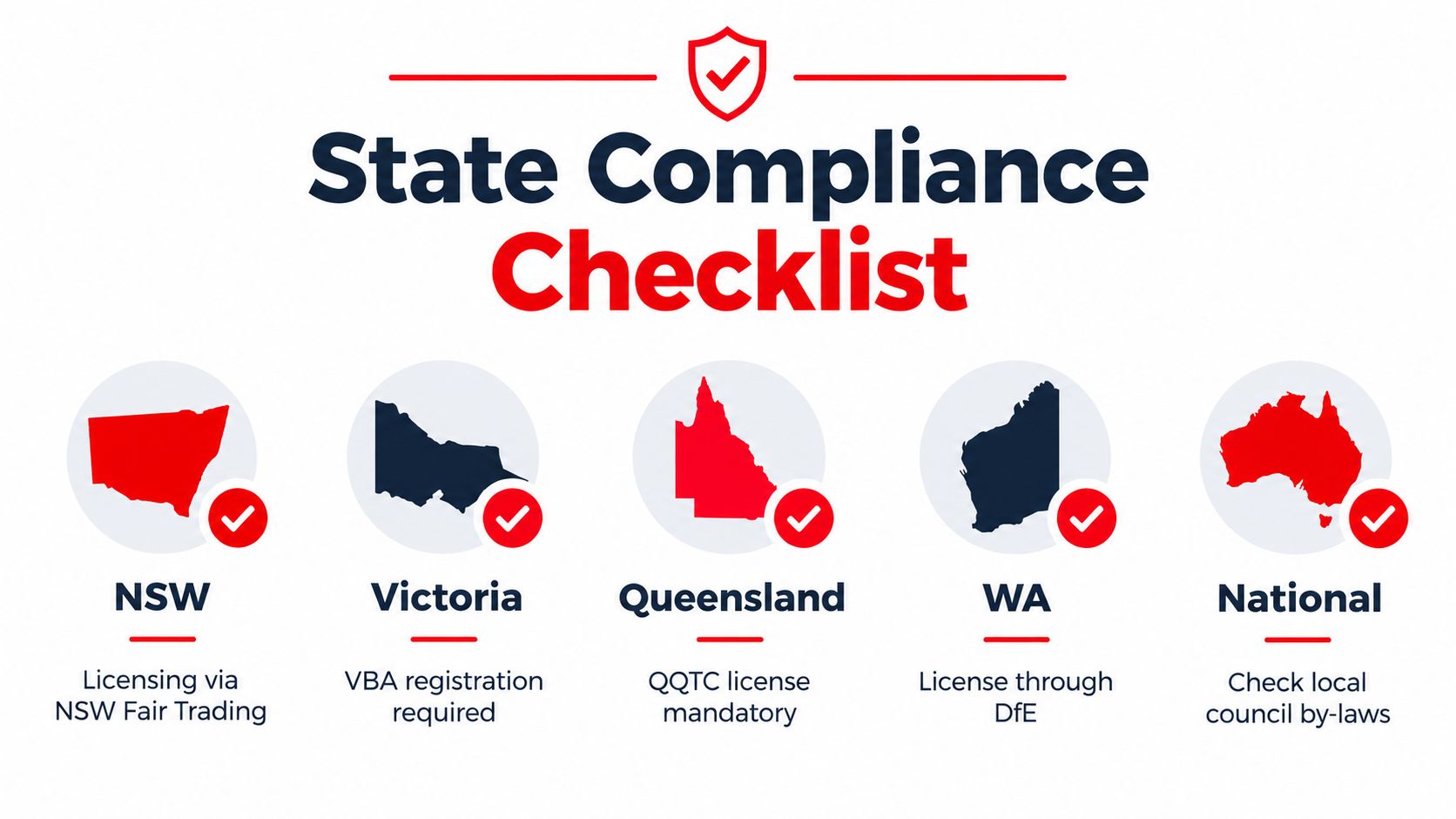
Multi-state deployments fail when organisers treat a home-state credential as a national permission. The correct approach is to create a compliance map before the roster is finalised.
In NSW, RSA certification is mandatory for anyone serving liquor at an event, including volunteers and security staff performing that role. Anyone undertaking a security activity must also be appropriately licensed. The NSW event safety and security guidance supports a two-part check for licensed areas: verify RSA eligibility for liquor service duties and security licensing for security activities.
Victoria has its own pathway. Applicants must be at least 18, be an Australian resident or hold a current visa, submit fingerprints, provide 100 points of certified identification and demonstrate competency for the relevant activities. A person working in Victoria needs a current Victorian private security licence or registration, or a Temporary Visitor Permit. Interstate holders need the Mutual Recognition process and supporting documents, as explained by Victoria Police's private security eligibility guidance.
A practical deployment checklist
- Map every activity: Separate guarding, crowd control, liquor service, patrols, monitoring and equipment work.
- Check each worker: Record licence numbers, state of issue, expiry information and the activity permitted.
- Plan interstate transfers: A NSW bodyguard or crowd controller sent to a Melbourne corporate event can't work under the NSW licence alone.
- Separate technical duties: In Queensland, a security equipment installer licence covers installing, repairing, servicing or maintaining acoustic, electronic or mechanical security equipment, including monitoring systems. Review the Queensland security equipment installer requirements before assigning technical work.
- Confirm local requirements: Include ACT and site-specific obligations in the same planning register, rather than adding them after contracts are signed.
Measuring ROI and Long-Term Value of Integration
Return on investment shouldn't be reduced to the cost of guards or the price of a camera system. Measure whether the deployment reduces duplicated work, improves accountability, supports compliance evidence and gives managers better control of incidents.
Australia's security workforce is substantial. ASIAL's 2025 report says the industry employs over 180,000 people, including more than 153,000 licensed security personnel. The ASIAL Security 2025 report puts the emphasis on a workforce where training, supervision and fit-for-purpose allocation matter.

Track the measures that affect decisions
A venue can compare scheduled and actual coverage, response ownership, incident closure quality, unplanned staffing changes and repeated access issues. A construction manager can review alarm follow-up, contractor records, patrol findings and equipment faults. These measures show whether the service is reducing operational friction, even when no major incident occurs.
Unified-platform adoption remains incomplete. One Australian market report states that 37% of organisations currently operate a unified security platform, while 53% are expected to do so within the next 12 to 24 months. The Australian unified security platform analysis also highlights the need to manage interoperability and governance, because adding integration without clear ownership can increase complexity.
Measure the handoffs: If the control room, supervisor and on-site team can't show who received an alert and what happened next, the integration is incomplete.
The business case should therefore include implementation effort, training, maintenance and governance. A cheaper bundle may cost more over time if it creates duplicate alerts, unclear accountability or repeated manual checks.
How to Choose a Fit-for-Purpose Security Provider
Price is only one selection criterion. A provider that supplies guards but can't validate licences across the required states may leave the client with an attractive roster and a compliance problem. A provider that supplies technology without a response structure may leave alarms unanswered or evidence poorly documented.
Ask potential providers to demonstrate how they would handle a real operating scenario:
- Who validates credentials? Request the process for checking state licences, RSA status where relevant and technical permissions.
- Who owns the control room? Identify the monitoring operator, escalation contact and supervisor responsible during the deployment.
- How do teams communicate? Ask whether patrols, static guards, venue management and monitoring use a shared protocol.
- What happens after an incident? Review report timing, evidence handling, client notification and follow-up.
- How is the roster matched to the site? A crowded festival, a hotel, a construction site and a corporate office need different profiles and supervision.
- What does the handover include? Look for access records, alarm details, site instructions, contacts and review responsibilities.
A fit-for-purpose provider should be able to combine services without pretending that every site needs the same package. Static guards, K9 teams, vehicle patrols, gatehouse control, loss prevention, monitoring and emergency response should be selected because the risk assessment supports them.
Red flags include vague claims about “full integration”, no named incident owner, reluctance to explain licensing checks, and a proposal that lists equipment without describing the operating procedures around it. Ask for a deployment plan that shows people, technology and processes working together.
Common Misconceptions About Integrated Security Solutions
“Integration always costs more.” The purchase price may rise when systems or supervision are added, but total cost also includes duplicated staffing, avoidable callouts, poor handoffs and compliance exposure. Compare the complete operating model, not just the hourly rate.
“It requires complicated technology.” A good design hides unnecessary complexity from guards and venue staff. Users should see the information and actions relevant to their role.
“One provider can't manage multiple states.” Providers can support multi-state work, but the client still needs state-by-state verification. A national roster doesn't remove local licensing obligations.
“Integration means losing flexibility.” Properly designed deployments can scale from a hospitality venue to a festival or construction site by changing coverage, permissions and procedures.
“Physical and cyber security are separate.” Ransomware reporting obligations and all-hazards security expectations show why incident records, escalation and evidence handling need to connect across operational teams.
Frequently asked questions
Do security staff serving alcohol need RSA certification in NSW? Yes, NSW guidance makes RSA certification mandatory for anyone serving liquor at an event, including security staff and volunteers assigned to that role.
Can an interstate crowd controller work in Victoria under a home-state licence? Not automatically. The worker needs the applicable Victorian licence, registration or Temporary Visitor Permit pathway.
Does integrated security mean using one supplier for everything? No. It means the selected people, systems and procedures operate as one coordinated model. Multiple suppliers can work if responsibilities and interfaces are documented.
GM GROUP Services provides customized security support across NSW, Victoria, Queensland and the ACT, including static guards, K9 units, patrols, gatehouse control, back-to-base monitoring, emergency response and risk assessments. Review how GM GROUP Services can align licensed personnel, operational procedures and coordinated protection with your event, venue or business requirements.
Discover more from GM Group Services
Subscribe to get the latest posts sent to your email.