
Emergency response vehicles matter most when a crowded festival, venue or worksite turns a routine shift into a time-critical incident. A person collapses beside a packed stage, a gate is locked after a perimeter breach, or an aggressive incident spills from a licensed venue into the access lane. The vehicle may be ready, but if marshals can't clear the route, the gatehouse can't identify the responder and the control room can't relay accurate directions, the response still fails.
The operational question isn't which vehicle to buy. It's whether the site, crew and communications system allow that vehicle to reach the right place, perform its role and leave safely. Australia's ambulance network handled 3.3 million incidents and 4.1 million responses in 2012–13, operating from 1,161 locations with 5,219 vehicles, according to the Australian Institute of Health and Welfare ambulance data. That scale shows why private planners must treat access as part of emergency readiness, not as a last-minute parking detail.
When Minutes Decide the Outcome
At a summer festival, a security supervisor receives a radio call about a medical emergency near the centre of the crowd. The nearest patrol car reaches the edge of the audience quickly, but the response vehicle is held at a service gate by temporary barriers. One marshal has the key, another has gone to the loading dock, and the control room is still confirming which internal route remains open.
The crew eventually reaches the patient. The delay wasn't caused by a lack of equipment. It came from an access plan that existed on paper but wasn't controlled on the ground.
That scenario repeats in different forms at construction compounds, hotels, clubs and exhibition centres. A vehicle needs a usable route, a trained driver, a person authorised to open gates, reliable radio traffic and a staging position that doesn't trap the crew in pedestrian flow. A response vehicle is a system component, not a standalone solution.
Put vehicle access in the first briefing
Event managers should walk the route before barriers, marquees, plant and delivery vehicles occupy the site. Test the gate, confirm who controls it, check whether a large appliance can turn, and identify a second route if the primary path is blocked. The supervisor should know the exact language for dispatch, including the gate name, access point, level, landmark and safest approach.
A short operational reference such as the CASA RePL emergency guide can also help teams think through emergency coordination, especially where airspace, incident control or specialist response activities overlap.
Practical rule: If a responder has to ask, “Which gate do I use?”, the site plan isn't finished.
The Core Categories of Emergency Response Vehicles
Choose the vehicle around the task, not the image it projects. A marked patrol car may be ideal for fast visibility and first attendance, while a command vehicle earns its place only when the incident needs sustained coordination, multiple teams or a mobile control point.
| Vehicle type | Primary capability | Best-fit deployment | Key limitation |
|---|---|---|---|
| Patrol or rapid-response car | Fast presence, observation and initial intervention | Venues, retail centres, compounds and dispersed event perimeters | Limited medical, rescue and command capacity |
| Ambulance-styled rapid intervention unit | Immediate medical support and patient stabilisation | Festivals, sports grounds, industrial sites and high-density venues | Doesn't replace public ambulance resources or specialist rescue |
| K9 transport vehicle | Safe movement of an accredited handler and dog | Detection, deterrence, search and controlled perimeter work | Requires an appropriately trained handler and welfare controls |
| Command or liaison vehicle | Communications, briefing, logging and incident coordination | Large events, complex sites and prolonged operations | Adds cost and space requirements, and isn't a substitute for frontline presence |
A patrol or rapid-response car is the practical first layer. It can reach a disturbance, check a gate alarm, escort emergency services and provide eyes on a changing situation. Don't treat it as a mobile ambulance or assume a visible vehicle covers every medical risk.
An ambulance-styled unit suits sites where trained personnel and immediate intervention are part of the risk treatment. Its value depends on crew competence, equipment checks and a clear handover process with public ambulance officers.
K9 vehicles need ventilation, secure separation, water, shade planning and controlled loading procedures. The vehicle supports the handler. It doesn't create capability without accreditation and disciplined deployment.
A command vehicle becomes worthwhile when supervisors need a fixed communications and documentation point away from the main crowd. For planners comparing operating costs and vehicle utility, background on commercial electric vehicle ROI provides useful context, but the calculation must include charging access, downtime and contingency coverage.
Essential Fit-Outs and Equipment
A fit-for-purpose vehicle carries equipment that supports a defined operating task. Buying more gear without assigning ownership, inspection and replacement responsibilities creates clutter, not readiness.
Start with crew protection
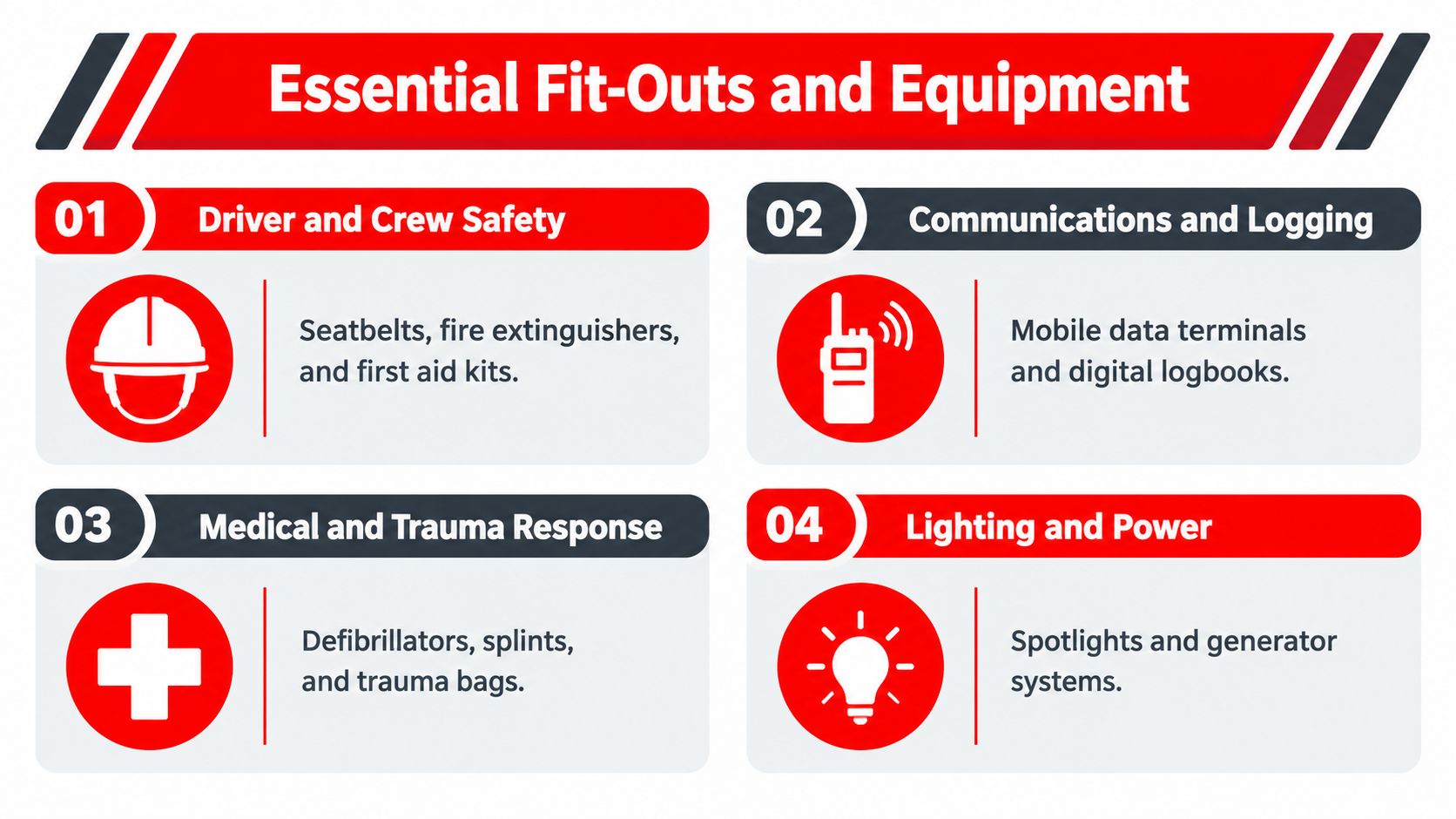
Seatbelts, fire extinguishers, first-aid kits, high-visibility clothing and safe storage belong in the driver and crew zone. Add gloves, eye protection and task-specific personal protective equipment where the site risk demands it. The driver must be able to reach essential items without creating a loose-object hazard or leaving the vehicle unsecured.
Build communications around the control room
A radio is only useful when everyone uses the same channel plan and call signs. Add a charged phone, duress capability, mobile data access where appropriate and a digital or paper log that records dispatch time, arrival, actions and handover. Supervisors should test the radio at the gate, inside the venue and in likely dead spots before opening.
Medical equipment should match the authorised skills of the crew. Defibrillators, trauma bags, splints, dressings and oxygen-related equipment require documented checks, expiry control and clear escalation limits. A private response unit should stabilise and communicate, not drift into an undefined substitute for clinical ambulance care.
Lighting needs equal discipline. Use lawful warning systems, work lights and spotlights that help crews operate without dazzling road users or creating confusion. K9 vehicles need secure animal separation, ventilation, temperature monitoring and cleaning supplies. A command unit may also require spare radios, charging banks, maps, incident forms and a stable work surface.
Road Rules That Shape How Response Vehicles Operate
Traffic law changes the physical design of a response route. It also changes what marshals tell drivers when a vehicle is stopped at an incident.
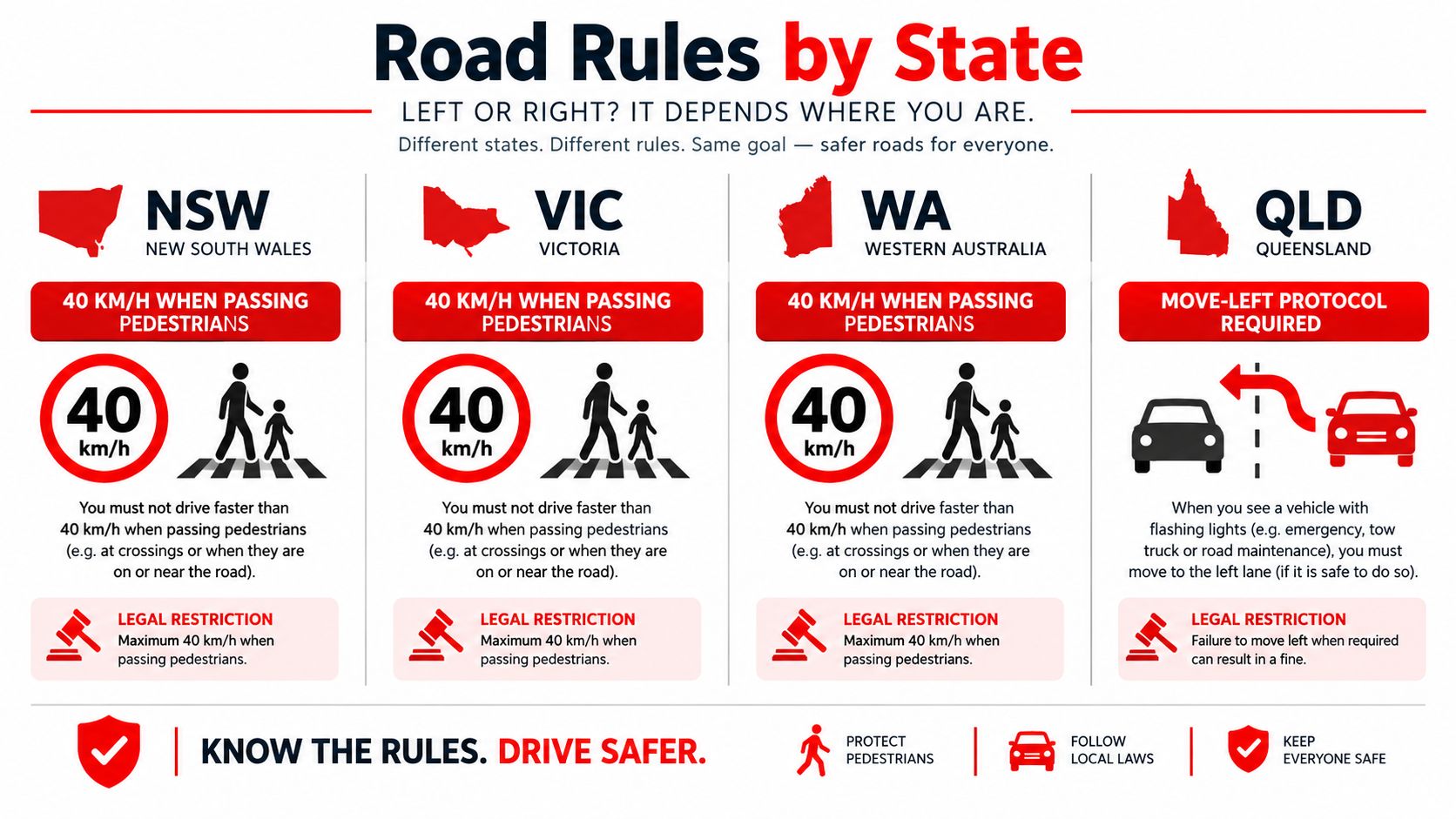
In Victoria, motorists must slow to 40 km/h when passing stationary or slow-moving emergency, enforcement, incident-response or escort vehicles displaying the relevant flashing lights or sounding an alarm. The rule applies while passing the incident area, and drivers must give way to approaching emergency vehicles even when their signal is green, as explained in the Victorian emergency and incident-response vehicle rules.
Western Australia applies a comparable 40 km/h Slow Down, Move Over approach. NSW requires drivers to slow to 40 km/h where the speed limit is 80 km/h or less when passing stationary emergency vehicles and roadside incidents. On roads above 80 km/h, drivers must slow safely and move over when possible, based on the NSW passing emergency vehicles guidance.
Design for arrival and roadside work
Queensland drivers must move out of the path of an approaching emergency vehicle showing flashing red or blue lights or sounding an alarm. They should slow and move left when safe, but must remain in place if moving left would create danger, as set out in the Queensland emergency vehicle road rules.
NSW vehicle standards specify that blue or blue-and-red flashing lights signal emergency response, while sirens are restricted to approved emergency and accredited vehicles. Private security fleets shouldn't imitate those signals. Use lawful amber warning systems, high-visibility markings, radios and preplanned access routes instead, consistent with NSW flashing light and siren standards.
A stopped response vehicle is an active work zone. Keep people and traffic away from it.
Deploying Vehicles at Events, Venues and Worksites
The right mix changes with crowd density, site geometry and the likely first incident. A festival often needs visible patrol coverage, a medical response point and a route protected for public ambulance access. A hotel or club may gain more from a mobile patrol car, a supervisor vehicle and a controlled gate or driveway than from a large command unit.
Match the vehicle to the environment
At concerts and festivals, stage production, food vendors and crowd barriers can consume the routes that responders need. Keep a hardstand or access lane free, position marshals at decision points and make sure the vehicle can leave after reaching the incident. A K9 vehicle may suit controlled perimeter searches, but it shouldn't be used as a substitute for medical coverage.
Bars, hotels and retail centres usually need rapid presence and clear escalation. A patrol vehicle can attend alarms, disorder and welfare concerns, while a supervisor coordinates with venue management and public responders. Keep loading docks and fire routes clear, especially during deliveries and peak customer movement.
Construction and industrial sites introduce plant, uneven surfaces, locked compounds and changing hazards. Mark access routes as the site changes, brief gatehouse staff on emergency entry and keep a turning area free of stored materials. Temporary welfare or coordination spaces can also support extended incidents, and temporary modular buildings for disaster relief offer useful planning context for sites that may need rapidly established operational space.
Use staging, not wishful parking
A response vehicle should be near enough to reach the risk quickly but far enough away to avoid crowd entrapment, falling objects, smoke, reversing movements or blocked egress. Assign a supervisor touchpoint for each shift and record who has authority to move barriers, close a lane or request public assistance.
Maintenance, Licensing and Compliance
Vehicle readiness begins before the crew signs on. A vehicle that starts reliably but has an unreported tyre defect, an expired medical item or a failed radio isn't ready for deployment.
Run a disciplined pre-shift check
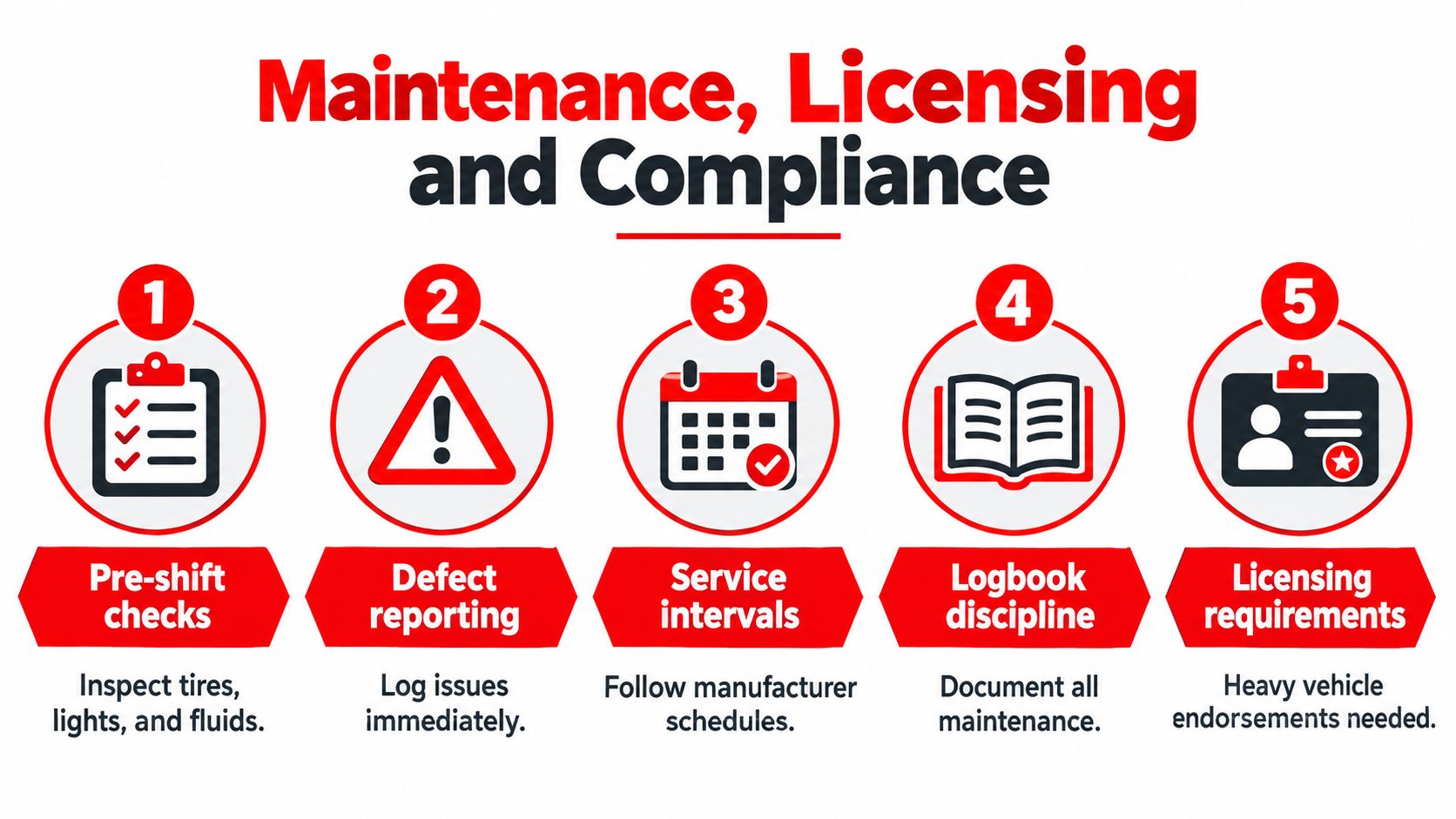
The driver should inspect tyres, lights, mirrors, fluids, fuel or charge level, warning equipment, doors, restraints and storage security. The crew should then check radios, duress devices, medical equipment, torches, protective equipment and the condition of any K9 compartment. These checks need a named sign-off, not a general assumption that the previous shift handled them.
Use a simple status decision:
- Ready: All critical systems work and consumables are present.
- Restricted: The vehicle can perform limited duties, with the restriction recorded and accepted by a supervisor.
- Unserviceable: Remove it from deployment until the defect is assessed and cleared.
Defects should be logged immediately, with the time, vehicle identifier, description, risk and action taken. Don't allow a driver to carry a known safety defect because the shift is busy. A replacement vehicle or revised deployment is safer than an undocumented compromise.
Keep the audit trail usable
Service intervals must follow the manufacturer and vehicle class requirements. Heavy or specialised vehicles may require the correct licence class or endorsement, and drivers must understand the vehicle's dimensions, braking behaviour, reversing risks and load limits.
Security compliance also follows the crew. State-specific security licensing, required training, RSA currency where relevant and incident-reporting duties affect whether a vehicle can lawfully and competently perform its assignment. An impressive vehicle with an unavailable or unlicensed crew is unavailable in practice.
Keep these records together:
- Vehicle identity: Registration, asset number, odometer or operating-hours record.
- Maintenance history: Service dates, repairs, inspections and outstanding defects.
- Equipment register: Serialised medical, radio, safety and specialist equipment.
- Crew authority: Licence, security licence, training and role approvals.
- Incident record: Dispatch, arrival, actions, escalation, handover and close-out.
- Communications test: Radio checks, dead zones, backup channels and control-room confirmation.
Connect the vehicle to the control room
A control room should know which vehicle is available, where it is staged, who is driving and what task it can perform. Mobile data and automatic vehicle location can help, but technology doesn't replace a clear dispatch protocol. Use short, consistent messages that identify the incident, location, immediate hazard, access route and support required.
For example: “Control, Rapid One. Medical incident, north service gate, patient conscious, crowd pressure present. Send supervisor and keep ambulance lane open.” That message gives the receiving team a task and a route instead of a vague request for help.
Handover quality matters just as much. When police, fire or ambulance crews arrive, the security team should provide the safest entry, patient or hazard location, crowd conditions, access restrictions and any known threats. After the incident, record what blocked the response, which radio messages worked and whether the route remained open. The post-event report should change the next site plan.
The Access and Redundancy Question Most Plans Skip
A response vehicle is only useful if it can reach the incident. Private security planners should treat readiness as a site-access problem, not a fleet-procurement exercise. A plan that depends on one gate, one route and one expected appliance has created a single point of failure.
Recent reporting on Victoria's Fire Rescue fleet found that appliance numbers had not kept pace with Melbourne's population, with up to 62 trucks offline at one point. The availability gap makes route redundancy and vehicle substitution planning necessary, not optional.
Electrification adds another operational decision. ACT Fire & Rescue reports that its electric pumper attended 189 incidents before being temporarily withdrawn after a battery-pack issue, returning to service after a replacement battery was installed in February 2026. The ACT fleet includes two electric emergency vehicles, and earlier transition planning involved electric and conventional vehicles attending incidents together, according to ACT Fire & Rescue's electric truck information.
Make the site resilient
Write the fallback into the site plan as a named substitution. If the electric pumper is unavailable, identify the designated backup appliance, its staging location and the expected response-time difference. Give the control room authority to activate that substitution without waiting for a fresh planning decision.
Your next site walk should confirm:
- Gate control: Who opens every locked gate, and who is the backup?
- Barrier removal: Can temporary barriers be removed without tools or delay?
- Turning space: Where can a large appliance turn without reversing through crowds?
- Hydrant access: Are hydrants, fire service connections and hardstands unobstructed?
- Route resilience: Is there a second access point if the main road is blocked?
- Communications: Can security contact the control room and guide public responders?
- Vehicle substitution: What changes if the expected appliance or response unit is unavailable?
Test the fallback with the actual people, keys, barriers and access points. Record who acts, where the replacement vehicle stages and how the route changes. The strongest plan makes the site usable by whichever compliant vehicle can attend.
Frequently Asked Questions About Emergency Response Vehicles
How do we keep a response vehicle moving through a crowded event?
Create a protected route before gates open, nominate a marshal at each controlled access point and keep barriers removable. Give the control room precise landmarks and brief staff not to park, queue or store equipment in the route.
What happens if an electric emergency vehicle is unavailable?
Use a documented conventional-vehicle fallback and maintain dual-response procedures during the transition. Reserve charging access, provide responders with battery and isolation information, and include repair downtime in the contingency plan.
Can a private security vehicle use blue or red flashing lights?
Don't fit unapproved blue or blue-and-red lights or siren-equivalent devices. NSW standards reserve those emergency signals for approved vehicles, so private operators should use lawful amber warning systems, high-visibility markings, radios and controlled access planning.
What should staff do when an emergency vehicle is stopped?
Treat it as an active work zone. Apply the relevant local rule, keep people away, protect the vehicle from passing traffic and don't reopen the route until responders and pedestrians are clear.
Does a command vehicle belong at every event?
No. Use one when the incident requires sustained coordination, multiple response groups or a mobile operations base. For a smaller site, a properly equipped supervisor and a reliable control-room link may provide better value.
GM GROUP Services provides licensed security support across NSW, Victoria, Queensland and the ACT, including vehicle patrols, emergency assistance, gatehouse control, K9 teams and risk assessments. For a site-specific access and response plan that connects vehicles, crews and communications, contact GM GROUP Services and arrange an operational review before your next event or site mobilisation.
Discover more from GM Group Services
Subscribe to get the latest posts sent to your email.