
Australia's private security sector employs over 110,000 licensed individuals across more than 5,000 registered businesses, with covert security operating within this regulated framework rather than as an unregulated shadow service. A covert security officer can support discreet observation and loss prevention, but must work within the licence, privacy, identification and staffing rules that apply in the relevant state or territory.
A festival promoter sees theft complaints rising around food queues and crowded walkways. Uniformed guards are visible, approachable and essential, yet adding more of them may change the atmosphere the organiser is trying to create. A plain-clothes officer positioned nearby can observe behaviour without broadcasting the location of the security response, then report patterns to the supervisor before a minor incident becomes a larger disruption.
That sounds simple until the deployment starts. The officer still needs the right licence, a defined task, an approved communication method, lawful intervention limits and a clear way for staff and police to identify them. Discretion reduces visibility, not responsibility.
What Is a Covert Security Officer and Why Venues Need Them
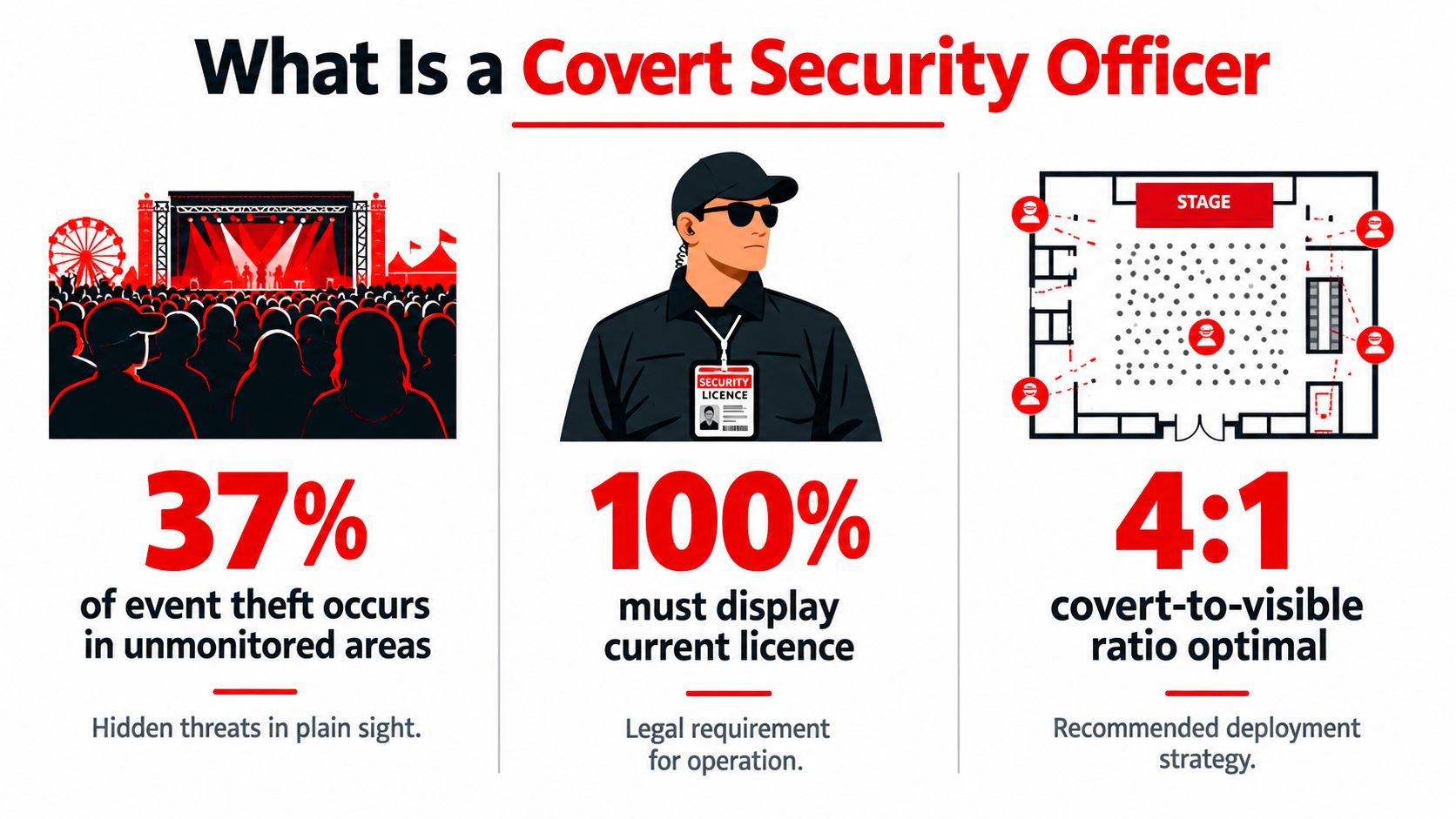
A covert security officer is a licensed security professional who performs an authorised security function without the conventional visible uniform. The role may involve discreet loss prevention, observation of crowd behaviour, support for access control or incident reporting. It isn't a licence category that gives someone unrestricted authority, and plain clothes don't turn a private officer into a police officer.
At a busy concert, for example, a visible team may manage entry lanes, respond to conflict and reassure patrons. A covert officer can work among the crowd, observe repeated attempts to enter restricted areas or identify behaviour associated with theft, and pass that information to the appointed supervisor. The useful outcome isn't dramatic intervention. It's earlier, better-informed decision-making.
A regulated role, not a shadow service
The scale of Australia's private-security sector explains why covert work must be managed professionally. An Australian Institute of Criminology analysis recorded 52,768 people employed full-time in the security industry in 2006, compared with 44,898 police officers. It also recorded more than 5,000 registered security and investigative businesses and over 110,000 individual licences. In 2008, licensing agencies recorded 112,773 individual licence holders with 168,165 separate licences, and the national total was approximately 114,600 licensees after additional corporate and government licences were counted, according to the Australian Institute of Criminology analysis.
Those figures establish the setting. Covert personnel operate inside a substantial, supervised industry that includes bodyguarding, crowd or venue control, monitoring-centre operations, guarding with dogs or firearms, general guarding and training. A venue shouldn't treat discreet work as an informal favour assigned to an unlicensed observer.
Where covert deployment adds value
The strongest use cases are situations where visible presence can alter behaviour:
- Retail loss prevention: An officer observes suspected stock concealment, refund fraud or collusion and reports through the approved chain.
- Festival operations: An officer monitors queues, transport routes, toilets or perimeter activity while uniformed teams remain available for visible response.
- Hospitality venues: A plain-clothes officer identifies early signs of theft, drug activity or unsafe patron behaviour without making every interaction feel like an enforcement action.
- Corporate and construction sites: A discreet observer can support an approved investigation, provided the task complies with workplace-surveillance and privacy requirements.
Communication matters because a covert officer can't rely on obvious gestures or public instructions. A venue should establish a disciplined radio and reporting method, supported by secure communication for frontline teams, so discreet observations reach the right supervisor without exposing the officer unnecessarily.
Legal Requirements and Licensing for Covert Operations
The first legal question isn't whether an officer can work in plain clothes. It's which licensed function the officer is performing. In NSW, the Security Industry Act 1997 states that a licence doesn't confer any function beyond those authorised by that licence, and NSW licences generally remain valid for five years unless revoked or otherwise ended, according to the current NSW Security Industry Act.
That principle should shape the deployment brief. Write the objective in operational terms, identify the licence class relied on, and specify what the officer may observe, report or do if an incident develops.
Verify the officer before the shift
Before deployment, an organiser should check:
- Identity and licence details: Confirm the person matches the licence record and that the licence covers the assigned function.
- Role description: State whether the task involves discreet observation, loss prevention, access-control support or incident reporting.
- Supervisor approval: Name the person responsible for decisions, escalation and post-event review.
- Evidence handling: Set rules for notes, photographs, recordings, access and retention.
- Intervention limits: Make clear that the officer isn't authorised to claim police powers or exceed lawful and proportionate action.
Queensland separately regulates security providers under the Security Providers Act 1993, including functions such as security officer, crowd controller and private investigator. A person who is suitable for discreet observation isn't automatically suitable for every crowd-control or investigative task.
Surveillance creates another legal layer
Observation by a person, photography, audio recording, vehicle tracking and concealed cameras can raise different legal issues. In the ACT, the Workplace Privacy Act 2011 defines covert surveillance as workplace surveillance conducted without notifying the worker. An employer may apply to the Magistrates Court for authority only to determine whether a worker is engaged in unlawful workplace activity, while unauthorised covert surveillance can attract a maximum penalty of 50 penalty units, with separate restrictions applying to the use or disclosure of records, according to the ACT Workplace Privacy Act.
The NSW Workplace Video Surveillance Act 1998 also distinguishes ordinary licensed security work from a covert surveillance authority and refers to a nominated licensed security operator in an application process, as shown in the NSW workplace video surveillance legislation. Don't assume a general security licence authorises a concealed camera.
For organisations covered by the Privacy Act 1988, surveillance-derived personal information must also be handled consistently with the Australian Privacy Principles. Obtain legal advice for the method, purpose, location, target, retention period and disclosure pathway before any covert recording begins.
Common Misconceptions About Plain Clothes Security
The most damaging mistake is treating “covert” as a synonym for invisible. A plain-clothes officer may be unobtrusive to patrons, but the officer still needs lawful identification, a defined role and a reliable reporting relationship.
Myth one, plain clothes means no identification
In NSW, an unarmed licensed security operator may work without a uniform, but the operator must display the original licence clearly on the front or side of outer clothing, at or above waist level. NSW Police sets out this requirement in its security licensing frequently asked questions.
That creates a design problem rather than a loophole. The officer can wear ordinary clothing, use discreet radio language and avoid unnecessary attention, while still making the licence visible when required. A supervisor should brief uniformed staff, venue managers and police liaison personnel on how to verify the officer. Armed officers face a stricter NSW rule and generally require a recognisable security uniform unless they hold a written exemption.

Myth two, a covert officer can replace crowd controllers
A covert officer can't be used to disguise an unlicensed crowd controller or avoid a statutory staffing requirement. In NSW, anyone performing a regulated security activity must hold the appropriate security licence, including people acting as crowd controllers, venue controllers or bouncers.
Consider a licensed venue where a plain-clothes officer notices a fight forming. The officer may report the developing risk and request a visible response, but the organiser still needs appropriately licensed personnel for duties that fall within crowd control. In NSW, RSA certification is mandatory for anyone serving liquor at an event, including security staff who perform that function. An observer isn't a substitute for RSA-trained staff or the required visible security team.
Myth three, privacy rules stop at the venue door
A retail manager investigating suspected employee theft might ask a contractor to install a concealed camera immediately. That approach can create a separate privacy and workplace-surveillance problem. The safer approach is to define the suspected conduct, determine whether observation or recording is necessary, obtain legal advice, limit collection, control access to evidence and set a deletion date.
Operational reality: The less visible the officer is to the public, the more visible the control system must be to management.
Integrating Covert and Visible Security Operations
A mixed deployment works when each role has a distinct job. Uniformed officers provide recognition, reassurance, access control and immediate visible response. A covert security officer gathers discreet observations and relays intelligence that helps the visible team position itself intelligently.
Start with the venue map, not the staffing list. Mark queues, pinch points, restricted doors, transport routes, toilets, bars, merchandise areas and locations where previous incidents have occurred. Then decide which areas need observation, which need visible coverage and which require both.
Four phases that work on the ground
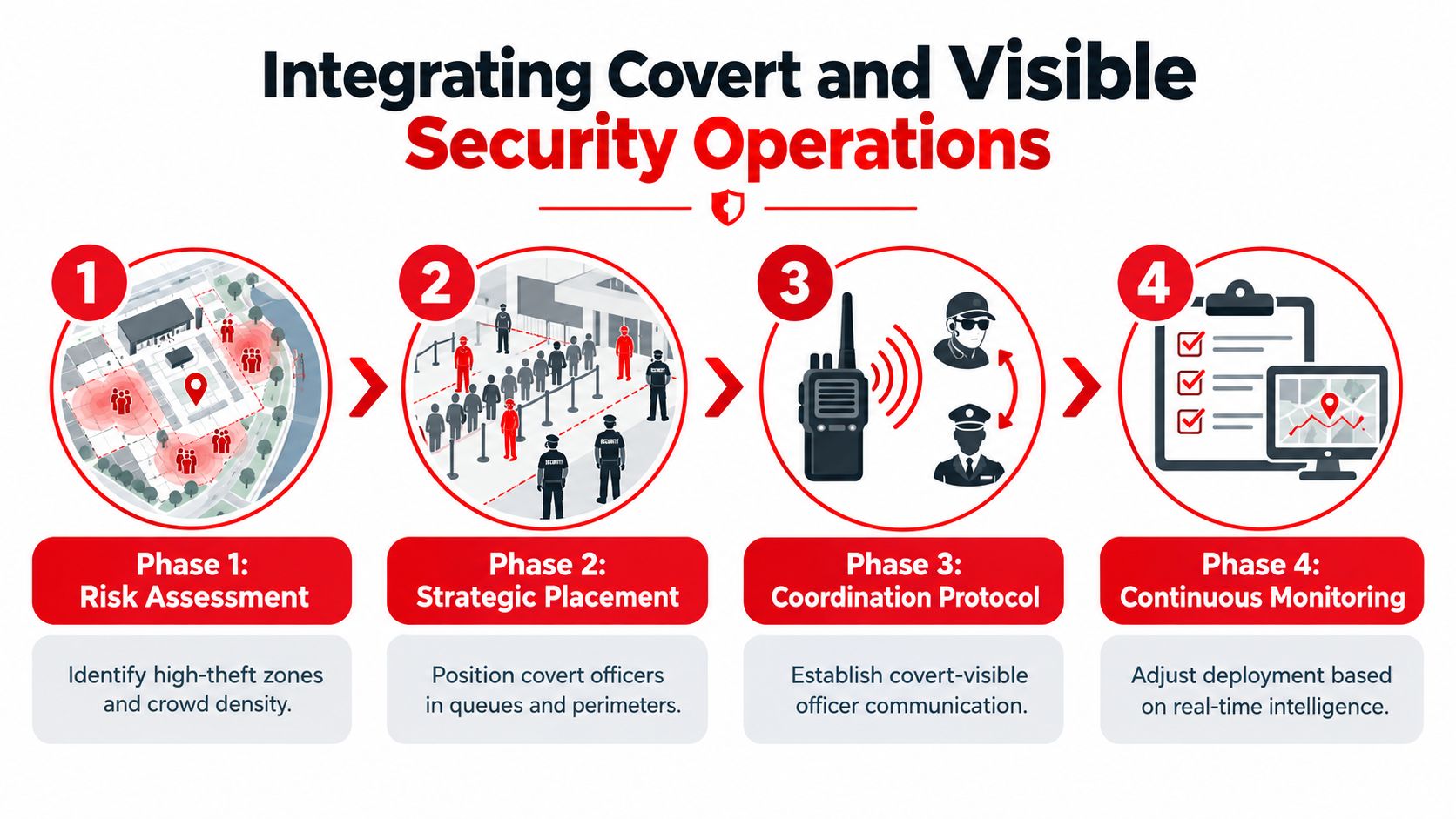
Phase one, risk assessment. Translate complaints and incident history into locations and behaviours. “Monitor theft” is too broad. “Observe bag handling near the north food queue and report repeated distraction behaviour” gives the officer a usable task.
Phase two, strategic placement. Position covert personnel where they can observe without obstructing patrons or creating confrontations. Queues, perimeter approaches and repeat-problem areas may be suitable, but the deployment must account for lighting, exits, radio coverage and safe withdrawal.
Phase three, communication protocol. Use neutral identifiers, agreed escalation words and a named supervisor. A covert officer should be able to report an observation without broadcasting a description that reveals their position. The visible team needs enough information to respond, not a stream of unfiltered suspicion.
Phase four, continuous monitoring. Supervisors should adjust coverage when crowd movement, weather, programming or incident patterns change. The post-event review should compare the tasking sheet with actual observations, interventions and handovers.
Queensland's high-risk event guidance requires seven licensed crowd controllers for the first 1,000 patrons plus at least one additional controller for every 250 patrons, or part thereof, unless another number is determined. It also requires at least two licensed crowd controllers to maintain surveillance outside the event area for one hour after the event ends or until patrons have left the vicinity, according to the Queensland high-risk event guidance.
A covert officer supplements that framework. They don't replace the mandated crowd controllers. For example, at a high-risk event with 1,251 patrons, the stated baseline is seven controllers for the first 1,000 and one additional controller for the next 250 or part thereof. The external-surveillance requirement still applies after the event.
State-by-State Licensing Differences for Multi-Venue Events
A touring promoter can't copy one covert-security plan from Sydney to Melbourne, Brisbane and Canberra. The same job title may sit beside different licensing, identification, surveillance and staffing requirements.
NSW and Victoria
NSW allows an unarmed licensed operator to work without a uniform, but the original licence must be displayed at or above waist level. Armed operators generally require a recognisable uniform unless a written exemption applies. The organiser should record the role, licence category, supervisor and identification method before the shift.
Victoria changed the framework effective 19 June 2025. All private-security activities became licensed activities, and affected workers or businesses had to transition from prior registrations to a Private Security Individual Operator Licence, Business Licence, or both, according to Victoria Police guidance on private-security changes. The framework includes investigators, bodyguards, crowd controllers and security guards. A contractor who worked under an older registration arrangement needs checking against the current Victorian requirements.
Queensland and the ACT
Queensland identifies licensed functions including security officer, crowd controller and private investigator under the Security Providers Act 1993. For venues trading after 1 a.m. in the Brisbane City Council area, security surveillance must operate from 11 p.m. on trading nights and for at least one hour after closing, including the 30-minute grace period that begins at closing. Security staff must be licensed, distinguishable from the crowd and RSA-trained for venues in that area, according to Queensland licensed-venue guidance.
The same guidance sets crowd-controller numbers by patron count. A venue with 401 to 500 patrons must roster at least five crowd controllers, and above 500 patrons one additional controller is required for every 250 patrons or part thereof. Employing unlicensed crowd controllers can attract a first-offence fine of up to $17,270.
The ACT requires particular care where workplace surveillance is involved. A promoter operating across jurisdictions should maintain a matrix covering:
- Licence class: Confirm the authorisation for the actual task.
- Business arrangement: Check the employing or subcontracting entity.
- Identification: Record uniform, licence-display and client-verification procedures.
- Surveillance method: Separate human observation from recording or tracking.
- Reporting: Use the local incident and disclosure process.
Implementation Checklist for Event Organisers
Good covert deployment starts before the officer arrives. The provider should be able to explain the objective, licence basis, supervision model, communication method and evidence controls without vague language.
Six checks before opening
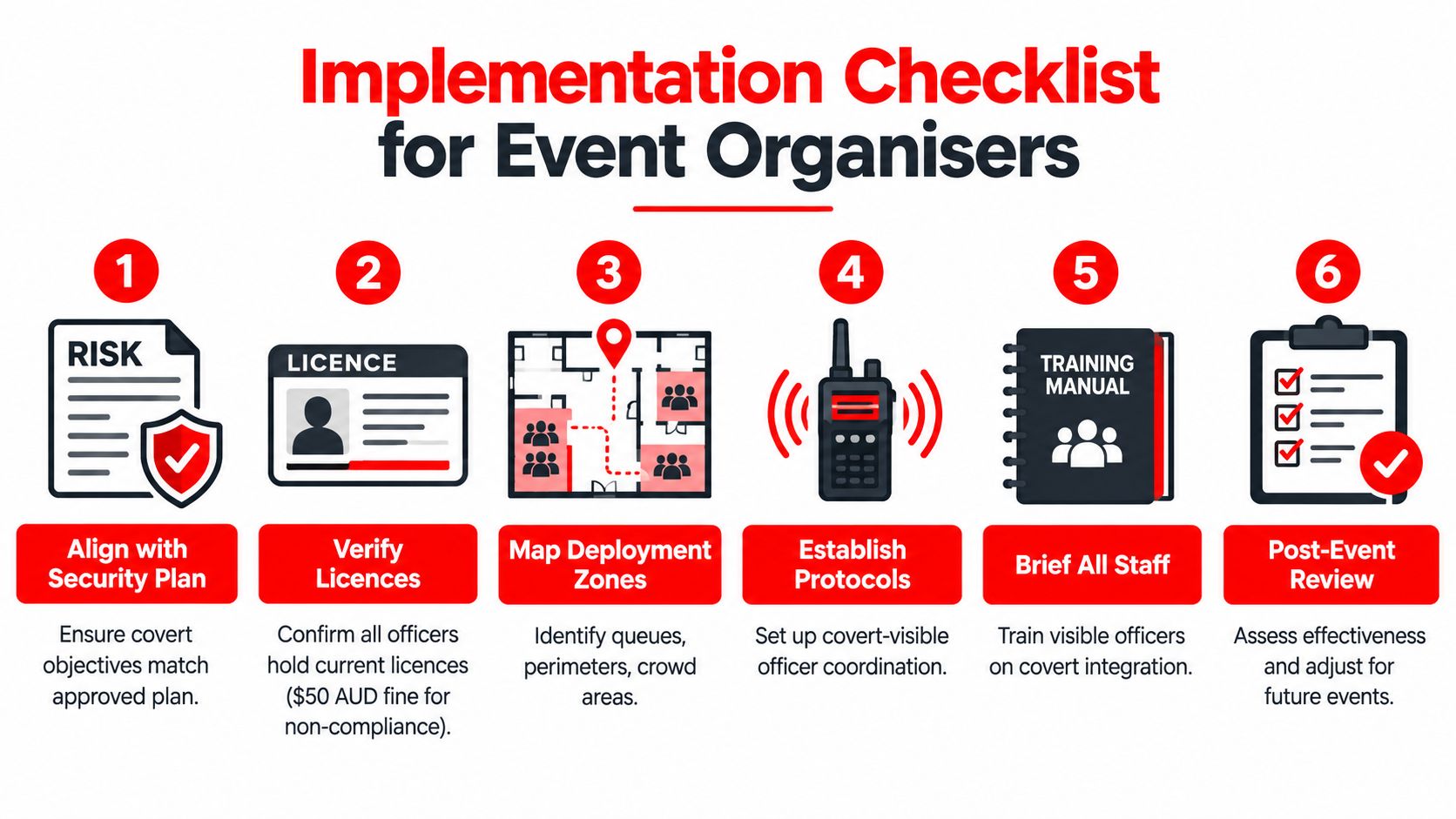
Align with the security plan. State the problem the covert officer is addressing, where they will work and what outcome the supervisor needs. Don't add an informal observer outside the approved risk assessment.
Verify licences. Check identity, licence status, class, state or territory authority and the assigned role. Keep the verification record with the event file.
Map deployment zones. Mark queues, perimeters, crowd areas, restricted doors and safe meeting points. Give the officer a workable route rather than a vague instruction to “keep an eye out.”
Establish protocols. Set radio identifiers, escalation words, emergency contacts and handover points. Test communication before patrons enter.
Brief all staff. Uniformed officers need to know how to recognise and support the covert team without exposing them unnecessarily. Venue managers also need a client-facing verification process.
Review after the event. Record observations, interventions, referrals to police, evidence handling and gaps in the plan. Use the findings to adjust the next deployment.
Ask providers whether the covert security officer will have a named supervisor, whether tasking sheets are issued, how incidents are logged, who can access evidence and how the team coordinates with police. Also ask whether the proposed deployment is additional to mandated crowd-control staffing.
A practical provider may offer several options, from discreet loss prevention to visible guards, K9 teams, patrols or risk assessments. GM GROUP Services provides covert operations in which discreet officers observe conduct, identify patterns and gather evidence for issues such as suspected employee or customer theft, refund fraud, stock concealment and collusion.
Frequently Asked Questions About Covert Security
Can a covert officer intervene?
Yes, where the intervention is lawful, proportionate and within the officer's authorised function. In practice, the officer will often report first and request visible support, particularly where intervention could expose the operation or increase risk.
How do covert officers work with police?
They should report suspected offences and immediate safety threats through the event supervisor and escalate to police. They mustn't imply that they're law-enforcement officers or claim powers they don't hold.
What training matters?
The officer needs the relevant state or territory licence, role-specific briefing, incident-reporting skills, communication training and instruction on evidence and privacy controls. A licence alone doesn't authorise every task.
Do RSA rules apply?
Yes, if the officer serves liquor. In NSW, RSA certification is mandatory for anyone serving liquor at an event, including security staff performing that function.
Can covert deployment replace visible security?
No. Queensland high-risk event and licensed-venue requirements still apply, and covert personnel should be treated as supplementary unless the regulator confirms otherwise.
GM GROUP Services can help event organisers, venues and businesses design licensed covert and visible deployments across NSW, Victoria, Queensland and the ACT, with supervision, reporting and risk-assessment support. Visit GM GROUP Services to discuss a compliant plan matched to your venue, audience and operating environment.
Discover more from GM Group Services
Subscribe to get the latest posts sent to your email.