
Corporate security services are often purchased after a problem has already appeared. A facility manager may have guards at the lobby, a contractor watching the gatehouse and cameras recording activity, yet discover during an evacuation that nobody knows who controls access, who contacts emergency services or how an incident report reaches the business continuity team. The visible presence exists, but the operating model is fragmented.
That gap matters for offices, venues, festivals, construction sites and retail environments. A capable provider should help protect people and property while supporting access control, incident response, customer service, compliance and operational resilience. The right question isn't merely how many guard hours you need. It's what combination of people, supervision, technology and procedures will reduce risk without creating new weaknesses.
Redefining Corporate Security Services for Modern Workplaces
A corporate security program fails when the guard is treated as a standalone product. Consider a multi-tenant office tower with a reception guard, electronic access control and a back-of-house loading dock. During a medical emergency, the guard may be the first person to respond, but if the building manager, facilities team and monitoring centre haven't agreed on escalation procedures, the response becomes improvised. A later access breach can be harder to investigate if patrol findings, visitor records and camera alerts sit in separate systems.
Corporate security services should operate as a risk management function, not merely as a physical deterrent. A guard can welcome visitors, identify unusual behaviour, manage contractors and coordinate an evacuation. A patrol officer can identify an unsecured plant room before it becomes an easy entry point. A supervisor can spot recurring failures in handover notes and adjust deployment rather than accepting them as routine.
The Australian market is substantial and highly regulated. ASIAL reports more than 180,000 people employed in the private security industry, including more than 153,000 licensed security personnel, and describes the industry as larger than Australia's police and defence forces combined. Its 2025 report also records more than 200,000 workers overall, including 167,530 licensed security personnel and 13,220 licensed security firms, based on the report's stated figures. These figures show why procurement decisions need to account for licensing, supervision and service consistency, not just availability. ASIAL's 2025 Security Industry Report provides the sector context.
What modern protection should achieve
A mature program normally combines:
- Visible deterrence, using appropriately presented personnel, controlled access and patrol activity.
- Early intervention, through risk assessments, observation, reporting and escalation.
- Operational coordination, connecting guards with facilities, emergency management, HR and IT contacts.
- Service-aware protection, so reception, concierge and event teams protect the customer experience rather than creating unnecessary friction.
- Evidence-based improvement, using incident reports, access records and supervisor reviews to refine deployment.
The trade-off is straightforward. A low-cost static post may appear efficient, but it can leave gaps around mobile response, supervision and emergency coordination. A layered model costs more to design, yet it gives the client a clearer connection between daily activity and business risk.
Practical rule: Buy an operating outcome, not a roster of people. Define what the team must prevent, notice, report and support before discussing hourly rates.
Core Corporate Security Services and Deployment Models
Start by mapping the site, people, operating hours and likely incidents. A premium office tower needs a different deployment from a construction project, a festival or a distribution facility. The following service types can be combined, but they shouldn't be ordered by habit.
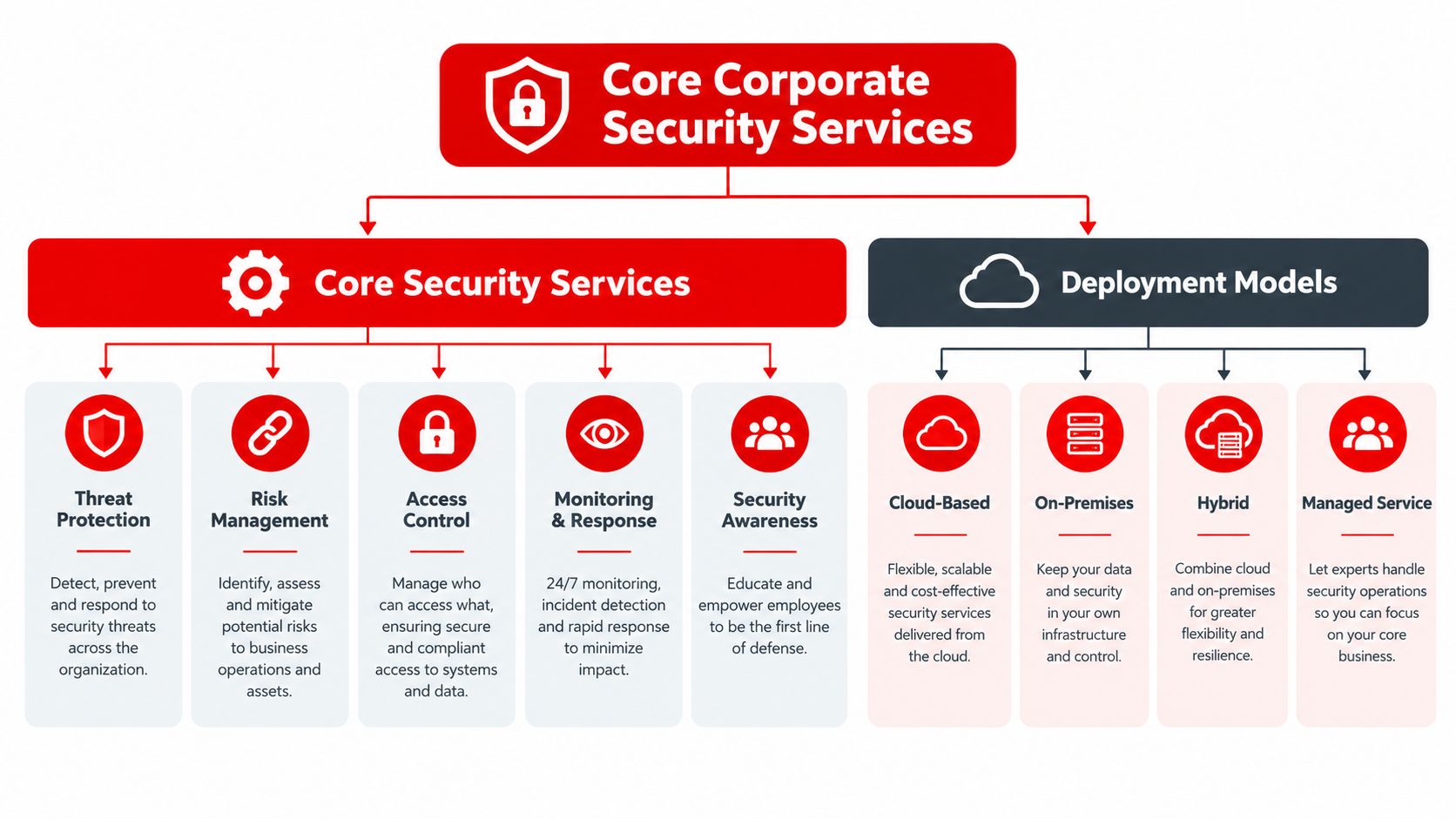
Match each role to the operational problem
Static guards suit reception desks, staff entrances, control points and sensitive internal areas. Their value increases when the brief includes visitor management, contractor sign-in, key control, alarm response and clear reporting. A guard positioned at a lobby shouldn't be expected to abandon the desk for every minor issue without a relief or escalation plan.
Concierge-trained security officers are appropriate for corporate offices, hotels and premium venues where security and hospitality overlap. They can manage deliveries, provide directions, challenge unauthorised access and support executives while maintaining a professional tone. A crowd-control profile may be properly licensed yet poorly suited to a client-facing reception environment.
Gatehouse and access-control teams verify vehicles, deliveries, inductions and credentials. Construction and industrial sites often need stronger control of plant, after-hours access and contractor movement. The brief should state what records the officer maintains and who can authorise an exception.
Mobile and foot patrols cover blind spots that a static post cannot reach. Use scheduled and randomised patrols around perimeters, car parks, plant rooms and storage areas, with findings recorded in a system that supervisors review.
For sites where theft, intrusion or hazardous materials are a concern, K9 units and handlers may be appropriate. They require a defined purpose, suitable terrain, welfare arrangements and handlers with the right competency. They aren't a universal substitute for lighting, access control or competent site management.
Add the response layer
Back-to-base monitoring can provide human review of alarms and camera events, while an emergency response team can attend when a site needs immediate support. Risk assessments should identify likely scenarios, escalation contacts, safe operating procedures and handover requirements before the first shift begins.
Technology also needs to fit the physical environment. A Queensland client reviewing cameras, storage and maintenance requirements may find this CCTV installation guide Queensland useful when separating equipment decisions from guard deployment.
For events, combine entry screening, crowd controllers, backstage access, vehicle movements, incident response and close communication with venue management. The strongest brief states where each function starts and ends. That prevents the common failure where every officer assumes another team is handling the loading dock, staff entrance or emergency access lane.
Navigating Australian Licensing and Compliance Requirements
A security licence isn't a universal qualification for every task. Procurement teams need to verify the state, activity, licence class, training pathway, expiry status and any role-specific evidence before approving a roster.
Victoria illustrates the issue clearly. The regulator accepts approved Registered Training Organisation delivery completed within the previous 12 months. The unarmed guard, crowd control and control room pathway is CPP20218 Certificate II in Security Operations, which requires 130 hours of training. Guarding with a dog follows the separate CPP31318 pathway, requiring 157 hours. These requirements mean a client shouldn't accept a generic statement that every proposed officer is “licensed”. The role and the evidence must match. Victoria Police's private security eligibility requirements explains the relevant pathways.
Build a state-specific verification process
In NSW, anyone undertaking a security activity must hold the appropriate licence. RSA certification is also mandatory for anyone serving liquor at an event, including volunteers and security staff working at the venue. A Sydney festival promoter using crowd controllers and bar-area staff should therefore maintain two separate checks before doors open:
- Security activity licence verification, covering the work each person will perform.
- RSA verification, covering anyone who will serve alcohol.
The distinction matters because a security licence doesn't replace RSA certification. The NSW event safety and security guidance sets out this connection between event staffing and liquor service.
Queensland has a different operational pathway. A person generally needs a Queensland security licence to work as a security provider, while short-term work may be covered by a temporary interstate permit. Interstate and New Zealand licence holders can also apply to transfer through mutual recognition. Separate short-term event cover from ongoing contract cover when planning rosters, then use the appropriate Queensland process for each. The Queensland security licence transfer guidance is a useful reference for that distinction.
Make compliance part of the contract
Ask providers to submit licence details, training evidence, expiry dates, role allocation and replacement procedures. Include an obligation to notify the client when an officer's evidence changes, and require approval before substituting personnel on high-risk posts.
For a practical perspective on organising evidence, audits and renewal workflows, Vigil Security's compliance management guidance offers a useful operational reference. Compliance shouldn't live in a spreadsheet that nobody checks after mobilisation. Supervisors need a current roster view, and clients need an auditable record.
Bridging Physical Guarding with Business Continuity Planning
A physical incident can become a technology, legal or reputational incident within minutes. An unauthorised visitor may access a restricted office, photograph a screen, remove a device or disrupt a critical meeting. A forced door at a data room may be a facilities issue, but it can also signal a wider compromise. Guards don't replace IT, cyber security or risk teams, but they can provide the observations and first actions those teams need.
Physical and digital resilience should connect through defined workflows. A patrol finding can enter the same risk register as an access-control exception. A suspicious badge event can trigger a facilities check, an HR notification or an IT review, depending on the agreed scenario. An incident report should capture time, location, people involved, actions taken and outstanding risks without asking guards to make technical conclusions outside their role.
Coordinate without duplicating internal teams
The provider's role is to detect, preserve information, escalate and support safe operations. IT retains responsibility for systems, accounts and cyber controls. HR handles employee matters. Business continuity leaders coordinate recovery priorities. The security manager makes sure those responsibilities meet at the site level.
That division works best when the contract includes:
- Named escalation contacts, with primary and backup details.
- Severity categories, so a lost pass doesn't receive the same response as a forced entry.
- Evidence handling rules, covering access logs, CCTV requests and incident notes.
- Joint exercises, testing who acts when physical and digital warning signs appear together.
- Recovery support, including access management, site reopening and welfare considerations.
Australia's information security market reflects this need for coordination. Datacom forecasts security services spending above AU$3.7 billion in 2026 and total information security spending above AU$7.5 billion in 2026, while reporting that only around one-third of Australian organisations have a tested business continuity or cyber incident response plan. These are projections and survey findings presented in Datacom's Cybersecurity Index 2026, not a reason to turn guards into cyber specialists.
The practical answer to the buyer's question, “How can one provider support physical and digital resilience without duplicating IT?” is to make the interfaces explicit. Security officers observe and control the physical environment. IT protects systems. Both teams share escalation rules and relevant evidence.
Evaluating Service Levels and Staffing Reliability
A provider can present a polished proposal and still struggle to fill a difficult Saturday-night shift, cover first aid or maintain the same standard across several sites. Staffing reliability deserves the same scrutiny as equipment and insurance.
Australian reporting describes a tighter security workforce since 2023, including shortages of currently licensed guards, first-aid coverage and reliable attendance. It also reports rising client expectations around transparency and renewal evidence. The operational implication is clear: ask how the provider recruits, verifies, supervises and replaces people before accepting a low rate. Security Time's workforce management analysis provides context for these labour and compliance pressures.
Compare the service models
A basic guarding contract usually pays for presence at an agreed post. A managed security partnership adds supervision, reporting, risk reviews, escalation ownership and performance improvement. Neither model is automatically right, but the first is risky when the site has multiple entrances, changing schedules or consequences that extend beyond the property.
| SLA Metric | Basic Guarding Contract | Managed Security Partnership |
|---|---|---|
| Attendance | Officer attends the scheduled post | Attendance is monitored, with a documented replacement process |
| Supervision | Occasional manager contact | Planned site supervision, shift checks and client reviews |
| Incident response | Officer follows a general procedure | Scenario-specific escalation, reporting and review |
| Training | Licence evidence at onboarding | Role matching, refresher evidence and ongoing competency checks |
| Reporting | Shift notes supplied on request | Structured reports, trend review and corrective actions |
| Scaling | Extra hours requested separately | Surge capacity and mobilisation rules agreed in advance |
Write measurable service expectations
An SLA should define response categories, escalation timeframes, reporting deadlines, supervisor availability and the process for missed shifts. If the site requires first-aid coverage, state that requirement directly rather than assuming every officer provides it. If the client needs a particular uniform standard or customer-service profile, include an approval process for key posts.
Ask for evidence of workforce management, not a generic promise of capacity. Useful questions include:
- Roster resilience: How are absences covered without sending an unverified replacement?
- Multi-site control: Who sees staffing gaps across NSW, VIC, QLD and the ACT?
- Supervision: Which manager attends the site, how often and with what records?
- Training visibility: How does the provider prevent expired or mismatched evidence from reaching the roster?
- Peak demand: What happens when an event, construction deadline or unexpected incident creates simultaneous demand?
A strong contract also includes service credits, corrective action and termination rights for repeated failures. Those provisions only work when the client measures performance consistently.
How to Select and Contract the Right Security Provider
Begin with a site-specific RFP, not a request for “security guards”. Describe the environment, operating hours, access points, customer expectations, known incidents, emergency arrangements and required records. Ask suppliers to explain their deployment logic so you can compare like with like.
Use an evidence-led procurement sequence
- Define the risk picture. Identify people, assets, processes and locations that need protection.
- Separate duties. Distinguish reception, gatehouse, patrol, event, monitoring and response functions.
- Set the service standard. Specify presentation, communication, reporting, supervision and escalation requirements.
- Request role-matched personnel. Require evidence that proposed officers suit the environment, not merely that they hold a licence.
- Test the operating model. Ask for a sample roster, escalation flow, handover record and incident report.
- Verify capacity. Review recruitment, relief staffing, training records and multi-site supervision.
- Run a mobilisation plan. Include site induction, contact lists, access permissions, uniforms and scenario briefings.
- Review performance. Schedule formal reviews, incident trend analysis and changes to deployment.
Test culture as well as capability
Ask shortlisted providers to walk the site with facilities, HR, event operations and IT representatives. A provider that only discusses posts and patrols may miss the client experience, while one that only discusses technology may overlook human judgement and response discipline.
Uniform presentation matters at a hotel or conference centre, just as clear authority matters at a construction gate. The right officer for a premium office may be calm, articulate and comfortable managing visitors. The right officer for a high-risk perimeter may need different experience, equipment and physical deployment. Fit-for-purpose selection protects both safety and brand reputation.
Pricing should be transparent about supervision, travel, relief coverage, monitoring, equipment, public holidays and emergency call-outs. A low hourly price can become expensive when the client must solve every absence, report failure and escalation issue internally.
Include a change-control process for new sites, seasonal events and altered operating hours. Require the provider to explain how it will scale without weakening licensing checks or supervision. In Australia, licence numbers have expanded, but supply still needs local validation. ASIAL recorded individual licence growth of 10.5%, reaching 162,535 at 31 December 2023, and reported growth in security firm licence holders of 10.3% in its 2024 report. Victoria added 4,087 individual licence holders and Queensland added 2,815, according to ASIAL's 2024 Licensing Report. Those figures indicate sector depth, but they don't prove that a particular provider can cover your sites.
Common Corporate Security Misconceptions and FAQ
The most expensive misconception is that a licence makes every officer interchangeable. Licensing establishes eligibility for defined activities. It doesn't automatically demonstrate concierge skills, de-escalation ability, report writing, event judgement, first-aid coverage or experience in a sensitive corporate environment.
Is the cheapest hourly rate the best option?
Not usually. Compare the total operating model, including supervision, relief staffing, training evidence, monitoring, reporting and response capability. A basic post may be suitable for a low-complexity site, but it isn't a substitute for managed coverage where several functions must work together.
How should a multi-state event handle licensing?
Treat each state as its own compliance workstream. Verify the relevant licence for NSW, Victoria, Queensland or the ACT, then check whether a temporary permit or mutual-recognition pathway applies. In Queensland, ongoing work and short-term interstate cover follow different operational routes, so a Brisbane contract shouldn't rely on an informal assumption that an interstate officer can work immediately.
Can security staff support HR and IT without taking over their jobs?
Yes, if the responsibilities are documented. Security can manage physical access, preserve observations, record incidents and escalate according to agreed thresholds. HR and IT should retain ownership of employee matters, accounts, systems and technical investigation.
What should the provider's insurance cover?
Ask for current certificates and policy details relevant to the work, including public liability, workers compensation and any professional or motor cover needed for the deployment. Check limits, exclusions, subcontractor arrangements and whether the policy matches events, patrols, K9 work, construction environments or vehicle operations. Your broker and legal adviser should confirm whether the proposed cover is adequate for the actual contract.
Does technology replace guards?
No. Cameras, access systems and monitoring can improve detection and evidence, but people still interpret situations, speak with visitors, manage conflict and coordinate immediate action. Technology is most useful when a trained team knows what an alert means and what happens next.
GM GROUP Services provides licensed static guards, K9 units, patrols, gatehouse control, monitoring, emergency response and risk assessments across NSW, VIC, QLD and the ACT, with deployment matched to the site and its operating demands. If your organisation needs a practical security plan that connects staffing, compliance and resilience, visit GM GROUP Services to discuss the right model for your workplace, venue or event.
Discover more from GM Group Services
Subscribe to get the latest posts sent to your email.