
SEO Title: 9 Critical Compliance Documentation Mistakes Australian Security Managers Must Avoid
Meta Description: Compliance documentation protects events, venues, and sites from audit failures, licensing issues, and operational disruption. Learn the practical systems Australian managers need.
URL Slug: /compliance-documentation-australia
Compliance documentation is the first thing that gets tested when a regulator, client representative, police liaison, or insurer asks a simple question on a busy day: “Show me who is on site, what they're licensed to do, and where the records are.”
If you manage a festival, licensed venue, construction site, retail precinct, or corporate event in Australia, you've probably been there. Gates are open. Contractors are rotating through. A patron incident has just been escalated. Someone asks for the guard roster, the incident report, the site risk assessment, the RSA evidence, and proof that the people on shift completed the required training. If those records are current and accessible, the conversation stays controlled. If they're scattered across inboxes, old folders, and a supervisor's phone, the site starts to wobble fast.
That's why compliance documentation can't be treated as back-office admin. In security operations, it's operational control in written form. It proves licence currency, deployment authority, incident handling, training completion, and the fact that management knew the risks and acted on them. It also matters more in short-term and multi-state work than most generic guides admit. A festival pack-up, a pop-up activation, or a last-minute venue extension creates failure points that a static office checklist won't catch.
The burden is real. In Australia, businesses have faced an average compliance load of approximately 427,000 hours per annum over the past five years, with small businesses accounting for about 180,000 hours annually, according to the Australian Bureau of Statistics submission to the Productivity Commission. That load has reduced by 34% compared with the 1995–96 baseline, but the volume is still significant. For security operators, a large share of that time sits in records, registers, certifications, logs, and proof trails.
Introduction to Security Compliance Documentation
Security compliance documentation starts before the first guard signs on. It begins when the job is scoped, the risks are assessed, the roles are allocated, and the client's operating conditions are translated into something staff can follow.
For event and venue managers, the trap is thinking documentation only matters if an audit is scheduled. It doesn't. It matters when a subcontractor turns up with the wrong licence class. It matters when alcohol service conditions change during an event. It matters when a patron complaint becomes a police matter and everyone suddenly wants timestamps, names, and actions.
What compliance documentation means on the ground
In a security context, compliance documentation is the working record set that proves your operation is lawful, current, and controlled. It usually covers:
- Licensing records for the security business and each deployed officer
- Training evidence such as induction records, refreshers, and site-specific briefings
- Deployment records including rosters, sign-on sheets, and supervision allocations
- Risk and incident records that show hazards were identified and events were handled properly
- Client and regulatory records tied to liquor, safety, privacy, subcontracting, or defence-related requirements
Short-term deployments make this harder, not easier. Temporary sites create constant document movement. Staff change mid-shift. Radios are handed over. Revised traffic plans appear after bump-in. A paper folder sitting in a site office doesn't solve that.
Practical rule: If a document can't be found during a live operation, you should assume it doesn't exist for compliance purposes.
Why the usual checklist often fails
Most compliance guidance is written for fixed workplaces. Event security doesn't work like that. Australian guidance has identified compliance documentation for dynamic, short-term security deployments as a gap, especially for festivals, concerts, construction sites, rotating teams, version-controlled training matrices, incident-specific reviews, and owner clarity during shift changes, as outlined in this Australian compliance audit checklist discussion.
That gap is exactly where site managers get exposed. Not because they don't care, but because the paperwork model often doesn't match the operating model.
The Foundation of Modern Security Operations
A professional security operation runs on documents the same way a building runs on a blueprint. Without the blueprint, trades start making assumptions. On a site, assumptions become gaps. In security, gaps become incidents, breaches, and client disputes.

Legal protection starts with records
When something goes wrong, nobody remembers events in exactly the same order. That's normal. What matters is whether your records show who was deployed, what authority they had, what they were told, and what they did.
A clean incident log, a signed briefing sheet, and a current training record can do more than any post-incident explanation. They establish that the operation was organised, supervised, and managed with due care. Without that paper trail, even a competent response can look improvised.
Operations stay consistent when documents are current
Managers often focus on having the right policy. The harder part is making sure the current version is the one people use.
That's where many operations break down. One supervisor prints a crowd management procedure from last month. Another sends a newer version by text. Casual staff get a verbal briefing only. By the time an incident occurs, there's no single trusted record of what instructions applied.
A solid document framework fixes this by locking down:
- Version control so staff use the latest approved material
- Role clarity so each person knows who approves, updates, and distributes records
- Access control so supervisors can retrieve current files during the shift, not after it
A security team without current documentation is usually relying on memory, habit, and goodwill. That's not a system.
Documentation proves professionalism to clients
Clients don't just buy manpower. They buy confidence that the operation will stand up if checked.
A venue owner wants to know the guards are properly licensed. A construction manager wants evidence that inductions were completed. An event promoter wants incident reporting that won't leave them exposed in a post-event review. Good documentation answers those concerns before they become arguments.
The same principle applies in government and defence-adjacent work. Contractors in that space must maintain documented security governance, including a DISP Security Plan, an Insider Threat Mitigation Strategy aligned to the Essential Eight, and approved supporting plans such as an SRMP and IRP, with annual review expectations and audit-linked documentation requirements explained in this DISP FAQ guide.
Nine Essential Types of Compliance Documentation
The fastest way to test your operation is simple. Ask whether you could produce each of the nine documents below, in current form, while the site is live.
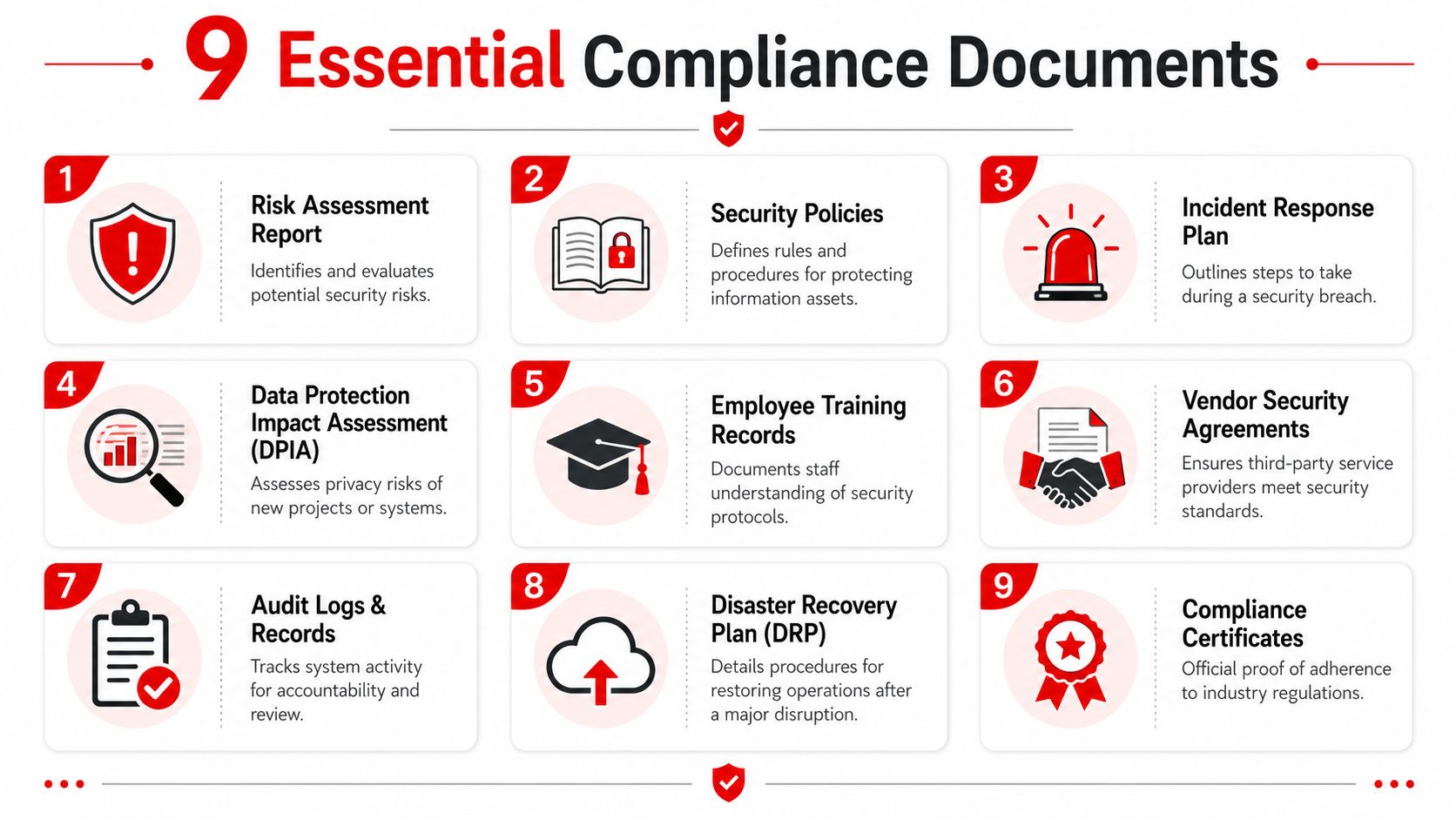
Compliance documentation checklist for live security environments
Security business and individual licence records
You need proof that the company and every deployed officer hold the right current authority for the work being performed. This is the first document class regulators and clients ask for.Site-specific risk assessments
A generic risk template isn't enough for a festival gate, a late-night club, or a live construction zone. The assessment has to reflect the actual hazards, access points, crowd profile, and escalation pathways for that site.Deployment rosters and sign-on records
These show who was on duty, when they started, where they were posted, and who supervised them. If an incident is reviewed later, this record anchors everything else.Training and induction records
Keep evidence of site induction, emergency briefing, role-specific instruction, and any refresher activity. If staff were briefed verbally but nothing was recorded, you have a gap.RSA and related venue competency records
For hospitality and event work, supervisors need a reliable way to confirm current alcohol-related competency records where required by the site conditions and role.
The records managers forget until an incident happens
Incident report logs
These should record facts, actions, times, witnesses, and escalation details clearly. A weak incident report usually fails in exactly the moments it matters most, such as insurer reviews, police follow-up, or client complaints.Emergency and incident response plans
Your response plan should match the site, not just the company template. Evacuation points, command structure, medical escalation, and communication paths should be obvious and current.Subcontractor due diligence files
If you use labour hire or subcontracted security staff, keep records showing licence checks, role suitability, and who approved deployment. Many mixed-workforce operations often get exposed through deficiencies in this area.Policy acknowledgement records
Having the policy isn't enough. You need evidence that workers received it, understood it, and acknowledged it. The gap between policy issue and employee acknowledgement is a known compliance weakness, especially for contractors, casuals, and remote staff, as discussed in Sentrient's guide to digital policy acknowledgement.
Field advice: If you run rotating crews, treat acknowledgement records the same way you treat licences. Current, attributable, and easy to retrieve.
For managers who also handle broader workforce obligations across jurisdictions, this Irish HR compliance checklist 2026 is useful as a comparison point. It's not Australian security guidance, but it's a good reminder that compliance failures often begin in onboarding, role allocation, and record ownership long before an audit starts.
Navigating State-Specific Security Regulations
Multi-state operators get into trouble when they assume one compliance pack covers every venue. It doesn't. The core disciplines are similar, but the documentation trigger points differ enough that a copied process can leave you exposed.
State-Specific Compliance Documentation at a Glance
| Requirement | NSW | VIC | QLD | ACT |
|---|---|---|---|---|
| Security licence verification | Must be current and matched to the role performed on site | Must be current and supported by the state's specific documentary requirements | Must be current and checked against role and venue conditions | Must be current and tied to deployment authority |
| Event and venue deployment records | Keep site rosters, sign-on records, incident logs, and briefing records current and accessible | Same core records required, with tighter documentary proof expectations for regulated security work | Same core records, especially where liquor and event conditions apply | Same core records, particularly for mixed public-facing and government-adjacent sites |
| State-specific documentary submission | Site and client requirements often drive format and accessibility | Approved Security Industry Organisation checklist with verified attachments must be submitted to the Licensing and Regulation Division to prove licence currency and adherence to the Private Security Act 2004, according to this Victorian compliance governance guidance | Venue and liquor-related record keeping often becomes a practical focus for operational compliance | Documentation expectations are often shaped by public sector and high-accountability operating environments |
| Short-term staff control | Strong version control needed for changing event conditions | Strong version control plus clear licence-class matching in records | Strong version control where transient staff and venue obligations overlap | Strong version control for site access, rosters, and incident escalation |
| Subcontractor evidence trail | Required in practice to show due diligence | Explicitly important because documentation must prove obligations are being met | Required in practice, especially on fast-moving events and construction sites | Required in practice where multiple contractors share a site |
What changes in practice across states
Victoria is the clearest example of why a generic national pack can fail. If you operate there, the ASIO checklist with verified attachments isn't optional paperwork. It's part of the evidentiary framework used to confirm licence currency and compliance.
In NSW, QLD, and the ACT, the practical challenge is often less about one named form and more about making sure the right records are available at the point of inspection. That matters on event days because compliance checks don't wait for head office to open.
A workable approach is to build one national document structure, then add state modules for licensing, venue conditions, and local record expectations. Don't build four separate systems if one controlled framework can do the job. But don't pretend the differences don't matter either.
Best Practices for Flawless Document Management
Most compliance failures don't happen because a manager refused to keep records. They happen because the record system was fragile. Files sat in too many places. Reviews were irregular. Nobody owned the final version. Old forms stayed in circulation because they were easier to find than the current ones.

Build a living system, not a filing cabinet
Good compliance documentation has a lifecycle. Someone creates it. Someone approves it. Someone stores it in the right place. Someone reviews it after a change or incident. If any one of those steps is vague, the system starts drifting.
Use a central platform with controlled permissions. That can be a dedicated compliance tool, a well-structured cloud document environment, or another managed system your team can use on shift. What doesn't work is a mix of email attachments, local desktop copies, and paper binders no one updates.
Focus on acknowledgement, review, and audit readiness
The biggest blind spot I see is proof of acknowledgement. Teams often keep excellent policies and weak evidence that workers ever saw them.
A stronger process looks like this:
- Assign ownership clearly so every core document has one accountable owner
- Set review triggers after incidents, scope changes, venue condition changes, or system changes
- Capture acknowledgement digitally for staff, contractors, and casual workers
- Make retrieval fast so supervisors can produce records during live operations
- Audit internally before a regulator or client does it for you
That last point matters. Australian audit evidence has shown that businesses receiving one of three audit types had a 30 to 42 percent reduction in non-compliance compared with a control group, according to the Australian Government report on building persistent compliance. In practical terms, audits work because they force record gaps into the open before those gaps become enforcement issues.
Don't treat an internal audit as a box-ticking exercise. Treat it as a rehearsal for the worst day on site.
For managers handling equipment disposal, data-bearing devices, or secure asset chains, the discipline is similar. This guide to ITAD compliance documentation is a useful example of how chain-of-custody records, approvals, and movement logs should be documented when accountability matters.
Digital or paper
A fully digital system can work well if it is structured, backed up, permission-controlled, and accessible when the site is active. Paper still has a place for immediate contingencies, sign-on support, or fallback access. The mistake is relying entirely on paper for a rotating workforce, or relying entirely on digital files that nobody on site can open when connectivity drops.
The best model for most event and venue operations is digital-first, with controlled offline contingencies for critical records.
How GM GROUP Services Integrates Compliance into Delivery
A serious security provider doesn't bolt compliance on after the roster is filled. It builds compliance documentation into the way work is accepted, assigned, supervised, and closed out.

Compliance documentation that supports live operations
In practical terms, that means guards aren't just allocated because they're available. They're matched to the site, the role, and the licensing and training requirements attached to that environment. Event work, licensed venues, construction sites, and corporate functions all need different record sets and different supervision habits.
For a client, that changes the experience completely. Instead of chasing scattered paperwork, they receive an operation where the compliance layer is already tied to deployment. The roster connects to verified personnel records. The site brief connects to current procedures. The incident process produces records that are usable after the shift, not just written to satisfy formality.
Why integrated systems matter
This matters most on fast-moving jobs. A festival can change operating conditions several times in a day. A venue can escalate from routine service to incident-heavy trading in an hour. A construction site can alter access points without much notice. If the provider's document process depends on manual catch-up later, the records won't reflect reality.
Integrated compliance documentation supports:
- Verified guard allocation
- Current training visibility
- Cleaner incident reporting
- Better supervision trails
- Faster client reporting after an event or site issue
That's the difference between hiring bodies and engaging a managed operation. The paperwork is not separate from the service. In a well-run security environment, it's one of the ways the service proves it did the job properly.
Frequently Asked Questions About Compliance Documentation
What happens if documentation is missing during a major incident
The immediate problem is loss of control. You may struggle to prove who was on site, what authority they had, what briefing they received, and how the response unfolded. That weakens your position with clients, insurers, investigators, and regulators.
Can we keep all compliance documentation digitally
Yes, provided the system is secure, controlled, backed up, and accessible during operations. A digital system is often the better option for mobile and short-term deployments. Keep fallback access for critical records in case devices fail or connectivity is interrupted.
What records are most often missing on event jobs
Usually it's not the headline documents. It's the support records. Policy acknowledgements, updated briefing sheets, subcontractor checks, shift-change approvals, and incident follow-up notes are common weak spots.
How often should documents be reviewed
Review them when the job changes, after incidents, when laws or site conditions change, and on a scheduled cadence set by the document owner. Annual review may be enough for some governance records, but live event documents often need review far more often.
Do we need different compliance packs for each state
You need one controlled framework with state-specific requirements built into it. Running one generic pack across NSW, VIC, QLD, and the ACT creates avoidable gaps.
What should a site manager ask a security provider before engagement
Ask how they verify licences, how they manage induction and policy acknowledgement, how quickly they can produce incident records, who owns document review, and how they handle state-specific compliance documentation for the locations you operate in.
If you need a security partner that treats compliance documentation as part of operational delivery, not an afterthought, speak with GM GROUP Services. Their team supports events, venues, construction sites, and businesses across NSW, VIC, QLD, and the ACT with licensed security services backed by practical reporting, supervision, and audit-ready documentation.
Discover more from GM Group Services
Subscribe to get the latest posts sent to your email.