
Client relationship management matters most when something goes wrong in public, in real time, with your brand attached to it.
If you're running a festival, venue, retail site, or construction project, you probably already know the weak point. It isn't usually the contract. It isn't the roster. It's the moment an incident starts moving faster than information. A barricade shifts, a patron becomes aggressive, a gatehouse alarm triggers, or a subcontractor reports suspicious activity, and suddenly the question isn't “Do we have security on site?” It's “Who is telling me what's happening right now, what does it mean, and what happens next?”
That's where strong client relationship management earns its keep. Not as a piece of software. Not as a sales pipeline. As an operating discipline built around communication, trust, and fast decisions under pressure.
SEO title: 7 Amazing Client Relationship Management for Security
SEO meta description: Client relationship management in security means proactive updates, real-time incident communication, clear reporting, and trusted partnership for venues, festivals, retail, and construction.
Suggested URL: /client-relationship-management-security
Why Traditional Client Relationship Management Fails in Security
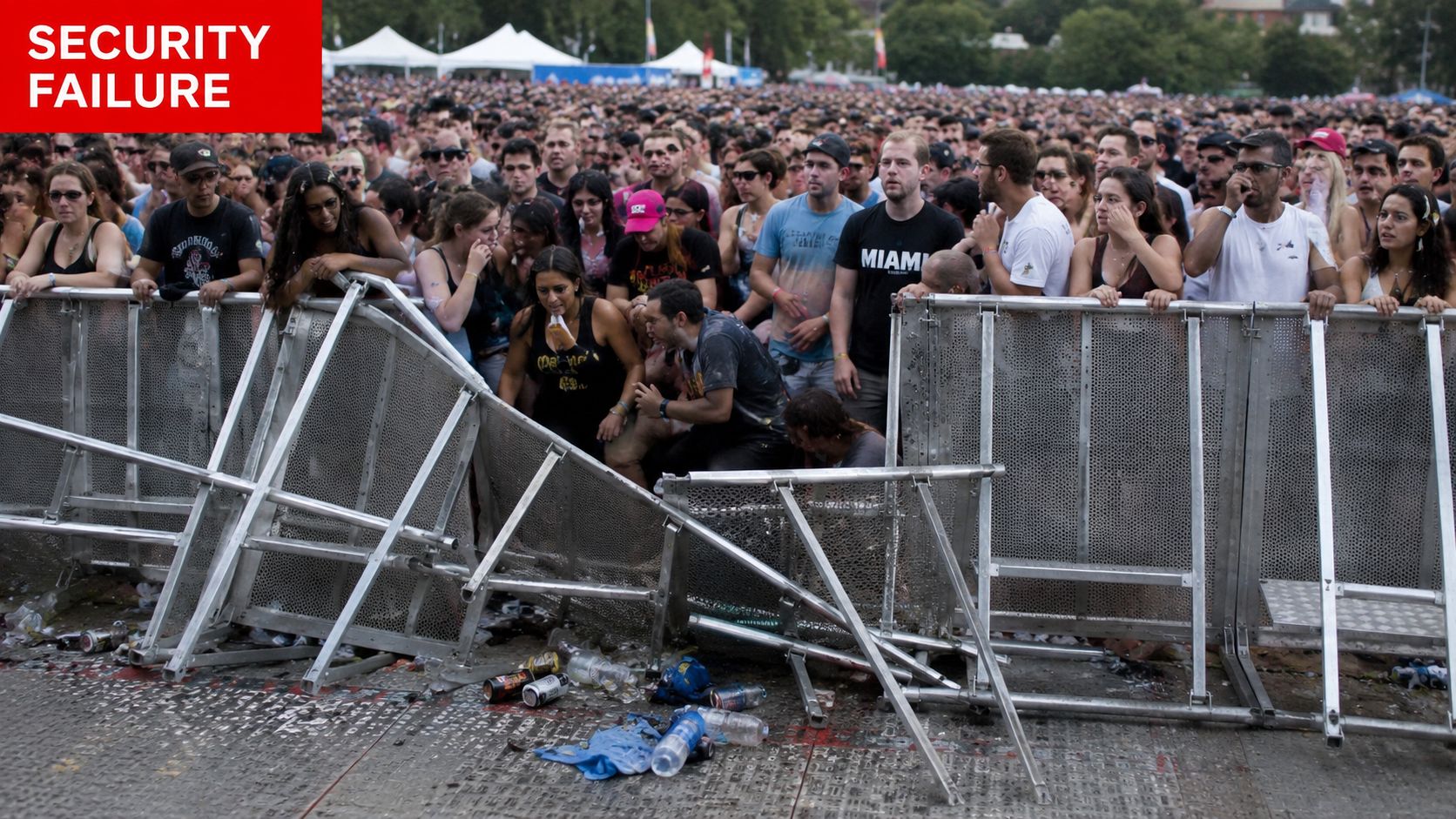
A common failure in security client relationship management looks like this. An incident starts in the crowd. The supervisor is busy. The venue manager hears about it from radio chatter, then from a staff member, then from a guest video on social media. By the time the client gets a proper update, they've already lost confidence.
That breakdown happens because most traditional client relationship management models were built for sales follow-ups, pipeline visibility, and account notes. They weren't built for live, high-risk environments where minutes matter and incomplete information can create bad decisions.
Where the usual model breaks down
Most generic CRM advice assumes the relationship is managed through scheduled contact. Monthly reviews. Service tickets. Follow-up emails. That approach has its place, but it falls apart when security teams are managing a live crowd, an intoxicated patron, a perimeter breach, or a fast-moving workplace issue.
As noted by Salesforce's CRM overview for Australia, most Australian client relationship management content neglects the critical gap of real-time, incident-driven communication protocols for high-risk service environments. That gap matters in security because information latency affects both brand reputation and safety.
What clients actually need during an incident
Clients don't need a flood of raw messages. They need decision-grade communication.
That means:
- Fast confirmation: Is the issue verified or still being assessed?
- Clear scope: Who is affected, and where?
- Immediate actions: What has security already done?
- Next decision point: What does the client need to approve, know, or prepare for?
- Follow-through: When is the next update coming?
Practical rule: In security, silence is rarely neutral. If a client doesn't hear from you during an incident, they'll fill the gap themselves, often with worse assumptions than the facts justify.
Why this matters more in public-facing environments
Festivals, licensed venues, retail centres, and construction sites all share one feature. Security incidents don't stay neatly inside a report. They affect operations, guest experience, contractor confidence, and sometimes regulator attention.
Traditional client relationship management often treats communication as an after-action task. In security, it's an operational task. If the client only hears from the provider after the site has stabilised, the relationship has already taken a hit.
Good security partnerships don't just deploy guards. They create a communication rhythm that holds up under stress.
The Core of Security Client Relationship Management
Strong client relationship management in security starts with a simple shift. A provider turns up and fills shifts. A partner helps you protect people, operations, and reputation.
That difference is becoming more important across Australia. The Australian CRM market analysis from Expert Market Research states that the market was valued at AUD 2.90 billion in 2025 and is projected to expand at a CAGR of 11.70% to 2035, reflecting stronger focus on structured relationship management in service-driven sectors.
Four pillars that matter on the ground
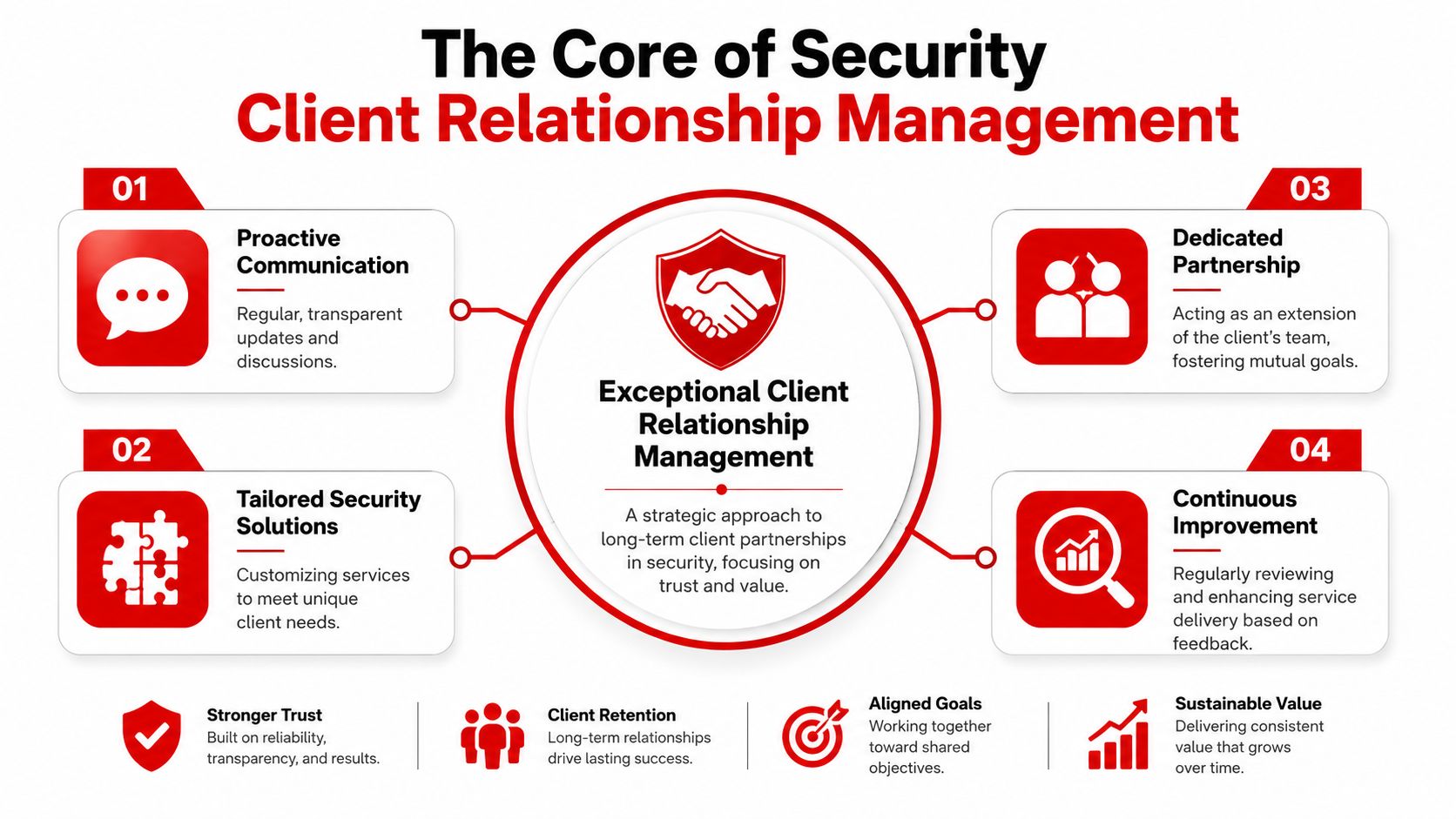
The relationship works when four pillars are in place.
Proactive partnership
Security shouldn't wait for the client to discover gaps. Before an event or deployment starts, the security lead should already understand access points, likely pressure areas, VIP movement, incident thresholds, reporting lines, and what “business disruption” means in that environment.
A festival director worries about crowd flow and patron behaviour. A construction manager worries about after-hours entry, gate integrity, and subcontractor movement. A venue operator worries about RSA pressure points and guest experience. Good client relationship management adjusts to those realities instead of forcing every site into the same template.
Transparent communication
Clients can handle bad news. What they can't handle is delayed, vague, or filtered news.
Transparent communication means saying what's confirmed, what isn't, and what's being done to close the gap. It also means matching detail to the moment. During an active issue, the client needs essentials. After the issue, they need sequence, actions, and any further risk.
The best update is short enough to absorb under pressure and detailed enough to support a decision.
Measurable performance
A healthy relationship needs evidence. That doesn't mean drowning the client in dashboards. It means showing whether communication protocols were followed, whether patrol findings were acted on, whether recurring issues were reduced, and whether the security team is improving site knowledge over time.
Unwavering trust
Trust in security is built through consistency. Calls get returned. Reports arrive when promised. Escalations happen at the right threshold. Site supervisors don't hide issues to protect appearances.
Technology supports the relationship, not the other way around
Software can help, especially when teams need shared records and real-time visibility, but tools should reinforce human judgement rather than replace it. For firms looking at operational systems that support this approach, AI solutions for security companies are worth reviewing because they show how automation can support reporting, responsiveness, and oversight without removing accountability from the people on site.
If the relationship depends on the client learning a complicated platform just to know what's happening at their own site, the model is backwards.
Key Processes for Events Venues Retail and Construction
Security client relationship management becomes real through process. Not generic process. Site-specific process that your team can follow on a busy Friday night, at a multi-gate festival bump-in, during a retail stocktake period, or on a construction site before first light.
Start with site truth, not assumptions
The CPPSEC3048A competency standard requires on-site inspections and the use of problem-solving techniques to promote client confidence. That matters because security relationships weaken when plans are built from paperwork instead of actual conditions on the ground.
For events, that inspection should test entry routes, ejection paths, queuing pressure, emergency vehicle access, and known patron behaviour hotspots.
For construction, it should cover fencing integrity, gatehouse workflow, plant areas, blind spots, after-hours access risk, and how trades move through the site.
For retail and hospitality, it should look at customer flow, staff-only zones, cash handling paths, loading docks, liquor service pressure points, and where confrontation is most likely to occur.
Build communication rules before the first shift
Most communication failures don't happen because staff are careless. They happen because nobody agreed on thresholds.
A practical protocol sets out:
- Who receives what: venue manager, festival operations lead, project manager, duty manager
- Which channel applies: phone call for urgent issues, message for low-risk updates, formal report for post-incident record
- What triggers escalation: injury, police attendance, ejection, suspected theft, crowd crush risk, perimeter breach, repeated non-compliance
- How often updates are issued: at incident start, after verification, at containment, and at closeout
Adjust the cadence to the environment
Different sites need different rhythms.
Events and festivals
Pre-event briefings matter more than people think. They align the promoter, venue operations, and security supervisor on likely flashpoints and the language used when something goes wrong. During the event, updates need to be shorter, more frequent, and operationally useful.
Venues and hospitality
Managers usually need concise escalation. They're juggling patrons, staff, RSA, and service flow. Good communication here is discreet, direct, and tied to operational choices such as removing a patron, repositioning staff, or changing door procedures.
Retail and shopping environments
Loss prevention and customer experience often pull in different directions. The best process protects evidence and staff safety without creating an unnecessary public scene. Internal communication should be calm, factual, and limited to those who need it.
Construction and industrial sites
Daily patterns matter. Access control, patrol observations, contractor movements, and after-hours irregularities should be reported in a way the site manager can act on quickly. If recurring issues appear, the response should change, not just the wording in the report.
A reliable security process doesn't just record incidents. It helps the client make better decisions before the next one happens.
Best Practices in Action Case Studies from GM GROUP Services
The value of client relationship management shows up most clearly in live operations. Three examples from the field show how communication, site understanding, and calm escalation change outcomes.

Festival crowd pressure before the headline act
At a major music event, crowd density began building near a front barricade well before the headline act. The issue wasn't yet an emergency, but it had the ingredients to become one. Front-of-stage pressure was rising, lateral movement was slowing, and nearby patrons were starting to react to discomfort.
The security team didn't wait for a collapse or patron distress call to start the client conversation. The supervisor verified conditions, advised the event lead of the developing pressure point, and recommended immediate crowd redistribution measures. That allowed the organiser to support a controlled response rather than a visible scramble.
What worked wasn't just the physical repositioning of staff. It was the sequence. Verify. Notify. Recommend. Update. That protects both safety and promoter confidence.
Hospitality venue loss prevention without a public scene
A premium hospitality venue had recurring concerns about internal asset loss and patron-facing disruption. The problem with many security responses in that environment is that they become too visible. Staff feel watched, guests notice tension, and management gets reporting that is either too vague or too dramatic.
The better approach used discreet observation, controlled information flow, and tightly scoped reporting to venue leadership. Security kept communication limited to the people who needed it, logged observations clearly, and avoided unnecessary floor disruption.
That's an important point in hospitality. Good client relationship management doesn't dump raw suspicion into the manager's lap. It gives them structured facts and practical options.
Construction site reporting that changed site behaviour
On a construction site, repeated low-level irregularities were showing up around access and materials movement after hours. None of the individual issues looked dramatic on their own. Taken together, they suggested weak routine control.
Security responded with visible patrol presence, tighter reporting, and clearer escalation of repeated patterns to site leadership. The client didn't just receive isolated incident notes. They received an operational picture. Which access points were recurring. Which times were vulnerable. Which behaviours were unusual but not yet proven breaches.
That changed the site manager's response. Procedures tightened, contractor messaging improved, and supervision became more targeted.
The lesson from all three
These examples share one principle. Security relationships get stronger when the client receives information they can use, not just information that proves the guard was there.
- For events: report developing risk before it becomes public.
- For hospitality: protect guest experience while preserving evidence and management control.
- For construction: identify patterns early so the client can correct conditions, not just react to losses.
Measuring Success KPIs for Security Partnerships
A lot of providers say communication is important. Fewer can show whether it's working.
The business case for structured systems is already established in the broader market. The IMARC analysis of the Australia CRM market states that investing in CRM yields an average ROI of $8.71 for every dollar spent, and 87% of Australian businesses use cloud-based versions, which supports real-time data access and responsive communication.
In security, though, the useful KPI set is different from a standard sales environment. You need measures that tell you whether the partnership is preventing surprises, reducing friction, and improving decisions.
Proactive vs reactive security KPIs
| Metric | Reactive Approach (Measures Failures) | Proactive Approach (Measures Success) |
|---|---|---|
| Incident reporting | Report sent after the matter is over | Client informed at agreed escalation point during the matter |
| Site knowledge | Guard notes are generic | Reports reflect recurring site-specific risks and patterns |
| Escalation quality | Client hears too late or too often | Escalations match pre-agreed thresholds |
| Supervisor involvement | Supervisor appears only after complaints | Supervisor checks, verifies, and updates before issues grow |
| Client confidence | Measured by absence of formal complaints | Measured by smooth decisions, fewer surprises, and clearer reviews |
| Post-incident learning | File is closed after report submission | Lessons are fed back into briefings, staffing, and procedures |
What to review each month or after each event
Not every KPI needs to be numeric in the client conversation. Some of the best indicators are operational and qualitative.
Use a review cycle that asks:
- Were incidents escalated at the right moment?
- Did the client get clear next-step advice, not just descriptions?
- Did reports identify patterns or only individual events?
- Were staffing adjustments based on observed conditions?
- Did communication help operations stay calm and organised?
The KPIs that clients actually feel
A festival organiser usually feels success through reduced confusion. A venue manager feels it through fewer awkward surprises. A construction manager feels it through cleaner oversight and faster answers.
Key takeaway: In security, the strongest KPI is often simple. The client knows what is happening, trusts the updates, and doesn't have to chase the provider for clarity.
That's the difference between a rostered service and a managed relationship.
Technology Compliance and Your Peace of Mind
Technology is useful in security when it improves accountability without weakening human contact. A reporting app can timestamp patrols. A supervisor dashboard can show whether an update has been lodged. A guard tracking tool can support verification. None of that should replace a direct phone call when the issue is serious.
That distinction matters because clients don't buy security to receive more software notifications. They buy confidence that the right people know what's happening and are handling it properly.

Keep data limited and purposeful
The Australian Government Architecture CRM standard requires entities to gather only data required for specific, defined purposes to prevent privacy compromises. That principle is especially important in security, where incident logs can involve sensitive details about patrons, staff, contractors, or site vulnerabilities.
In practice, that means disciplined record keeping:
- Collect only what supports the task: not every detail belongs in every report.
- Control access: only relevant personnel should view sensitive incident information.
- Separate operational urgency from data sprawl: the need for a quick update doesn't justify recording unnecessary personal detail.
Compliance should reduce client risk
Security work often crosses licensing, venue policy, workplace obligations, privacy expectations, and industry-specific rules. Technology can either help manage that complexity or make it worse.
Good systems help by creating clearer audit trails, cleaner reporting, and better consistency between what happened on site and what was recorded. Bad systems create clutter, duplicate records, and confusion about which version is accurate.
Human contact still matters
Earlier market reporting noted that many Australian customers still prefer direct human communication for complex issues. That rings true in security. During a live incident, clients usually want a person who can explain what is confirmed, what is changing, and what decision is needed now.
The best setup uses technology for visibility and compliance, then uses people for judgement, reassurance, and accountability.
Frequently Asked Questions about Security Client Management
How is this different from having an account manager
An account manager often focuses on scheduling, contract issues, and general service satisfaction. Security client relationship management goes deeper into operations. It includes escalation rules, site familiarity, supervisor judgement, post-incident review, and alignment with your operating pressures.
If the relationship only activates at renewal time or after a complaint, it isn't strong enough for security.
Do I need to learn a new CRM platform to make this work
No. The relationship shouldn't depend on you becoming a software user.
You should receive information in the format that helps you act. That might be a direct call during an incident, a concise shift report, a supervisor summary, or a structured review after an event. The technology should support the provider's consistency in the background.
What should I expect during a live incident
You should expect a disciplined sequence, not chaos.
A strong process usually includes:
- Verification: the supervisor confirms what is happening.
- Initial client update: short, factual, and focused on risk and action.
- Containment updates: only the information needed for operational decisions.
- Closeout summary: what happened, what was done, and any follow-up required.
What role does the client play in the relationship
A big one. The best security outcomes come from shared expectations.
Clients help most when they provide clear escalation contacts, define what matters most operationally, share known risk periods, and give feedback on what reporting format is useful. Security can't align with your priorities if those priorities stay unstated.
How often should communication happen when nothing is wrong
Often enough that the relationship stays live, but not so often that updates become noise.
For events, communication should intensify before and during the operation. For venues, retail, and construction, the rhythm should match the risk profile and the pace of change on site. The key is consistency. Clients shouldn't only hear from security when there's a problem.
What does poor client relationship management look like in security
It usually has the same signs:
- Vague updates: lots of words, no decision value
- Late escalation: the client hears after staff or patrons already know
- Generic reporting: nothing reflects the actual site
- Defensive communication: issues are softened to protect appearances
- No learning loop: the same problems recur without procedural change
Can strong client management reduce incidents on its own
Not on its own, but it changes how quickly issues are identified, how cleanly they are handled, and how effectively the site learns from them. That often means fewer repeated failures, better coordination, and more confidence across everyone involved.
If you need a security partner that treats communication, supervision, and incident reporting as seriously as guard deployment, speak with GM GROUP Services. Their team supports events, venues, retail, construction, and corporate environments across NSW, VIC, QLD, and the ACT with a practical, client-first approach built for real operations.
Discover more from GM Group Services
Subscribe to get the latest posts sent to your email.