
Building security assessment starts with the site you've got, not the site you wish you had. If you're managing a sold-out venue weekend, a handover-heavy construction site, or a retail store that keeps getting hit after hours, the question isn't whether you've bought enough gear, it's whether your controls still hold under pressure.
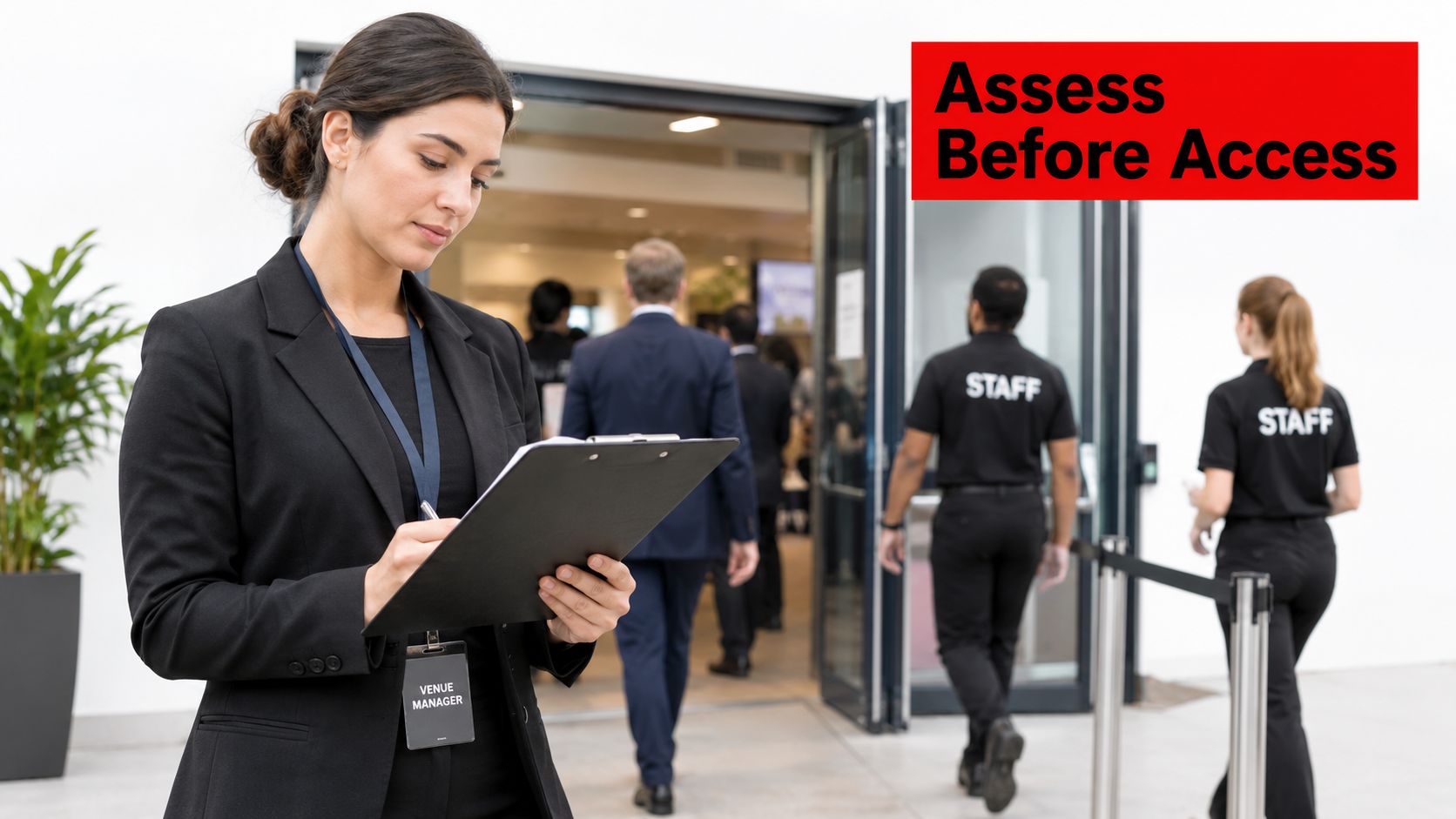
A proper building security assessment turns that pressure into something measurable. It looks at where people move, where assets sit, where criminals can test the boundary, and where your team's habits have drifted away from the plan. It also has to sit inside the building's safety and performance obligations, because Australian building regulation has been nationalised in stages, with the first Building Code of Australia in 1988, the performance-based BCA in 1996, and the consolidation into the National Construction Code in 2011 creating a single national framework for building work across Australia (NCC history).
That matters on the ground. Controlled entry, surveillance provisions, secure service areas, lighting, access routes and emergency egress interfaces can't be treated as a guard-only issue. They sit alongside life safety and building performance, and the NCC allows either Deemed-to-Satisfy provisions or a documented Performance Solution depending on the complexity of the site (NCC history).
For the assessor, that means the report can't be a one-off compliance photo. It has to reflect local adoption and implementation details, because state and territory governments still control those mechanics. If you don't check currency before you sign off, you're not really assessing the site, you're assessing an old assumption.
Why a Building Security Assessment Matters Right Now
During a walkthrough, the weak point is often familiar enough to disappear from view. A loading dock stays propped open during peak deliveries, a side gate remains “temporary” after handover, or overnight alarm response depends on a phone tree nobody has tested recently. A building security assessment exposes those operating gaps before they become an incident.
The checklist matters less than the discipline of testing what happens at the boundary. Review controlled entry, surveillance, lighting, service access, visitor movement and emergency egress as one operating picture. Security measures must work with the fire plan, tenancy arrangements and daily workflow. The practical test is whether the site performs under current use, including rushed deliveries, staff changeovers and reduced overnight coverage.
Treat the assessment as a time-based operating system rather than a static document. Walk the site during bump-in, when contractors and deliveries create temporary openings. Recheck it at peak, when queues, visitors and competing priorities test access controls. Examine the overnight position, when staffing falls, lighting changes and response depends more heavily on alarms, cameras and escalation procedures. Each phase can expose a different failure.
A strong assessment still follows a repeatable cycle: establish context, catalogue assets, identify threats, analyse vulnerabilities, evaluate risk, recommend controls, then review after change. That sequence suits venues, offices, retail sites and industrial yards, where process drift, access creep and poor shift handover can undermine well-designed measures.
Practical rule: if a control only works when everyone behaves perfectly, it isn't a control, it's a hope.
The National Construction Code gives assessors room to match the response to the site. A straightforward facility may use Deemed-to-Satisfy provisions, while a more complex building may require a documented Performance Solution. In either case, the assessment should connect physical security with life-safety obligations and operational requirements.
Why the regulatory history matters
Australian building regulation developed in stages. The first BCA appeared in 1988, the performance-based approach followed in 1996, and the NCC consolidated building and plumbing regulation in 2011 into a national framework (NCC history). That history explains why a modern building security assessment needs to consider more than guard coverage.
The assessor must also check the applicable state or territory adoption details before issuing the report. National provisions provide the framework, while local implementation affects how requirements apply at the site. A polished report built on an outdated edition can give management confidence without giving them a usable control plan.
The Seven-Stage Assessment Cycle You Can Reuse
A useful building security assessment follows the site through its operating day. Conditions shift during bump-in, peak occupancy and overnight closure, so the assessment must test controls across those phases rather than capture a single static snapshot. Start with the site context, then work through assets, threats, vulnerabilities, risk, treatments and review.
South Australia Police guidance recommends completing an assessment for each job and rating risks before and after treatment (SAPOL guide). Apply that discipline to the relevant NCC provisions and the site's state or territory requirements. A control may meet a written requirement yet fail during a crowded entry, a contractor handover or a quiet overnight period.
What the cycle looks like on site
Begin with plans, operating procedures and incident history. Then walk the property during daylight, peak activity and after dark. Check how bump-in affects vehicle separation, whether queues compromise entry points, and whether overnight lighting, alarms and patrol arrangements cover the site when staffing drops. Review perimeter lines, loading docks, doors, glazing, reception, restricted zones, emergency exits, CCTV views, alarms, visitor handling and guard response.
Use CPTED checks throughout the walk. Look for natural surveillance, clear sightlines, territorial definition and routes that reduce concealment. Record where temporary fencing, staging, stock or event infrastructure changes those conditions.
Write every finding as a scenario. “Tailgating at a staff entrance during shift change” gives the client a workable problem. “Weak access control” does not. Scenario wording supports a clear treatment, owner and verification test.
A clean report records the owner, deadline and test for each treatment. Recheck the result after a tenancy change, event build, altered layout or operating-hours change.
Controls that depend on perfect behaviour are hopes.
A simple way to keep the cycle honest
| Stage | What good practice looks like |
|---|---|
| Context | Confirm layout, operating phases, hours and occupancy |
| Assets | List people, property, information and operational dependencies |
| Threats | Separate nuisance issues from credible attack paths |
| Vulnerabilities | Test how controls fail, not only whether they exist |
| Risk | Rate the scenario and its consequence |
| Treatments | Assign an owner, deadline and verification test |
| Review | Reassess after incidents, changes or new activity |
The cycle keeps the assessment practical. The aim is a report that supports decisions during bump-in, peak operations and overnight closure, while remaining usable after the site changes.
Reading the Numbers Behind Non-Residential Risk
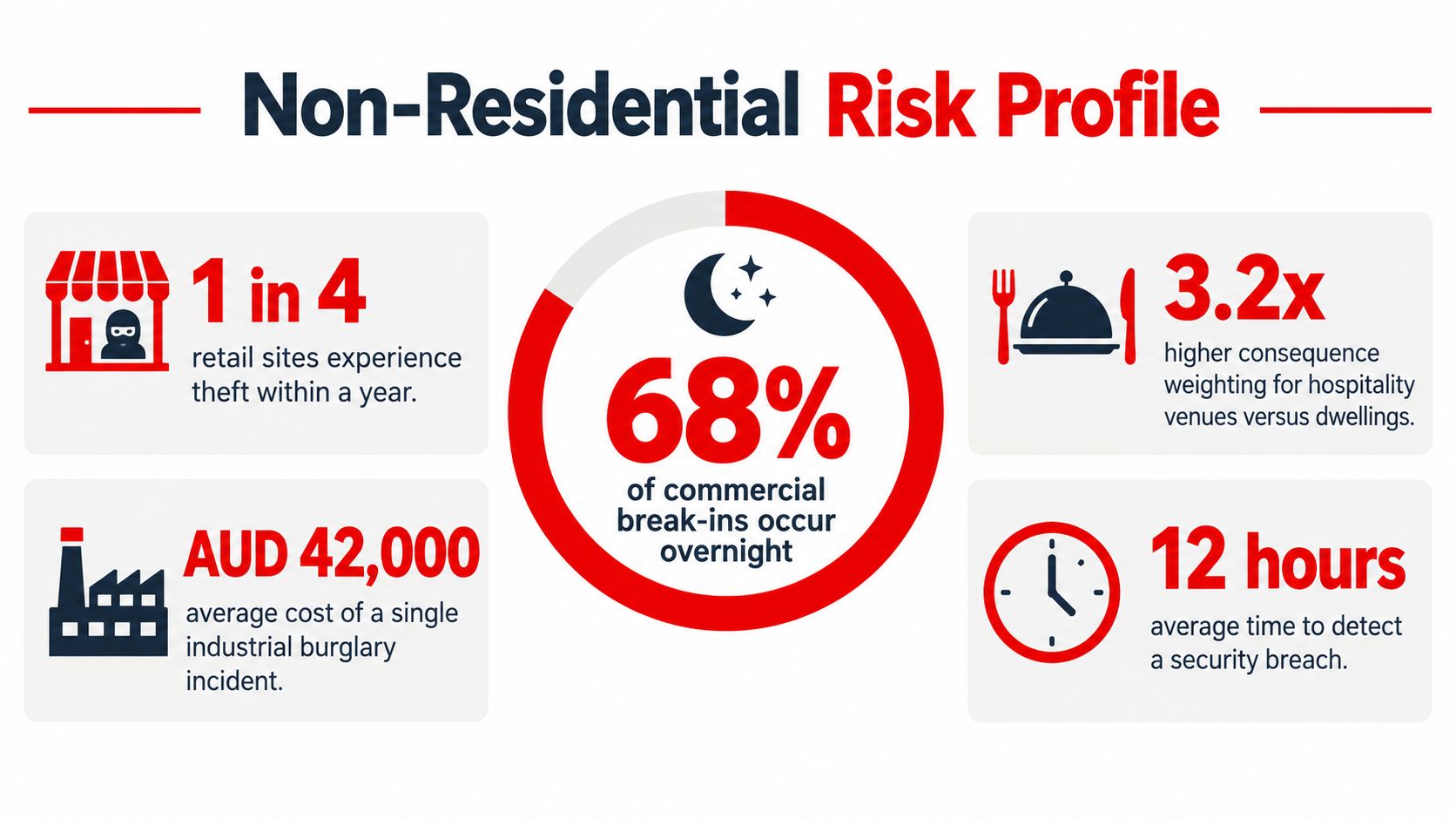
At 6 p.m. a venue can look controlled. By 2 a.m., the same loading dock, side gate and staff door can become the easiest path in. That is why non-residential risk has to be read by operating phase, not as a static checklist.
Commercial, retail, hospitality and industrial sites fail differently from dwellings. The direct loss matters, but the bigger hit is often interruption, spoiled stock, denied access, clean-up, and the reputational mess that follows. Analysts at the Australian Institute of Criminology estimated that in 2001 Australia recorded 819,000 residential burglaries and 176,000 non-residential burglaries. Non-residential incidents made up 18% of all burglaries but accounted for 32% of burglary costs, with an estimated average cost of about $4,500 per incident compared with $2,000 for residential burglary (AIC burglary analysis).
For a site walk, that changes the weighting. Likelihood still matters, but consequence carries real operational weight, especially where a break-in during bump-in, peak trade or overnight closure can stop the next shift from trading at all.
Read the numbers against time of use. Ask when the site is unattended, which assets sit closest to an exit path, how long a forced entry could go unnoticed, and what happens if a key area is out of action by morning. That is where a useful assessment separates day settings from after-hours settings and checks whether controls still hold once staffing, visibility and response capacity drop.
The practical pattern is familiar on the ground. Non-residential loss often clusters around weekends, overnight periods and any handover window where responsibility is blurred. For venues and mixed-use sites, I would also test any moment when temporary infrastructure, contractors or delivery activity changes the boundary condition. A compliant door set under the NCC can still be a poor security control if it is left on latch only during pack-down. A car park with acceptable lighting can still fail a CPTED check if pallets, fencing or bins create concealment near a staff entrance.
What to prioritise first
- Vulnerable periods: map weekends, overnights, bump-in, pack-down and shift-change windows.
- Boundary failure points: inspect side gates, roller doors, service corridors, shared driveways and any door that shifts from public to staff-only use.
- Alarm response: confirm who gets the alert, who attends, and what the escalation path is at each operating phase.
- Lighting and visibility: test whether entries, approaches and asset zones stay observable after hours, not just during business trading.
- Asset placement: keep attractive items and portable stock away from simple grab paths and poorly observed exits.
The point is straightforward. Uniform controls rarely suit a site whose risk changes by the hour. Better results usually come from layered measures aimed at the periods when the place is easier to enter, slower to detect a breach, and harder to recover before opening.
Running the Site Survey Through a CPTED Lens
A venue can look controlled during trading and become exposed during bump-in or overnight. Run the survey by zone and operating phase, then test how public, semi-public, staff-only and high-security areas connect. The six CPTED elements are surveillance, lighting and technical supervision, territorial reinforcement, environmental maintenance, activity and space management, and access control (UNSW CPTED report).
Five steps that make the survey usable
| Survey Step | What You Check | Evidence to Capture |
|---|---|---|
| Zone mapping | Public, semi-public, staff-only, high-security areas across bump-in, peak and overnight periods | Annotated site plan |
| Sightline test | Lighting, camera view and recognition distance at each phase | Photos, camera IDs, night notes |
| Boundary check | Doors, turnstiles, keys, cards, visitor passes and delivery routes | Reader logs, gate conditions |
| Environment review | Landscaping, signage, maintenance and ownership cues | Photos, contractor notes |
| Scenario test | Lost credentials, forced-door alarm, suspicious package and after-hours intrusion | Test results and response times |
The same UNSW standard warns against over-engineering controls before basic environmental weaknesses are fixed. It also places security zoning within facility characterisation, threat assessment and vulnerability assessment. Start with what staff and visitors can see, where they move, and who owns each boundary. If planting hides a side gate or a dark path delays access to a breach, another camera may add little value.
Fix visibility, ownership cues and movement paths first. Then test the technology.
Walk the site during each operating phase. A clear loading area, readable signage and an obvious staff-only separation support consistent behaviour. A cluttered yard with one locked gate and several unofficial entry paths invites workarounds, particularly when contractors change between bump-in and pack-down.
Lighting needs its own maintenance check. Failed lamps, dirty fittings and gaps around paths or entries can reduce observation after dark. A practical commercial landscape lighting upkeep guide can frame that inspection, but it does not replace security judgement on site.
Record the operational owner for each weakness, the phase in which it appears, and the action required. Rank quick fixes, such as signage or key-control changes, separately from capital work, such as boundary redesign or camera relocation. Re-test both after-hours conditions and the handover process, because a control that works at peak may fail when the site changes state.
Access Control, Perimeter, CCTV and Patrol Recommendations
Once the survey is done, the recommendations have to be specific enough to survive a handover. That means the report should say what failed, where it failed, who owns the fix and how the team will know it's working. If you don't force that level of detail, access control, CCTV and patrol recommendations blur into generic advice.
On access control, check credential hygiene first. Old cards, shared codes and lazy revocation are still common failure points, and they're especially poor practice where staff change often. Visitor passes need a clear issue and return process, and lift control has to match the building's actual movement pattern, not just the original design intent.
Emergency-egress interfaces need to be assessed at the same time as life-safety provisions. If a door has to open freely during an evacuation, the assessor still has to confirm how it behaves the rest of the time, and whether the chosen control creates a security gap, a safety gap, or both.
Field checks that usually expose the real problem
- Perimeter: Walk the fence line, gatehouse, loading dock and car park, and look for roller-door tracks, side gates and shared driveways that make unauthorised entry too easy.
- CCTV: Confirm coverage of every approach, and test how lighting changes the image after dark. Recording retention, alarm integration and post-alarm response all need checking, not just camera placement.
- Patrols: Don't rely only on either random or scheduled patrols. A smart design ties patrol frequency to incident history, then links observations to back-to-base monitoring and response targets.
- Ownership: Every recommendation needs an owner, a deadline and a verification test.
A site can also need a physical barrier specialist in the loop when the boundary itself is weak. In that context, it can make sense to compare local fencing and security options with a resource such as find a fence contractor in Connecticut, especially when you're documenting the standard of perimeter hardening rather than just the gate hardware.
The practical test is simple. If an alarm sounds, do you know who verifies it, how fast they move, and what the escalation path is? If the answer is vague, the control is not finished.
Common failure: teams install technology before they settle the operating routine. That usually creates an expensive system with no one confidently running it.
State-Specific Checks for NSW, Victoria and Queensland Sites
Jurisdiction matters because a good building security assessment has to sit inside the local compliance stack, not beside it. The national framework gives you the backbone, but the state rules decide what the site has to prove when it's inspected, opened or handed over.
In New South Wales, Fire and Rescue NSW says applicants requesting an emergency-plans report should submit the completed material to its fire-safety email address, and it will acknowledge receipt by email. If no acknowledgement arrives within 21 days, the applicant should contact Fire and Rescue NSW to confirm the plan was received (FRNSW emergency plans report). That turns into a simple assessment control, record the submission date, keep the acknowledgement, and escalate if the confirmation doesn't arrive.
In Victoria, venue and event assessments should be tied to a Risk Management Plan or Risk Assessment, an event-specific Emergency Management Plan, and traffic and crowd-management plans where roads, footpaths or car parks are affected. The Boroondara outdoor event guidance also says individual guards and security firms must hold a valid licence issued by Victoria Police, and armed security requires the relevant firearms licence (Boroondara guidance). A street festival using nearby parking should therefore name the pedestrian and vehicle conflict points, assign supervisors to entry and traffic zones, and check licences before deployment.
Queensland brings a different operational layer. Building occupiers have a duty to ensure required Fire Safety Installations comply with QDC MP 6.1, and the Building Fire Safety Regulation 2008 requires businesses with 30 or more employees in defined high-risk-occupancy buildings to appoint and train at least one employee as a fire safety adviser (Queensland Fire and Emergency Services). For a hospitality venue with 35 staff, that means the assessment should confirm the appointed FSA, the training evidence, inspection records, evacuation procedures and staff awareness.
For Queensland events and temporary sites, the assessment has to be more sequential than a static hazard list. If you're managing a temporary stage with public power leads and fireworks, map the cable routes, note where cable covers are needed, identify extinguisher locations, record the trained personnel responsible for fire response and verify the fireworks notification timing before anything goes live.
The strongest report keeps all of those checks in one place. Security, fire safety, licensing and emergency planning should sit in the same integrated assessment, because that's how the site operates.
Scoring Risks, Writing the Report and Closing the Loop
A defensible building security assessment ends in a ranked residual-risk list the client can act on. Score each finding against likelihood, consequence and the effectiveness of existing controls, then record the residual rating. This separates evidence from opinion and makes trade-offs clear.
The Australian National Security crowded-places audit asks whether plans are reviewed for each event and whether physical, information and personnel security are considered together (crowded-places audit). The report still needs to translate those checks into decisions for each operating phase, from contractor arrival through public activity and overnight handover.
Score the event by phase
A venue or festival changes risk as the day progresses. Bump-in exposes loading areas, temporary access points and contractor credentials. Public opening introduces queues and unfamiliar visitors. Peak periods increase density and pressure on screening, communications and egress. Alcohol service, artist or VIP movements, bump-out and overnight handover create different control requirements.
Score each phase separately, then identify controls that must be ready before that phase begins. A missing licence check or absent post-event debrief can usually be corrected through procedure and supervision. A poor boundary layout or blind camera approach may require capital work, with cost, effort, ownership and timing recorded in the action plan.
The close-out pack should state the residual risk, control owner, due date and verification method. Record the next reassessment trigger as well. Incidents, tenancy or layout changes, new technology, construction, major events, altered operating hours and changes in the threat environment should all reopen the assessment. A review date alone will miss operational changes that occur between scheduled audits.
The cleanest reports make the next review easier, rather than trying to sound clever on submission day.
Common client questions should have direct answers. Reassess after meaningful change, not only on a calendar. The site owner or operator owns the plan, while the security lead coordinates updates and evidence. If the client initially requests only a quote, define the exposure properly, because a shallow scope is difficult to defend after an incident.
GM GROUP Services provides security risk assessments for venues, festivals, offices, retail sites and construction environments, identifying threats, vulnerabilities and control gaps before converting them into site-specific actions. For support across NSW, Victoria, Queensland and the ACT, visit GM GROUP Services and book a conversation about your site.
Discover more from GM Group Services
Subscribe to get the latest posts sent to your email.