
Back to base alarm monitoring cost in Australia is about AUD 300 to 720 a year for standard monitoring, before patrol, call-out, activation and false-alarm charges are added. That annual figure is only the subscription for receiving and escalating signals, not the full cost of owning a monitored alarm over five years.
A single preventable attendance can cost more than a year of basic monitoring. A communicator that no longer works on a current mobile network can leave a site paying for a service that never receives the alarm. Those two risks explain why comparing monthly prices in isolation produces poor buying decisions.
For venues, construction sites, retailers and offices, the useful question isn't which provider quotes the lowest monthly fee. It's what you'll pay after installation, migration, polling, batteries, patrol attendances and false activations are included. Build that total first, then judge whether the protection matches the site.
Back to Base Alarm Monitoring Cost at a Glance
Five years of standard back to base monitoring costs roughly AUD $1,500 to $3,600 before a single patrol attendance, activation fee or false-alarm charge is added. That baseline is arithmetic: the Australian monthly range multiplied across sixty months.
The Quote Yard pricing guide for security alarm and CCTV costs in NSW places standard monitoring at approximately AUD $25 to $60 per month, equivalent to about $300 to $720 per year. Where a quote lands inside that band depends on the communications path and what the monitoring centre is asked to handle. Internet-only connections sit toward the lower end. Mobile or dual-path connections cost more, because a second path can still carry the signal if the first fails. Commercial sites pay extra for multiple zones, fire or duress signals, camera verification, larger call lists and any patrol response bundled into the plan.
Back to Base Alarm Monitoring Cost Stack in Australia
| Cost item | Typical amount | How it is charged | Applies to |
|---|---|---|---|
| Standard monitoring (single path) | AUD 25-60 per month (about AUD 300-720 a year) | Recurring monthly subscription | Most intrusion alarm sites |
| Response-inclusive monitoring with patrol | Quoted above single-path rates; confirm the per-attendance fee in writing | Recurring, plus attendance fees | Venues, construction sites, retail |
| Patrol or guard attendance | AUD 70-150 per call-out | Per attendance, genuine or false | Any response-inclusive plan |
| Existing panel takeover | AUD 300 one-off plus AUD 39.95 per month | One-off activation, then monthly | Migrating an existing alarm |
| GPRS communicator fitting | About AUD 450 | One-off installation | Sites needing a wireless path |
| Unwanted automatic fire alarm attendance (NSW) | AUD 1,656 | Per attendance, subject to exclusions | Fire alarm systems, invoiced to the alarm provider |
| Five-year standard monitoring | AUD 1,500-3,600 | Recurring; excludes installation and attendance | Budget baseline |
The stack accumulates. A response-inclusive plan raises the recurring line while the per-attendance charge underneath still applies. A takeover looks inexpensive monthly until the activation fee is added. A wireless communicator carries a one-off fitting cost before its higher weekly rate begins.
At AUD 1,656 per chargeable attendance, the NSW fire alarm row is the largest single number in the stack. Alarm quality, zoning and staff behaviour therefore belong in a cost comparison alongside the subscription.
Budgeting rule: Separate capital expenditure from the recurring subscription, then add a realistic allowance for attendances before you compare providers.
We provide Back to Base Monitoring alongside Bar and Club Security, Construction Site Security, Corporate Security Services, Emergency Response, Event Security, Gatehouse Security, K9 Security, Loss Prevention, Retail Security, Vehicle Patrols and other licensed services. That mix matters when a monitoring plan needs a physical response rather than telephone escalation alone.
Retail listings such as security electronics for GCC homeowners show what alarm devices cost as products. An Australian commercial monitoring quote is a different cost category, and its communications path, monitoring centre and response terms all need confirming in writing.
Any proposal that omits GST treatment, contract duration, connection type, the verification process or per-attendance fees leaves the five-year total unstated.
What Drives Back to Base Alarm Monitoring Cost Up or Down
Two quotes for the same building can differ because they're not selling the same level of assurance. Three drivers explain most of the gap, the communications path, the supervision level and whether physical response is included.
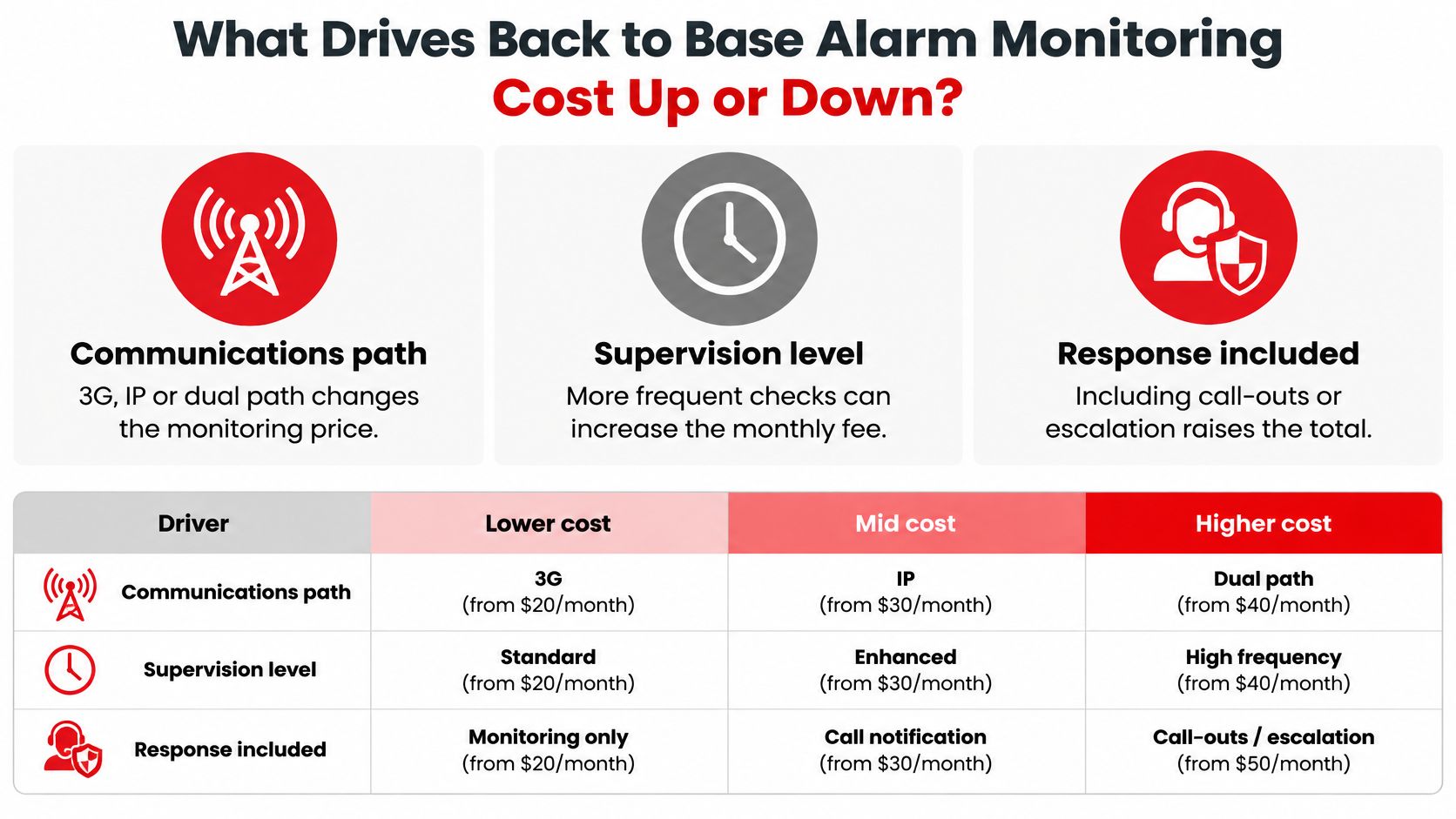
A Queensland provider's published back to base monitoring options list analogue PSTN monitoring from $6.95 per week, IP monitoring from $7.95 per week and GPRS monitoring from $11.95 per week, with prices including GST and GPRS fitting generally costing $450. Annualised, those starting prices are about $361, $413 and $621 respectively.
Transmission Options and Annual Cost Compared
| Transmission option | Advertised starting price (GST incl.) | Main dependency |
|---|---|---|
| Analogue phone line (PSTN) | AUD 6.95 per week | Phone line must stay live |
| IP internet | AUD 7.95 per week | Internet connection must stay live |
| GPRS wireless | AUD 11.95 per week, plus about AUD 450 fitting | None; can fail over to fixed line or internet |
The price steps reflect dependency. PSTN relies on the phone line staying live. IP relies on the site's internet and powered network equipment. GPRS doesn't need either service, uses mobile data and can be powered by the alarm panel during a power failure, which is why the hardware and weekly price are higher.
What Supervision Actually Buys
An unsupervised connection can send an intrusion event, but it gives weaker assurance that the panel remains reachable between events. A supervised service polls the communicator, so the control room can detect a communications failure instead of waiting for an alarm that may never arrive.
The monthly fee works like a car's registration. The cheap option is fine until the day the car doesn't start. The question is what failure you're paying to detect, and how quickly you need someone to know about it.
That distinction is visible in the CTC Communications back to base price list, which lists communicator services at approximately $38 to $59 plus GST per month, with unsupervised or supervised open/close signalling and single- or dual-SIM options. Annualising that range gives approximately $456 to $708 plus GST per site before installation, patrol attendance or repairs.
Dual-SIM supervised polling sits at the high end because it combines network redundancy with fault detection. A low nominal fee can therefore be the weaker technical service, even when both quotes use the words back to base monitoring.
Compare signalling protocol, polling interval, primary and backup networks and battery-backup expectations before you compare the monthly number.
Response is the third step change. Signal receipt and telephone escalation are not the same product as a plan that sends a patrol, verifies the event and follows an agreed intervention process. If a quote doesn't separate those functions, you can't tell whether you're buying monitoring, response, or only the first half of both.
Patrol, False Alarm and Site Scenario Costs
The subscription is predictable. Activations are not. The LeadKit alarm system installation cost guide places individual patrol attendances at approximately $70 to $150 per call-out, with false activations potentially charged in the same way as genuine incidents.
That single term reshapes the value of every plan. A venue with reliable zoning and trained closing staff may need few attendances. A dusty construction site, a hotel with steam near detectors, or a retailer with delivery doors opening after hours can turn a modest subscription into a much larger operating cost.
First-Year Back to Base Alarm Monitoring Cost by Site Type
| Site type | Recurring monitoring (year one) | One-off costs | Call-outs | First-year total |
|---|---|---|---|---|
| Office, existing panel takeover | AUD 479.40 (12 x AUD 39.95) | AUD 300 activation | None assumed | AUD 779.40 |
| Hospitality venue, response-inclusive plan | AUD 1,200 (12 x AUD 100) | None assumed | 6 x AUD 120 = AUD 720 | AUD 1,920 |
| Construction site, GPRS wireless | AUD 621.40 (52 x AUD 11.95) | AUD 450 fitting | 2 x AUD 150 = AUD 300 | AUD 1,371.40 |
These are worked scenarios, not universal quotes. Each figure uses the GST treatment shown in its quoted price, the totals exclude repairs and equipment upgrades, and each row assumes the call-out count stated. Rebuild each row with your own monthly fee, attendance rate and activation history before treating it as a budget.
Read them across five years, not twelve months. Activation and fitting are paid once, while the recurring line repeats 60 times and call-outs keep arriving at the site's own rate. A cheap first year can sit inside an expensive five years, and a heavy first year can turn out to be the cheap one.
Hospitality Venue With Patrol Response
Say a hospitality venue chooses a response-inclusive plan at AUD 100 a month. The subscription alone is AUD 1,200 over 12 months. Four patrol attendances at AUD 120 each add AUD 480, taking the year to AUD 1,680, which is 40 per cent above the subscription.
Six attendances at the same rate produce the AUD 1,920 total in the table. The contract has not changed. The site's activation pattern accounts for the difference, and that pattern repeats every year the underlying cause goes unfixed.
Buyers often weigh a small monthly saving against a competing plan while ignoring attendance volume. At this rate, preventing two unnecessary call-outs a year returns more than a marginal fee reduction, and the levers are operational: correct detector placement, sensible entry delays, current call lists and closing procedures staff follow.
Office Taking Over an Existing Panel
An existing panel is not automatically ready for a new monitoring centre. The Metwide alarm monitoring service page lists an existing-panel takeover at $39.95 per month including GST, plus a one-off $300 activation fee, giving a first-year total of $779.40 before hardware or response charges.
Activation covers checking panel compatibility, programming the communicator to the site profile, staged test alarms with the control room and go-live approval. Communicator hardware or panel upgrades are quoted separately if required, so a low monthly figure does not prove the old system can be reused without extra work.
Across five years, that example reaches about AUD 2,697 if the monthly fee stays unchanged, because the activation is paid once while the subscription repeats 60 times. Year one looks disproportionately expensive only if that structure is ignored.
Construction Site on a Wireless Path
A construction site may have no stable internet, no permanent phone line and no secure space for network equipment. In the scenario above, GPRS monitoring at AUD 11.95 a week costs AUD 621.40 over 52 weeks. Add the AUD 450 fitting and two attendances at AUD 150, and year one reaches AUD 1,371.40.
The higher communications cost can still be rational. A cheaper IP plan has little value if site power is interrupted, the temporary router is unplugged, or the connection is removed during a fit-out stage. Paying for path independence is different from paying more for the same service, and on a five-year view the one-off fitting shrinks against the weekly billing that keeps repeating.
We provide static security guards, mobile patrols, gatehouse security, crowd management, personal protection and K9 security, and we handle everything from selecting suitable officers to providing site-specific instructions and ongoing management support. For a monitored site, those arrangements determine who attends, what instructions they follow and how the incident is closed out.
The False Fire Alarm Exposure
Fire systems carry a separate and larger risk. Fire and Rescue NSW guidance on automatic fire alarms states that an unwanted automatic-fire-alarm attendance can attract a $1,656 charge, subject to exclusions and leniency rules, with one false alarm within a 60-day period not charged and a 24-hour leniency period applying to repeat alarms.
The charge is invoiced to the approved alarm service provider, which may recover it from the building owner or manager under the contract. Poor detector placement, dust, construction work, inadequate maintenance and staff-generated activations can each convert a modest monitoring expense into a four-figure incident cost. On the office and construction scenarios above, a single unwanted attendance would exceed the entire year's monitoring fee.
Don't wait for an invoice to discover the pass-through clause. Your contract should state who verifies the alarm, who contacts emergency services, how authorised users are trained and whether authority charges are passed on.
Practical habit: Log every activation with the time, zone, likely cause, person contacted, attendance decision and corrective action. Review the log monthly and fix repeat causes.
Our security incident records support communication, follow-up and review of security-related incidents. Used consistently, that record turns unexplained activations into maintenance, zoning or training actions instead of a recurring call-out expense nobody owns.
Communication Paths and Migration Costs After the 3G Shutdown
A monitoring plan is only worth its monthly fee if alarm signals reach the monitoring centre. For sites still running 3G-era communicators, that link may already be broken, and no tariff comparison fixes it.
The Access Communications guide to Australia's 3G network shutdown explains that Australia's major carriers have retired their 3G networks, so older communicators that depend on 3G may no longer deliver signals to the monitoring centre. A back to base alarm monitoring cost comparison that ignores the communicator treats hardware as settled when it may be the largest unbudgeted item over a five-year term.
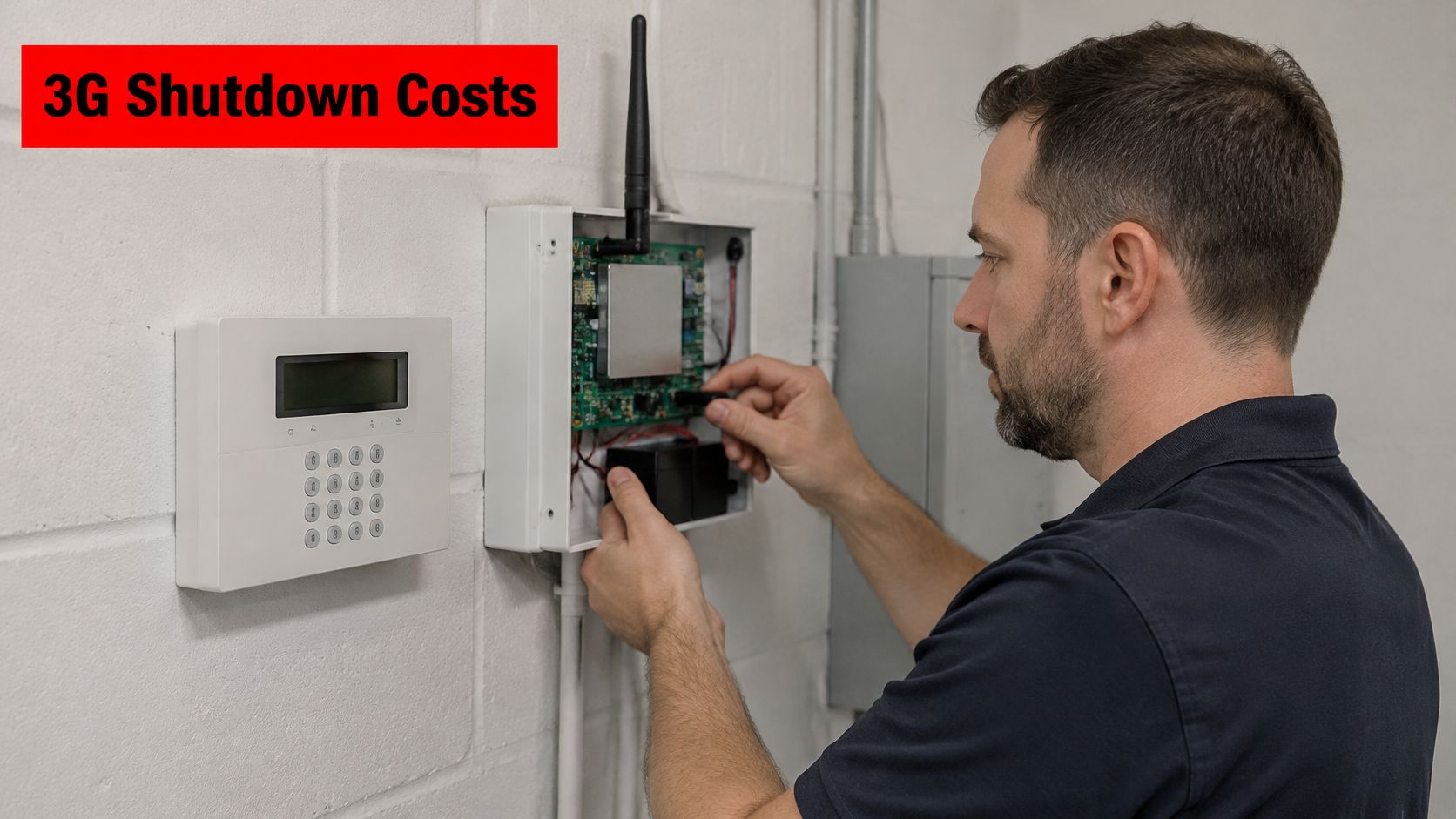
A panel can still power up, chirp and appear normal while its communicator has no viable network path. Local noise is not evidence of remote monitoring. Only a received test signal proves the service works.
Run the Two-Path Test
Modern systems typically pair broadband or fixed internet as the primary path with 4G mobile backup. Have the installer or monitoring provider run these checks in sequence:
- Test the primary path: Trigger a controlled alarm and confirm the monitoring centre receives it with the correct site and zone details.
- Test the backup path: Disable or disconnect the primary path under installer supervision, trigger another controlled event and confirm receipt again.
- Confirm fault reporting: Ask how quickly a path failure is detected, who is notified and what happens outside business hours.
- Record the result: Keep the test date, communicator model, networks used and the name of the person who confirmed receipt.
Sites that depend on fixed internet should also consider how they'll keep your business connected during outages from SwiftNet Wifi, because a router or provider failure can remove the primary alarm path at the same time as other business systems. Backup connectivity reduces one avoidable point of failure, while alarm path supervision remains the monitoring provider's job.
The less obvious comparison is single-path versus dual-path pricing. A cheaper single-path plan can deliver weaker protection than a more expensive dual-path service where internet, power or equipment can be disrupted. Construction sites, temporary event infrastructure and venues with shared communications cupboards face exactly those failures.
Price the migration separately from the monitoring. Ask the provider to itemise the recurring monitoring fee, the one-off communicator replacement, installer labour, SIM or data charges, any internet dependency and the dual-path upgrade as distinct lines. Then ask who carries the risk when carriers retire the next network technology. A communicator bought cheaply today becomes an unowned liability if the contract says nothing about the next shutdown, and one unplanned hardware swap can erase years of saving on a lower monthly plan.
Procurement Checklist for Back to Base Alarm Monitoring Quotes
Start by splitting the budget in two. Put installation, communicator hardware, programming and panel upgrades in the capital column, then put monitoring, communications and expected attendances in the recurring column. A provider that blends them into one attractive monthly figure makes comparison harder, not easier.
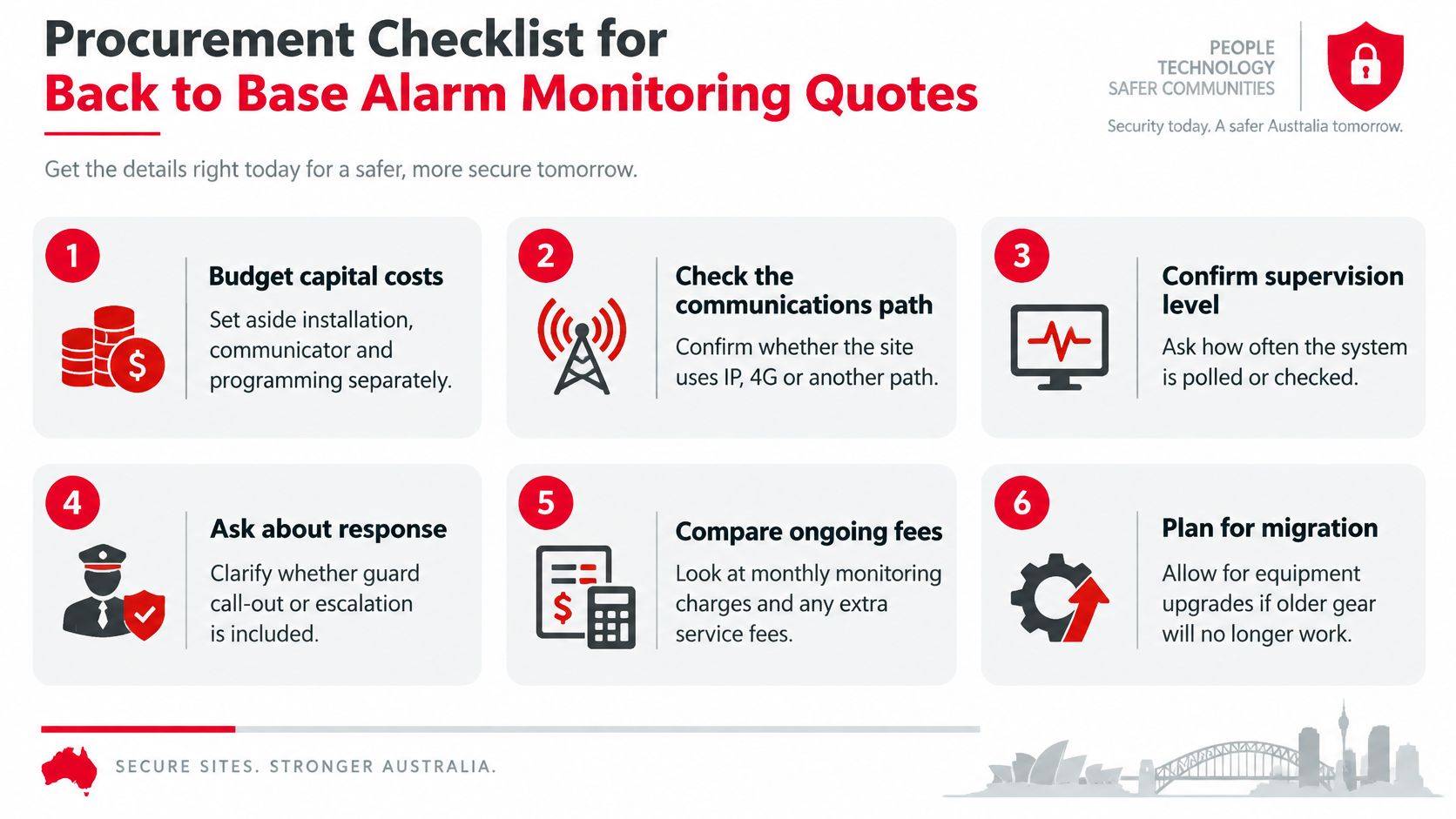
Ask every provider to answer the same items in a written quote. Verbal assurances don't help when the first attendance invoice arrives.
Cost Terms to Confirm
- GST and contract terms: State whether prices include GST, the contract length, price-change rights, exit fees and notice periods.
- Attendance pricing: Confirm the fee per patrol or guard attendance and whether genuine and false activations are charged at the same rate.
- Included attendances: State whether any attendances are included, capped or discounted, and what happens after that limit.
- Authority charges: Identify whether fire authority or other attendance charges can be passed through to the owner or manager.
- Takeover work: Include compatibility checks, communicator programming, staged test alarms and go-live approval as priced items.
- Hardware and batteries: Name who's responsible for communicator replacement, backup batteries, repairs and panel upgrades.
Technical Terms to Confirm
- Primary and backup paths: Name the exact connection types, not just the marketing label given to the plan.
- Supervision interval: State how often the monitoring centre polls the communicator or otherwise checks that it's reachable.
- Outage notification: Confirm who gets told when a path fails, how they're told and how quickly escalation occurs.
- Power failure behaviour: Ask what the panel battery supports, what it doesn't support and when low-battery or mains-fail signals are actioned.
- Zone information: Check that the control room receives useful zone descriptions rather than unlabelled detector numbers.
Responsibility Terms to Confirm
- Verification: State who verifies the alarm, what evidence they use and how many contact attempts occur before dispatch.
- Emergency services: Name who contacts police, fire or ambulance and under what conditions.
- Call list control: Set who can add or remove authorised contacts and how changes are authenticated.
- Network changes: Assign responsibility for future carrier shutdowns, communicator obsolescence and replacement costs.
- Credentials: Ask each provider to state its industry accreditation and licence status in writing rather than relying on verbal claims.
GM Group is a member of the Australian Security Industry Association Limited. You can request a quote from us or call 1300 14 14 41 or 0499 020 304 to discuss your security requirements.
Score the responses over five years. Add the subscription, one-off migration, likely attendances, servicing and battery replacement, then assess whether the technical protection matches the site's risk. The lowest monthly back to base alarm monitoring cost only wins if it still wins after those lines are visible.
Back to Base Alarm Monitoring Cost Questions Answered
Is back to base monitoring a one-off or ongoing cost?
It's an ongoing subscription, generally AUD 300 to 720 a year for standard monitoring. Budget installation and activation separately, then carry the monthly fee as an operating cost for the full contract term.
Do monthly fees include call-outs?
Usually they don't, even when a plan is described as response-inclusive. Get the per-attendance rate in writing and confirm whether false activations cost the same as genuine incidents before you sign.
Will my existing alarm still work after the 3G shutdown?
It may not if it relies on an obsolete 3G communicator. Ask the provider to prove that each communications path is live and that a controlled test signal reaches the monitoring centre.
How can I lower cost without losing protection?
Reduce false alarms through correct zoning, detector maintenance, staff training and a monthly activation log. Then choose the communications path and supervision level that match the site's failure risks, rather than cutting the backup path to save a small monthly amount.
We offer a confidential discussion about a client's security needs. Use that discussion to test your current activation history against the five-year cost model and decide which cost lines you can remove.
If you're reviewing back to base alarm monitoring cost for a venue, construction site, retail premises or office, visit GM GROUP Services to discuss monitored protection alongside patrols, guards, emergency response and site-specific security planning. Bring your current quote, communicator details and recent activation history, and we'll help you identify what the monthly price includes, what it leaves out and what needs testing before you commit.