
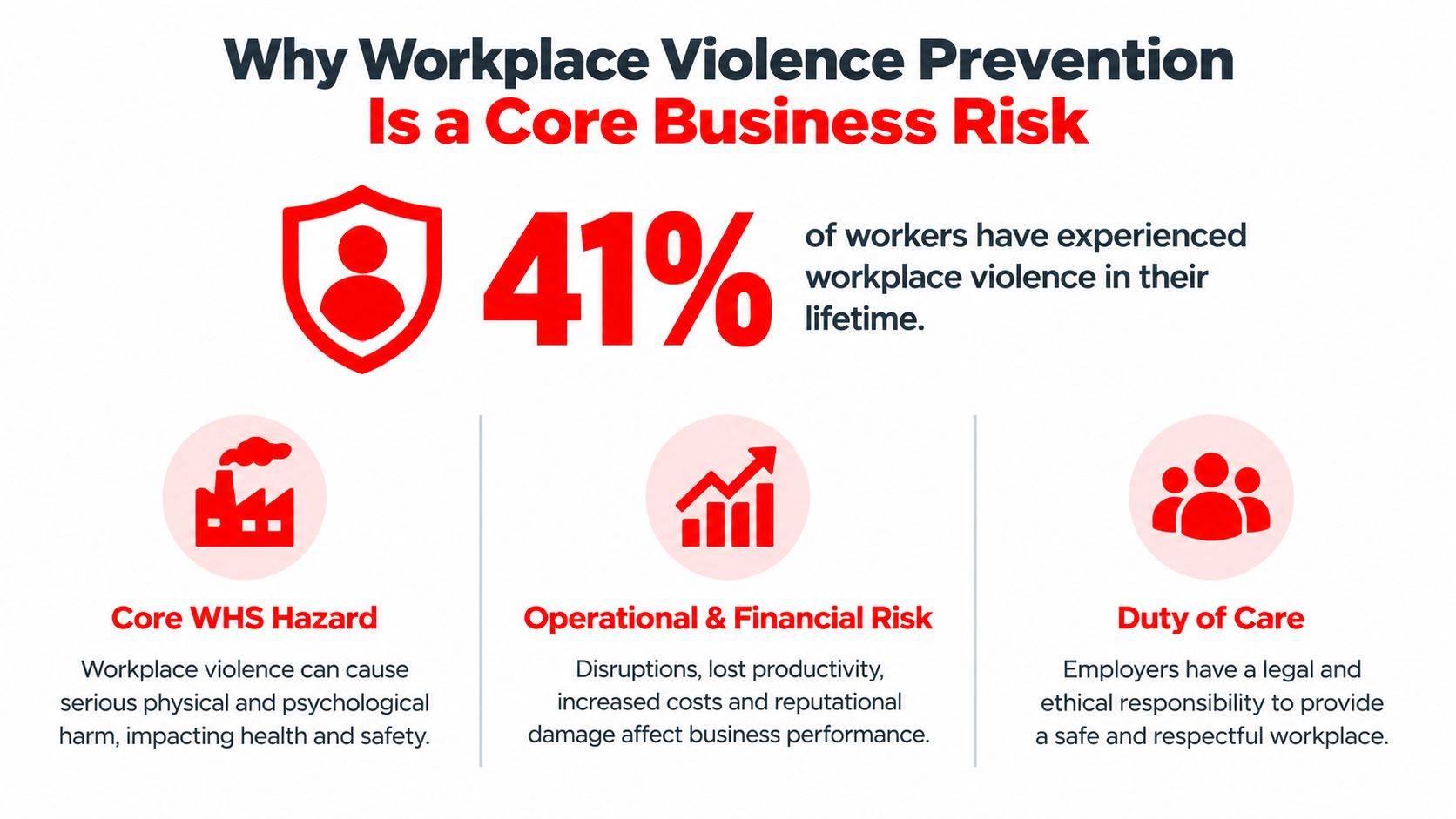
Workplace violence prevention starts with a fact many Australian operators underestimate: 8 million Australians, or 41% of people aged 15 and over, have experienced at least one incident of violence since age 15. Safe Work Australia records more than 1 million work-related violence incidents, along with 176,100 workplace incidents in the last 10 years. Only about 46% were formally reported as workplace or on-the-job incidents, so a site's incident register often shows only part of the exposure. (Safe Work Australia workplace violence data)
The practical response isn't ordering more guards and hoping visibility solves everything. It's separating repeat customer abuse from one-off events, identifying where aggression starts, giving staff usable rules, and combining physical, administrative and security controls that work during a real shift.
Why Workplace Violence Prevention Is a Core Business Risk
Workplace violence prevention belongs beside slips, trips, manual handling and fatigue in the WHS plan. Safe Work Australia defines workplace violence and aggression as an incident where a person is abused, threatened or assaulted at work or while carrying out work, whether that happens in person, over the phone or online. Employers are expected to identify hazards, assess risks, implement controls and review those controls regularly. (Safe Work Australia guidance on workplace violence and aggression)
The exposure looks different by operating environment:
- Retail and hospitality face repeat customer abuse, refusal-of-service disputes, intoxication, queues and cash-handling pressure.
- Festivals and corporate events often deal with one-off incidents involving crowd density, alcohol, unfamiliar attendees or sudden disputes.
- Construction and industrial sites face third-party aggression, trespass, after-hours access and conflict between subcontractors.
- Corporate offices can experience internal threats, client-facing aggression, harassment and disputes that enter through reception or digital channels.
The commercial impact extends well beyond the immediate injury. A serious incident can create workers' compensation claims, interrupt trade, trigger RSA concerns, close a venue temporarily or require managers to divert staff from core work. Repeated abuse also wears down retention, recruitment and morale, while visible disorder can damage a venue's reputation with customers and neighbouring businesses.
The national trend makes passive management difficult to defend. Serious workers' compensation claims for workplace violence and assault rose 56% from 2017–18 to 2021–22, and preliminary 2023 data recorded at least 6 worker deaths from assault by another person, after 6 such deaths in the previous 5 years combined. (Safe Work Australia reports and snapshots)
Operational rule: Treat every repeated threat, near-miss and refusal-of-service escalation as information about the system, not just a problem caused by one person.
A workable programme has seven connected parts: site assessment, a readable policy, layered controls, role-specific training, first-hour response, reporting and scheduled review. Security staffing can support that system, but it can't replace it.
Running a Site-Specific Risk Assessment
A useful assessment starts with the site as it operates, not the site as it appears on a floor plan. Walk the property during opening, peak trade, closing and any period when workers operate alone. Consult workers, review incident and near-miss records, and note where customer-facing duties, access points and escape routes change across shifts.
Four phases for a practical assessment
Scope the site. Record the public interface, staff-only areas, entrances, loading zones, car parks, cash points, bars, queues, toilets, plant rooms and remote work areas. On a construction project, include subcontractor access, delivery windows and incomplete perimeter sections.
Map hazards. Mark triggers rather than labelling an area “high risk”. These may include intoxication, refusal of service, cash handling, lone working, after-hours access, waiting times, public complaints or an employee who must deliver unpopular decisions.
Evaluate likelihood and consequence. Ask who could be exposed, how often the interaction occurs, what escalation looks like and how quickly assistance can arrive. A busy bar and a quiet office may both need controls, but the trigger, response time and staffing model won't be the same.
Document controls. Apply the hierarchy of controls. Redesign the task or layout where possible, then add safe work procedures, training, reporting pathways and fit-for-purpose security. Safe Work Australia's guidance emphasises eliminating or minimising the hazard as far as reasonably practicable, followed by response, reporting and support. (Safe Work Australia's workplace violence guide)
Three worked examples
At a licensed venue, map the bar queue, refusal-of-service point, smoking area and exit. Put the refusal conversation where staff can summon help without trapping themselves. At a late-night retail floor, assess self-checkout, service counters, low-visibility aisles, closing procedures and lone workers. At construction sites, prioritise gatehouse control, perimeter breaches, plant theft risk, deliveries and after-hours entry.
Use this walkthrough checklist:
- People: Who interacts with the public, contractors or distressed customers?
- Place: Where are staff isolated, blocked in or difficult to see?
- Time: Which shift, event phase or closing task increases exposure?
- Trigger: What decision or condition usually starts the conflict?
- Response: Who receives the alert, and how does assistance arrive?
- Evidence: Where are CCTV, reports, witness details and access records stored?
The output should be a short risk register that names the hazard, exposed role, existing control, gap, responsible manager and review date. That document gives the policy a real operating basis.
Building a Policy That Staff Actually Read
Most workplace violence policies fail because they're written for an audit folder instead of a person working a Saturday night. A frontline employee needs to know what behaviour crosses the line, what to say, who to call and what happens after the report.
Write a one-page operational policy first. Put the detailed legal, investigation and contractor arrangements in an annex. The one-page version should use language staff already understand, including RSA-aligned instructions for licensed venues: refuse service when required, don't argue about the decision, call the duty manager or security officer, and move away when the situation becomes unsafe.
Give every role a defined job
A manager shouldn't assume a security officer will handle every interaction. Floor staff often identify the first warning sign, security officers manage positioning and separation, and HR or WHS personnel handle support, records and follow-up.
| Role | Core Responsibilities | Reporting Duty | Escalation Trigger |
|---|---|---|---|
| Manager | Open and close the response plan, allocate support, preserve records | Notify the required internal contacts and record the event | Threat, assault, weapon, serious injury or ongoing danger |
| Security officer | Observe, communicate, create distance and protect exits | Complete a factual security report | Aggressive movement, attempted assault, refusal to leave or breach of exclusion direction |
| Floor staff | Follow refusal-of-service and customer conduct rules, seek help early | Report threats, abuse, near-misses and repeat offenders | Personal safety concern, obstruction, intimidation or escalation |
| HR or WHS lead | Support affected workers, review controls and coordinate follow-up | Maintain formal records and action tracking | Pattern of incidents, significant injury or control failure |
Include a clear zero-tolerance statement for threats, assault and harassment, but don't confuse “zero tolerance” with reckless confrontation. The policy must state that staff can withdraw, refuse unsafe work and request assistance. It should also explain reporting options, non-retaliation expectations, support for affected workers and consequences for breaches.
Distribution matters as much as wording. Add the policy to induction packs, display the short version in staff areas, collect digital acknowledgements, brief contractors and run a quarterly refresh. A shared drive is storage, not communication.
Choosing the Right Layered Controls
A control earns its place when it addresses a named hazard. CCTV won't stop an argument at a service counter if nobody watches the feed. A static guard won't solve a construction perimeter gap if deliveries still enter through an uncontrolled side gate.
Match the control to the exposure
Engineering controls change the environment. Improve lighting around exits and car parks, remove hiding spots, separate queues from staff work areas, create a clear barrier at service counters and restrict back-of-house access. Panic buttons should connect to a monitored communications process, not sit unused beneath a counter.
Administrative controls make the expected response repeatable. Use refusal-of-service scripts, two-person closing procedures, visitor sign-in, exclusion registers where lawful and practical, contractor induction, radio protocols and incident categories that distinguish verbal abuse from physical assault.
Security staffing then fills the response gap. Static officers provide visible deterrence and a known point of contact. Concierge-style officers suit hotels, corporate events and offices where service and early intervention matter. Roaming patrols cover larger sites but create response-time trade-offs because the officer may not be at the hotspot when a dispute begins. Covert loss-prevention work can complement visible staff on retail floors, while gatehouse and perimeter officers are more relevant to construction sites.
| Control Type | Venue / Bar | Retail Floor | Construction Site | Corporate Office |
|---|---|---|---|---|
| Engineering | Queue separation, clear exits, improved lighting | Counter barriers, open sightlines, safer closing layout | Perimeter lighting, controlled gates, secure plant areas | Reception separation, access-controlled floors |
| Administrative | RSA procedures, exclusion process, radio calls | Repeat-offender process, lone-worker checks, incident logging | Visitor induction, delivery control, after-hours procedure | Visitor screening, threat reporting, manager escalation |
| Technology | CCTV at entry, bar and exits, monitored duress | CCTV covering counters and low-visibility areas | Access logs, gate cameras and perimeter alarms | Access control, reception camera and duress communications |
| Security staffing | Visible static or mobile response cover | Loss-prevention crossover and peak-period support | Gatehouse, patrol and perimeter focus | Concierge, mobile patrol or event-specific officers |
Access control works best when it reflects the movement of people, not just the hardware available. For practical background on gate and entry design, FenceScape access control advice is a useful reference, particularly for sites balancing vehicle flow with restricted areas.
The right budget question isn't “How many guards do we need?” It's “Which exposure remains uncontrolled after layout, systems and procedures are applied?”
Training Teams for De-Escalation and Reporting
A bartender has been threatened by the same patron on three weekends. Each time, the customer calmed down after staff called a manager, then returned later and acted as though nothing had happened. That isn't three unrelated incidents. It's a repeat-customer pattern requiring a shared decision, not another isolated reminder to “stay calm”.
The trained response starts early. The RSA-certified staff member keeps a clear exit, uses a steady voice, avoids touching the customer and states the decision without debating it. An officer positions at an angle rather than chest-to-chest, watches hands and movement, and brings a second person into the interaction before the customer blocks the bar or follows the employee.
Define the withdrawal point
Training should give staff permission to stop trying to resolve the conversation. Raised volume, personal threats, clenched fists, sudden movement towards a worker, crowding, refusal to leave or attempts to reach behind a counter are signals to create distance, call backup and protect bystanders. Staff shouldn't wait for physical contact before using duress procedures.
A strong induction combines site orientation, policy rules, radio language, refusal-of-service practice, emergency exits and reporting. Refreshers should use scenarios from the actual venue or store, including repeat offenders, closing periods and staff who work alone. A short drill that tests who answers the radio is more useful than a long presentation nobody remembers.
For managers, resolving tensions at the nurses' station offers relevant context on communication, boundaries and de-escalation in a pressured customer-facing environment. The setting differs, but the operational lesson transfers: staff need a shared method for reducing tension while protecting themselves.
Make the report travel
After the customer leaves, the bartender records the words used, time, location, witnesses, staff response and any available footage. The manager flags the repeat pattern, advises the security contractor and sends the information through the WHS reporting path. HR checks on the affected worker, while the operations lead reviews whether the exclusion, staffing or layout control needs changing.
Don't allow reports to disappear into a paper folder. A clean chain turns one shift's information into a control across venues, stores or projects.
Responding to an Incident in the First Hour
The first hour is where good plans either become useful or collapse. Staff need a simple sequence that protects people first, preserves evidence second and starts support without forcing an injured or shaken worker to retell the event repeatedly.
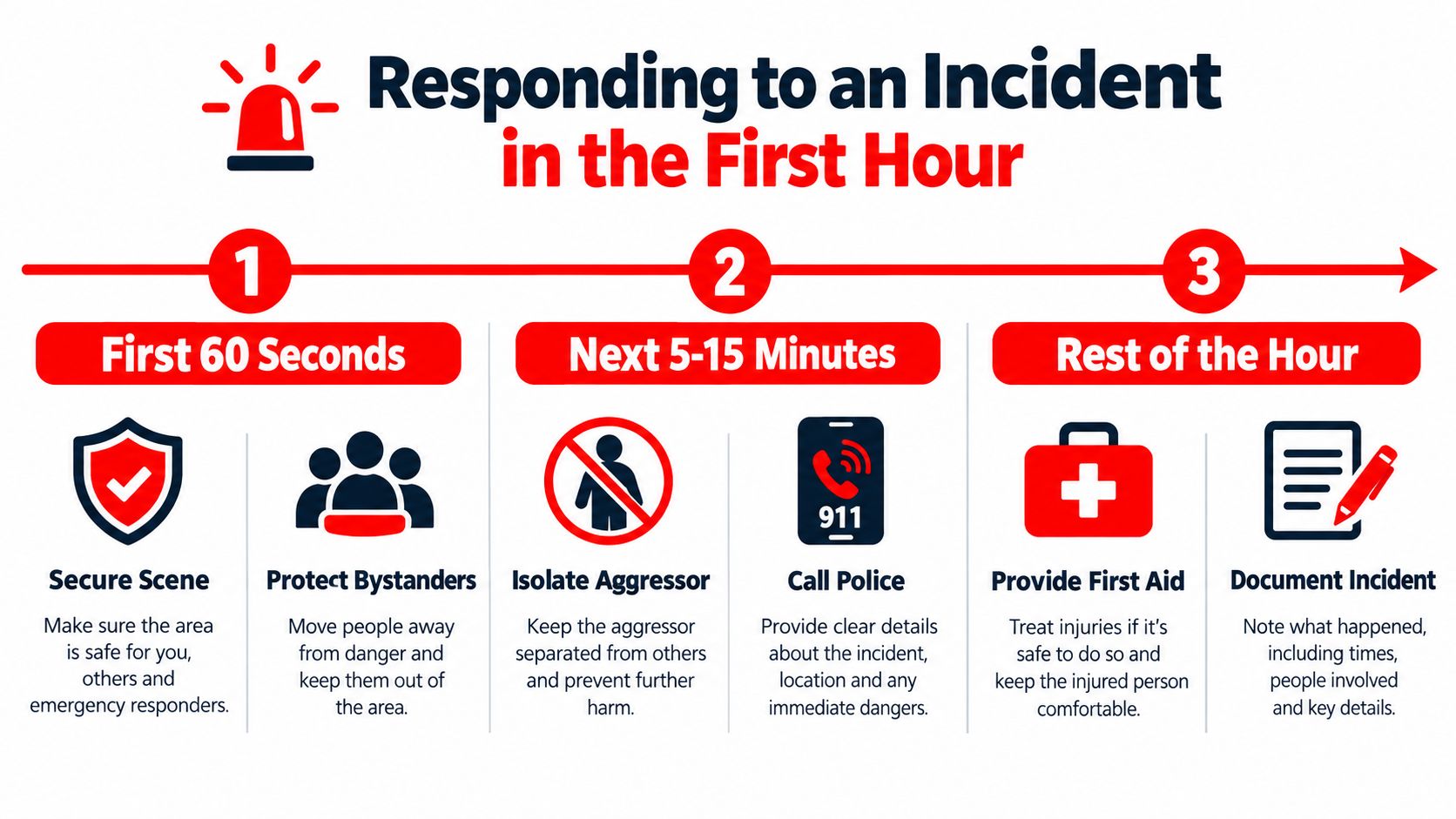
The first 60 seconds
The nearest trained person should create distance, direct bystanders away and trigger duress communications. Don't chase an aggressor into an unsafe area. Isolate the immediate danger where it can be done safely, call police when a criminal act or continuing threat meets that threshold, and arrange first aid for anyone injured.
- Secure the area: Keep staff and customers away from the conflict point.
- Protect exits: Prevent crowd compression and keep an escape route available.
- Trigger assistance: Use radio, duress or emergency communication procedures.
- Avoid escalation: Don't argue, threaten or physically intervene beyond training and lawful authority.
The next 5 to 15 minutes
The duty manager takes control of coordination. Separate witnesses so accounts aren't influenced, identify the affected worker, preserve CCTV and access records, and note the exact location and time while memories are fresh. Notify the security supervisor, WHS contact and relevant senior manager according to the site plan.
A licensed venue should also check whether the event involved refusal of service, intoxication management or a breach of its RSA procedure. A retail manager may need to secure the counter and preserve footage. A site supervisor should protect the scene, control access and account for contractors.
The rest of the hour
Provide first aid and arrange appropriate medical or counselling support. Take factual statements, not speculative conclusions. Record what people saw, what staff said, what controls were active and where the response broke down.
Record the sequence, not the story. Write what happened, when it happened and who did what.
- Notify: Complete internal notifications before the shift ends where practicable.
- Preserve: Save relevant CCTV, radio logs, access data and photographs.
- Support: Check on affected workers privately and explain the next step.
- Escalate: Confirm police, regulator or insurer notifications where required.
- Review: Schedule a formal investigation rather than closing the matter with a quick debrief.
During the first week, compare the event with the risk assessment, identify root causes, update controls and brief the affected team. The purpose isn't to blame the worker who made a difficult customer interaction. It's to find out why the system allowed the situation to reach that point.
Monitoring, Compliance and Continuous Improvement
A workplace violence prevention programme needs a management rhythm. Track leading indicators before an injury or compensation claim forces attention. A site that records repeat-offender flags, near-misses, response delays and unresolved corrective actions can see deterioration earlier than a site that counts only assaults.
Useful monthly measures include incident frequency per 1,000 shifts, time-to-report, repeat-offender flags, training completion, security coverage and corrective actions closed. These measures don't replace investigation. They show whether the controls are being used and whether the same exposure keeps returning.
Build a 90-day operating loop
During the first month, check reporting quality, radio coverage, duress testing, lighting, access points and policy comprehension. In the second, run a scenario exercise with the people who work the shift. In the third, review trends, close overdue actions and change the risk assessment where the operating environment has changed.
Quarterly drills should test a specific failure point, such as a blocked exit, a repeat customer returning after exclusion, a construction gate breach or an aggressive visitor entering reception. Refresh the full policy annually, and update it sooner after a serious incident, layout change, new contractor arrangement or material change in trading conditions.
State-by-state monitoring snapshot
| State / Requirement | Reporting Trigger | Monitoring KPI | Review Cadence |
|---|---|---|---|
| NSW, WHS and licensed venues | Incident, threat, injury, unsafe work or RSA-related escalation | Reporting time, repeat-offender flags and corrective actions | Monthly checks, quarterly drill |
| Victoria, WHS and licensed venues | Violence, aggression, injury, threat or control failure | Training completion, response coverage and incident quality | Monthly checks, quarterly drill |
| Queensland, WHS and licensed venues | Reportable event, threat, injury or unsafe workplace condition | Incident patterns, duress tests and action closure | Monthly checks, quarterly drill |
| ACT, WHS and licensed venues | Threat, assault, injury, near-miss or RSA-related issue | Repeat patterns, response time and policy acknowledgement | Monthly checks, quarterly drill |
State obligations vary, so operators should confirm notification and licensing requirements with the relevant regulator and liquor authority rather than relying on a generic national template. Safe Work Australia's small-business guidance emphasises safe physical and online environments, prevention and response, and encouraging workers to report concerns. (Safe Work Australia small-business workplace violence guide)
The key test is simple: can a manager show what changed after the last incident? If the answer is no, the programme is recording events but not preventing recurrence.
GM GROUP Services provides licensed security, risk assessments, static and mobile officers, access control, loss prevention and emergency response for venues, events, retail and construction sites across NSW, VIC, QLD and the ACT. Review how GM GROUP Services can help you build a fit-for-purpose workplace violence prevention plan and put the right controls on shift.
Discover more from GM Group Services
Subscribe to get the latest posts sent to your email.