
What Is VIP Protection starts with a practical problem. You've got a keynote speaker, artist, executive, politician, or public figure arriving at a venue that already has queues, staff movement, deliveries, alcohol service, media attention, and the usual last-minute changes. Standard event security can manage access points and crowd flow. It often can't manage the personal risk that follows one specific individual.
That's where many organisers get misled. They ask for “a bodyguard,” but what they need is VIP protection. In Australia, that means a planned close-protection service built around compliance, movement control, venue coordination, and emergency options. It isn't theatre. It isn't a large guard standing beside a client trying to look intimidating. It's a risk-management function designed to reduce exposure before anything goes wrong.
If you're hiring for a festival, licensed venue, conference, hotel arrival, executive roadshow, or high-profile appearance, the right question isn't “Do I need someone to stand near them?” The right question is “What risks attach to this person's movements, profile, schedule, and environment, and how will the protection plan control them?”
What Is VIP Protection and Why It Is More Than a Bodyguard
What Is VIP Protection in practical terms? It's a professional security function that protects a high-profile person through advance planning, risk assessment, controlled movement, physical protection, communication, and emergency response.
That's very different from the popular idea of a bodyguard.
A bodyguard, as many buyers imagine it, is reactive. Someone visible. Someone who steps in after a problem starts. Professional VIP protection is proactive. The strongest work usually happens before the protectee arrives on site at all. Routes are checked. Entry and exit timings are controlled. Exposure points are identified. Venue staff know who to call and what not to do. The team plans for disruption, not just assault.
In Australia, that distinction matters because the work sits inside a regulated security environment. Public guidance referenced in this overview of VIP protection services in Australia notes that in New South Wales a security master licence is valid for 5 years, while in Victoria a security guard licence has a 2-year validity period. That licensing structure tells you something important. Real VIP protection isn't informal personal muscle. It operates inside a compliance framework.
What event organisers usually get wrong
The most common mistake is treating VIP protection as an add-on. The organiser locks in production, ticketing, artist liaison, media access, and bar operations, then asks security for “one close guy” the day before.
That approach fails because personal protection depends on details that sit outside the guard's arm span:
- Arrival method: Front entrance, basement, loading dock, or private side access all create different exposure.
- Crowd behaviour: Fans, protesters, guests, media, and intoxicated patrons behave differently.
- Venue conditions: A licensed venue with RSA obligations needs a different operating style than a corporate lobby.
- Schedule pressure: Tight runs between green room, stage, meet-and-greet, and vehicle handover create predictable vulnerability.
Practical rule: If the person's movement matters as much as their destination, you're no longer talking about ordinary guarding.
What good VIP protection actually delivers
A competent protection plan gives the principal freedom to appear, speak, move, and leave without the event losing control. It also protects your venue's reputation. Heavy-handed security can create almost as many problems as weak security. The point is calm control, not drama.
For organisers, the value is simple. VIP protection reduces avoidable exposure, supports compliance, and gives you a clearer response plan when timings, crowds, or behaviour change fast.
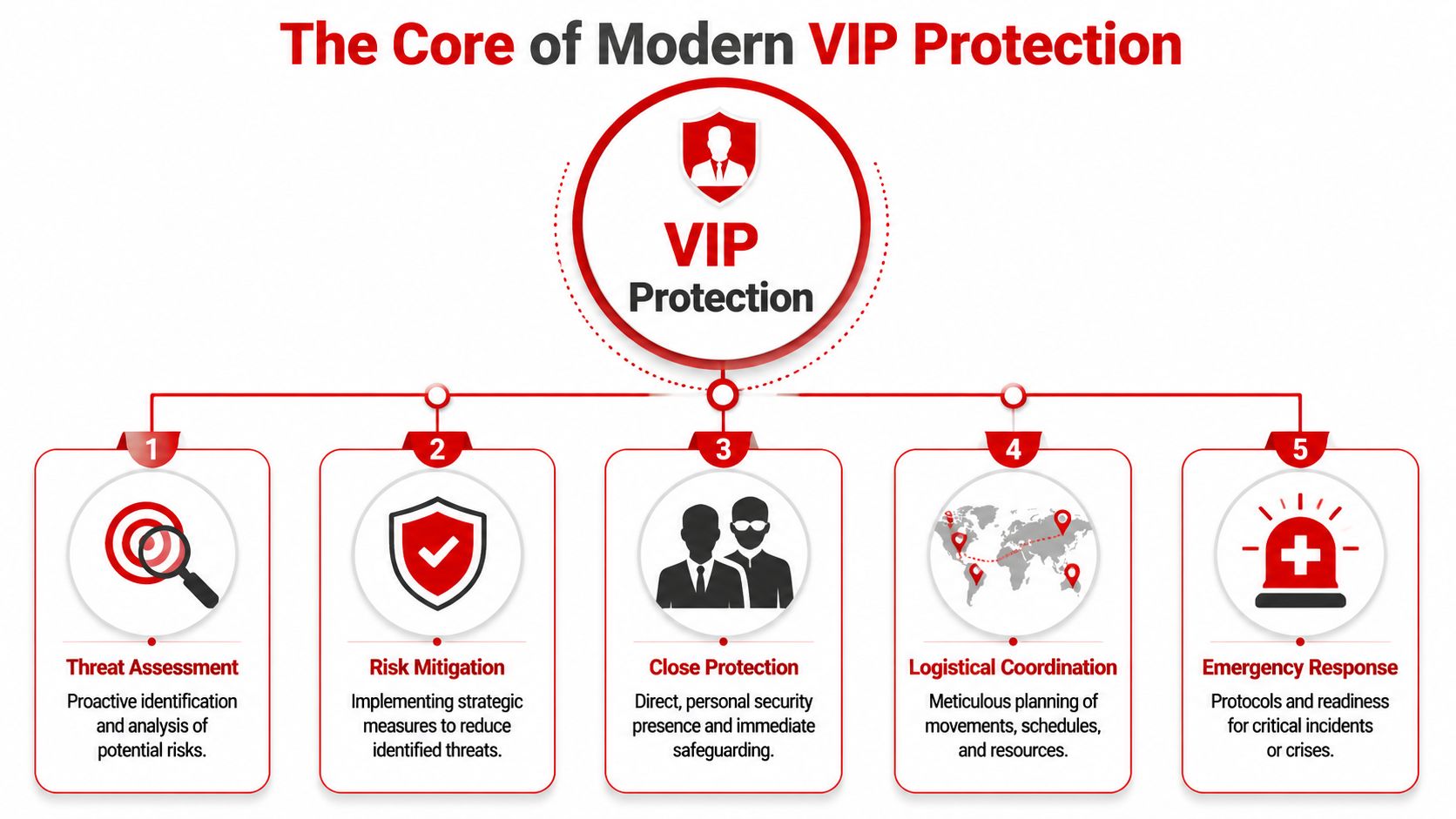
The Core of Modern VIP Protection
Modern VIP protection works more like air traffic control than a human shield. The team isn't just there to absorb danger. It's there to sequence movement, reduce uncertainty, and keep the protectee on a controlled path through changing conditions.
What sits underneath VIP protection
At the operational level, VIP protection has several moving parts working at once.
| Component | What it means on the ground |
|---|---|
| Threat assessment | Identifying likely risks tied to the person, event, route, audience, and location |
| Risk mitigation | Adjusting timings, access points, room layouts, staffing, and transport to cut exposure |
| Close protection | Maintaining immediate personal safety around the principal |
| Logistical coordination | Aligning movements with venue staff, drivers, organisers, and control points |
| Emergency response | Having a rehearsed option for extraction, medical response, or lockdown |
A Close Protection Officer or personal protection officer doesn't just “stay close”. The officer watches space, people, timing, bottlenecks, sightlines, and behavioural change. Good operators are reading the environment constantly. They're noticing what shouldn't be there, who is moving with intent, and where a route starts to collapse.
The layered model that actually works
Professional work uses layers, not a single person floating beside the client. The basic tactics used in VIP protection teams describe a layered close-protection model where a personal protection officer sits in the inner ring and support members build outer rings using formations such as Box, Diamond, and V.
That matters because threats don't always arrive head-on. A layered structure gives the team room to channel pressure, preserve distance, and move the principal without bunching up.
The same guidance also explains that teams may split into a fixation module and an evacuation module when a danger is announced. In plain language, part of the team deals with the problem while another part gets the principal off the X and into a safe route.
Good protection isn't judged by how well someone fights. It's judged by how smoothly the person never gets trapped in the first place.
What works and what doesn't
What works:
- Advance route checks
- Clean entry and exit plans
- Direct liaison with venue operations
- Clear comms between protection, transport, and organiser
- Alternative movement options
What doesn't:
- Last-minute deployment with no recon
- Using generic crowd controllers as a close-protection team
- Public meet-and-greets with no separation plan
- Overt security posturing that escalates attention
- No extraction route beyond “back through the crowd”
In practice, the best VIP protection often looks uneventful. That's the point.
Key Types of VIP Protection Services
Not every job needs the same style of protection. Event organisers usually do better when they stop asking for a generic package and start matching the service type to the actual risk.
Overt VIP protection
This is the visible model. The protection team is identifiable, close to the principal, and clearly controlling space.
Use it when visibility is already high. Think red carpet arrivals, festival headliners, political appearances, public signings, or situations where the presence of a protection team itself helps deter interference.
The advantage is obvious control. The downside is that overt teams can attract more attention, particularly if the operators are too theatrical or too physically dominant for the venue.
Covert VIP protection
Covert protection aims to stay low-profile. The officer blends into staff, guests, or the wider operating environment while still maintaining surveillance and intervention capacity.
This works well for corporate executives, private dinners, hotel stays, board meetings, and discreet hospitality settings where a visible security detail would create friction. It also suits clients who want privacy more than display.
The trade-off is that covert work demands stronger planning and sharper communication. You can't rely on visible deterrence, so positioning and timing have to be right.
Residential and static protection
Some principals need protection around accommodation, homes, private suites, or holding rooms rather than only during movement. In event terms, this often means securing green rooms, backstage areas, hotel floors, loading access, and private waiting zones.
This isn't glamorous work, but it matters. Many exposure points happen in transitional spaces where people assume they're already “inside” and therefore safe.
Travel and movement protection
A lot of risk sits between locations. Vehicle transfers, airport pickups, hotel arrivals, and venue departures are where schedules tighten and predictability increases. That's why secure movement should be treated as part of the protection plan, not a separate booking. If transport is a major part of the job, this guide to ground transport for high-net-worth clients is useful context because it shows how the vehicle layer supports the broader protection task.
Matching the service to the scenario
Here's the practical test.
- Music artist with fan attention: Overt team plus controlled transport and backstage access.
- CEO attending a conference: Covert protection with route management and hotel coordination.
- Speaker at a polarising event: Layered close protection with strong exit planning.
- High-value guest at a licensed venue: Low-profile protection integrated with venue operations and RSA-sensitive conditions.
The mistake is over-servicing low-risk appearances or under-servicing complex ones. A single visible guard may be enough for presence. It usually isn't enough for movement control, route security, and contingency response.
When You Really Need What Is VIP Protection
Most organisers don't need VIP protection for every guest. But when the threshold is met, standard event security isn't enough.
The right trigger isn't wealth or status on its own. It's the combination of profile, exposure, movement, access pressure, and threat environment. If those factors stack up, the risk becomes personal rather than purely site-based.
Practical thresholds organisers can use
Ask these questions before you decide.
- Is the person publicly recognisable? A known face changes crowd behaviour fast.
- Will they move through uncontrolled or semi-controlled spaces? Entries, foyers, carparks, corridors, and public-facing hospitality areas matter.
- Is there likely to be emotional crowd contact? Fans, critics, activists, media, or intoxicated patrons create different forms of pressure.
- Is timing tight? Compressed schedules remove options.
- Would a disruption affect safety, reputation, or operations? Some incidents don't need to be violent to become serious.
If you answer yes to several of those, you should at least assess close protection rather than relying on standard guarding.
Australian risk context matters
This isn't only about rare edge cases. The Australian crime figures referenced in this market overview reported 1.8 million total victims of personal, household, and property crime in 2022–23, with 3.8% of people aged 15 and over experiencing personal crime. That same release notes 3.5% experienced physical assault and 1.0% experienced threatened assault.
Those numbers don't mean every event needs a protection detail. They do mean public-space risk is real enough that high-profile individuals shouldn't be planned around casually.
If your event increases attention around one person, that person needs a dedicated risk plan, not just nearby guards.
Scenarios where VIP protection is justified
A festival headliner is a clear example. The crowd knows when the artist is due. Phones are out. Back-of-house is busy. Vehicle movements can be exposed. A generic security team may secure gates and stage pits, but the artist still needs controlled arrival, backstage separation, and a clean extraction plan.
A controversial speaker is another. The issue isn't celebrity. It's friction. The threat may come from protest, confrontation, or organised disruption around access points.
A corporate case is often quieter but still significant. A board chair, founder, or executive attending a public conference can draw targeted attention even when the event itself looks low-drama. Meet-and-greet requests, media contact, and predictable routes create opportunity.
When standard event security is enough
Standard event security is usually enough when the guest has low public recognition, the route is controlled, the schedule is simple, and there's minimal reason for focused interference. In those cases, adding close protection can create more visibility than the job warrants.
The smart call is proportionality. Professional organisers don't buy VIP protection because it sounds premium. They use it when the event creates concentrated personal risk that ordinary site security won't manage well.
Australian Standards and Compliance Explained
In Australia, VIP protection is only professional if it is also compliant. That's not paperwork for its own sake. Compliance affects who can lawfully work, how they operate, and whether your venue ends up exposed when something goes wrong.
Licensing is the baseline, not the finish line
A provider needs the right state licensing setup for the work they are doing. If they can't explain their licensing clearly, stop there.
The Australian market treats security as a regulated occupation, and close protection sits within that broader licensed environment. That matters because event organisers often assume “VIP” work is somehow outside normal compliance. It isn't. It has to fit the same legal and operational framework as other security functions, while carrying a higher expectation around planning and accountability.
Licensing alone still doesn't tell you whether the operator can effectively run a protection task. It tells you they have at least crossed the legal threshold to operate.
RSA-sensitive venues change the job
The guidance on VIP protection duties and responsibilities makes an important point. True VIP protection is risk management, not just a visible guard presence. In Australia, that means the provider has to integrate with venue compliance requirements, including RSA-sensitive environments, while handling route reconnaissance and emergency coordination with venue staff.
That's a major issue in bars, clubs, hotels, and festival hospitality zones.
Protection officers in those environments need to understand:
- How alcohol service affects patron behaviour
- How to remove the principal without escalating a crowd
- When venue policy controls the response
- Who inside the venue has operational authority
- How to protect the client without disrupting lawful service unnecessarily
A protection operator who ignores RSA realities can create conflict with management, floor staff, and licensing conditions.
A close-protection plan that doesn't fit the venue's rules isn't a professional plan. It's a liability.
What organisers should verify before engagement
Don't settle for a vague promise of “experienced bodyguards”. Ask specific questions.
| Check | Why it matters |
|---|---|
| State licensing | Confirms the provider is authorised for the work in that jurisdiction |
| Insurance position | Protects the event and clarifies responsibility |
| Venue integration process | Shows whether they can work with operations, not around them |
| Risk assessment method | Tells you whether they plan or just deploy |
| Communication system | Determines how quickly information moves under pressure |
| Experience in licensed venues | Critical where alcohol, crowd density, and reputation intersect |
What weak providers usually reveal
They focus on appearance instead of method. They talk about “muscle”, “presence”, or “having your back” but not route planning, advance work, or liaison with venue management. They can't explain how they'd run arrivals, internal movement, or emergency extraction in a club, festival compound, or hotel.
That's the wrong fit for Australian events. The job is to protect the principal while preserving compliance, customer experience, and operational control.
How to Hire the Right Provider and The GM GROUP Standard
A provider earns trust before the event starts. The test is simple. Can they explain how they will reduce risk, fit inside your venue rules, and document decisions if something goes wrong?

For Australian organisers, that standard matters more than style or size. A polished team with no clear licensing position, weak reporting, or poor coordination with venue management will create work for your operations staff and expose you to avoidable problems. A good provider makes the day easier to run. A weak one shifts pressure onto your team.
Use this shortlist when assessing providers
- Ask for the operating model: They should define whether the task is overt, low-profile, static, mobile, or a mix, and explain why that approach fits the risk.
- Ask who owns movement planning: One person should control routes, timings, arrivals, departures, and fallback options.
- Ask how incidents are recorded and escalated: You need clear reporting, live updates, and a process for sharing information with the organiser, venue, and emergency services if required. Earlier in the article, we noted that modern protection work often includes GPS visibility, mobile reporting, and central monitoring.
- Ask how they handle compliance in licensed venues: A capable provider should be able to speak clearly about RSA conditions, patron management, and how they protect a principal without interfering with lawful venue operations.
- Ask for comparable experience: They do not need to name clients. They should be able to describe similar environments, risk profiles, and operating constraints.
A practical benchmark for organisers
I use one question as a filter. Will this provider adapt to the event, or will the event end up adapting to them?
The right provider builds around your run sheet, venue rules, entry points, alcohol service conditions, transport timing, and stakeholder chain of command. They know when a single close protection officer is enough, when an advance operative is needed, and when the job has crossed into a broader security operation that needs supervision, reporting discipline, and formal liaison with the venue and police. That judgment is what separates professional VIP protection from informal bodyguarding.
GM GROUP Services is one example of a provider operating in this space, with licensed coverage across NSW, VIC, QLD and the ACT, including VIP and venue-based deployments. For organisers, the relevant point is not the name. It is whether the provider can show state-by-state licensing, work inside Australian venue compliance settings, and communicate clearly with your event control team on the day.
Frequently Asked Questions About VIP Protection
What's the difference between a bodyguard and a Close Protection Officer
A bodyguard is often used as a catch-all term. A Close Protection Officer works inside a structured protection plan. The role includes movement control, surveillance of the immediate environment, route discipline, coordination with transport and venue staff, and emergency action if conditions change. The difference is planning and method.
Can VIP protection be completely covert
It can be low-profile, but never invisible in an operational sense. Even covert work needs someone controlling access, movement, communications, and fallback options. The aim is discretion, not pretending the risk doesn't exist.
How much lead time should organisers allow
More time is always better because advance work matters. A simple, low-profile task may be arranged faster than a complex multi-site movement plan, but organisers should avoid leaving it until the last moment. If the event includes transport, media, hospitality, backstage areas, or licensed service, early planning gives the protection team room to reduce exposure instead of just reacting to it.
Is VIP protection only for celebrities
No. It's also used for executives, politicians, speakers, investors, dignitaries, and high-profile attendees whose role, visibility, travel pattern, or threat profile creates personal risk. Public recognition is one trigger, but it isn't the only one.
Does standard event security replace VIP protection
Usually not. Standard event security protects the site. VIP protection protects the person. On some jobs the two work side by side. That's often the safest arrangement because each team handles a different part of the risk picture.
If you're planning an appearance, event, venue activation, or executive movement that needs more than generic guarding, GM GROUP Services can help assess the risk, match the right protection model, and align the deployment with Australian licensing and venue requirements.
Discover more from GM Group Services
Subscribe to get the latest posts sent to your email.