
Professional conduct in Australia is the set of enforceable behaviours, honesty, competence, confidentiality, accountability, respect, that sit inside industry codes and state regulations. It's not just manners, and if you manage security, events, hospitality, retail, or construction, that difference changes how you run a site.
What is Professional Conduct in practice? It's the gap between someone looking polished and someone being able to prove they followed the rules, protected information, and made decisions that can stand up to scrutiny. In frontline work, that's the difference between a routine interaction and a complaint, a breach, or a compliance problem.
Redefining Professional Conduct Beyond Workplace Manners
The usual advice on professional conduct is too soft for Australian operations. Punctuality, polite language, and clean uniforms matter, but they're not the test. The test is whether a worker follows written obligations on honesty, competence, confidentiality, and accountability when a client, patron, contractor, or regulator is watching.
Australia's ethics frameworks make that shift explicit. The Australian Board of Statistics' ethical guidance for statisticians requires objectivity, avoidance of predetermined outcomes, protection of confidential information, and disclosure of conflicts of interest, while the 2023 revised professional ethics framework names responsibility, competence, truthfulness, integrity, independence, objectivity, and transparency as professional values, with methods and findings to be presented “openly, completely, and in a transparent manner” (ethical guidance and professional values). That same logic travels well into security and site operations, because supervisors need conduct they can audit, not just behaviour they can admire.
Why the old etiquette model falls short
In the field, “good manners” doesn't answer the hard questions. Did the guard disclose a conflict? Did the incident report match what happened? Did the team member protect confidential information instead of chatting about it in a loading dock or at a bar? Those are conduct questions, and they're measurable.
Practical rule: If a behaviour can't be checked against a policy, report, licence condition, or code, it's not a strong enough standard for a regulated site.
That's why modern professional conduct is less about appearance and more about compliance. In high-contact environments, a calm tone helps, but lawful action, accurate reporting, and disciplined escalation matter more. A venue owner may like “nice people”, but a regulator cares whether staff followed the process and handled information properly.
The Core Pillars of Professional Conduct in Australia
The strongest Australian conduct frameworks rest on a small set of pillars that translate cleanly into frontline behaviour. They're not abstract virtues. They're the practical filters supervisors use when deciding whether a worker can be trusted with access, information, and public interaction.
From values to observable actions
The ethical frameworks referenced above place responsibility, competence, truthfulness, integrity, independence, objectivity, transparency, fairness, impartiality, nondiscrimination, accountability, and confidentiality at the centre of conduct expectations (Australian ethics framework). In practice, those values become specific actions.
- Honesty: A guard reports what happened, not what sounds tidy.
- Competence: A worker follows the site procedure they were trained on, not their own shortcut.
- Confidentiality: Personal details, incident notes, and patron issues stay inside the proper chain.
- Accountability: The person who made the decision can explain why it was made.
- Respect: Staff speak to patrons and contractors without humiliation, threat, or baiting.
- Non-discrimination: Access decisions and complaint handling don't change because of race, gender, disability, or culture.
- Transparency: The report shows what was observed, what action was taken, and what was handed over.
What supervisors should look for
You don't need a vague “good attitude” score. You need evidence. Was the ID check completed the same way every time? Did the officer preserve privacy when dealing with an intoxicated guest? Was a deviation from procedure recorded and escalated? That's how conduct becomes auditable.
A professional team doesn't rely on memory. It relies on repeatable behaviour, written instructions, and a clean record of who did what.
For a useful self-assessment tool that maps behaviour expectations into practical workplace language, see the acceptable behaviours overview. It's useful because it reminds managers to turn broad expectations into visible conduct standards, not just slogans.
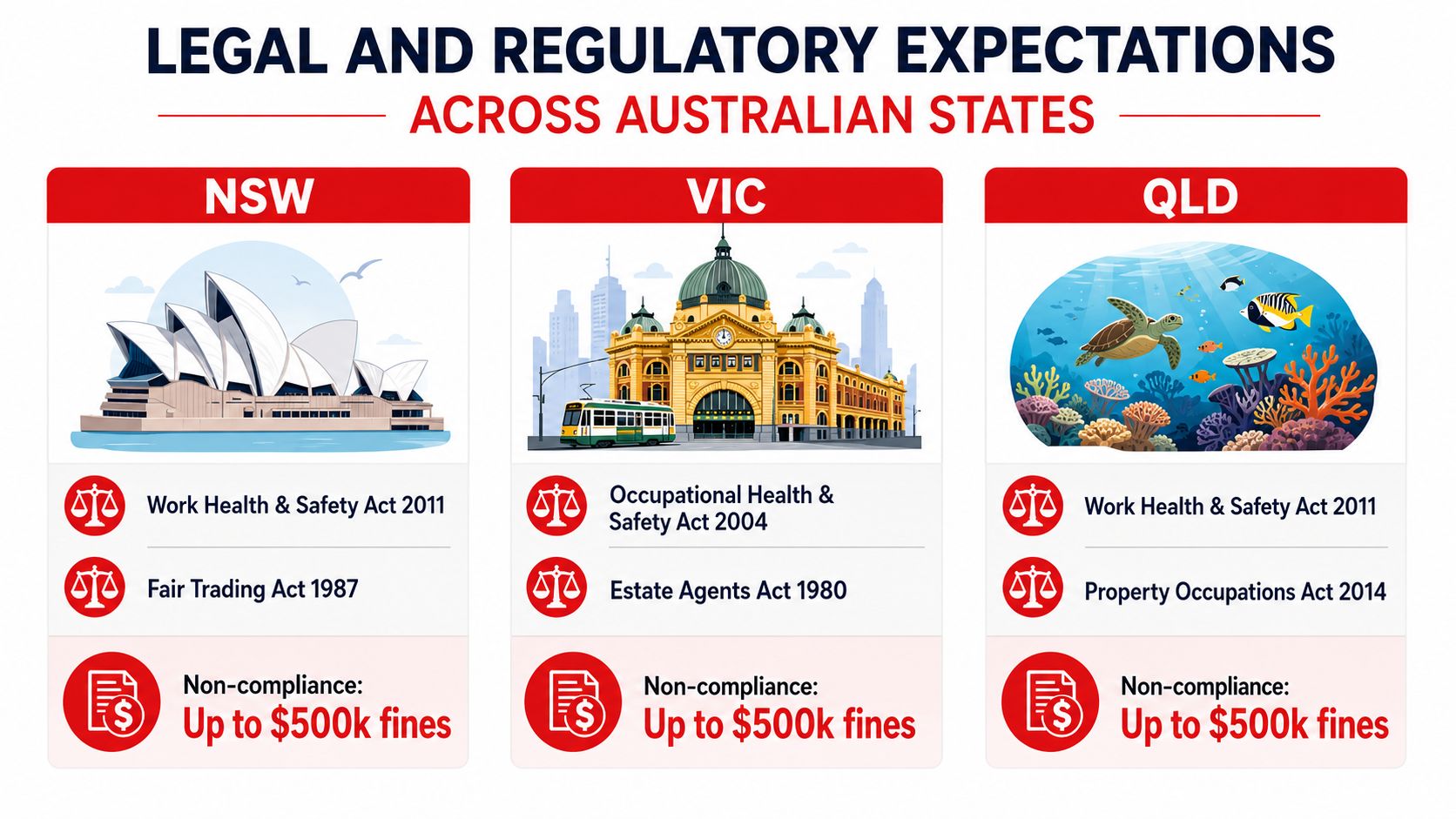
Legal and Regulatory Expectations Across Australian States
In Australia, professional conduct is not just a workplace preference. In licensed security work, it sits inside the compliance framework, and a conduct failure can quickly become a regulatory failure. In NSW, the Security Industry Act 1997 and related licensing controls place security providers and officers under formal rules, so conduct problems can trigger regulatory consequences, not just managerial follow-up (security compliance context).
What changes when the work is licensed
The standard on the ground is straightforward. Keep the licence current, follow lawful directions, document incidents accurately, and do not misstate qualifications. If a worker lets a licence lapse, gives misleading evidence, or mishandles confidential information, the problem has moved beyond poor performance. It is now a compliance issue.
That applies across NSW, VIC, QLD, and the ACT because frontline staff often work in public spaces where they are expected to act inside a clear chain of command. A patrol officer at a retail site, an event crowd controller, or a gatehouse operator needs to know when to escalate, what to record, and how to preserve evidence. Written standards beat workplace mood every time.
The grey area most teams miss
A lot of breaches happen in small, fast decisions. A supervisor tells a guard to “just sort it out”, the guard improvises, and later nobody can prove the decision was lawful or aligned with policy. That is why professional conduct has to be trained as a process, not a personality trait.
For managers briefing mixed teams quickly, the acceptable behaviors overview gives a plain-language reference point for turning broad expectations into workable conduct standards. It is useful because it keeps the focus on what staff do, not on vague slogans.
Professional Conduct in Action Across Five Key Industries
Conduct standards only make sense when they're tested under pressure. In security, events, hospitality, retail, and construction, the same rule can look different, but the underlying expectation stays constant. Act with integrity. Protect information. Respect people. Record accurately. Escalate properly.
Security and events
A guard working a late-night venue doesn't need to win an argument with an intoxicated patron. The professional move is calmer and harder. Keep the voice low, avoid crowd-raising language, preserve dignity, and call for support only when the situation needs it. That aligns with conduct benchmarks that emphasise respectful communication, confidentiality, and non-discrimination, especially where patrons or guests are distressed or excluded (professional and personal conduct benchmark).
At events, the same standard applies when handling a discrimination complaint or a welfare issue. The supervisor doesn't gossip, minimise, or improvise a story for the client. They log the complaint, isolate the facts, and hand over cleanly.
Hospitality and retail
Hospitality teams deal with intoxication, refusal of service, and privacy issues every shift. Professional conduct means staff don't embarrass patrons in front of a crowd, and they don't discuss a guest's condition across the bar. Retail teams face different pressure, but the conduct test is similar. A loss-prevention officer who treats a suspected shoplifter with contempt can create more risk than the original incident.
Construction and site operations
On a construction site, schedule pressure can push people to cut corners. Professional conduct is the decision to stop, document, and follow safety instructions even when the next task is waiting. The OACETT code's peer-referenced standard, avoiding conduct that would be regarded as “disgraceful, dishonourable or unprofessional”, is useful here because it ties behaviour to competence, integrity, and compliance with legislation (OACETT code).
If a worker can't explain a decision in writing, it probably wasn't professional enough for a regulated site.
For teams that need practical support across these environments, GM GROUP Services is an example of a security provider that works across events, venues, retail, and construction with licensed deployment, reporting, and supervision built into the operation.
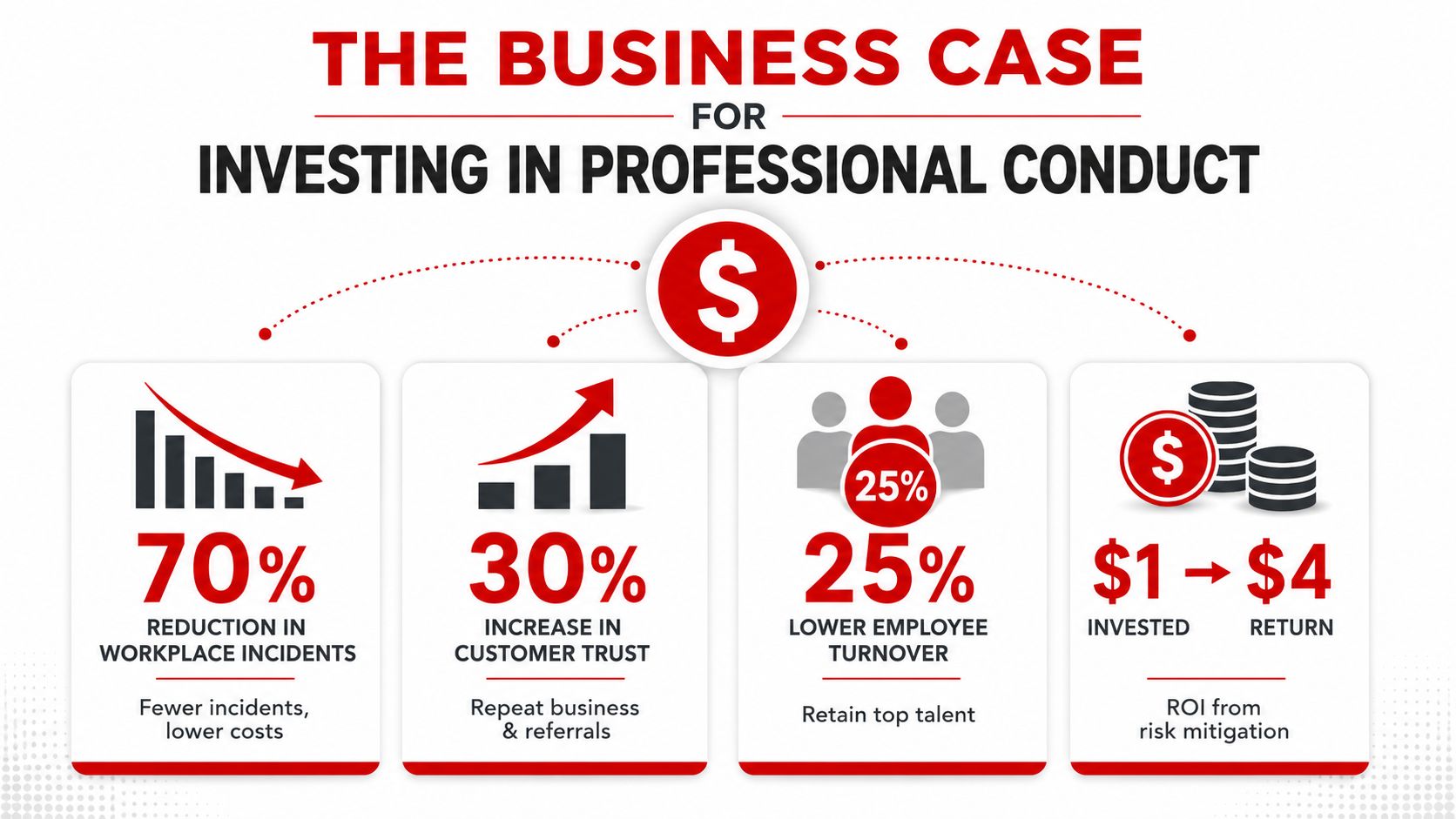
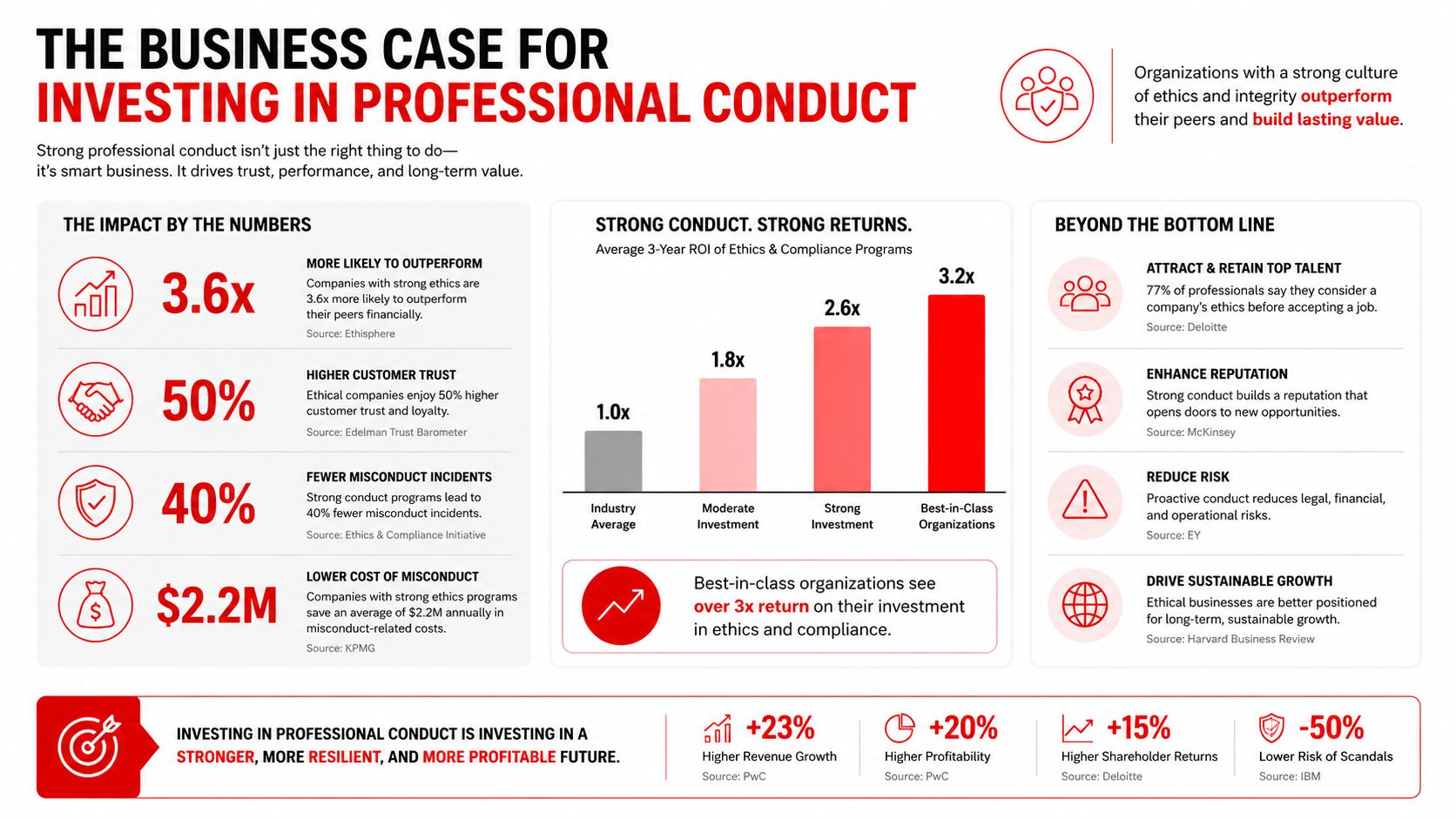
The Business Case for Investing in Professional Conduct
Professional conduct pays for itself because it reduces the kind of mistakes that create cost. When staff de-escalate properly, document accurately, and follow procedure, managers spend less time dealing with complaints, rework, and avoidable conflict. That's not soft value. That's operational control.
What changes on the balance sheet
The business case shows up in three places. First, fewer escalations mean fewer reportable incidents and less time spent on cleanup. Second, consistent conduct improves auditability, which helps when a client asks for evidence after an incident. Third, respectful treatment and reliable communication strengthen trust with tenants, patrons, contractors, and clients.
A useful mental model is to treat conduct as part of risk management, not a separate people initiative. The same team culture that keeps a crowd interaction calm also helps a supervisor write a report that stands up under review. In practice, that protects contract retention and brand reputation because clients remember how a site behaved when something went wrong.
What investment should actually look like
Training has to be specific. Staff need scenario practice, not just a policy PDF. They also need supervision that checks the quality of reports, the tone of interactions, and the consistency of escalation. For workplace wellbeing resources that sit alongside conduct and supervision, support employee well being is a useful lens because tired, unsupported teams are less likely to sustain disciplined behaviour under pressure.
The point isn't to create robotic staff. It's to create teams who can stay composed, accurate, and lawful when the room turns difficult.
Implementing and Monitoring Professional Conduct on Site
Good standards fail when nobody measures them. If you want professional conduct to hold up on a live site, build it into the same systems you use for safety, access control, and incident reporting. That means training, supervision, escalation, and review.
A simple operating playbook
Start with role-specific training. A gatehouse officer, an event floor supervisor, and a site patrol guard don't need identical examples, but they do need the same conduct principles. Then pair that with direct observation. Managers should review body language, tone, report quality, and adherence to lawful directions, not just attendance.
Next, use escalation pathways that are clear enough to work at 2 a.m. under pressure. If a staff member faces aggression, discrimination complaints, or intoxicated behaviour, they should know exactly when to ask for backup, when to preserve evidence, and when to hand over. GM GROUP Services, for example, builds reporting and supervision into its security operations, which is the sort of structure that helps turn conduct standards into routine practice.
Checklist for supervisors
- Set the standard: Write the conduct expectations in plain language, then link them to site rules.
- Train for scenarios: Use role-play for refusals, ejections, welfare checks, and complaint handling.
- Review incident reports: Check for accuracy, neutrality, and complete handover notes.
- Watch the interactions: Observe how staff speak to patrons, contractors, and the public under stress.
- Escalate early: Don't wait for a small breach to become a public incident.
- Correct consistently: Deal with minor lapses the same way every time so the standard doesn't drift.
A final practical point. If the site culture rewards “sorting it out discreetly” over reporting accurately, conduct will slide. Staff do what supervisors reward, not what policies promise.
Frequently Asked Questions About Professional Conduct
Does professional conduct apply to contractors and temporary staff? Yes. If they represent the site, handle information, or interact with the public, they need the same conduct standards as permanent staff. The contract may be shorter, but the expectation isn't.
What if a senior team member breaches conduct standards? Deal with it the same way you'd deal with anyone else. Seniority doesn't lower the standard. If anything, it raises the need for a documented response because junior staff watch what gets tolerated.
What happens when workplace culture conflicts with regulation? The regulation wins. A casual internal culture can't override licensing, confidentiality, or lawful reporting duties. If the culture is telling people to stay quiet about incidents, the organisation has a control problem.
Is conduct different in office roles and frontline roles? The core values stay the same, but the pressure points change. Office teams usually face document integrity and information handling. Frontline teams face direct public interaction, conflict, and rapid escalation, so their conduct training has to be more scenario-based.
Can conduct be improved without expensive programs? Yes. Start with clear standards, tighter supervision, and cleaner incident review. Most failures come from inconsistency, not from a lack of slogans.
If you need professional conduct standards translated into real site procedures, reporting habits, and frontline supervision, contact GM GROUP Services to discuss a practical security setup for your venue, site, or event.
Discover more from GM Group Services
Subscribe to get the latest posts sent to your email.