
Understanding what is a risk management plan is the first step toward safeguarding your business. A risk management plan is a formal document that lays out exactly how your organisation will spot, analyse, and control potential threats to its operations, people, and assets. Think of it as a strategic blueprint. It moves you beyond just ticking compliance boxes and gives you a proactive framework for handling uncertainty, ensuring everyone knows their role when things don't go to plan.
Decoding Your Risk Management Plan
Let's get practical. Imagine you're organising a major outdoor music festival in Sydney. Your job isn't just about booking bands and selling tickets; it's about thinking through everything that could possibly go wrong.
What if a massive storm rolls in without warning? What if there’s a medical emergency deep in the crowd? This is precisely where your risk management plan proves its worth. It’s your strategic guide for navigating all that uncertainty.
This plan is so much more than a document you create once and file away. For Australian businesses—whether you’re running a bustling Melbourne event venue or a sprawling Brisbane construction site—it’s a living, breathing tool. It details how you proactively find potential threats, figure out their likely impact, and put clear, actionable strategies in place to manage them before they spiral out of control.
Why Is This Plan So Important?
A well-thought-out plan is absolutely essential for protecting your business from multiple angles. It becomes the bedrock of your operational stability and safety, proving your commitment to due diligence. This builds incredible trust with your staff, your clients, and the public. To really get a handle on your plan, it helps to understand the bigger picture concepts of Enterprise and Risk Management (ERM).
A risk management plan isn't just about avoiding the bad stuff; it's about creating a stable, trustworthy, and resilient business. Below is a quick breakdown of its core functions and what they mean in the real world.
The Core Functions of a Risk Management Plan
| Core Function | What It Means For Your Business | Practical Example |
|---|---|---|
| Protecting People & Assets | This is the number one priority: creating a safe environment for everyone involved and keeping your physical assets secure. | For a music festival, this means having clearly marked first aid stations, security patrols to prevent theft, and sturdy crowd-control barriers. |
| Minimising Financial Loss | By thinking ahead, you can prevent expensive incidents that might shut down your operations or lead to legal battles. | Identifying a faulty generator before it fails prevents a costly power outage and potential ticket refunds during a live event. |
| Ensuring Legal Compliance | This keeps you on the right side of the law, meeting all your obligations under Australian safety regulations. | Your plan would detail how you'll enforce Responsible Service of Alcohol (RSA) rules and meet state-specific security licensing requirements. |
| Safeguarding Your Reputation | A clear commitment to safety screams professionalism, building a strong brand that people want to do business with. | When patrons see visible security and organised safety procedures, they feel looked after and are more likely to return and recommend your venue. |
Ultimately, a strong plan helps turn potential chaos into a manageable process, protecting your bottom line and your brand's future.
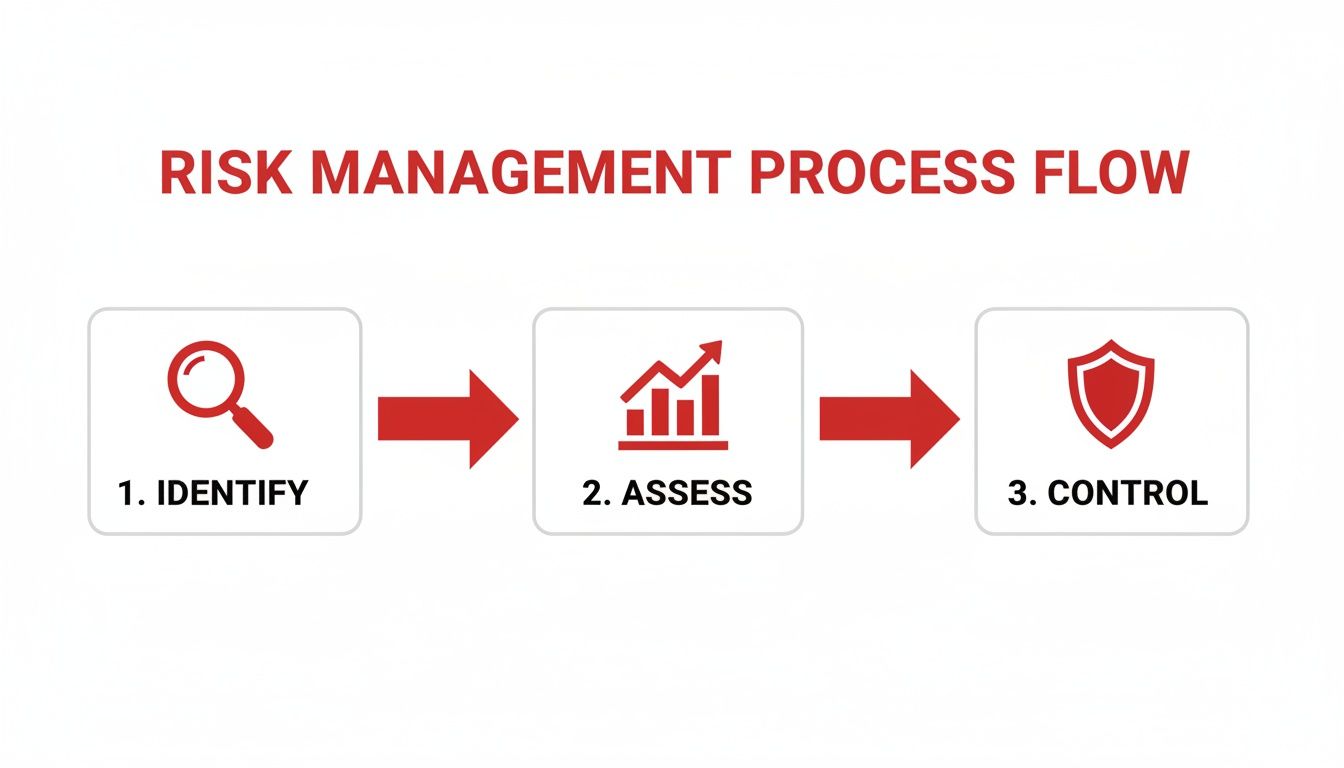
At the end of the day, effective risk management isn't a one-and-done task. It’s a continuous cycle of identifying, assessing, mitigating, and reviewing. This ongoing process is what builds true resilience, ensuring your business is ready for whatever challenges come its way.
The 5 Pillars of an Effective Risk Management Plan
So, what does a risk management plan actually look like in practice? It’s not just a one-off task but a living, breathing cycle built on five core pillars. Think of these as the essential stages that turn your plan from a document on a shelf into a practical tool that actively protects your venue, event, or worksite.
Each pillar flows logically into the next, creating a clear path from identifying a problem to taking decisive action. Getting this process right is the key to staying ahead of potential trouble and keeping your operations stable.
Pillar 1: Risk Identification
It all starts with Risk Identification. This is essentially a structured brainstorming session where you ask the big question: "What could possibly go wrong here?" The goal is to get everything out on the table and create a comprehensive list of potential hazards and threats unique to your specific situation.
Actionable Insight: Don't do this in isolation. Get your team involved—from frontline staff to management. A bartender in a Queensland pub will see different risks, like a slippery floor near the service area, than a security guard watching the main entrance. Everyone's perspective is valuable.
For a big event like a Sydney music festival, your list might include things like:
- Sudden, extreme weather – think heatwaves or flash downpours.
- Crowd surges near the main stage when a headline act comes on.
- Medical emergencies, from heatstroke to injuries in the crowd.
- Technical failures, like the sound system or stage lighting going down.
Pillar 2: Risk Analysis
Once you’ve got your list, it's time for Risk Analysis. This is where you dig a bit deeper into each potential issue. For every risk you've identified, you need to figure out its likelihood (how likely is this to actually happen?) and its potential impact (if it does happen, how bad will it be?).
Not all risks are created equal, and this step helps you see that clearly. A minor glitch with a decorative light is a nuisance, but a total power failure at the main stage is a catastrophe. Often, you'll use a simple matrix to score each risk, which makes the next step much more straightforward and less about guesswork.
Pillar 3: Risk Evaluation
With your analysis in hand, you can move on to Risk Evaluation. This is all about prioritisation. Using the likelihood and impact scores you just worked out, you can rank your risks from the most critical down to the least concerning.
A risk with a high likelihood and a high impact, like a crowd surge, needs your immediate and full attention. On the other hand, a risk with a low likelihood and low impact, such as a single merchandise stall running out of a particular t-shirt size, can be dealt with later.
This ranking process ensures you’re putting your resources—your time, money, and people—where they’ll make the biggest difference. You tackle the biggest threats first. Simple as that.
Pillar 4: Risk Treatment
Now it’s time for action. Risk Treatment, sometimes called risk mitigation, is where you choose and implement strategies to get your prioritised risks under control. For each major risk, you have a few options for how to handle it.
The main strategies fall into four buckets:
- Avoidance: Completely change your plans to eliminate the risk. Practical Example: Cancelling an outdoor concert because of a severe storm warning.
- Reduction: Put measures in place to lower the risk’s likelihood or impact. Practical Example: Adding more crowd control barriers and security personnel to manage large crowds safely.
- Transfer: Shift the financial fallout of a risk onto someone else. The most common example is buying public liability insurance.
- Acceptance: For small, minor risks, you might simply decide to accept them and do nothing specific.
Professional security is often a huge part of this pillar. Australia's private security industry is a massive field, generating around $11 billion annually and employing over 180,000 people – and it’s still growing. This gives businesses access to a wide range of specialised services, from static guards to electronic monitoring, that can effectively treat all sorts of risks. You can explore more about these industry trends and what they mean for modern security strategies.
Pillar 5: Monitoring and Review
Last but not least, a risk management plan is never "done." The fifth pillar is Monitoring and Review, and it’s a continuous loop. This means constantly keeping an eye on your identified risks, checking if your control measures are actually working, and updating your plan whenever things change.
Actionable Insight: Schedule a formal review of your plan at least once a year. Additionally, conduct a post-event debrief after every major function or incident to identify what worked, what didn't, and how the plan can be improved for next time.
Creating Your First Risk Management Plan: An Actionable Guide
Alright, you understand the theory. Now it’s time to roll up your sleeves and build a plan that works in the real world. Knowing what is a risk management plan is a great start, but creating one from scratch can feel like a massive undertaking.
Don’t worry. With a clear, structured approach, you can put together a practical document that genuinely protects your event or venue. This isn’t about writing a dense, jargon-filled report; it’s about creating a set of clear, actionable steps that your whole team can actually use.
Step 1: Assemble Your Risk Team
First things first: get the right people in the room. You can't do this alone, and trying to create a plan in a vacuum is a recipe for disaster. The best insights almost always come from the people on the front lines who see the potential problems up close every day.
- Practical Example (Event Manager): If you’re an event manager in Melbourne, you’ll want your head of security, bar manager, and lead first-aid officer at the table.
- Practical Example (Construction): For a construction supervisor in Brisbane, your team absolutely needs to include the site foreman, key contractors, and your workplace health and safety (WHS) representative.
Each person brings a completely different viewpoint, helping you spot a much wider range of potential risks you’d almost certainly miss on your own.
Step 2: Conduct a Thorough Walkthrough
Now, get out from behind the desk. Walk through your venue, festival site, or construction zone with your newly formed team. This physical inspection is non-negotiable for spotting hazards that just don’t show up on a blueprint or floor plan.
Actionable Insight: During your walkthrough, take photos and make notes. Look for things like uneven ground that could cause trips, poorly lit corners that might invite trouble, or pinch points where crowds could dangerously bottleneck. This hands-on method grounds your entire plan in the physical reality of your space.
Step 3: Use a Risk Register Template
Your risk register is the heart of your plan. Think of it as a master list where you log every single risk you've identified. For each risk, you’ll note its potential impact, how likely it is to happen, and exactly what you're going to do to manage it. Using a template is a lifesaver here, ensuring you don’t forget any crucial details.
A risk register isn't just a to-do list of problems; it's a dynamic tool for accountability. For each risk, it must clearly name the person responsible for monitoring it and making sure the control measures are actually in place.
Once you have the basics down, the next step is building the plan itself. For a more detailed breakdown, this practical guide to developing a risk management plan is an excellent resource.
Step 4: Document Everything Clearly
With all your findings in hand, it’s time to pull them together into a single, easy-to-read document. Ditch the corporate speak and overly technical terms. The goal here is pure clarity, so anyone from a casual event volunteer to a senior manager can quickly understand their role and responsibilities.
Use simple headings, bullet points, and tables to make the information easy to scan and digest. For instance, a nightclub in Sydney’s plan should clearly outline procedures for dealing with intoxicated patrons or managing long queues in straightforward language everyone understands.
Step 5: Communicate and Train Your Team
A brilliant plan is worthless if it just sits in a folder. The final, and arguably most important, step is to communicate the plan to every single staff member and give them the training they need to execute it.
Run briefing sessions before shifts or events to go over key risks and what to do in an emergency. This ensures that when something does go wrong, your team can react with confidence and skill. This is the step that turns your document from a piece of paper into a living, breathing safety strategy.
Putting Theory into Practice: Risk Management in the Real World
It’s one thing to talk about risk management plans in the abstract, but it’s another to see them in action. That’s where the concepts really start to make sense. Let's look at a few scenarios where a solid risk management plan isn't just a document—it's the backbone of a safe and successful operation.
These examples show you exactly how a plan gets off the page and into the real world, turning proactive thinking into practical, on-the-ground strategies that keep people and property safe.
Scenario 1: A Major Music Festival in NSW
Picture this: a huge multi-day music festival out in rural New South Wales, with 50,000 fans pouring in. The energy is incredible, but so is the potential for disaster. For the event organisers, the risk management plan is their most important tool.
- Identified Hazards: The big worries? Things like crowd surges crushing people near the main stage, mass dehydration if a heatwave hits, or a serious medical emergency happening a long way from the nearest ambulance.
- Potential Impact: A crowd surge can cause devastating injuries and turn a celebration into chaos. A delayed medical response could be fatal, leading to massive legal fallout and destroying the festival's reputation for good.
- Mitigation Strategies: To get ahead of these risks, the plan calls for specific actions. Static guards are placed at known choke points in the crowd, multiple first-aid tents are set up and fully stocked, and mobile patrols constantly move through the audience, looking for anyone in distress before a situation gets out of hand.
Scenario 2: A High-End Melbourne Hotel
Now, let's switch gears to a luxury hotel in Melbourne's CBD. Here, the risks are less about huge crowds and more about subtle threats that could shatter the trust of high-paying guests and tarnish a five-star name.
A hotel's risk management plan is built on a promise of safety and discretion. It needs to cover everything from a thief trying their luck in the lobby to protecting a high-profile guest, all without disrupting the calm, welcoming vibe.
Common risks include theft of guest valuables, someone getting onto a secure floor without authorisation, or a medical issue with an elderly guest. The plan would lay out clear responses, like having plain-clothed security officers in common areas, using keycard access for all lifts, and ensuring every concierge is trained in first aid.
Scenario 3: A Multi-Level Construction Site in the ACT
Finally, imagine a large construction site in the ACT. After hours, these sites are full of expensive gear and materials, making them a magnet for thieves and vandals. The site manager’s risk plan is all about locking things down and controlling who comes and goes.
- Identified Hazards: The usual suspects are break-ins after the crew goes home, theft of valuable copper wiring or heavy machinery, and vandals causing damage that brings the project to a grinding halt.
- Potential Impact: Losing one key piece of equipment can stop work for days, blowing budgets and pushing back deadlines significantly.
- Mitigation Strategies: The plan would detail specific deterrents. K9 units might be deployed for night patrols, monitored CCTV cameras would cover all entry points, and static guards would manage a strict sign-in and sign-out log at the main gate during work hours.
These scenarios reflect a clear trend. The Australian physical security market was valued at USD 2,632 million in 2024 and is forecast to reach USD 4,316.30 million by 2033, with concerns over theft being a major driver. It goes to show that a modern risk management plan isn't complete without smart security systems and professional services to provide real-time protection. Learn more about Australian physical security market trends.
Preparing for Modern Threats
It's easy to think of risk management in terms of things you can see and touch—a wet floor, a faulty fire exit, or a crowded entryway. But these days, that's only half the story. The biggest vulnerabilities for many Australian businesses are the ones you can't see, where the digital and physical worlds collide.
Think about it. A data breach at a retail checkout isn't just a headache for the IT department; it can cripple your finances and destroy customer trust overnight. A coordinated threat campaign on social media aimed at your corporate event can quickly spiral into a genuine on-the-ground safety issue. A truly modern risk plan has to anticipate and prepare for these blended threats.

Integrating Digital-Age Risks into Your Risk Management Plan
This means your risk framework needs a serious upgrade. You can't just have a physical security plan and a separate cybersecurity plan operating in silos. They need to talk to each other. A holistic approach is the only way to cover all your bases and protect your operations from a much wider spectrum of potential disruptions.
Some of the most common digital-age risks we see now include:
- Data Breaches: Unauthorised access to sensitive customer details or confidential company information.
- System Disruptions: A targeted attack on connected systems, like the operational technology controlling an industrial site or the ticketing system for a major event.
- Social Engineering: Classic phishing scams or cleverly disguised communications designed to trick your staff into giving away the keys to the kingdom.
The numbers don't lie. Cyber threats are a massive part of modern risk management, with a staggering 47 million data breaches reported in Australia in 2024 alone. With our country ranking fourth globally for cyber attacks, businesses simply must structure their plans to tackle both physical and digital vulnerabilities head-on. You can get more insights on Australia's cyber threat landscape on Security Quotient.
By proactively including these risks, you are not just ticking a box. You are building a resilient organisation that is prepared for the complex challenges of today, positioning your business as forward-thinking and thoroughly protected.
So, when we ask what is a risk management plan, thinking in these broader terms is no longer just a good idea—it's essential. It's the only way to properly safeguard your people, your assets, and your reputation in an environment that gets more complex by the day.
Frequently Asked Questions About Risk Management Plans
We've walked through the fundamentals, but it's natural for a few questions to pop up. Let's tackle some of the most common ones we hear, clearing up any lingering uncertainties you might have about putting your risk management plan into action.
How often should I review my risk management plan?
Think of your risk management plan as a living document. As a rule of thumb, you should give it a thorough review at least once a year. However, you must revisit it immediately if a major event occurs, such as a significant safety incident, a big change to your business operations (like a venue renovation), or when new government regulations are introduced.
What’s the difference between a risk assessment and a risk management plan?
It’s easy to get these two mixed up. The risk assessment is the process of identifying and analysing potential hazards (the "what if"). The risk management plan is the overarching strategy that outlines how you will treat, monitor, and communicate those risks (the "what we'll do about it"). In short, the assessment is a key input for your overall plan.
Can I just use a generic template I found online?
A template can be a brilliant starting point. It gives you a solid structure and ensures you don’t miss any essential sections. However, your final plan must be customised for your specific business. The hazards a bustling nightclub in Sydney faces are worlds away from those on a construction site in regional Queensland. Use a template for the skeleton, but you need to add the flesh and blood unique to your operation.
When should I bring in a professional?
You can certainly create a basic plan yourself, especially for a smaller operation. However, calling in a professional security and risk assessment expert brings a new level of insight. An expert can spot subtle risks you might miss, recommend proven control measures, and ensure full compliance with regulations. It’s an investment that can save you significant time, money, and stress down the track.
What is the primary goal of a risk management plan?
The primary goal is to create a structured framework that proactively identifies, evaluates, and mitigates potential threats to an organisation. This protects people and assets, minimises financial and operational disruptions, ensures legal compliance, and safeguards the company's reputation.
A solid risk management plan is your best line of defence. For expert help creating a tailored plan that genuinely protects your business, you can count on the multi-award-winning team at GM GROUP Services. Our specialists deliver expert risk assessments and security solutions across NSW, VIC, QLD, and the ACT. Secure your operations by partnering with us today.
Discover more from GM Group Services
Subscribe to get the latest posts sent to your email.