
Staff performance evaluation usually becomes urgent at the worst possible time. A festival gate backs up. One guard handles frustrated patrons calmly, checks credentials properly, and keeps the line moving. Another waves people through to avoid conflict, misses a wristband issue, and gives the client a reason to question the whole team. By the next shift, a different supervisor has a different opinion about both officers, and nobody's working from the same standard.
That's the fundamental problem in security, events, venues, and construction. Performance isn't judged in a quiet office. It's judged at entrances, in loading docks, on patrol routes, near licensed bars, and during incidents where timing, communication, and judgement all matter. If your review process depends on memory, personality, or whichever supervisor happened to be on site, you don't have a staff performance evaluation system. You have opinion tracking.
In Australian operations, that's risky. It also makes rostering harder, coaching weaker, and promotion decisions less credible. The fix isn't a glossy annual review form. It's a practical system that measures behaviour consistently across sites, shifts, and supervisors.
Why Your Ad-Hoc Staff Reviews Are a Major Risk
An event manager usually spots the warning signs before HR does. One venue keeps asking for the same two guards back because they're sharp with patron interactions and never miss reporting. Another site complains that instructions aren't followed consistently on bag checks and perimeter control. Then a team leader writes “good worker” on one review and “needs improvement” on another, with no detail behind either comment.
That kind of inconsistency causes three immediate problems. First, you can't confidently place the right person on the right site. Second, staff stop trusting the process because ratings look personal. Third, if you need to defend a decision later, the file is thin.
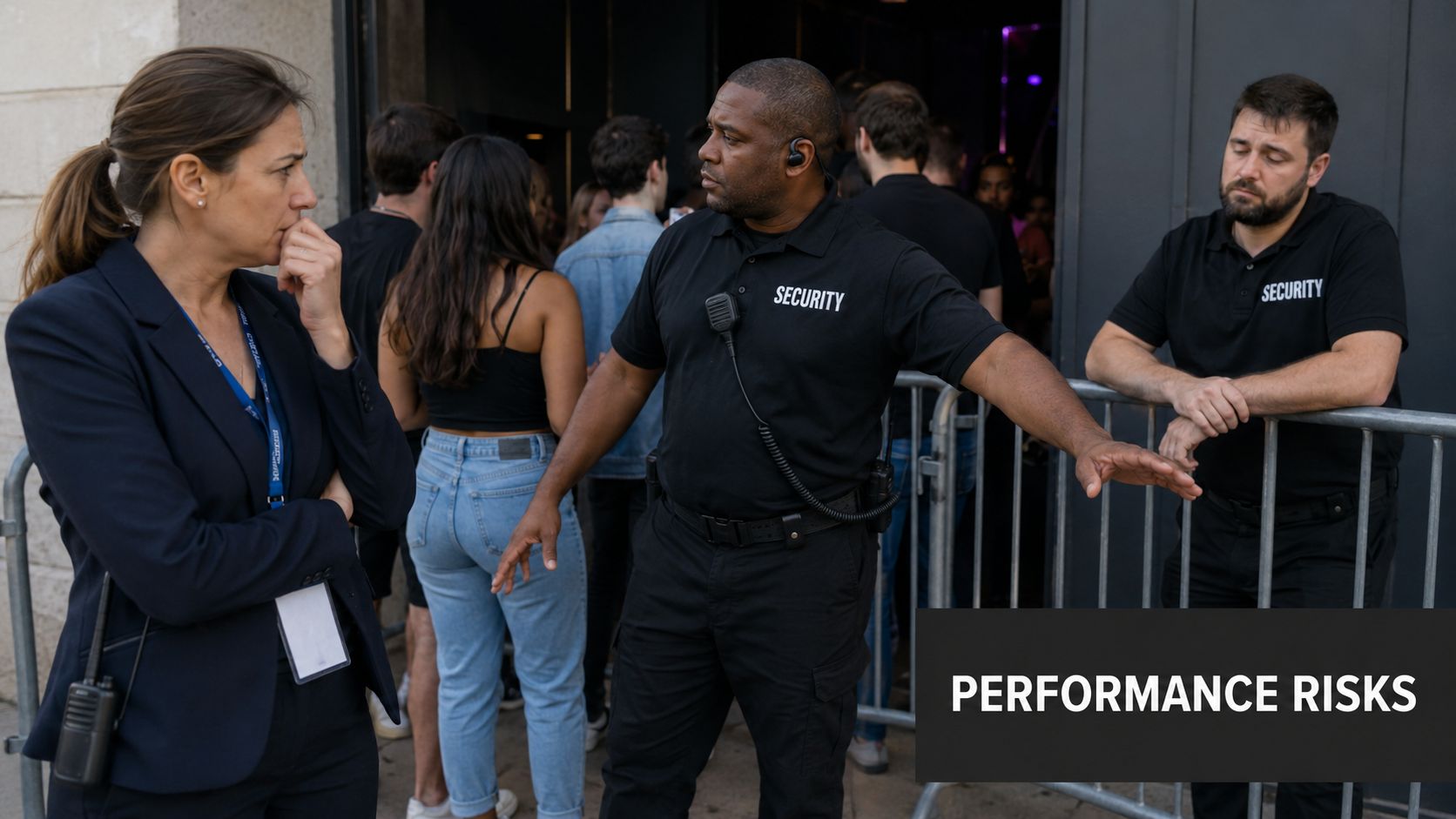
Where inconsistency hurts most
In security and events, performance is often observed rather than counted. A supervisor might assess radio discipline, queue management, access control, incident handling, or how a guard speaks to a patron who's already agitated. That creates room for bias unless the business defines what good looks like in advance.
A key gap in many systems is making ratings defensible and legally consistent across shifts, sites, and supervisors. That matters because Australia's anti-discrimination framework requires employers to apply performance standards consistently, and the issue is especially relevant where frontline work is judged through customer interactions, incident response, and supervisor observation, as discussed in this analysis of why employees dislike performance appraisals.
Good operators don't resent being measured. They resent being measured differently depending on who's watching.
If you're scaling a team, the same issue appears in other fast-moving businesses as well. This piece on performance management for scale-up leaders is useful because it reinforces a point operations managers already know. Informal feedback works only while the team is small and everyone sees the same work.
What ad-hoc reviews usually miss
A weak staff performance evaluation process tends to miss:
- Shift context: Night patrol work, festival entry work, and gatehouse control require different behaviours.
- Evidence quality: A vague supervisor comment isn't the same as an incident log, client note, or observed breach.
- Comparability: If each supervisor scores differently, your ratings mean very little.
- Follow-up: Staff hear criticism once, then get no coaching, no checkpoint, and no clear standard.
That's why the answer isn't “review more often” on its own. The answer is to build a framework that can survive scrutiny and still help supervisors run better sites.
The Foundations of a Defensible Evaluation Framework
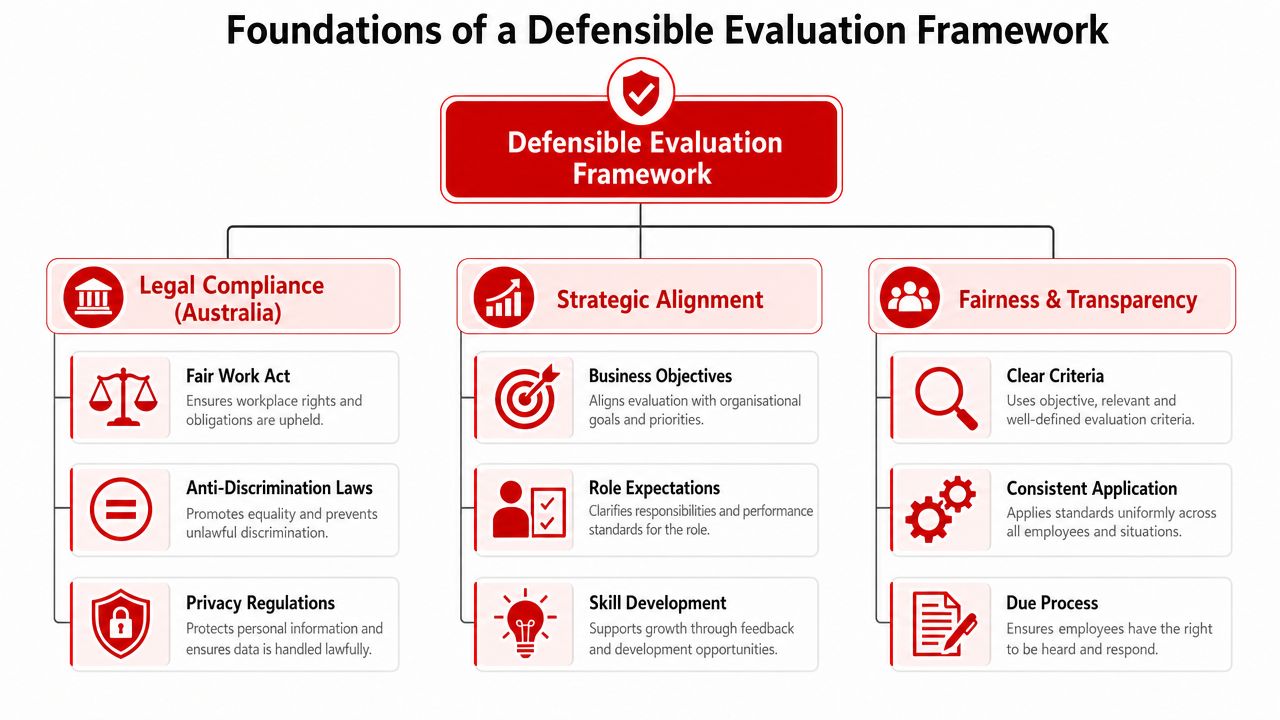
In Australia, a staff performance evaluation system has to do more than support development. It has to support fairness, documentation, and operational decisions. That starts with accepting one hard truth. If performance concerns aren't documented properly, they're harder to act on and much harder to defend.
The legal backdrop matters. The Fair Work Act 2009 established the National Employment Standards, and performance management now sits inside a broader expectation of procedural fairness and evidence-based decision-making. The Fair Work Ombudsman reports it recovered over A$500 million for workers in 2023–24, which underlines how expensive workplace compliance failures can become when supervision and documentation are weak, as outlined in this Australian performance and compliance reference.
Start with role clarity
A patrol officer and a crowd controller shouldn't be scored on the same generic form. They may share core standards such as punctuality, presentation, communication, and compliance, but the role-specific part needs to reflect actual duties.
Use role-based expectations such as:
- Static guard at a construction site: access register accuracy, contractor sign-in compliance, gatehouse communication, escalation of unauthorised access
- Mobile patrol officer: check-in timeliness, lock and alarm procedure compliance, report completion, variance handling
- Event security officer: patron interaction quality, de-escalation, bag check consistency, incident note quality
- Venue security staff: RSA-aware conduct, conflict management, queue control, coordination with venue management
Many review systems err by chasing “professionalism” and “attitude” instead of defining the work in observable terms.
Build standards before you build forms
A review form should come last, not first. Before anyone fills in a rating, managers need agreement on three things:
- What the role requires on site
- What evidence is acceptable
- How supervisors will apply the same standard
If you don't settle those points, every review becomes a personal interpretation exercise.
Operational rule: If a supervisor can't explain a rating using observed behaviour, records, or client-facing outcomes, the rating isn't ready to go on file.
Make the framework usable on busy sites
A defensible process still has to work in live operations. Supervisors won't use a ten-page form properly during a packed event weekend. Keep the system practical:
- Separate core competencies from site-specific ones
- Use short observation fields during shifts
- Require examples for low and high ratings
- Record coaching notes close to the event, not weeks later
For managers looking at broader systems thinking outside security, these effective performance management strategies are a helpful cross-check. The useful lesson is that alignment matters. Reviews work when business needs, role expectations, and manager behaviour all match.
Fairness is operational, not just legal
Fairness doesn't come from saying the process is fair. It comes from applying the same rules to the day shift at a shopping centre, the overnight officer on a construction project, and the crowd controller at a sold-out venue.
That means adjusting for context without lowering standards. A difficult site may generate more incidents, but the officer can still be assessed on response quality, reporting discipline, and professionalism under pressure. The standard stays stable. The evidence changes with the environment.
Designing Scorecards That Measure What Matters
Most rating forms fail because they use broad labels like “excellent”, “satisfactory”, or “poor” without explaining what those words mean on the ground. In security operations, that creates rating drift fast. One supervisor gives a high score because the guard is well-liked. Another gives a low score because the same guard needed reminders on radio protocol. Neither score is very useful unless it's tied to behaviour.
A better method is Behaviourally Anchored Rating Scales, often shortened to BARS. This approach is considered a strong option for reducing rater bias in customer-facing and compliance-heavy roles because it anchors scores to observable behaviours such as radio discipline and de-escalation tactics, rather than traits or personality, as explained in this overview of employee performance evaluation methods.
What a workable scorecard looks like
A strong staff performance evaluation scorecard usually has two layers:
- Core standards that apply to most frontline roles
- Role or site standards that reflect the actual post
For example, core standards might include punctuality, presentation, communication, compliance, reporting quality, and teamwork. Site standards might include gatehouse logging, patron screening, incident containment, or contractor verification.
A BARS example for de-escalation
Below is a simple example for one competency.
| Rating | Behaviour anchor for de-escalation |
|---|---|
| 1 | Reacts emotionally, argues with patrons, or escalates tension through tone or body language |
| 2 | Attempts to calm the situation but applies inconsistent language or misses escalation triggers |
| 3 | Uses a calm tone, follows basic procedure, and seeks support when the situation starts to rise |
| 4 | Applies approved techniques well, keeps space controlled, communicates clearly, and documents the interaction properly |
| 5 | Defuses tension confidently, protects safety, uses approved steps consistently, and provides clear handover or reporting afterward |
That scale gives supervisors something concrete to assess. It also gives staff a fairer target. They know what “good” looks like.
Vague scales measure popularity. Behavioural scales measure work.
Sample KPIs for Security and Venue Staff
| Role | KPI Category | Example KPI | How to Measure |
|---|---|---|---|
| Static guard | Access control | Follows visitor and contractor sign-in procedure consistently | Spot checks, entry logs, supervisor observation |
| Patrol officer | Patrol execution | Completes assigned patrol route and records site variances clearly | Patrol logs, checkpoint records, report review |
| Event security officer | Patron management | Handles entry screening and queue issues according to site brief | Supervisor observation, incident notes, client feedback |
| Venue security staff | Incident response | Escalates patron conflict appropriately and records outcome accurately | Incident reports, manager review, follow-up notes |
| Construction site guard | Compliance | Applies gatehouse and after-hours access rules correctly | Access records, site manager feedback, observation |
Use evidence captured during the work
Memory is a poor source document. Good scorecards depend on evidence gathered across the review period, including:
- Daily occurrence notes
- Incident reports
- Client comments
- Patrol or activity logs
- Training completion records
- Supervisor observation notes
If a crowd controller handled a difficult ejection professionally in March, that should be recorded in March. If a gatehouse officer repeatedly missed contractor ID checks in May, that needs to sit in the file as a documented pattern, not a vague recollection at review time.
The practical advantage is simple. By the time the formal meeting happens, the manager isn't trying to remember the year. They're interpreting the record.
Conducting a Productive Staff Performance Evaluation Meeting
It is 5:45 pm at a stadium. Gates open in 15 minutes. One supervisor says an officer is strong on screening. Another says the same officer waves people through when the queue builds. If that conflict is first raised in the formal review, the meeting turns into an argument about memory instead of a decision about performance.
That is the job of the meeting. Confirm what the record shows, test whether the employee understands the standard, and lock in clear next steps. In security operations, especially across events, venues, and construction sites, the meeting only works if the same role is being judged the same way across sites, shifts, and supervisors.
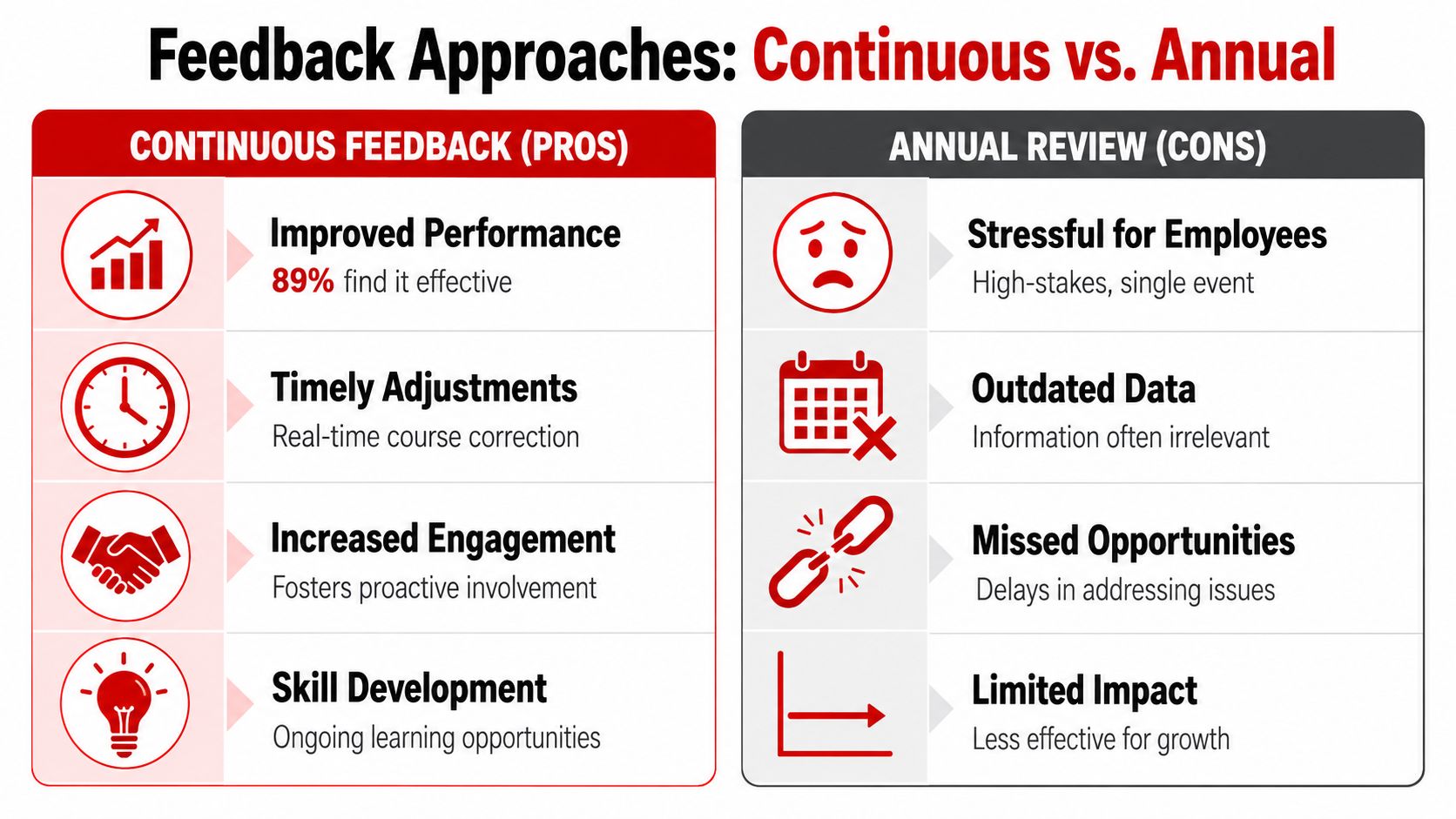
Annual reviews on their own rarely do that job well. Gallup's research on workplace feedback has long pointed to a simple operational truth. Staff respond better when feedback is regular, specific, and tied to recent work rather than saved up for one formal conversation. That matters in a rostered environment where a crowd controller may report to three different supervisors in a month.
How to structure the conversation
Hold the meeting somewhere private, with enough time to work through evidence properly. A rushed discussion in a control room, gatehouse, or loading dock creates two problems. The staff member feels ambushed, and the manager starts cutting corners.
A practical sequence looks like this:
- State the purpose and the role standard
- Confirm strengths with examples
- Work through concerns using recorded evidence
- Ask for the employee's explanation
- Agree on actions, support, and review dates
- Document the outcome before the meeting closes
Start with what the employee is doing well, but keep it factual. For example, a venue officer may be reliable with bag checks, punctual for briefing, and calm with intoxicated patrons. State those points plainly, then turn to the issue that needs correction. If the concern is inconsistent ID checks at a construction gate, bring the log entries, site observations, and any client notes that show the pattern.
Consistency matters here too. A supervisor should not mark down one event guard for weak report writing while another supervisor ignores the same issue on a different site. The meeting is where that inconsistency gets exposed, so managers need to bring the same standards into the room every time.
Ask questions that test judgment
A productive review is not a speech from the manager. It is a structured discussion that checks accountability and exposes site conditions that may be affecting performance.
Use questions such as:
- “Talk me through what happened at the gate when the delivery driver arrived after cut-off.”
- “What is stopping you from finishing the incident note before handover?”
- “Which part of the site brief was unclear on that shift?”
- “What do you do when patron behaviour starts to escalate but has not reached removal point?”
Those questions matter in frontline security because poor performance is not always refusal or laziness. Sometimes the officer has not understood the site brief. Sometimes two supervisors have given different instructions. Sometimes the employee is cutting corners under crowd pressure. The meeting should separate those issues. You cannot fix a training problem with a warning, and you cannot excuse a conduct problem as a training gap.
Keep the language disciplined
Loose language creates legal risk and weakens credibility. Terms like “bad attitude”, “not proactive”, or “clients don't like you” are too vague to defend if the matter later ends up in a grievance, unfair dismissal claim, or client escalation.
Use direct language tied to observed work:
- For a strength: “Your reports from the last three incidents were clear, chronological, and easy for the venue manager to follow.”
- For a concern: “On four recorded shifts, contractor ID was not checked against the access list before entry was granted.”
- For accountability: “I want your view on why that happened, because the required process was clear in the site brief.”
- For next steps: “From the next shift, every after-hours entry needs to be logged at the time of access, not at the end of the night.”
That wording keeps the discussion on conduct, skill, and compliance. It also gives another supervisor enough detail to follow up later without guessing what the original manager meant.
What to avoid
Some mistakes turn a fair meeting into a weak one fast:
- Relying on general impressions instead of documented examples
- Letting one recent incident outweigh six months of steady performance
- Comparing one officer to another by name instead of comparing both to the same standard
- Debating personality instead of conduct
- Promising promotion, extra shifts, warnings, or termination outcomes before the record is complete
Technology can help if it supports timely supervisor notes across changing rosters and sites. Managers reviewing real time employee feedback platforms should check one practical point first. Can supervisors record a quick, usable observation at 2 am on a construction site or during a busy ingress at an arena? If the answer is no, the system will fill up with late entries and weak evidence.
A productive meeting feels controlled, fair, and specific. The employee should leave knowing what they did well, where they fell short, what standard applies on every site, and what happens next. That is how a review meeting improves performance instead of just recording disappointment.
Action Plans for Remediation and Recognition
A staff performance evaluation means very little if nothing changes afterwards. Some staff need correction and support. Others need challenge, recognition, and a pathway forward. Strong managers handle both with the same level of discipline.
The follow-up should come from recorded evidence, not from how the meeting felt. If the issue was weak reporting, the plan should improve reporting. If the officer is excellent with patrons and consistently calm under pressure, the next step should build on that strength in a way that benefits the operation.
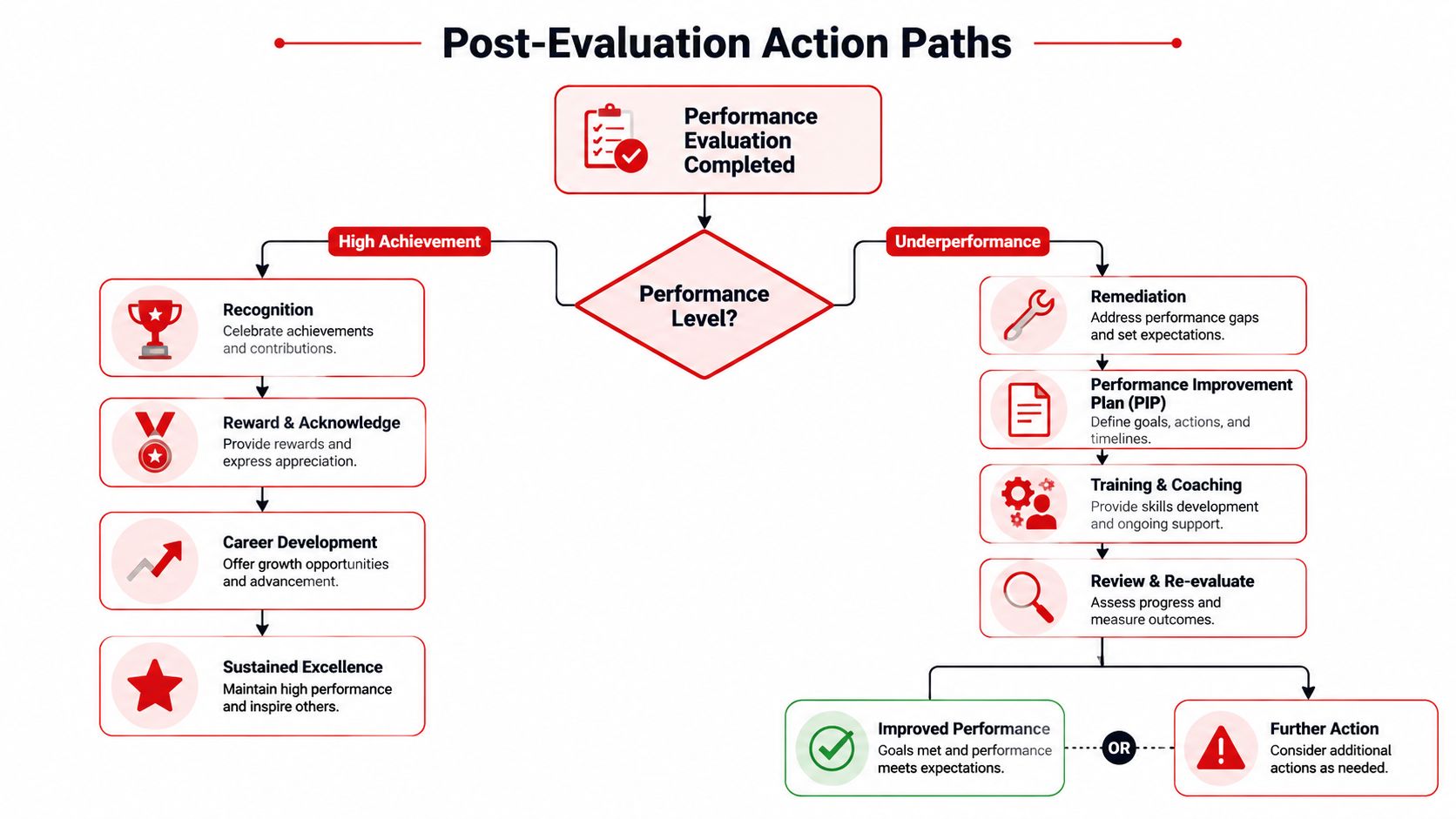
When performance is below standard
A remediation plan should be precise. “Improve communication” is not a plan. “Use correct radio call format and complete end-of-shift incident notes before handover on every assigned shift” is something a supervisor can coach and observe.
A practical remediation plan usually includes:
The exact issue
Example: incomplete incident notes, weak gate screening, repeated lateness to briefing.The required standard
State the expected behaviour clearly and tie it to the role.Support provided
Extra site briefing, shadowing with a senior officer, refresher on incident reporting, conflict management coaching, or RSA-related reminders where relevant to venue work.Review points
Put check-ins in the diary. Don't leave improvement to chance.
Use ongoing evidence, not one-off impressions
A technically sound process uses continuous evidence capture. UCLA's evaluation guide sets out three practical steps: set clear goals, observe and track performance over time using objective inputs such as work logs and customer feedback, and provide ongoing coaching. It also makes the key point that each rating should be linked to specific recorded observations to be defensible, as set out in this performance evaluation guide.
That fits frontline security well. If a construction gatehouse officer improves after coaching, the evidence should appear in cleaner logs, more accurate visitor handling, and fewer supervision corrections. If a venue guard still mishandles patron interactions after support, that pattern should also be visible in records.
When performance is strong
High performers shouldn't be rewarded only with harder shifts and higher expectations. That's one of the fastest ways to lose good people.
Use the evaluation outcome to build a development path such as:
- Mentoring junior staff on site routines, reporting standards, or crowd flow techniques
- Stepping into team lead duties during lower-risk shifts
- Taking on specialist training for higher-trust posts
- Being matched to premium client-facing roles where judgement and presentation matter most
Recognition doesn't always need to be formal to be effective. Clear acknowledgement, preferred placements, development opportunities, and visible trust all matter in security teams.
Strong operators usually want two things. Clear standards and proof that good work leads somewhere.
Keep records balanced
One practical point gets missed often. Files shouldn't only contain mistakes. A balanced record includes strengths, improvements, coaching notes, and successful outcomes. That gives a more accurate picture of the employee, and it helps show that the process is genuine performance management rather than a paper trail built only when problems appear.
Continuous Monitoring and Your Questions Answered
A supervisor on a Friday night at a live music venue marks an officer down for slow bag checks. The same officer gets praised on a weekday corporate lobby shift for being calm, efficient, and precise. If those observations sit in separate notebooks, under different supervisors, with no common standard, the final staff performance evaluation will depend more on who wrote the notes than what the employee did.
That is the operational problem generic HR advice often misses. In security, events, and construction, people work across different sites, different shift types, and different supervisors. A fair system has to produce consistent judgments in inconsistent conditions.
Continuous monitoring means the evidence is gathered as the work happens, using the same core standards across the business and site-specific expectations for each post. The review meeting then tests the pattern against the record. It does not rely on memory, personality, or whichever supervisor speaks first.
What continuous monitoring looks like on site
On a well-run operation, monitoring is built into normal supervision:
- Post orders and site briefs set the expected standard for that location
- Supervisors record observations close to the shift, while details are still clear
- Incident reports, patrol logs, access control records, and client notes are reviewed as supporting evidence
- Short coaching happens early, before a small issue becomes a repeated one
- Formal reviews pull the record together across sites, shifts, and raters
This matters most where staff rotate. A crowd controller might work a stadium event on Saturday, a retail loss prevention shift on Monday, and a construction gatehouse on Wednesday. The role changes. The core standards should not. Punctuality, report quality, compliance with instructions, communication, presentation, and judgement can still be measured consistently, even when site tasks differ.
Consistency across supervisors also needs active management. If one venue supervisor scores hard on every minor issue and another gives everyone top marks to avoid conflict, the business does not have a staff performance system. It has a rating problem.
Frequently asked questions
How often should staff performance evaluation happen in security operations
Formal reviews should happen on a set cycle, but operational feedback should happen throughout the year. High-risk posts, probation periods, problem contracts, and client-facing roles usually need closer observation than stable low-variation sites. The point is regular evidence collection, not paperwork for its own sake.
How do you evaluate staff fairly when they work different venues or shifts
Use one business-wide framework with a small number of core measures, then add site-specific criteria for the actual post. Compare a loading dock officer with another loading dock officer, or compare both against the same core standards if their tasks differ. That keeps the process fair without pretending all posts are the same.
What if one supervisor scores far harsher than another
Run calibration checks. Review a sample of completed evaluations together. Look at the evidence behind the score, not just the score itself. Vague comments such as "bad attitude" or "great operator" should be challenged until they are tied to observable behaviour.
I have seen this issue more than once in venue operations. One supervisor treats confident communication as professionalism. Another reads the same behaviour as being abrupt. Without calibration, the employee gets rated on supervisor preference rather than performance.
Can client feedback be used in a staff performance evaluation
Yes, but it should be treated as one input, not the whole case. Client feedback is useful when it lines up with incident records, shift notes, body-worn footage where available, and direct supervisor observations. A client complaint can point to a real problem. It can also reflect poor briefing, unrealistic expectations, or a one-off disagreement on site.
What should be documented after a difficult conversation
Record the issue discussed, the examples relied on, the employee's explanation, the standard expected, and the next review point. Keep the language factual. Avoid guessing at motive or recording emotional reactions as if they were findings.
For example, "failed to complete visitor log at Gate 2 on 14 May despite site procedure and reminder from supervisor" is useful. "Did not seem to care about the job" is not.
What if a strong employee is excellent on one site and average on another
Check the operating conditions before labelling the person inconsistent. Site fit, briefing quality, supervisor capability, roster fatigue, and layout all affect performance. A strong construction gatehouse officer may struggle in a noisy entertainment precinct if the role depends more on patron management than access control. That does not excuse underperformance, but it does affect how the result should be read and what support is likely to work.
Should every issue lead to a formal performance plan
No. Routine coaching and recorded follow-up will deal with many issues. A formal plan is more appropriate where the problem is repeated, serious, safety-related, or affecting the client relationship. Good operators should not feel that every correction puts them on a disciplinary path.
What's the biggest mistake in staff performance evaluation
Letting the process drift from evidence to opinion.
Once that happens, legal risk rises, supervisor bias carries more weight, and staff stop trusting the system. In Australian operations, especially where unfair dismissal, adverse action, or client complaints may later be examined, the safest approach is simple. Use clear standards, keep balanced records, and make sure the same conduct is judged the same way whether it happens at a concert, a shopping centre, or a construction site.
If you need a security partner that understands how performance, supervision, and site fit work in practice, GM GROUP Services supports events, venues, retail, hospitality, and construction sites across NSW, VIC, QLD and the ACT with specialized security operations, responsive reporting, and ongoing staff oversight that helps protect both safety and brand reputation.
Discover more from GM Group Services
Subscribe to get the latest posts sent to your email.