
A solid site security construction plan is your first and best line of defence against disastrous outcomes. It’s what stands between your project and the very real threats of theft, vandalism, and tragic accidents. This isn’t just about putting up a fence; it's a strategic approach that blends physical barriers, smart technology, and professional security personnel to protect your assets, keep people safe, and stick to your project timeline. A security failure isn't a minor hiccup—it can trigger devastating financial losses and serious legal trouble. A lapse in site security construction can halt progress instantly.
The Critical Need for a Site Security Construction Plan
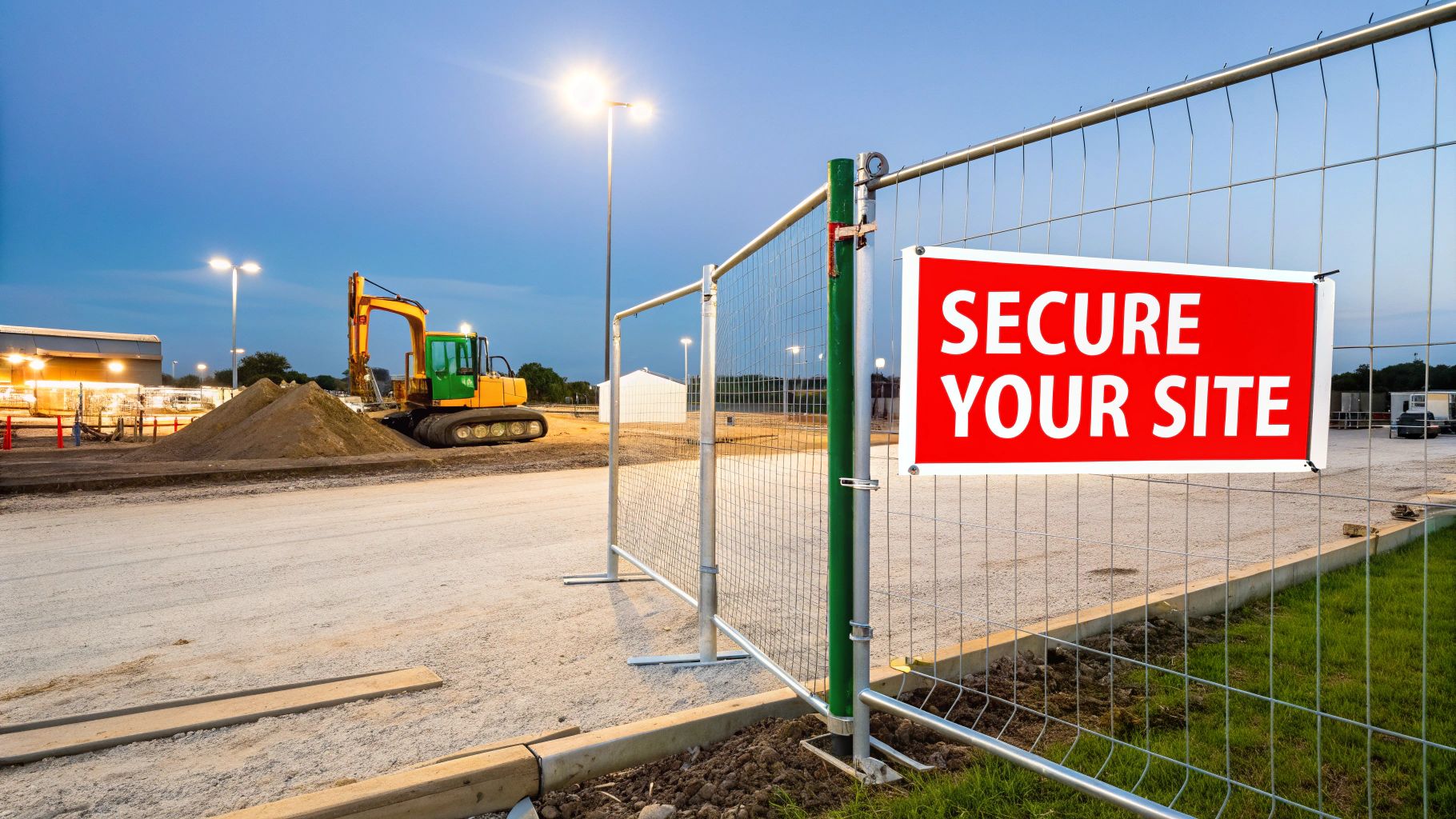
Leaving a construction site unsecured is practically rolling out the welcome mat for trouble. We're not just talking about opportunistic thieves grabbing some copper wire or a generator, though that happens all the time. The consequences can be far more severe. Every unlocked gate or gap in the fence is a massive liability, exposing your project to risks that can completely derail your schedule and obliterate your profit margin.
An inadequate site security plan doesn't just attract criminals. It also creates a hazardous playground for unauthorised visitors, including curious kids. The thought of a child getting hurt on your site is a nightmare scenario, and it’s a risk every project manager needs to tackle head-on.
Beyond Simple Fencing: A Proactive Approach to Site Security Construction
A proper security strategy goes way beyond just throwing up some temporary fencing. It's a layered, structured system where multiple elements work together. The real goal is to shift your mindset from reacting to incidents to actively preventing them from ever happening.
This proactive approach relies on several key pillars:
- Protecting Your Assets: Construction sites are packed with high-value gear and materials. Theft means more than just the cost of replacement; it can bring work to a grinding halt while you wait for new equipment to arrive. Actionable Insight: Maintain a detailed, photo-based inventory of all major equipment and materials. This not only deters theft but also streamlines insurance claims if the worst happens.
- Ensuring Public Safety: An open site is a danger zone for the public. Your security measures are crucial for preventing unauthorised entry and avoiding the accidents and injuries that can result.
- Maintaining Project Continuity: A single major incident—whether it's theft, vandalism, or a safety breach—can stop work for days or even weeks. That leads to costly overruns and blown deadlines.
This is precisely why your security measures must be integrated with the overall building construction schedule. A well-thought-out plan ensures your security adapts and scales with the project right from day one.
The Real-World Consequences of Negligence
These risks aren't just hypothetical. A tragic incident in Western Australia, where a 12-year-old boy fatally fell from height on an unsecured site after hours, spurred WorkSafe to launch its Construction Site Security Project. The inspections that followed uncovered widespread failures in how sites were being secured against trespassers—a massive red flag for project managers right across Australia. You can explore the full findings and learn more about compliance requirements on the WorkSafe WA website.
Investing in a professional site security construction plan isn't an expense. It's a vital investment in your project's success, your team's safety, and your company's reputation. It’s about managing risk, not just cleaning up after a disaster.
When you treat security as a core part of project management, you build a foundation of safety and stability. This guide will walk you through the practical, actionable strategies you need to create a formidable defence for your next project.
Conducting a Comprehensive Security Risk Assessment
Before the first fence panel goes up or a single guard clocks on, the real work of securing your construction site begins. It all starts with a thorough security risk assessment. Think of it as the foundation for your entire security plan—skipping it is like trying to build without a set of blueprints. You might end up with something standing, but it certainly won’t be strong or well-thought-out.
At its core, a risk assessment is simply a methodical way of looking at your site, identifying potential threats, and figuring out where your weak spots are. This isn't just a quick walk-around looking for an unlocked gate. It’s about getting under the skin of your project to understand how it operates, where the high-value items are, and what specific risks you face based on your location and the nature of the build.
Identifying Key Vulnerabilities and Threats
No two construction sites are the same, so no two risk profiles are identical. A high-rise project squeezed into a bustling city centre has a completely different set of challenges compared to a new housing development on the edge of town. The city site might have to deal with constant foot traffic and petty theft, while the suburban one could be a tempting target for organised gangs looking to steal heavy machinery.
Your first job is to walk the site with a critical eye, putting yourself in the shoes of a potential thief. Ask yourself the tough questions:
- Access Points: Where are the easy entry points? Look for unsecured gates, gaps in the fence, or even sections that are just too easy to climb. How are you actually controlling who comes and goes?
- Lighting: Where are the dark spots? Intruders love shadows. Pay close attention to poorly lit corners, dark alleyways, or sprawling laydown yards that become pitch-black after sunset.
- High-Value Assets: Pinpoint exactly where you’ll be storing the expensive stuff—copper wiring, power tools, and heavy equipment. Are these areas out in the open, or are they secured and easily watched?
- Environmental Factors: Take a look at the surrounding area. Is the site in a high-crime neighbourhood? Or is it so isolated that thieves could work undisturbed all night?
Evaluating Likelihood and Impact
Once you have a list of potential weak points, it's time to weigh them up. For each risk, you need to consider two things: the likelihood of it happening and the potential impact if it does. This simple exercise is crucial for deciding where to spend your security budget for the biggest return.
Practical Example: Someone swiping a few hand tools is pretty likely, but the financial hit is relatively minor. On the other hand, the theft of a $42,000 excavator is less probable, but the impact would be absolutely devastating to both your budget and your project schedule. A smart security plan has to account for both ends of that spectrum.
A proper risk assessment shifts your mindset from a reactive "what if" to a proactive "what we'll do when." It's the single most important step in creating a truly resilient construction site security plan.
The Value of a Professional Perspective
While project managers can do a great initial sweep, bringing in a professional security provider like GM GROUP Services can make a world of difference. An experienced security consultant brings a fresh, trained eye to your site. They’ll spot vulnerabilities that your own team, who see the site every day, might have become blind to.
A professional assessment also goes much deeper. They’ll analyse things like contractor movements, delivery protocols, and procedural gaps that might not seem like security issues at first glance. They can tap into local crime data to give you real insights and recommend specific, cost-effective solutions for your unique situation. This upfront investment in expert advice is one of the smartest ways to prevent much larger, more painful costs down the track.
Once you've mapped out the risks, it's time to get tangible. Your security plan moves from paper to the real world by building layers of physical defence. This is where you implement robust perimeter controls, lock down access points, and set up a smart surveillance network. These three elements are the backbone of any effective security strategy, turning a vulnerable site into a genuinely secure one.
Building Your Fortress With Physical Security Measures
The first thing anyone sees is your perimeter—it's your frontline defence. A solid perimeter is designed to do two things: deter the casual opportunist and slow down a determined intruder. But not all fences are built the same, and picking the right one for your specific site is absolutely critical.
For example, solid hoarding is great for privacy. It keeps prying eyes from taking inventory of your valuable tools and materials. The flip side? Once someone gets over it, that same hoarding provides them with perfect cover. On the other hand, anti-climb mesh fencing gives you excellent visibility, meaning patrols and cameras can easily spot trouble. The trade-off is that it puts all your expensive gear on display.
So, what's the right call? It really comes down to your site's location and unique risks. For a busy urban project, hoarding often makes more sense to reduce public disruption and prevent casual theft. For a more isolated site, the high visibility of mesh fencing might be the more powerful deterrent.
Securing Your Entry Points
A fence is only as strong as its gate. Leave a gate unsecured or unmonitored, and you might as well have left an open invitation for thieves. Your plan must have rock-solid procedures for securing every access point after hours, and that means using industrial-grade locks and chains, not just a simple padlock.
On an active site, nothing beats a staffed gatehouse for controlling who comes and goes. This creates a single, managed checkpoint where every worker, visitor, and delivery driver has to check in.
Strict sign-in and sign-out procedures are non-negotiable. It's not just about knowing who is on-site for safety reasons—it’s also a powerful psychological deterrent. When people know their presence is logged, they’re far less likely to try anything foolish.
A recent Queensland WorkSafe blitz highlighted just how common security lapses are. Auditors visited 224 construction sites and found eight serious non-compliances directly related to sites being wide open to unauthorised access. You can review the official findings on construction site compliance to see why this is such a critical issue for the industry.
For bigger projects or sites with high-value assets, technology can add another powerful layer of control. Things like key cards, PIN codes, or even biometric scanners ensure only authorised people can get into sensitive areas, creating a digital footprint of every entry and exit.
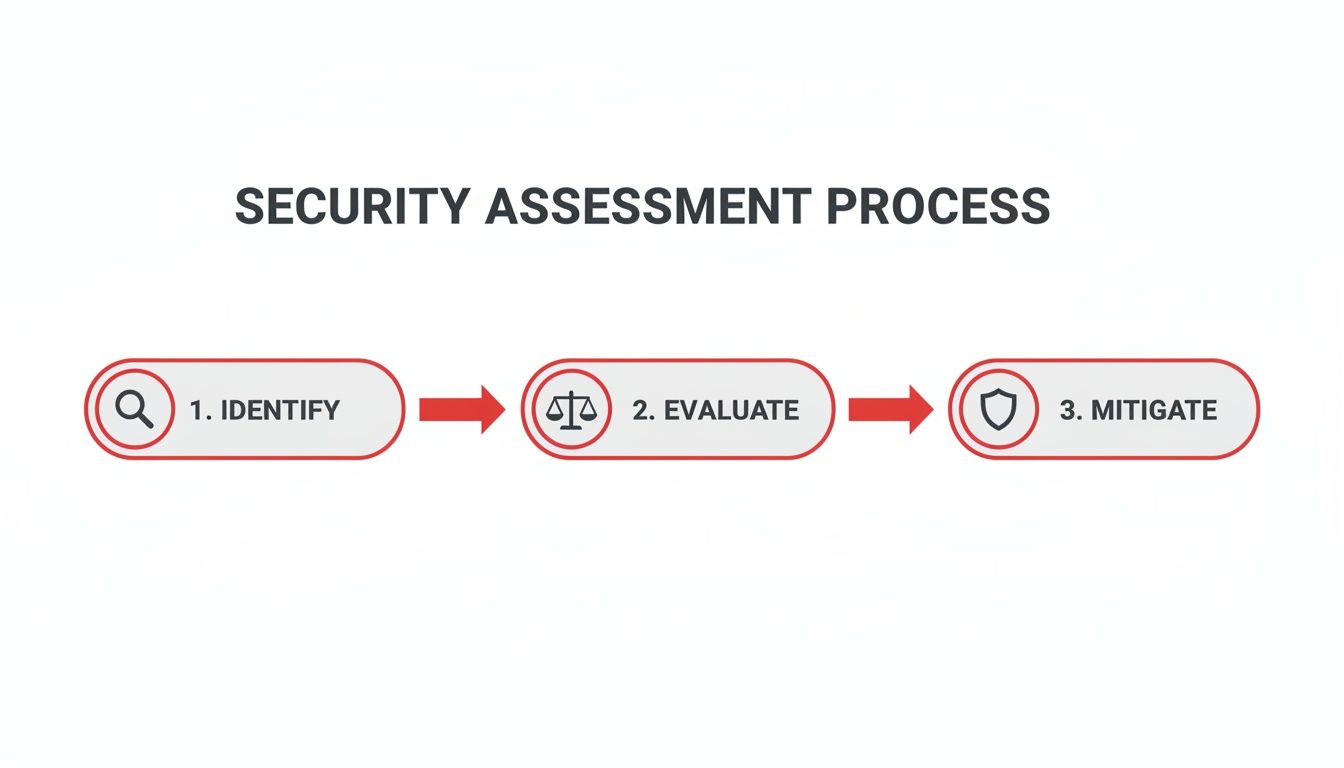
This process chart shows the basic flow of a security assessment, which is always the starting point for deciding which measures you actually need.
As you can see, identifying your vulnerabilities directly shapes the solutions you choose, whether that’s a specific type of fencing or a more advanced access control system.
The All-Seeing Eye of Surveillance
Surveillance is the final pillar of your physical security. Modern CCTV isn't just about recording what happens; it's a powerful tool for active monitoring, gathering evidence, and triggering a real-time response. But cameras are only useful if they're pointing at the right things.
A smart camera layout should always cover:
- Entrances and Exits: Every single gate and access point needs to be watched.
- Storage Zones: High-value areas like tool lockups and material storage yards demand dedicated coverage.
- Perimeter Lines: Cameras placed along the fenceline can catch an intrusion attempt as it happens.
- Blind Spots: You have to pay close attention to those dark corners or areas blocked by buildings and equipment.
Just recording footage isn't enough, though. That's a passive approach. To make your surveillance a truly active defence, you need to connect it to a back-to-base monitoring service. This means a team of trained professionals is watching your camera feeds after hours. If their system detects motion, they can instantly verify the threat and dispatch a mobile patrol or the police.
Practical Example: A suburban housing development was getting hit repeatedly by thieves stealing copper wiring. The project manager finally put in a layered defence. He installed motion-activated floodlights around the material storage, linked his CCTV to a back-to-base monitoring service, and scheduled two random mobile patrols each night. A week later, at 2 AM, intruders tripped the motion sensors, flooding the area with light. The monitoring team saw them on camera, verified it wasn't a false alarm, and immediately dispatched a patrol car and called the local police. The thieves bolted empty-handed, and the site was never targeted again. That's the power of an integrated site security construction strategy in action.
Security Technology Comparison for Construction Sites
Choosing the right technology can feel overwhelming. Different tools serve different purposes, from basic deterrence to sophisticated access management. This table breaks down some of the most common options to help you decide what fits your site's needs and budget.
| Technology | Primary Use | Pros | Cons |
|---|---|---|---|
| CCTV Cameras | Deterrence, evidence collection, monitoring | Visual deterrent, records incidents, enables remote viewing. | Can be passive without monitoring, requires power, vulnerable to damage. |
| Motion Sensors | Intrusion detection, triggering alarms/lights | Cost-effective, immediate alerts, integrates with other systems. | Can cause false alarms from animals or weather, limited range. |
| Floodlights | Deterrence, illumination for cameras | Excellent deterrent, improves nighttime camera footage, enhances safety. | High energy consumption, can be a nuisance in residential areas. |
| Access Control | Restricting entry to authorised personnel | High security, provides an audit trail, eliminates traditional keys. | Higher upfront cost, requires training, can be complex to manage. |
| Alarm Systems | Intrusion notification | Loud audible deterrent, can be linked to professional monitoring. | Prone to false alarms, requires maintenance, can be ignored. |
Ultimately, the best approach is often a combination of these technologies. A layered system, where each piece of tech supports the others, provides the most comprehensive protection against the diverse threats facing a modern construction site.
Deploying the Right Security Personnel
Fences and cameras are crucial, but they're only part of the puzzle. Technology is a powerful tool, no doubt, but it can't match the judgment, intuition, and sheer physical presence of a trained security professional. A camera can record a crime; a guard can stop it in its tracks.
Think of it this way: a human presence turns your passive surveillance into an active, responsive defence. It’s what keeps your project safe around the clock. But deploying the right people isn't a one-size-fits-all job. It’s about carefully matching the right skills to the right role on your specific site.
Static Guards for Access Control
Static guards are your site’s gatekeepers. Stationed at key entry and exit points, their job is far more than just watching a gate—it's about actively managing the flow of people, vehicles, and materials.
A professional guard enforces sign-in procedures, verifies credentials, and makes sure every single person on-site is authorised to be there. This highly visible, uniformed presence is often all it takes to deter an opportunistic thief. They also become a central point of contact, directing delivery drivers and managing contractor arrivals, which keeps the entire site running more smoothly and safely.
Mobile Patrols for Broad Coverage
On a large, sprawling construction site, a single guard at the gate can't see everything. That's where mobile vehicle patrols come in. They provide a visible and, crucially, unpredictable security presence across your entire perimeter, laydown yards, and storage areas.
The random nature of these patrols makes it incredibly difficult for a potential intruder to time their break-in. This uncertainty is a massive deterrent. Mobile patrols are perfect for:
- Large Perimeters: Covering huge fencelines that would be impossible to monitor effectively on foot.
- Multiple Sites: Efficiently checking in on several smaller projects within the same area.
- Rapid Response: Acting as the first responders when your CCTV or motion sensors trigger an alarm.
The Specialised Role of K9 Units in Site Security Construction
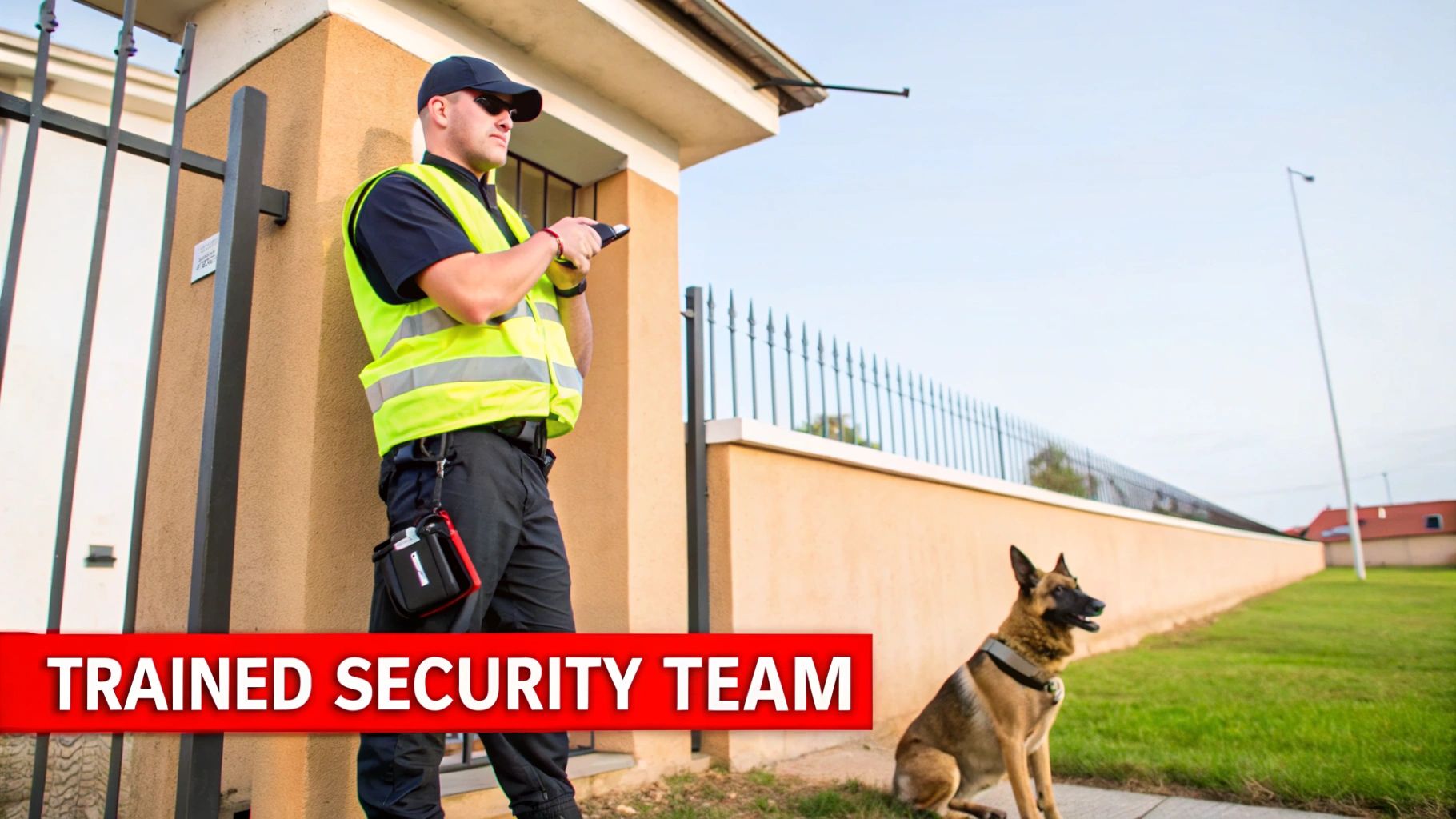
Sometimes you need a level of detection that technology and human senses just can't provide. This is where K9 units shine. A trained security dog's sense of smell and hearing are exceptionally sharp, allowing them to find intruders hiding in dark corners or concealed behind building materials.
Practical Example: A couple of thieves cut through a back fence and hide behind a stack of pre-cast concrete panels, waiting for things to quiet down. Your fixed cameras might miss them completely. A K9 unit on patrol, however, will pick up their scent instantly, leading the handler straight to their hiding spot and preventing a major theft before it even happens.
A licensed, well-trained security professional is more than just a guard; they are a site ambassador. Their communication skills are as important as their observational abilities, allowing them to manage contractors and visitors effectively while maintaining a secure and orderly environment.
Covert Operations and Loss Prevention
Unfortunately, not all threats come from outside the fence. Internal theft can account for huge losses on a project. In these sensitive situations, a high-vis uniform isn't the answer. Covert security operatives, dressed as regular construction workers, can be brought in to discreetly monitor site activities.
Their role is to observe workflows, pinpoint procedural weaknesses that might enable theft, and gather evidence of any misconduct from the inside. It’s a highly effective way to handle loss prevention without disrupting site morale.
Choosing a security partner like GM GROUP Services gives you access to this full spectrum of personnel, from high-visibility guards to discreet covert operators. This strategic deployment is a vital part of any truly robust site security construction plan.
Weaving Procedures and Incident Response into Your Security Fabric
Great site security construction is more than just installing fences and cameras. It's about building a living, breathing system grounded in clear procedures and having a rock-solid plan for when things inevitably go sideways. Your hardware and guards are the tools, but your procedures are the instruction manual that guarantees they’re used correctly, every single day.
Without well-documented processes, even the most expensive security setup can crumble under pressure. These documents, often known as Standard Operating Procedures (SOPs), give your team a clear playbook. They eliminate guesswork and ensure everyone, from the project manager to the gate guard, knows their exact role in keeping the site secure.
Laying Down Clear Standard Operating Procedures
Think of SOPs as the daily habits that forge a secure site. They need to be simple, direct, and cover every routine security function.
Here’s what you absolutely must document:
- Access Control: The nitty-gritty of signing in visitors, checking contractor credentials, and managing every vehicle that comes and goes. This has to include strict protocols for after-hours access.
- Patrol Duties: Don't just tell guards to "do a lap." Define specific routes, critical checkpoints to inspect (like fuel storage or high-value material lockups), and how they should report what they see on each shift.
- Lock-up and Unlock: A detailed, step-by-step checklist for securing the site at knock-off time and a corresponding process for opening up in the morning, which must include a sweep for any overnight issues.
- Emergency Contacts: A highly visible and accessible list of who to call for what—fire, medical emergency, security breach—and the precise order to call them.
These documents can't just be created and forgotten. They need to be practical and constantly reviewed and updated as your project evolves and new risks pop up.
The Stinging Cost of Getting It Wrong
Ignoring established procedures isn't just lazy—it's a massive financial and operational gamble. Regulatory bodies are coming down hard on unsecured sites, and the penalties can bring a project to its knees.
Just look at the SafeWork SA compliance campaign in South Australia. It was a real eye-opener. Inspectors hit 213 construction sites and handed out a jaw-dropping 674 statutory notices. That included 195 prohibition notices that shut down work on the spot, completely derailing project timelines and budgets. To see why this is so critical, you can dig into the findings and learn why proactive security compliance is essential for Australian construction projects.
An incident response plan isn't about admitting defeat; it's about taking control. It turns a potential crisis into a managed, documented event, minimising disruption and protecting your project from further harm.
Building a Bulletproof Incident Response Plan
No matter how tight your security is, you have to be ready for an incident. A well-thought-out incident response plan is your roadmap for navigating the chaos in the immediate aftermath of a break-in, vandalism, or safety breach. The mission is simple: contain the situation, protect the evidence, and get the project back on track safely and quickly.
Here’s a practical checklist to follow when the alarm bells ring:
- Secure the Scene: Safety first, always. Make sure no one is in danger and immediately cordon off the area to stop evidence from being disturbed or another incident from occurring.
- Notify the Authorities: If it’s a crime, the police are your first call. For safety breaches, get onto the relevant work safety authority as legally required. Don't delay.
- Alert Key People: Get your security provider, the project manager, and company leadership on the phone. Quick, clear communication is the key to a coordinated effort.
- Preserve Evidence: Nobody touches a thing until the police give the all-clear. As soon as it’s safe, start taking photos and videos of the scene from every possible angle.
- Document Everything: Start a detailed incident report immediately. Note the time it was discovered, who found it, every action taken, and a list of everyone you notified. This paper trail is gold for police reports and insurance claims.
- Talk to Your Team: Give your crew a clear, factual briefing. This stops the rumour mill and ensures everyone is aware of any new security protocols you're putting in place.
Getting information to the right people at the right time is crucial for coordinating a response. You can learn more about purpose-built tools for this by checking out communication software for construction companies.
By baking these procedures and plans into your site security construction strategy from day one, you build a truly resilient operation—one that can not only stop incidents but also manage them like a pro when they happen.
Frequently Asked Questions about Site Security Construction
When you're managing a construction project, security questions are bound to come up. It's a complex area, and getting it right is crucial for protecting your investment. We’ve pulled together some of the most common queries we hear from project managers to give you clear, straightforward advice based on real-world experience.
1. How much should I budget for security?
There's no magic number; the cost depends on your project's size, location, and risk profile. As a general guideline, the industry often budgets between 0.5% to 2% of the total project cost. However, the most accurate figure comes from a professional risk assessment, which ensures you invest in the right measures without overspending.
2. When is the best time to implement a site security construction plan?
The ideal time is during the pre-construction planning phase, before any work begins on-site. Integrating security measures like fencing, access control points, and camera placement from day one establishes a secure environment from the start, deterring potential threats before valuable assets arrive.
3. Are security cameras enough to secure my site on their own?
No. While CCTV is a vital tool for deterrence and evidence gathering, it is a passive measure. A camera records a crime; it doesn't physically stop it. For a robust defence, layer technology with a physical presence. Combine cameras with back-to-base monitoring and rapid-response mobile patrols for a comprehensive site security construction strategy.
4. What are the most common security mistakes on construction sites?
The most frequent mistakes include inadequate perimeter fencing (gaps or easy-to-climb sections), poor lighting in storage areas, failing to secure access points after hours, and not having a formal visitor sign-in/out procedure. Another major error is treating security as an afterthought rather than a core part of project planning.
5. What should I look for in a security provider?
Look for a partner with proven experience in the construction industry. They should offer a full range of services, including risk assessments, static guards, mobile patrols, and electronic solutions. Ensure their personnel are fully licensed and trained, and ask for client references. A great provider acts as a proactive member of your team, not just a contractor.
Ready to build a security plan that protects your project from day one? The expert team at GM GROUP Services provides tailored security solutions for the construction industry, from in-depth risk assessments to professional on-site personnel. Secure your site with confidence today.
Discover more from GM Group Services
Subscribe to get the latest posts sent to your email.