
Security systems monitoring is the critical service that transforms a standalone security camera or alarm from a passive recording device into a proactive, round-the-clock shield for your business. It’s a dedicated service where a team of experts keeps a vigilant eye on your alarms and cameras, 24/7. This isn't just about recording events; it's about turning your security into a live, active defence that ensures every alert is professionally verified and acted upon immediately.
For business owners, this means shifting from reviewing footage after a break-in to stopping criminals in their tracks.
What Is Security Systems Monitoring?
Think of it like having a vigilant, round-the-clock security team guarding your premises, but from a high-tech control room. Instead of just passively capturing footage for you to review tomorrow, this service actively watches for threats in real time. It’s a digital watchdog that never sleeps, constantly analysing what’s happening on your property.
At its heart, security monitoring is about smart threat detection, professional verification, and swift, decisive action. It shifts your security posture from simply reacting to problems to actively preventing them.
Moving From Passive Recording to Proactive Defence
A standard, unmonitored security setup is a bit like a history book—it tells you what happened, but it can't change the ending. Your cameras might record a break-in perfectly, but that footage only becomes useful after the damage is done and the culprits are long gone.
Professional monitoring flips this script entirely. The moment an alarm is tripped or unusual movement is detected, a signal is instantly sent to a specialised monitoring centre. This makes your security system an active player in protecting your assets.
Actionable Insight: The real power of professional security systems monitoring is its ability to intervene. It closes that critical time gap between an incident starting and a response team arriving, which can be the difference between a minor scare and a major loss.
The Role of Human Expertise in Modern Security Systems Monitoring
While technology like AI-powered cameras and smart sensors is incredibly advanced, it’s the human touch that makes all the difference. Trained security operators are the "brains" behind the whole operation. They have the experience to tell a real threat from a false alarm—like a stray cat wandering past a sensor versus an intruder trying to force a door.
This human verification is crucial. It ensures that when a response is initiated—whether it’s dispatching a mobile patrol or calling the police—it’s for a genuine, confirmed incident. This not only leads to a faster and more effective response but also builds trust with law enforcement, who prioritise verified alarms over automated ones.
The demand for these services is surging. Australia's security market generated a massive USD 4,591.7 million in revenue in 2024, with security systems—including surveillance and monitoring—accounting for the lion's share at 84.35%. With the sector projected to grow at an 8.8% CAGR from 2025 to 2030, it's clear that businesses in construction, events, and retail across NSW, VIC, QLD, and the ACT are increasingly relying on professional monitoring. You can learn more about these security market trends.
The Core Types of Security Monitoring Systems
Security systems monitoring isn't a one-size-fits-all solution. It's really a collection of specialised services, each designed to tackle different weak spots. Figuring out which ones you need is the first step to building a security plan that actually works for your business, whether you're running a massive festival in Queensland or locking down a high-value construction site in the ACT.
Let's break down the main pillars of modern security monitoring. Each one has a distinct job to do, and when they work together, they create a seriously effective safety net for your people and property.
To help you get a clearer picture of what's what, here’s a quick comparison of the main monitoring types.
Comparison of Security Monitoring Types
| Monitoring Type | Primary Function | Best For | Practical Example |
|---|---|---|---|
| Back-to-Base Alarm Monitoring | Sends an immediate alert to a 24/7 monitoring centre when a sensor is triggered. | Unoccupied properties, retail stores after hours, warehouses, and construction sites. | A motion detector trips at a closed retail store. The monitoring centre is alerted, verifies the threat via camera, and dispatches police. |
| CCTV & Video Surveillance Monitoring | Proactively watches live camera feeds to identify threats, manage crowds, and prevent incidents. | Large venues, public events, busy commercial spaces, and high-risk areas. | An operator spots a fight breaking out in a crowd at a music festival and directs on-site security to the exact location. |
| Access Control Monitoring | Manages and logs who enters and exits restricted areas using electronic systems. | Corporate offices, data centres, government buildings, and secure facilities. | An employee tries to access a server room outside their authorised hours. The system denies entry and flags the attempt for review. |
| Remote Guarding & Virtual Patrols | Combines live video with two-way audio to create a virtual security presence and deter intruders. | Large industrial sites, car parks, remote storage yards, and sprawling commercial properties. | An operator sees someone trying to climb a fence, uses a loudspeaker to warn them off, and alerts a mobile patrol. |
Each of these services plays a vital role, and the best security strategies often blend several types to create layers of protection.
Back-to-Base Alarm Monitoring: Your Direct Line to Safety
This is the one most people are familiar with. Think of it as a direct, emergency hotline from your property to a team of security professionals. When a sensor is triggered—say, a door is forced open at your shop after hours or a motion detector trips on an empty construction site—it sends an instant signal to a 24/7 central monitoring station.
An operator immediately picks up the alert and follows a pre-agreed plan. This ensures a spiderweb doesn't accidentally trigger a police call-out, but a genuine threat gets the right response, right away.
Actionable Insight: Back-to-base monitoring turns a simple alarm from just a loud noise into an actionable alert that guarantees a professional response, even when you’re not there.
Of course, it’s not just about door sensors. Beyond cameras, a comprehensive system often relies on various detection devices. Knowing how to select and use effective lighting motion sensors, for example, is crucial for covering all your bases.
CCTV and Video Surveillance Monitoring: Your Eyes in the Sky
While an alarm tells you something has happened, live CCTV monitoring gives you the crucial visual context to see what is happening. This service involves trained operators actively watching live video feeds from your property to spot threats, manage situations, and ideally stop incidents before they even get started.
Practical Example: Operators for a Sydney music festival are watching crowd flow to prevent dangerous bottlenecks. They spot a potential conflict brewing in a packed Melbourne bar and can dispatch on-site security before it escalates. This proactive observation allows for real-time intervention, guiding on-site guards to the exact spot they're needed.
There's a reason this area of security is booming. The Australian security market is on track to hit AUD 4.38 billion by 2025, with a huge chunk of that growth driven by the demand for video surveillance. For events and venues across New South Wales and Victoria, it's become an essential tool for deterring crime and helping with investigations.
Access Control Monitoring: The Digital Gatekeeper
Who has access to your most sensitive areas, and when? Access control monitoring answers that question by keeping a close watch on your electronic entry systems, like keycard readers, biometric scanners, and digital locks.
From a central station, operators can remotely grant or deny access, pull up entry and exit logs, and respond instantly to unauthorised entry attempts. For a corporate office in Canberra, this could mean an operator verifying a late-night access request to the server room, making sure only authorised IT staff get in.
Remote Guarding and Virtual Security Patrols
This is where things get really clever. Remote guarding combines live video monitoring with interactive tech like two-way audio to create a powerful virtual presence. It's a smart, cost-effective way to get more coverage than you could with physical guards alone.
Virtual Patrols: An operator conducts scheduled "tours" of your property by jumping between your cameras, methodically checking key spots like perimeters, entry points, and storage yards.
Audio Intervention: If an intruder is spotted, the operator can speak directly through on-site speakers. A booming voice announcing, "You are being monitored and police have been dispatched," is often more than enough to send criminals running.
For a massive industrial park in Victoria, virtual patrols can cover far more ground than a single guard on foot ever could, ensuring consistent, eagle-eyed surveillance across the entire property all night long.
How Professional Security Systems Monitoring and Verification Works
So, your security system has been triggered. What actually happens in those critical moments between the initial alert and a real response on the ground?
Imagine a motion sensor trips at your pub well after closing time. Without a proper verification process, that alert could be anything—a genuine intruder, or just a poster falling off the wall. This is where a professional monitoring service shows its true value, turning a simple digital ping into a smart, decisive security action.
It all starts when an event is detected. This could be a door sensor being forced, a motion detector picking up movement, or even advanced video analytics flagging suspicious behaviour. A secure signal is instantly fired off from your site to a 24/7 professional monitoring centre, where a trained operator immediately takes control.
This is the core workflow that turns a potential threat into a managed incident.
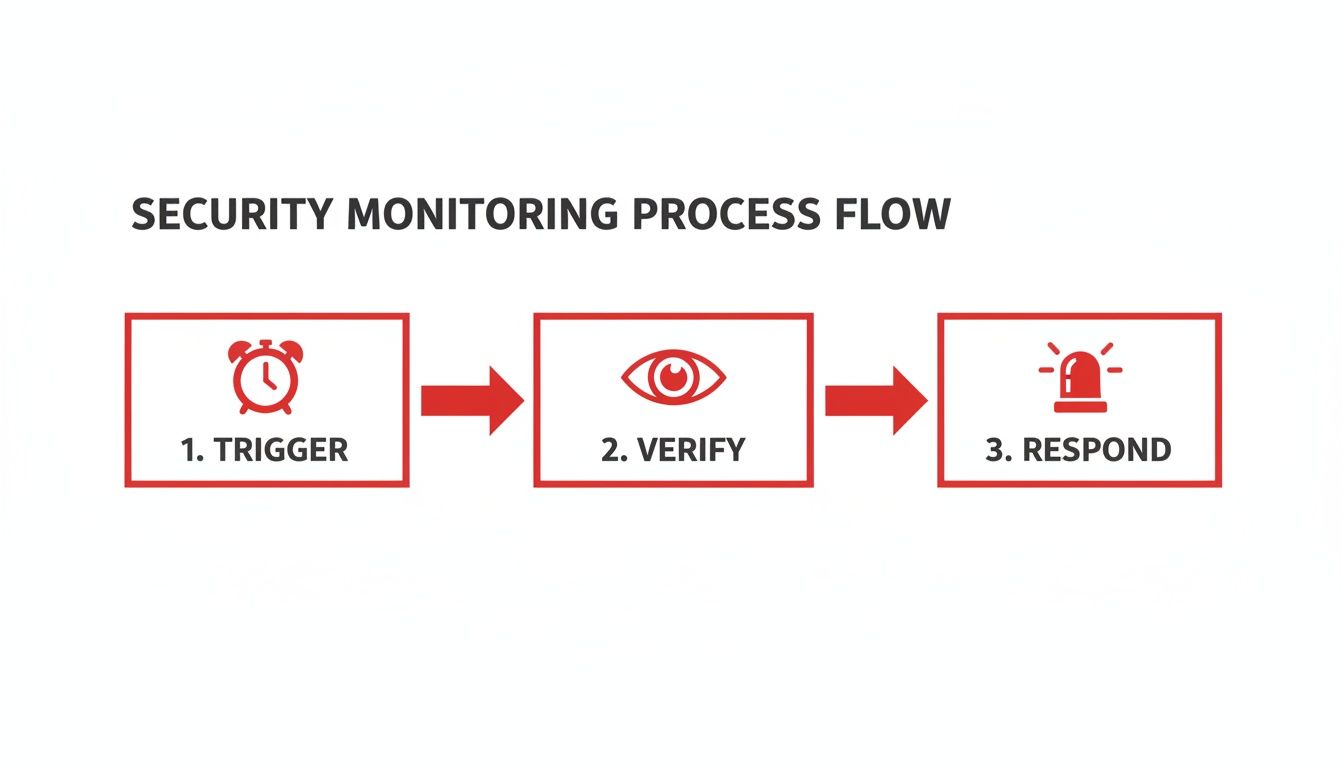
This simple three-step process—Trigger, Verify, Respond—is the backbone of effective security monitoring. It ensures every single alert is handled with precision.
The Critical Role of Verifying Alarms Before Response
The second step, alarm verification, is arguably the most important part of the entire service. The operator doesn't just blindly dispatch the cavalry; they investigate. Tapping into live video feeds, audio listen-in capabilities, or other data from your system, their goal is to confirm whether the threat is real.
This simple act of verification is what separates professional monitoring from a basic, unmonitored "noisy box" alarm. It’s what tackles the costly and frustrating problem of false alarms head-on. Police departments often issue hefty fines for false call-outs, and repeated offences can even lead to them de-prioritising your address.
Actionable Insight: By confirming a genuine intrusion before contacting authorities, professional monitoring ensures police resources are used effectively and that your emergency calls are taken seriously, every single time.
This focus on reliable, verified security is a key reason for the industry's steady growth. In Australia, the Investigation and Security Services industry is projected to hit $13.9 billion in revenue in 2025, expanding at a compound annual growth rate of 1.6% since 2020. This growth highlights the essential role security systems monitoring plays for businesses across New South Wales, Victoria, and Queensland. You can dig deeper into the data on the Australian security services industry.
Crafting Your Customised Incident Response Protocol
Once an alarm is verified as a legitimate threat, the operator executes a pre-agreed response plan. This isn't a generic, one-size-fits-all reaction; it’s a protocol we build specifically for your business and its unique risks.
Your response plan clearly outlines who to contact, in what order, and what actions to take. This ensures the right people are notified and the correct resources are deployed without a moment's delay.
Here are a few practical examples of what a response protocol might include:
- Dispatching a Mobile Patrol: For a verified intruder on a large construction site, the first move might be to send a dedicated mobile patrol unit to secure the perimeter fast.
- Contacting Law Enforcement: If there's a confirmed break-in at a retail store, the operator will immediately contact the police with critical details: number of intruders, their location, and a physical description if possible.
- Notifying Keyholders: The protocol will list primary and secondary contacts from your team, ensuring you are always kept in the loop.
- Remote Intervention: With some systems, the operator can take direct action by activating sirens, floodlights, or even using two-way audio to verbally warn off the intruder.
This tailored approach guarantees the response is always appropriate for the situation, giving you genuine peace of mind that your property is protected by a smart and efficient security systems monitoring service.
So, What's the Real Payoff? The Key Benefits of Security Monitoring
Thinking of security monitoring as just another expense is a common mistake. It's not a passive cost like your electricity bill; it's an active investment that protects your assets, your people, and your reputation. When you move from simply recording incidents to having them professionally monitored, you're getting a powerful layer of proactive defence.
Of course, the benefits aren't one-size-fits-all. What a festival organiser needs is worlds away from the security challenges of a construction site, but the underlying advantage is the same: having expert eyes on your operation when you can't.
Enhanced Safety for Events and Public Venues
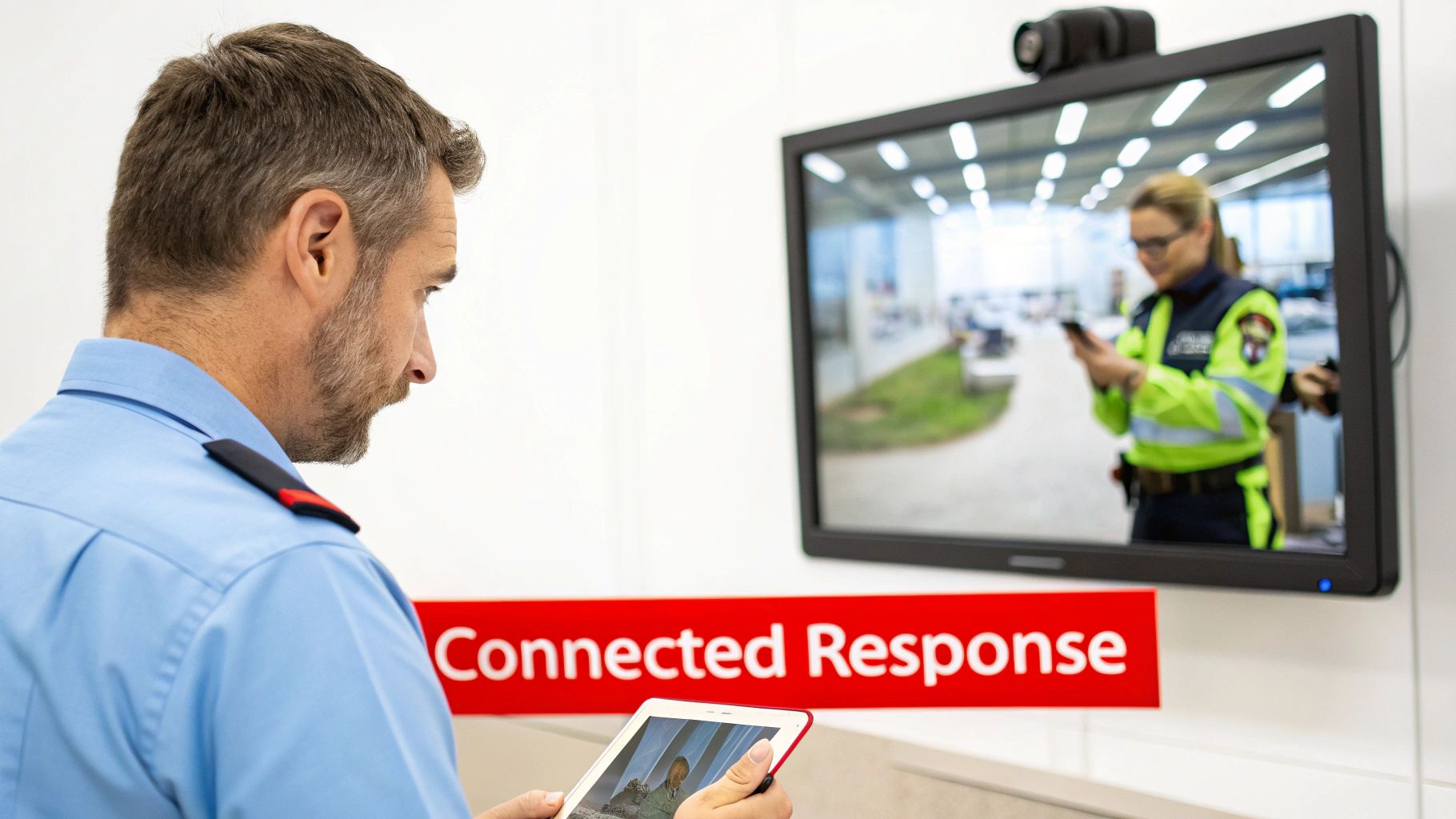
When you’re managing a large crowd at a festival or concert, safety is everything. This is where security monitoring really shines, offering immediate, critical support for crowd control and fast incident response. A trained operator can spot the subtle signs of trouble—overcrowding in one area, a medical issue, or a heated argument—long before it boils over.
Practical Example: Picture a packed food festival in Sydney. An operator spots someone collapsing in a thick crowd. Instead of waiting for a bystander to fight their way to a security guard, the operator is already on the radio, giving on-site medics the exact location. That kind of rapid, coordinated response can literally save a life.
Protecting Assets on Construction and Industrial Sites
Let's be honest, construction sites are magnets for thieves and vandals. The cost of stolen copper, tools, and heavy equipment can completely derail a project budget. After hours, these sites are particularly vulnerable, and this is where professional security systems monitoring acts as a powerful deterrent.
Imagine a building site in Brisbane at 2 a.m. A motion sensor trips, and a camera feed shows two people trying to break into a shipping container. A remote operator doesn't just watch—they act. They trigger a loud siren and use a two-way speaker to tell the intruders they're being recorded and the police are on their way. More often than not, that’s enough to send them running, preventing a major loss.
Actionable Insight: For construction managers, monitoring isn't just about catching thieves. It's a critical tool for keeping projects on time and on budget by stopping loss before it happens.
Ensuring Compliance and Patron Safety in Hospitality
For pubs, clubs, and hotels, monitoring plays a dual role. First and foremost, it helps keep guests safe. But just as importantly, it provides a clear, unbiased record to uphold Responsible Service of Alcohol (RSA) compliance and shut down disputes.
Think about a disagreement at a busy Melbourne bar where a patron claims they were treated unfairly. Instead of a messy "he said, she said" situation, you can review the high-definition footage. It provides an objective account of what actually happened, protecting your staff from false claims and your venue from liability. That kind of proof is gold.
Reducing Shrinkage and Enhancing Security for Retailers
Retailers are in a constant fight against shrinkage, whether it's from organised shoplifters or internal theft. A solid security systems monitoring strategy is one of the best tools in your loss-prevention arsenal. It’s not just about deterrence; it’s about providing the evidence needed to take action.
Here’s what that looks like in the real world:
- Live Intervention: An operator keeping an eye on the electronics aisle spots a known shoplifter. They can immediately radio the floor manager, allowing staff to intervene before anything is stolen.
- Staff Safety: Monitoring provides peace of mind for employees during late-night closing shifts, ensuring someone is always watching and can dispatch help if a situation turns ugly.
- Evidence Collection: When a theft does occur, clear, professionally monitored footage is what the police need to identify suspects and what you need to press charges, helping you recover losses and prevent repeat offences.
By bringing in a monitoring service, retailers create a safer store for customers and staff alike, all while directly protecting their bottom line. It’s a smart business decision, plain and simple.
Integrating Monitoring with On-Site Security Teams
It’s a common mistake to see security systems monitoring and on-site security guards as an either/or choice. In reality, they are two sides of the same coin. When you bring them together, you create a layered security strategy that is far more powerful than either one could ever be on its own.
Think of it like this: your remote monitoring service is your 'eyes in the sky', providing constant, eagle-eyed surveillance over your entire site. At the same time, your on-site security team acts as the 'boots on the ground', ready to respond with a physical presence and immediate action. Together, they create a smart, responsive security ecosystem.
This synergy is what turns your security from a passive, wait-and-see function into a proactive force. Information flows seamlessly from the monitoring centre directly to the guards on patrol, making sure they’re always in the right place at the right time.
Creating a Force Multiplier for Your Security Team
Fusing these two services together genuinely acts as a force multiplier. A single remote operator can effectively watch over a huge area—one that would take a whole team of physical guards to patrol—which makes your security budget stretch much further. This operator can then guide your on-site team with surgical precision.
Imagine a large construction site in NSW after hours. A monitoring professional spots intruders on a thermal camera near where you store valuable equipment. Instead of a guard stumbling upon the breach during their next routine patrol, the operator is already on the radio to the on-site team.
They provide critical, real-time intelligence:
- Exact Location: "Two individuals at the southern perimeter fence, heading toward the excavator."
- Detailed Description: "Both wearing dark hoodies; one is carrying a large bag."
- Live Updates: "They are now attempting to cut the lock on the machinery."
Armed with this live feed of information, the on-site patrol can intercept the intruders quickly and safely, stopping a major theft before it even happens. This level of tight coordination is simply impossible when you have guards or technology working in isolation.
Improving Response Times and Overall Guard Safety
This integrated model also has a massive impact on guard safety. When a security professional is heading towards a potential threat, knowing they have a second set of eyes watching over them from a monitoring centre is a huge advantage. The remote operator is their backup.
If a situation starts to escalate, the monitoring operator can immediately dispatch police or other support to the guard's exact location. This provides a crucial safety net, ensuring your team is never truly alone when confronting a potentially dangerous scenario.
This hybrid model delivers a more robust and responsive security posture. It ensures that every alert is not just detected by technology, but is also met with a swift, intelligent, and coordinated human response.
Ultimately, the combination of vigilant security systems monitoring and responsive on-site teams creates a security solution that is both incredibly efficient and highly effective, protecting your people, property, and brand reputation.
How to Choose the Right Security Monitoring Provider
Picking the right provider for your security systems monitoring is a huge decision. It’s not just about ticking a box; you’re choosing a partner to protect your assets, your site, and your people. The market is crowded, and frankly, it can be tough to know who you can really trust.
A top-notch provider does so much more than just watch a screen. They become an extension of your own team, a crucial part of your overall safety strategy. To make the right call, you need to look past the slick brochures and get into the nuts and bolts of what they offer. This means checking their credentials, understanding how they operate, and making sure their services are a perfect fit for your specific needs, whether that’s a music festival in Melbourne or a construction site in Brisbane.
A Checklist for Finding the Right Partner
The best way to cut through the marketing noise is with a structured checklist. It forces you to compare providers apples-to-apples, so you don’t miss something critical. You want to see hard evidence and certifications, not just hear vague promises.
A good security partner will be completely transparent about their operations and won't hesitate to show you the documents to prove it. Part of this process also means thinking about your hardware, like choosing the best security camera systems for small businesses.
Actionable Insight: A key indicator of a quality provider is the standard of their monitoring centre. An Australian Standards graded control room (like Grade A1) guarantees high levels of redundancy for power and communications, meaning the service won't fail you during a critical event like a widespread power outage.
To help you out, we’ve put together a simple table to guide your evaluation. Think of this as your cheat sheet for vetting potential partners.
Provider Evaluation Checklist
Use this checklist to assess potential security monitoring providers and ensure they meet your business's critical needs.
| Evaluation Criteria | What to Look For | Why It Matters |
|---|---|---|
| Licensing & Compliance | Valid security master licenses for all states of operation (NSW, VIC, QLD, etc.). Membership with industry bodies like ASIAL. | This is non-negotiable. It confirms they are legally authorised and committed to industry best practices. |
| Monitoring Centre Grade | Official certification to Australian Standard AS/NZS 2201.2, preferably Grade A1. Don't just take their word for it—ask to see the certificate. | This grade guarantees the centre has fail-safes for power, comms, and security, ensuring it's always online when you need it most. |
| Customisation & Scalability | A clear process for creating bespoke alarm response plans. Do they ask the right questions about your site, assets, and risks? | A one-size-fits-all approach doesn't work. The protocol for a retail store is worlds away from what a sprawling construction site needs. |
| Integration Capability | In-house mobile patrol and guard response services that work hand-in-glove with their remote monitoring. | A unified service means faster, more coordinated responses. There's no "blame game" between different companies when an incident occurs. |
| Reporting & Communication | Clear, detailed, and timely incident reports. They should be able to show you examples. | You need to know what's happening. Professional reporting provides accountability and valuable data for improving your security over time. |
This checklist gives you a solid framework for making an informed choice and finding a provider who will genuinely have your back.
Key Questions to Ask a Potential Security Partner
Once you've narrowed it down to a shortlist, it's time to get direct. The way they answer these questions will tell you everything you need to know about their professionalism and capabilities.
Here’s what you should be asking:
- Can you please provide copies of your state-specific security master licenses?
- What is the official grade of your monitoring centre, and can we see the certification?
- Can you walk me through how you would develop a customised response protocol for our specific type of business?
- After a verified alarm, what’s your average response time for dispatching a mobile patrol?
- Could you show us an example of a typical incident report we would receive?
By asking these sharp, specific questions, you move from being a buyer to being an informed client. You’re setting yourself up to find a true security systems monitoring partner who not only meets the industry standard but is the right one to protect what you’ve built.
Frequently Asked Questions About Security Systems Monitoring
Stepping up to professional security monitoring can feel like a big move, so it's only natural to have a few questions about how it all works on the ground. To clear things up, we've pulled together some of the most common queries we hear from business owners, event managers, and site supervisors right across Australia.
1. How much does professional security monitoring cost?
The honest answer? It varies. Professional security systems monitoring isn't a one-size-fits-all product, so the cost really depends on what you need to protect. The final price tag is shaped by your site's size, the number of devices being monitored (cameras, sensors), and the agreed-upon response plan (e.g., notify a keyholder vs. dispatching a mobile patrol).
2. What happens if there's a false alarm?
False alarms are a massive headache, and that’s exactly why a professional service is designed to filter them out. When a sensor triggers, our first move is always alarm verification. A trained operator immediately accesses live video or audio feeds to see what’s actually happening. Is it a real threat, or just a possum setting off a sensor? This crucial step prevents pointless call-outs, saving you from potential fines.
3. Can you monitor my existing security cameras and alarm system?
More often than not, yes. A good monitoring provider can usually integrate with the security hardware you already have, as long as it's compatible with modern systems. This is a fantastic way to add a professional layer of protection without having to rip everything out and start from scratch. A provider will conduct a technical assessment first to ensure compatibility.
4. How long does it take to set up a new monitoring service?
Getting you up and running can take anywhere from a few days to a couple of weeks, depending on the complexity of your site and existing systems. The process usually starts with a site assessment, followed by creating a tailored response plan. After that, it's a matter of technically connecting your system to the monitoring centre.
Ready to take your security from just recording incidents to actively preventing them? The team at GM GROUP Services provides expert security systems monitoring across NSW, VIC, QLD, and the ACT, specifically designed for events, venues, and construction sites. Find out how our integrated approach can keep your assets safe by visiting us at https://www.gmgroupservices.com.au.
Discover more from GM Group Services
Subscribe to get the latest posts sent to your email.