
Choosing the right security services for guard protection is a critical, proactive strategy to safeguard your people, property, and brand reputation. At their core, these services provide highly trained professionals to deter threats, control access, and respond effectively when incidents occur, creating a safe, controlled environment for your business to thrive. This guide provides actionable insights to help you make an informed decision.
Do You Really Need a Security Guard Service?
Before you start looking at providers, it's worth understanding what a professional guard service truly brings to the table. Today’s security guard isn’t just a passive observer; they're a dynamic asset and your first line of defence against a whole range of risks, from theft and vandalism to disorderly conduct and medical emergencies.
It helps to think of a professional guard as your on-site risk manager.
- Actionable Insight: Conduct a simple risk assessment. Walk your premises and identify vulnerable areas. Are there poorly lit corners, unsecured entrances, or high-value assets left exposed? This list will clarify exactly what you need a guard to protect.
- Practical Example: For a packed music festival, a guard is the calm presence directing crowd flow and stepping in before a disagreement turns into a fight. On a sprawling, dark construction site, they’re the vigilant eyes preventing the theft of expensive equipment that could set your project back weeks. In a luxury retail store, their polished, customer-focused approach makes shoppers feel safe while deterring would-be shoplifters.
This visible, proactive presence is an incredibly powerful deterrent. In fact, the Australian Institute of Criminology highlights that a visible security presence is one of the most effective ways to stop opportunistic crime. When a potential thief or troublemaker sees a professional guard on patrol, they are far more likely to think twice and move on.
What Does a Security Guard Actually Do?
Getting a handle on the specific functions a guard performs really clarifies the value they add. While their duties are always tailored to the specific site, they generally fall into a few key areas:
- Deterrence is Job Number One: A guard in uniform is there to stop incidents from ever happening. Their mere presence sends a strong, clear message: this property is monitored, protected, and not an easy target.
- Rapid, On-the-Spot Response: When something does happen—whether it’s a medical emergency, a fire alarm, or a security breach—a trained guard is your immediate first responder. They know how to de-escalate tense situations, coordinate with police or paramedics, and secure the scene until help arrives.
- Protecting Your Assets: Guards are absolutely essential for protecting physical assets. This could mean preventing stock from walking out the door in a retail environment, securing valuable machinery on a building site, or controlling access to sensitive data centres in a corporate office.
- Your Brand Ambassador: Often, the security guard is the first and last person a customer, employee, or guest interacts with. A professional, approachable guard doesn’t just provide security; they enhance your brand’s reputation by creating a welcoming and safe atmosphere for everyone.
These roles often blend together. A guard at a corporate product launch, for example, will be checking invitations at the door, managing crowd movement near the main stage, and be fully prepared to execute an emergency response plan if needed.
The decision to bring in a guard service is an investment in stability and peace of mind. By identifying the specific risks your business faces, you can see how these core functions directly solve your problems, paving the way for a safer, more secure operation.
The table below breaks down these primary roles to help you pinpoint exactly what your business needs.
Core Functions of Professional Security Guard Services
| Service Function | What It Achieves | Best For |
|---|---|---|
| Access Control | Monitors and controls entry points, preventing unauthorized access to secure a perimeter. | Construction Sites, Corporate Buildings, Gated Communities |
| Crowd Management | Ensures orderly conduct at large gatherings, manages crowd flow, and de-escalates potential conflicts. | Festivals, Concerts, Sporting Events, Licensed Venues |
| Loss Prevention | Deters theft and shrinkage through visible presence and proactive surveillance, protecting assets. | Retail Stores, Warehouses, Shopping Centres |
| Emergency Response | Acts as the immediate first responder, coordinating with emergency services and executing safety plans. | All Business Types and Public Venues |
Ultimately, understanding these functions helps you move from thinking of security as an expense to seeing it as a vital operational tool that supports your business goals.
What Kinds of Security Guard Services Are There?
Choosing the right security guard service isn't a one-size-fits-all decision. Think of it like a doctor prescribing a specific treatment for a specific ailment; your security plan has to be tailored to the unique risks of your environment. It's about moving past the generic idea of a security guard and understanding the different specialist roles that exist.
The need for this kind of specialised security is booming. The Australian security market, valued at AUD 4.38 billion in 2024, is projected to more than double to AUD 8.94 billion by 2035. This surge is especially noticeable in commercial settings like bars, clubs, and retail stores, which are expected to lead the charge with an 8.4% compound annual growth rate. You can dive deeper into this trend by exploring the full research on the Australian security market.
Static Guards: The Constant Presence
A static guard is like a lighthouse—a constant, visible beacon of security for a single, fixed location. Their job is to maintain a consistent presence, control who comes and goes, and act as a powerful deterrent in one specific area.
You’ll often see static guards:
- Monitoring CCTV feeds and alarm systems from a central control room.
- Managing the front desk in a corporate lobby or the gatehouse of a construction site.
- Providing a visible security presence in a retail shop to discourage theft.
This type of service is perfect for any place where a continuous, focused security presence is absolutely non-negotiable.
Mobile Patrols: The Roaming Watch
In contrast, mobile patrols are the security equivalent of a dedicated neighbourhood watch, designed to cover much larger areas or multiple properties. Instead of staying put, these guards conduct regular—and often randomised—patrols in a clearly marked vehicle.
- Actionable Insight: For maximum effect, work with your provider to map out a patrol route that is deliberately unpredictable. Varying the timing and path of patrols prevents criminals from learning your security schedule.
Mobile patrols are a great fit for industrial parks, sprawling shopping centre car parks, or residential communities where having a full-time static guard at every corner just isn't feasible. Their visible, unpredictable movement keeps potential wrongdoers guessing.
The real power of mobile patrols is their cost-effectiveness. They provide a security blanket over a wide area, offering both a deterrent and a rapid response capability that covers multiple sites with a single team.
Specialised Security Guards: The Experts for High-Stakes Situations
Beyond these two core roles, some situations demand a higher level of expertise. These specialised units are brought in when the risk profile is unique or elevated, requiring training that goes far beyond standard security duties.
The core functions of any guard—access control, crowd management, and loss prevention—are the building blocks for these more advanced roles.
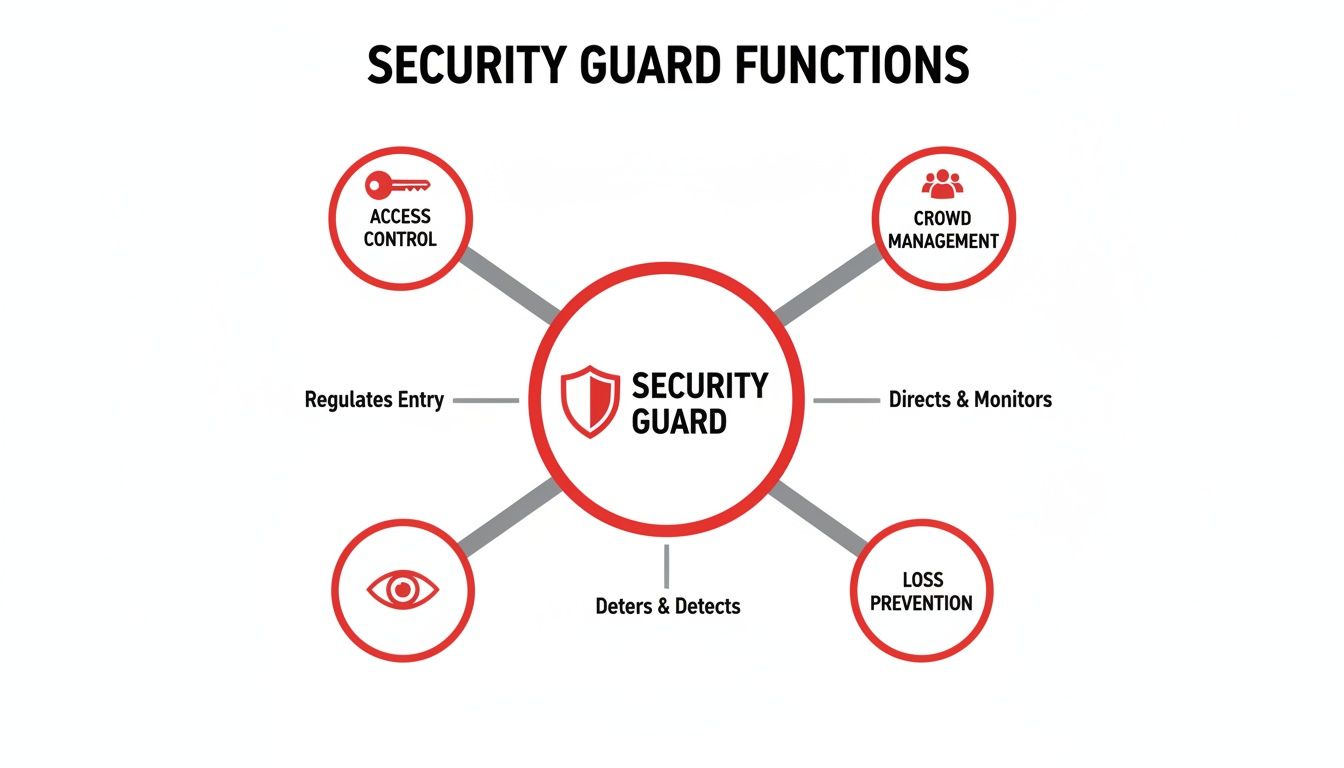
This diagram shows how these distinct duties all flow from a guard's central mission: protecting people and assets.
Here are a few examples of where you might need a specialist:
- K9 Units: These teams are the expert detectors. A dog’s sense of smell is far more powerful than any technology, making K9 units invaluable for sweeping festival grounds for drugs or checking a large venue for explosives before a big event.
- VIP Protection (Bodyguards): Think of these operatives as a personal shield. They provide close protection for executives, celebrities, or anyone facing a direct personal threat. Their work is all about meticulous planning, route analysis, and discreet surveillance.
- Covert Operatives: These are the eyes and ears you never see. Posing as shoppers, they can identify organised retail crime rings from the inside. At a corporate function, they might mingle with the crowd to spot threats without creating a scene.
By understanding these different types of guard services, you can make sure you're matching the right solution to your specific problem. It’s the best way to ensure your investment is actually delivering the protection you need.
Navigating Licensing and Compliance for Your Security Services for Guard
Hiring professional security isn't just about getting a person in a uniform; it's a legal partnership. Choosing an unlicensed security provider is more than just a bad business move—it’s a massive legal and financial gamble that can leave your business facing hefty fines, liability claims, and a reputation that’s hard to repair.
You have to get your head around the complex web of security licensing across Australia. Each state and territory has its own rulebook and governing body. This means a security licence that’s perfectly valid in New South Wales won't cut it in Victoria or Queensland. A "one-size-fits-all" approach to compliance is just asking for trouble.
This strict regulatory landscape is there for a reason: to maintain high professional standards across the industry. And it's a growing industry. A recent report showed a 6.10% jump in individual licence holders in just the last year, bringing the total to over 155,000 licensed professionals. This is the workforce needed to meet the demand in key states like NSW, QLD, and the ACT, as highlighted in ASIAL's latest licensing report.
Key Licensing Requirements by State
Getting to grips with the different state regulations is your first step. Every jurisdiction has unique requirements for both the security company (the Master Licence) and the individual guards themselves (the Individual Licence).
- New South Wales (NSW): Everything runs through the Security Licensing & Enforcement Directorate (SLED). Security companies need a Master Licence, and their guards must hold a Class 1 licence with the right subclass for the job (like 1A for an unarmed guard or 1C for a crowd controller).
- Victoria (VIC): The Licensing and Regulation Division (LRD) of Victoria Police is in charge here. A security business needs a Private Security Business Licence, while guards need a Private Security Individual Operator Licence, again with specific categories for their duties.
- Queensland (QLD): The Office of Fair Trading governs the industry. Companies need a Security Firm Licence, and individuals must have a Security Provider Licence with different classes for roles like crowd control or unarmed security.
Beyond the Security Licence: Specialised Certifications
A standard security licence is just the starting point. For many roles, guards need extra, specialised training to do their job legally and safely. Overlooking these additional certifications is just as risky as hiring an unlicensed guard in the first place.
A perfect example is the Responsible Service of Alcohol (RSA) certificate. If a guard is working in any licensed venue—a bar, pub, or festival—a current, state-specific RSA isn't a nice-to-have; it's a legal must. This training gives them the skills to handle intoxicated patrons and keep the environment safe for everyone.
Other vital certifications to check for include:
- First Aid Certificate: This is non-negotiable for guards in almost any setting. It means they can provide immediate help in a medical emergency.
- White Card (Construction Induction): This is mandatory for any security personnel stepping foot on a construction site in Australia.
Choosing a fully licensed and insured provider isn't just about ticking a box. It's a fundamental risk management strategy that protects your business from liability, ensures a higher standard of service, and demonstrates your commitment to safety.
While knowing the specific state rules is vital, implementing broader effective compliance risk management strategies provides a solid framework for your entire operation. This knowledge gives you the power to ask the right questions and partner with a truly professional security firm.
Your Checklist for Vetting Security Guard Providers
Choosing the right security provider is one of the most important decisions you'll make for your business. It's a high-stakes call that directly impacts the safety of your people and the security of your assets. To get it right, you need a solid framework that goes beyond gut feelings and lets you evaluate potential partners with confidence.
A huge part of this is understanding that one size never fits all.
- Practical Example: The guard you need for a black-tie corporate event is a world away from the one required to secure a muddy, after-hours construction site. One role demands impeccable customer service and discretion; the other calls for sharp vigilance, perimeter control, and a deep understanding of site safety. A truly professional provider knows this and won't just send a generic guard—they’ll assess your unique environment to deploy the right person for the job.
Key Questions to Ask Every Potential Provider
Before you even glance at a contract, you need to ask some pointed questions. The answers will tell you everything about a company's professionalism, their operational readiness, and how reliable they'll be when it matters.
- Actionable Insight: Don't just accept "yes" for an answer. When you ask these questions, ask for specific examples or documentation.
Training and Supervision: "How do you actually train your guards for a site like mine, and what does your on-site supervision look like in practice?" You're listening for evidence of both initial training and ongoing, site-specific coaching. A great provider will have field supervisors who physically visit sites to support their guards and ensure everything is running smoothly.
Incident Communication: "Walk me through your exact communication process when an incident occurs." You need to hear a clear, structured plan. They should be able to explain precisely how a guard escalates an issue, who gets notified (and when), and how you receive detailed incident reports. Vague answers are a major red flag.
Industry Experience: "Can you share case studies or references from businesses in our industry?" Proven experience in your sector is the single best predictor of success. A company that’s fantastic at event security might not be the best fit for a corporate high-rise or a logistics warehouse.
A provider’s commitment to maintaining clear and current Standard Operating Procedures (SOPs) is another great indicator of their professionalism. It shows they are organised and serious about delivering a consistent service. You can learn more about effective strategies for keeping Standard Operating Procedures up-to-date to see what best practice looks like.
Provider Evaluation Checklist for Security Guard Services
To make comparing providers easier and more objective, a checklist is your best friend. It ensures you systematically weigh up each company against the most important criteria, so no red flags are missed.
| Evaluation Criteria | What to Look For | Why It Matters |
|---|---|---|
| State-Specific Licensing | A valid Master Licence for the company and individual guard licences for your state (NSW, VIC, QLD, etc.). Ask to see them. | This is non-negotiable. It ensures legal operation and protects your business from massive fines and liability. |
| Comprehensive Insurance | Current certificates for Public Liability and Professional Indemnity insurance. Don't just take their word for it. | This cover protects your finances if there are any accidents, damages, or claims of negligence. |
| Tailored Training Programs | Proof of ongoing, site-specific training and regular performance supervision. | This guarantees that the guards on your site are professional, prepared, and genuinely effective in your specific environment. |
| Industry-Relevant Experience | Positive testimonials, solid references, and case studies from businesses just like yours. | This is real-world proof of their reliability and ability to handle the unique challenges your industry faces. |
Taking this structured approach ensures you partner with a provider who genuinely gets your security needs. In Australia's private security sector—an industry that now brings in over $11 billion annually and employs more than 180,000 professionals—the demand for quality is at an all-time high. The industry is now larger than the Australian police and defence forces combined, which just highlights how critical it is to partner with a reliable, well-established provider.
Making Your Security Services a Part of Your Team
Signing on the dotted line for a security guard service is just the first step. The real work—and the real value—comes from weaving that service into the fabric of your daily operations. This isn't just about hiring a contractor; it's about building a genuine partnership.
Think of it less like an external service and more like onboarding a new department. Their success is your success. A smooth integration means your new team hits the ground running, creating a safer environment from day one. It's all about collaboration, clear communication, and shared goals.
Nailing the Site Briefing
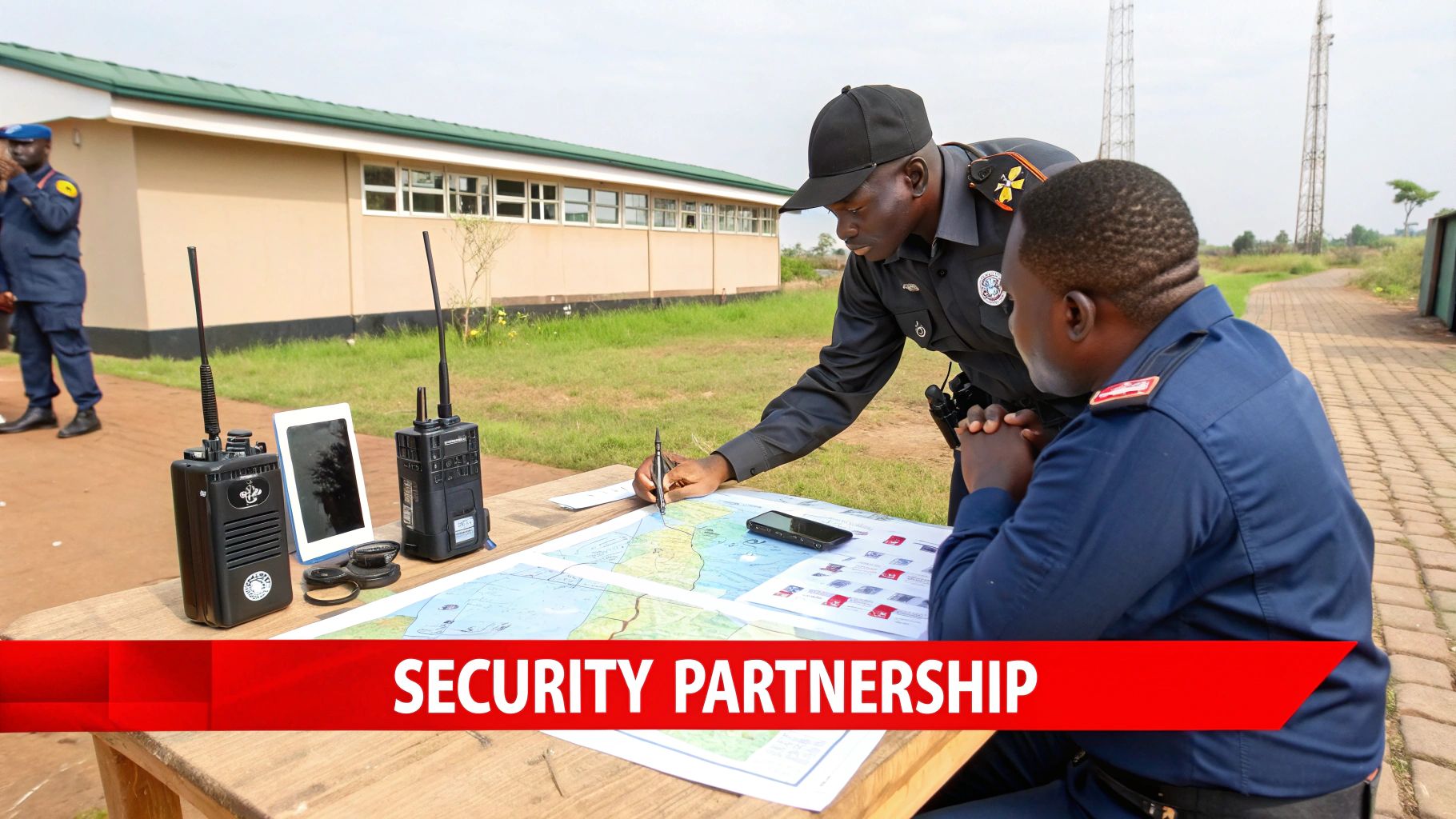
Everything starts with the site briefing. This is your chance to give the security team the specific, ground-level knowledge they need to do their job properly. A quick, five-minute chat isn't going to cut it; a comprehensive orientation is absolutely essential.
- Actionable Insight: Create a simple "Site Pack" for your security team. Include a site map, key contact numbers, emergency procedures, and a one-page summary of your company culture and expectations.
A proper briefing should cover:
- Key Areas and Hotspots: Point out the critical spots. Where are the main access points? Where are your high-value assets stored? Are there any areas with a history of trouble? For a construction site, this might be the tool lockup or fuel depot. In a retail store, it could be the stockroom or electronics aisle.
- Emergency Procedures: Run them through your exact emergency plans. Show them the fire exits, first aid kits, and designated assembly points. Make sure they know who to contact within your company when something goes wrong.
- Your Company Culture: This one is often overlooked but hugely important. Explain your brand’s personality. A guard at a five-star hotel needs a different approach—welcoming and discreet—than a guard at a music festival, who needs to be more assertive but still approachable.
A detailed briefing empowers the security team to understand not just what they need to do, but why they're doing it. That context helps them make smarter, more effective decisions in the moment.
Keeping the Lines of Communication Open
Clear, consistent communication is the lifeblood of any good security operation. You need to agree on how you'll handle daily updates, incident reports, and urgent alerts. Getting this right from the start prevents crossed wires and ensures you're never in the dark about what’s happening on your property.
A solid communication plan turns security from a purely reactive function into a proactive intelligence-gathering asset. It ensures small issues are logged and sorted out before they have a chance to become big problems.
Practical Example: A Music Festival
An event organiser could set up a dedicated two-way radio channel for the security supervisor, event manager, and first aid team leader. They might also use a shared digital log for hourly updates on crowd movements, minor issues, and potential safety hazards. This keeps everyone on the same page and enables a fast, coordinated response.
Practical Example: A Retail Store
The store manager could require a formal, written incident report for every suspected theft or major customer complaint. Submitted daily via email, these reports allow the manager to spot patterns over time, identifying problem areas or times of day that need more attention for loss prevention. This data-driven approach helps fine-tune how the security services for guard team is deployed.
Defining and Measuring Success with KPIs
How do you know if your security investment is actually paying off? You need to track Key Performance Indicators (KPIs). These metrics take the guesswork out of it, moving your assessment from a vague feeling to a concrete, data-backed evaluation.
Effective KPIs for a security guard service might include:
- Reduction in Incidents: A measurable drop in theft, vandalism, or trespassing over a specific period.
- Incident Response Time: How quickly, on average, a guard responds to and resolves a reported issue.
- Accuracy of Reporting: The quality and detail of daily logs and incident reports. Is all the critical information being captured correctly and consistently?
By setting these clear benchmarks, you and your security provider can work together to track performance, pinpoint areas for improvement, and make sure the security program is always aligned with your business goals. This turns a simple service into a powerful operational partnership.
Understanding the Real Cost of Professional Security
It’s tempting to look at the hourly rate for a security guard and see it as just another line item on the budget. But that’s a narrow view. Thinking of security as a simple expense misses the point entirely; a professional, well-run security service is actually a smart investment in keeping your business safe, running, and profitable.
The real cost isn't just the number on an invoice. It's a direct reflection of the value and protection you're getting, and understanding what goes into that number helps you see past the price tag.
What Determines the Cost of Security Services for a Guard
The price for professional security isn't just pulled out of thin air. It’s carefully worked out based on the real-world risks and specific needs of your site.
- Risk Level: A high-risk site, like a packed music festival or a construction site loaded with expensive machinery, needs guards with serious training and experience. Naturally, that level of expertise comes at a higher rate than what's needed for, say, a quiet corporate lobby.
- Guard Duties: What you’re asking the guard to do is a huge factor. A guard checking IDs at a door has a different cost profile than a covert loss prevention officer trained to spot theft, or a guard who needs an RSA certification to work in a licensed venue.
- Location and Hours: Rates can shift depending on where you are, with major city centres often having different pricing structures. On top of that, overnight shifts, weekends, and public holidays usually cost more to make sure guards are fairly paid for working those unsociable hours.
- Contract Duration: A long-term, ongoing contract often comes with more favourable pricing than a one-off event. It’s simply more efficient to manage a sustained partnership, and that saving gets passed on.
The crucial shift in thinking is from 'cost' to 'value'. A single prevented theft, averted liability claim, or de-escalated conflict can save your business far more than the cost of the security service itself.
Putting your money into a quality, professionally supervised service isn't a cost—it's a proactive financial move. It helps you avoid the massive, and often catastrophic, expenses that come with theft, property damage, or legal trouble. When you understand the factors that shape security pricing, you can see it for what it truly is: an essential investment in your business’s future.
Answering Your Top Questions About Security Guard Services
You've got questions, and that's a good thing. Making the right call on security is crucial, so let's walk through some of the most common queries we hear from business owners. The goal here is to give you the clarity you need to feel confident in your decision.
How Do I Figure Out the Right Number of Guards?
This is the classic "how long is a piece of string?" question, but there's a definite science to it. The right number of guards isn't a guess; it's based on a proper risk assessment that looks at your specific environment.
We consider things like the sheer size of your venue, how many people are coming and going, and what unique risks you face. For instance, a licensed venue in NSW often works on a baseline of one guard per 100 patrons. But a sprawling construction site is a different beast entirely—there, we’d be looking at the length of the perimeter, the number of access points, and the value of the equipment you're protecting. It’s all about providing a real deterrent and effective coverage without overstaffing.
What Actually Happens if There Is an Incident on My Property?
Think of a professional guard as your first line of defence—your immediate on-site responder. They're trained to be a calming presence, not an inflammatory one, using de-escalation skills to manage situations before they get out of hand.
If an incident does occur, they follow a clear, pre-agreed plan. This means securing the area to keep everyone safe, administering first aid if required, and being the direct point of contact for police or paramedics. Afterwards, every detail is captured in a formal incident report for your records. Their job is to contain the situation professionally, so your business can get back to normal as quickly as possible.
Are the Guards Trained Specifically for My Industry?
They absolutely have to be. Putting the wrong guard in the wrong environment is a recipe for disaster. Security is never a one-size-fits-all solution.
A guard standing in a corporate lobby needs to be an ambassador for your brand, with impeccable customer service skills. The guard protecting a construction site, on the other hand, needs their White Card and a deep understanding of site safety protocols.
Any quality security provider will carefully match the guard's qualifications to your site's demands. For a pub or club, that means having a current RSA certification. It’s all about deploying someone who is genuinely prepared for the specific challenges your industry presents.
Can I Just Hire Guards for a One-Off Event?
Of course. Flexibility is key. Most reputable security companies are set up to handle everything from short-term gigs to permanent, long-term contracts.
Whether you need a team for a single-day corporate conference, a weekend music festival, or a construction project that will last for months, the service should be built around your timeline. This way, you get that professional presence exactly when you need it, without being tied to an agreement that doesn't make sense for you.
Frequently Asked Questions (FAQ)
Here are answers to some additional common questions about choosing and implementing security services for guard professionals.
1. How can I verify a security provider's licence?
Actionable Insight: Don't take their word for it; verify it yourself. Most state regulators have online public registers. You can jump on their website and search for a company's Master Licence or an individual's licence number to see if it's valid. Always ask a potential provider for their licence numbers and do the check.
2. What happens if I hire an unlicensed guard?
The penalties are severe. You can expect substantial fines for both your business and the unlicensed provider. Even worse, it can completely void your insurance policies, leaving you personally on the hook for any incidents, damages, or injuries.
3. Does a guard's licence from one state work in another?
Not automatically, no. While some states have mutual recognition arrangements, a guard usually needs to apply for a new licence or have their existing one formally recognised to work legally in a different state. A professional provider will handle all of this to make sure their team is 100% compliant in your location.
4. How important are online reviews and testimonials?
They’re a great starting point, but they need context. Look for detailed reviews from businesses in your specific industry. A string of glowing reviews from music festival organisers is fantastic if you're planning an event, but it's far less relevant if you're trying to secure a data centre.
5. Should I choose a large national company or a smaller local one?
Both have their pros and cons. A big national firm might offer more resources and a wider footprint, whereas a local provider often brings more personalised service and deep-seated knowledge of the local area. The "best" choice is simply the one that ticks all the boxes on your evaluation checklist.
6. What are the biggest red flags to watch out for?
The most glaring red flags are an inability to quickly produce current licences and insurance certificates, giving vague answers about training and supervision, and rock-bottom pricing. An unusually cheap quote is almost always a sign that corners are being cut on compliance, training, or staff wages—all of which puts your business directly at risk.
Ready to secure your event, venue, or business with a team you can trust? GM GROUP Services provides professional, licensed security solutions across NSW, VIC, QLD, and the ACT. We specialise in matching the right guard to your specific needs, ensuring your people and property are protected. Find out how our expert team can support you at https://www.gmgroupservices.com.au.
Discover more from GM Group Services
Subscribe to get the latest posts sent to your email.