
Security requirements for events are where most organisers get caught out. The problem usually starts two weeks before gates open, when the bar roster is still fluid, the council wants sign-off, police want the final plan, and nobody has checked whether the people at the door are licensed for the actual duty they're being sent to do.
That's when a compliant-looking event can still fail inspection. The right crowd-controller ratio, the right RSA coverage, the right emergency plan, and the right paperwork matter more than a generic “security presence”. Inspectors don't care that the weekend is busy. They care whether you can prove the site is lawful, staffed correctly, and documented properly.
Why Most Australian Event Organisers Misread the Security Brief
A mid-tier festival organiser usually thinks the security conversation is about numbers. It isn't. It's about who can lawfully do what, where the alcohol boundary sits, and which documents the regulator will ask for before anyone is allowed through the gate.
The common mistake is treating event security like a single service. In Australia, it isn't. A person working crowd control, a person refusing entry, a person standing on a licensed bar, and a person doing VIP protection may need different licence classes, different competency evidence, and different roster notes. The earlier section on licensing is not optional admin, it's the core of whether the roster is lawful.
Practical rule: if you cannot point to the licence class, the RSA status, and the duty description for each person on site, you're not ready for an inspection.
The seven pillars that hold an event together are straightforward. Licensing, risk documentation, crowd control, medical and police liaison, insurance, compliance checklists, and a workable incident reporting trail. The regulators do not reward vague intent. They reward evidence.
This is especially true in Victoria, where public-event guidance says an emergency management plan should be prepared and approved for every event with more than 5,000 patrons, and also for events where alcohol will be consumed or where local government requires it Victoria Police public event guidelines. That is not a nice-to-have planning note, it's a hard compliance trigger. The same guidance also ties event safety to documented planning, licensed personnel, surveillance, and evidence retention.
A good organiser stops asking, “How many guards do I need?” and starts asking, “Which licence class, which ratio, which plan, and which sign-off will the inspector demand?” That shift saves time, avoids rework, and keeps the event from being blocked at the last minute.
Licensing Requirements for Security and RSA Across Australian States
Start with the licence, then check the roster. If a staff member is carrying out a security task, they need the correct authority for that work. NSW guidance is direct, anyone doing a security activity, including crowd control or bouncer duties, must be licensed under the relevant class NSW event safety and security guidance.
Match the task to the state system
In NSW, treat crowd control, gate duties, refusal of entry, and licensed-premises work as separate compliance checks. If alcohol is involved, RSA applies as well. The liquor guidance also requires security officers doing crowd-control duties at a limited liquor licence function to complete an approved RSA course, and it expects security or RSA-trained staff to monitor intoxication, anti-social behaviour, underage drinking, and liquor removal from the licensed area VIC and NSW liquor-related guidance.
In Victoria, crowd controllers must be licensed, and the staffing baseline is 2 licensed crowd controllers for the first 100 customers, then 1 additional crowd controller for every extra 100 customers or part thereof Victorian crowd safety and emergency planning sheet. Victoria Police public event guidance also expects organisers to brief stakeholders, involve emergency services and local government where appropriate, and include private security staff in the management plan with a clear understanding of venue risks and statutory duties Victoria Police public event guidelines.
In Queensland, organisers should run the event as a security-and-liquor compliance job. If the site includes a licensed area, the staff doing crowd work and alcohol monitoring need the relevant security approval and the RSA competence expected for that role.
In the ACT, use the same standard. Match the security licence to the actual duty, then add RSA where alcohol service or alcohol monitoring is part of the assignment.
A licence that looks close enough usually fails inspection.
Security and RSA Licence Classes by State
| State | Security Licence Class | Issuing Authority | RSA Authority | Event Role Covered |
|---|---|---|---|---|
| NSW | Relevant security class for the task, including crowd control and licensed-premises work | NSW security regulator / SLED framework | Approved RSA pathway for liquor duties | Gate control, crowd control, bouncer work, licensed-area supervision |
| VIC | Crowd controller and security registration | Victoria Police | RSA certification recognised for liquor duties | Venue entry, crowd control, licensed-area monitoring |
| QLD | Security provider and crowd controller class | Queensland regulator | RSA for liquor-service roles | Event gates, licensed areas, crowd duties |
| ACT | Security licence matched to the duty | ACT regulator | RSA where alcohol service or monitoring applies | Access control, crowd management, licensed-function support |
Paperwork matters just as much. Keep licence numbers on the roster, keep photo ID on shift, and make sure each duty description matches the credential. Inspectors usually want the name, the licence, the RSA status, and the post assignment in one place.
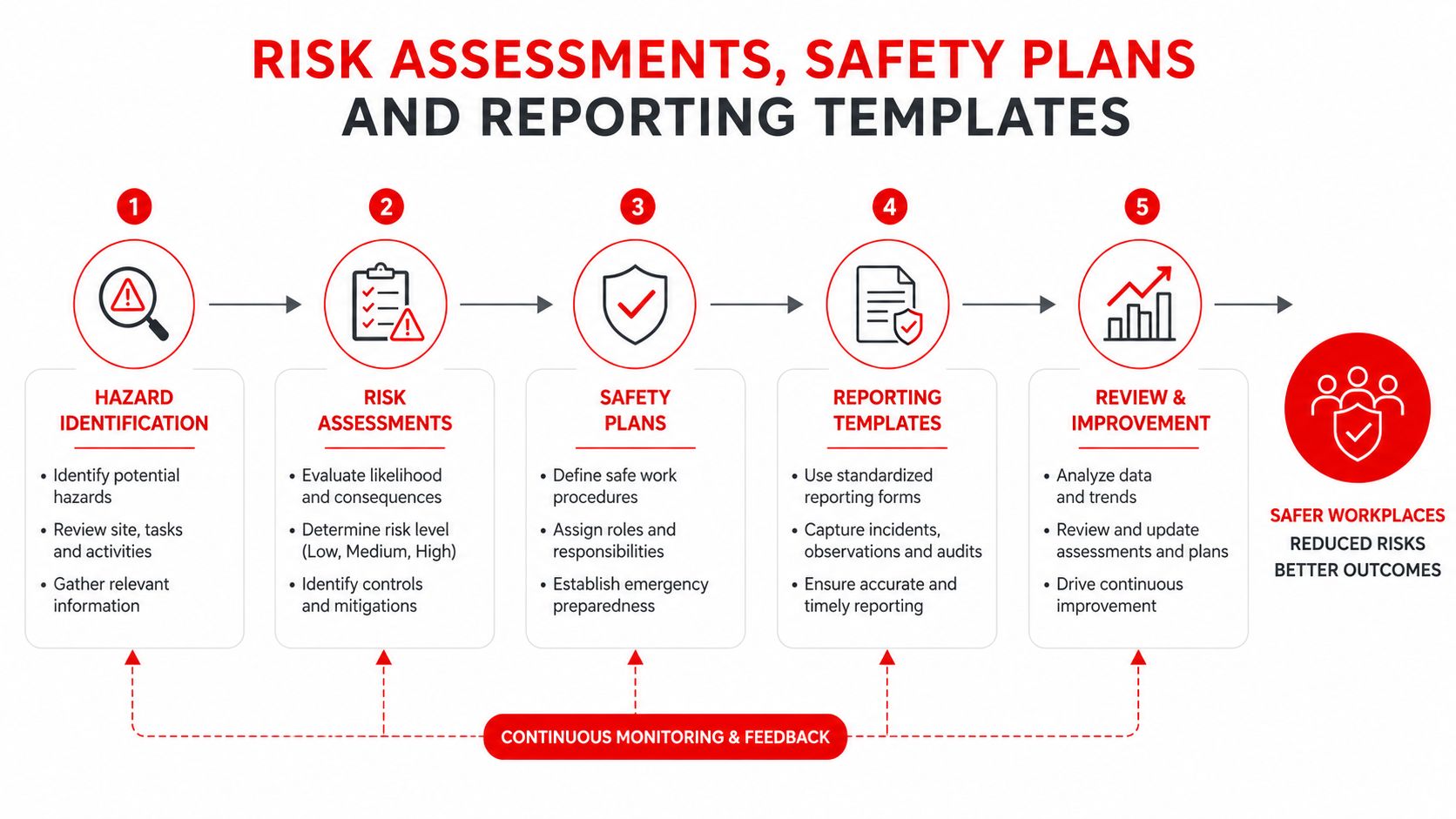
Risk Assessments, Safety Plans and Reporting Templates You Must Have
A strong event file lives or dies on four documents. Leave one out, and council, police, venue management, or an insurer will start asking awkward questions.
Start with a written risk assessment built on a recognised matrix such as AS/NZS ISO 31000. Name the hazard, score the likelihood and consequence, then state the control. Keep it specific. Write queue compression at entry, alcohol-related aggression at closing time, or blocked emergency access near the stage. “Crowd issues” and “weather risk” are too vague to pass scrutiny.
Next, prepare an Event Safety Plan. It needs the details that drive the roster and the post order, ingress, egress, crowd density points, stage or pyrotechnic zones if they apply, lost-child handling, and the comms channel for the day. In Victoria, the Victoria Police public event guidelines expect private security to sit inside the management plan, not get tacked on at the end.
Then put together an Emergency Management Plan. Inspectors check whether it can run the event. Include activation triggers, command structure, evacuation routes, and the contact chain for police, ambulance, venue management, and the event controller. Victoria's public-event guidance also expects the plan to be prepared and approved for qualifying events, including those over 5,000 patrons or where alcohol will be consumed.
Keep an Incident Report template ready before the first guest walks in. Record time, location, person involved, witness details, escalation path, refusal of entry, and any referral to medical or police. For licensed functions, add RSA refusal logs and alcohol-related incidents in the same file.
Practical rule: if the plan cannot survive a post-event request for evidence, it is not finished.
Keep the documents together, version-controlled, and signed off by the right person. That is what matters when an incident hits at 10.15 pm and everyone wants the paperwork immediately.
Crowd Control Ratios, Egress Planning and Surveillance Rules
The crowd-control number has to match the site, the licence class, and the risk profile. In Victoria, the clearest baseline for licensed settings is 2 crowd controllers for the first 100 customers, then 1 additional crowd controller for every extra 100 customers or part thereof. Treat that as the floor, not a target. The ratio changes if the venue layout, alcohol load, or entry conditions are tighter than the ordinary pub or club model.
What inspectors look for at exits and pinch points
Door staffing has to cover the actual pressure points. Put controllers at pinch points, not just the main gate. Keep exits clear, make signage easy to read, and plan egress so people do not bottle up as the event closes.
NSW guidance says the same thing in operational terms, stagger finishing times, separate exit points, and keep transport options available at closure to reduce crowd crush risk and compressive loading during egress. That is how inspectors read a plan, they want to see whether people can leave without being forced into a single choke point.
Surveillance gets judged the same way. Victoria Police public event guidance expects cameras to cover entrances, bars, and entertainment or dance floor areas, to run before, during, and after opening hours, and to keep footage for at least 4 weeks Victoria Police public event guidelines. If a venue says it has CCTV but cannot prove coverage and retention, treat it as unusable for compliance.
A physical storage plan matters too. Stock, radios, paperwork, and spare gear need a controlled place on site, especially at the perimeter or backstage. For organisers looking at container-based event storage, Pacific Mobile Structures entertainment storage is a sensible reference point.
Crowd Control and Surveillance Baselines by State
| State | Controller Ratio Baseline | Egress / Sign-off Requirement | CCTV Retention |
|---|---|---|---|
| NSW | Use duty-based staffing matched to access control and liquor risk | Stagger closures, separate exits, keep transport available | Retain footage to support incident evidence and compliance |
| VIC | 2 for the first 100, then 1 per extra 100 or part thereof | Emergency plan approval for qualifying events, clear exits and signage | At least 4 weeks |
| QLD | Use event-specific controller numbers based on access and risk | Apply perimeter and exit control suitable to the site | Keep footage long enough to evidence incidents and compliance |
| ACT | Use task-based staffing matched to crowd and access risk | Apply site-specific egress and police coordination | Keep footage long enough for review and enforcement |
Understaffing usually shows up at closing time. That is when crowd pressure, alcohol, and poor exit design collide, and that is the moment inspectors will ask for the roster, the plan, and the footage.
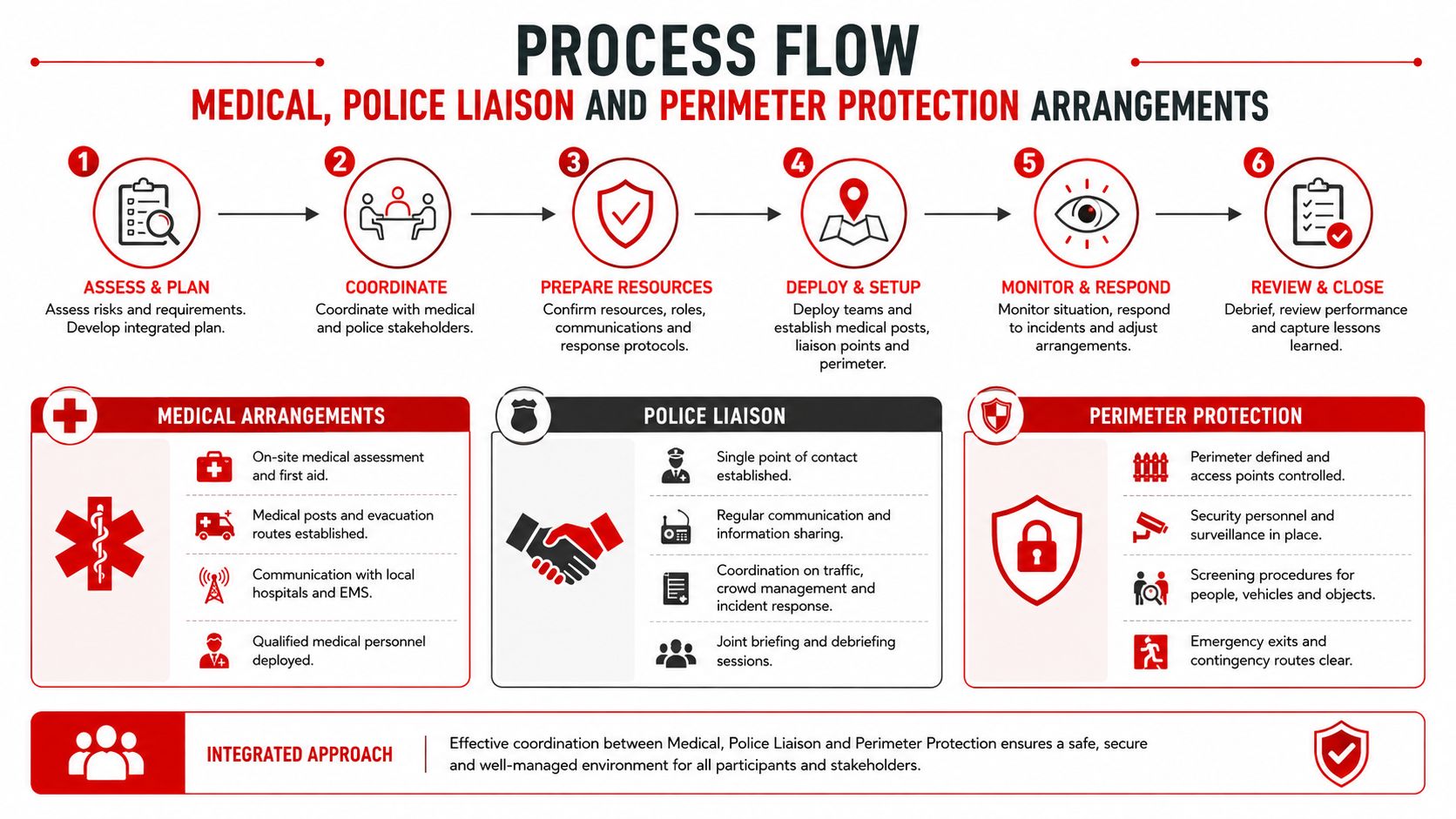
Medical, Police Liaison and Perimeter Protection Arrangements
Medical coverage should be sized before the map is finalised. Don't wait for the event day to decide whether you need first aid kits, trained responders, or a paid contractor. The right answer depends on the site, the crowd, the alcohol load, and whether people can move quickly to a treatment area.
SafeWork guidance and WorkSafe expectations generally push organisers toward visible first aid capability, trained responders, and a clear path for escalation when something goes beyond basic treatment. If the event has higher-risk activities, remote areas, or alcohol service, a paid medical contractor becomes the sensible call. A box of bandages isn't a medical plan.
Police liaison and perimeter control need one owner
For NSW major events, the legal structure already recognises crowd management and access control as agency functions, including traffic and pedestrian control NSW legislation on special and major events. That means you need a named police liaison contact, not a loose chain of messages across WhatsApp.
Use one organiser to own notice of event, police briefing, access maps, and any traffic interface. In Victoria and Queensland, the same principle applies. A clean liaison plan is what keeps patrols, medical teams, and security supervisors from working from different versions of the truth.
Perimeter protection is where modern event security gets serious. Vehicle barriers, hostile-vehicle mitigation bollards, bag checks, ID scanning, and K9 sweeps are not for every event, but they are warranted when the threat profile says the perimeter is vulnerable. The contrarian point is simple, the risk is not only the crowd. It can also be the vehicle line, the service entrance, or a breach at the rear fence.
Recent Australian incidents have shown why this matters, including a car ploughing into a crowd at a race event, breaches at Federation Square's World Cup live site, and public scrutiny after a Jewish festival incident event security risk discussion. Those examples don't replace site assessment, but they do show why a soft perimeter is a bad default.
A site that looks calm at 4 pm can still fail at 11 pm if the perimeter and response plan are weak.
Insurance, Liability and Certificates of Currency
Insurance is not a formality. Councils, venue operators, and liquor authorities reject weak cover all the time, especially when the risk profile is unclear. If you want approval, the policy has to match the event, the site, and the people on the roster.
The core covers usually sit in five buckets. General Liability protects against third-party injury and property damage. Event Cancellation covers interruption risk. Workers Compensation applies to staff and labour. Professional Indemnity matters where planning or advisory work is contracted. Volunteer insurance is there when unpaid helpers form part of the operation.
Certificates of Currency need to be read properly. Check the insured entity, the policy period, the activity description, and the exclusions. If the certificate doesn't clearly cover event operations, or if unlicensed security staff are used, the insurer can have room to dispute the claim later.
For a straightforward explanation of why the cover matters at all, this overview of why you need event insurance is worth reading before you submit your paperwork.
What voids cover fast
Three mistakes cause the most pain. Under-disclosed crowd numbers, unapproved pyrotechnics, and unlicensed security staff. If the event file says one thing and the site does another, the insurer will not be generous.
The Insurance Council of Australia's code also matters here because higher-risk categories usually attract tighter scrutiny and, in practice, tougher underwriting. That means your risk assessment, site map, staffing plan, and contractor list need to be aligned before the policy is bound. Don't send a polished certificate with a messy operational plan behind it.
Keep the insurance file with the rest of the event pack. If the certificate of currency, the contractor scope, and the actual site use all line up, you've made the approval process far easier.
Ready-to-Use Compliance Checklist and Sample Templates
Run the event through this checklist at 30 days, 7 days, and event day. That timing catches the problems before they become expensive.
| Deliverable | Approving Party | Pass or Fail |
|---|---|---|
| Security licences and RSA evidence | Police, liquor authority, venue | |
| Risk assessment and event safety plan | Council, venue, insurer | |
| Emergency management plan | Police, council, venue | |
| Crowd-controller roster and ratios | Venue, liquor authority | |
| Insurance certificates of currency | Council, insurer, licensor | |
| Medical and police liaison plan | Police, medical contractor | |
| Incident report template and refusal register | Venue, compliance lead |
Use this one-page Event Security Plan outline:
- Entry and exit points, list every public and service access point.
- Controller posts, name the person and the duty at each post.
- Comms channels, note radio channel, supervisor contact, and escalation line.
- Lost-child meeting point, state the exact location, not a vague area.
- Medical point and police liaison, put the names on the page.
Use this Incident Report format:
- Time and location
- Person involved
- Witness statement
- Action taken
- Escalation path
- Follow-up owner
NSW, Victoria, Queensland, and the ACT all differ on which attachments they want with a permit or liquor application, so check the local version before you submit. The safest default is to build the pack once, then trim it to fit the authority, not the other way around.
Frequently Asked Questions About Event Security Requirements
Do bag check staff need a security licence or is a ticket-style wristband enough?
If the person is doing a security task, they need the right licence class for that duty. A wristband scanner is not a security credential, and it does not replace a security licence.
Does RSA replace crowd-control licensing at a licensed event?
No. RSA and crowd-control authority sit together when alcohol is served, especially where security officers are also monitoring intoxication, refusal of entry, or movement in licensed areas VIC and NSW liquor-related guidance.
How do I calculate controller numbers once I separate VIP, minors, and pit areas?
Count the zones that still carry crowd risk, then apply the relevant jurisdictional baseline to the exposed crowd. Do not use total ticket sales if parts of the site are fenced off or separately controlled.
How late can I send the crowd-management plan to police or liquor authorities?
Do it early enough for review, amendments, and sign-off. Last-minute lodgement is where organisers get refusal, or conditions that are harder to meet on site.
GM GROUP Services helps organisers lock down the practical side of event security requirements, from licensed crowd control and RSA-aligned rosters to event security planning across NSW, Victoria, Queensland and the ACT. If you are staging a festival, corporate function, venue event, or VIP program and want the paperwork, staffing, and compliance to line up cleanly, visit GM GROUP Services and put the plan in front of a team that works this space every day.
Discover more from GM Group Services
Subscribe to get the latest posts sent to your email.