
Security patrol services are your first line of active defence. It’s not about stationing a guard in one spot; it’s about creating a dynamic, visible, and unpredictable presence that keeps potential threats off-balance. This approach is a significant upgrade from a traditional static guard, who acts more like a fixed deterrent. Think of it this way: a static guard is a scarecrow in a field, while a security patrol is the farmer actively walking the perimeter.
What Are Security Patrol Services, Really?
Imagine a static guard as a lighthouse – a powerful, fixed beacon. Now, picture mobile security patrol services as a coast guard cutter actively surveying the entire coastline. One is a deterrent at a single point, while the other provides a blanket of security over a much larger area. That's the core idea behind security patrols. They’re designed to cover sprawling construction sites, quiet business parks after hours, or busy retail centres where threats can pop up anywhere.
The number one job of a patrol is deterrence. Just the sight of a marked security vehicle doing its rounds is often enough to make a would-be thief or vandal think twice and move on. In fact, some studies have shown that targeted, visible security patrols can slash property crime by up to 20%. It’s about making your property a harder, less appealing target.
The Real-World Benefits of Mobile Security Patrol Services
But it's not just about scaring off criminals. A good patrol service offers layers of protection that protect your physical assets, your staff, and even your reputation. They’re your eyes and ears on the ground, trained to spot trouble long before it escalates.
Here’s what that looks like in practice:
- Spotting Trouble Before It Starts: Patrols are trained to look for more than just intruders. They'll spot safety hazards like a water leak in the basement, a fire risk from piled-up rubbish, or a gate that's been forced open. Actionable Insight: Ask your patrol provider to include a check for safety hazards (like blocked fire exits or leaks) in their standard patrol checklist. This small addition can prevent costly damages. For example, a patrol officer on a construction site might find a cut fence, allowing you to get it repaired immediately before thousands of dollars in tools go missing.
- Being First on the Scene: When an alarm goes off at 2 AM, a mobile unit is almost always closer than the police. They can get there fast, assess the situation, and determine if it's a false alarm or a genuine incident, providing a much quicker response for non-emergencies.
- Smarter Coverage, Better Value: For a big site like an industrial park or a large residential community, stationing static guards at every corner would be incredibly expensive. A single mobile patrol can cover that same ground effectively for a fraction of the cost.
The real power of a security patrol lies in its ability to break patterns. Opportunistic criminals look for predictable, quiet properties. By introducing active, visible surveillance, you completely disrupt their plans and make your site a far riskier proposition.
Choosing the Right Type of Security Patrol
Picking the right security patrol isn't a one-size-fits-all job. The best approach hinges entirely on your property's layout, its unique risks, and how your business actually operates day-to-day. Getting this match right is the first real step toward building a security plan that stops incidents before they happen, instead of just cleaning up the mess afterwards.
Think about it: different patrol methods deliver different results. A security vehicle can sweep through a massive industrial park in minutes, but that same vehicle is useless for checking the individual shopfronts inside a multi-level shopping centre. That's where foot patrols shine. Understanding these nuances is crucial to getting the most bang for your buck and making sure you have the right eyes in the right places.
Vehicle Patrols for Broad Coverage
When you’re dealing with a large area, vehicle patrols are hands-down the most efficient choice. We’re talking sprawling construction sites, huge business parks, or the outer fence lines of a major festival. A marked security car is more than just transport; it’s a powerful visual deterrent that projects a constant security presence over a massive area, fast.
A classic example is a construction site manager trying to stop gear from walking off overnight. A vehicle patrol can run multiple, randomised checks on fences, equipment lock-ups, and material storage areas. That speed and unpredictability make it incredibly difficult for thieves to find a safe window to strike—a massive headache for any large, open site.
Foot Patrols for Detailed Inspections
For indoor spaces or anywhere with crowds, you absolutely need foot patrols. This is where security officers can engage with people, physically check that doors and windows are secure, and get into all the nooks and crannies a car can't. Think high-end hotels, busy retail stores, and corporate lobbies—they all rely on foot patrols to offer a reassuring presence and perform detailed, hands-on checks.
Take a luxury hotel, for instance. An officer on foot can discreetly walk the hallways, keep an eye on amenities like the pool and gym, and handle a noise complaint without causing a scene. Their ability to interact with staff and guests makes them part of the service experience, all while keeping everything secure and orderly.
The core idea is simple: use vehicles for distance and visibility, and use foot patrols for detail and accessibility. The smartest strategies often blend both, creating layers of protection that cover all your bases.
This quick decision tree can help you visualise if patrols are needed to protect your business assets.
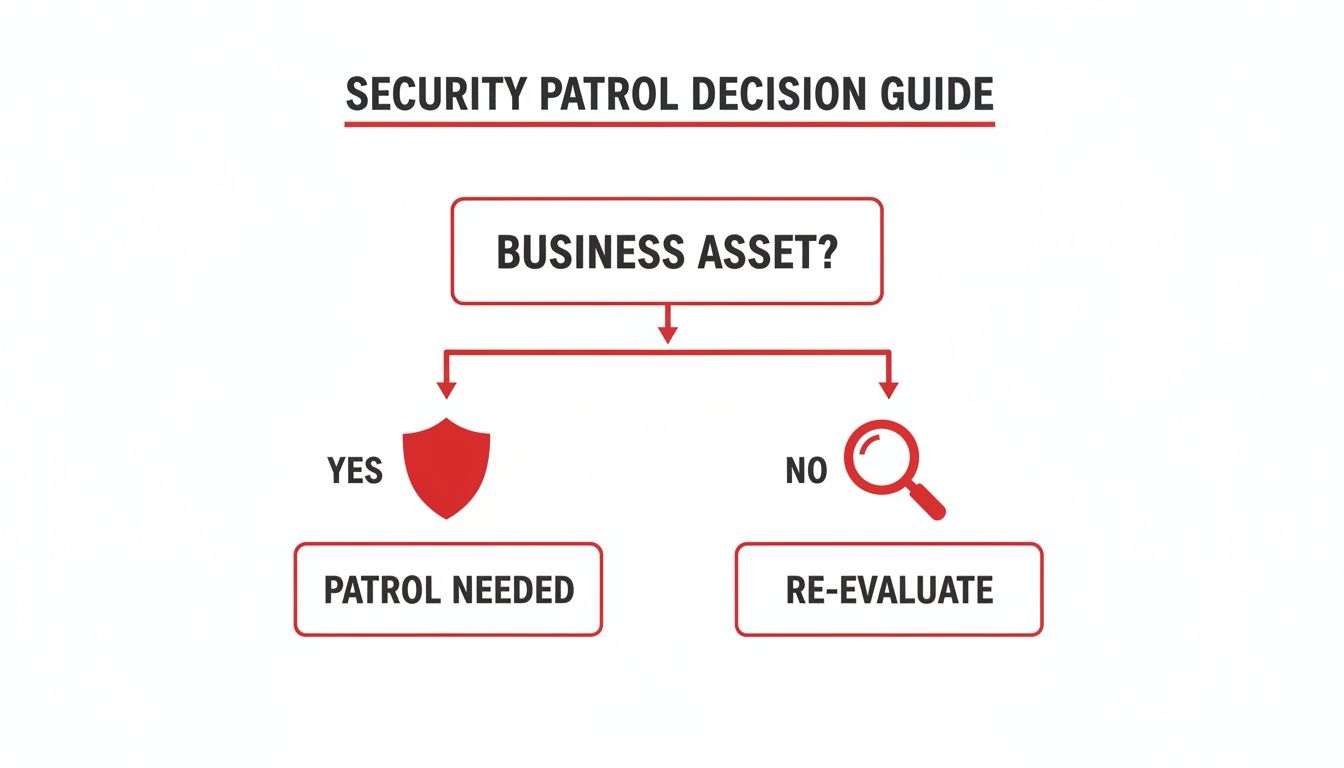
At its heart, the process is straightforward: if you have valuable assets, a patrol service becomes a necessary safeguard.
To help you decide, here’s a quick comparison of the main options.
Comparing Security Patrol Service Options
This table breaks down the ideal patrol type for different business needs, making it easier to see what fits you best.
| Patrol Type | Best For | Key Advantage | Example Scenario |
|---|---|---|---|
| Vehicle Patrol | Large, open areas (e.g., industrial parks, construction sites) | High visibility and rapid coverage of extensive ground. | A nightly patrol making randomised checks across a 10-hectare business park. |
| Foot Patrol | Indoor or confined spaces (e.g., retail centres, hotels, office buildings) | Detailed inspections, direct engagement, and accessibility. | An officer checking every door and interacting with guests in a multi-storey hotel. |
| K9 Patrol | Events, high-threat areas, and substance detection needs. | Superior detection senses and a powerful psychological deterrent. | A K9 unit screening bags for prohibited items at the entrance to a music festival. |
| Covert Patrol | Investigating internal issues like employee theft or policy breaches. | Discreet observation and evidence gathering without alerting subjects. | A plain-clothes officer monitoring stock movement in a warehouse to identify theft. |
Hopefully, that gives you a clearer picture of where each service shines.
Specialised Security Patrol Services
Sometimes, a standard patrol just won't cut it. Certain situations demand a more specialised touch to handle unique threats.
- K9 Patrols: A dog's sense of smell is lightyears ahead of ours. This makes K9 units incredibly effective for sniffing out narcotics or explosives at event entrances. They also serve as a serious psychological deterrent in crowd control situations—few people are willing to argue with a trained German Shepherd.
- Covert Patrols: If you’re worried about internal problems like staff theft or policy violations, a covert or plain-clothes officer is the way to go. They can watch how things really operate without disrupting your team or tipping off the person you're investigating, quietly gathering the proof you need.
Where Security Patrols Make a Real Difference
Think of security patrol services as more than just a cost—they're a smart investment that pays for itself by protecting your assets and people. It's one thing to talk about security in theory, but when you apply it to the real world, you see just how vital these patrols are. Whether it’s keeping an eye on thousands of festival-goers or safeguarding millions in machinery on a building site, this is where the rubber meets the road.
A visible security presence is one of the most effective deterrents there is. For anyone managing a large property, understanding the core safety and compliance best practices for facility managers is non-negotiable, and active patrols are a huge piece of that puzzle.

Event and Hospitality Security Patrol Services
At big events like a music festival or a footy final, the vibe can change in a heartbeat. This is where mobile security patrol services shine. They're not just standing at the gate; they're the eyes and ears on the ground, spotting potential trouble like overcrowding or arguments before things get out of hand.
- Proactive Crowd Management: Patrols can cleverly redirect people to ease up a bottleneck or ensure emergency exits stay clear.
- Rapid Incident Response: If someone needs medical help or a fight breaks out deep in a crowd, a mobile patrol can get there in seconds—much faster than a guard stuck at the perimeter.
- Guest Reassurance: For hotels and resorts, patrols offer a subtle but constant reassurance. Seeing a guard doing a sweep of the carpark or hallways late at night helps guests relax and feel safe.
A single theft or a badly-handled disturbance can wreck a hotel's reputation online. Regular patrols are a direct investment in your guest experience, creating a safe, welcoming vibe that keeps people coming back.
Construction and Industrial Site Protection
Construction sites are a magnet for thieves and vandals. Valuable materials and heavy machinery are often left exposed after hours, just waiting to be targeted. Losing a haul of copper wire, power tools, or equipment can set a project back weeks and cost a fortune.
This is where overnight security patrol services truly prove their value. By conducting patrols at random, unpredictable times, they make it almost impossible for criminals to plan a break-in. A guard might spot a snipped fence on a 2 AM check, secure the breach, and call the site manager straight away. That single action could prevent a $50,000 loss of stolen gear.
Retail and Commercial Centre Safety
In shopping centres and retail hubs, patrols are your first line of defence against shoplifting, anti-social behaviour, and carpark crime. Often, just the sight of a uniformed officer on a regular foot patrol is enough to de-escalate a tense situation between customers. Their presence alone makes the whole environment feel safer for shoppers and staff.
Right across Australia, businesses are catching on. The demand for professional security patrol services is on the rise, with mobile patrols being the fastest-growing part of an industry expected to hit $13.9 billion in revenue by 2025. It’s a clear sign that business owners are shifting towards visible, active security to stop incidents before they start.
How Professional Security Patrols Operate
Forget the old image of a security guard just doing laps in a car. A truly professional security patrol service is a finely tuned machine, built on strategy, technology, and rock-solid accountability. It’s not about random checks; it’s a system designed to give you genuine peace of mind.
It all kicks off with a detailed risk assessment. We’re talking about an expert walking your site, seeing it through the eyes of a potential intruder. They’re looking for the weak spots—that dark fence line, the back entrance nobody watches, or valuable gear left out in the open. This first step is everything; it’s the blueprint for a patrol plan that actually protects your specific property.
Strategy and Accountability in Motion
Once that plan is locked in, the key is deliberate unpredictability. Criminals look for patterns. If they know a guard shows up at 2 AM every night, they’ll just show up at 3 AM. That's why professional patrols are conducted at randomised times and use varied routes. The goal is to make it impossible for anyone to guess when or where an officer will be next.
So, how do you know this is actually happening? Modern security patrol services rely on technology to keep everything transparent.
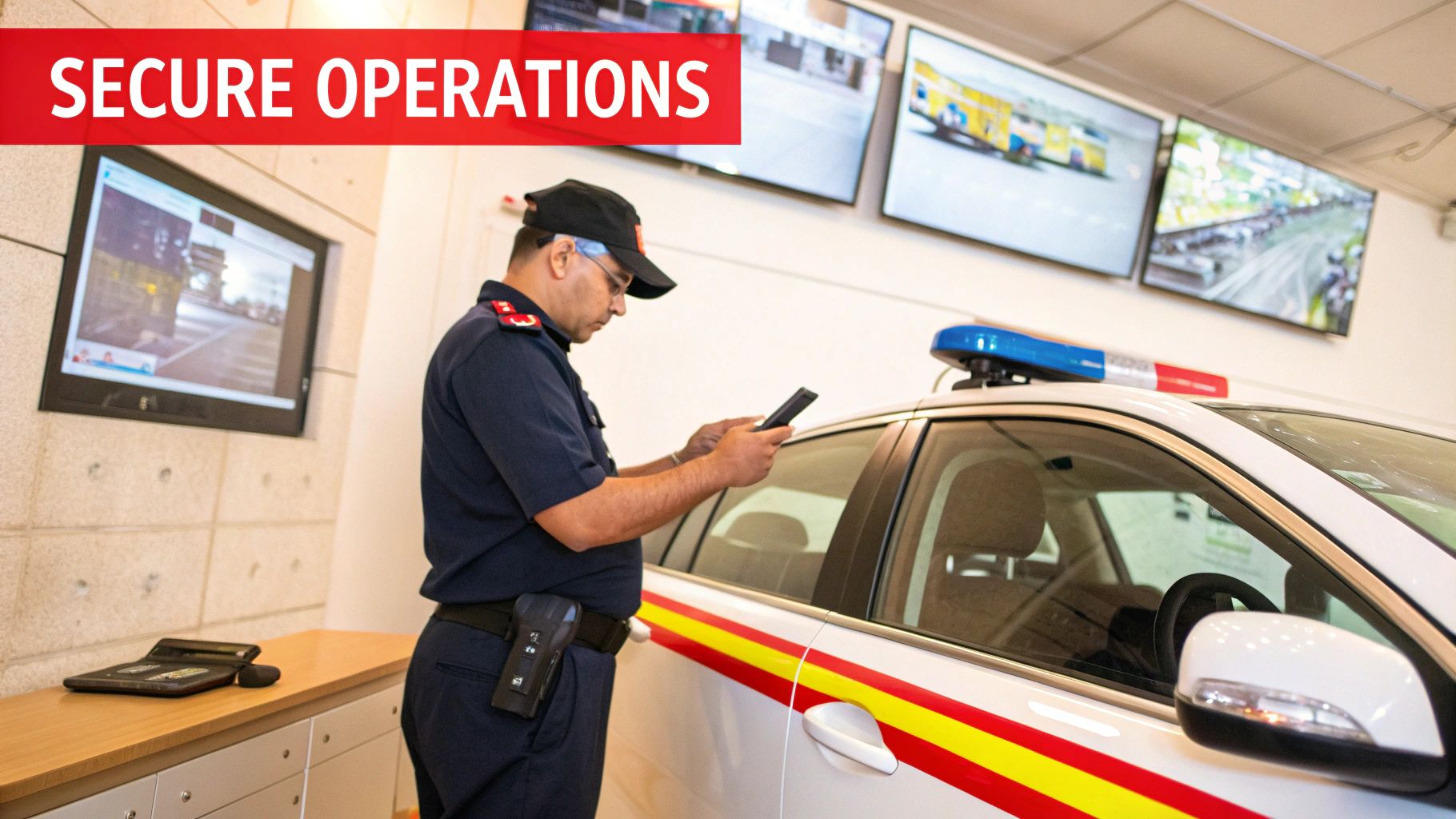
- Guard Tour Systems: Officers carry devices that scan little tags or QR codes at key points around your site. This creates a digital breadcrumb trail, proving exactly where they were and when. No more guesswork.
- 24/7 Communication: Every patrol officer is connected to a central command centre. If they see something, they can report it instantly and get backup or emergency services on the way in a heartbeat.
- Field Supervision: A good security company doesn't just trust; it verifies. Supervisors make their own random spot checks on patrol officers to ensure they’re on their game and doing the job right.
The whole point is to build an unbroken chain of accountability. From the initial site walk-through to the final incident report, every single action is logged and verified. You get concrete proof of the protection you're paying for.
Integrating Technology for Smarter Security Patrol Services
Today's patrols are much more than just a physical presence. They’re the human link that makes all your security tech work together. An alarm or a camera can spot a problem, but it takes a person to respond to it effectively.
That's why professional patrols are trained to work with systems like security access control systems, CCTV feeds, and alarm panels. When a camera flags movement in a restricted area at 3 AM, it’s the patrol unit that gets dispatched to investigate immediately. This fusion of human intelligence with technology creates a far more robust security shield for your business, making sure every potential threat is dealt with swiftly and decisively.
Finding the Right Security Patrol Provider for Your Business
Choosing a security partner is a big deal. It’s a decision that directly affects the safety of your people, your property, and your peace of mind. With so many security firms out there, how can you tell the real pros from the fly-by-nighters? It really comes down to doing your homework and asking the right questions.
First things first, you need to cover the essentials. Any provider you’re even thinking about hiring must have the right, up-to-date master licenses for every state they work in—whether that's NSW, VIC, QLD, or the ACT. Just as crucial is checking they have comprehensive public liability and professional indemnity insurance. If something goes wrong on your site, you need to know they’re fully covered, protecting you from a world of financial and legal pain.
Looking Beyond the Licence
Once you’ve ticked the licensing and insurance boxes, it's time to dig a bit deeper. You want a provider with a solid, proven track record. Don't just take their word for it; ask for client testimonials and references, especially from businesses in the same boat as you. A company that excels at securing construction sites will have a completely different skillset to one that specialises in high-end hotels.
Be wary of any company trying to sell you a generic, cookie-cutter package. A quality security patrol provider should always start with a detailed risk assessment of your property. They need to walk the site with you, pinpoint the specific vulnerabilities, and then build a patrol plan that tackles those weak points head-on. This isn't just better security; it means you're not wasting money on services you don’t actually need.
The private security industry in Australia is massive, employing over 180,000 people across more than 11,000 licensed businesses. That's a workforce significantly larger than the country's police and defence forces combined, which just goes to show how much businesses rely on private security. You can find more insights in ASIAL's Security 2025 summary on the growing demand for well-resourced providers.
The Key Questions You Need to Ask
To really get a feel for a provider's professionalism, you’ve got to ask some probing questions. Their answers will tell you everything you need to know about their standards and how they treat their staff and clients.
Here are a few must-ask questions for your vetting process:
- What kind of ongoing training do your officers get? You’re looking for answers that go beyond the basic license requirements. Think de-escalation techniques, advanced first aid, and even customer service skills.
- How do you choose which officers to send to a site? The best firms think about an officer’s temperament and specific skills. You need a friendly, welcoming face for a hotel lobby, but a more assertive presence for a late-night construction site.
- What happens in an emergency? They should have clear, documented procedures for everything, from a medical incident to a fire or a break-in. Ask them to walk you through it.
- How do you actually supervise your patrols? Find out about their field supervisors, their 24/7 control room support, and the tech they use (like guard tour systems) to make sure their security patrol services are being delivered as promised.
Making the right choice takes a bit of effort. But by focusing on these key areas—licensing, tailored plans, real-world experience, and operational accountability—you can find a security patrol provider that acts as a genuine partner in protecting your business.
Frequently Asked Questions About Security Patrol Services
Stepping into the world of professional security can feel a little overwhelming. If you’re wondering where to start, you’re not alone. We’ve pulled together some of the most common questions business owners ask when thinking about bringing in security patrol services, with straightforward answers to help you get it right.
Getting clear on these points from the start means you’re not just hiring a guard; you're building a proper security solution that protects what’s yours and gives you genuine peace of mind.
What is the primary purpose of security patrol services?
The primary purpose is deterrence. By creating a visible and unpredictable presence, security patrol services aim to discourage criminal activity like theft, vandalism, and trespassing before it happens. They also provide rapid response to incidents and identify safety hazards.
What is the average cost of security patrol services in Australia?
Honestly, it varies. The cost really depends on what you need – how often patrols swing by, how long they stay, whether they're on foot or in a vehicle, and the risk level of your site. Any provider worth their salt will start with a proper risk assessment to give you a quote that actually fits your situation, so you only pay for what you truly need. Actionable Insight: Always look for a detailed proposal, not just a flat hourly rate. That way, you can see exactly what you’re getting and how it’s designed to solve your specific problems.
Are mobile patrols better than a static guard?
They're different tools for different jobs. A static guard is your rock-solid solution for a single, critical spot, like a front desk or a main gate. But for covering a lot of ground, mobile security patrol services are a game-changer. Their random, visible presence is a huge deterrent for anyone thinking of trying their luck. For many businesses, the sweet spot is actually a combination of both. A static guard holding down the fort at a key entry point, backed up by mobile patrols keeping an eye on the wider area.
What kind of reports will I get from a patrol service?
You should expect clear, detailed digital reports after every shift. These should tell you exactly when patrols happened, which checkpoints were visited, and anything out of the ordinary they noticed. If something does happen, you need a formal incident report breaking down what occurred, the immediate actions taken, and what should happen next. This isn't just paperwork; it's essential for insurance, compliance, and fine-tuning your entire security plan.
The real value of patrols extends beyond just deterring crime; it's about building a safer environment. In fact, 53% of Australians feel unsafe after dark, a perception that drives the need for visible patrols. Research also shows that businesses using mobile patrols can cut theft by around 25%, proving a tangible return on investment. You can discover more insights on these security trends from the Australian Security Industry Association Limited.
How can I be sure the patrols are actually happening?
Great question. Accountability is everything. Modern security providers use guard tour systems where officers scan NFC tags or QR codes placed at key points around your property. It’s a simple, foolproof way to log their presence in real-time. You should have access to this data. On top of that, ask if they have field supervisors who drop in for random checks. It keeps everyone on their toes and ensures you’re getting the service you’re paying for.
Ready to secure your event, venue, or business with a team you can trust? At GM GROUP Services, we provide multi-award-winning, licensed security patrol services across NSW, VIC, QLD, and the ACT. We specialise in matching the right professionals to your specific needs, ensuring your people and property are always protected. Contact us today for a tailored security assessment.
Discover more from GM Group Services
Subscribe to get the latest posts sent to your email.