
A security patrol service provides a crucial, mobile, and proactive layer of protection for diverse locations such as event sites, entertainment venues, and construction zones. Instead of stationing a guard in a single spot, this service utilizes highly trained officers who move around your property—either in vehicles or on foot—to conduct regular yet intentionally unpredictable security checks. The result is a powerful and visible deterrent that keeps potential threats off-balance and your assets secure.
What Is a Security Patrol Service and How Does It Work?
At its core, a security patrol service is about creating a dynamic and unpredictable security presence. It’s like a professional, highly organised neighbourhood watch, but for your business. Rather than a guard staying put, mobile units are constantly and randomly monitoring a designated area. This constant, unscheduled movement is specifically designed to keep potential criminals off-balance because they can never be sure when or where an officer might show up.
This approach is much more than just simple observation. The main goal is to deter threats before they even happen. A clearly marked security vehicle doing its rounds at a construction site overnight, or a uniformed officer walking through a festival car park, sends an unmistakable message: this area is being actively monitored. That visible presence is often all it takes to prevent opportunistic crimes like vandalism, theft, or trespassing.
The Proactive Security Model
Unlike a static guard, who mainly reacts to incidents that happen at their specific post, a security patrol service is built on a proactive model. Officers are trained to actively look for vulnerabilities and early signs of trouble during their rounds.
Some of their key duties usually include:
- Perimeter Checks: Making sure all gates, fences, doors, and windows are properly secured and haven’t been tampered with.
- Identifying Irregularities: Spotting anything out of the ordinary, like unfamiliar vehicles, signs of forced entry, or people loitering where they shouldn’t be.
- Responding to Alarms: Acting as the first line of response when an alarm goes off, quickly verifying the cause, and liaising with the police if a real threat is confirmed.
- Detailed Reporting: Documenting every single patrol with digital logs, which often include photos and GPS data, giving you a clear and transparent record of all security activities.
Practical Example: A patrol officer checking a retail centre after closing might discover a side door was accidentally left unlocked by a staff member. They would immediately secure it, document the finding with a photo, and report the issue to the property manager. This simple, preventative action completely prevents a potential break-in before it has a chance to occur.
Core Functions of a Professional Security Patrol Service
This table offers a snapshot of the primary duties and outcomes you can expect from a mobile security patrol service.
| Function | Objective | Primary Beneficiary |
|---|---|---|
| Visible Deterrence | Discourage opportunistic crime through a visible, active security presence. | All clients (Retail, Events, Construction, Venues) |
| Perimeter Integrity Checks | Identify and secure physical vulnerabilities like unlocked doors or damaged fences. | Property owners, venue managers |
| Alarm Response | Provide rapid, on-site verification of alarm triggers to minimise false alarms and ensure swift action. | Business owners, event organisers |
| Incident Reporting | Create a detailed, verifiable log of all patrol activities, irregularities, and actions taken. | All clients for compliance and insurance purposes |
| Staff & Patron Escorts | Ensure the safety of individuals moving through a site, especially after hours. | Event attendees, retail staff, venue employees |
Ultimately, these functions work together to create a comprehensive security shield.
Actionable Insight: When engaging a patrol service, provide them with a detailed site map highlighting critical areas, access points, and known vulnerabilities. This empowers them to perform more effective and targeted checks from day one.
Adapting to Modern Threats
Let's face it, today’s security threats aren't always predictable. A modern security patrol service uses technology to stay one step ahead. GPS tracking in vehicles confirms that patrols are being completed as promised, while digital reporting tools give you instant, detailed accounts of any incidents.
This blend of well-trained people and smart technology creates a security solution that's both adaptable and accountable. It provides a robust and reliable shield for your assets, people, and reputation.
Choosing the Right Type of Security Patrol Service
When it comes to security patrols, there’s no such thing as a one-size-fits-all solution. The right approach depends entirely on your specific environment, the assets you’re protecting, and the unique threats you face. Picking the wrong type of patrol is more than just inefficient—it can leave you with critical vulnerabilities. It’s all about matching the method to the mission.
So, how do you decide what’s best for your site? Let’s break down the different types of patrols to see what makes sense for you, whether you’re running a huge music festival, a luxury retail store, a busy construction site, or a corporate campus.
This infographic captures the core purpose of any good security patrol.
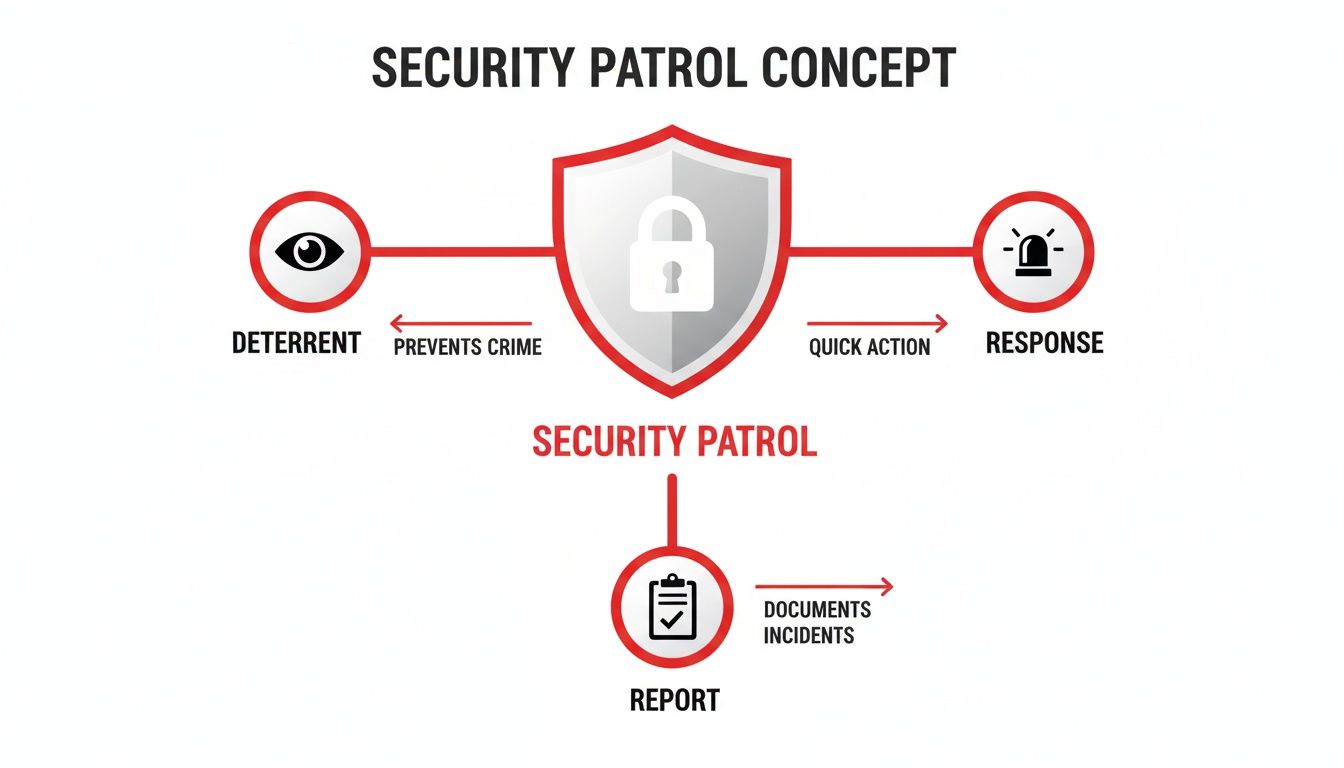
As you can see, it really boils down to three pillars: deterring threats, responding quickly when something happens, and reporting everything meticulously. Knowing your options helps you build a much stronger defence for your people and property.
Vehicle Patrols for Broad Coverage
Think of vehicle patrols as your eyes and ears across large, open spaces. They're perfect for covering big areas efficiently—places like industrial parks, sprawling event car parks, or massive construction sites where walking the entire perimeter just isn't practical.
The sheer presence of a marked security car making regular, unpredictable rounds is often enough to deter troublemakers. For instance, at a festival, a patrol car moving through the campgrounds overnight sends a powerful signal to would-be thieves that the area is being watched. That constant, random movement makes it nearly impossible for anyone to find a "safe" time to act.
Foot Patrols for Detailed Inspection
When you need a closer, more hands-on approach, nothing beats boots on the ground. Foot patrols are essential for environments where detail and interaction matter most, like navigating the floors of an office building, checking doors in a shopping centre after close, or weaving through a crowded venue.
A guard on foot can do things a vehicle can’t. At a corporate event, they can not only spot potential threats but also help guests with directions, creating a secure yet welcoming vibe. They can physically check that doors are locked, windows are secure, and sensitive areas haven't been disturbed—a level of detail a drive-by check simply can't match.
K9 Patrols for Heightened Deterrence
In high-risk situations or when you need specialised detection, K9 patrols bring an unmatched level of security. A highly trained dog and its handler are a serious psychological deterrent, often stopping a tense situation from escalating before it even starts. Plus, their incredible sense of smell is a game-changer for finding contraband or hidden intruders.
Practical Example: Imagine a massive public concert with thousands of people. A K9 unit at the entrance can screen for prohibited items far more effectively than a visual search alone, boosting safety without creating huge bottlenecks. Their presence is reassuring for attendees and a clear warning to anyone with bad intentions.
These specialised services are part of a massive industry in Australia. The private security sector now generates an estimated AUD 11+ billion in revenue each year and employs over 180,000 people. To put that in perspective, analysis shows the private security workforce is significantly larger than Australia’s police and defence forces combined. You can find more industry insights from the Australian Security Industry Association Limited.
Covert Patrols for Discreet Monitoring
Sometimes the most effective security is the kind nobody knows is there. Covert patrols, using plain-clothed officers, are designed for situations where you need discretion. They are perfect for tackling internal theft in a warehouse, identifying organised shoplifters in a retail environment, or gathering intelligence on potential troublemakers at an event.
By blending in, these officers can watch what’s happening and intervene without causing a scene or tipping off the people they're observing. It’s a subtle but incredibly powerful layer of security.
The Real-World Payback of Having Security Patrols On-Site
When you bring in a professional security patrol service, you're investing in more than just peace of mind. It’s a strategic move with concrete, measurable benefits that directly impact your bottom line. While the sight of a uniformed officer is a powerful deterrent, the true value is found in the positive outcomes that proactive patrols bring to your business. Let's break down how this security layer translates into tangible advantages.
The most obvious win is an immediate drop in crime and losses. A visible security presence is a massive turn-off for opportunistic thieves, vandals, and trespassers. When a would-be criminal spots a marked patrol car or a guard doing regular, unpredictable rounds, they see a high-risk target. It’s often enough to make them simply move on.
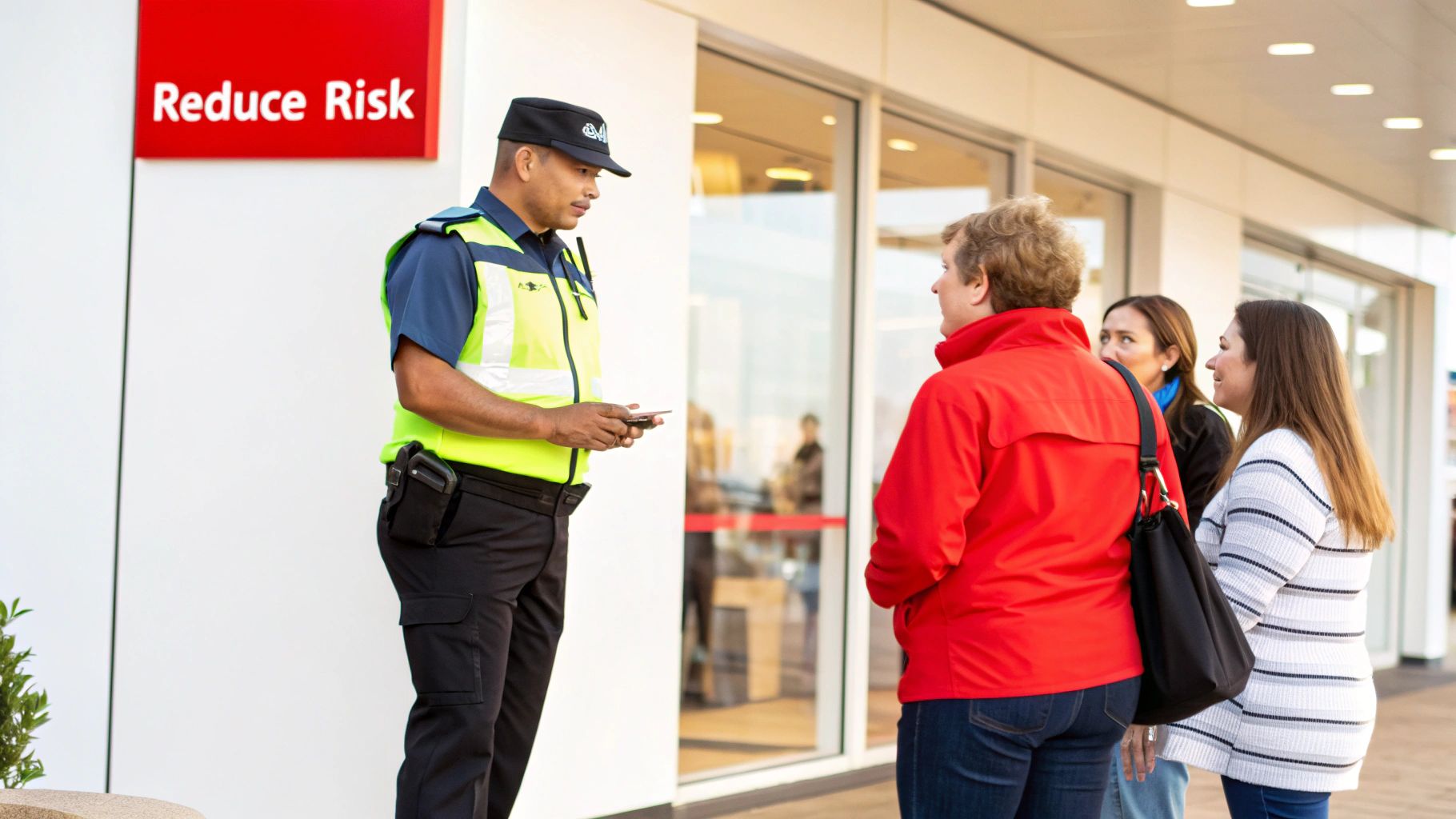
This isn’t just theory; Australian research backs it up. One analysis revealed that businesses using contract security services slashed theft by around 25% compared to those without any dedicated protection. For retail stores, licensed venues, and building sites—where stolen stock or equipment can cripple profitability—that's a huge difference.
Rapid Response That Limits Damage and Liability
Beyond just preventing trouble, a patrol's ability to react fast is a game-changer. When an alarm goes off or an issue kicks off, having a trained officer just minutes away can mean everything. They are equipped to de-escalate conflicts, guide emergency services, and secure the area before real damage—or liability—sets in.
This quick-response capability delivers several key advantages:
- Faster Resolution: Patrols are often on-site in minutes, far quicker than police can typically respond to a non-urgent call.
- Minimised Damage: Intervening quickly during a break-in or vandalism incident can significantly reduce property damage and the cost of repairs.
- Reduced Liability: Professionals know how to handle everything from a slip-and-fall to a heated confrontation, following proper protocols that protect your business from legal headaches.
Boosting Public Perception and Customer Confidence
A visible security presence doesn't just deter the bad guys; it reassures your customers, event attendees, and staff. When people feel safe and secure, their entire experience improves, and that positive feeling is an incredible asset for any business.
Practical Example: Think about a music festival. A friendly yet professional security team helps create a vibe where everyone can relax and have a good time. In a shopping centre, that sense of safety encourages people to stay longer and come back more often. It directly builds a stronger brand and fosters loyalty.
Of course, looking after your own people is just as important. Implementing robust lone worker safety solutions is a critical part of ensuring your security personnel are protected while they're protecting you.
Turning Security from a Cost into a Strategic Asset
Finally, a top-tier security patrol service gives you something incredibly valuable: data. Modern patrols don't just walk a beat; they use digital tools to log every check-in, report any issue, and document incidents with photos and GPS-stamped data. This isn't just about proving the job was done—it's about giving you powerful operational intelligence.
With this information, you can:
- Pinpoint recurring security weak spots on your property.
- Provide hard evidence for insurance claims or legal matters.
- Spot trends that help you make smarter, long-term security decisions.
Suddenly, your security patrol is no longer just an expense. It becomes a strategic asset that feeds you intelligence, protects your profits, and makes your entire operation stronger.
Real-World Applications for Your Industry
It’s one thing to talk about security patrols in theory, but where do they really make a difference on the ground? Let's move past the concepts and look at how these mobile units solve real, everyday problems for businesses just like yours. This is where the true value in protecting your assets, ensuring safety, and keeping things running smoothly really shines through.
The need for this kind of active, on-the-move security is bigger than ever. In fact, the Australian investigation and security services industry is on track to hit AUD 13.9 billion in revenue by 2025. What’s driving that growth? A huge part of it is the security patrol service segment, which actually makes up the largest slice of revenue. This tells us that more and more businesses are seeing the benefits of proactive, roaming patrols over a purely fixed guard. You can dig deeper into these industry stats over at IBISWorld.
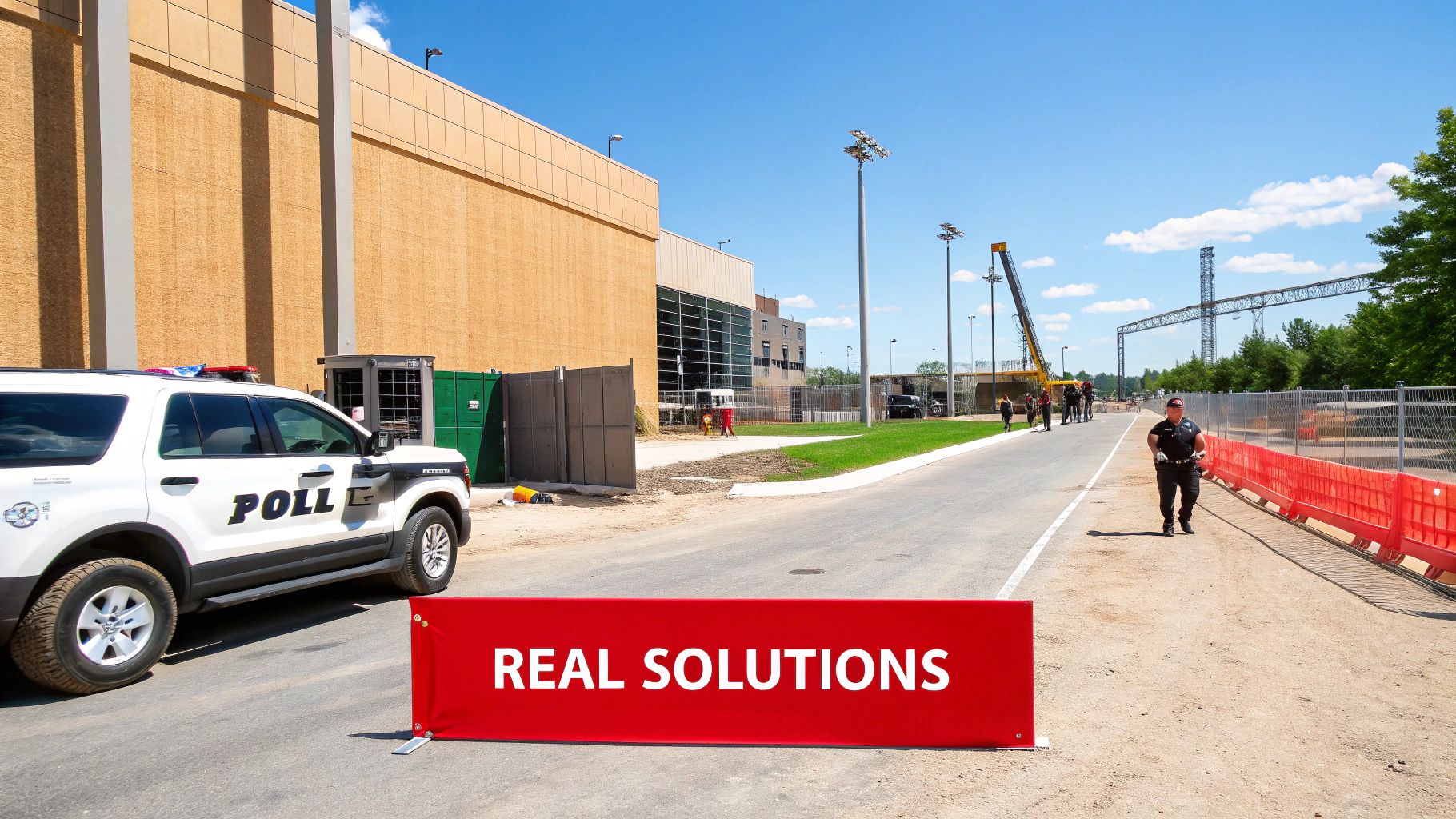
This clear shift towards mobile security really speaks to how effective it is in today's complex environments.
Events and Festivals
When you're running a large event, your security headaches don't stop at the main stage. You’ve got huge car parks and long, sprawling perimeters that become magnets for theft and people trying to sneak in, especially when things quieten down.
- Practical Example: Think about a multi-day music festival. Vehicle patrols can run frequent, random sweeps through the parking areas. Just seeing that patrol car is often enough to put off would-be thieves and gives attendees peace of mind that their cars are being looked after. Once the crowds are gone for the night, foot patrols can walk the entire fenceline, checking for breaches and stopping trespassers and vandals in their tracks.
Hospitality Venues
For pubs, clubs, and hotels, the real risks often appear after you've called last drinks and locked the doors. That’s when you have to worry about loiterers, property damage, and potential break-ins that can harm your assets and even your license.
A regular but unpredictable security patrol service is a fantastic deterrent. When an officer shows up unannounced to check doors, gates, and beer gardens, it sends a clear message to anyone hanging around with bad intentions. It’s a straightforward way to protect your property from damage and make sure the venue is secure until your morning staff arrive.
This proactive step also goes a long way in keeping your neighbours and local council happy by preventing late-night trouble.
Construction Sites
Construction sites are a goldmine for thieves. They’re filled with expensive tools, heavy machinery, and valuable materials, leaving them wide open to theft, particularly overnight and on weekends.
- Practical Example: A mobile patrol that visits a building site multiple times a night, always at random intervals, makes it nearly impossible for thieves to plan their move. The officer can do a quick check to ensure heavy equipment is disabled, storage sheds are locked tight, and the perimeter fence is intact. This simple routine can prevent the kind of costly theft that throws project timelines and budgets completely off course.
Retail and Shopping Centres
In retail, security is a delicate balance. You need to deter shoplifters and troublemakers without making honest shoppers feel like they're in a fortress. The aim is a safe, welcoming vibe.
A security patrol service nails this perfectly. Guards moving through the shopping centre and its car parks create a visible, reassuring presence for customers and staff. That same visibility is a powerful warning to potential thieves. Because they're trained professionals, they can handle any incidents that do pop up, ensuring a safe and pleasant experience for everyone. It's about protecting your tenants' stock while reinforcing the centre's reputation as a great place to shop.
Staying on the Right Side of the Law: Security Compliance and Regulations
Hiring a professional security patrol service is about more than just putting a visible deterrent on your property. It’s about partnering with a legitimate, legally compliant operator who shields your business from significant liability. The reality is, choosing a security provider is a big decision, and making sure they understand and stick to the complex web of state and national regulations is what separates a genuine asset from a massive legal risk.
Think about it this way: if an incident happens on your watch and your security team isn't properly licenced, the fallout can be severe. We're talking hefty fines, potential legal action, and a hit to your brand's reputation that can be hard to come back from. Getting this right isn't just a box to tick; it's a non-negotiable part of protecting your entire operation.
State-by-State Licensing: What You Need to Know
Australia’s security industry is tightly regulated, and the rules can change dramatically the moment you cross a state border. The first thing you absolutely must check is the provider's Master Licence. This is the business-level certification that gives them the legal right to offer security services in a particular state.
For instance, a security company needs a:
- Class 1 Master Licence to supply guards in New South Wales (NSW).
- Private Security Business Licence to operate legally in Victoria (VIC).
- Security Firm Licence in Queensland (QLD).
- Master Licence in the Australian Capital Territory (ACT).
Don't just take their word for it. Always ask for their Master Licence number and check it yourself with the relevant authority, like the NSW Security Licensing & Enforcement Directorate (SLED) or the Victoria Police Licensing & Regulation Division.
Actionable Insight: Hiring a company without the correct Master Licence is like getting an uncertified electrician to rewire your building. If something goes wrong, the liability lands squarely on your shoulders. It’s a huge, unnecessary risk.
Are the Guards on the Ground Properly Qualified?
It doesn't stop with the company's licence. Every single security officer who sets foot on your property must hold their own personal qualifications. This means a state-issued security licence, which is proof they’ve passed the required background checks and completed their formal training. A uniform alone means nothing; they need to be legally certified to do their job.
This is a fundamental check every business needs to make when hiring a security patrol service.
Going Deeper: Industry-Specific Rules
Often, compliance goes beyond general security licensing. Certain industries have their own unique requirements, especially businesses that serve alcohol, where officers need specific training to handle the risks that come with licensed venues.
One of the most critical certifications here is the Responsible Service of Alcohol (RSA). If your patrol officers are working at a pub, club, or festival, they absolutely must be RSA-trained. This equips them to manage patrons effectively, spot signs of intoxication, and know when—and how—to refuse entry or service. It's not just about safety; it’s essential for keeping your liquor licence intact.
Working with a provider like GM GROUP Services, who knows the ins and outs of these compliance layers across NSW, VIC, QLD, and the ACT, means your security is not only effective but also completely above board. That deep focus on the rules is what truly protects your people, your property, and your business's good name.
How to Choose the Right Security Patrol Provider
Picking the right security patrol service is one of those business decisions that has consequences far beyond the bottom line. It’s not just about comparing hourly rates; you're choosing a partner to protect your assets, your people, and your reputation. They become an extension of your own team.
This guide gives you a practical checklist to cut through the sales talk. We'll cover the essential questions you need to ask to find a provider who delivers reliability, professionalism, and real value, not just a warm body in a uniform.
First Things First: Verify Licensing and Insurance
Before you even start talking about patrol routes or guard duties, you need to lock down the legal stuff. This is absolutely non-negotiable and protects you from massive liability down the track.
- Master Licence: Ask for their Master Licence number for your state (NSW, VIC, QLD, or ACT). Any legitimate company will have this on hand and be happy to share it.
- Public Liability Insurance: Get a copy of their Certificate of Currency for public liability insurance. This is your proof that you’re covered if something goes wrong on your property.
- Guard Qualifications: You need to know that the individual guards walking your site have the right tickets. Confirm they hold current state-issued security licences and any other required certifications, like an RSA for a licensed venue.
Actionable Insight: A truly professional security firm sees compliance as the bedrock of their operation. If a potential provider gets defensive or hesitant when you ask for these documents, that’s a huge red flag. Just walk away.
Check Out Their Tech and Communication
In this day and age, technology is what separates the pros from the amateurs. A modern security service should be using digital tools to give you complete transparency, proving they’re actually doing the job you’re paying them for. You want clear, verifiable data, not just their word for it.
Here are the key tech features you should be asking about:
- Real-Time Reporting: Can they provide digital incident reports, complete with photos and timestamps, through a client portal? This gives you an immediate, accurate log of everything that happens on site.
- GPS Tracking: Do they use GPS to verify patrol routes? This is the only way to be certain that guards are covering the entire area as promised and not cutting corners.
- 24/7 Communication: What happens when you need to call them at 3 AM? For a critical service like security, you can't afford to get a voicemail. Top-tier providers often use smart solutions showing how a 24/7 AI receptionist can prevent missed calls, ensuring someone is always there to respond.
Dig Into Their Training and Real-World Experience
A uniform doesn’t make a security guard effective—their training and experience do. You need to know how they’ll perform when a real situation kicks off. A provider's track record with businesses like yours is the best indicator of whether they can handle your specific challenges.
When you’re vetting them, ask direct questions. Find out about their experience with events, venues, or construction sites that are similar in scale and complexity to yours. A company that knows its stuff will be proud to share case studies or connect you with references from happy clients in your industry. That kind of proof is worth its weight in gold.
Frequently Asked Questions About Security Patrol Services
Deciding on the right security patrol service brings up a lot of practical questions. It’s a big decision, and you want to be sure you're getting the right kind of protection. We get it. Below, we've answered some of the most common queries we hear from event organisers, venue managers, and site foremen to help you make a confident choice.
1. Are random patrols more effective than scheduled patrols?
Both have a crucial role. Scheduled patrols guarantee essential tasks are completed at specific times, like locking gates at midnight. Random patrols provide a powerful psychological deterrent by being unpredictable, making it difficult for criminals to plan. The most effective strategy combines both, offering reliability and the element of surprise.
2. How much does a security patrol service typically cost?
The cost varies based on your needs: patrol frequency, property size, location, and required duties. However, it is almost always more cost-effective than hiring a full-time static guard, particularly for larger areas. The best way to get an accurate figure is through a professional risk assessment, which ensures you pay only for the protection you need. For instance, a low-risk site might need two random patrols nightly, while a busy city pub could require four patrols plus a scheduled lock-up.
3. What technology should a modern provider use?
You shouldn't have to guess if patrols are being completed. A top-tier security patrol service uses technology to provide full transparency. Look for providers offering real-time GPS tracking to verify patrol routes, digital incident reports with photos, and a client portal for 24/7 access to all logs and security data. This technology creates an undeniable record of all activity on your site.
4. How many patrols does my site actually need?
There is no "one-size-fits-all" answer. The ideal frequency is determined by a professional risk assessment that considers your site's size, layout, local crime rates, asset value, and operating hours. A good provider will perform an on-site evaluation to identify vulnerabilities and recommend a tailored patrol schedule that provides the best coverage and deterrence for your specific situation.
5. Can a patrol service respond to alarms?
Yes, this is a core function of a professional security patrol service. They can act as the primary keyholder and first responder for alarm activations. This is often much faster than waiting for a police response to a non-verified alarm. The officer can quickly assess the situation, reset a false alarm, or coordinate with law enforcement if a real threat is present, saving you time and potential false alarm fees.
Ready to secure your event, venue, or construction site with a team you can count on? GM GROUP Services provides expert security solutions across NSW, VIC, QLD, and the ACT.
[Request a free, no-obligation quote today at https://www.gmgroupservices.com.au]
Discover more from GM Group Services
Subscribe to get the latest posts sent to your email.