Security management services are the backbone of a resilient business, providing a strategic shield that goes far beyond a simple guard at the door. It's the comprehensive, proactive system that integrates trained personnel, intelligent risk analysis, and modern technology to protect your people, property, and reputation from every angle. This isn’t just about stopping trouble; it’s about creating an environment where threats are neutralized before they even begin.
This guide provides actionable insights and practical examples to show you why professional oversight is no longer a luxury but a crucial investment for modern businesses.
Understanding What Security Management Services Truly Mean
Think of it like the foundation of a building. You don't see it, but you absolutely depend on it to keep everything standing strong. That's what professional security management services are for your operations. It’s a complete system that weaves together physical guards, smart risk analysis, modern technology, and expert planning to create a holistic defence against any threat.
This kind of strategic oversight is crucial because no two businesses face the same risks. A busy retail store has a completely different threat profile from a sprawling construction site, and a high-energy music festival requires a different approach than a quiet corporate office. Real security management coordinates all the moving parts to plug those specific gaps.
Practical Example: A retail chain might need covert loss prevention officers to tackle internal theft, while a logistics warehouse would prioritize mobile patrols after hours to secure its large perimeter and high-value inventory. A professional service analyzes these distinct needs and builds a tailored solution.
Beyond the Uniform: A Proactive Strategy
At its heart, this is about moving away from the old-school "guard in a chair" model and embracing an intelligent, forward-thinking operation. It’s about sniffing out potential weak spots long before anyone can exploit them and putting the right measures in place to shut them down.
- Risk Assessment: It starts with a top-to-bottom analysis of your environment to find every vulnerability, from an unlocked gate to a potential crowd-control headache.
- Customised Planning: Using that assessment, a security plan is built just for you. This might involve a mix of static guards, mobile patrols, and technological support like CCTV.
- Operational Execution: This is where the plan comes to life, with trained professionals who know your site's specific rules, how to interact with your customers, and what to do in an emergency.
- Continuous Improvement: A great security strategy is never set in stone. It’s constantly fine-tuned based on incident reports, your feedback, and the changing world outside.
A managed security strategy isn't just about presence; it's about intelligence. It’s the art of placing the right people with the right training in the right place at the right time to mitigate risk effectively.
An Integral Part of the Australian Economy
The sheer scale of the private security industry in Australia shows just how vital these services have become. In fact, it has grown so much that it's now on par with traditional public policing in terms of numbers.
The Australian Security Industry Association Limited (ASIAL) reports that the sector pulls in over AUD 11 billion in revenue each year. With nearly 150,000 licensed individuals and more than 11,000 security firms across the country, it's clear that businesses are increasingly turning to expert partners to keep their assets safe. You can check out the official ASIAL security report to see just how much the industry is expanding.
What Are the Core Parts of Security Management?
Good security management services are never a simple, off-the-shelf product. Think of it more like a custom-built system with different parts, each doing a specific job to create multiple layers of defence for your business, event, or property. Knowing what these core parts are makes it much clearer how a professional security strategy actually comes together.
A truly solid security plan is built from several pieces working in sync. The diagram below shows the three main pillars that every security effort is ultimately designed to protect.
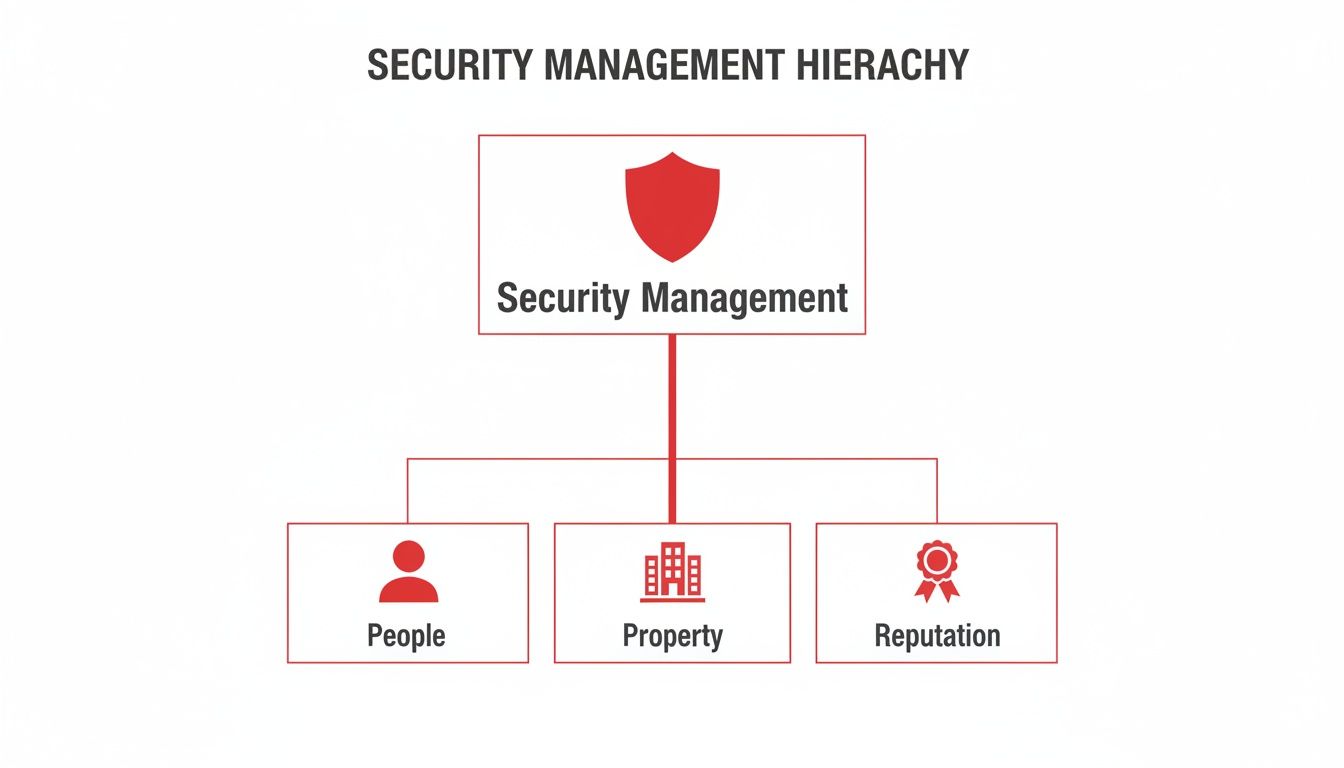
As you can see, the end game is to build a shield that keeps your people, your physical assets, and your brand’s good name safe and sound.
Static and Mobile Security Personnel
The most obvious part of any security strategy is usually the guards themselves. They can be deployed in two main ways, and each serves a different—but equally vital—purpose.
Static Guards are exactly what they sound like: they’re assigned to one fixed spot. This could be the gatehouse of a construction site, the front desk of a corporate building, or the main entrance to a music festival. Their constant presence acts as a powerful deterrent, putting off potential troublemakers while giving staff and visitors a clear point of contact. It’s the perfect solution for controlling access and keeping an eye on a specific, high-value area.
Mobile Patrols, on the other hand, are always on the move. These units cover a much wider area, like an industrial park, a sprawling retail complex, or an event spread across multiple venues. By performing checks at random times, they break up any predictable patterns that criminals might try to exploit, making them ideal for securing large perimeters, especially after hours.
Specialised Security Units
Sometimes, a standard guard isn't enough. Many situations have unique risks that call for specialised skills to add extra layers of protection.
K9 Units: A dog and its handler bring a set of skills that technology and people just can't match. They are incredibly effective at sniffing out explosives or drugs at event entry points, helping with crowd control in tense situations, and tracking intruders across large, open areas.
VIP Protection (Bodyguards): For high-profile individuals like executives, celebrities, or public figures, close personal protection is a must. These highly trained officers are experts in threat assessment, route planning, and discreet surveillance, all focused on keeping one specific person safe.
Covert Loss Prevention: Not all threats come from outside. Plain-clothes officers can blend in with customers or staff inside a retail store to spot and deal with internal theft or shoplifting, all without alarming genuine shoppers.
To give you a clearer picture of how these services fit different needs, here’s a quick comparison.
Comparing Key Security Management Services
| Service Type | Primary Function | Best For (Example Scenarios) |
|---|---|---|
| Static Guards | Visible deterrence, access control, and monitoring a single point. | Corporate lobbies, construction site gates, event entrances. |
| Mobile Patrols | Covering large areas with unpredictable checks to deter crime. | Industrial parks, large car parks, residential communities. |
| K9 Units | Specialised detection (drugs, explosives) and crowd control. | Major events, airports, high-security facilities. |
| VIP Protection | Personal safety for high-profile individuals. | Executives, celebrities, dignitaries at public appearances. |
| Loss Prevention | Discreetly identifying and preventing internal theft and shoplifting. | Retail stores, warehouses, distribution centres. |
As you can see, the right service depends entirely on the specific risks you're facing.
The Growing Demand for Integrated Services
The need to mix and match these services is becoming more and more common. As threats get more complicated and sites get bigger, Australian businesses are increasingly looking for a single provider who can handle everything. In fact, the Australian security market is expected to hit USD 7,713.7 million by 2030, with managed services like patrols and monitoring growing the fastest. This shows a real shift away from just hiring a guard to adopting a complete, managed security solution.
A well-rounded security plan doesn't just rely on one tactic. It strategically combines visible guards, mobile patrols, and specialised units to create a comprehensive safety net that addresses threats from every angle.
This idea even extends into other areas of business operations. For example, in the food service industry, strict frameworks like HACCP Food Safety Protocols are a key part of an overall security management strategy. Why? Because they protect public health and the brand’s reputation from a different kind of threat.
Ultimately, every component—from the guard at the door to a specific safety procedure—works together toward the same goal: total protection of your assets.
Why Investing in Security Management Isn't Just an Option—It's Essential
It’s easy to fall into the trap of thinking security is just another expense on the balance sheet. But that's a dangerous mistake. Professional security management services are an investment, not a cost, and they do far more than just stop theft. Think of it as a vital business function that actively protects your bottom line, your reputation, and your ability to operate day-to-day. A proper security program isn't about just placing a guard at the door; it's about building a resilient shield around your entire operation.
This shield works against a huge range of risks. On a busy construction site, for example, a security team isn't just watching for stolen equipment. They're on the ground enforcing critical Workplace Health and Safety (WHS) protocols, controlling who gets on-site, and keeping detailed logs—all essential for compliance and keeping everyone safe.
It's the same story in a licensed venue like a bar or club. Security staff are on the front line, making sure the team is following Responsible Service of Alcohol (RSA) rules. They manage crowd dynamics, de-escalate fights before they start, and keep the venue operating within the law, which is crucial for protecting that all-important liquor license.
Protecting Your Brand and Nailing the Customer Experience
Here's something people often miss: professional security management services have a direct impact on how people see your brand. Your security team is often the first and last person your customers or guests interact with. Their level of professionalism (or lack thereof) instantly shapes public perception.
Practical Example: Picture a big music festival. A well-trained, customer-focused security team does more than check tickets. They give directions, help with small problems, and create a real sense of calm and safety. That positive vibe makes the entire experience better, encouraging people to come back next year. On the flip side, an unprofessional crew can create a tense, hostile atmosphere that leads to bad reviews and damages your brand for years to come.
The Financial Case for Professional Security
The return you get from security management isn't just about fuzzy feelings like reputation. It delivers hard, financial benefits that you can see in your bank account. One of the biggest wins is the potential for reduced insurance premiums. When insurers see a business with a formal, professionally managed security plan, they see a lower-risk client. This often translates to better rates on public liability and property insurance.
Actionable Insight: When requesting insurance quotes, be sure to provide your insurer with a copy of your formal security plan and your provider’s credentials. This documentation can be key to unlocking lower premiums.
A proactive security strategy is an investment in stability. It moves your business from a position of reacting to costly incidents to one of preventing them, creating a more predictable and secure financial environment.
This proactive approach also does wonders for employee morale and retention. When your staff feel safe—whether they’re closing a retail store late at night or working in a corporate office—they're more productive, engaged, and loyal. That means lower turnover costs and a much better company culture, all contributing to your long-term success. The peace of mind that comes from knowing experts are managing your risks 24/7 is simply invaluable.
Across Australia, the demand for structured risk programs is on the rise. Shifting crime indicators are forcing businesses to get more serious about their protection strategies. It’s no surprise the Investigation and Security Services sector has grown into an estimated AUD 13.9 billion market, driven by this need for complete protection. You can explore more about these industry trends to see where the market is headed.
Ultimately, investing in security management services is a non-negotiable part of doing business today. It’s about creating a safe, compliant, and welcoming environment that protects your people, secures your assets, and builds a stronger brand from the ground up.
How to Choose the Right Security Management Partner
Picking the right partner for your security management services is a massive decision, and it goes way deeper than just comparing hourly rates. The right provider becomes an extension of your own team—a trusted advisor whose sole focus is protecting your people, property, and reputation. Get it wrong, and you could be facing compliance nightmares, damage to your brand, or worse, a completely false sense of security.
This isn't a choice to be rushed. You need to look past the price tag and really dig into a company's reliability, training standards, and how transparent they are in their operations. A truly professional security provider adds value by stopping problems before they start, not just by having a person in a uniform standing around.
Key Questions to Ask Potential Providers
Before you even think about signing a contract, it's time to do some serious digging. A reputable company won't just tolerate these questions; they'll welcome them and have clear, verifiable answers ready to go. Your goal here is to build a complete picture of who they are and how they operate.
Start with these essentials to quickly filter out the pretenders:
- Licensing and Compliance: Can you show me your current master and individual security licenses for all the states you operate in, specifically NSW, VIC, QLD, and ACT?
- Insurance Coverage: What are your public liability and professional indemnity insurance limits? Can I see a certificate of currency?
- Recruitment Process: Walk me through your vetting process for new guards. Does it always include police checks and proper reference verification?
- Training and Development: What kind of ongoing training do your guards receive beyond the basic license? Are they trained in customer service, first aid, or conflict de-escalation?
These first few questions set a baseline for professionalism. If a provider fumbles these, it’s a major red flag.
Evaluating Their Approach to Security Management Services
Once you've sorted the basics, it's time to get a feel for how they think and operate. This is what separates the average security companies from the truly exceptional ones. You’re looking for a partner who thinks strategically about your specific environment, not just a one-size-fits-all solution.
For businesses with unique needs, like property managers, this evaluation might also involve seeing how their services can integrate with your existing systems. For instance, many modern property management apps with security features can work hand-in-glove with a physical security team to create a much stronger, more complete safety net.
The best security partners don't just sell you guards; they offer a security solution. They invest time in understanding your unique risks and work with you to develop a plan that addresses those specific vulnerabilities head-on.
Pay close attention to their communication and reporting methods. How will they keep you in the loop on daily activities and, more importantly, on any incidents? Ask to see sample incident reports to check for clarity, detail, and professionalism. Solid, consistent communication is the bedrock of any successful security partnership.
Understanding Pricing and Service Agreements
Finally, you have to get into the nuts and bolts of the contract. While cost should never be the only factor, you absolutely need to understand what you're paying for. You’ll find different pricing models out there, from simple hourly rates to all-inclusive managed service fees.
Make sure you know exactly what’s included in the price. For example, does the quote cover uniforms, supervision, and reporting, or will those pop up later as extra costs?
The Service Level Agreement (SLA) is your most important document in this whole process. It needs to clearly define the expectations for both sides and outline the key performance indicators (KPIs) you'll use to measure their success.
Key Elements to Look for in an SLA:
- Defined Scope of Work: A detailed breakdown of every duty and responsibility.
- Performance Metrics (KPIs): Specific, measurable targets like a maximum incident response time or required patrol frequencies.
- Reporting Requirements: The format, frequency, and content of all reports.
- Escalation Procedures: A clear chain of command for handling emergencies or complaints.
- Termination Clause: Fair and unambiguous conditions for ending the contract if they aren't meeting the agreed-upon standards.
By carefully assessing a provider's qualifications, their operational style, and their contractual terms, you can confidently choose a partner for your security management services who will be a genuine asset to your business.
Putting Your New Security Strategy into Action
This is where the rubber meets the road. You’ve done the hard work of choosing a provider, and now it’s time to turn that strategy into a real, on-the-ground security presence. This isn’t a switch you just flip; it's a careful process where a solid implementation plan makes all the difference for long-term success.
A truly professional partner won't just turn up on day one. They'll walk you through a deliberate, collaborative process to make sure every detail is dialled in, creating a security posture that’s effective from the moment they arrive. It’s all about moving from paper plans to practical execution that fits your business like a glove.

Kicking Off with a Detailed Risk Assessment
First things first: a thorough risk assessment. This is non-negotiable. Your new security partner needs to conduct a deep dive into your site to understand its unique vulnerabilities. This is way more than a quick walkthrough.
Actionable Insight: Before the assessment, prepare a list of past incidents, areas of concern, and operational peak times. This information will help your security partner create a more accurate and effective plan from day one.
Think about it. For a corporate high-rise, they might focus on access control weak points and what happens after hours. But for a sprawling outdoor festival, the priorities are totally different—perimeter security, crowd flow, and emergency exit routes become the main game.
The whole point is to map out and prioritise every potential threat, from the glaringly obvious to the things you’d never think of. This assessment becomes the blueprint for everything that follows, ensuring your resources are put where they'll do the most good.
Developing a Security Plan That Actually Fits
With the risks clearly identified, it’s time to build a customised security plan, and this has to be a team effort. You bring the operational knowledge of your site; they bring the security expertise. Together, you’ll hash out a plan that details every single aspect of the operation.
Here’s what a solid plan should cover:
- Post Orders: These are crystal-clear instructions for each security post. They spell out specific duties, emergency contacts, and what to do when things go wrong.
- Personnel Deployment: A detailed roster showing exactly which guards are where, and when. No gaps, no guesswork.
- Technology Integration: A clear strategy for how the team will use any tech you have, like CCTV or access control systems.
- Communication Protocols: A straightforward chain of command and a system for updates and incident reports, keeping your management in the loop.
This level of detail ensures everyone is on the same page before a single guard sets foot on your property.
The Importance of Strategic Deployment and Briefing
Deployment is so much more than just dropping guards off at a location. A quality provider of security management services manages the rollout with structured, pre-deployment briefings. This is where the security team assigned to you gets fully acquainted with your site, your company culture, and the plan you’ve just built.
They’ll learn about your brand’s standards and how you expect them to interact with people. This turns them into effective ambassadors, not just protectors.
A successful security implementation isn't just about having people in uniform; it's about having the right people, fully briefed and aligned with your objectives, from the moment they arrive. This initial briefing is what transforms a group of guards into a cohesive security team.
Of course, it doesn’t stop there. Continuous supervision is critical, especially in the early days. A dedicated supervisor should be on-site to provide leadership, sort out any teething issues immediately, and make sure the team is hitting the standards you agreed upon. This hands-on management is a hallmark of high-quality security management services and is absolutely crucial for building a security presence you can count on.
Frequently Asked Questions About Security Management Services
Choosing a security partner is a big step, and you've probably got a few questions. That's completely normal. We've put together some straight answers to the most common queries we hear, covering everything from cost and compliance to what really makes a security team tick. Let's get you the clarity you need to move forward with confidence.
How Much Do Security Management Services Cost?
The honest answer? It depends. The cost of security management services is shaped by a few key things: the type of service you need (a static guard has a different role than a mobile patrol), the specific risks at your site, where you're located, and how long you need us for. Any provider worth their salt will never throw a generic price at you. Instead, they'll conduct a thorough risk assessment and then give you a clear, itemised quote. Be wary of quotes that seem too good to be true—they often are. Rock-bottom prices can be a red flag for corner-cutting on training, compliance, or insurance. The focus should always be on the value and protection you're getting, not just the hourly rate.
Are Your Security Guards Licensed and Fully Insured?
Absolutely. This is the bare minimum, and for any professional security partner, it’s completely non-negotiable. Every single guard must hold a current, valid security licence for the state they’re working in, whether that's NSW, VIC, QLD, or the ACT. On top of that, a first-rate provider will have comprehensive insurance, including public liability and professional indemnity, backing every operation. This is what protects your business from liability. Don't be afraid to ask for their certificate of currency to see the proof for yourself.
A great security partner views compliance not as a checkbox, but as a foundational principle. Ensuring every team member is fully licensed and insured is the first step in building a trustworthy and reliable security operation.
What Really Separates a Great Security Provider from the Rest?
Beyond the licences and insurance policies, the best providers are set apart by their obsessive focus on the client. The real difference isn't on paper; it's in the quality of their people and their processes. Here’s what you should be looking for:
- Top-Notch Staff Training: Great training covers crucial soft skills—customer service, conflict de-escalation, and first aid—that make a guard truly effective.
- Strong On-Site Supervision: You need to see active and consistent supervision to ensure high standards are met and provide immediate support for the team on the ground.
- Proactive Communication: A great partner keeps you in the loop. They provide clear, regular reports and are always ready to pick up the phone and discuss your needs.
Ultimately, you’re looking for a provider that acts like an extension of your own team.
Can You Handle Security for a Massive One-Off Event?
Yes, and this is where an experienced provider truly shines. The ability to scale services for large, temporary events—think music festivals, major corporate conferences, or big sporting fixtures—is a core strength. It requires meticulous planning and serious logistical expertise. The process involves creating detailed plans to manage huge crowds, securing numerous entry and exit points, and working seamlessly with event organisers and local emergency services. A skilled provider has the resources and the playbook to deliver a safe, successful event, no matter the scale.
How quickly can a security team be deployed to our site?
Deployment speed depends on the complexity of your needs. For straightforward assignments, a team can often be deployed within 24-48 hours. However, for more complex sites requiring a detailed risk assessment and custom post orders, the onboarding process may take a few days to a week. The priority is always to ensure the team is fully briefed and prepared for your specific environment, rather than rushing a deployment that isn't ready. A reputable provider will give you a clear and realistic timeline from the outset.
Ready to build a security strategy that protects your people, property, and reputation? The team at GM GROUP Services provides expert, licensed, and reliable security solutions across NSW, VIC, QLD, and the ACT. Visit us to get a free, no-obligation quote and risk assessment for your business.
Discover more from GM Group Services
Subscribe to get the latest posts sent to your email.