
Having security guards on your construction site isn’t just an expense—it’s a critical investment. They are your first line of defence against the theft, vandalism, and unauthorised entry that can cripple a project, cause costly delays, and create a compliance nightmare. Think of them less as a deterrent and more as a proactive shield for your high-value assets, from copper wiring to heavy machinery.
Why Your Construction Site Needs Proactive Security
A chain-link fence and a padlock can give you a dangerously false sense of security. Construction sites are magnets for trouble. They’re constantly changing, full of valuable materials, and often left exposed after hours, making them prime targets for everyone from opportunistic thieves to organised criminal crews.
The risk goes way beyond stolen tools. Unauthorised people wandering onto your site can lead to serious safety incidents and liability claims. Vandalism can halt progress for days, and the domino effect of project delays can blow your budget and damage your reputation.
The Real Cost of a Security Breach
Let’s put this into a real-world context. Picture a multi-storey high-rise project right in the city centre. Overnight, a crew bypasses your basic fence, snips the locks, and covers a standalone camera. They then have all night to strip several floors of newly installed copper wiring and plumbing fixtures.
The direct cost of replacing the stolen copper is bad enough. But the real pain comes from the knock-on effects. Your project is now delayed by at least two weeks waiting for new materials and for the trades to redo the work. You’re bleeding money on labour costs and potentially copping liquidated damages from the client. On top of that, the incident triggers a safety investigation, putting a further brake on your schedule.
One single breach has turned a profitable project into a logistical and financial mess.
Professional security isn’t just another line item on your budget; it’s a direct investment in your project’s continuity and profitability. A visible, proactive security presence is the backbone of any serious protection strategy.
More Than Just Preventing Theft
While stopping theft is front of mind, the role of security guards for construction sites is much wider. A professional guard on the gate ensures only authorised personnel get on-site, which dramatically cuts down the risk of accidents and public liability issues.
After hours, they become the project manager’s eyes and ears. They can report potential hazards like a water leak, maintain detailed access logs, and make sure safety protocols are being followed even when management isn’t around.
This constant vigilance is also crucial for meeting tough worksafe regulations. And many sites are falling short. A recent WorkSafe Queensland’s Construction Report for Q1 2024–25 found that inspectors recorded non-compliance on a staggering 59% of proactive assessments. Several of these notices specifically called out sites for being unsecured against unauthorised access. You can read the full construction report from WorkSafe Queensland for more details.
Ultimately, a well-thought-out security plan does more than just protect your gear. It:
- Deters criminal activity with a visible and professional presence.
- Controls site access, filtering out anyone who shouldn’t be there.
- Protects high-value assets like machinery, tools, and raw materials.
- Ensures compliance with safety and regulatory standards.
- Prevents costly delays by stopping risks before they escalate into major problems.
Conducting a Practical Site Security Risk Assessment
Before you even think about hiring guards or installing a single camera, you need to know exactly what you’re protecting and from who. This is where a proper site security risk assessment comes in. It’s not about ticking boxes; it’s the strategic bedrock of your entire security plan.
Without a solid assessment, you’re just guessing. That can mean blowing your budget on security measures you don’t need or, even worse, leaving a gaping hole for thieves to walk right through. The whole point is to build a security setup that tackles the unique challenges of your specific project.
Step 1: Figure Out What’s Worth Stealing
First things first, walk your site with a critical eye. It’s time to catalogue everything of value, and I don’t just mean the big, obvious stuff. You need to think like a thief: what’s valuable, and what’s easy to grab and sell?
You’ll quickly build a list that includes things like:
- Heavy Machinery: Excavators, bobcats, and cranes are prime targets, often stolen to order for resale or stripped for parts.
- Tools and Gear: Think power tools, welders, and generators. They’re portable, untraceable, and disappear in a flash.
- Building Materials: Stacks of copper wiring, plumbing fixtures, and even timber are hot commodities, especially when scrap metal prices are high.
- Fuel Storage: On-site diesel and petrol tanks are constantly being siphoned. It’s a quick and easy score.
Once you know what you have, you can start prioritising. Protecting a locked container of hand tools needs a different approach than securing an entire floor of freshly installed copper piping.
Step 2: Find Your Weak Spots
Now that you know what the targets are, you need to figure out how someone might get to them. Every site has vulnerabilities, and they change depending on the location, surrounding environment, and even the stage of the project.
A sprawling new housing estate in the suburbs, for example, has a massive perimeter that’s almost impossible to watch all at once. An inner-city high-rise, on the other hand, might have a small, defined perimeter but could be accessible from the rooftop of the building next door.
Get out there and look for common weak points:
- Perimeter Flaws: Gaps in the fence, gates that don’t quite close, or areas hidden from the street.
- Poor Lighting: Thieves love the dark. Unlit corners and shadowy access ways are an open invitation.
- Easy Access: Scaffolding is a ladder to every floor. Unsecured ladders or half-built structures can give intruders an easy way in.
- Blind Spots: Areas where there’s no line of sight from the site office or where cameras can’t see.
I’ve seen it a hundred times: a project manager thinks a standard 1.8m temporary fence is enough. A determined thief sees that as a minor hurdle, not a barrier. Your job is to find the exact spots where that fence is most likely to be cut or climbed.
Step 3: Understand the Threats You’re Facing
Finally, you need a realistic picture of who might be targeting your site. The threat isn’t always the same.
The Opportunist: This is your casual thief who spots an unlocked gate or a ute full of tools left unattended. It’s usually a crime of convenience, but the losses can still add up fast.
Organised Crews: These groups are a whole different problem. They’re professionals. They might watch your site for days, learning the security patrol routes, delivery schedules for high-value materials, and the location of your cameras. They come prepared and hit you hard, often targeting specific machinery or large hauls of copper.
Vandals and Trespassers: Sometimes, the goal isn’t theft but pure destruction. Unauthorised entry can lead to graffiti, smashed windows, or even arson, causing costly delays and creating serious safety hazards for your crew.
To give you a head start, here’s a simple checklist you can use to structure your own assessment.
Construction Site Risk Assessment Checklist
This checklist is a practical tool to guide you through identifying and prioritising the specific security risks on your site. Work through each area, thinking critically about potential threats and how vulnerable you really are.
| Risk Area | Potential Threats | Vulnerability Level (Low/Medium/High) | Recommended Security Action |
|---|---|---|---|
| Perimeter | Fence cutting, gate ramming, climbing, unauthorised entry | High | Mobile patrols, monitored CCTV, secure lockbox, signage |
| Site Entry/Exit | Unauthorised vehicle/personnel access, tailgating | Medium | Gatehouse guard, access control system, visitor logbook |
| High-Value Storage | Break-in (containers), theft from laydown yards | High | Static guard, alarm systems on containers, GPS trackers |
| Plant & Machinery | Theft of machine, theft of fuel, vandalism | High | GPS tracking, immobilisers, dedicated night watch |
| Sub-Contractor Tools | Theft from vehicles, theft of tools left on site | Medium | Secure lockup cage, clear ‘tools-down’ policy |
| Installed Materials | Theft of copper wiring, plumbing fixtures, appliances | High | After-hours patrols, motion-sensor lighting, CCTV |
| Vandalism | Graffiti, property damage, arson | Medium | High-visibility patrols, strong lighting, anti-climb fencing |
| Site Office | Theft of computers/data, break-in | Low | Back-to-base alarm monitoring, secure windows/doors |
By systematically walking through your assets, vulnerabilities, and threats, you create a clear, detailed picture of your actual security needs. This assessment is your roadmap, ensuring every dollar you invest in security is targeted precisely where it will have the biggest impact.
Matching the Right Security Guard to Your Site Needs
Once your risk assessment is done, you’ve got a solid map of your site’s weak points. The next job is to pick the right kind of security guard to plug those gaps. Not all guarding services are created equal, and choosing the wrong one means you’re either burning cash or leaving a massive hole in your defences.
Making the right call is all about matching the service to the threat. It’s a strategic decision, not just a matter of sticking a person in a uniform at the front gate and hoping for the best.
Static Guards: Your Dedicated On-Site Presence
A static guard is exactly what it sounds like: a security officer assigned to a fixed spot on your construction site. Think of them as the anchor of your security plan. They’re perfect for controlling a single, critical point that sees a lot of traffic or houses high-value assets.
This type of guard really shines in roles where a constant, visible presence is an absolute must.
- Gatehouse Control: During the day, a static guard is your gatekeeper, managing the flow of every vehicle, delivery, and person. They keep detailed access logs, check credentials, and make sure only authorised people get past the fence.
- High-Value Asset Protection: If you’ve got a specific laydown area for expensive machinery or a shipping container packed with copper and power tools, positioning a static guard nearby is a powerful, localised deterrent.
Real-World Scenario: Picture a busy high-rise construction project in a capital city CBD. You’ve got dozens of subcontractors, delivery trucks, and visitors trying to get in and out all day. A static guard at the gatehouse is non-negotiable here. They prevent randoms from wandering on-site, maintain a crucial log for compliance, and stop the chaotic “free-for-all” that so often leads to theft and safety dramas.
A static guard provides focused, high-intensity protection for a specific zone. They quickly learn the normal patterns of their area, which makes them incredibly good at spotting anything that seems even slightly off.
Mobile Patrols: Cost-Effective Coverage for Large Areas
For those sprawling sites or projects with a massive perimeter, posting static guards everywhere just isn’t financially realistic. This is where mobile patrols come into their own. These guards move around your site, usually in a clearly marked vehicle, following either a set or randomised route.
Their real strength is creating an unpredictable, highly visible presence across a huge area. They’ll check the fence line for breaches, look for signs of intrusion, and ensure remote storage areas are locked down tight. It’s a smart, cost-effective way to cover a lot of ground.
This service is so effective it’s become a cornerstone of the Australian security industry. In fact, mobile guards and patrol services make up the largest slice of Australia’s Investigation and Security Services industry, which is projected to hit around $13.9 billion in 2025. This really underscores how well-suited they are for protecting widespread assets, just like those on a typical construction site. You can dig into more details in this WorkSafe Queensland construction report.
K9 Units: The Ultimate Psychological Deterrent
Sometimes, a standard security presence just won’t cut it. This is especially true for sites with a history of determined intruders or organised theft rings. A K9 security unit—a licensed handler paired with a highly trained dog—brings a psychological and physical deterrent to the table that a human guard alone simply can’t match.
A trained dog’s senses, particularly smell and hearing, are off the charts. They can detect an intruder long before a human guard ever could. Frankly, the mere presence of a K9 unit is often enough to make would-be thieves think twice and move on to an easier target down the road. They are brilliant for:
- Clearing large, open areas after hours.
- Securing sites with multiple buildings or complex, dark corners.
- Responding to an active alarm where an intruder might be hiding.
Ultimately, picking the right security guards for your project is a nuanced game. It’s rarely about choosing just one type. More often than not, the most effective solution is a hybrid model—maybe a static guard at the main gate during the day, backed up by mobile patrols and CCTV monitoring after hours. This kind of layered strategy ensures you have the right level of protection, exactly where and when you need it.
Integrating Technology with On-Site Guards
Let’s be realistic: even the best security guard can’t be everywhere at once. This is where technology becomes your secret weapon. It doesn’t replace your people on the ground; it makes them exponentially more effective. The smartest security plans I’ve seen on Aussie construction sites are always a hybrid—blending human intuition with smart tech to create a security net that’s tough to beat.
When you give your guards the right tools, they become more efficient, more accountable, and can get ahead of problems before they escalate. Instead of just relying on what they can see during a patrol, they get a bird’s-eye view of the entire site. This means a single guard can effectively monitor multiple zones, react faster to real threats, and provide hard evidence when an incident does happen.
Smart Cameras as a Force Multiplier
Your starting point should always be strategically placed CCTV cameras. But we’re not just talking about old-school recording. Modern systems are active players in your site’s defence. When you pair them with AI-powered analytics, these cameras can be trained to spot specific movements—like a person or vehicle—while ignoring false alarms from a stray dog or branches blowing in the wind.
This turns your camera network from a passive recorder into a proactive early warning system. Instead of a guard finding a cut fence on their morning patrol, the system can send an instant alert the second someone gets too close to the perimeter after hours. This gives your mobile patrol a massive advantage, allowing them to respond to a verified threat in real-time.
A simple decision tree can help you visualise where to focus your human resources based on the site’s risk profile.
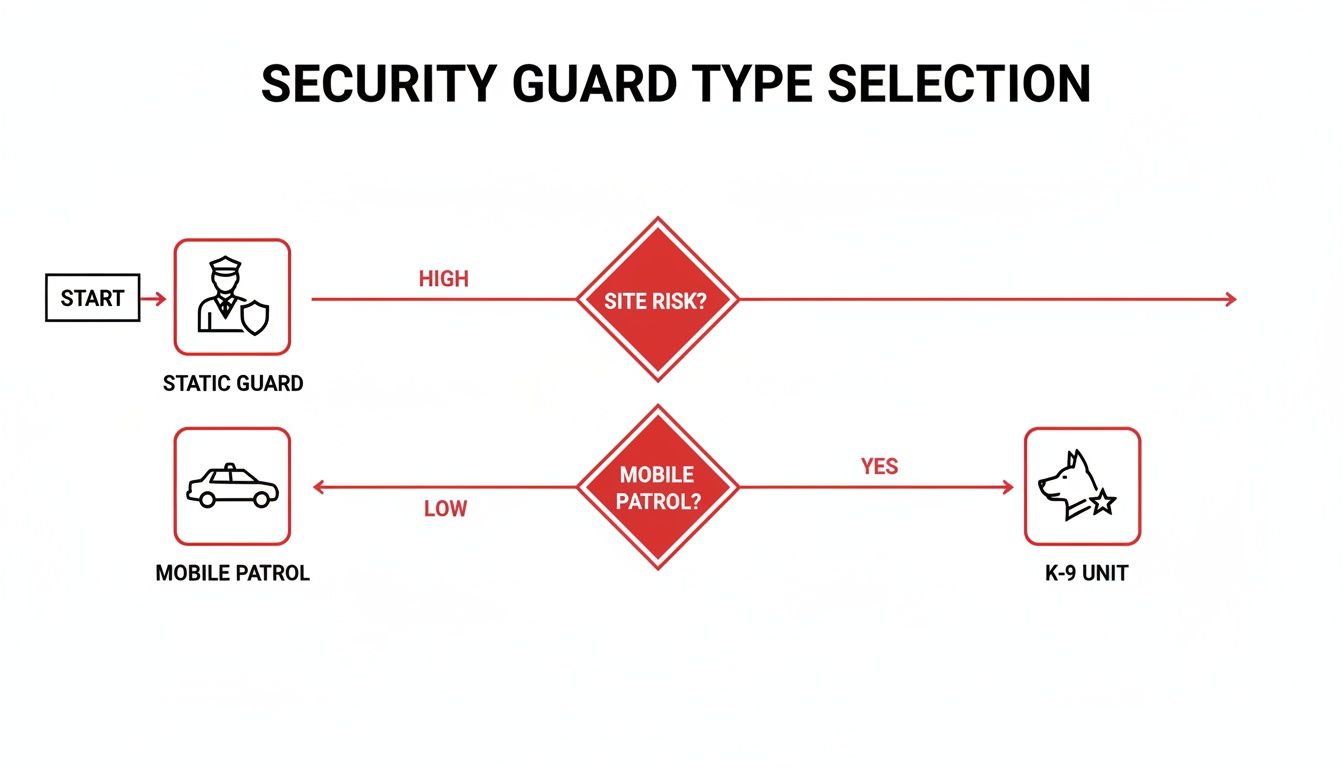
As you can see, as the risk level climbs, the need for a dedicated physical presence like a static guard becomes non-negotiable. For larger, lower-risk sites, mobile patrols can be a fantastic, cost-effective solution.
Keeping Everyone Honest with Patrol Management Apps
So, how do you really know your after-hours patrol is checking every corner of a massive site? This is where patrol management apps come in. These systems use GPS tracking and checkpoints—usually simple NFC tags or QR codes—placed at critical spots around your project.
As the guard does their rounds, they scan each point with their smartphone. This creates a real-time, tamper-proof digital log of their movements. It brings a whole new level of transparency and accountability to the table. Plus, it makes incident reporting a breeze. If a guard discovers a breach, they can snap photos and type up notes directly in the app, giving you and the security provider an instant heads-up.
I once worked with a site manager on a large civil works project who was plagued by petty theft—tools, copper, diesel, you name it. We convinced his security provider to implement a patrol app with QR checkpoints. The problems stopped almost overnight. Just knowing the patrols were being verified made the security presence feel far more active.
A Real-World Example: Putting it All Together
Imagine you’re developing a remote subdivision. The site is huge, only partially fenced, and you’ve got millions of dollars of heavy machinery sitting there. Here’s how a hybrid approach works.
You deploy several solar-powered camera towers with thermal imaging and back-to-base monitoring.
One night, the monitoring centre operator gets an alert—a heat signature right next to the excavators. They can see two individuals trying to siphon diesel. The operator immediately calls the rostered mobile patrol guard, giving them the exact location of the intruders.
The guard arrives within minutes. Armed with live intel from the operator, they’re able to catch the thieves before they get away.
Think about it: without the tech, the theft wouldn’t have been discovered until the next morning. And without the guard, the alert from the monitoring centre would have been useless. It’s this perfect partnership that truly secures a modern construction site.
Navigating Security Licensing and Contracts in Australia
Getting security guards onto a construction site in Australia is more involved than just picking a company and signing on the dotted line. Every state and territory plays by its own rules, with specific laws and licensing requirements. If you get this wrong, you’re not just taking a gamble—you’re opening your project up to some serious legal and insurance headaches.
Frankly, hiring an unlicensed or non-compliant security provider is just asking for trouble. It doesn’t just put your expensive machinery and materials at risk; it could make you legally liable if something goes wrong on their watch. Your first and most important job is to check that both the security firm and the individual guards are fully licensed.
Verifying Security Licenses
In Australia, any legitimate security firm must hold what’s known as a master license (or a similar corporate-level permit, depending on the state). This gives them the legal right to offer security services. On top of that, every single guard they send to your site needs to have their own individual security license.
Never just take their word for it. It’s on you to independently verify these credentials with the official government body in your state.
- New South Wales: Run a check through the Security Licensing & Enforcement Directorate (SLED).
- Victoria: Head to Victoria Police’s Licensing and Regulation Division to verify licenses.
- Queensland: You can use the public register on the Office of Fair Trading website.
- Australian Capital Territory: Access Canberra is the place to check.
This isn’t a complicated process; it’s usually just a quick online search. Any reputable provider will happily give you their master license number and the details for the guards they’ve rostered. If they hesitate or make excuses, that’s a massive red flag. Walk away.
Building a Bulletproof Security Contract
Once you’ve confirmed a provider is above board, it’s time to talk contracts. A vague agreement is a recipe for disaster, leading to misunderstandings and sloppy service. Your contract needs to be a rock-solid document that leaves absolutely no room for interpretation. To get this right, you need a smart approach to mastering contracting with suppliers, making sure every detail is locked in from the start.
Your contract must precisely define the scope of work. Think of it as the ultimate rulebook for security on your site.
A well-written contract and a detailed briefing document are your best defence against poor performance. They set clear expectations and provide a benchmark to measure the security provider’s effectiveness, ensuring you get the service you’re paying for.
There are a few clauses that absolutely must be in your security contract:
- Proof of Insurance: The provider has to supply current Certificates of Currency. Look for Public Liability (a minimum of $20 million is standard), Professional Indemnity, and WorkCover. No certificates, no contract.
- Staff Training and Qualifications: The agreement should specify that all guards hold the necessary qualifications, like a Certificate II in Security Operations and a current First Aid certificate.
- Clear Termination Clause: This needs to spell out how either party can end the agreement. It should cover notice periods and, importantly, reasons for immediate termination (like a major compliance breach).
- Incident Reporting Protocols: Get specific about how, when, and to whom incidents are reported. This should cover everything from a cut fence to a major theft, with a clear chain of command for escalation.
Your Essential Site Briefing Checklist
Before the first guard sets foot on your site, they need a thorough briefing. Don’t just leave this to the security company. A direct briefing from you or your site manager ensures nothing gets lost in translation and your priorities are crystal clear.
Use this checklist to build a comprehensive briefing document:
- Site Map and Key Areas: Give them a detailed map marking all access points, high-value zones (like machinery compounds and material stores), any no-go areas, and where to find emergency gear like fire extinguishers.
- Standard Operating Procedures (SOPs): Write down their exact duties. For example: “Conduct a full perimeter check every two hours, scanning QR codes at points A, B, C, and D. Check and secure all locks on storage containers during each patrol.”
- Emergency Contact List: This list needs your mobile number, the site foreman’s details, and direct lines for local police and emergency services. Be clear about who to call for different types of incidents.
- Access Control Rules: Define exactly who is allowed on-site after hours. Provide a list or clear instructions on how to verify authorisation so they don’t accidentally turn away a late-night contractor.
- Reporting Requirements: Outline the format you expect for daily activity logs and immediate incident reports. Insist that photos must be included for any discovered damage or signs of an attempted break-in.
By taking firm control of the licensing, contracting, and briefing, you’ll make sure the security guards for your construction sites are not only legally compliant but also perfectly in sync with what your project actually needs.
Budgeting for Security and Measuring Your ROI
It’s easy to fall into the trap of viewing security as just another line item on the project budget. I’ve seen it happen time and again. But thinking of it as a pure cost is a mistake; it’s a direct investment in your project’s profitability. Let’s reframe the conversation from an expense to a crucial business decision by looking at what goes into the budget and, more importantly, how to measure the return.
When you start budgeting for security guards for construction sites, you need a realistic view of the variables at play. The final number on a quote is never just about a simple hourly rate. It’s a reflection of the risk, the complexity, and the specific skills your project actually needs.
What Influences Security Costs
The quotes you get from security providers will vary, and it’s worth understanding why. An inner-city site with a history of theft and vandalism is a different beast entirely from a low-risk suburban build, and the price will reflect that.
A few key things drive the cost:
- Guard Experience and Type: An experienced guard running a gatehouse and managing site access will naturally cost more than a standard mobile patrol officer doing a couple of drive-bys. If you need a specialised K9 unit, you’re looking at a premium, high-impact service with a price tag to match.
- Site Risk Profile: This one’s simple. The higher the value of your assets and the greater the perceived threat, the more robust—and costly—your security solution will need to be.
- Hours of Coverage: Round-the-clock protection is a significant investment. It’s a world away from just having a patrol car swing by a few times after hours.
- Geographic Location: Labour costs are not uniform across the country. You can expect to pay more for a guard in Sydney than in Brisbane, simply because the local market and cost of living dictate it.
The sheer size of Australia’s private security sector—generating over $11 billion annually and employing more than 180,000 people—plays a big part in these costs. While this huge labour pool means providers can find staff, the competition for good people and fair wage expectations ultimately shape the price you pay. For a deeper dive, you can learn more about the Australian security industry landscape to get a feel for these market dynamics.
Before we move on, let’s look at some ballpark figures. Keep in mind these are estimates and can vary based on the provider, the guard’s experience, and the specific contract terms. But they give you a solid starting point for your initial budget discussions.
Estimated Hourly Rates for Security Guards in Australia
| Service Type | Sydney (AUD/hr) | Melbourne (AUD/hr) | Brisbane (AUD/hr) |
|---|---|---|---|
| Static Guard (Unarmed) | $45 – $60 | $42 – $58 | $40 – $55 |
| Mobile Patrol (per visit) | $35 – $50 | $33 – $48 | $30 – $45 |
| K9 Unit (Guard & Dog) | $85 – $110 | $80 – $105 | $75 – $100 |
| Gatehouse/Access Control | $50 – $65 | $48 – $62 | $45 – $60 |
These figures should help you map out a preliminary budget based on the type of coverage you think you’ll need.
From Cost to Value How to Calculate Your ROI
Getting the budget signed off by stakeholders becomes a whole lot easier when you can show them a clear return. The ROI from professional security isn’t just about the thefts you stop; it’s about the catastrophic costs you avoid.
The most powerful way I’ve found to frame a security budget is by calculating the potential cost of not having it. One major theft of copper wiring or a significant act of vandalism can easily wipe out more cash than an entire year’s worth of professional security services.
To work out your potential ROI, start by adding up the losses that security prevents:
- Prevented Asset Loss: Tally up the replacement value of your most commonly stolen items—power tools, copper, diesel, and small machinery. Stopping even a few “minor” thefts can quickly cover the daily cost of having a guard on site.
- Avoided Project Delays: This is the big one. A major theft doesn’t just mean lost materials; it can bring the entire project to a grinding halt for days, or even weeks. Calculate your daily operational cost (labour, plant hire, overheads) and multiply it by the potential downtime. The number is often staggering.
- Lower Insurance Premiums: Don’t forget this. Many insurers will offer a decent discount on your premiums if you have professional, 24/7 security in place. That’s a direct, tangible saving you can put straight back against your security spend.
When you shift the focus from a simple hourly rate to the massive financial risks that security neutralises, you build a compelling business case. It’s a decision that protects not just your assets, but your project’s entire bottom line.
Frequently Asked Questions About Construction Site Security
Even with a solid plan, questions always come up when bringing security guards for construction sites on board. Here are actionable answers to the most common queries from project managers.
Should our construction site guards be armed?
For over 99% of construction sites in Australia, the answer is a firm no. Introducing armed guards escalates risk significantly, creating complex legal and insurance liabilities that are unnecessary for a typical building project. Armed security is reserved for high-risk environments like critical infrastructure, not commercial or residential sites. The strength of an unarmed guard lies in their training, presence, and ability to coordinate with law enforcement—a far safer and more effective strategy for your project.
What are the first steps to take after a security breach?
A calm, methodical response is critical. The on-site guard’s primary duty is to ensure their own safety, avoid confrontation, and contact the police immediately. Your protocol should then be:
- Preserve the Scene: Prevent anyone from entering or disturbing the area. This is crucial for police to collect evidence.
- Demand a Report: Your security provider must give you a detailed incident report with photos, a timeline, and a narrative of events within a specified timeframe (e.g., 12 hours).
- Review Footage: Immediately secure and analyse all CCTV footage and data from patrol management apps to understand how the breach occurred.
- Actionable Insight: A security breach is a tough lesson. Use the incident report and footage to identify the vulnerability, then work with your provider to implement corrective measures immediately. This could mean adding a camera, changing a patrol route, or reinforcing a weak fence line.
How can we ensure the quality of the security guards on our site?
Quality control starts with the contract. Specify your minimum requirements clearly:
- Licensing: Mandate that all guards hold current, state-approved security licenses.
- Training: Require a Certificate II in Security Operations and a current First Aid/CPR certificate as a baseline.
- Experience: For critical roles like a gatehouse operator, you can request a minimum of 1-2 years of experience in a similar environment.
- Site Induction: Ensure every guard, including any replacements, completes your full site safety induction before their first shift.
- Performance Reviews: Schedule regular meetings (e.g., monthly) with your security provider to review patrol logs, incident reports, and overall performance.
Protecting your project takes more than just a temporary fence; it demands professional, reliable security designed around your specific risks. GM GROUP Services provides licensed, experienced security guards for construction sites across NSW, VIC, QLD, and the ACT, ensuring your assets are safeguarded 24/7. Secure your site and your bottom line by partnering with a team you can trust. Learn more about our construction security solutions.
Discover more from GM Group Services
Subscribe to get the latest posts sent to your email.