
Security guard qualifications matter most when you're under pressure to hire quickly. A festival date is locked in, a venue is opening next week, or a construction site has moved into a higher-risk phase, and suddenly every provider says they can “supply qualified guards”. That word sounds reassuring until you ask the next question: qualified under which state's rules, for which duties, and with what proof?
In Australia, that's where many buyers get caught out. There isn't one national security guard licence with one uniform standard. Security licensing is regulated by each state and territory, and the rules differ across NSW, Victoria, Queensland and the ACT. O*NET describes security guards broadly as people who patrol or monitor premises to prevent theft, violence, or rule infractions, and it notes substantial variation in preparation requirements in its occupational profile for security guards. In practice, that variation becomes a real operational issue for venues, promoters, retailers and site managers.
If you're hiring security, the standard can't be “someone in uniform turned up”. The standard has to be legal compliance, role suitability, and documented verification. Anything less exposes your people, your site, and your liability position.
Understanding Security Guard Qualifications Starts Here
The first mistake clients make is assuming security guard qualifications mean a training certificate and a pulse. That's not how regulated security work operates in Australia, especially if you're running events, licensed venues, retail sites, or construction projects where public interaction and incident response are part of the job.
A common scenario looks like this. You've shortlisted a contractor because the quote is fast, the uniforms look professional, and the roster is available. Then you realise the event is in one jurisdiction, some of the staff usually work in another, and nobody has clearly explained whether the guards assigned to crowd-facing duties are licensed for that specific work.
Why vague hiring creates real risk
When buyers use “qualified” as a generic label, they often miss three separate questions:
- Legal authority: Is the person licensed to perform security work in that state or territory?
- Role fit: Are they cleared for the exact task, such as crowd control, static guarding, access control, or venue work?
- Operational readiness: Can they de-escalate, communicate with patrons, and follow site procedures under pressure?
Practical rule: If a provider can't explain the licence position in plain language for the state where the job is happening, stop there and ask harder questions.
What clients actually need to verify
The broad title “security guard” covers very different environments. A retail loss prevention role is not the same as a pub entry point. A construction gatehouse is not the same as a music festival. A corporate reception post is not the same as a late-night crowd control shift.
That's why smart procurement starts with the site and the duty, then works backward into the guard's compliance profile. The safest approach is to treat security guard qualifications as a combination of licensing, training, checks, and role-specific suitability. Once you do that, weak providers become easy to spot.
The Mandatory Foundation State Based Security Licences
In Australia, the mandatory baseline for security guard qualifications is licensing under state and territory law. The regulatory framework is built around nationally recognised competency units, while state regulators require applicants to meet local licensing rules before they can work, as outlined in the U.S. Bureau of Labor Statistics fact sheet discussing the Australian model of security guard licensing and competency standards.
That distinction matters. Training creates the competency base. The state licence creates the legal permission to work. If either part is missing, you don't have a properly qualified guard.
Training base versus licence authority
This is the part many buyers misunderstand.
Nationally recognised competency units form the educational foundation. Those units cover areas such as crowd control, conflict management, workplace communication, and emergency response. But no employer should confuse completion of training with approval to perform security work. The power to authorise, restrict, suspend, and regulate security work sits with each state or territory regime.
For employers, that means the job brief has to match the licence settings. If the assignment is a licensed venue, a major event, or a public-facing environment with crowd interaction, the required licence class may differ from a standard unarmed site presence.
State based security guard qualifications at a glance
| State | Primary Unarmed/Crowd Control Licence | Key Requirements (Examples) |
|---|---|---|
| NSW | 1AC or 1A for crowd control/public space work | State-based licence class, local application rules, identity checks, probity screening |
| Victoria | State-specific licence categories apply | Separate licence categories, identity checks, probity screening |
| Queensland | State-specific licence categories apply | Separate licence categories, identity checks, probity screening |
| ACT | State-specific licence categories apply | Separate licence categories, identity checks, probity screening |
The practical lesson is simple. A guard who is compliant in one jurisdiction may still need separate licensing or endorsement to work the same event or venue in another. That's a key point explained in this overview of Australian security officer licence differences by state.
What works and what fails in procurement
What works:
- Match the licence to the assignment: Ask what licence class covers the exact duties on your site.
- Check interstate assumptions early: If your provider operates across borders, ask how they verify each placement.
- Document the duty type in writing: Entry screening, patrols, crowd movement, and venue control shouldn't sit under one vague label.
What fails:
- Buying on uniform and availability alone: Fast supply is useless if the assigned staff can't lawfully perform the role.
- Accepting “all our guards are licensed” as enough: That statement means nothing until the state, class, and expiry are checked.
- Treating security like general labour hire: It isn't. It's regulated work with compliance consequences.
A good security brief names the environment first. Event, licensed venue, retail, corporate, construction. The licence and training checks follow from that.
If you manage multiple regulated contractors across a site, it helps to treat security compliance with the same discipline you'd apply to trade compliance. This guide to 2026 contractor license requirements is useful as a parallel reference for building tighter vendor verification habits.
Beyond the Basics Specialised Security Guard Qualifications
A licence gets someone through the gate. It doesn't automatically qualify them for every security function on your roster.
Many deployments go wrong. A buyer books “security guards” when the site needs crowd controllers, covert retail operators, K9 support, or close protection. The result is legal mismatch, operational friction, or both.
Crowd roles and public facing work
For public space and crowd-facing work, you need to be precise. NSW requires a 1AC or 1A licence class for crowd control or public space duties, while Victoria, Queensland and the ACT apply their own licence categories, identity checks and probity screening. That's why cross-border workforce planning and licence verification have to be treated as an operational control, not an admin afterthought.
If you're running a festival, concert, nightclub, or large conference, don't assume a standard static guard is the right fit for gate management, line control, intoxication-related issues, or patron removals. Those duties require a guard whose licensing and training align with crowd interaction and the venue environment.
Specialised roles require role specific proof
Here's how I'd assess common specialised assignments.
- K9 deployments: Ask for handler competency, dog-and-handler pairing records, site suitability, and supervision arrangements. K9 presence can be effective in perimeter control, detection-related tasks, and visible deterrence, but only when the team is properly trained for that environment.
- VIP and bodyguard work: Look for advanced planning ability, route discipline, discretion, communication maturity, and experience in executive or public-profile settings. A close protection role isn't just “better guarding”. It's a different operating model.
- Loss prevention and covert work: Retail-focused assignments require people who can observe carefully, report accurately, and understand the store's procedures without escalating routine issues.
- Vehicle patrols and emergency response: The provider should be able to show response procedures, escalation paths, radio discipline, and reporting standards.
Fit for purpose beats generic staffing
The right question isn't “Are they licensed?” It's “Are they licensed and suitable for this exact duty in this exact setting?”
A casino-style front-of-house presence requires calm communication. A construction gatehouse requires consistency and access control discipline. A hotel or corporate site often needs polished interpersonal skills as much as security presence. If the provider sends the same profile of officer to every site, they're staffing for convenience, not for risk.
On-site reality: The wrong guard can make a safe venue feel hostile, or a high-risk venue feel unmanaged. Both outcomes create problems for the client.
The Human Factor Essential Checks Skills and Fitness
The strongest security guard qualifications file on paper can still produce poor outcomes on site. A licence doesn't guarantee judgement. It doesn't guarantee restraint. It doesn't guarantee that the guard can speak to patrons clearly, calm an argument, or represent your brand properly at the front door.
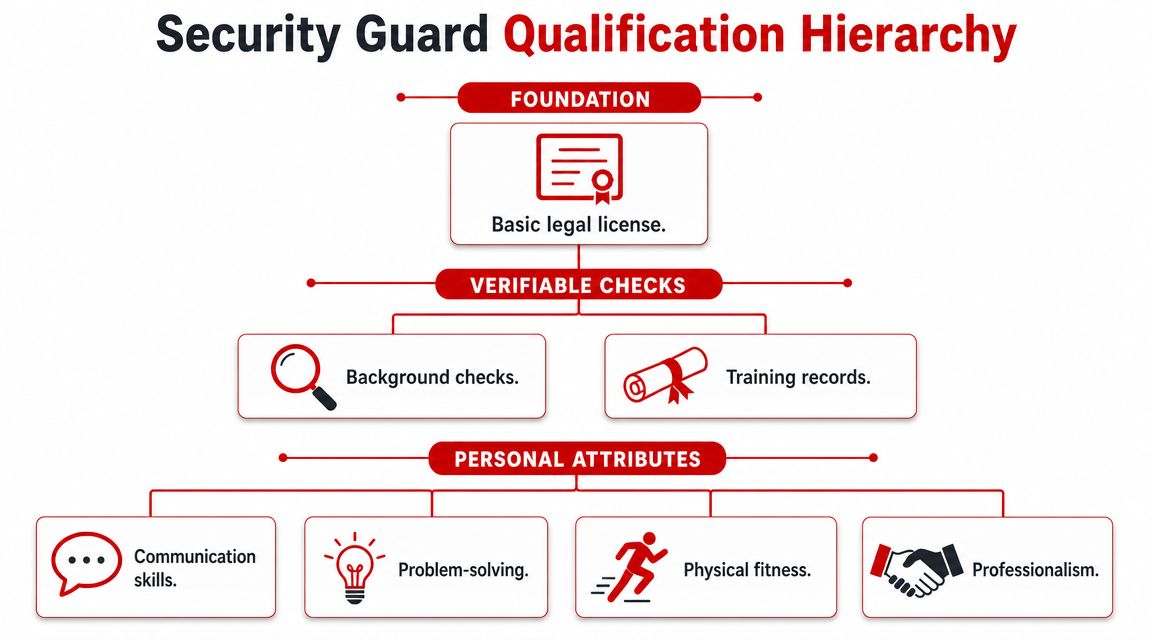
Checks that should never be skipped
Before I'd clear a guard for a client-facing role, I'd want the provider to confirm more than the licence alone.
- Background screening: Police checks and any role-relevant probity review should be current and appropriate to the work.
- Working with children clearance where relevant: If the site includes children, schools, family activations, or community events, ask specifically.
- Training records: First Aid, incident reporting, emergency procedures, and venue-specific inductions should be documented.
- RSA where the venue requires it: In bars, pubs, clubs, hotels and some event environments, RSA matters because the guard is operating alongside alcohol service and intoxication management.
The soft skills clients notice first
Clients often focus on legal compliance first, which is correct. Patrons, staff and visitors notice something else first. They notice how the guard speaks, listens, and manages tension.
The most reliable officers are usually strong in these areas:
- Communication: Clear directions, calm tone, concise radio use, and accurate handovers.
- De-escalation: The ability to lower tension without ego or unnecessary force.
- Observation: Spotting behaviour changes, access issues, and environmental risks early.
- Professionalism: Punctuality, presentation, report quality, and respect for site procedures.
If you want a structured way to think about how behaviour affects hiring decisions, this article on unlocking talent with behavioral assessments is a useful reference point for screening beyond technical credentials.
Fitness and composure still matter
Not every role demands the same physical output, but every role demands capability. Guards may need to stand for extended periods, move quickly to an incident, maintain alertness on long shifts, or assist with emergency procedures. A provider should be realistic about whether the assigned officer can perform the site duties.
That isn't about image. It's about safe deployment.
Your Verification Checklist How to Confirm Security Qualifications
Most hiring problems can be reduced by running a proper verification process before the first shift. You don't need to become a licensing expert. You do need a repeatable checklist.
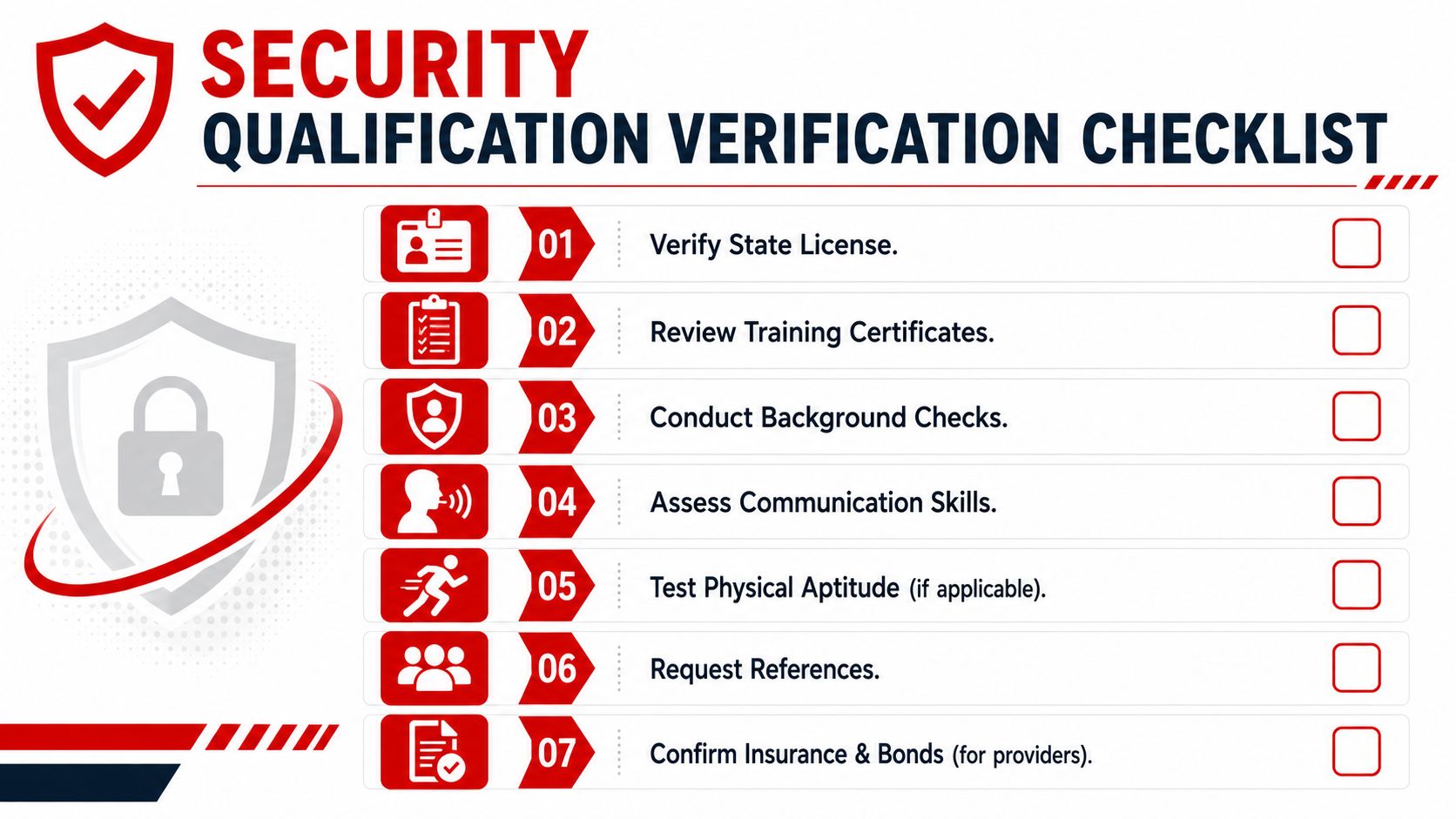
The practical client checklist
Request company and individual licence details
If you're engaging a provider, ask for the company's operating credentials and the individual guard licence details for assigned staff. Don't accept a verbal assurance.Verify the licence in the relevant state register
Use the official public register for the jurisdiction where the work will occur. Check status and expiry, and make sure the licence class fits the role.Review training certificates tied to the job
If the site needs crowd-facing staff, First Aid, RSA awareness, emergency response capability, or venue induction, ask for evidence. General security paperwork is not a substitute for task-relevant records.Confirm background and probity checks
Ask what screening the provider performs before assignment and how often records are reviewed.Assess communication before the shift starts
The quickest way to spot a weak placement is to speak directly with the proposed team leader or supervisor. If instructions are unclear in a planning call, they won't improve at gate time.Ask about supervision and escalation
Security failures often come from poor oversight, not lack of manpower. Confirm who supervises the team, who handles incidents, and how reporting reaches you.Check insurance and incident documentation
Request proof of public liability insurance and ask what incident reports look like. If there's no disciplined reporting process, post-incident review will be messy.
The best time to discover a compliance gap is before site induction, not after an incident.
What to ask in the interview or briefing call
Use plain questions:
- Which licence class covers this assignment?
- Has each guard worked legally in this state before?
- Who checks renewals and expiry dates?
- What extra credentials do your crowd-facing staff hold?
- Who is the supervisor on shift, and how do they report incidents?
For teams that want to improve hiring judgement around role fit and communication style, this guide to understanding behavioral assessments for recruitment can help frame better pre-deployment screening questions.
Contracting Compliant Guards The GM GROUP Services Standard
When clients struggle with security guard qualifications, they're usually trying to manage too many moving parts at once. Licensing, role suitability, venue conditions, shift supervision, incident reporting, and interstate compliance all sit inside one purchasing decision.
The practical solution is to work with a provider that manages those controls as part of the service, not as an afterthought. GM GROUP Services provides security guard hire and related services across NSW, Victoria, Queensland and the ACT, including event security, venue security, retail, construction, K9, VIP protection, patrols, and loss prevention. For a client, that means one provider can align deployment to the operating environment instead of treating every shift like a generic booking.
What a managed standard should include
A compliant security service should give you:
- Role-matched deployment: Crowd-facing duties, retail loss prevention, concierge-style front-of-house, and construction access control shouldn't be staffed the same way.
- Documented compliance control: Licence checks, training records, and assignment suitability should be reviewed before roster confirmation.
- Operational supervision: Guards need site briefs, escalation support, and performance monitoring once the shift is live.
- Clear reporting: You should know what happened, who handled it, and what follow-up is required.
That's the difference between buying labour and contracting a managed security function. One fills a slot. The other reduces risk.
Frequently Asked Questions About Security Qualifications
What's the difference between a crowd controller and a security guard
A crowd controller performs a more specific public-facing function, usually in environments where patron behaviour, entry management, intoxication issues, and conflict risk are higher. A general security guard role may involve patrols, monitoring, access control, or static site presence. If your site includes licensed venue conditions or active crowd movement, ask for the exact licence class and duty fit rather than relying on the generic title.
Can I hire an independent guard instead of a company
You can, but the risk profile is different. You need to think about insurance, backup coverage, supervision, incident escalation, and who checks ongoing compliance. A single operator may be suitable in limited circumstances, but many clients underestimate the admin and liability that sit behind even a simple shift.
How often do security qualifications need to be renewed
Licences and related certificates don't last forever. Renewal timing depends on the jurisdiction and the credential involved. First Aid, role-specific clearances, and other supporting records also need monitoring. That's why it's important to work with a provider that tracks expiry dates and can produce current documentation when asked.
If you need help checking security guard qualifications before your next event, venue opening, retail rollout or site mobilisation, GM GROUP Services can help you review role requirements, confirm compliance expectations, and arrange appropriately licensed security personnel for NSW, Victoria, Queensland and the ACT.
Discover more from GM Group Services
Subscribe to get the latest posts sent to your email.