
Obtaining a security guard permit is your professional passport into the security industry. Think of it as the official, government-issued licence that confirms an individual is legally qualified to work in security. This isn't just a formality; it's a non-negotiable credential proving you have passed mandatory background checks and completed nationally recognised training. For employers, it’s the most critical assurance of a guard's competence, trustworthiness, and legal standing to protect people and property.
This guide provides actionable insights and practical examples to help you successfully navigate the application process and avoid common pitfalls.
Why Your Security Guard Permit Is a Professional Passport
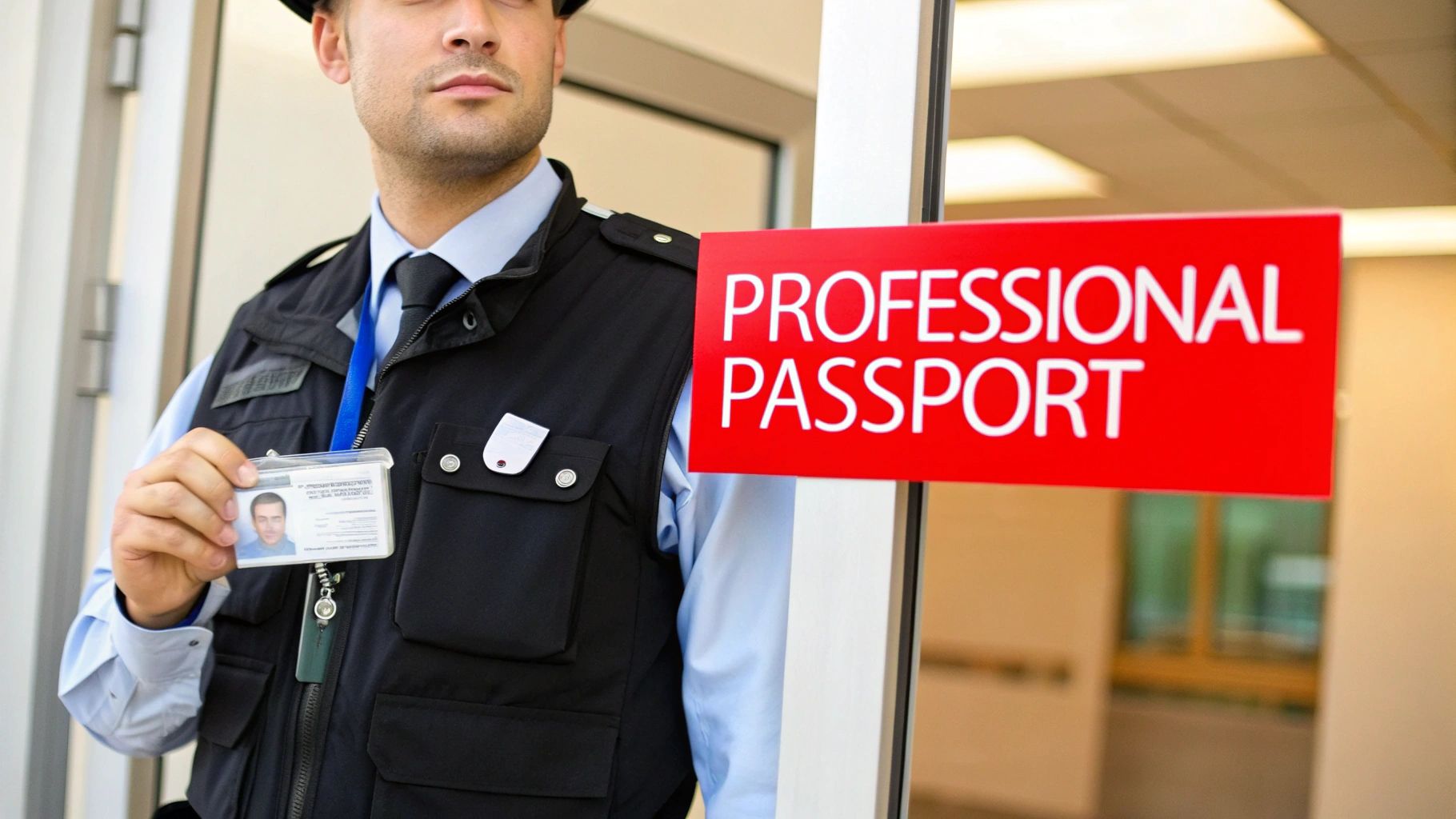
Before we get into the nitty-gritty of applications and renewals, let's nail down what this permit really means. It’s so much more than a plastic card or a number in a database. For any event organiser, venue manager, or construction site supervisor, this permit is the bedrock of trust and accountability in Australia's security industry. It's your first line of defence against risk.
When you hire a licensed guard, you’re bringing in a professional who has been thoroughly vetted. And this isn't a quick, superficial check. It involves comprehensive criminal history screenings to ensure that anyone entrusted with your safety has a clean and reliable background. This official stamp of approval confirms they meet the strict legal and ethical standards required to operate in a position of authority.
More Than Just a Uniform
A valid security permit also tells you the holder has completed specific, nationally accredited training. This isn't about learning to stand at a door; it’s about mastering a real-world skill set. The core qualification, known as the CPP20218 Certificate II in Security Operations, equips guards with crucial abilities, including:
- Risk Assessment: Spotting potential threats and weak points before they turn into real problems.
- Conflict De-escalation: Using proven communication techniques to defuse tense situations calmly and professionally.
- Legal and Procedural Compliance: Knowing their rights, responsibilities, and the strict legal boundaries they must work within.
- Emergency Response: Understanding how to react effectively during an incident, whether it’s a medical emergency or a security breach.
Actionable Insight: For an employer, this training is a guarantee of capability. It means the security professional on your site doesn't just look the part—they have the proven skills to act decisively and correctly when it matters most, protecting your assets, staff, and reputation. Always ask to see the physical permit before a guard starts their shift.
The Foundation of Industry Regulation
The permit system is the very backbone of security industry regulation in Australia. It’s what ensures a consistent, high standard of service and professionalism right across the country. It’s a serious business, with over 153,000 individuals nationwide holding active permits—a workforce larger than policing and defence combined. This highlights the rising demand for security guards in Australia and the importance of proper regulation.
Ultimately, verifying a security guard's permit is the single most critical step you can take when hiring security. It builds an immediate foundation of trust, minimises your liability, and ensures the people protecting your event or business are qualified, vetted, and fully compliant with Australian law. This simple check is fundamental to effective risk management.
Meeting the Core Eligibility for a Security Guard Permit
Getting a security guard permit isn't as simple as filling out a form and hoping for the best. It's a deliberate process, carefully designed to make sure every licensed professional has the right character and skills for the job. Before you can even think about training, you need to clear a few fundamental hurdles.
Think of these initial checks as the gatehouse to the security profession. You have to pass through them before you can go any further.
The Foundational Eligibility Checks
The first screening is straightforward but strict. It’s all about making sure you’re a suitable person to be placed in a position of trust and responsibility. While the paperwork might look a bit different from state to state, the core criteria are the same right across Australia.
Every single applicant has to meet these minimum standards:
- Age Requirement: You must be at least 18 years old. This is a hard-and-fast legal requirement with no exceptions.
- Residency and Work Rights: You need to be an Australian citizen, a permanent resident, or hold a visa that gives you full, unrestricted rights to work in Australia.
- Criminal History Check: A national police check is absolutely mandatory. This process flags any past convictions that could disqualify you, especially serious violent offences, theft, or fraud. Be completely honest here—failing to disclose something relevant is often a one-way ticket to a rejected application.
Mastering the Skills: The CPP20218 Certificate II
Once you've cleared the personal background checks, it’s time to get trained. In Australia, the cornerstone qualification for an unarmed security guard permit is the CPP20218 Certificate II in Security Operations. This isn't just about ticking boxes in a classroom; it's a hands-on course that drills you on the practical skills you'll use every single day on the job.
This qualification is what separates a prepared guard from someone who is just standing around. The training pushes past theory and focuses on what you actually need to do in the real world to protect people and property. To get a better sense of how professional qualifications are structured, it can be useful to look at examples from other fields, like in this guide about understanding other professional certification programs.
The Certificate II in Security Operations is the national benchmark that gives everyone confidence. It’s proof that a permit holder has the core skills to manage risk, communicate clearly, and respond correctly when things get stressful.
To give you a clearer idea, let’s break down what some of these training units actually mean for a guard on the ground. These are skills that are directly put to the test at an event, a retail store, or a construction site.
Key Training Units in CPP20218 Certificate II in Security Operations
The Certificate II curriculum is made up of specific units, each one designed to build a critical skill. Below are a few of the most important ones and what they look like in action.
| Unit Code | Unit Name | Practical Skill Gained |
|---|---|---|
| CPPSEC2106 | Protect self and others using basic defensive techniques | Knowing how to use positioning and minimal force to safely control a situation without escalation, keeping everyone safe. |
| CPPSEC2109 | Monitor and control access and exit of persons and vehicles | Efficiently managing the gate at a music festival or building site, properly checking credentials, and stopping unauthorised access. |
| HLTAID011 | Provide First Aid | Being the first person on the scene during a medical issue, able to give CPR or treat an injury until paramedics arrive. |
| CPPSEC2103 | Apply legal and procedural requirements to work effectively | Understanding the laws of arrest, what "reasonable force" actually means, and how to operate within the law to avoid personal liability. |
Ultimately, it’s this combination of personal vetting and rigorous training that makes a security guard permit a meaningful credential. It’s the system that ensures every licensed guard has the right character and the essential skills needed to create a safe and secure environment.
Navigating the State-Specific Application Process
So, you've ticked all the eligibility boxes and are ready to get your security guard permit. This is where things get a bit more complex. Think of Australia not as one single system, but as a collection of states and territories, each with its own rulebook for security licensing. What works in New South Wales won't necessarily fly in Victoria or Queensland.
Don't worry, though. While it might seem like a maze of bureaucracy, the process in each state is actually quite straightforward once you know the steps. We'll walk you through exactly what you need to do in NSW, VIC, QLD, and the ACT, breaking down the specific requirements for each.
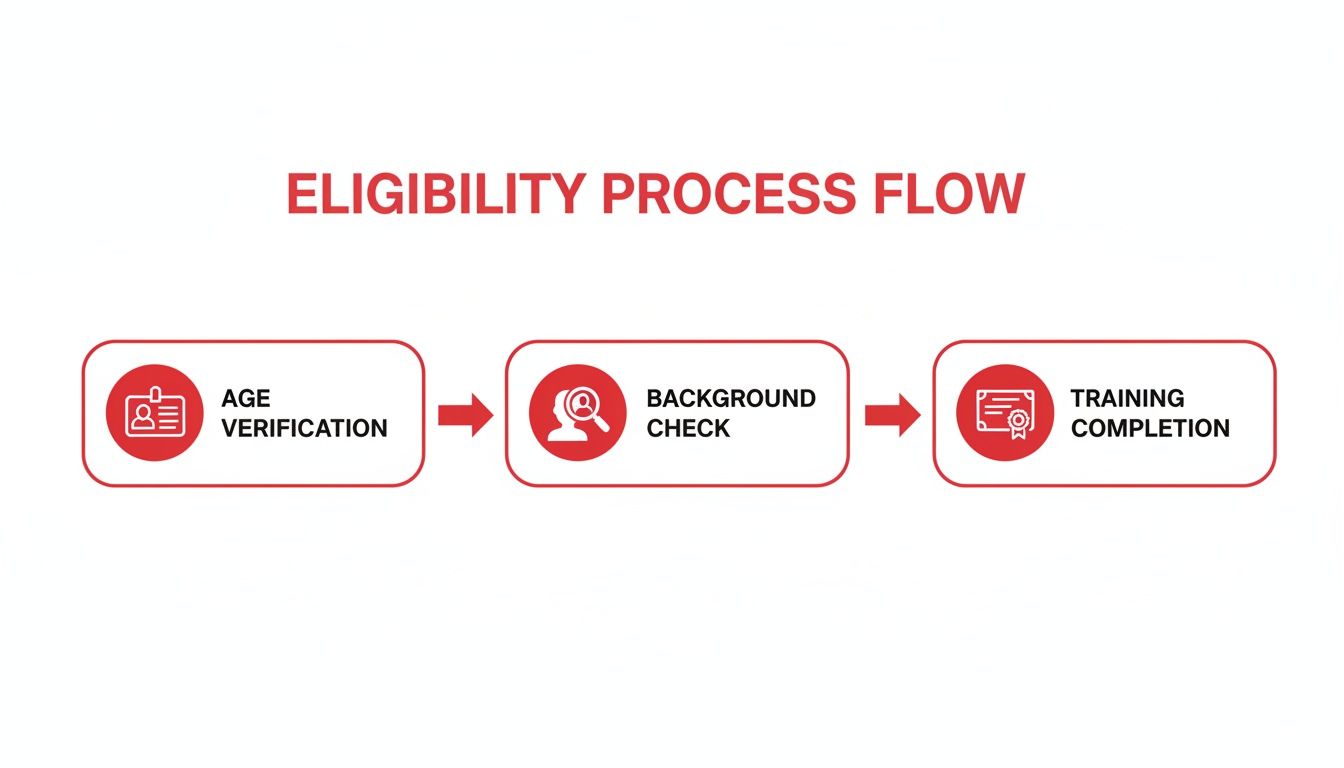
First, let's look at the common ground. This flow diagram shows the universal checkpoints every applicant must clear, no matter where they apply.
As you can see, verifying your age, passing a background check, and completing the right training are the non-negotiable foundations. Once you have these sorted, you can tackle the specific state application.
New South Wales Application Roadmap
In NSW, it's the Security Licensing & Enforcement Directorate (SLED)—a branch of the NSW Police Force—that runs the show. The licence you'll be aiming for as an unarmed guard is the Class 1A Security Officer Licence.
The entire process is managed online, so being organised with your digital documents is crucial. Here’s how it works:
- Complete Your Training: You must have a CPP20218 Certificate II in Security Operations and a current First Aid certificate from a training organisation approved by SLED.
- Get Your Docs Ready: You'll need 100 points of identification, your training certificates, and any other supporting paperwork, all scanned and ready to go.
- Apply Online: Head to the Service NSW website to lodge your application. You'll need to set up an account, complete the online form, and pay the fee.
- Get Your Prints Taken: After you submit the application, you’ll get instructions to visit a police station for fingerprinting and palm scanning.
Actionable Insight: The key to a smooth application in NSW is preparation. Create a digital folder on your computer and save all required documents as PDFs before starting the online form. This will save you from timing out or losing your progress.
Victoria Application Steps
Down in Victoria, the Licensing and Regulation Division (LRD) of Victoria Police is the governing body. Much like NSW, their system is online, but they have their own set of unique requirements.
To get your private security guard permit, you’ll use their eServices Portal.
- Gather Your Paperwork: You'll need certified copies of your ID, proof of your training qualifications, and—importantly—two character references from people who have known you for at least 12 months.
- Consent to a Police Check: As part of the application, you'll consent to a National Police Check and need to list all your addresses from the past five years.
- Book Your Fingerprinting: Once your application is in, you will be prompted to book an appointment at an approved centre to have your fingerprints taken.
A key difference in Victoria is the emphasis on character references. The LRD takes these seriously, so choose referees who can genuinely speak to your suitability for a position of trust.
Queensland Licence Process
Up north, the Office of Fair Trading (OFT) handles security provider licences. Their process is a bit of a hybrid, mixing online and in-person options, with a very strong focus on determining if you are a "fit and proper person" for the role.
Here's what you need to do:
- Lodge the Application: Complete the application form for a security provider licence (individual—Class 1). This can be done online, by post, or at a service centre.
- Prove Who You Are: Provide certified copies of your identification documents.
- Show Your Qualifications: Attach your statement of attainment for the required training units.
- Undergo a History Check: The OFT performs a very thorough check of your criminal and personal history. It’s absolutely vital to be upfront about everything; trying to hide something is a sure-fire way to get your application denied.
The security industry is booming in Queensland. With over 162,000 licensed personnel across Australia, Jobs and Skills Australia data reveals that Queensland is home to 21.2% of the nation's security officers. You can learn more about this growth and the national push for industry reform to get a better sense of the professional landscape.
Australian Capital Territory Guide
In the nation's capital, licensing falls under Access Canberra, governed by the Security Industry Act 2003. The process is just as strict, with a few extra hurdles to clear.
To apply for your security guard permit in the ACT, you'll need to:
- Fill Out the Form: Complete the official Application for a Security Employee Licence.
- Arrange Background Checks: This is a big one. You need a police certificate from every Australian state or territory you've lived in for more than six months since you were 16. If you've lived overseas for over 12 months, you'll need one from that country too.
- Provide Proof of Competency: Attach your training qualifications and your current First Aid certificate.
- Get Fingerprinted: You will also need to have your fingerprints taken by ACT Policing.
The ACT’s requirement for police certificates from all previous jurisdictions really stands out. It adds another layer of due diligence to the screening process, so make sure you factor that extra legwork into your timeline. Getting these state-specific details right is the final piece of the puzzle to securing your permit and launching your career.
Costs, Timelines, and Common Mistakes to Sidestep
Getting your security guard permit is an investment—not just in paperwork, but in your time and money. If you go in blind, you can easily get tripped up by unexpected costs or long waits. Let’s walk through what you should realistically budget for, how long it all takes, and the common pitfalls that can derail your application before it even gets started.
Knowing what to expect from the get-go makes the whole process a lot less stressful. It lets you plan properly and focus on what matters: getting qualified and starting your career.
Mapping Out the Costs
The price of a security licence isn't a single, flat fee. It’s actually a collection of different costs you'll pay at various stages, and the exact amounts can differ slightly from state to state.
Here’s a realistic breakdown of what you'll need to budget for:
- Training Course Fees: This is usually the biggest chunk of your investment. The CPP20218 Certificate II in Security Operations can set you back anywhere from $500 to over $1,500, depending on who you train with and where they're located.
- Licence Application Fee: Every state’s regulatory body charges a non-refundable fee just to process your application. Expect this to be between $100 and $500.
- Fingerprinting and Background Checks: You can’t skip the mandatory fingerprinting and national criminal history checks. These usually add another $50 to $100 to your total.
- First Aid Certificate: Having a current HLTAID011 Provide First Aid certificate is non-negotiable. This course typically costs between $100 and $200.
It’s worth remembering that these costs are your entry ticket into a massive industry. The Australian security sector is a serious economic player, pulling in around $13.9 billion in revenue and growing steadily. This just goes to show how much value is placed on having properly trained and vetted professionals on the ground. You can find more insights on the future of the security industry at asset.edu.au.
Navigating the Timeline
When it comes to getting your licence, patience is a virtue. This isn't an overnight process. Regulatory bodies have to do their due diligence to ensure public safety, which means thorough background checks. On average, you should brace yourself for a wait of four to eight weeks from the day you submit your application to the day you have your permit in hand.
Practical Tip: That clock only starts ticking after you’ve finished all your training and have every single document ready to go. Any mistakes or missing info will only push that timeline out further. Submit your application as soon as your training is complete to minimise downtime.
The Most Common Pitfalls to Avoid
So many applications get delayed or flat-out rejected because of simple, avoidable mistakes. If you can steer clear of these common blunders, you’ll be well ahead of the game.
- Incomplete or Incorrect Forms: Rushing your paperwork is the fastest way to slow things down. Take your time, double-check every single field, make sure names and dates are spot on, and sign everywhere you’re supposed to.
- Failure to Disclose History: This is a big one. Being anything less than 100% honest about your past is a massive red flag for regulators. They will find out during the background check, and trying to hide something is often seen as a bigger issue than the original offence itself.
- Expired or Unapproved Training: Make sure your Certificate II and First Aid qualifications come from a Registered Training Organisation (RTO) that’s actually approved by your state’s licensing authority. Handing in expired or unrecognised certificates is an instant rejection.
- Not Providing All Required Documents: Each state has a very specific checklist of what you need to provide, from 100 points of ID to character references. Forgetting even one piece of paper will put your application on hold until you get it sorted.
How We Guarantee Your Security Guard Permit Compliance
Getting a security guard permit is one thing, but for our clients, real peace of mind comes from knowing that every single guard on their site is currently and verifiably compliant. It’s not just about ticking a box during the hiring process. It’s about active, ongoing management. At GM GROUP Services, we’ve built our entire system around eliminating the guesswork and risk for you.
We’ve developed a meticulous, multi-layered verification system to ensure every professional we send your way is not just qualified on paper, but fully authorised and up-to-date.

Our Rigorous Internal Verification System
Before any GM GROUP guard even thinks about stepping onto your property, they have to pass through our strict internal compliance checks. We never just take a security guard permit at face value. Instead, our process involves going straight to the source and verifying each permit with the official state regulatory bodies in NSW, Victoria, Queensland, and the ACT.
This isn't just a formality. This step confirms three critical details:
- Validity: Is the permit genuine? We make sure it hasn’t been forged or tampered with.
- Status: We confirm the permit is currently active and hasn't been suspended, cancelled, or revoked for any reason.
- Correct Class: We ensure the licence class is the right one for the job, whether it’s for static guarding, crowd control, or another specific role.
Proactive Management of Qualifications
A guard’s compliance is more than just their main permit. Other essential certifications, like First Aid, have their own expiry dates and are just as vital for keeping your environment safe. Our systems are built from the ground up to track these deadlines proactively.
We keep a detailed digital record for every single team member. This file logs all their training qualifications, First Aid certificate expiry, and security permit renewal dates. Our system automatically flags these dates well in advance, so there are absolutely no gaps in compliance. Ever.
This proactive approach means you’ll never have to worry about a guard’s credentials lapsing while they’re on your watch. We take care of all the administrative heavy lifting so you can focus on your business, completely confident that your security team is always compliant.
A Partnership Built on Trust and Accountability
When it comes down to it, our compliance guarantee is the foundation of the trust you place in us. Partnering with GM GROUP Services means you're not just hiring security personnel; you're bringing on a risk management partner. We know that just one non-compliant guard can open your organisation up to serious legal and reputational damage.
Our thorough vetting and continuous management systems are designed to lift that risk entirely off your shoulders. We make sure every guard representing your brand is fully licensed, properly trained, and legally authorised to be there, giving you total confidence and a genuinely secure environment.
Frequently Asked Questions About the Security Guard Permit
Navigating the world of security permits can feel a bit like a maze. It’s completely normal to have a bunch of questions, whether you're just starting out in your security career or you're a business owner trying to make sure your team is above board. Getting the right answers is crucial.
This section is all about tackling those common questions we hear every day. Think of it as your quick guide to clearing up the tricky details that can mean the difference between a smooth process and a major headache.
Can I Work While My Security Guard Permit Application Is Being Processed?
The short answer is a hard no. In just about every Australian state and territory, including NSW, VIC, QLD, and the ACT, you absolutely must have your physical security guard permit in your hand before you can step onto a site.
Working without a valid, current licence isn't just a small mistake; it's a serious offence. You could be hit with massive fines, and so could your employer. That waiting period while your application is processed isn't just red tape—it's when the authorities are doing the deep-dive background and criminal history checks needed to keep the public safe.
So, you have to wait for that official approval and the actual permit card to arrive before you can start any security work. It’s why reputable providers like GM GROUP Services have such strict checks in place to confirm every single guard is fully licensed before they're ever deployed.
Is a Security Guard Permit from One State Valid in Another?
No, your security guard permit is state-specific. A licence issued in New South Wales won't let you legally work a security job in Victoria or Queensland. Australia’s licensing system is run on a state-by-state basis.
But there is a way to work across borders. Thanks to the Mutual Recognition Act 1992, you can have your qualifications recognised in another state. It’s not automatic, though—you have to apply for it.
This usually means submitting a formal application to the licensing body in the new state, showing them your current licence, proving your identity, and sometimes completing extra training modules to meet local rules. You’ll also have to pay an application fee. You must get that new, state-specific licence before you start any security duties there.
What Happens If I Fail the Criminal History Check?
If you fail the mandatory criminal history check, your application for a security guard permit will be refused. This is probably the most critical part of the whole process, put in place to protect the community and uphold the integrity of the security industry.
Each state’s regulatory body has a list of what they call disqualifying offences. These often include things like:
- Serious violent crimes
- Major theft or fraud convictions
- Drug trafficking charges
- Certain firearms or weapons offences
The regulator looks at your entire history to decide if you are a "fit and proper person" to hold a position of trust. If they refuse your application, they'll notify you in writing and explain why. While you can usually appeal the decision, it's often a long and difficult road. The best policy is always honesty—failing to disclose an old offence is often enough to get you rejected on its own.
How Often Must I Renew My Security Guard Permit?
Renewal timelines aren't the same across the country; it all depends on which state or territory issued your licence. It's completely up to you to keep track of your expiry date and get your renewal in on time so you can keep working without any interruptions.
Just to give you an idea of the differences:
- New South Wales: A Class 1 licence generally needs to be renewed every five years.
- Victoria: A private security individual licence is usually renewed every three years.
You likely won't have to re-do the entire CPP20218 Certificate II in Security Operations, but you will need to prove you're still competent. This almost always means having a current First Aid certificate, which itself needs to be renewed every three years (with the CPR part updated annually). Make sure you check the specific renewal rules with your state’s licensing authority well before your permit is due to expire.
At GM GROUP Services, we don't just supply security; we deliver guaranteed compliance and peace of mind. Our rigorous verification and proactive management systems ensure every guard is fully licensed, trained, and ready to protect your assets. Secure your event, venue, or site with professionals you can trust by visiting us at https://www.gmgroupservices.com.au.
Discover more from GM Group Services
Subscribe to get the latest posts sent to your email.