
Security guard hire Sydney usually becomes urgent at the worst possible moment. A venue is opening in two days. A contractor has had tools go missing. A festival site suddenly needs tighter access control. A retail manager wants a stronger floor presence before a busy trading period. In each case, the first instinct is often the same. Find a guard fast.
That approach causes more problems than it solves.
Good security isn't about filling a roster line. It's about matching the right licensed people, the right supervision, and the right operating plan to the actual risk in front of you. A quiet corporate lobby, an RSA-heavy late-night venue, a construction gatehouse, and a public event all need different security responses. Treat them as interchangeable, and you create gaps in coverage, confusion on site, and compliance risk.
In Sydney, buyers also need to think beyond availability. They need to think about NSW licensing, role-specific experience, reporting standards, site induction, escalation pathways, and whether the provider can supervise the deployment after the first shift starts. That's what separates a stable operation from a guard who turns up, stands there, and adds very little.
Your Essential Guide to Security Guard Hire in Sydney
If you're arranging security guard hire in Sydney, you're probably trying to solve one of two problems. You either need immediate protection for people, assets, or operations, or you're trying to prevent the next issue before it happens.
The mistake many buyers make is asking for “a security guard” as if that's a complete brief. It isn't. A proper brief should identify what the guard is there to do, what authority they need on site, who they report to, what they're expected to prevent, and how incidents will be recorded and escalated. Without that, even a licensed guard can be deployed badly.
Sydney adds another layer. City venues, high-footfall retail, major events, transport-adjacent sites, and mixed-use developments all create different pressure points. The practical question isn't whether you need security. It's what kind of security presence fits your environment.
Practical rule: If you can't describe the risk in one clear paragraph, you're not ready to hire yet.
A sound buying process usually comes down to five decisions:
- Define the environment: Know whether you're protecting a site, an event, staff, stock, guests, or a combination.
- Choose the function: Decide whether you need deterrence, access control, loss prevention, crowd management, patrol, or incident response.
- Check compliance: Confirm the provider and guards are licensed for the work being performed in NSW.
- Assess capability: Look at supervision, reporting, communication, and site-specific experience.
- Plan the handover: Security works best when your team and the guards operate from the same instructions.
That's how security guard hire in Sydney should be handled. Not as labour hire. As operational risk control.
Assess Your Unique Security Needs and Risks
Most poor deployments start with vague instructions. “Keep an eye on things” isn't an operating brief. Before you speak to any provider, write down the risks that matter on your site.
Build a brief around the site, not the job title
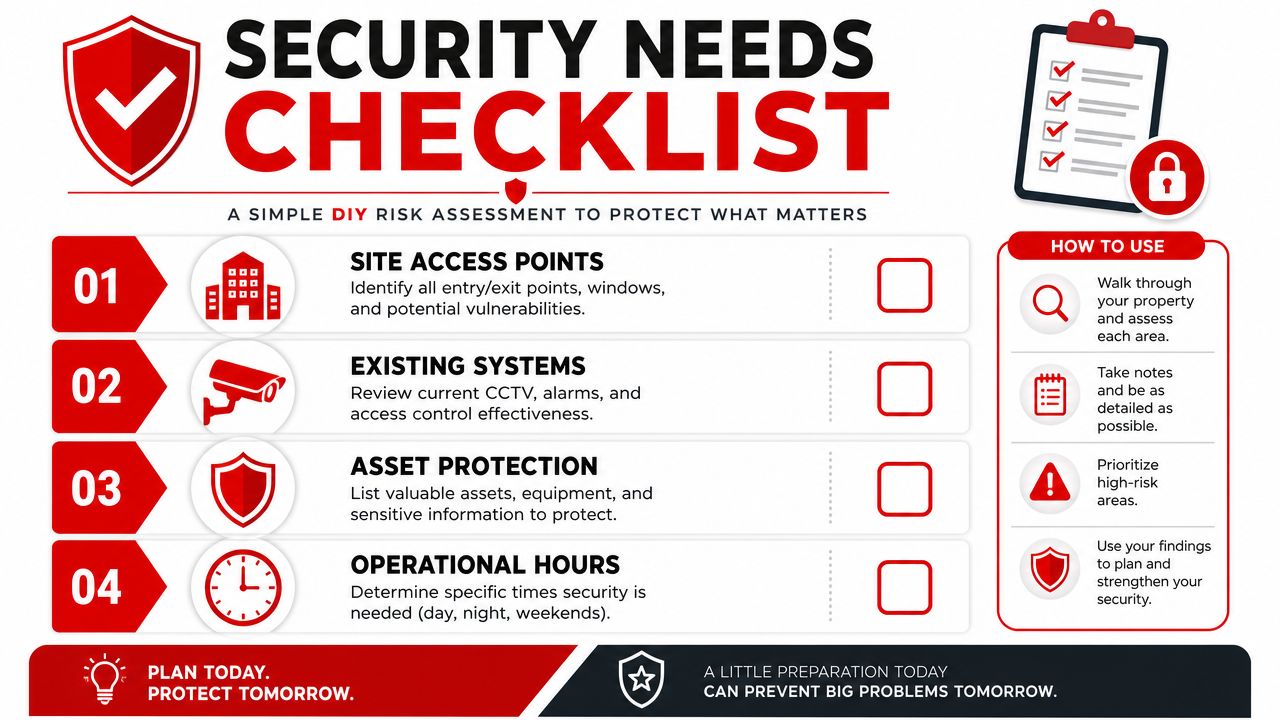
Start with the property or venue itself. Walk it like an outsider would. Look at entries, exits, blind spots, cash points, loading areas, staff-only zones, fencing, after-hours access, and any area where people tend to gather or drift. Security planning gets better when it's physical and specific.
Use this checklist:
- Site access points: List every public entrance, staff entry, vehicle gate, emergency exit, and weak boundary.
- Existing systems: Note what CCTV, alarms, lighting, intercoms, or access control already do well, and where they fail.
- Asset exposure: Identify what would hurt most if lost, damaged, or accessed without permission.
- Operational timing: Record when the risk peaks. Opening and closing times often matter more than the middle of the day.
For mobile patrols across larger footprints, movement planning matters as much as headcount. If your site involves multiple checkpoints, loading docks, or dispersed buildings, it helps to understand OnRoute's definition of route optimization because patrol efficiency depends on sequencing stops sensibly rather than walking or driving the same ground twice.
Ask threat questions that match your industry
A construction manager should ask different questions from a nightclub operator. So should a retailer compared with a festival organiser.
Consider the risk by environment:
- Retail: Are you dealing with shop theft, aggressive behaviour, staff safety concerns, or after-hours entry?
- Construction: Is the issue unauthorised access, theft of materials, vehicle gate control, or weekend vacancy?
- Hospitality: Do you need ID checks, patron management, queue control, or support around intoxication-related incidents?
- Events: Are the pressure points perimeter control, credential checks, crowd movement, backstage access, or evacuation routes?
The cleaner your risk brief, the easier it is to reject the wrong proposal.
Turn your notes into an operational brief
A useful client brief is short. It doesn't need corporate language. It needs decisions.
Include:
- What must be protected
- When coverage is needed
- What the guard is expected to do
- What the guard is not expected to do
- Who gives directions on site
- How incidents should be reported
If you do this before requesting quotes, conversations improve immediately. Providers stop guessing. You stop comparing generic offers that don't match your venue.
Navigating NSW Security Licensing and Compliance
A Sydney venue can have the right number of guards on paper and still be exposed on the night. I've seen it happen when a client books fast, assumes all licences are interchangeable, and only checks details after an incident, an entry refusal dispute, or a complaint from staff. By then, the actual issue is no longer staffing. It is whether the deployment was lawful, supervised, and suitable for the job.
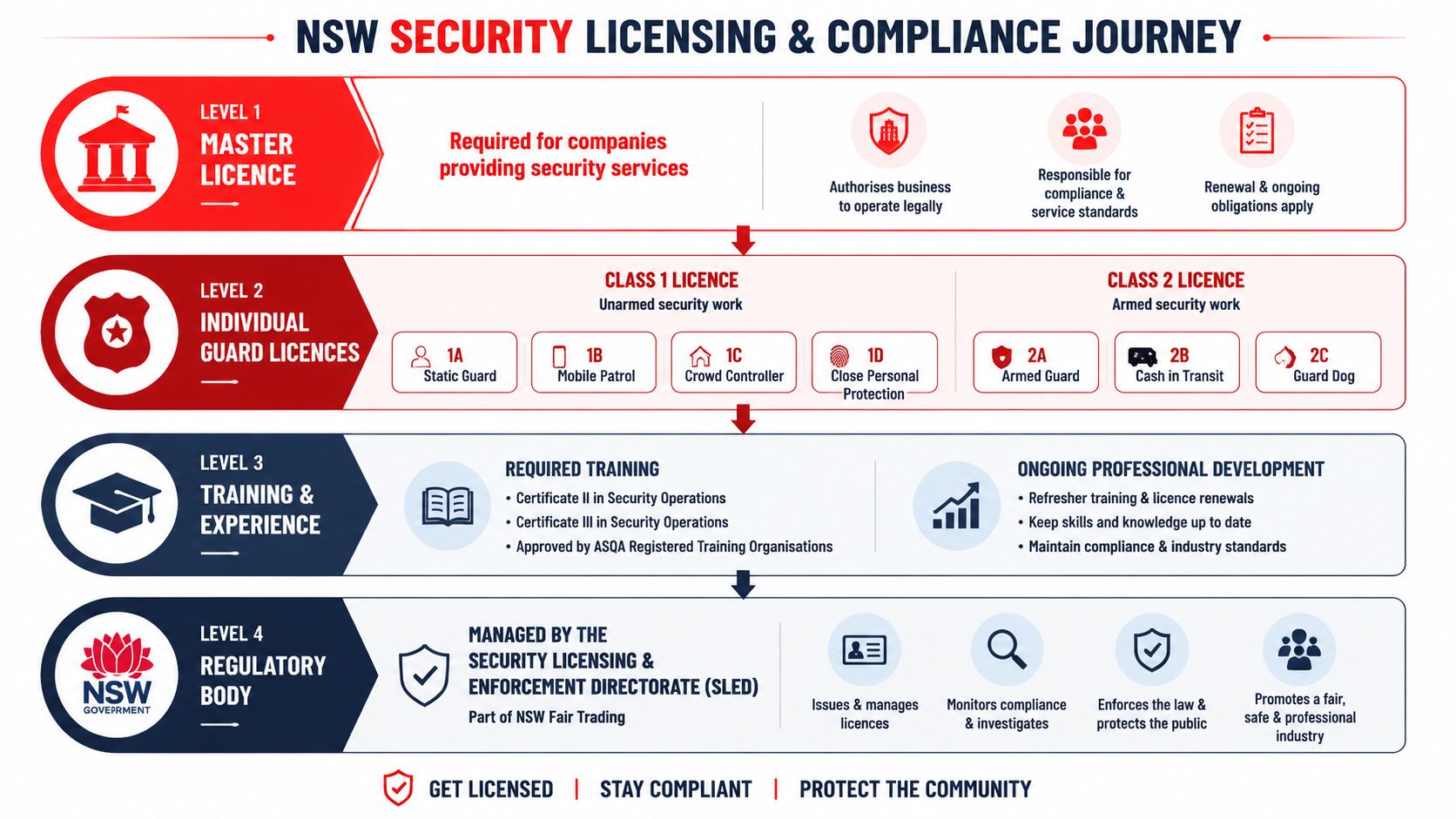
Check compliance in three layers
Start with the provider. A company supplying guards in NSW needs authority to offer those services.
Then check the individual officer. The guard assigned to your site must hold the right licence class for the work required, not just any current security credential.
The third layer is the assignment itself. A construction site, licensed venue, retail floor, festival gate, and corporate lobby all create different operational requirements. Site inductions, first aid expectations, venue rules, incident reporting standards, and alcohol-related procedures can all affect whether a guard is ready to work your site properly.
That broader operating discipline sits inside compliance. A licence matters, but so do supervision, written post orders, escalation paths, and usable incident records. If those pieces are missing, a technically licensed deployment can still create legal and operational problems.
What to verify before the first shift
Ask for documents before confirming the roster. A serious provider will expect that.
Request:
- Company licence details: Confirm the business is authorised to supply security services in NSW.
- Assigned guard credentials: Check that the specific officer booked for your site is licensed for the actual role.
- Site and role qualifications: Some venues require inductions, first aid, or practical familiarity with alcohol service controls, entry management, or contractor access rules.
- Insurance and operating procedures: Ask how incidents are recorded, who supervises the shift, and how replacements are handled if the assigned officer drops out.
Cheap rates often hide expensive weaknesses. If a provider cannot produce documents, explain supervision, or define who is accountable on site, the problem is not paperwork. The problem is control.
Role fit affects compliance
Buyers make avoidable mistakes. They ask for "a guard" as if static site security, crowd control, concierge coverage, and covert retail work are interchangeable. They are not.
A late-night hospitality venue needs officers who can manage patron behaviour, refusals, queues, and incident escalation within venue rules. A construction site usually needs access control, perimeter discipline, visitor logging, and after-hours asset protection. An event may need a different mix again, including crowd movement, credential checks, bag screening, or back-of-house control. K9 support may be justified for some higher-risk perimeter tasks, while it would be unnecessary and poorly matched in a low-risk reception environment.
The compliance question is tied to the operating model. If the role is wrong, the licence check alone will not save the deployment.
Ask providers to define the function, not just fill the shift
The better question is simple. What licensed function is this officer performing on this site, under whose supervision, and with what written instructions?
That question quickly separates serious operators from booking agencies. It also helps you buy the right service for your Sydney venue, whether that means a static guard for a gatehouse, crowd controllers for a festival entry, or a specialist team for a higher-risk assignment. Procurement gets sharper once the role, authority, and site conditions are clear.
Matching Security Services to Your Sydney Industry
A guard posted at a festival gate, a pub door, and a construction site may hold the same licence class, but the job is not the same. In Sydney, service selection has to follow the site, the people on it, the hours of operation, and the incidents you are trying to prevent.
Buyers usually get better results when they stop asking for headcount and start asking what the guard must do on that site. A warehouse with repeated after-hours trespass needs perimeter discipline and patrol routine. A licensed venue needs officers who can manage refusals, queues, and aggression without creating a bigger problem. A corporate lobby often needs a visible security presence with strong communication and presentation, not a heavy-handed posture that unsettles staff and visitors.
Match the service to the operating risk
Different security models solve different problems, and the trade-offs matter.
- Static guards: Best for fixed posts such as gatehouses, loading docks, reception desks, plant entry points, and access-controlled areas. You get consistent presence and tighter control over visitors, keys, deliveries, and sign-in procedures.
- Mobile patrols: Better for larger properties, vacant sites, school grounds, industrial yards, and multi-point assets after hours. Patrols cover more ground at lower cost than a full-time static post, but they do not give constant on-site presence.
- Crowd controllers: Suited to pubs, clubs, bars, festivals, sporting events, and any venue where entry management and patron behaviour are regular issues. This work depends on judgement, communication, and incident restraint.
- Loss prevention officers: Used in retail where theft, staff intimidation, and suspicious behaviour need close observation and coordination with store teams. A visible guard at the door can deter some offending, but it rarely addresses internal shrinkage on its own.
- K9 teams: Best reserved for sites where added deterrence, perimeter sweeps, or specialist support are justified by the risk profile. They are useful on some industrial, infrastructure, and event perimeter tasks. They are a poor fit for low-risk concierge or customer-facing environments.
Identification on site matters too. If security staff work around plant, contractors, delivery teams, or traffic control, clear visual distinction prevents confusion at entry points and loading zones. On mixed-use sites, it can help to find the right custom safety vests so guards are visible without being mistaken for logistics or venue crew.
Security service recommendations by Sydney industry
| Industry | Primary Risk | Recommended Service 1 | Recommended Service 2 |
|---|---|---|---|
| Events and festivals | Crowd flow, perimeter breaches, restricted-area access | Crowd controllers | Static entry and backstage guards |
| Hospitality venues | Patron behaviour, entry refusal, RSA-related friction | Crowd controllers | Door or concierge security |
| Retail | Theft, staff safety, high-footfall incidents | Loss prevention officers | Uniformed floor guards |
| Construction | Theft, trespass, gate access, after-hours vacancy | Gatehouse static guards | Mobile patrols |
What works on common Sydney sites
For events and festivals, I would usually start with public entry, perimeter integrity, liquor areas, restricted zones, and pack-down. That often points to a mixed deployment, not one guard type. Crowd controllers at entry and high-interaction areas do the front-line people management. Static guards cover credential checks, artist or staff access points, cash rooms, control tents, and back-of-house zones. On larger footprints, patrols or K9 support may be justified around fencing, vehicle access, or dark perimeter sections.
For hospitality venues, the wrong officer can create complaints, refusals, and incident reports that were avoidable. Door staff need calm verbal control, awareness of venue policy, and the judgement to de-escalate early. A physically imposing presence alone is not enough. In many Sydney venues, the better model is a smaller team of experienced crowd controllers rather than extra numbers with weak patron-handling skills.
For retail, visibility helps, but observation and reporting usually matter more. Shopping strips, supermarkets, and larger format stores often need a combination of floor presence, suspicious behaviour recognition, and direct coordination with duty managers. If the brief is only "stand near the entrance," expect gaps in theft response and poor coverage of staff safety issues deeper in the store.
For construction and industrial sites, structure beats show. The strongest deployments are usually simple and disciplined: gatehouse control during operating hours, documented visitor and vehicle movements, and patrol coverage when the site is closed. If theft risk is low, patrols may be enough. If you are dealing with copper theft, repeated trespass, vandalism, or high-value plant, a static post with clear escalation instructions is often the safer spend.
The right service mix changes as the site changes. A festival bump-in does not need the same coverage as event day. A construction site in early civil works has different risks from a site approaching fit-out. Good planning accounts for that and adjusts the security model before the incident profile changes, not after.
A Smart Workflow for Vetting Security Providers
Friday afternoon, your event starts at six, and the guard who arrives has never worked your venue type, has not been briefed properly, and does not know who to call when a patron refuses directions. That problem usually starts days earlier, during provider selection.
A proper vetting process is less about comparing quotes and more about testing whether a company can supply the right officer, with the right supervision, for your specific Sydney site. A construction gatehouse, a licensed venue, and a festival entry point all need different judgement, reporting habits, and escalation skills. The provider should be able to explain that difference clearly before the first shift is even rostered.
Start by asking who will run the account once the proposal is signed. Sales staff win work. Operations staff keep sites stable. If the company cannot name the supervisor, explain after-hours coverage, or set out how site instructions are issued and updated, expect confusion once the job goes live.
Then test role fit. Ask what experience the proposed officers have in your environment, not just whether they are licensed. A guard who is solid on static corporate work may struggle at a busy event entry. A crowd controller who handles patrons well may be the wrong choice for a low-traffic industrial site where access control, logs, and contractor management matter more. Good providers do not send the nearest available body. They match the assignment.
These questions expose weak operators quickly:
Who supervises the site and how often do they check it
You need a named supervisor, a contact path, and a clear attendance and quality-check process.What experience do the assigned officers have in this exact setting
Ask for relevant examples by site type, shift pattern, and incident profile.How are incidents recorded, escalated, and closed out
The answer should cover reporting format, response times, and who gets notified.What happens if the guard is late, unsuitable, or absent
A real provider has relief capacity and a replacement procedure.How do you brief officers on site-specific instructions
Generic induction is not enough for venues with patron rules, plant movement, restricted areas, or cash handling.
Communication is usually the dividing line between an average deployment and a reliable one. Guards need to speak clearly with staff, visitors, contractors, emergency services, and your duty managers. They also need to write reports that are useful later. If an officer cannot explain an incident in plain language, your records, insurance position, and follow-up all get weaker.
I also look closely at how a provider handles documentation. Ask to see sample incident reports, handover notes, patrol records, and daily occurrence logs with client details removed. The paperwork does not need to be fancy. It does need to be consistent, legible, and tied to an actual escalation process.
Use a practical checklist during vetting:
- Licence and identity checks: confirm the company and assigned officers meet NSW requirements.
- Role matching: test whether the proposed team suits your venue, crowd, assets, and operating hours.
- Supervision model: confirm who audits performance, manages relief staff, and handles complaints.
- Reporting standard: require incident logs, handover notes, and clear notification triggers.
- Presentation and conduct: check uniform standard, communication style, and professionalism.
- Replacement capacity: confirm how the company fills gaps without dropping site quality.
Treat the first few shifts as a live trial. Watch punctuality, briefing discipline, patrol quality, and whether the guard follows site instructions without constant correction. The early signs are usually accurate. If the provider misses simple details in week one, problems tend to show up later in supervision, reporting, and incident response as well.
The best security relationship is built on fit, control, and follow-through. Company size matters less than whether the provider can place the right service model at your site and keep that standard steady. That is the difference between merely hiring a guard and buying a security operation that suits your Sydney venue.
Understanding Pricing Contracts and Guard Onboarding
A Sydney venue can buy the wrong security model even with a competitive hourly rate. I see it when a client books one static guard for a site that requires mobile patrol support, a crowd controller, or a stronger after-hours lock-up process. The contract looks fine on paper. The service still underperforms because the scope and onboarding were built around price, not the underlying operating risk.
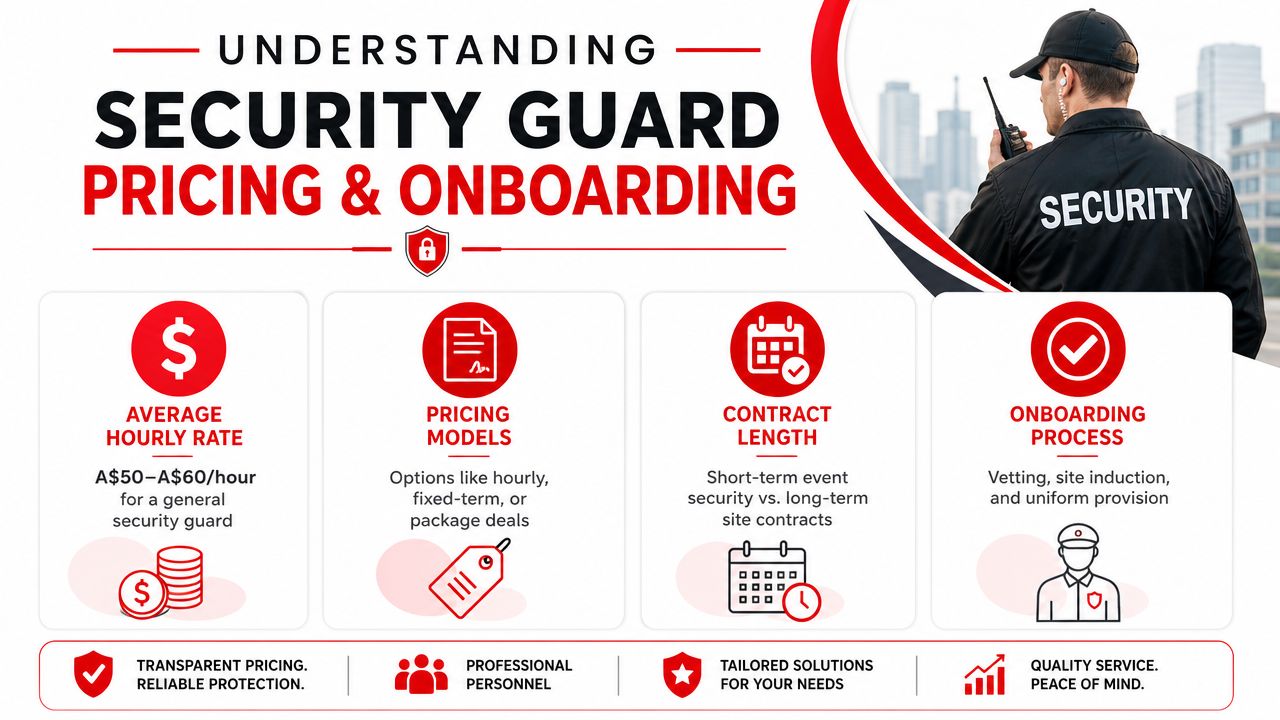
What actually drives the rate
Rates change with the job. A front-of-house commercial post, a construction site with plant and materials, and an event entry point all need different staffing logic, reporting standards, and supervision.
The main cost drivers are straightforward:
- Service type: static guarding, event security, crowd control, mobile patrols, and K9 support are priced differently because the work and skill mix differ.
- Hours and timing: overnight shifts, weekends, public holidays, and short-notice coverage usually cost more.
- Site complexity: multiple access points, public interaction, loading docks, restricted zones, and isolation all increase the work.
- Risk level: sites with theft exposure, aggressive behaviour, cash handling, alcohol service, or repeated incidents need tighter control.
- Supervision and backfill: reliable relief coverage, field supervision, and after-hours management all sit behind the roster, and they affect the rate.
A cheaper quote is not automatically a bad quote. It becomes a bad quote when the provider has priced out supervision, cut the reporting standard, or assigned a generic officer to a role that needs specific experience. That is where clients end up paying twice. First in contract cost, then in internal time spent fixing preventable problems.
Read contracts like an operations document
The contract should show how the service will run day to day. If it only shows a rate card and broad terms, it is incomplete.
Check these points closely:
- Defined duties: access control, patrol frequency, incident response, lock-up, visitor management, asset checks, and escalation tasks should be written down.
- Coverage model: confirm whether you are buying a dedicated static post, event deployment, ad hoc shifts, or a fixed roster with relief arrangements.
- Shift minimums and cancellation terms: these affect real spend, especially for events, construction changes, and short-term projects.
- Reporting deliverables: require shift reports, incident reports, handover notes, and a clear timeline for serious incident notification.
- Supervision structure: the contract should identify who manages performance, conducts site visits, and approves replacement staff.
- Variation rules: if your festival grows, your retail risk increases, or your build moves into a new stage, the service should be able to scale without confusion.
One contract point matters more than many clients expect. Ask who has authority to change post orders on the day. If that control is loose, guards can receive conflicting instructions from venue staff, contractors, and management.
Onboarding decides whether the service works
Good onboarding starts before the first shift. By the time an officer arrives on site, they should already know the post purpose, reporting line, uniform standard, and the difference between routine issues and escalation triggers.
A proper handover usually includes four parts:
Site induction
Show the officer entrances, exits, alarm panels, restricted areas, emergency equipment, amenities, and any blind spots or known problem areas.Written post orders
Set out patrol timings, key control, visitor procedures, contractor access, incident thresholds, radio use, and who to contact for urgent decisions.Client-side coordination
Your managers, concierge team, event staff, or site supervisors need to know what security owns and what stays with operations.Early shift review
Review the first few shifts fast. Fix reporting gaps, patrol issues, and communication problems before they become the accepted standard.
The onboarding detail should match the service model. A static guard in a warehouse needs clear patrol routes, lock-up checks, and after-hours escalation contacts. Event security needs entry procedures, crowd flow instructions, refusal protocols, and a command structure that holds up under pressure. Construction security needs induction rules that align with site safety requirements, vehicle movements, and subcontractor access.
That is the practical difference between hiring a licensed person and putting a workable security operation in place.
FAQs for Security Guard Hire in Sydney
How quickly can security guard hire in Sydney usually be arranged
It depends on the role, the timing, and the quality threshold you expect. Straightforward coverage can often be arranged faster than specialist deployments, but urgency always narrows your options. If the site needs specific experience, strong communication, or venue-specific compliance, allow enough time for proper screening and briefing instead of treating the job like generic labour.
What should I send a provider before requesting a quote
Send a short written brief with your site address, operating hours, required duties, main risks, expected public interaction, and any site rules that matter. Also note whether the role involves access control, incident response, patrols, crowd management, or customer-facing work. The clearer your brief, the more useful the quote.
Is one guard enough for my venue or site
Sometimes yes. Often no. The better question is whether one officer can realistically observe, respond, report, and maintain presence across the entire risk area at the same time. A single guard at a compact reception desk may be enough. A large event footprint, a retail site with multiple exits, or a construction site with vehicle and pedestrian access usually needs a different structure.
What's the biggest mistake clients make
They buy for availability before they buy for fit. That leads to the wrong guard type, weak briefing, poor supervision, and frustration on both sides. The strongest results usually come from a narrow, practical process. Define the risk, match the service type, verify compliance, and review the first shifts closely.
Should I choose visible security or a lower-profile approach
Choose based on the problem you're solving. Visible security works well for deterrence, gate control, patron management, and reassurance. Lower-profile or covert coverage suits some retail and observational roles better. If you need both deterrence and intelligence, a mixed deployment can make more sense than forcing one style to do everything.
If you need a provider that can supply licensed security guard hire across Sydney with services spanning events, venues, retail, construction, patrols, K9, concierge, and site-specific deployment planning, GM GROUP Services is one option to contact. Share your site brief, operating hours, and risk profile first. That makes the discussion more productive and helps ensure the guard role matches the environment.
Discover more from GM Group Services
Subscribe to get the latest posts sent to your email.