
At its heart, a security guard’s job is all about protecting people, property, and assets. This is done through a smart mix of proactive prevention, keeping a watchful eye, and being ready to respond in a heartbeat. It’s about patrolling, monitoring surveillance, controlling who comes and goes, and carefully documenting everything to keep the environment safe. The real goal? To stop incidents before they even have a chance to start.
The Three Pillars of a Security Guard’s Mission
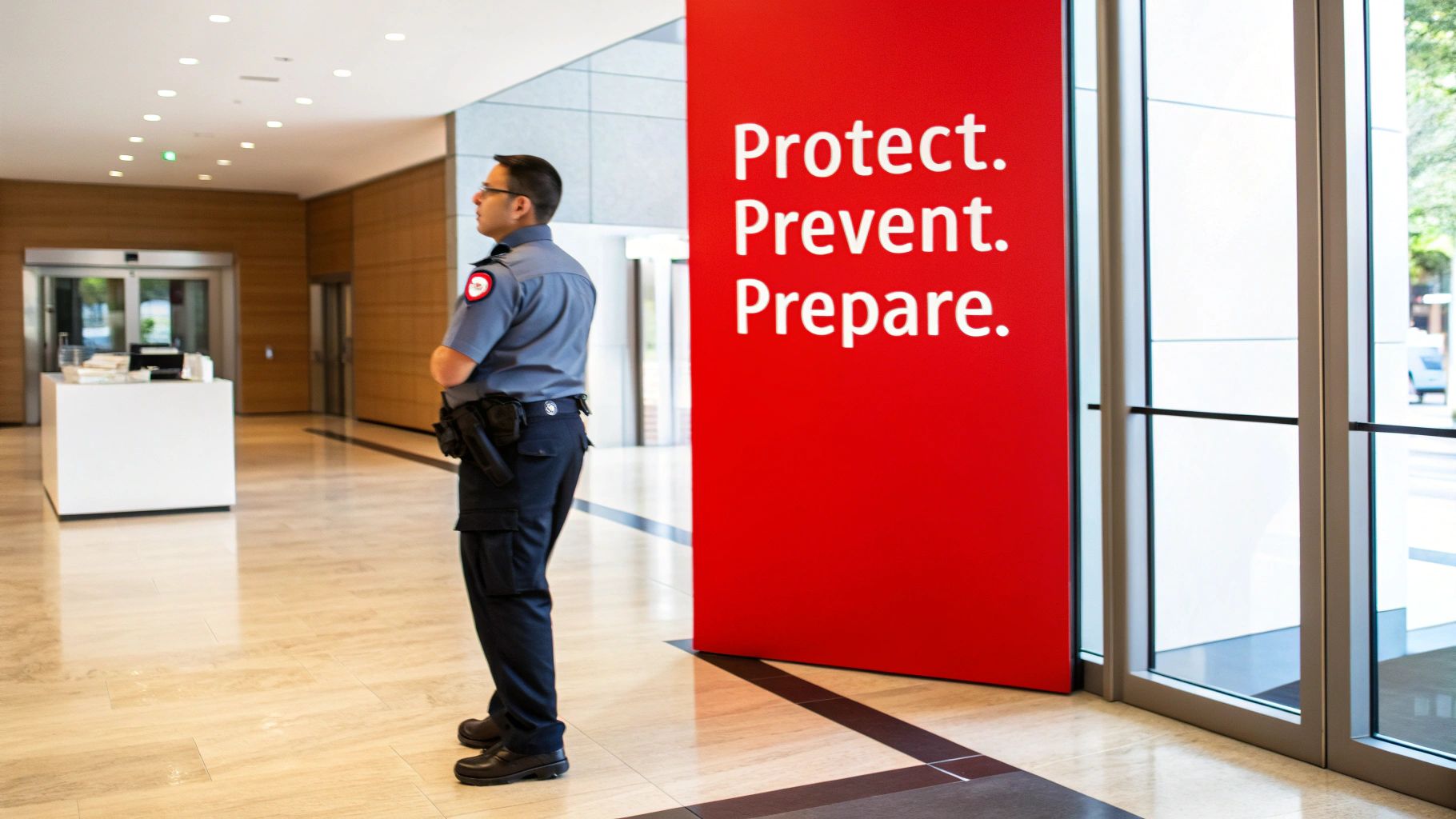
Before diving into a long list of tasks, it’s crucial to understand the ‘why’ behind what a guard does. Their role is so much more than just wearing a uniform; it’s an active, thinking job built on three solid foundations: Protection, Prevention, and Preparedness.
This simple framework, known in the industry as the ‘Three Ps’, really gets to the core of what modern security is all about—managing risk before it becomes a problem. Every single thing a guard does, from checking an ID badge to filling out a patrol log, ties directly back to one of these pillars.
Protection: The Shield of the Operation
Protection is the most obvious pillar. This is the hands-on part of the job: safeguarding everyone on site—employees, customers, visitors—as well as the physical assets like the building itself, expensive equipment, or valuable stock. It’s what most people picture when they think of security.
But protection isn’t just about reacting when something goes wrong. It’s also about creating a genuine sense of safety. When people feel secure, they work better, and customers have a far more positive experience.
“A security guard’s most valuable contribution isn’t just responding to an incident; it’s creating an environment where incidents are less likely to occur in the first place. Their presence is a powerful message that safety is a top priority.”
Prevention and Preparedness: The Unseen Work
The other two pillars, prevention and preparedness, are less visible but just as vital. Prevention is all about being proactive to stop potential threats in their tracks. This means maintaining a visible presence, varying patrol routes to be unpredictable, and consistently enforcing site rules to shut down opportunities for trouble.
Preparedness is about being ready to act effectively when an incident does happen. It means knowing the emergency procedures inside and out, having solid communication plans, and being trained to handle a crisis calmly and professionally until the police or paramedics arrive.
To make this clearer, let’s break down how these pillars translate into everyday duties.
The Three Pillars of Security Responsibilities
| Pillar | Core Duty | Practical Examples |
|---|---|---|
| Protection | Safeguarding People & Assets | Escorting staff to their vehicles after a late shift, managing access control at a front desk, responding immediately to a fire alarm. |
| Prevention | Deterring Threats & Misconduct | Conducting regular, randomised foot patrols, monitoring CCTV systems for suspicious activity, enforcing safety rules like no-smoking zones. |
| Preparedness | Ensuring Effective Response | Knowing all evacuation routes and assembly points, participating in quarterly emergency drills, writing clear and accurate incident reports for future analysis. |
Thinking about a security guard’s responsibilities through this lens helps show they are a critical, thinking part of any organisation’s safety plan, not just a bystander in a uniform.
Universal Duties All Security Guards Perform
While a security guard’s specific tasks can change dramatically from one site to another, there’s a core set of duties that forms the bedrock of the job everywhere. These aren’t just about having a uniform on-site; they are the fundamental actions that make up genuine risk management. Getting your head around these foundational responsibilities is the first step to understanding what professional security is all about.
Think of these duties as the essential tools in a guard’s toolkit. A builder wouldn’t show up to a job without a hammer and a tape measure, and a security guard can’t be effective without mastering patrols, access control, and reporting.
The Art of Observation and Patrolling
At its most basic level, a security guard’s job is to observe and report. They are paid to be the eyes and ears of a property, spotting potential trouble long before it boils over. This is done through active patrolling, which is a lot more strategic than just wandering around a building.
The whole point of a patrol is to be an unpredictable deterrent. A guard who walks the exact same route at the exact same time every hour is easy for a would-be thief to time and avoid.
- Practical Example: On a construction site, a guard might check the high-value equipment container first on one round, then make a beeline for the back fence on the next. This simple change prevents thieves from getting comfortable and timing their entry.
- Actionable Insight: The best guards deliberately mix things up. They’ll vary their patrol routes, change their timings, and even walk the route in reverse. One patrol might start from the north perimeter, but the next one will kick off from the main entrance. This little bit of randomness makes it incredibly difficult for anyone with bad intentions to find a safe window to act.
Mastering Access Control and Communication
Controlling who comes and goes is another absolute cornerstone of security. We call this access control, and it involves everything from checking IDs and signing in visitors to making sure only authorised people get into sensitive areas. It’s often the first human interaction a visitor has, which means it’s also a critical customer service role.
But access control also means telling people “no,” and that can sometimes lead to friction. This is where professional communication isn’t just a nice-to-have, it’s a core skill.
A guard’s tone of voice and body language can be the difference between a smooth interaction and a volatile confrontation. The goal is always de-escalation, not provocation.
- Practical Example: An employee forgets their ID badge. Instead of a blunt refusal, the guard checks a pre-approved staff list, verifies their identity with a photo ID, and issues a temporary pass, all while explaining the policy politely. This maintains security without creating resentment.
- Actionable Insight: When denying entry, a guard needs to stay calm, polite, and firm. Instead of a blunt, “You can’t come in,” a much better approach is something like, “I’m sorry, but for safety reasons, I can’t grant you access without prior authorisation. Here’s the number for site management if you’d like to arrange a visit.” This gives a reason and a potential solution, which goes a long way in calming a tense situation.
The Critical Role of Reporting and Record-Keeping
It might be the least glamorous part of the job, but meticulous record-keeping is arguably the most important. Every single patrol, observation, and incident has to be documented clearly, factually, and as soon as possible. These reports are far from just administrative busywork; they are vital legal and operational documents.
A well-written incident report creates an objective record that can be used for anything from an internal investigation to an insurance claim or even as evidence in court. It turns what the guard saw into solid, actionable intelligence for the client.
Key elements of a strong report include:
- Who: Full names of everyone involved (witnesses, subjects).
- What: A detailed, step-by-step description of what happened. No opinions, just facts.
- When: The precise date and time of the incident.
- Where: The exact location on the property where it happened.
- Actions Taken: A clear account of what the guard did in response.
These universal duties—patrolling with purpose, managing access with professionalism, and documenting everything precisely—are what separate a passive observer from a proactive security professional. They are the essential skills that empower a guard to protect people and property, no matter the setting.
How Security Duties Adapt to Different Environments
The bedrock principles of security—protection, prevention, and preparedness—are universal. But how they’re put into action? That changes completely from one site to the next. A security guard’s role isn’t a simple, one-size-fits-all checklist; it has to be carefully moulded to the unique risks and daily rhythm of each environment. Getting this right is the difference between an effective security presence and a purely cosmetic one.
Think of it like comparing different emergency service workers. A paramedic and a firefighter both save lives, but their tools, training, and immediate priorities are worlds apart. It’s the same in security. The duties of a guard in a quiet corporate lobby bear little resemblance to those of an officer managing a heaving festival crowd.
The most fundamental duties always boil down to three core functions.
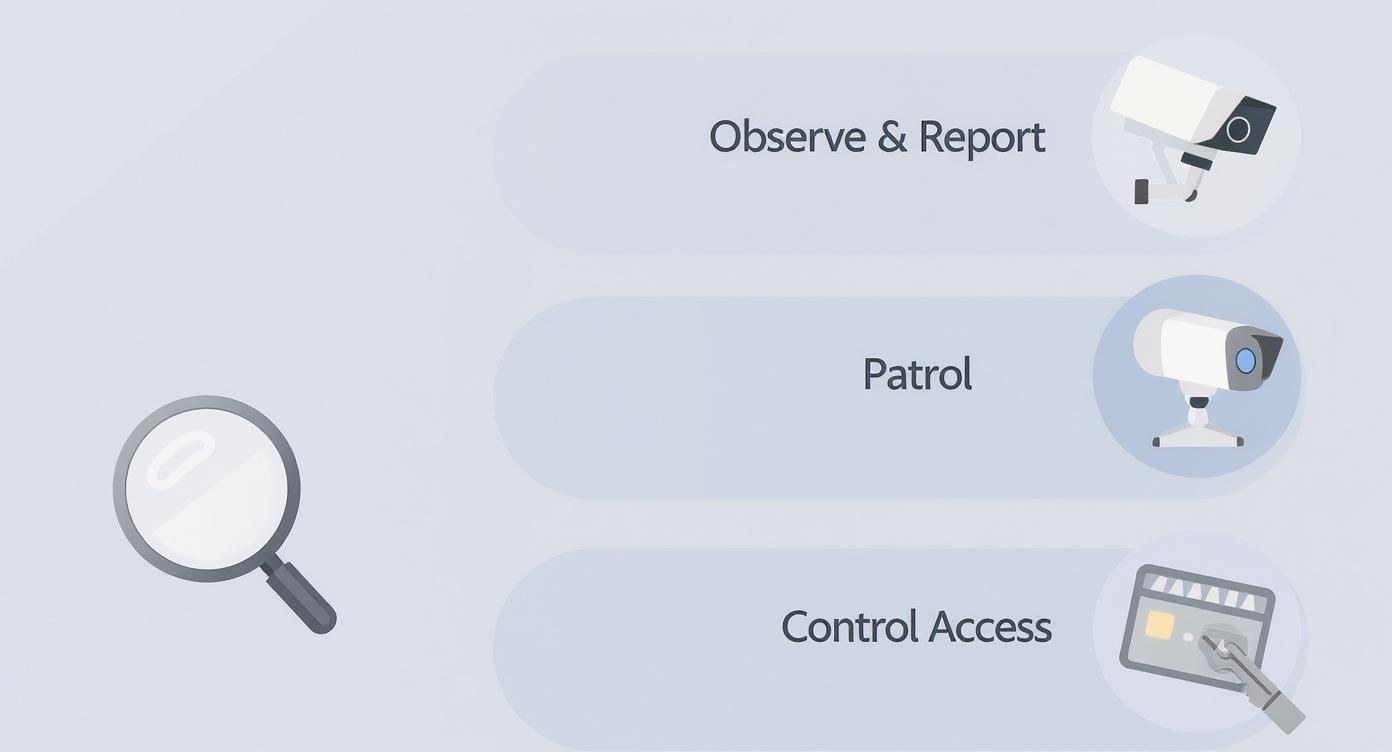
This really just shows that observing and reporting is the big-picture mission. It’s the “why.” Patrolling, monitoring, and controlling access are the “how”—the active tasks that make it all happen.
Let’s break down how these duties look in the real world across different sectors.
Corporate and Office Security
In a corporate setting, the focus is all about access control and maintaining a professional, secure atmosphere. A security officer is often the first face a visitor or employee sees, making them a vital ambassador for the company’s brand.
Here, the duties are more subtle and service-focused. This involves managing visitor sign-in systems, issuing access cards, and making sure only authorised people can get into sensitive areas. They need to be sharp enough to recognise regular employees while being polite but firm when challenging anyone without proper credentials.
- Practical Example: A guard on the executive floor isn’t just a gatekeeper. They’re protecting intellectual property. Their role involves controlling physical access, yes, but also being discreetly aware of unfamiliar faces and verifying their purpose without disrupting the flow of business.
Retail and Loss Prevention
Shift to a retail environment, and the mission pivots to loss prevention and customer safety. While a visible presence is still key, the guard’s duties are geared towards stopping theft—both from external shoplifters and, sometimes, from internal staff.
This demands a trained eye for suspicious behaviour, like someone watching the staff more than the merchandise or carrying a foil-lined “booster bag.” They also play a huge role in customer service. Simply helping a shopper find an item creates a positive vibe that makes would-be thieves uncomfortable.
A great retail security guard knows how to balance being approachable with being an authority figure. They need to make legitimate shoppers feel completely safe while making potential thieves feel like they’re being watched.
Construction Site Security
Construction sites are a different beast entirely. Here, a security guard’s primary duties are asset protection and enforcing safety protocols. These sites are huge targets for thieves looking to steal high-value materials like copper wiring and heavy machinery, especially overnight.
An officer’s responsibilities include running a tight ship at the gatehouse, logging every vehicle and contractor that comes and goes. They conduct regular patrols of the perimeter fence, looking for weak spots or signs of a breach. They’re also a second set of eyes for safety, ensuring everyone wears their Personal Protective Equipment (PPE) and follows the site rules.
- Actionable Insight: A construction guard’s patrol isn’t just about spotting intruders. They’re also looking for safety hazards—unsecured scaffolding, potential fire risks, or water leaks that could cause thousands in damage. Their detailed daily reports are invaluable to the site manager.
Event and Venue Security
Events are dynamic, high-pressure environments where the focus is squarely on crowd management and public safety. An event guard’s job is very hands-on and very public. They manage queues, check tickets, conduct bag searches, and monitor the crowd for anyone who’s had too much to drink or is looking for trouble.
They have to be trained in de-escalation techniques and know the emergency plans inside and out, whether for a medical incident or a full-scale evacuation. For licensed venues, a critical, non-negotiable part of the job is enforcing Responsible Service of Alcohol (RSA) laws.
To really see how different these roles are, it helps to put them side-by-side.
Comparing Security Priorities Across Key Sectors
The table below highlights the distinct focus areas and typical duties you’d find in each of these environments.
| Sector | Primary Focus | Key Responsibilities Examples |
|---|---|---|
| Corporate | Access Control & Professionalism | Managing visitor logs, escorting staff, monitoring sensitive areas, acting as a concierge. |
| Retail | Loss Prevention & Customer Safety | Monitoring for shoplifters, observing employee behaviour, assisting shoppers, responding to till alarms. |
| Construction | Asset Protection & Safety Compliance | Patrolling perimeters, logging vehicle access, enforcing PPE rules, securing equipment after hours. |
| Events | Crowd Management & Public Safety | Conducting bag searches, monitoring crowd density, managing queues, enforcing RSA, responding to medical issues. |
As you can see, you can’t just drop any guard onto any site and expect good results. Truly effective security comes from understanding the specific risks of an environment and assigning officers with the right skills and training to handle them.
A Closer Look at Specialised Security Roles
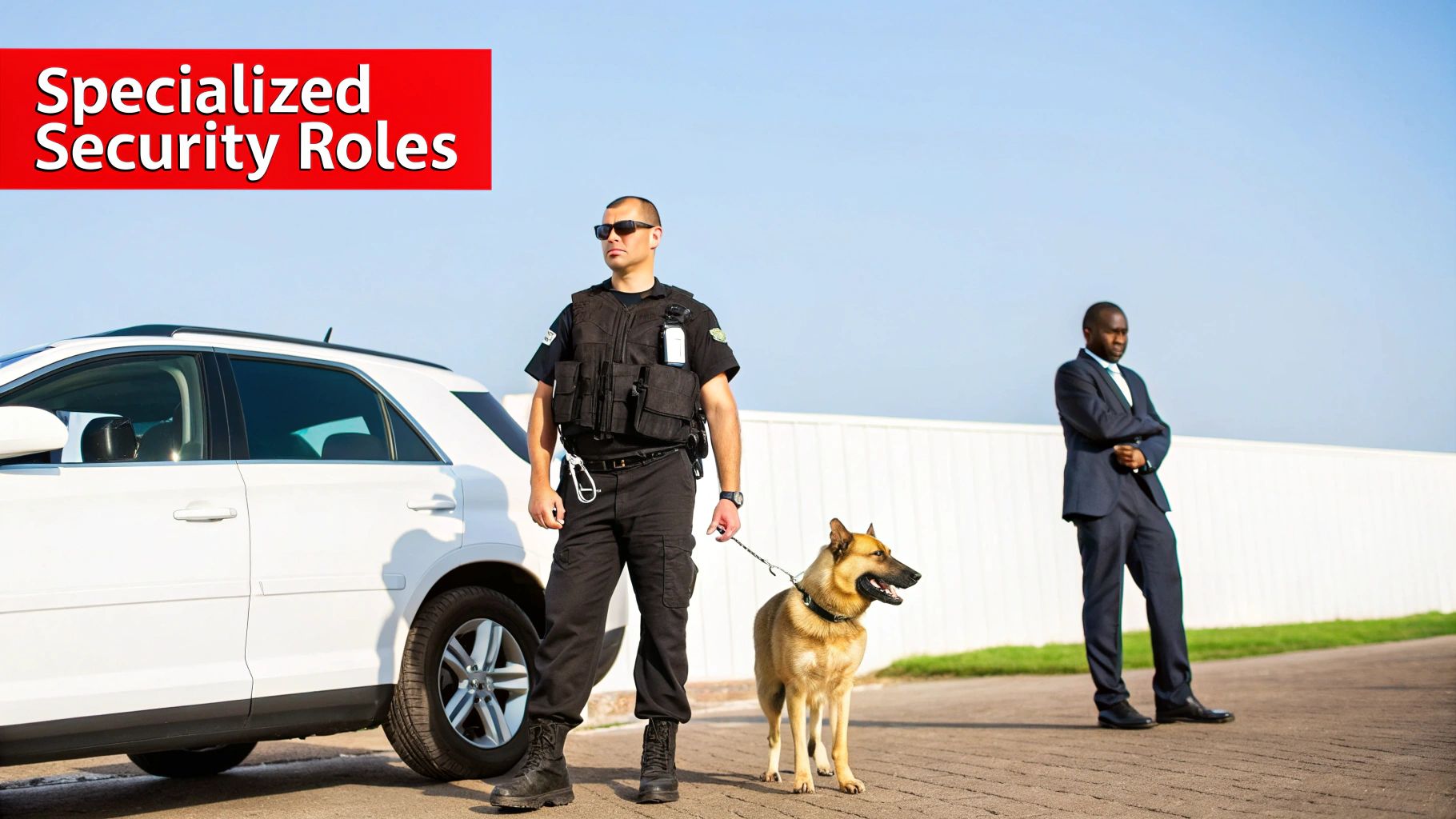
While having a static guard watching the front desk is a cornerstone of security for many businesses, some situations call for a different playbook. The fundamental security guard duties and responsibilities shift dramatically when we talk about roles like mobile patrol, K9 handling, and executive protection. These aren’t just slightly different versions of the same job; they’re entirely separate disciplines that demand unique skills, training, and mindsets.
Think of it this way: a GP and a heart surgeon are both doctors, but you wouldn’t ask your GP to perform a triple bypass. They use different tools and focus to solve very specific problems. In the same way, specialised security roles offer a focused, higher level of protection built for unique threats.
Mobile Patrols: Eyes on Multiple Sites
Mobile patrol officers are the answer when you need to secure multiple properties or a massive area that one person at a fixed post just can’t handle. Their duties go far beyond a single location, revolving around rapid response, verifying alarms, and creating a security presence that’s always on the move.
Instead of walking the same perimeter all night, a mobile patrol officer’s shift is a constant rotation of driving between client sites, doing thorough external and internal checks, and locking down properties. A huge part of their role is responding to alarm activations, a task that demands a cool head and a quick, careful approach.
- Practical Example: At 3 AM, an alarm is triggered at a warehouse. The mobile officer arrives, finds a broken window, and immediately notifies the police and the client while securing the scene. Their quick response prevents further loss before the sun comes up.
- Actionable Insight: The best mobile patrol officers live by their checklists, especially after an alarm goes off. This methodical process ensures nothing gets overlooked in a high-stress moment. It includes an exterior check for forced entry, a full perimeter walk, a systematic interior sweep (once safe), and a detailed report with photos before resetting the system.
K9 Units: A Higher Level of Detection and Deterrence
A K9 unit brings a whole different set of tools to the table—ones a human officer just can’t match. The bond between a handler and their dog creates an incredibly powerful security asset. Here, the duties move from basic observation to specialised detection and a much stronger deterrent. Let’s be honest, the sight of a trained security dog is a serious psychological barrier for any would-be criminal.
But it’s not just about intimidation. The dog’s phenomenal sense of smell makes the team invaluable for sniffing out contraband, from drugs to explosives, at events and entry points. The handler’s job is to direct the dog, read its signals, and manage the situation safely and effectively.
Executive Protection: Staying One Step Ahead of Trouble
In the high-stakes world of executive or VIP protection, the focus shifts entirely from reacting to threats to proactively stopping them from ever happening. This is a strategic game where the main goal is to prevent an incident before it even begins. Close Protection Officers (CPOs) are masters of threat assessment, surveillance detection, and detailed logistical planning.
Their duties involve sweeping venues in advance, mapping out secure travel routes, and providing discreet, up-close protection for their client. It’s far less about physical altercations and much more about quiet observation and constant situational awareness.
The entire philosophy of executive protection is to build a secure bubble around the principal. This isn’t done with brute force, but through meticulous planning, good intelligence, and keeping a low profile to avoid attracting the wrong kind of attention.
This specialisation demands a unique ability to think ahead and de-escalate potential problems, making it one of the most mentally taxing roles in the security industry.
Navigating Legal and Compliance Obligations
A security guard’s authority isn’t a blank cheque; it’s carefully fenced in by Australian law. Getting these legal boundaries right is one of the most critical parts of a guard’s job. It’s not about box-ticking—it’s about making sure every action taken on your property is defensible and keeps both the guard and you, the client, out of hot water.
Before a guard even steps onto your site, they need the right credentials. In Australia, security licensing is handled by each state and territory, so a licence from NSW won’t cut it in Victoria. Every guard has to go through mandatory training, like a Certificate II in Security Operations, and pass detailed criminal history checks to get that licence.
Actionable Insight: Always, without fail, ask your security provider to show you the current licences for every single guard they assign to you. It’s a simple check, but it’s your first line of defence in managing risk and ensuring you’re legally covered.
Knowing the Limits: A Guard is Not a Police Officer
This is where things often get blurry. A security guard’s powers are not the same as a police officer’s—not even close. They operate under the same laws as any private citizen, and that has huge implications for what they can and can’t do on the job.
- Citizen’s Arrest: Can a guard detain someone? Yes, but only if they actually see them committing a serious (indictable) offence. The moment they do, their next call must be to the police. They can only hold the person until the police arrive, and that’s it.
- Reasonable Force: If a guard has to defend themselves, you, or someone else, they can use what the law calls “reasonable force.” This is a crucial term. It means the force has to be proportional to the threat—no more than what’s absolutely necessary to get the situation under control. Anything more is assault, plain and simple, and can lead to criminal charges.
- Searching Property: A guard cannot legally search someone’s bag, pockets, or car without their permission. If entry to your venue is conditional on a bag search, patrons can still refuse—you just don’t have to let them in. Forcing a search is illegal.
When the Duties Get More Specific
In some places, the rulebook gets even thicker. Think about guards working in pubs, clubs, or at music festivals. For them, a valid Responsible Service of Alcohol (RSA) certificate isn’t just nice to have; it’s a legal requirement.
This training makes them legally responsible for spotting patrons who’ve had too much, refusing them service, and ensuring they are removed from the venue safely. It’s a massive responsibility and a core part of keeping everyone safe in the hospitality world. Making sure your security team has these specific qualifications isn’t a suggestion—it’s a legal and operational must-have.
Creating Post Orders to Define Security Success
Just putting a guard on your property isn’t a security plan. It’s a start, but without clear direction, it’s just a person in a uniform. To turn that presence into real, effective security, you need a detailed operational playbook. In our world, we call this crucial document Post Orders.
Think of Post Orders as the instruction manual for your site’s security. This document turns your general expectations into a concrete list of security guard duties and responsibilities. It gets rid of the guesswork, makes sure every guard on every shift is on the same page, and gives you a solid benchmark to measure how they’re doing. Without it, guards are forced to make assumptions, and that’s exactly how dangerous gaps in your security appear.
What Goes Into Your Post Orders
Good Post Orders are practical and packed with detail, leaving no room for confusion. They should be treated as a living document, something you review and update whenever things change on-site or after an incident occurs. This document needs to be the single source of truth for your security team.
Here’s a checklist of the absolute essentials:
- Site-Specific Information: This should feature a map of the property showing patrol routes, key access points, and where to find critical gear like fire panels and first aid kits.
- Contact Information: A rock-solid emergency contact list is non-negotiable. It must have phone numbers for site management, local police, fire services, and any emergency contractors like glaziers or plumbers.
- Daily Duties and Routines: Spell out the specific tasks for each shift. This covers everything from lock-up procedures and patrol schedules to how visitors are signed in and which CCTV cameras need the most attention.
- Incident Response Protocols: Give them clear, step-by-step instructions for what to do in common scenarios. What’s the process for a fire alarm? A medical emergency? Finding an unauthorised person on site?
Actionable Insight: When you clearly define these procedures, you empower your security officers to act decisively and correctly when the pressure is on. That confidence can make all the difference in a real emergency.
Measuring Success with Key Performance Indicators
So, you’ve defined the duties. But how do you know if they’re actually being done well? This is where Key Performance Indicators (KPIs) come into play. KPIs are measurable metrics that let you objectively judge the performance of your security team, moving you away from a vague “feeling” of safety towards data-driven proof.
The best KPIs are specific, measurable, and tied directly to what you’re trying to achieve with your security. They provide the tangible evidence that your investment is paying off.
Actionable Security KPIs to Track
- Patrol Completion Rate: Are guards completing the required number of patrols every single shift? Modern guard tour systems can track this automatically using GPS and NFC checkpoints, giving you 100% accountability.
- Incident Response Time: From the moment an alarm goes off or a call comes in, how long does it take for a guard to respond? This is a critical measure of their readiness and alertness.
- Report Accuracy and Timeliness: Are incident reports being filed on time (say, within an hour of the event)? Are they detailed, factual, and free from errors? This KPI tells you a lot about an officer’s diligence and communication skills.
- Number of Identified Hazards: How many potential safety or security risks—like a broken fence, a dodgy lock, or a poorly lit area—does the guard proactively find and report each month? This tracks their initiative and how observant they really are.
Your Top Questions About Guard Duties Answered
When you’re looking at hiring security, it’s natural to have questions about what a guard actually does day-to-day. Let’s clear up a few of the most common queries we hear from clients and even from people looking to get into the industry.
What is the most important duty of a security guard?
It’s tempting to think a guard’s main job is to react to problems, but it’s actually the opposite. Their single most important responsibility is observation and prevention. A good guard is always thinking one step ahead, looking for risks and stopping incidents before they even have a chance to start.
- Practical Example: A guard who spots a faulty lock on a gate and gets it fixed has done far more for your security than one who has to chase a thief who walked right through it. That proactive mindset is everything.
Can a security guard legally detain someone in Australia?
Yes, but it’s a very fine line to walk. In Australia, a security guard has the same power as any other citizen to perform a “citizen’s arrest.” This means they can only detain someone if they catch them in the act of committing a serious (indictable) offence.
Once they’ve detained someone, their only job is to call the police immediately and wait for them to arrive.
Crucially, they can only use “reasonable force,” which is the absolute minimum needed to keep the person and the situation under control. Using excessive force can land the guard, and you as the client, in serious legal trouble. It’s a power used only as a last resort.
How do I create effective Post Orders for my security guard?
Vague instructions lead to poor outcomes. Great post orders are the instruction manual for your site, and they need to be crystal clear, detailed, and practical.
- Make them visual: Don’t just describe the patrol route; include a site map with it clearly marked. Highlight the locations of fire extinguishers, first aid kits, and emergency exits.
- Spell it out: What’s the exact procedure for a fire alarm? Who should they call for a plumbing emergency at 2 AM? Detail the step-by-step process for common scenarios.
- Create a master contact list: Include phone numbers for emergency services, key management personnel (both during and after hours), and essential contractors like electricians or glaziers.
A solid set of post orders removes all the guesswork and gives your guard the confidence to handle anything that comes their way.
What qualifications are essential for a security guard in Australia?
The absolute baseline is a current, state-issued security licence. To get this, they need to have completed a Certificate II in Security Operations and passed all the necessary background checks.
However, for most professional roles, that’s just the start. If they’re working anywhere that serves alcohol, a Responsible Service of Alcohol (RSA) certificate is non-negotiable. A current First Aid and CPR certification is also a standard expectation for any high-quality guard.
At GM GROUP Services, we don’t just check for licences. We make sure every guard we place has the right qualifications, experience, and temperament for your specific environment. Contact us today to talk about building a security solution that gives you real confidence.
Discover more from GM Group Services
Subscribe to get the latest posts sent to your email.