
Effective security guard and patrol services are the essential front line of any modern safety strategy. They offer a potent, visible deterrent and an immediate human response that technology like alarms and cameras simply cannot match. If you're managing a corporate office, a special event, or a construction site, understanding what these services truly deliver is the first step toward properly protecting your people, assets, and reputation.
Why On-Site Security Is More Than Just a Uniform
Having professional security guards on site shows you're serious about safety. It's not just about ticking a box; it's about building an environment where everyone—from employees to customers and guests—feels genuinely safe and looked after. That feeling has real-world payoffs, leading to everything from lower theft rates to a better overall customer experience.
This hands-on approach is absolutely critical. Picture a static guard at a corporate event. They aren't just watching a door; they’re the first point of contact. They become a brand ambassador who checks credentials, offers directions, and keeps the atmosphere welcoming but controlled. This blend of security and service is incredibly valuable.
It’s the same story with mobile patrols. When they cover a large industrial park after hours, they aren’t just doing a quick drive-by. They’re performing randomised checks, inspecting fence lines, and making sure gates are secure, creating an unpredictable obstacle for would-be intruders. Their presence alone messes with criminal planning and dramatically cuts the risk of theft and vandalism.
The Foundation of a Secure Operation
A visible security presence is one of the most effective psychological deterrents there is. It sends a clear message that a property is actively monitored and protected, which immediately makes it a less appealing target for crime. It’s a core principle of protecting any asset.
The Australian security industry has grown into an essential part of the country's protective fabric. In fact, the Investigation and Security Services sector is on track to generate $13.9 billion in revenue by 2025 after years of steady growth. With around 6,727 security businesses operating nationwide, it's obvious that organisations see the value. You can explore more about these industry trends to get a sense of the scale.
A well-trained security professional does more than just watch. They assess, de-escalate, and respond. Their ability to manage situations as they happen is what stops minor issues from turning into major incidents, protecting both people and property.
Key Roles Beyond Deterrence
The job of a security professional often goes far beyond just keeping a watchful eye. Their skills create a layered defence for any business or event.
- First Responders: In many cases, a security guard is the first person on the scene for a medical emergency or safety hazard. They can provide crucial initial aid and coordinate with emergency services.
- Access Control: They are the gatekeepers, ensuring only authorised people enter restricted areas—vital for corporate headquarters, construction sites, and ticketed events.
- Customer Service: Guards frequently double as concierges, offering information and help that genuinely improves the experience for visitors and clients.
- Incident Reporting: Clear, detailed reports from security staff are essential. They provide the documentation needed for investigations, insurance claims, and refining future safety measures.
Static Guards vs. Mobile Patrols: Which Security Approach is Right for You?
Choosing the right kind of security for your business isn’t just a box-ticking exercise. It's about getting the right fit for your property, your risks, and your budget. Get it wrong, and you could be paying for protection you don't need or leaving yourself dangerously exposed. The key is understanding how different security guard and patrol services function.
The two mainstays of on-site security are static guards and mobile patrols. Think of it this way: a static guard is like having a permanent concierge for a critical spot, a constant set of eyes controlling who comes and goes. A mobile patrol, on the other hand, is more like a neighbourhood watch on wheels for your commercial property, covering a lot of ground in unpredictable patterns.
Each one has a distinct job to do. Your decision will hinge on your unique security challenges, the layout of your site, and what you’re looking to achieve. Let’s dig into how each one works in the real world.
The Role of Static Security Guards
A static guard is exactly what it sounds like—an officer assigned to a specific post for their entire shift. This is your go-to solution when you have a high-risk area or a constant flow of people that needs non-stop, focused attention. Their consistent presence is a powerful deterrent and allows for immediate response.
Practical Example: A busy corporate lobby. A static guard is essential. They’re there to manage visitor sign-ins, check employee credentials, and keep an eye on CCTV, making sure only authorised people get inside. Just seeing them there gives staff a real sense of safety and makes troublemakers think twice.
It's the same story for a big music festival. You need static guards on the gates, backstage, and in VIP areas. They’re your first line of defence for preventing ticketless entry, managing queues, and dealing with any issues right there on the spot.
A static guard becomes an anchor for your security. They get to know their post inside and out, picking up on small things that are 'off'—subtle changes a roving patrol might easily miss. That's how you stop incidents before they even start.
The Power of Mobile Patrol Services
Mobile patrols bring a different set of strengths to the table: massive coverage and the element of surprise. A single officer in a clearly marked vehicle can secure a huge area, like an industrial estate, a sprawling construction site, or a retail park with dozens of shops.
This approach is incredibly efficient from a cost perspective, as one officer can look after multiple sites in one shift. But the real power lies in their unpredictability. Patrol routes and timings are deliberately varied, so would-be criminals never know when a security vehicle is about to round the corner. That uncertainty is a massive deterrent.
Practical Example: An after-hours patrol for a large car dealership. The mobile officer will do several drive-throughs and foot checks during the night, inspecting the fence line, making sure vehicles are secure, and checking doors on the showroom. This random, visible presence is often all it takes to prevent theft and vandalism.
To help you decide, here’s a straightforward comparison of the two main types of security guard and patrol services.
Comparing Security Guard and Patrol Services
A side-by-side look at different security services to help you choose the most effective solution for your specific business needs, from events to construction sites.
| Service Type | Primary Role | Best Use Case | Key Advantage |
|---|---|---|---|
| Static Guard | Provide a constant, fixed presence at a specific location to control access and respond immediately. | Corporate lobbies, event entry points, construction site gates, high-value asset protection. | High visibility and immediate response to incidents within their designated zone. |
| Mobile Patrol | Cover large areas or multiple properties with randomised, recurring checks in a marked vehicle. | Industrial estates, retail parks, large car parks, unoccupied properties. | Cost-effective coverage of wide areas and a strong psychological deterrent due to unpredictability. |
| Hybrid Model | Combines static guards at key points with mobile patrols for broader perimeter security. | Large campuses (universities, hospitals), logistics centres, major construction projects. | Layered, comprehensive security that covers both high-risk access points and the wider area. |
Ultimately, the best security plan often uses a mix of services tailored to the property’s specific weak points and operating hours.
Making the Right Choice for Your Needs
So, how do you decide between static and mobile security guard and patrol services? It all starts with a hard look at your vulnerabilities. Do you have one critical choke point that needs constant watching, like a main entrance or a gatehouse? A static guard is almost certainly the right call.
Actionable Insight: Before deciding, walk your property at different times of the day and night. Identify single points of failure (like a main entrance) and large, vulnerable perimeters. This simple exercise will often make the choice between static, mobile, or a hybrid solution clear.
But if your challenge is securing a large, open area or several buildings spread out over a big site, mobile patrols offer a much more practical and budget-friendly way to get the job done. Often, the smartest solution is a hybrid one. You might use static guards at your main gates during business hours and then bring in mobile patrols overnight to keep the entire perimeter secure. It’s all about creating layers of protection.
The Hidden Benefits of a Visible Security Presence
When you bring in a uniformed professional from a security guard and patrol services team, you're getting so much more than just a deterrent for troublemakers. While stopping crime is their main job, the real value of having a visible security presence is how they add multiple layers of support to your daily operations, creating a safer, more positive environment for everyone involved.
The most obvious win is an immediate drop in things like theft and vandalism. It’s no secret that criminals look for easy targets. A study on retail crime actually confirmed that a visible security guard was one of the single most effective ways to deter shoplifters. This isn't just true for shops; the same principle holds for construction sites, corporate lobbies, and event venues, protecting your assets and preventing needless losses.
But the benefits go much deeper than that. A well-trained guard quickly becomes a valuable part of your own team, boosting your operational efficiency and even customer satisfaction in ways you probably haven't considered.
More Than a Guard: A Brand Ambassador
It helps to think of your security personnel as the very first point of contact for your guests, clients, or staff. Their professionalism and how they interact with people directly reflect on your brand's reputation. At a hotel or a festival, for example, a guard who can give clear directions, offer a helping hand, and keep a cool head under pressure completely elevates the guest experience.
This customer service role is absolutely crucial. When you brief your security team on your brand's values and how your operation runs, you transform them from being passive observers into active ambassadors for your business. They help foster a welcoming atmosphere while making sure everyone feels safe and looked after.
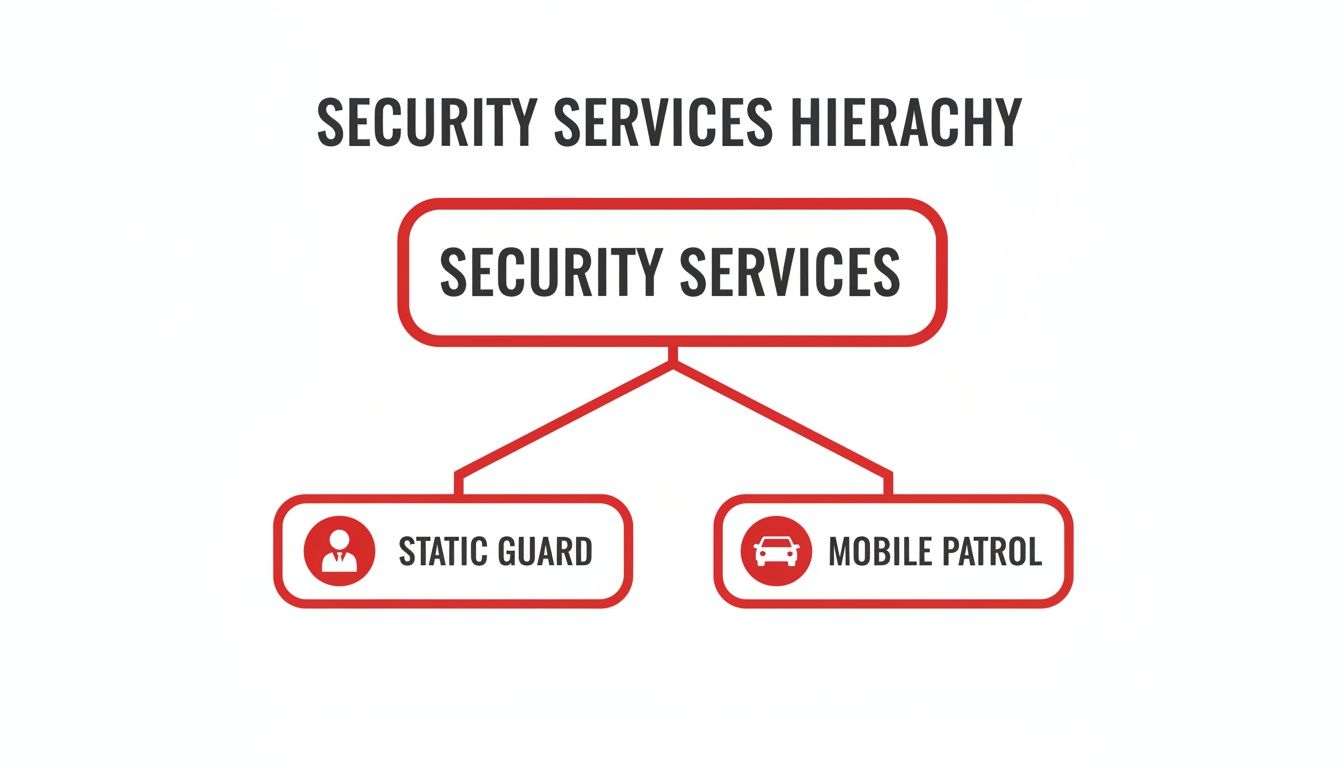
This diagram shows the two foundational types of on-site security that create this visible presence.
As you can see, it clearly splits security into two main streams: the fixed-post focus of a static guard and the broader, dynamic coverage you get from mobile patrols. Both are essential components of a well-rounded security strategy.
Proactive Hazard Identification and Mitigation
Here's another benefit that often flies under the radar: your on-site security guard and patrol services team is an active part of your safety management. As they make their rounds, they aren’t just looking for suspicious behaviour. They’re trained to spot and report potential safety hazards before they turn into major problems.
A guard's routine patrol can be the difference between a minor clean-up and a major incident. By identifying a spill, a fire risk, or a structural issue early, they provide a critical layer of operational risk management that protects both people and property.
This proactive mindset essentially makes your security detail an extension of your health and safety team. They become an extra set of eyes and ears, dedicated to keeping the environment safe around the clock.
Here’s how this plays out in the real world:
- At a Construction Site: A patrol guard might spot a section of fencing that's been damaged by high winds. They can secure it on the spot, preventing unauthorised entry and protecting you from potential liability.
- In a Hotel: An officer doing their rounds can notice a small water leak in a hallway, reporting it to maintenance long before it causes major water damage or becomes a slip hazard for guests.
- During a Festival: A guard can identify a chokepoint where a crowd is becoming dangerously dense and redirect foot traffic, ensuring a smooth and safe flow of people.
By building these responsibilities into their role, your investment in security pays dividends across different parts of your operation. It helps build a culture of safety and care, which not only enhances your reputation but also protects your bottom line.
Finding the Right Security Services Partner for Your Business
Choosing a company to handle your security guard and patrol services is a massive decision. You’re not just hiring someone to stand at a door; you’re bringing in a partner to protect your people, your property, and the reputation you’ve worked so hard to build. The right choice is a proactive team that works with you, not a reactive firm that only shows up after the damage is done.
The whole process can feel a bit daunting, but it really comes down to asking the right questions and knowing what separates the great from the good. A top-tier security partner will be open, organised, and obsessed with creating a security plan that actually fits your business. Think of them as an extension of your own team, one that's completely focused on keeping your environment safe.
Verifying the Essentials: Licensing and Insurance
Before you get into the nitty-gritty of security plans, you have to tick the essential boxes. Any security company worth its salt must have the correct, up-to-date master licenses for every state they operate in. This is an absolute deal-breaker.
For instance, if a provider works along Australia's east coast, they need to be able to show you their master licenses for:
- New South Wales (NSW)
- Victoria (VIC)
- Queensland (QLD)
- Australian Capital Territory (ACT)
It doesn't stop there. Each guard on your site must also hold their own personal security licence for that state. Don't feel awkward about asking to see proof of this. Just as crucial is their insurance. Make sure they have comprehensive public liability and professional indemnity coverage, as this is what shields your business from financial fallout if an incident occurs.
Evaluating Training and Supervision Protocols
A licence is just the ticket to the game. What truly sets an exceptional security provider apart is their deep commitment to continuous training and hands-on supervision. The best companies invest heavily in their people, giving them the skills to manage difficult situations with a calm, professional head.
Ask potential partners what their training actually looks like. Does it go beyond the bare minimum? You want to see programs that include:
- Conflict De-escalation: The ability to cool down a heated situation without physical force is an invaluable skill.
- First Aid and Emergency Response: Guards are often the first to arrive at an incident, and knowing what to do in those first few minutes can literally save lives.
- Customer Service: A security professional should be a positive presence—approachable, helpful, and a great ambassador for your business.
Strong supervision is the other side of that coin. How does the company keep its team accountable when they're on your property? Ask if they have field supervisors who drop in for regular, unannounced checks. This is how you know standards are being upheld and that guards are staying sharp and professional for their entire shift.
The Power of a Proactive Partnership
The best security guard and patrol services don't just react to problems; they get ahead of them. A true security partner kicks things off with a thorough risk assessment of your site. They’ll walk the grounds with you, point out vulnerabilities you might have missed, and then build a security strategy to tackle those specific risks head-on.
Actionable Insight: When vetting a security company, ask for a sample site risk assessment. A quality provider will be able to show you a detailed, anonymised report that demonstrates their methodical approach to identifying and mitigating threats.
This collaborative, hands-on approach is what you should be looking for. It proves they're genuinely invested in your security, not just trying to fill a roster. They should also be using modern tools for reporting, like digital logs and guard tour systems that give you real-time updates. That level of transparency and accountability is the hallmark of a professional you can trust.
Custom Security Strategies for Different Industries
Effective security is never a copy-paste job. What works for a roaring music festival would be completely out of place in a quiet corporate headquarters. The best security plans are carefully shaped around the specific environment, risks, and daily rhythm of each industry, making sure the protection feels like a natural extension of the business, not an intrusion.
This means getting under the skin of what makes each sector tick. For an event manager, it’s all about managing the flow of people and being ready to react in a split second. For a construction site manager, the focus is squarely on protecting valuable assets and keeping watch after everyone’s gone home. Let's look at how these tailored strategies play out in the real world.
Event Security: A Focus on Crowd Management
For anyone organising an event, security is a dynamic, high-stakes game. The number one priority is making sure thousands of attendees have a safe and fantastic time, which calls for a multi-layered strategy that can shift and adapt on the fly.
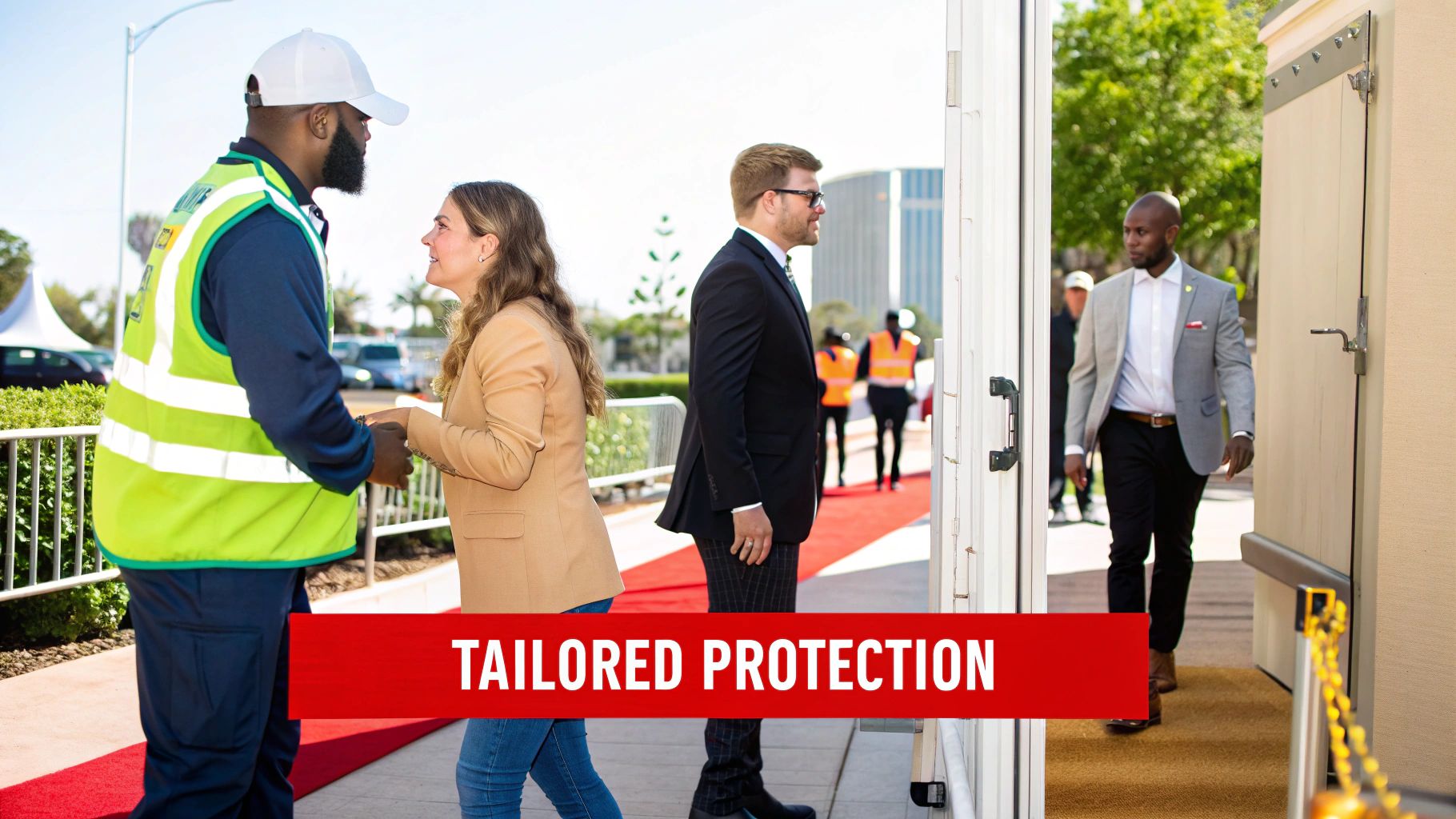
A huge part of this is access control. This goes way beyond just checking tickets. It means thorough bag checks, verifying credentials for staff and performers, and managing entry and exit points to prevent dangerous crushes. Guards are trained to be firm but friendly, setting a positive, secure tone from the moment guests arrive.
Then there’s crowd management. Security officers are positioned strategically across the venue to keep an eye on crowd density, spot potential friction before it escalates, and guide the flow of people. For any licensed event, guards with Responsible Service of Alcohol (RSA) certification are non-negotiable for handling intoxicated patrons and keeping the atmosphere safe for everyone.
Think of the security team at a large-scale festival as the event's central nervous system. They’re not just trained for security threats; they’re also a core part of the emergency response plan, coordinating with medics and emergency services to handle any situation with speed and professionalism.
Hospitality Venues: Creating a Welcoming Atmosphere
In the world of hospitality—from buzzing bars and clubs to five-star hotels—security has a dual role. The team must be a capable protective force while also acting as ambassadors for the venue. They help build a safe and welcoming environment that keeps people coming back.
Conflict de-escalation is a vital skill here. Guards are trained to recognise the early warning signs of trouble and step in calmly to defuse situations before they get physical. This demands top-notch people skills and a solid grasp of RSA principles to manage patrons responsibly. When building out a full security plan, it's wise to consider every angle of physical protection, including robust locks and access systems from reputable commercial locksmith services.
This emphasis on the human touch is a major reason for growth in the security market. The service side of Australian security is on the fastest growth track, showing that clients recognise the irreplaceable value that professional, customer-facing guards provide.
Construction Site Protection
Construction sites are magnets for theft and vandalism, with high-value equipment and materials often left exposed. Here, the focus of security guard and patrol services pivots to hardcore asset protection, especially after working hours.
A solid strategy usually includes:
- Gatehouse Control: A static guard is posted at the main entrance during work hours to log every vehicle, delivery, and person. This creates a tight record of who is on-site and when.
- After-Hours Mobile Patrols: At night and on weekends, mobile patrols conduct regular but deliberately randomised checks of the entire site perimeter. This unpredictability is a powerful deterrent against would-be thieves.
- Asset Monitoring: Guards can be assigned to watch over specific high-value zones, like tool storage containers or fuel depots, preventing losses that can bring a project to a grinding, costly halt.
Corporate Security: A Professional Presence
In a corporate setting, security needs to be visible enough to be a deterrent but discreet enough to blend in. It’s all about maintaining a highly professional image that matches the company’s brand. More often than not, the guard is the first person a client or visitor meets, making their concierge and customer service skills absolutely essential.
Their duties often involve managing the visitor sign-in process, issuing access cards, monitoring CCTV feeds, and carrying out regular foot patrols through the building. Their presence gives employees peace of mind and projects an image of a secure, well-run organisation.
Measuring the Success of Your Security Program
So, you’ve invested in security guard and patrol services. How do you know if you're actually getting your money's worth? It's about more than just avoiding break-ins; it’s about having a strategic asset that protects your business. Real success isn't just about what doesn't happen—it's about having proof of proactive, well-documented, and transparent security operations.
A top-tier security provider won't just hand you a basic shift summary. You should expect, and honestly, you should demand, detailed reporting that gives you a clear window into what their team is doing on your property. This data is the only way to truly understand your return on investment and make smart tweaks to your security strategy over time.
Key Performance Indicators to Demand
Measuring success starts with knowing what to look for. Your security partner should be able to track and share data on a few key performance indicators (KPIs) that prove they’re effective and accountable.
Here are the non-negotiables:
- Response Times: How fast are guards reacting to alarms, calls for assistance, or incidents they spot themselves? A quick response, ideally under a few minutes for on-site issues, is a fundamental sign of a team that's on the ball.
- Incident Report Quality: Are the reports clear, detailed, and submitted promptly? A solid report covers the who, what, where, when, and why of an incident, plus the specific actions the guard took. Vague reports are a red flag.
- Patrol Completion Rates: For mobile patrols, are they hitting all their checkpoints consistently? Modern guard tour systems offer digital proof, so there's no more guesswork.
Leveraging Technology for Transparency
The best security firms today are using technology to provide a level of transparency that was impossible a decade ago. Ask any potential provider about their guard tour systems. These often use simple NFC tags or QR codes at key checkpoints, which a guard scans to create a digital, time-stamped log of their patrol route. It’s a simple but powerful way to replace flimsy paper logs with hard data.
On top of that, real-time reporting apps are a game-changer. Guards can file incident reports, complete with photos and notes, right from their smartphones. This means you get vital information the moment it happens, not hours later. This kind of accountability transforms your security team from a line-item expense into a verifiable, data-driven asset.
The goal is to move from a subjective feeling of safety to an objective understanding of your security posture. Detailed reports and verifiable data allow you to identify patterns, address vulnerabilities, and make informed decisions to improve site safety.
Beyond just incident reports, think about the efficiency of your mobile patrols. Things like effective electric vehicle fleet management can make a huge difference in cost and effectiveness, impacting the overall success of the program. By analysing the data your provider gives you, you can turn security from a necessary cost into a smart investment that actively protects your bottom line.
Frequently Asked Questions About Security Guard and Patrol Services
When you're looking into security, a few questions always pop up. It's completely normal—you're making a big decision to protect your people, your assets, and your brand's reputation. Getting straight answers is the first step. Here are some of the most common things we get asked by business owners, event managers, and construction site supervisors.
Think of this as your cheat sheet. It’ll help you figure out exactly what you need and what you should expect from a security partner you can actually trust.
What's the Real Difference Between a Static Guard and a Mobile Patrol?
It really boils down to one thing: focused presence versus broad coverage.
A static guard is your dedicated set of eyes on a single, crucial point. Think of them as a sentinel posted at an event entrance, a lobby desk, or the gate of a construction site. Their job is to be a constant, visible deterrent and provide an instant response right where it matters most.
On the other hand, a mobile patrol is more like a security blanket for a much larger area. An officer in a marked car will sweep through a business park, a shopping centre car park, or even several different properties you own. They operate on a randomised schedule, which is key. This keeps would-be criminals guessing and creates a powerful, cost-effective deterrent over a wide space.
Is one service better than the other?
Neither is inherently "better"—it's all about what you need. Static guards are unbeatable for single-point, high-traffic areas where you need constant oversight. Mobile patrols are the champion for cost-effectively covering large spaces. A good security provider can assess your site and tell you which makes the most sense.
Can I combine both static and mobile services?
Absolutely, and it's often the most effective strategy. A construction site, for example, might have a static guard at the main gate during the day to log all visitors and deliveries. Then, overnight, they might switch to mobile patrols to secure the entire perimeter. This gives you tailored, layered protection that adapts to the changing risks throughout a 24-hour period.
Are Your Guards Properly Licensed and Trained for My State?
This is a big one, and the answer should always be a firm yes. Any professional security company in Australia will guarantee that every single guard holds the correct, up-to-date licence for the state they're working in—whether that’s NSW, VIC, QLD, or the ACT. There's simply no room for compromise on this; it's a legal and ethical baseline.
Beyond that, if the guard is working in a licensed venue like a pub or club, they absolutely must have their Responsible Service of Alcohol (RSA) certification. The best companies don't stop there, either. They invest in continuous training covering everything from conflict de-escalation and first aid to good old-fashioned customer service, so the team is ready for whatever the job throws at them.
A licence gets a guard in the door. It's the ongoing, practical training in things like conflict resolution and professional communication that really makes the difference. That’s what protects your reputation when things get tense.
How Do You Work Out the Cost of Security Services?
Pricing isn't just a number pulled out of thin air. It’s calculated based on a few key variables that reflect the risk and the specific job at hand. Generally, it comes down to these factors:
- Type of Service: A dedicated static guard is a one-to-one service, so it naturally costs more per hour than a mobile patrol that covers multiple clients.
- The Risk Factor: A high-risk site, like a location with millions of dollars in equipment or a late-night hospitality venue, demands a higher level of security, and the price will reflect that.
- The Job Itself: What are we asking the guard to do? There's a big difference between simple observation and actively managing access control for a festival with thousands of attendees.
- When You Need Us: As you'd expect, nights, weekends, and public holidays attract higher rates. This is driven by industry awards and the often-higher risks associated with these times.
A good provider will always start with a proper risk assessment. That's the only way to give you an accurate quote that lines up with your actual security needs and budget.
Ready to put a professional, proactive team on your site, at your venue, or for your next event? GM GROUP Services delivers multi-award-winning, fully licensed security solutions across NSW, VIC, QLD, and the ACT. Let's work together to protect your people, property, and reputation. Get your tailored security plan today.
Discover more from GM Group Services
Subscribe to get the latest posts sent to your email.