
Security for parties prices in Australia usually start at about A$20 to A$35 per hour for an unarmed guard, while armed guards sit around A$35 to A$60+ per hour, and smaller private functions often budget A$200 to A$500 for a couple of guards for the evening. That gives you a starting figure, but it won't be your final budget unless your event is simple, low-risk, and easy to staff.
If you're planning a birthday, engagement, corporate function, club event, or community gathering, you're probably staring at a spreadsheet right now trying to work out what security costs and why one quote can look very different from another. That's a fair question. In practice, event security isn't priced like chair hire or a DJ package. It's a labour-heavy service shaped by risk, timing, venue setup, and compliance.
Most new clients make the same mistake. They ask for a rate before they define the job. A provider can give you a ballpark, but a useful quote only happens once someone understands where the crowd enters, whether alcohol is being served, how long patrons stay on site, and what happens when things go wrong at closing time.
Security for parties prices also change because the work changes. A suburban private party with one gate, invited guests, and no bar is one job. A licensed venue with queues, intoxication management, and late departures is another job entirely.
Planning Your Event Budget An Introduction
Security for parties prices make sense when you budget them as an operating cost, not as an afterthought. If the event is already booked, suppliers are confirmed, and guest numbers are moving, security needs to sit alongside transport, staffing, and venue costs from the start.

A practical budget starts with four details:
- Event type: House party, corporate function, community event, bar activation, awards night.
- Guest profile: Invited guests only, mixed public access, VIPs, families, alcohol-heavy crowd.
- Operating hours: Bump-in, guest arrival, peak service, close, and guest dispersal.
- Venue conditions: One entry point, multiple access doors, car park, green room, loading area, outdoor perimeter.
Those details matter because security isn't just about standing at a door. Guards manage entry, refusals, conflict de-escalation, patron behaviour, access control, and incident reporting. If alcohol is involved, the job usually needs tighter supervision and better coordination with venue staff.
Practical rule: Budget security around your riskiest hour, not your quietest hour.
Clients often ask whether they can just book “one guard for the night” and sort the rest out on the day. That usually doesn't work. One person may cover a low-risk front door at a small private gathering, but once you have separate entrances, a bar area, smokers moving in and out, or guests arriving in waves, the deployment needs structure.
A better approach is to build your estimate in layers.
Start with the baseline and then test it
Begin with the benchmark market range already quoted in the opening. Then ask:
- Is the event licensed or alcohol-focused
- Will guests queue or arrive in bursts
- Do you need bag checks, credential checks, or access control
- Will the team need to stay through pack-down or guest dispersal
If the answer is yes to several of those, your final spend will usually sit above the most basic starting rate.
The 7 Key Factors That Determine Security Prices
There's a reason one security quote looks lean and another looks detailed. Good pricing isn't random. It's built around operational load.
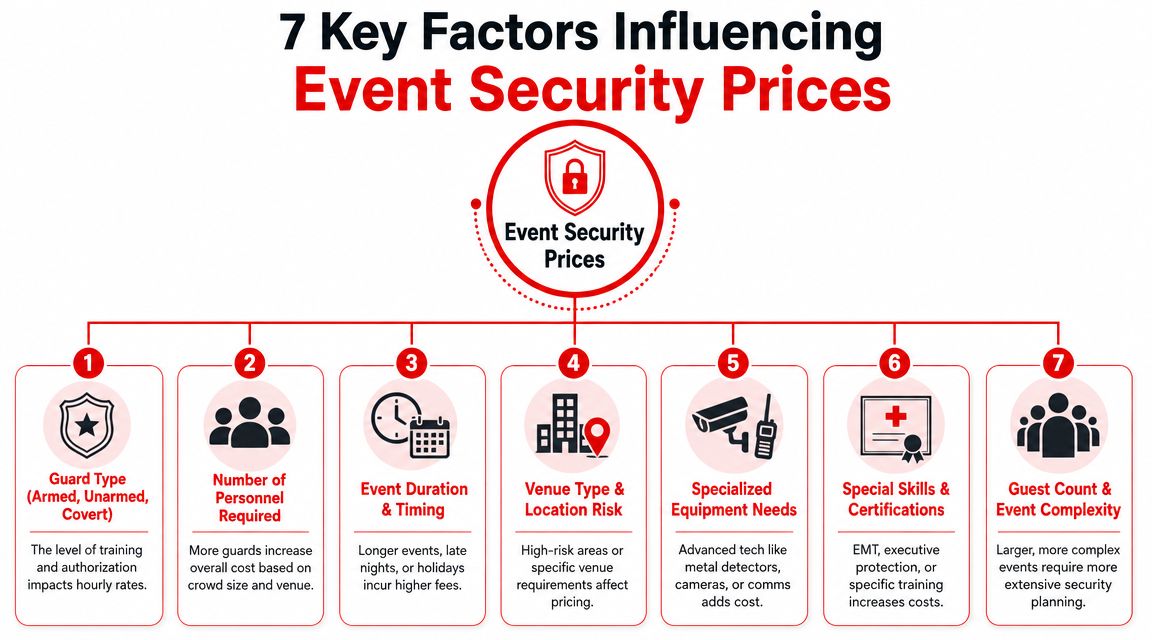
Guard type changes the base cost
An unarmed event guard, an armed guard, and a close protection operator aren't interchangeable. The more specialised the role, the more training, authorisation, and supervision sit behind it. For most parties and functions, unarmed crowd control or static event staff are the practical fit. Specialist roles should only be added when the risk profile justifies them.
Headcount drives the quote fast
Every added post changes the budget. One person on a single doorway is simple. Two people on entry and one floating inside gives you better coverage, but the labour cost scales immediately.
When planning, planners should think in zones, not bodies. Entry. Internal floor. Perimeter. Exit. If you can define the zones clearly, staffing gets more accurate.
Duration and timing affect what you really pay
A four-hour event rarely means four paid hours in practice. Guards may need to arrive before guest entry, stay through close, and remain on site while the crowd clears. Late-night work can also be harder to staff smoothly than daytime shifts.
Continuous or extended coverage becomes expensive for a straightforward reason. The provider has to account for shift lengths, handover time, overtime risk, relief coverage, and fatigue management rather than only multiplying one visible hourly rate across a roster.
Venue complexity matters more than people expect
A house with one gate and one driveway is easier than a warehouse with multiple roller doors. A hotel ballroom is different again because access points, lifts, loading docks, and public-facing areas all create extra touchpoints.
Good security planning follows movement. How guests enter, where they gather, how they leave, and where problems are most likely to start.
Risk profile shifts everything
Security for parties prices rise when the event includes alcohol service, past incidents, cash handling, VIP attendance, public access, or a crowd that's likely to surge at certain times. A low-drama seated dinner needs one kind of plan. A late-night dance event needs another.
Most avoidable overspend comes from a vague brief. Most avoidable risk comes from understaffing the wrong area.
Equipment and specialist support add layers
Some events need more than visible personnel. You may require radios, screening support, gate control, incident logging, vehicle patrol interface, or a supervisor who can coordinate multiple posts. Those additions don't always look dramatic on paper, but they can change the shape of the operation.
Compliance adds cost even when clients don't see it
One of the biggest pricing drivers in Australia is compliance. Licensed security provision in NSW, Victoria, Queensland, and the ACT carries overheads tied to state-based licensing, supervision, RSA alignment, and documentation. Those non-labour inputs raise the effective cost because the provider isn't only covering the guard's wage. They're also carrying training, insurance, and administrative compliance requirements, as outlined in this guide to private security service costs.
That same mindset applies across the event budget. If you're comparing line items beyond security, transport pricing often works the same way, with time windows, vehicle type, and service conditions affecting cost more than a simple flat fee. For that reason, many planners also review pricing details from Oz Coach Hire Australia when they're building the full event logistics budget.
Typical Security for Parties Prices in Australia 2026
If you want a working benchmark, use published Australian industry guidance rather than random forum estimates. A useful reference point is this: unarmed guards are about A$20 to A$35 per hour, armed guards are about A$35 to A$60+ per hour, and smaller private functions are often budgeted at A$200 to A$500 for a couple of guards for the evening, according to this Australian event security pricing guide.
Those figures are best treated as planning benchmarks for 2026 budgeting, not as universal flat rates. The same guide also notes that cost rises with venue complexity, crowd size, and risk profile. That's why a simple private booking and a festival gate team never price the same way.
Estimated event security costs by type and location 2026
| Event Type | Typical Guard Count | Estimated Cost (NSW/VIC) | Estimated Cost (QLD/ACT) |
|---|---|---|---|
| Small private party at home | Couple of guards | Often falls within the small private function benchmark range, depending on hours and risk | Often falls within the small private function benchmark range, depending on hours and risk |
| Corporate dinner or awards event | Varies by access points, alcohol service, and guest management needs | Commonly built from hourly guard rates, then adjusted for complexity and compliance | Commonly built from hourly guard rates, then adjusted for complexity and compliance |
| Community event in a park | Varies by entry layout and public access | Usually priced from guard hours plus any supervision or perimeter needs | Usually priced from guard hours plus any supervision or perimeter needs |
| Licensed nightlife event or late function | Higher staffing intensity than a low-risk private event | Typically above the most basic benchmark because risk and supervision load increase | Typically above the most basic benchmark because risk and supervision load increase |
| Event requiring armed coverage | Specialist role only where justified | Based on the armed guard benchmark, then adjusted to the site and brief | Based on the armed guard benchmark, then adjusted to the site and brief |
Why state context still matters
The benchmark rates give you a national starting point, but local operating conditions still shape what lands on the quote. In practice, planners in NSW and Victoria often see more quote detail around venue procedures, alcohol management, and reporting expectations. In Queensland and the ACT, the same core issues apply, but the exact deployment model can vary with venue style, staffing availability, and how the event is being run.
That's why the right question isn't only “What's your hourly rate?” It's “What does that rate include, and what assumptions are sitting behind it?”
Cost Scenarios and Your Simple Budgeting Calculator
Abstract pricing isn't much use when you're trying to approve a budget. Here's how security for parties prices look when you build them from a real brief.
Scenario one, a 21st birthday at a suburban home
The host expects a mixed crowd, music, a backyard bar setup, and guests arriving over a short window. The main concern isn't high threat. It's gate control, turning away uninvited guests, and managing noise and departures.
A practical first pass is:
Number of guards x hours x hourly rate = starting estimate
If the host is thinking about a couple of guards for the evening, that lines up with the published benchmark for smaller private functions. In other words, this sits in the same planning territory as the A$200 to A$500 range already noted earlier for a couple of guards at a smaller private function.
What can push this job upward qualitatively? A second entry point. Street parking issues. Alcohol-fuelled re-entry. A request for guards to stay until the property is fully clear.
Scenario two, a corporate awards night in a CBD venue
This job usually looks calmer on the surface and more detailed underneath. Guests are dressed well, the tone is formal, and management may assume the need is minimal. But the operation can include guest list checks, lift access, loading access, green room control, VIP movement, and coordination with venue management.
A quote for this kind of event often includes:
- Front-of-house coverage: Guest list and access control
- Internal roaming: Quiet presence near bar and function space
- Supervisor oversight: Useful where multiple vendors or VIPs are involved
- Post-event hold: Coverage through guest exit and staff pack-down
The mistake here is underestimating the pre-event and post-event windows. Security often starts before the first guest walks in and ends after the last guest leaves.
If the event has layers, your quote should too. One flat line item usually means someone hasn't mapped the job properly.
Scenario three, a small community music event in a park
Outdoor events create a different security picture. Access is looser, perimeter control is harder, and public interaction is less predictable. Even a small program can need an entry point, stage-side presence, roaming support, and someone watching how the crowd disperses near roads or public paths.
This kind of booking is where simple hourly maths helps, but only if you remember the operational extras. Open public edges, equipment zones, performer access, and weather-driven movement all affect deployment.
Your simple budgeting calculator
Use this formula for an initial estimate:
| Budgeting Step | What to Enter |
|---|---|
| Guard numbers | How many separate posts must be covered at the same time |
| Hours per post | Include setup, guest entry, service period, close, and exit |
| Rate type | Use the appropriate hourly benchmark for the guard type |
| Special requirements | Add supervision, specialist roles, or equipment if needed |
| Final check | Ask whether alcohol, public access, or complex layout changes the plan |
A practical worksheet looks like this:
- List each zone that needs coverage.
- Assign hours to each zone, not just to the event headline time.
- Choose the guard type that fits the risk.
- Add any non-standard requirement such as screening, VIP escorting, or extended close-down.
- Pressure-test the exit period, because that's where many under-budgeted jobs fail.
3 Smart Ways to Reduce Security Costs Safely
Cutting headcount without changing the risk is the worst way to save money. It creates a cheaper quote and a weaker operation. There are better options.
Book early and give the provider room to plan
Last-minute requests often produce messy staffing. The provider has less room to match the right personnel to the right event, and you have less time to refine the brief. Early booking gives both sides time to define access points, problem areas, and realistic hours.
This doesn't guarantee a lower quote in every case, but it usually gives you a cleaner deployment and fewer avoidable add-ons.
Give a precise brief instead of a vague one
Security for parties prices blow out when the client says, “We just need a few guards,” and leaves the rest open. A proper brief helps the provider avoid over-allocating to protect themselves against unknowns.
Include:
- Venue map or layout note: Entrances, exits, smoking area, car park, staff doors
- Service details: Alcohol, cash handling, VIPs, performers, ticketing
- Crowd pattern: Arrival surge, peak bar period, hard close, staggered exit
The clearer the brief, the easier it is to remove unnecessary overlap.
Use tiered deployment during peak periods
Not every event needs the same staffing level from open to close. A common, sensible option is to keep lean coverage during setup or quieter periods, then increase the team for arrival, peak service, or dispersal.
This works well when the event has obvious pressure points. It doesn't work when the risk is constant across the whole shift or where compliance requirements need a stable post throughout.
Save money by trimming dead time, not by stripping coverage from the busiest point of the event.
Essential Questions to Ask Your Security Provider
At quote stage, the right questions usually tell you more than the hourly rate. A provider who can explain staffing, supervision, reporting, and change conditions in plain terms is usually easier to work with on the night. A provider who stays vague often becomes expensive later through scope gaps, overtime disputes, or poor incident handling.
Ask about licensing and state compliance
Start with licensing for the state where the event is being held. In NSW, Victoria, Queensland, and the ACT, guards must hold the correct licence for that jurisdiction. Ask whether every person on the roster is licensed for that state, who the supervisor is, and whether crowd control duties are being assigned to properly authorised staff.
Also ask how they record incidents and who signs off on reports. If police, the venue, or your insurer need a timeline after an ejection, injury, or property issue, that paperwork matters.
Ask what the quote includes, and what triggers extra charges
Many pricing problems come from assumptions. One client assumes the quoted hours cover briefing, setup, guest entry, close-down, and report writing. The provider may have priced only the visible event hours.
Get the scope pinned down before you approve anything. Ask:
- Are minimum shift lengths applied?
- Is setup or pre-event briefing included?
- What is billed if the event finishes late?
- Are supervisor time, radios, and incident reports included?
- Is there an after-hours operations contact if the plan changes on the night?
Those answers should be specific. If they are loose, the invoice usually is too.
Ask how they handle alcohol, refusals, and removals
If alcohol is being served, ask how security works with the venue manager, bar staff, or event organiser during refusals and patron issues. The practical question is not whether they can remove someone. It is how they stop a minor issue turning into a physical one.
Good providers can explain the sequence. Who makes the call to refuse entry or service, who leads the conversation, where a person is moved to, and when police are contacted. That is the difference between a controlled night and a messy one.
Ask whether the personnel fit the event
Presentation affects both guest experience and effectiveness. A private birthday at a licensed venue, a school formal, and a corporate function may all need different types of officers. Some jobs suit visible uniformed guards at entry points. Others need discreet front-of-house staff who can manage access without making the event feel over-policed.
Ask why they are recommending that mix. A serious provider should be able to justify the roster based on crowd profile, venue layout, alcohol service, and exit pattern, not just send whoever is available.
For planners coordinating several suppliers, the same discipline applies across the event. A structured checklist, such as this wedding rentals planning guide, is useful because it reduces the small omissions that later create confusion between vendors.
Ask how changes, cancellations, and extensions are managed
Events shift. Guest numbers increase, bump-in runs late, weather changes access, or the venue asks for extra coverage at the gate. Ask what notice is required for roster changes, what happens if you need more guards on short notice, and how cancellation fees are calculated.
Also ask who has authority to approve extra hours on the night. That one point avoids a lot of dispute later, especially at private functions where multiple family members or venue staff may try to give directions.
Ask who is actually in charge on the night
This gets missed often. You need one clear operational contact from the security company and one decision-maker from your side. Ask who briefs the team, who the supervisor reports to, and how issues are escalated if the situation moves beyond routine crowd management.
Clear command lines save time when something goes wrong. They also make the event run more smoothly when nothing does.
Your Booking Checklist with GM GROUP Services
A clean booking starts with a clean brief. Before you ask for pricing, gather the operational details that affect the job.
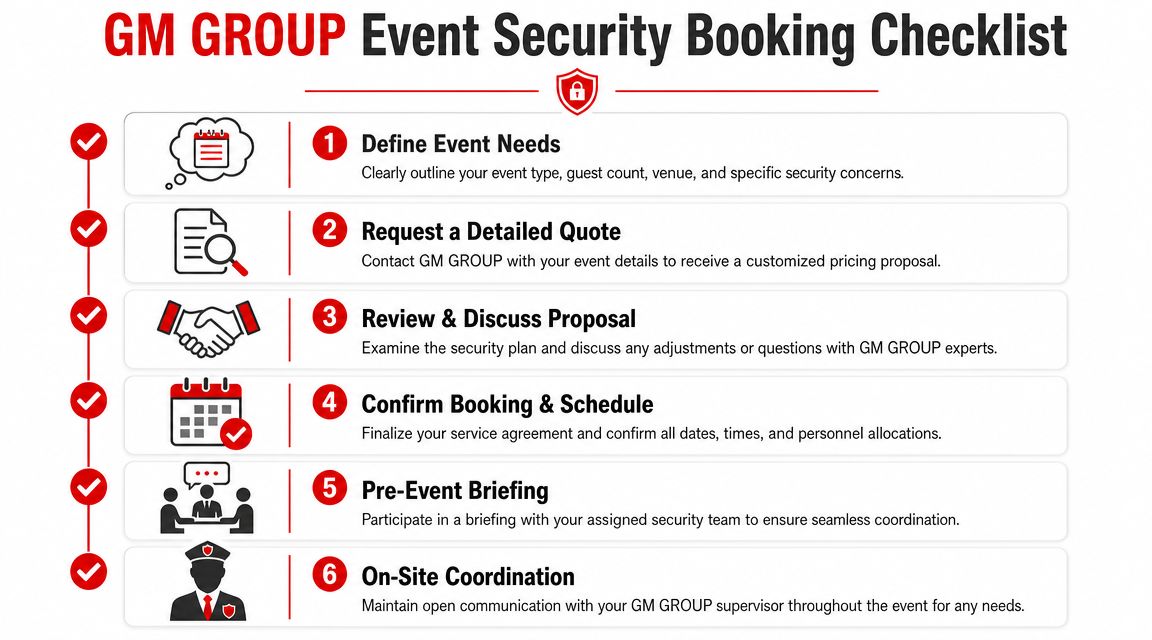
Use this checklist before requesting a quote
- Define the event clearly: Type of function, venue, timing, expected guest flow, and whether alcohol is being served.
- Mark the pressure points: Entry queue, bar area, car park, smoking zone, VIP access, performer space.
- Set a realistic hours window: Include setup, guest arrival, operating period, and final clear-out.
- Decide the presentation standard: Uniformed, discreet, corporate, or mixed deployment.
- Prepare your planning documents: Run sheet, floor plan, venue rules, emergency contacts.
If you're managing a broader celebration or formal event, a structured planning document helps align every supplier, not just security. A simple example is this wedding rentals planning guide, which shows how a checklist approach keeps event logistics from slipping between vendors.
For bookings with GM GROUP Services, the key is giving enough operational detail upfront so the quote reflects the actual event rather than a generic guard rate.
Frequently Asked Questions about Security Pricing
Do extra hours get billed if the event runs overtime
Usually, yes. Security teams are rostered against agreed times, but if the event extends, the labour extends too. The practical issue isn't only the extra time. It's whether the provider can safely keep the same team on duty and maintain proper supervision.
Is insurance included in the price
A professional security quote should account for the provider's operating overheads, including the compliance and administrative load that sits behind the service. If you want certainty, ask the provider to confirm what insurances they hold and whether anything falls outside the quoted scope.
Can I request guards in suits instead of standard uniforms
Often, yes, if the event style suits that approach and the request is made early enough. Corporate functions, private VIP events, and high-end hospitality settings sometimes need a lower-visibility presence than a standard uniformed deployment.
Is one guard enough for a private party
Sometimes. Sometimes not. It depends on the layout, entry points, guest profile, alcohol service, and whether the person can realistically manage the front gate while also responding to issues elsewhere on site. One guard works best for a simple, low-risk brief with a single clear post.
How do I compare two quotes fairly
Compare scope before rate. Ask what posts are covered, what hours are assumed, whether supervision is included, how incidents are recorded, and what happens if the event changes. The cheaper quote may be missing part of the job.
If you're planning an event and want a quote that reflects the actual operating conditions, speak with GM GROUP Services. Share the venue, guest profile, hours, alcohol service details, and any access or crowd concerns, and the team can help you turn those details into a practical security plan and a customized budget.
Discover more from GM Group Services
Subscribe to get the latest posts sent to your email.