
Proper security for event planning is much more than just putting guards on the doors. It’s the invisible framework that holds the whole experience together, making sure every single person feels safe and can enjoy themselves without a second thought. Getting the security for event strategy right means building a detailed, proactive plan from the ground up, ensuring a safe and memorable experience for everyone involved.
Why You Can't Afford to 'Wing It' With Security for an Event
Let's be blunt: proper security planning isn't just a nice-to-have, it's a non-negotiable part of protecting your guests and your brand. A smooth, incident-free event builds an incredible amount of trust and a solid reputation. On the flip side, a single security lapse can lead to disastrous, and very public, consequences. The old model of just having a visible presence is long gone; today, it’s all about smart, intelligence-led planning.
This really boils down to a few core principles:
- Spotting Risks Early: You need to get ahead of potential threats way before the event day. Actionable Insight: Conduct a "tabletop exercise" with your team where you simulate potential security scenarios (e.g., a medical emergency, a sudden power outage) to test your response plan. This helps identify weaknesses in your security for event plan before they become real issues.
- Smart Resource Deployment: Don't just throw bodies at the problem. A one-size-fits-all approach is wasteful and ineffective. The key is to put the right people and technology in the right places at the right times.
- Staying Compliant: Keeping up with all the legal requirements for security, staffing, and safety protocols across states like NSW, VIC, and QLD is crucial.
- A Seamless Guest Experience: The best security is often the least intrusive. Your measures should be effective without making attendees feel like they're in a fortress, contributing to a positive and relaxed atmosphere.
The Real Cost of Doing Security Right
There’s no getting around it—investing in comprehensive event security in Australia has become more expensive, and for good reason. It's not just another operational cost; it’s a vital investment in safety, which ultimately protects you from liability.
We've seen a massive shift here. For example, a medium-sized music festival in Australia might budget anywhere from AUD 150,000 to 400,000 for private security alone. For major stadium events, especially high-risk ones, the bill for police presence can climb as high as AUD 1.2 million. These figures show just how seriously the industry now takes formal risk assessment and boots-on-the-ground presence. If you're interested, you can dive deeper into current event safety trends.
A proactive, detailed approach to security isn't just a box to tick—it's the cornerstone of a memorable and safe event. It protects your guests, your team, and your reputation from preventable harm.
Laying the Groundwork: Your Pre-Event Risk Assessment
Great event security doesn't just happen on the day. It's built on a solid foundation laid weeks, or even months, before the first guest walks through the gate. The single most important document in your security arsenal is a comprehensive risk assessment. This isn't just a box-ticking exercise; it's a deep dive into everything that could go wrong, allowing you to build a security plan that's both realistic and robust.
Think of it as your strategic map. You’re meticulously analysing the venue's layout, scouting for weak spots, and taking stock of the existing infrastructure. The goal is to move from reacting to problems to proactively preventing them.
This entire process boils down to three core phases: Assess, Plan, and Protect.
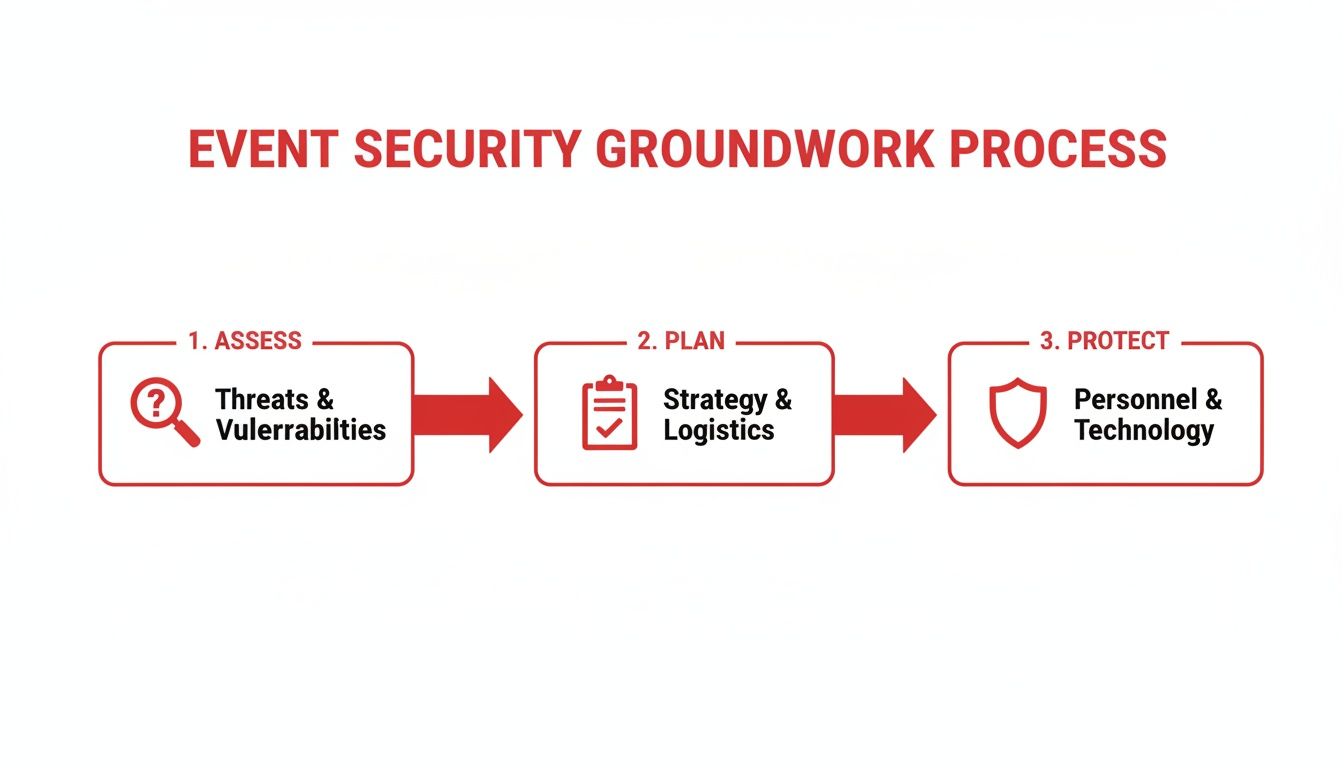
As you can see, a strong plan begins with a thorough assessment, which then informs your strategic planning, and finally leads to effective protection on the day of the event.
What Could Go Wrong? Identifying Your Unique Risks
Every single event has its own unique risk profile. A corporate conference in a Sydney CBD hotel faces entirely different challenges than a three-day music festival in regional Victoria. The first step is a no-holds-barred brainstorm of every conceivable hazard. Don't censor yourself—if you can imagine it, write it down.
To make sure you cover all your bases, it helps to break your thinking down into categories.
Here are a few to get you started:
- The Venue Itself: Are there blind spots in the CCTV coverage? Unsecured service entrances? Practical Example: During a venue walkthrough for a product launch, you notice a back delivery door is often propped open for convenience. This is a significant vulnerability for unauthorized access.
- The Crowd Factor: Think about overcrowding during peak times, the potential for intoxicated patrons causing trouble, or even friction between different groups of attendees.
- Outside Influences: This covers everything from a sudden summer thunderstorm and local road closures to the unlikely (but possible) threat of targeted criminal activity.
- Medical & Welfare: What’s the likelihood of heatstroke at an outdoor summer event? Slips and falls on wet ground? Or substance-related medical issues requiring an immediate response?
Turning Worries into Data: The Risk Assessment Matrix
Once you have a long list of potential hazards, you need a way to prioritise them. This is where a risk assessment matrix becomes your best friend. It’s a simple but powerful tool that helps you systematically score each risk based on its likelihood of happening and its potential impact if it does.
This simple scoring system immediately shows you where to focus your time, budget, and manpower.
You can't eliminate every single risk—that’s just not realistic. What you can do is understand your risks inside and out, allowing you to reduce their probability and minimise their impact with smart, pre-emptive planning.
A sudden downpour at an indoor conference, for example, is a low-impact risk. But that same downpour at an outdoor festival with tonnes of electrical gear and temporary stages? That’s a high-impact event you need a serious plan for.
Use the matrix below to identify, rate, and plan mitigation strategies for the most common risks at your event.
| Risk Category | Potential Hazard | Likelihood (1-5) | Impact (1-5) | Risk Score | Mitigation Strategy |
|---|---|---|---|---|---|
| Crowd Management | Overcrowding at stage front | 4 | 5 | 20 | One-way crowd flow system, designated "chill-out" zones, mobile security patrols. |
| Venue Security | Unauthorised access via service entry | 3 | 4 | 12 | Dedicated static guard, enforced credential checks for all staff/vendors. |
| Medical | Heatstroke/Dehydration | 5 | 3 | 15 | Free water stations, shaded rest areas, roaming first aid teams. |
| External Threats | Severe weather (thunderstorm) | 2 | 5 | 10 | Real-time weather monitoring, clear "shelter in place" communication plan. |
By filling this out for your specific event, you create a clear, actionable roadmap for your security team.
From Theory to Action: Creating Mitigation Strategies
Scoring your risks is only half the job. The final, and most critical, step is developing concrete mitigation strategies for each high-priority threat. This is what turns your assessment from a document on a shelf into a living, breathing operational plan.
Let’s look at how this plays out in the real world:
Identified Risk: Overcrowding at the main bar during intermission.
- Mitigation Plan: Open a secondary "express" bar serving only beer and wine. Implement a clear queueing system with barriers and have two guards specifically tasked with managing the flow of people.
Identified Risk: A lost child in a large, crowded venue.
- Mitigation Plan: Establish a clearly marked and staffed "Lost Persons" tent. Ensure all security and event staff know the exact procedure (Code Adam protocol) for a lost child report, including immediate communication to all posts.
Identified Risk: Medical emergency in a location far from the main first aid tent.
- Mitigation Plan: Pre-position roaming first aid teams on foot or in golf carts. Establish clear, unobstructed emergency access lanes and ensure every security guard's radio can communicate directly with the central medical dispatcher.
This level of detailed pre-planning is what separates amateur event management from professional execution. It ensures your team isn't just reacting to problems—they’re already two steps ahead.
Assembling Your Security Team and Defining Roles
Let's be clear: effective event security isn't just about hiring a bunch of people in uniforms. It's about building a smart, layered defence. Your security personnel are the living, breathing extension of your safety plan, and their success hinges entirely on a well-organised structure and crystal-clear roles.
Simply sticking a guard at every door won't cut it. You need to think bigger and match the team's skills to the specific risks you've already identified. A corporate gala and a multi-day music festival are two completely different beasts, and their security teams should reflect that.
Building a Multi-Layered Security Team
Think of your security setup not as a single wall, but as overlapping layers of protection. Each layer has a distinct job, and together they create a comprehensive net of safety.
- Static Guards: These are your anchors. You'll position them at key points like entrances, exits, VIP areas, and anywhere you have valuable assets (like a merchandise tent). Their main job is access control and being a highly visible deterrent.
- Mobile Patrols: These teams are your eyes and ears on the move. They constantly roam the venue perimeter, car parks, and internal areas, proactively looking for trouble—anything from a trip hazard to the first signs of a brewing conflict.
- Command Centre Operators: This is your nerve centre. From a central point, these operators watch CCTV feeds, manage radio traffic, and coordinate the response to any incident. They're the ones who see the big picture.
Beyond these core roles, you'll want to bring in specialists to handle the unique risks of your event. If you have high-profile guests, a dedicated VIP protection detail is a must. For a festival, a K9 unit trained in substance detection can be a powerful, non-intrusive way to keep things safe. And don't underestimate the value of covert operatives—plain-clothes security who can blend into the crowd and give you intel on potential threats before they ever escalate.
Calculating Staffing Ratios and Selecting Vendors
Figuring out how many staff you need is a direct result of your risk assessment. While there's no single magic number, Australian standards give us a pretty solid starting point. A low-risk indoor conference might only need one guard per 100 attendees. A high-risk festival serving alcohol, on the other hand, could demand a ratio closer to one guard for every 50-75 patrons, especially in crowded areas like the main stage or bars.
Once your numbers are sorted, choosing the right security company is your next big decision.
Don't make the all-too-common mistake of just picking the cheapest quote. A truly professional security partner will insist on a site visit and will want to work with you on the risk assessment before they even think about sending a proposal. That's a huge green flag.
When you're vetting potential vendors, do your homework. Check their master license and confirm every single guard they propose has an individual license for your state (be it NSW, VIC, or QLD). It's also critical to ensure they are trained in Responsible Service of Alcohol (RSA) and hold current first aid certifications. In a medical emergency, a well-drilled team is everything; understanding clearly defined resuscitation team roles can make a life-or-death difference and is a hallmark of a properly trained crew.
Defining Clear Roles and Responsibilities
A well-briefed team is an effective team. It's that simple. Before the gates open, every member of your security staff needs to know exactly what their role is, where they're supposed to be, and who they report to. A pre-event briefing isn't just a good idea; it's non-negotiable.
This briefing is your chance to cover the essentials:
- Key Personnel: Who is the event manager? Who is the security lead? Who is the head of the medical team? Everyone needs to know who's who.
- Communication Protocols: Explain how the radios work, what the call signs are, and precisely when an issue needs to be escalated up the chain.
- Emergency Procedures: Run through the exact steps for fire, medical crises, or major security threats. No ambiguity.
- Rules of Engagement: Provide clear guidelines on de-escalation techniques and the specific circumstances under which physical intervention is acceptable.
By investing the time upfront to build a properly structured team and define everyone's responsibilities, you're setting yourself up for success. This preparation is what allows a security force to operate with precision and confidence, ensuring your event is remembered for all the right reasons.
Mastering Crowd Dynamics and Access Control
When it comes to event security, everything boils down to how you manage the flow of people. Getting crowd dynamics and access control right isn't just about stopping gatecrashers; it's about engineering a safe environment from the ground up, designing out dangerous bottlenecks and crush points before they ever have a chance to form. This isn't something you can leave to chance.
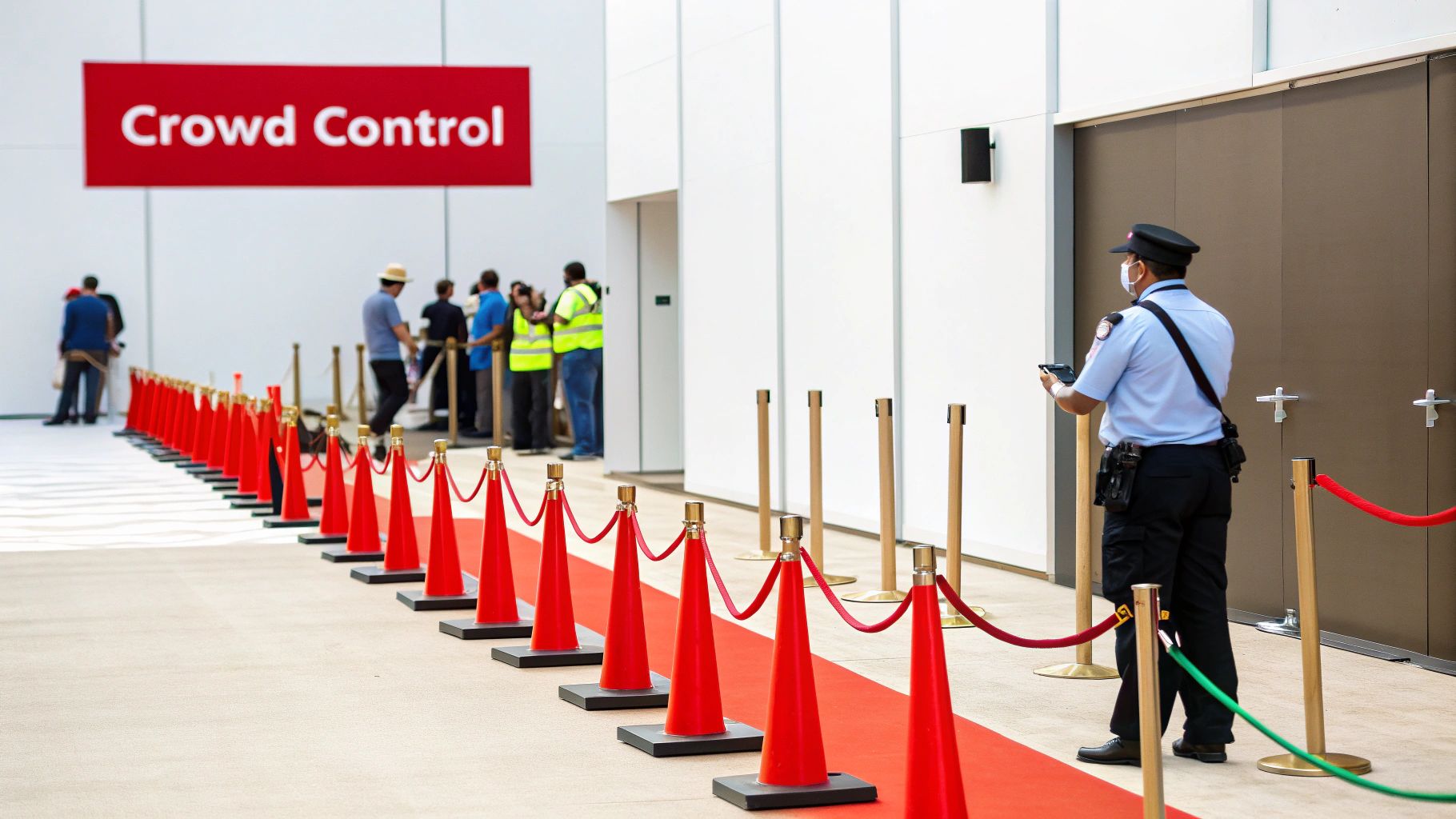
What that looks like in practice is creating smart entry and exit funnels that can comfortably handle your peak traffic. People moving smoothly and in an orderly fashion doesn't just happen by magic—it's the direct result of careful planning that considers every part of their journey, from the queue outside to navigating busy areas inside the venue.
Implementing Robust Screening and Entry Protocols
Should you use bag checks or metal detectors? That decision has to come directly from your risk assessment. For a high-profile concert with a big-name artist, they're non-negotiable. For a small corporate breakfast, they'd be complete overkill. The goal is to match the security measure to the actual threat level.
The landscape for this has changed dramatically in Australia over the past decade. Concerns around terrorism have completely reshaped screening protocols at our major venues. The use of metal detectors and mandatory bag checks at ticketed indoor arenas shot up from around 18% in 2016 to between 48–55% by 2023–24.
This had a massive knock-on effect on operations. The average time to get one person through the gates went from 8–12 seconds to about 18–26 seconds. To cope with this and keep queues manageable, planners had to boost their entry point staffing by an estimated 20–35%.
And don't forget, your ticketing system is a critical part of the puzzle. You need to protect its integrity to control who gets in. It's worth looking into strategies to prevent ticket scalping to maintain order and keep things fair for genuine fans.
Your perimeter is your first and best line of defence. How you manage it sets the tone for the entire event. A calm, efficient, and secure entry process creates confidence and starts the guest experience on a positive note.
Managing Internal Crowd Behaviour
Once your guests are inside, the game changes. Now, the challenge is all about managing their movement and behaviour within the venue. You need to keep a close eye on high-density zones—think food courts, merchandise stalls, or right in front of the stage—as these are the spots that need constant monitoring and active management.
Effective internal crowd management is built on a few key pillars:
- Clear and Abundant Signage: Don’t make people guess where they’re going. Big, well-lit signs for toilets, exits, and first-aid stations cut down on confusion and stop wandering crowds from creating blockages.
- Proactive De-escalation: This is a big one. Train your staff to spot the early warning signs of agitation or conflict. A calm, respectful intervention from a trained guard can defuse a tense situation before it blows up into a real problem.
- Hostile Vehicle Mitigation: If you’re running an outdoor event or your venue has an exposed perimeter, you have to think about this. Temporary, rated bollards or even strategically placed heavy vehicles can secure public spaces from vehicle-based threats—a tactic that’s now standard at major Aussie street festivals and sporting events.
- Consistent Communication: Use the PA system and digital screens to give regular updates, especially on scheduling changes or exit procedures. An informed crowd is a calm crowd.
At the end of the day, proactive crowd management is a mix of smart physical design and well-trained, switched-on people. Your team's ability to communicate clearly and manage those high-density hotspots is one of the most powerful tools you have for making sure everyone has a safe and enjoyable time.
Weaving Medical Response into Your Security Plan
Think of event security and medical response as two sides of the same coin. A truly professional security plan doesn't just bolt on a first-aid tent as an afterthought; it deeply integrates health and safety into a single, seamless operation. This isn't just best practice—it's your fundamental duty of care to every single person who walks through your gates.
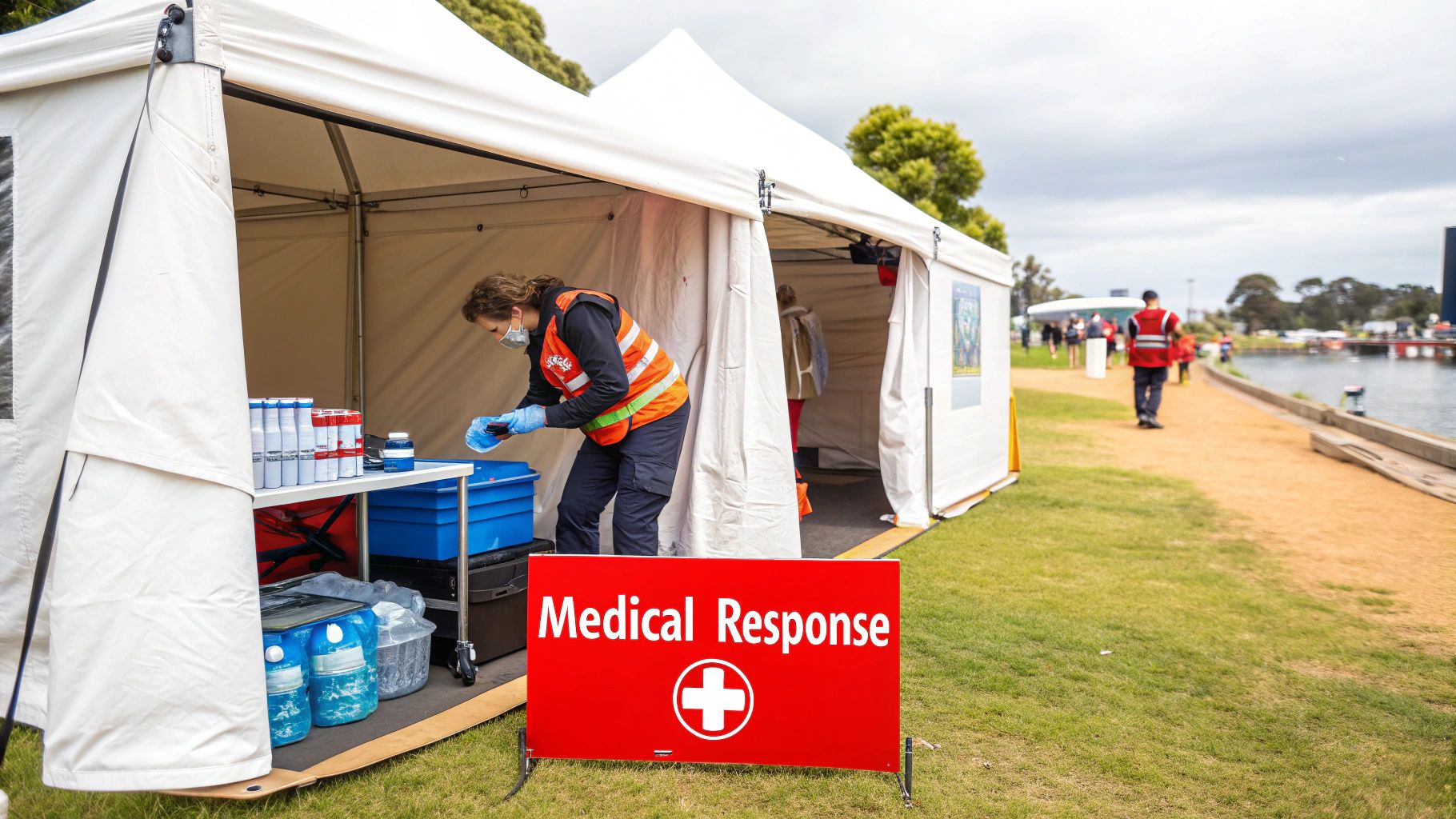
Your medical readiness needs to be just as robust and meticulously planned as your access control or crowd management strategies. It’s about creating a proactive system where help is not only available but also highly visible, easy to find, and working in lockstep with your security team. In a real emergency, that tight integration is what saves precious seconds and, ultimately, lives.
Getting Your Staffing and Compliance Right
So, how many medical staff do you actually need? Your starting point is always the local regulations. Australian states like NSW, Victoria, and Queensland have pretty clear guidelines that spell out minimum staffing levels based on your event’s size, type, and overall risk profile. Getting this wrong is a non-starter and can shut you down.
- Low-Risk Events: Picture a corporate conference or a small indoor trade show. Here, you might only need a couple of qualified first-aid officers and a well-signed first-aid room to meet your obligations.
- High-Risk Events: Now think of a major multi-day music festival. The requirements jump significantly. Health and safety guidelines for these larger events often mandate at least 1 registered paramedic or clinician for every 1,000 attendees. You'll also likely need an on-site ambulance for every 5,000–10,000 people. The industry has thankfully improved here; between 2020 and 2024, compliance rates for licensed festivals submitting adequate medical plans rose from around 45% to between 72% and 86%. It's a sign of a maturing industry, and you'll find more insights by looking into how defence and security directorates are evolving their approaches.
I can't stress this enough: get in touch with your local ambulance services and hospitals well before the event. This isn't just a courtesy call. It's a critical coordination step to ensure they're briefed on your event's scale and your on-site capabilities. It makes any handover for a serious medical evacuation smooth and efficient.
Building Your On-Site Medical Infrastructure
Beyond having the right people, you need the right setup. The physical placement of your medical resources can make or break your response time. You want them to be strategically located for quick access and high visibility, so attendees in distress know exactly where to turn.
Your on-site medical footprint should absolutely include:
- First-Aid Posts: These are your front line for everything from blisters to more serious issues. Make them impossible to miss—bright lighting, big signs, and marked on every single event map.
- Triage Areas: Set these up right next to your main first-aid posts. This is a designated zone where, in a worst-case scenario, medical staff can rapidly assess patients and prioritise care.
- Clear Evacuation Routes: This is a joint effort between your security, venue, and medical teams. Map out clear, wide, and unobstructed pathways for ambulances to get in and out. These routes must be kept clear—no exceptions.
Don't Forget Proactive Harm Minimisation
A truly expert medical plan doesn't just wait for things to go wrong. It actively tries to prevent them. This is especially true for festivals and big outdoor events where factors like heat and crowds come into play. These proactive measures take a huge load off your response teams.
Some simple, high-impact strategies include:
- Free and Obvious Water Stations: Dehydration is one of the most common medical issues at events. Don't hide the water; make it free, plentiful, and clearly signposted everywhere.
- Dedicated "Chill-Out" Spaces: The sensory overload at a big event can be overwhelming for some. Providing shaded, quieter zones where people can sit, rest, and decompress is a game-changer for patron welfare.
- Constant, Clear Messaging: Use your big screens, social channels, and stage announcements to push simple reminders: drink water, take a break, and look out for your mates.
By weaving medical preparedness into the DNA of your security plan, you're not just ticking a compliance box. You’re building a safer, more responsible event and showing a genuine commitment to the wellbeing of every person on-site.
Tying It All Together and Looking Ahead
You've done the hard yards: you've assessed the risks, built your team, planned for crowd dynamics, and synched up with medical. You now have the foundations of a solid, professional security operation. But the job isn't quite done. The final piece of the puzzle is locking in the plan and, just as importantly, setting yourself up to learn from the experience.
It’s easy to let this slide in the post-event haze, but meticulous documentation is your best friend. From that first risk assessment to every briefing note and incident report, keep it all. This isn't just about ticking compliance boxes for state regulations; it's about building a library of real-world data that will make your next event even tighter, safer, and more successful.
The Real Work Starts After the Pack-Down: The Debrief
Once the lights are up and the last person has headed home, one of the most valuable parts of the entire operation can begin. I’m talking about the post-event debrief. This is absolutely non-negotiable for any professional outfit. Forget about pointing fingers; this is a candid, constructive look at what went right, what went wrong, and what we can do better next time.
Get the right people around the table:
- Your security lead and key supervisors
- The head of the medical team
- A representative from the venue
- Key members of your event operations staff
This is where you pull out all the incident logs and reports and really dig in. Were there patterns? Maybe a specific entry point consistently caused bottlenecks, or communication blackouts kept happening in one area. This is how you turn gut feelings into hard evidence. Practical Example: If the incident log shows a cluster of minor scuffles near the back bar, that’s not just bad luck. It could point to poor lighting, a blind spot for staff, or a need for an extra guard positioned right there next year.
The post-event review is your single greatest tool for improvement. It’s what turns one event’s lessons into the next event’s strengths, proving you’re committed to professional excellence, not just getting through the night.
What to Look for in the Aftermath
In your review, you need to look at the cold, hard facts. Get into the data on everything from how long it took to get people through the gates to the number of first-aid calls. Did your team hit its target response times? Was the security presence felt without being overbearing? Getting honest answers to these questions is how you refine your entire approach. It's how you build a culture that genuinely puts safety and a positive guest experience at the very top of the list.
Wrapping Up Your Security for Event Planning
How soon after the event should we hold the debrief?
Actionable Insight: Get it done within 48-72 hours. Any longer, and crucial details start to fade. Send out a calendar invite for the debrief before the event even starts to ensure it happens. You want memories to be fresh so the feedback is accurate and genuinely useful.
What’s the single most important document to review?
The incident log, without a doubt. It’s the unfiltered, chronological story of your event from a security perspective. From a minor argument to a serious medical situation, this log gives you a raw look at what actually happened on the ground.
Frequently Asked Questions about Security for Event
When you're deep in the trenches of event planning, security questions are bound to pop up. It’s a complex area, and it's easy to feel unsure. We get it. Let's walk through some of the most common queries we hear from organisers, so you can feel confident in your security for event plan.
This isn't just about ticking a box; it's about making smart decisions that protect everyone. From staffing numbers to picking the right team and sidestepping common blunders, here's what you need to know about providing security for event gatherings.
What’s the Right Guard-to-Guest Ratio?
Honestly, there's no single magic number. The "right" ratio is completely driven by your risk assessment. Anyone who gives you a flat number without asking questions is waving a red flag.
A low-key corporate awards night in a five-star hotel ballroom might be perfectly fine with 1 guard per 100-150 attendees. The environment is controlled, and the risks are minimal.
But if you're running a music festival with multiple bars and a young crowd, you’re in a different league. For that kind of event, regulations in NSW, VIC, or QLD will likely require a much heavier presence, pushing the ratio to 1 guard per 50-75 patrons, especially near the stage, bars, and entry points.
Your risk assessment is your North Star here. It’s the tool that helps you justify your numbers by looking at who your audience is, the venue's layout, crowd density, and whether alcohol is being served. Always, always talk it through with your security provider and, if necessary, the local police.
How Do I Choose the Right Security Vendor?
This is probably the single most important security decision you'll make. Getting it right sets you up for success; getting it wrong can be a disaster. Here’s what to look for.
- Licensing is Non-Negotiable: Check that the company has a valid master license for your state, and don't be shy about asking to see proof that their individual guards are also properly licensed.
- Ask for Relevant References: Don’t just take their word for it. Ask to speak with organisers of events similar to yours. A good provider will be proud to connect you with happy clients.
- Insist on a Site Visit: Be very wary of any company that emails you a quote without ever setting foot on your site. A true professional will insist on walking the venue with you to understand the space and build a real plan.
A great sign of a quality partner is their focus on ongoing training. Ask them about their programs for RSA, first aid, and conflict de-escalation. And before you sign anything, confirm they have solid public liability and professional indemnity insurance.
What Are the Biggest Mistakes Organisers Make with Event Security?
We see the same mistakes time and again. The biggest one? Treating security as an afterthought—a line item to be filled with the cheapest quote at the last minute.
That approach almost always leads to trouble: not enough guards, poorly trained staff, and a flimsy plan that falls apart when a real issue arises.
Another classic blunder is skipping a formal, written risk assessment. This isn't just paperwork; it’s your roadmap to identifying and preventing problems before they ever happen.
Finally, poor communication is a silent killer of event safety. This can look like:
- A rushed, unclear briefing for the security team.
- No dedicated communication channel, like two-way radios.
- Forgetting to coordinate with local police, paramedics, and fire services.
And don't forget the guest journey. Messing up the entry and exit flow creates dangerous choke points and starts the event on a sour note. A solid security plan covers every single touchpoint, from the moment guests arrive to the moment they head home.
At GM GROUP Services, we don’t just provide guards; we build customised security strategies that protect your attendees, your assets, and your reputation. Our licensed, experienced teams are experts in everything from initial risk assessments to dynamic crowd management for events across NSW, VIC, QLD, and the ACT. Let's work together to create a safe, welcoming environment for your next event. Learn more about our event security solutions.
Discover more from GM Group Services
Subscribe to get the latest posts sent to your email.