
Think of robust security and training not as just another expense, but as a core investment. It’s what turns a security guard from a passive observer into a proactive leader, fully equipped to protect your people, your assets, and your brand’s reputation. This approach is what allows them to confidently de-escalate conflicts and manage emergencies before they spiral out of control.
Why Modern Security and Training Is Non-Negotiable

A top-tier security team operates a lot like a surgical team in an operating theatre. Every member knows their exact role, they communicate flawlessly under immense pressure, and they are always thinking one step ahead to ensure a positive outcome. This kind of instinct and coordination isn’t accidental—it’s forged through consistent, high-calibre training.
Without that foundation, security staff are left guessing. They react to situations inconsistently, often lacking the legal know-how or communication skills to navigate sensitive moments. This reactive posture can quickly turn a minor incident into a major liability, putting patrons at risk and leaving your business exposed.
Moving from Reactive to Proactive Security
Truly effective security is a careful mix of skills, all honed through dedicated training. The aim is to shift your team’s mindset from simply being there to actively preventing incidents before they even have a chance to start. This proactive stance is built on:
- Situational Awareness: Training staff to read a room, pick up on subtle cues, and spot potential trouble long before it escalates.
- Practical Example: A guard at a concert notices a small group becoming agitated near a crowded exit. Instead of waiting for a fight, they discreetly position themselves nearby and use calm, open body language, subtly defusing the tension before it can erupt.
- Advanced Communication Skills: Giving guards the verbal tools to de-escalate tension, calming situations down without ever needing to get physical.
- Actionable Insight: Role-play different scenarios during training, such as dealing with an intoxicated patron who has lost their friends. This builds the muscle memory needed for real-world de-escalation.
- Legal and Procedural Knowledge: Making sure every officer is crystal clear on their legal authority, their responsibilities, and the correct, compliant procedures for any incident.
A well-trained security professional does more than just stand guard; they become an ambassador for safety, enhancing the customer experience while actively mitigating risk. Their confidence and competence create a secure environment where patrons feel safe and valued.
The Broader Impact of Education on Safety
This idea—that education creates safer environments—isn’t new. Globally, organisations recognise this link. The African Union Peace and Security Council, for example, has highlighted education in conflict zones as a critical security issue. They’ve pushed member states to fund emergency education, understanding its direct role in building peace. You can learn more about the AU’s stance on education and security to see this principle in action.
In this guide, we’ll unpack what makes a security and training framework truly successful. From initial inductions to specialised emergency drills, you’ll get the insights you need to build a team that doesn’t just protect your venue but elevates its reputation as a safe, professional place to be.
The Essential Types of Security Training Programs
When it comes to security, a one-size-fits-all training program just doesn’t cut it. It’s not only ineffective; it’s downright dangerous. Think about it: a security officer managing crowd flow at a music festival needs a completely different set of skills than one preventing theft in a quiet retail store. A truly robust training program is built with different, specialised modules, each tackling specific risks and responsibilities.
This layered approach is key. It ensures every team member has both the core, foundational knowledge and the specific skills they need to handle their job with confidence. We’re moving beyond just ticking a box for a license; we’re building a team that’s genuinely prepared for the real world.
Foundational and Role-Specific Training
Every new team member starts their journey with Induction Training. This is the bedrock. It covers the absolute essentials: company policies, specific procedures for the site they’ll be working on, how we communicate, and our code of conduct. It gets everyone on the same page from day one, regardless of their past experience.
From that solid base, the training gets laser-focused. Role-Specific Training is where we adapt to the unique demands of each job.
- Retail Loss Prevention: This is all about the subtle art of spotting suspicious behaviour, knowing the common tricks of the trade for theft, and using covert communication to stop stock loss—all without alarming genuine customers.
- Event Crowd Control: Here, officers dive into crowd psychology, verbal de-escalation, and managing barriers and chokepoints. They learn to guide large flows of people and respond to incidents in a packed, high-energy environment.
- Construction Site Security: This module is focused on managing access control for a constantly changing workforce, preventing the theft of expensive tools and materials, and enforcing critical workplace health and safety (WHS) rules in what is often a high-risk setting.
Think of it this way: Induction Training teaches everyone how to use the same radio. Role-Specific Training teaches them what to listen for and how to react depending on whether they’re backstage at a concert or watching a loading dock at 3 a.m.
Compliance and Crisis Management
A security team that doesn’t know the law is a massive liability. That’s where RSA and Legislative Training comes in. Every officer must have a rock-solid understanding of the rules that govern their actions, from Responsible Service of Alcohol (RSA) laws in licensed venues to their legal powers of arrest and the guidelines for using force. This isn’t optional; it’s what protects your business.
Of course, security is also about being ready for the unexpected. Emergency Response Drills are practical, hands-on simulations that build muscle memory for when stress levels are high. This covers everything from being the first responder to a medical issue, executing a fire evacuation, or coordinating with police and paramedics during a major incident. Part of building a team that can handle these situations is ensuring they have a strong ethical compass. Exploring resources like the Top 12 Integrity Training Courses can help build that crucial foundation.
Practical Example: The Power of De-escalation
Picture a heated argument flaring up near the door of a busy pub. An undertrained guard might go straight to physical intervention, which only throws fuel on the fire and makes a bigger scene. But a guard who has been through proper de-escalation training spots the rising tension early. They use a calm but firm tone, separate the individuals, actually listen to what the problem is, and guide them towards a solution. The fight never happens, and the safe atmosphere is maintained. That is the real-world result of targeted security and training.
Frequently Asked Questions
What is the most important type of training for event security?
While it’s all connected, Crowd Control Techniques and Emergency Response Drills are probably the most vital for events. In such a dynamic environment, the ability to manage thousands of people safely and act decisively when something goes wrong is everything.
How does training differ for a static guard versus a mobile patrol?
A static guard’s training is heavily focused on sharp observation skills, tight access control procedures, and knowing every vulnerability of the single site they are protecting. For a mobile patrol officer, the training also has to cover safe driving practices, planning routes for the best coverage, and the right procedures for responding to alarms across a much larger area.
What is induction training and why is it so critical?
Induction training is the first training any security officer receives upon joining a team or starting at a new site. It’s critical because it establishes the foundational rules, site-specific procedures (like emergency exit locations), and communication protocols. It ensures every team member, regardless of experience, operates under the same consistent framework from day one, which prevents confusion during an incident.
Getting to Grips with Australian Security Compliance
In the world of professional security, compliance isn’t just a box to tick—it’s the absolute bedrock of the entire operation. This framework is what guarantees every officer on your site is legally qualified, properly trained, and fully authorised to be there. Get it wrong, and you’re not just looking at subpar service; you’re opening the door to serious legal and financial trouble.
Trying to make sense of the legal requirements for security and training can feel like navigating a maze, especially since the rules change the moment you cross a state line. A qualification that’s perfectly valid for a guard in Sydney might not cut it for a job in Melbourne or Brisbane. For anyone managing a venue, event, or construction site, this patchwork of laws makes one thing crystal clear: you need a security partner who lives and breathes state-specific compliance.
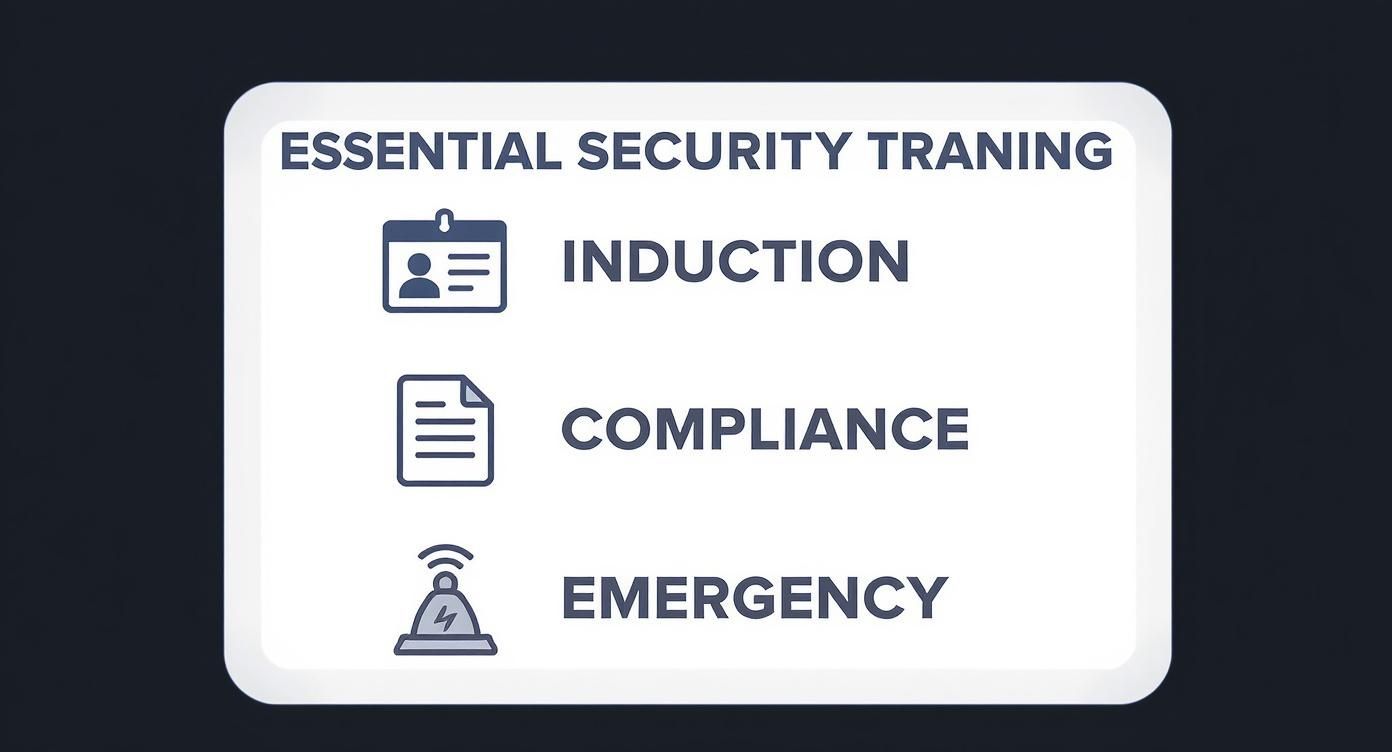
As this shows, a guard’s readiness isn’t a one-off event. It’s built on a solid foundation of initial induction, backed by continuous compliance training and sharp emergency response skills.
A State-by-State Look at Licensing Rules
Every Australian state and territory has its own regulator setting the agenda for security licensing. This means the required training units, background checks, and even the official name of the licence can differ dramatically. It’s precisely why a generic, one-size-fits-all training program simply doesn’t work in the real world.
Let’s break it down with a practical example. Imagine you need a crowd controller for a major event:
- In New South Wales, they’ll need a Class 1A Security Licence, which involves completing specific units from a Certificate II in Security Operations.
- Over in Victoria, the same job requires a Private Security Individual Licence with a crowd control endorsement, again linked to mandatory training modules.
- Head up to Queensland, and the role falls under a distinct Crowd Controller Licence, managed by the Office of Fair Trading.
These aren’t minor differences; they’re fundamental legal requirements. A top-tier security provider won’t just know these rules—they’ll have robust systems to track licence renewals, refresher courses, and any legislative updates that could impact their team’s ability to operate legally on your site.
A truly compliant security partner doesn’t just hire licensed guards. They actively manage and verify every credential to ensure 100% adherence to local laws, shielding your business from the significant risks of using improperly certified staff.
This principle of targeted, specialised training isn’t just a local concern. It’s recognised globally as essential for maintaining stability. For instance, the Amani Africa Training Institute provides intensive programs for policymakers engaging with the African Union’s peace and security frameworks. This international approach to peace and security training highlights a universal truth: specialised education is key to capability, whether on a continental scale or at your front gate.
To help clarify the landscape, here’s a snapshot of the core licensing and training requirements across the eastern states.
State-by-State Security Training and Licensing Requirements
| Requirement | New South Wales (NSW) | Victoria (VIC) | Queensland (QLD) | Australian Capital Territory (ACT) |
|---|---|---|---|---|
| Primary Licence | Security Licence (Class 1 & 2) | Private Security Licence (Individual/Business) | Security Provider Licence | Security Industry Licence |
| Regulating Body | Security Licensing & Enforcement Directorate (SLED) | Victoria Police Licensing & Regulation Division | Office of Fair Trading | Access Canberra |
| Core Qualification | Certificate II in Security Operations (CPP20218) | Certificate II in Security Operations (CPP20218) | Certificate II in Security Operations (CPP20218) | Certificate II in Security Operations (CPP20218) |
| First Aid | HLTAID011 Provide First Aid (or higher) is mandatory for licensing. | HLTAID011 Provide First Aid is a prerequisite for licensing. | HLTAID011 Provide First Aid required for application. | Current First Aid certificate is a mandatory licensing requirement. |
| RSA Required? | Yes, for licensed premises (SITHFAB021). A separate RSA competency card is needed. | Yes, for licensed venues. A Responsible Service of Alcohol certificate is required. | Yes, for licensed venues. A Responsible Service of Alcohol statement is needed. | Yes, for licensed venues. An RSA certificate is mandatory. |
As you can see, while there are common threads like the Certificate II qualification, the specifics are handled differently by each regulator. A professional partner stays on top of these details so you don’t have to.
Frequently Asked Questions
What’s the absolute minimum qualification for a security guard?
Across the board, the starting point is a Certificate II in Security Operations. But think of that as just the entry ticket. Specialised roles like crowd control, armed guarding, or K9 handling all demand extra, specific certifications and licence endorsements dictated by each state’s regulator.
How can I be sure a security provider is actually compliant?
Don’t be afraid to ask for proof. Start by requesting to see their Master Licence for the state they operate in. You should also ask for documentation of their public liability insurance and confirmation that all guards assigned to you hold current, valid individual licences for their specific duties. A reputable company will have this information ready and will be happy to share it.
Are refresher courses a legal must-have?
Yes, in many instances, they are non-negotiable. Certifications like First Aid and RSA have strict expiry dates and legally require refresher courses to stay valid. Any professional security firm will have an internal system dedicated to tracking these dates for all staff, ensuring no one’s qualifications lapse while on the job.
Designing a Custom Security Training Program That Works
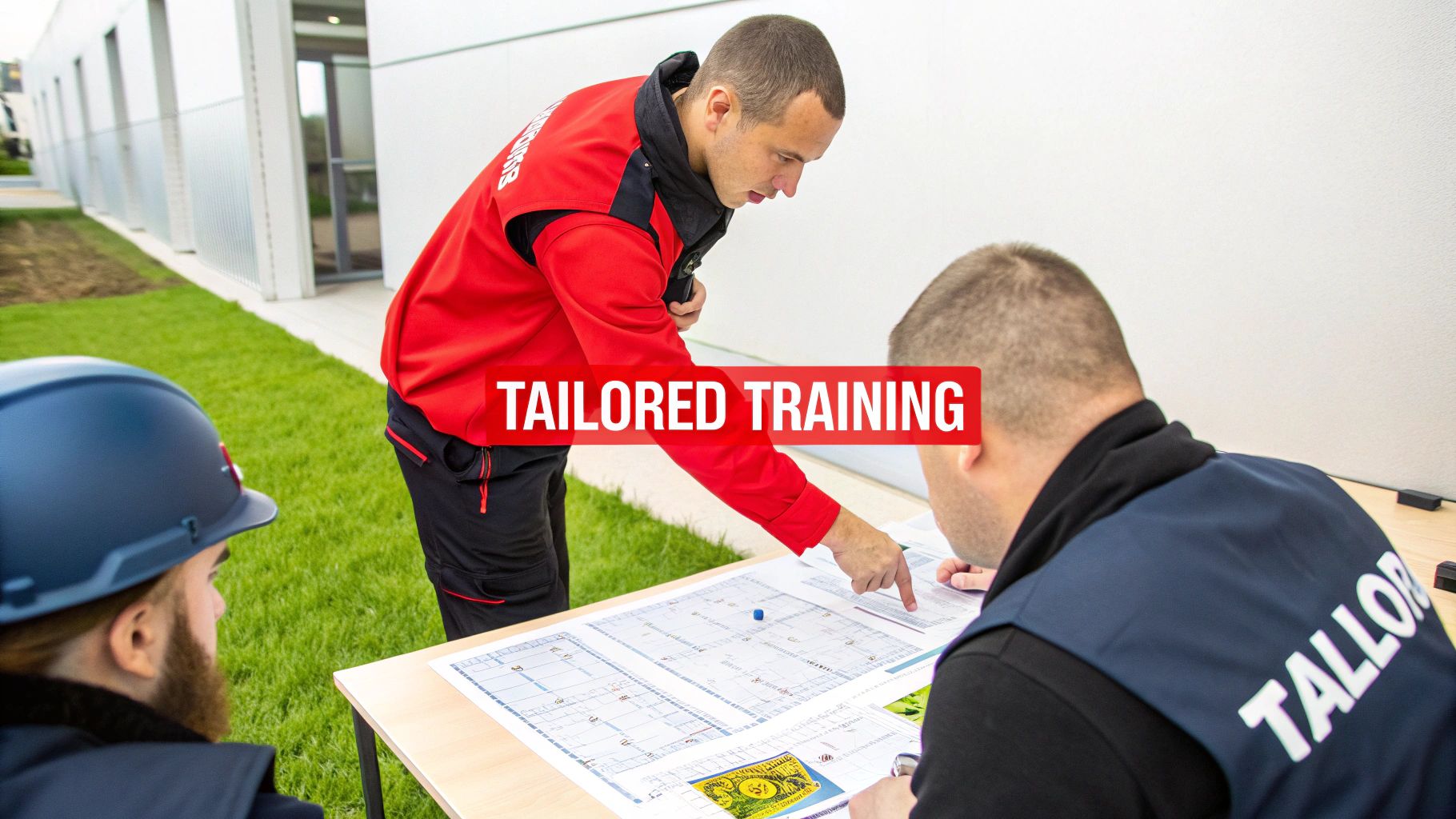
Let’s be blunt: a generic, off-the-shelf training program is a recipe for failure. It simply can’t account for the unique blend of risks your venue, event, or construction site faces every day. Building a genuinely effective security and training framework demands a thoughtful, custom-built approach that starts long before the first training module ever gets delivered.
The whole process kicks off with a detailed needs analysis. This isn’t just about ticking boxes; it’s about walking the floor, understanding the specific pressure points of your operation, and identifying the real-world challenges your team will actually encounter. A plan designed for a noisy, sprawling festival will be dangerously inadequate for a high-end retail store, and vice versa.
Starting with a Clear Needs Analysis
The first step is always a deep dive into your specific environment to build a comprehensive risk profile. We ask the tough but necessary questions to get a clear picture of your vulnerabilities and what you’re trying to achieve operationally. This has to be a collaborative process, not just a one-way security audit.
The goal is to move past assumptions and use real data to shape the training objectives. A proper analysis involves:
- Reviewing Past Incidents: What kind of issues have you dealt with before? Digging into incident reports reveals patterns that a good training program can directly address.
- Identifying High-Risk Areas: Pinpointing locations or times where incidents are most likely to flare up, like entry points during peak hours or isolated service corridors after closing.
- Understanding Your Patron Demographics: A family-friendly community event has wildly different security needs than a late-night music venue. The training has to reflect who you’re protecting.
Only after this detailed work can we define clear, measurable learning objectives. We move away from vague goals like “improve crowd control” to something specific, like “ensure every officer can clear an evacuation route in under three minutes during a simulated emergency.”
Choosing the Right Delivery Methods
With clear objectives locked in, the next step is picking the best ways to actually deliver the training. From our experience, a blended learning approach is almost always the most successful, simply because different skills are best learned in different ways.
Think of it like building a toolkit. You wouldn’t use a hammer for every single job, and the same logic applies to training. The trick is to match the method to the learning objective.
A well-designed security program combines different training styles to build both knowledge and practical skill. It ensures staff not only know what to do but have the muscle memory to do it correctly under pressure.
This means pulling from a mix of formats to create a truly well-rounded skillset:
- Classroom Learning: This is perfect for the foundational stuff—the legal theory, compliance rules, and the “why” behind their actions. This is where officers get their heads around state licensing laws or the finer points of RSA.
- Scenario-Based Training: Here’s where theory smacks into reality. Officers work through realistic, simulated situations—like handling an aggressive patron or spotting a potential theft—to practise their decision-making in a controlled, safe environment.
- On-Site Drills: These are absolutely essential for building team coordination and pressure-testing site-specific emergency plans. There’s no substitute for running a live evacuation drill or a medical response scenario on your actual premises.
This combination makes sure that the critical link between security and training is rock-solid, preparing your team for the challenges they will genuinely face on the ground.
A Practical Checklist for Evaluating a Provider
When you’re assessing a potential security partner, make sure their proposed training plan is actually fit-for-purpose.
Use this checklist:
- Needs Analysis: Did they conduct a thorough site visit and ask detailed questions about your specific risks and past incidents?
- Custom Content: Does the training plan address your unique environment (e.g., retail loss prevention, event crowd flow) or does it feel like a generic template?
- Blended Methods: Does the proposal include a mix of classroom theory, scenario-based practice, and hands-on, on-site drills?
- Clear Objectives: Can they define specific, measurable outcomes for the program, not just offer vague promises of “improvement”?
Frequently Asked Questions
How much input should I have in the training design?
A great deal. The best security providers see this as a genuine partnership. Your input on your business’s specific challenges, customer service standards, and operational flow is absolutely vital to creating a program that works in the real world.
Is e-learning effective for security training?
E-learning can be a fantastic tool for delivering foundational knowledge, refresher modules, and compliance updates in a really efficient way. However, it should never fully replace practical, hands-on training for skills like de-escalation or emergency response where muscle memory is key.
How to Measure the Success of Your Training

Investing in a custom security program is a big step, but how do you know if it’s actually working? Proving the value of security and training means looking beyond simple pass/fail grades. Real success shows up in tangible improvements to your daily operations and the overall safety of your environment.
It’s about shifting focus from ticking a box to observing genuine on-the-ground performance. When training truly lands, you’ll see it in how your team handles pressure, interacts with the public, and stops incidents before they even start. This is how you transform security from a line-item cost into a measurable, value-adding function that protects your people, assets, and reputation.
Key Performance Indicators for Security Training
To get a real handle on your program’s effectiveness, you need to set clear Key Performance Indicators (KPIs). Think of these as specific, measurable data points that prove the training is making a positive impact. Instead of guessing, you’ll have concrete evidence of your return on investment (ROI).
Once you’ve rolled out your security training, understanding its impact is everything. You can use a comprehensive guide to measuring training effectiveness to help build out a solid framework. Some of the most telling KPIs we track for our clients include:
- A Drop in Safety Incidents: This is the big one. We track the number of reported altercations, thefts, or accidents over a set period. A steady downward trend is the clearest sign that proactive training is paying off.
- Faster Conflict Resolution: How long does it take your team to de-escalate and resolve an issue? Shorter resolution times mean less disruption for everyone and a much safer atmosphere.
- Better Patron Feedback: Don’t just wait for complaints. Actively ask for feedback on your security team through surveys or comment cards. A jump in positive comments about staff being professional, helpful, and reassuring speaks volumes.
- Flawless Compliance Audits: Passing regulatory checks for RSA or site safety isn’t just about dodging fines. It’s solid proof that your team understands their compliance training and applies it consistently when it matters most.
Measuring success isn’t just about counting what went wrong; it’s about recognising what went right. Positive patron feedback and near-misses that were expertly handled are just as important as a drop in official incident reports.
Calculating the Return on Investment
Calculating the ROI of security training helps reframe it as a smart business decision, not just another operational expense. It’s about connecting training outcomes directly to financial results. For example, a measurable reduction in theft directly protects your bottom line, while fewer physical incidents can lower your insurance premiums and legal risks.
Actionable Insight: Create a simple dashboard to track your security KPIs month-over-month. Share this with your security provider. A good partner will use this data collaboratively to fine-tune training and continuously improve performance, proving their value beyond just showing up.
By tracking these KPIs, you create a powerful feedback loop. The data shows you exactly which parts of your security and training program are delivering the goods and where you might need to make a few tweaks. It ensures your investment continues to pay dividends in safety, efficiency, and peace of mind.
Frequently Asked Questions
How soon can I expect to see results from a new training program?
You should notice immediate improvements in staff confidence and how they follow procedures. But for measurable changes in KPIs, like fewer incidents, it can take three to six months for the data to show a clear, statistically significant trend as the team gets comfortable with their new skills.
What is the best way to collect patron feedback?
A mix of methods works best. Simple QR codes linked to a short survey can be placed at exits or on tables. It’s also smart to monitor online reviews and social media for any mentions of your security team’s conduct, both good and bad.
How do I track something as subjective as “better de-escalation”?
While it feels subjective, you can measure it through other metrics. Track the number of incidents resolved without ejecting a patron or calling law enforcement. If that number goes up, it’s a strong indicator that your team’s de-escalation skills are improving.
Your Security Training Questions Answered
When you’re responsible for protecting a business, navigating the world of security training and compliance can feel overwhelming. You need to make smart, confident decisions, and that starts with getting clear answers. Let’s break down some of the most common questions we hear from clients about security and training.
What’s the Absolute Minimum Training a Security Guard Needs in Australia?
The baseline for any security professional in Australia, regardless of the state, is a Certificate II in Security Operations. Think of it as the foundational driver’s licence for the industry – you can’t get on the road without it.
But that’s just the starting point. The real world of security is full of specialised roles, and those demand extra qualifications. A guard at a pub or club, for example, absolutely needs a Responsible Service of Alcohol (RSA) certificate. Someone working a major event will need specific crowd control endorsements on their licence. These aren’t optional extras; they’re legal requirements ensuring the guard has the right skills for that specific, often higher-risk, environment.
How Often Does a Security Team Need Refresher Training?
As a rule of thumb, we recommend annual refresher training for all core skills. This is especially true for things like first aid, emergency responses, and conflict de-escalation, where you need instinct and muscle memory to kick in under pressure.
Legally, some tickets like First Aid and RSA have hard expiry dates. A professional security partner will track these meticulously. It’s our job to ensure no guard is ever working on your site with lapsed credentials, keeping you 100% compliant and your operations safe.
Beyond the legal minimums, regular training is simply good practice. It stops skills from getting rusty and keeps the team up-to-date with any new threats or changes in procedure.
Can We Just Do On-the-Job Training Instead of Formal Courses?
In a word: no. While on-the-job training is incredibly important, it complements formal training – it doesn’t replace it. On-site training is perfect for teaching your venue’s specific emergency exits, your unique operational procedures, and the customer service style that reflects your brand.
However, it is not a substitute for the nationally recognised qualifications needed to legally hold a security licence in Australia. That formal certification is your guarantee that an officer has met a consistent, industry-wide standard of knowledge before they even arrive on your property. For legal and insurance reasons, this foundation is completely non-negotiable.
Ready to partner with a security provider that puts training and compliance first? The team at GM GROUP Services delivers highly skilled, licensed, and site-ready security professionals for venues, events, and businesses across Australia. Contact us today to build a security plan that protects your people and your reputation.
Discover more from GM Group Services
Subscribe to get the latest posts sent to your email.