
Let’s be honest, choosing a security provider can feel like navigating a minefield. It’s easy to see it as just another expense, a box you have to tick. But thinking of security and patrol services as a cost is the first mistake. It’s actually one of the smartest investments you can make to protect your people, your property, and your hard-earned reputation.
This guide is for event organisers and site managers who need to get this right. We’ll cut through the jargon and give you the confidence to find a security partner that’s a perfect fit.
Why a Good Security Patrol Is More Than Just a Guard in a Uniform
For a lot of managers, security is a reactive measure—you hire someone just in case things go pear-shaped. The real game-changer is switching that mindset. A well-planned security and patrol strategy is all about being proactive. It’s a visible deterrent that stops trouble before it even starts, preventing disruptions that can cost you money, tarnish your brand, or worse, create a dangerous environment.
Practical Example: Think about a major food and wine festival. A top-notch patrol team isn’t just standing around waiting for a fight to break out. They’re creating a sense of order and safety. Their presence alone discourages opportunistic thieves. They’re managing the flow of the crowd to prevent bottlenecks and identifying potential risks, like an unattended bag or an overloaded generator, long before they become a real problem.
The return on that investment isn’t just a quiet night. It’s a safe, positive experience that makes your guests feel looked after and eager to come back next year.
The Real Pay-Off of Professional Patrols
Professional security and patrol services bring so much more to the table than just having a person on-site. The real value is in the structured, planned approach they take—one that should blend right in with your own operations.
Here’s what you’re really paying for:
- Protecting Your Assets: Regular, visible patrols are a massive deterrent to theft, vandalism, and trespassing. This directly protects your bottom line.
- Guarding Your Reputation: When customers, staff, and guests feel safe, they trust you. That trust is priceless for your brand.
- Lowering Your Liability: Proper security measures and meticulous incident reports are your best friends when it comes to insurance claims or legal issues.
- Keeping the Doors Open: By preventing incidents before they happen, a great patrol service ensures your event or business runs without a hitch and without costly shutdowns.
Actionable Insight: A well-designed security patrol isn’t just about someone walking a set route. It’s a key part of your safety plan, built to tackle genuine risks efficiently while giving you clear, verifiable proof of what’s been done. Ask a potential provider to show you a sample patrol report so you can see the level of detail they provide.
Ultimately, we’re going to give you a clear roadmap to make the best choice. We’ll cover everything from the different types of patrols and standard procedures to the specific compliance rules in NSW, VIC, and QLD. The goal is to arm you with practical knowledge so you can find a security provider that gives you real value and, most importantly, peace of mind.
Matching the Right Patrol Type to Your Needs
Choosing the right kind of security patrol isn’t a one-size-fits-all decision. In fact, getting it wrong can be the difference between a secure site and a false sense of safety. The key is to match the patrol strategy to your specific environment and risks. You wouldn’t use a hammer to turn a screw, and you wouldn’t use a vehicle patrol to secure a crowded indoor music festival.
Understanding the fundamental differences between patrol types is the first step. Let’s break down the most common options so you can figure out which approach—or combination of them—is the right fit for your situation.
If you’re feeling a bit overwhelmed by the options, this simple decision tree can help guide your thinking.
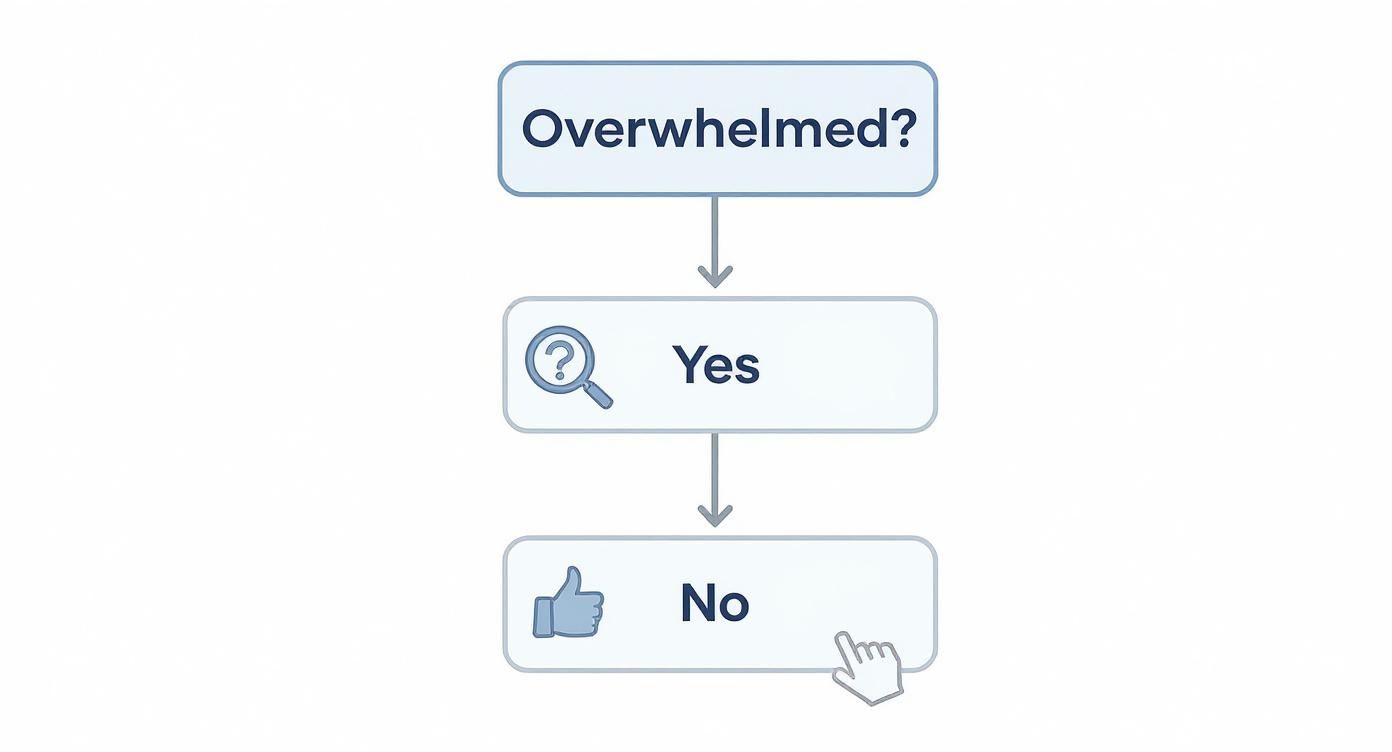
As you can see, it always starts with taking a good, hard look at your needs before jumping into solutions.
High-Visibility Patrols for Deterrence
When your main goal is to stop trouble before it starts, a visible security presence is your most powerful tool. These patrols are designed to be seen, acting as a powerful psychological barrier for anyone considering opportunistic crime.
- Foot Patrols: These are the gold standard for places with high foot traffic or complex layouts. Think of a busy shopping centre, a multi-storey hotel, or a sprawling music festival. Guards on foot can easily navigate crowds, check tricky areas like stairwells and back corridors, and interact with the public, offering help while reinforcing a feeling of safety.
- Vehicle Patrols: For large, spread-out areas, vehicle patrols are incredibly efficient. A university campus, a large industrial park, or even a massive car park are perfect examples. A single marked security car can cover a huge amount of ground quickly, creating that all-important visible presence much more effectively than someone on foot.
- K9 Units: This is a specialised and highly effective option for higher-risk situations. The mere presence of a professionally trained security dog can be enough to de-escalate a tense crowd or deter troublemakers at major events. They’re also brilliant for screening for prohibited items, like explosives or narcotics, at entry points.
Covert Operations for Internal Threats
Sometimes, the biggest threats don’t come from the outside. If you’re dealing with suspected internal issues—like employee theft or serious policy breaches—a visible guard can actually be counterproductive. It just encourages offenders to get better at hiding what they’re doing.
Actionable Insight: Experiencing unexplained stock losses in your retail store or warehouse? A covert or ‘plain clothes’ security operative is your best bet. They can blend in as a customer or new staff member to observe behaviour without raising suspicion, allowing them to gather evidence you’d never get otherwise.
This discreet approach is all about intelligence gathering rather than overt deterrence. It’s a completely different discipline.
Understanding Different Service Models
Beyond the type of patrol, you need to think about the service model. This is all about how the security team is deployed on your site.
To make this clearer, I’ve broken down the main patrol types into a simple comparison table. It shows what each is best used for and highlights their main advantages, which should help you pinpoint what makes the most sense for your property or event.
Choosing the Right Patrol Type for Your Needs
| Patrol Type | Best Suited For | Key Advantages |
|---|---|---|
| Static Guard | A guard assigned to a fixed post, like a gatehouse, reception desk, or loading dock. | Ideal for controlling access points, monitoring CCTV, and protecting high-value assets in a specific spot. |
| Mobile Patrol | A patrol team visits multiple sites on a randomised, unpredictable schedule. | A cost-effective way for businesses to get after-hours security checks without the expense of a full-time guard. |
| Roving Patrol | Guards who continuously move throughout a single, large site. | Perfect for maintaining a constant and visible presence across a large venue like a hospital, university campus, or major event. |
Practical Example: A construction site might have a static guard at the main gate during working hours to log all visitors and deliveries. Then, after hours, they could switch to a mobile patrol service that performs several random checks throughout the night to make sure the perimeter is secure. This kind of layered approach delivers comprehensive coverage while being smart with the budget.
The Blueprint for a Professional Security Operation
What separates a truly professional security team from a group of people in uniforms? It’s not just about looking the part. The real difference lies in the stuff you don’t see—the systems, the procedures, and the constant training that forms the operational backbone of any effective security and patrol service.
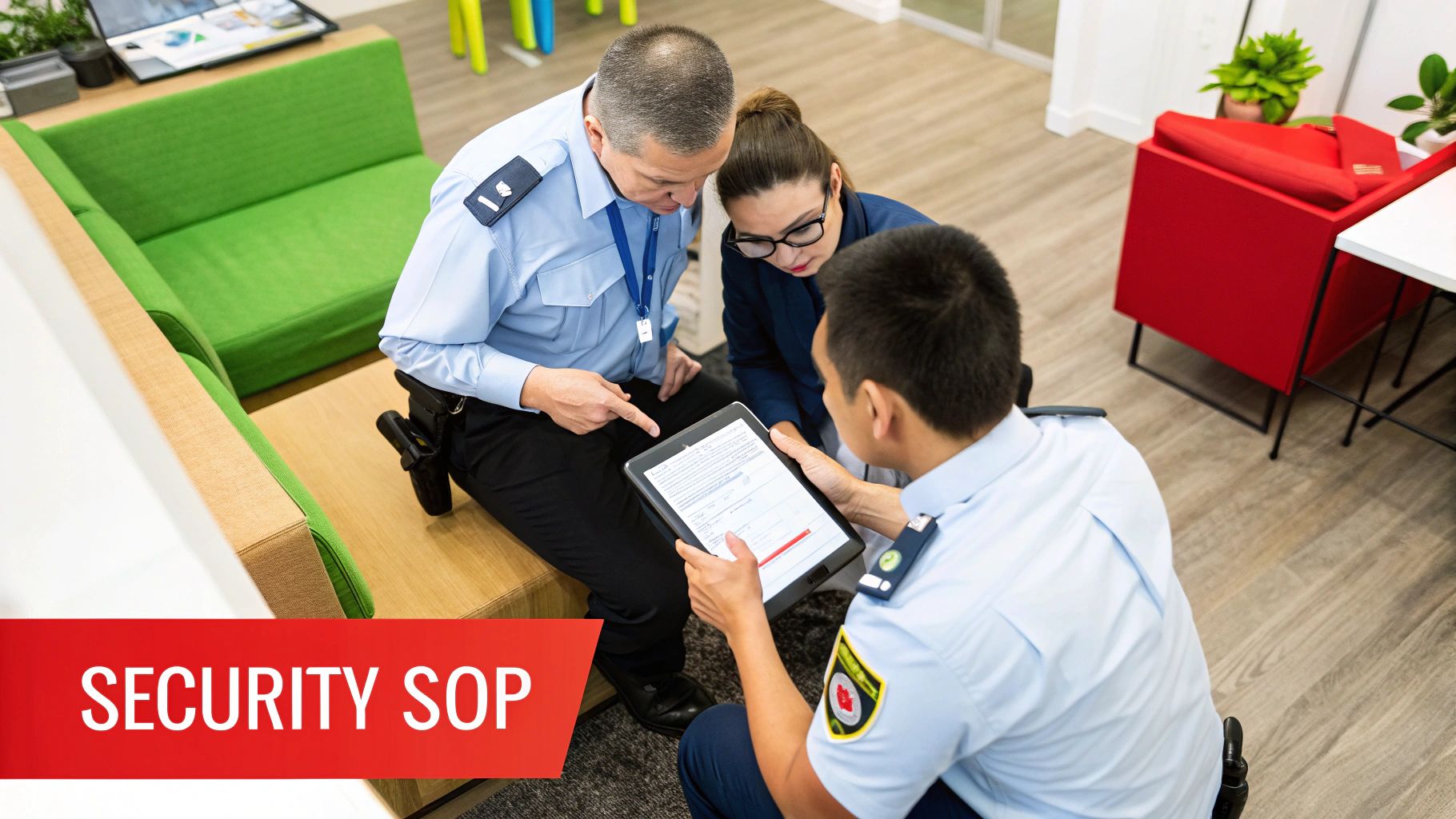
Great security isn’t about guesswork or improvisation. It’s built on a foundation of clear, repeatable processes that ensure every guard acts consistently, effectively, and accountably, no matter what gets thrown at them. At the very heart of this are Standard Operating Procedures (SOPs).
Think of an SOP as a detailed playbook. It tells your security team exactly what to do in any given scenario, from a routine patrol to a critical emergency. This takes the ambiguity out of the equation and guarantees a high standard of service across the board. It transforms a security response from a knee-jerk reaction into a planned, professional action.
Anatomy of an Effective SOP
A solid SOP is far more than a simple list of rules. It’s a step-by-step guide designed to prioritise safety, clear communication, and legal compliance. Let’s walk through a common situation to see how a well-crafted SOP plays out on the ground.
Practical Example: Handling an Unauthorised Person
- Observe and Assess: A guard spots someone in a restricted area. The first move isn’t to rush in, but to safely observe from a distance, assess the person’s behaviour, and check for any immediate threats.
- Initial Approach and Communication: The guard approaches calmly and professionally, using open body language. They’ll introduce themselves and politely ask why the person is there, using de-escalation language to keep things from getting heated.
- Verification and Direction: If the person is cooperative, the guard can check their credentials or simply point them in the right direction. The interaction is logged. Simple.
- Escalation: But what if the person becomes hostile or refuses to leave? The SOP dictates the next moves: radio for backup, contact the site manager, and, if it comes to it, alert the police—all without physically escalating the situation.
- Reporting: As soon as the situation is resolved, every detail is documented in an incident report.
This structured approach ensures every officer on your site handles the situation with the same level of professionalism, which dramatically reduces your liability.
Why Incident Reports Are Not Just Paperwork
After something happens, the incident report is your most critical document. It’s not just administrative busywork; it’s a vital tool that serves several crucial functions. A well-written report provides a clear, factual, and chronological account of what happened, when, and who was involved.
Actionable Insight: A detailed incident report is your primary evidence for insurance claims, your legal defence in case of disputes, and your best source of intelligence for preventing future problems. It turns a reactive event into a proactive lesson. Ask potential providers about their incident reporting software – modern systems allow for real-time updates and photo attachments directly from the field.
This kind of meticulous documentation is the hallmark of a professional security and patrol service. It proves accountability and gives you the data needed to continually strengthen your overall security posture.
Evaluating Personnel Quality Beyond the Licence
Ultimately, any security operation is only as good as its people. While every guard must hold the correct state-issued licence, that’s just the ticket to the game. The best providers invest heavily in ongoing training and development. The principles of capacity-building and sharing knowledge are key to operational readiness, a philosophy mirrored by international groups like The African Union Mechanism for Police Cooperation (AFRIPOL), which works to improve the skills of police forces across its member states.
When you’re assessing a security provider, dig deeper than the licence. Ask specifically about their training in these areas:
- Conflict De-escalation: The ability to talk down a tense situation is far more valuable (and safer) than physical intervention.
- First Aid and CPR: Guards are often the first on the scene of an incident. This training can, and does, save lives.
- Customer Service Skills: Especially for events and hospitality venues, your guards are ambassadors for your brand. They need to be approachable, helpful, and professional at all times.
By looking beyond the uniform and focusing on the SOPs, reporting standards, and personnel training, you can accurately gauge the quality of a security provider and make sure you’re investing in a truly professional operation.
Getting the Paperwork Right: Security Licensing Across Australia
Hiring a security provider without the right licences isn’t just a simple oversight—it’s a massive legal and financial gamble. Every Australian state and territory has its own rulebook, and the buck stops with you, the client, to make sure your provider is compliant. Get it wrong, and you could be facing serious fines and leaving your business wide open to risk.
Think of licensing as the industry’s baseline for quality and safety. It’s proof that the company and its guards have cleared the necessary background checks, completed proper training, and are held to a professional standard. Hiring an unlicensed operator is like letting an uncertified electrician rewire your building; you’re just asking for trouble.
Let’s cut through the jargon and focus on what you actually need to check to keep your operations safe and legal across the eastern states.
What to Look For in Each State
While the names change from state to state, the core idea is the same: the business needs a master licence to operate, and every guard on the ground needs their own personal licence. Your job is to check both.
- New South Wales (NSW): In NSW, the Security Licensing & Enforcement Directorate (SLED) calls the shots. Your provider must show you their Master Licence. Each guard needs a Class 1 licence, and you need to check the subclass matches the job (like 1A for an unarmed guard or 1C for a crowd controller).
- Victoria (VIC): Down in Victoria, it’s the Licensing and Regulation Division (LRD) of Victoria Police that’s in charge. The company needs a Private Security Business Licence, and every guard must hold a Private Security Individual Operator Licence.
- Queensland (QLD): The Office of Fair Trading handles things up north. A provider must have a Security Firm Licence, and individual officers need a Security Provider Licence that covers the specific duties they’ll be performing for you.
There’s no grey area here. A provider trying to work without these credentials is operating illegally, and by hiring them, so are you.
Your 3-Step Verification Checklist
Verifying a licence is simple once you know how. Don’t just take their word for it—always see the proof for yourself.
- Ask for a Copy: Request a copy of the company’s main business licence and a few examples of the individual licences for the guards who will be assigned to your site.
- Check the Official Online Register: This is the most important step. Each state has a public database where you can enter a licence number and verify it instantly. A physical card can be faked, but the government portal is the source of truth.
- Match the Licence to the Job: Make sure the guard’s licence permits the work you need done. A guard in NSW with a 1A (unarmed patrol) licence can’t legally step in to do crowd control. It’s a small detail that can have huge consequences.
Actionable Insight: Your best defence is the five minutes it takes to check a licence on the official government portal. This simple action protects your business from the massive legal and financial fallout of hiring an illegitimate operator. Bookmark the public registry pages for your state so you can perform checks quickly.
This level of due diligence is fundamental to creating a secure environment. It’s the same principle applied on a much larger scale in major security initiatives, like international peacekeeping missions. Those operations depend entirely on verified credentials and clear mandates to be effective. For instance, the African Union’s ‘Silencing the Guns’ initiative relies on legitimate, coordinated forces to stabilise entire regions. You can see how these principles work on a global stage at the African Union Peace and Security Department.
By taking licence verification seriously, you’re not just ticking a box; you’re ensuring your security partner is a professional, accountable, and legitimate asset to your team.
How to Confidently Choose Your Security Provider
Picking a security provider can feel like a massive decision, and frankly, it is. You’re not just hiring guards; you’re placing your trust in a partner to protect your people, your assets, and your reputation. This isn’t about falling for a slick sales pitch—it’s about making a smart, confident choice based on solid evidence.
The real work starts long before you even think about asking for a quote. It begins with taking a hard look at your own vulnerabilities. After all, you can’t find the right solution if you haven’t properly diagnosed the problem first.

Start with a Practical Risk Assessment
Before you even speak to a security company, do your own risk assessment. This simple exercise puts you in the driver’s seat by helping you figure out exactly what you need to protect. It makes you a much smarter buyer.
Walk your site—whether it’s a festival ground, a construction zone, or a hotel lobby—and try to think like an opportunist. Where are the weak spots?
- Pinpoint High-Risk Areas: Look for spots like poorly lit car parks, back entrances that are out of sight, cash handling areas, or isolated stairwells.
- Identify Time-Based Threats: Does the risk jump at certain times? Think about late-night closing, shift changes, or during big public events.
- Get Specific About Vulnerabilities: Are you worried about vandalism? Unauthorised access? Internal theft? Public safety? The more specific you are, the better.
This initial assessment gives you the concrete details you need for a meaningful conversation with potential providers. Instead of vaguely asking for “a guard,” you can ask for a patrol strategy that directly targets the risks you’ve already identified.
Before diving into quotes, it’s worth mapping out your findings. A simple checklist can help you organise your thoughts and present a clear picture of your needs to potential security partners.
Site Security Risk Assessment Checklist
| Area of Concern | Risk Level (Low/Medium/High) | Specific Threats | Action Required |
|---|---|---|---|
| Perimeter Fencing/Gates | Unauthorised entry, vandalism | Inspect fence integrity, review lock-up procedure | |
| Car Park / Loading Docks | Theft from vehicles, loitering, poor lighting | Assess lighting, consider CCTV or vehicle patrols | |
| Main Entrance / Lobby | Unauthorised access, public disturbance | Review access control, define staff response protocol | |
| Cash Handling Areas | Internal theft, robbery | Evaluate cash transit procedures, staff training | |
| Isolated Areas (Stairwells, Corridors) | Unsafe for staff/public, vandalism | Check lighting, consider regular foot patrols | |
| High-Value Asset Storage | Burglary, internal theft | Verify alarm systems, restrict key access | |
| Public-Facing Areas | Anti-social behaviour, public safety incidents | Plan for visible security presence during peak hours |
This checklist isn’t just a to-do list; it’s your blueprint for building a security plan that actually works for your specific site.
Decoding Contracts and Costs
Once you’ve shortlisted a few providers, the service agreement is where the rubber meets the road. Any professional company will provide a transparent, detailed contract. Your job is to look past the headline hourly rate and get into the fine print.
Here are the non-negotiables to check in any security agreement:
- A Crystal-Clear Scope of Work: The contract must spell out the duties, patrol routes, and post orders. Any ambiguity here is a recipe for future disputes.
- Proof of Insurance: It must state that the provider holds adequate Public Liability and Workers’ Compensation insurance. Don’t just take their word for it—always ask for a current Certificate of Currency.
- Transparent Pricing: Is the quote genuinely all-inclusive? Watch out for hidden costs like uniforms, equipment, or after-hours call-out fees.
- The Termination Clause: Make sure you understand the notice period and the conditions for ending the contract if the service isn’t up to scratch.
Actionable Insight: A clear, comprehensive contract is the foundation of accountability. It protects both you and the provider by setting firm expectations and creating a solid framework for your partnership. Don’t be afraid to ask for amendments to clarify any vague terms before you sign.
Measuring What Matters Most
So, how do you know if your security provider is actually delivering value for money? The key is to establish clear Key Performance Indicators (KPIs) right from the start. These are the tangible metrics you’ll use to measure their effectiveness.
Good KPIs go beyond just having a person on-site; they measure real performance and hold the provider accountable.
Actionable KPIs to Track
- Incident Report Quality: Are reports detailed, timely, and clear? A well-written report is the hallmark of a professional operation.
- Mobile Patrol Response Time: If you’re using mobile patrols, what is their guaranteed response time for an alarm or a call-out? Track this metric religiously.
- Checkpoint Completion Rate: For larger sites, technology like QR codes or NFC tags can prove that guards have physically visited every critical checkpoint on their route. You should be aiming for a 100% completion rate.
This data-driven approach is what separates reactive security from proactive protection. On a much larger scale, organisations like the African Union use their Continental Early Warning System (CEWS) to map risks and forecast threats, allowing them to deploy security assets more effectively across member states. You can learn more about this strategic approach at the African Union Peace and Security Council. By using clear KPIs, you can hold your provider to a high standard and ensure you’re getting the proactive security you’re paying for.
Frequently Asked Questions About Security and Patrol
Once you’ve got a handle on the basics of finding and managing a security provider, a few practical questions always seem to pop up. Let’s tackle the most common ones I hear from site managers and event organisers, so you can lock in those final details with confidence.
How much does security and patrol cost in Australia?
There’s no simple price tag for security and patrol services. The cost can swing pretty wildly depending on what you need, where you are, and the level of skill involved. It’s a bit like booking a hotel – a standard room has one price, but the penthouse suite with all the trimmings is in another league entirely. As a rough guide, a mobile patrol visit can range from $35 to $55, while a dedicated static guard typically costs between $45 and $80+ per hour. Rates climb for guards with specialised skills, for public holiday shifts, or for high-risk environments. To avoid any nasty surprises, always insist on a detailed quote that breaks down every single cost.
What insurance must my security provider have?
This is non-negotiable. Your security provider must have two key types of insurance. The first is Public Liability Insurance, and you shouldn’t accept anything less than $20 million in coverage. This protects you if a third party is injured or has their property damaged due to the security team’s actions. The second is Workers’ Compensation, which covers the guards themselves if they’re injured on your site.
Actionable Insight: Before you sign anything, ask to see their current Certificate of Currency for both policies. A legitimate provider will have these ready to hand over. Don’t just take their word for it; verifying these documents is your best defence.
Should my security patrols be visible or discreet?
The right answer is all about your objective. A highly visible patrol, with uniformed officers and marked cars, is a fantastic deterrent for public events, shopping centres, or construction sites. The goal is to stop trouble before it even starts. A discreet or covert patrol is what you need when you’re trying to figure out an internal issue like employee theft. In this scenario, a visible guard might just encourage culprits to be sneakier, whereas a plain-clothes operative can gather intelligence without raising suspicion.
What are the first steps after a serious security incident?
When something serious happens, a calm and clear response is everything. Your team and the security provider’s standard operating procedures (SOPs) need to be perfectly in sync.
- Prioritise Safety: Ensure everyone is safe, guide people away from danger, and secure the area to prevent escalation.
- Contact Emergency Services: If there are injuries or any ongoing threat, call Triple Zero (000) immediately.
- Notify Your Security Manager: Alert your main contact at the security company so they can activate their response protocol.
- Preserve the Scene: Do not touch or move anything unless necessary for safety. The area is a potential scene for police or insurance assessors.
Your security guards are trained to manage the scene, begin documentation, and act as the point of contact for emergency services, ensuring the incident is handled professionally from the start.
Managing site safety is a huge responsibility, but you don’t have to go it alone. For a security partner that delivers professional, reliable, and friendly security and patrol services across NSW, VIC, QLD, and the ACT, trust GM GROUP Services. We work with you to create a safe environment that protects your people, assets, and reputation. Contact us today for a comprehensive risk assessment.
Discover more from GM Group Services
Subscribe to get the latest posts sent to your email.