
Security alarms systems matter most when something has already gone wrong. A venue manager arrives before opening and finds a rear door forced. A construction supervisor gets a call that tools are missing before the morning shift starts. An event organiser learns that someone accessed a restricted area overnight and no one knows when it happened.
That's the point where most operators realise a siren alone was never the plan. They needed a system that detected the issue early, transmitted it reliably, triggered a response, and supported the decisions that followed. For Australian businesses, venues, and temporary sites, that's what well-designed security alarms systems are for.
Why Modern Security Alarms Systems Are Foundational for Your Business
At 2:13 am, a detector trips at your warehouse, venue, or temporary site. What happens in the next two minutes matters more than the siren itself. If the signal is clear, routed properly, and tied to an agreed response, you have a chance to contain loss, verify the threat, and decide whether a guard, keyholder, or police response is warranted.
That is why modern security alarms systems sit at the centre of business protection. They are not just electronic hardware. They are the trigger point for an operational security process that has to work after hours, under pressure, and often without your staff on site.
For Australian businesses, the key value is not limited to high-crime locations. I see stronger returns where interruption is expensive. A hotel cannot leave plant faults unnoticed overnight. A licensed venue cannot afford uncontrolled access to cash, stock, or restricted rooms. An event organiser cannot treat an after-hours perimeter breach as a minor incident when the same weakness can affect crowd safety, contractor access, and insurance exposure the next day.
What a business-grade alarm actually does
A business-grade alarm system gives your team an early, usable alert and a framework for acting on it. That distinction matters. Plenty of sites have devices installed. Fewer have a system configured around actual operating risk, nominated responders, access procedures, and verification steps that reduce false dispatches.
In practical terms, a well-designed setup should do four jobs:
- Detect the right event at the right point: That may be a forced door, movement in a restricted area, a perimeter breach, or an equipment fault after hours.
- Send a reliable signal off site: An alarm has limited value if the alert stays local or reaches the wrong person too late.
- Support a defined response plan: Monitoring staff, mobile patrols, on-site guards, keyholders, and emergency services all need clear escalation rules.
- Protect business continuity: Alarm inputs often extend beyond intrusion to include duress, fire interface, temperature, water ingress, power loss, and plant alarms.
The trade-off is straightforward. More coverage is not always better coverage. Poorly placed sensors, bad zoning, or vague user procedures create nuisance alarms, wasted patrol callouts, and staff who stop taking activations seriously. Good alarm design balances sensitivity with control, then matches the system to how the site operates.
Practical rule: If an alarm activation does not lead to a clear decision, the system is underperforming.
This is also where many business owners get caught out. They buy to a specification sheet instead of an operating model. The better question is not, “What panel should we install?” It is, “Who gets the signal, how is it verified, what happens next, and what evidence do we keep?” Once those answers are clear, the technical specification becomes much easier to get right.
That operational view matters across Australia because alarm performance is tied to response protocols, guard attendance, and state-based requirements around false alarms and licensed security activity. A system that works on paper can still fail in practice if no one has authority to attend, if access instructions are outdated, or if repeated false alarms damage confidence in the site. For that reason, the strongest alarm systems are usually part of a wider protection plan that includes monitoring, documented escalation, and human response where the risk justifies it.
The Three Primary Types of Security Alarms
Most buying mistakes happen before the first sensor is installed. The client asks for “an alarm system” when what they really need is protection against a specific risk. For one site, that risk is forced entry. For another, it's a fence breach. For another, it's a freezer fault or water leak after hours.
Comparison of Security Alarm System Types
| Alarm Type | Primary Function | Common Business Use Case |
|---|---|---|
| Intrusion alarm | Detects unauthorised entry into buildings or restricted internal areas | Retail store, office, licensed venue |
| Perimeter alarm | Detects approach or breach at the site boundary before entry to a structure | Festival grounds, depot, construction site |
| Environmental alarm | Detects non-criminal threats that affect safety or continuity | Server room, kitchen, cool room, plant room |
Intrusion alarms for doors, rooms, and internal movement
Intrusion alarms often come to mind first. They're built to detect unauthorised access into a building or specific internal zone.
Typical devices include door contacts, window contacts, motion detectors, glass-break sensors, and panic buttons. In a retail setting, that might mean protecting front entry points, storerooms, and cash-office areas. In hospitality, it often means separating public space from restricted stock, office, and plant areas.
These systems work well when the threat is entry into the premises. They're less useful as a stand-alone measure if the primary problem starts outside, such as perimeter climbing, loitering near compounds, or vehicle access to a temporary event site.
Perimeter alarms for earlier warning
Perimeter alarms shift the alert point outward. Instead of waiting for someone to reach a building, they create a monitored boundary around the property.
That boundary can be useful for:
- Construction sites: Detecting after-hours trespass before offenders reach containers, fuel, or plant.
- Events and festivals: Identifying fence breaches or restricted-area access before they develop into wider crowd-management issues.
- Industrial yards: Protecting open storage and external assets that aren't inside a traditional building envelope.
A perimeter alarm is often the better lead control when your critical assets sit outside, or when response time depends on getting an earlier warning than an internal PIR can provide.
On open sites, the best alarm point is rarely the back door. It's usually the line an intruder crosses before they ever reach it.
Environmental alarms for continuity, not just crime
Environmental alarms are frequently overlooked because they don't sound like “security” in the traditional sense. They should still be part of the conversation.
For a restaurant, that can mean temperature alerts tied to refrigeration risk. For an office or data room, it can mean heat, water ingress, or power-loss supervision. For a venue, it can mean plant faults that create operational shutdowns long before a criminal incident occurs.
The best commercial systems don't force a false choice between security and continuity. They allow both. That matters because after-hours loss doesn't always begin with a person. Sometimes it begins with equipment failure, moisture, heat, or an unnoticed outage.
Anatomy of a Modern Commercial Security Alarm System
When clients review quotes, they often see a list of devices without understanding what each part contributes. A stronger way to assess security alarms systems is to look at the job each component performs inside the whole.
Here's the visual layout most businesses should understand first.
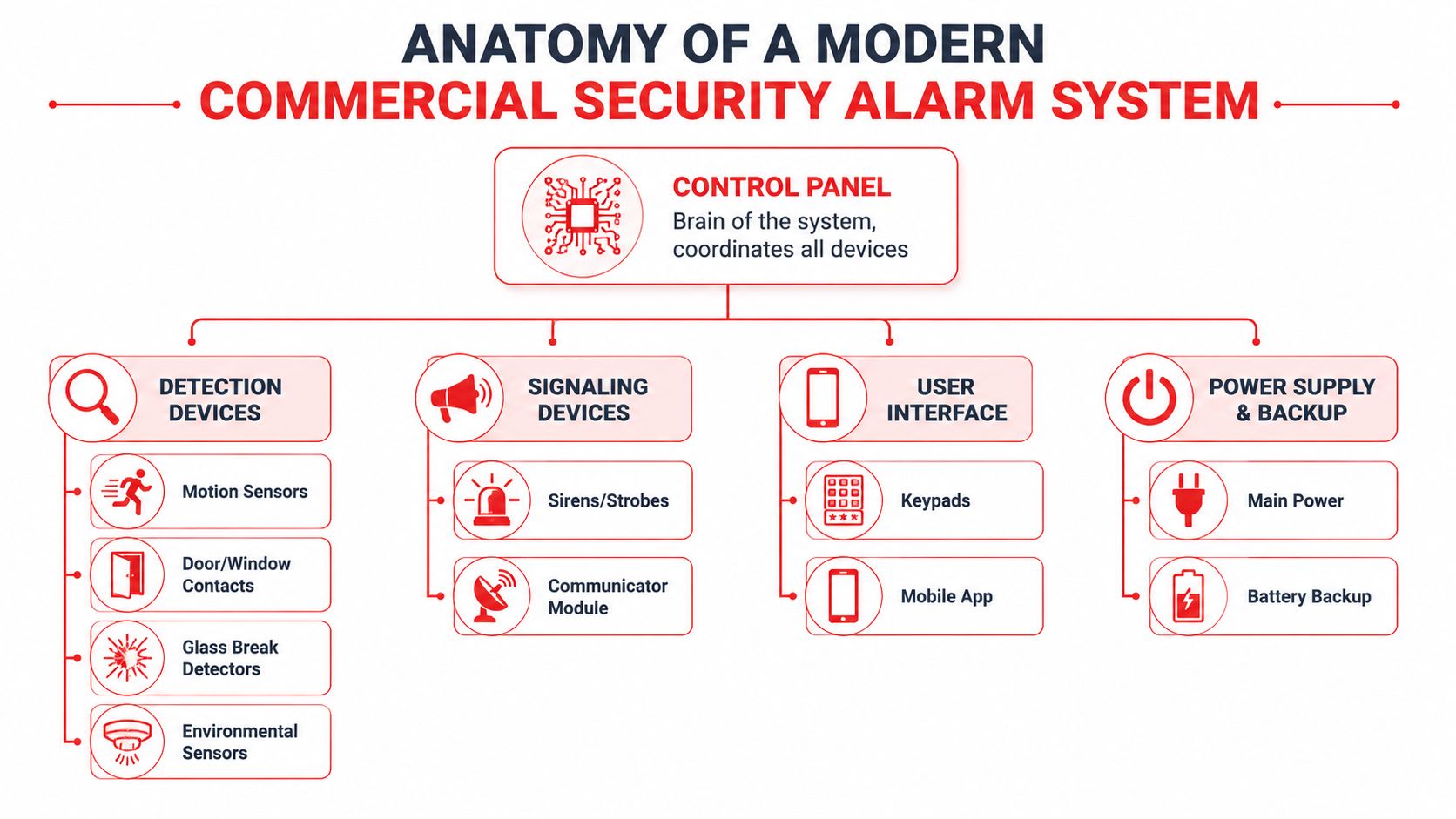
The control panel is the brain
The control panel receives inputs from different zones, applies programmed rules, and decides what event is being reported. In monitored Australian systems, this panel commonly aggregates zone inputs and transmits events over dual-path communications, typically IP plus cellular, so a single network fault doesn't stop alarm reporting, as described in this overview of Australian monitored alarm architecture.
That design matters on real sites. If someone cuts an NBN or ethernet connection, or if a local fault affects one path, the system still has another route to report the alarm.
Sensors are the system's eyes and ears
A control panel without good field devices is useless. The right sensor mix depends on the risk.
Common components include:
- Motion detectors: Best for internal room coverage and movement through protected spaces.
- Door and window contacts: Useful where you need precise status on openings and access points.
- Glass-break detectors: Helpful where smash-and-grab entry is a realistic threat.
- Panic or duress devices: Critical where staff may need immediate assistance without moving to a fixed point.
The trade-off is straightforward. More devices don't always mean more protection. Poorly chosen devices create nuisance activations. Well-chosen devices create clear, reliable alarm events.
Communication, power, and user control decide reliability
The parts clients under-value are often the ones that decide whether the system works when it's needed.
Pay close attention to:
- Dual-path signalling: One path is not enough for most commercial sites.
- Battery backup: Power failure shouldn't take your reporting layer offline.
- Keypads and user permissions: If everyone uses the same code or no one knows the arm-disarm sequence, accidental activations become inevitable.
A good installer should be able to walk you through the site map, explain every zone in plain English, and tell you what happens if power, internet, or one communication path fails. If they can't, the specification probably hasn't been designed around operational reality.
From Detection to Response With Back to Base Monitoring
It is 2:13 am. A rear roller door at your warehouse opens outside approved hours, the alarm activates, and an app notification lands on a manager's phone that is set to silent. By the time anyone sees it, the site has been entered, stock is gone, and the CCTV review starts too late. Commercial alarming has to do more than report an event. It has to trigger a defined response.
That is the practical value of back-to-base monitoring. Instead of pushing responsibility onto whoever happens to receive an alert, the system sends alarm events to a monitoring centre that works from agreed instructions, site notes, and escalation rules. For Australian businesses, that matters most where response decisions need to line up with after-hours access, keyholder availability, guard attendance, and the conditions for police or patrol dispatch.
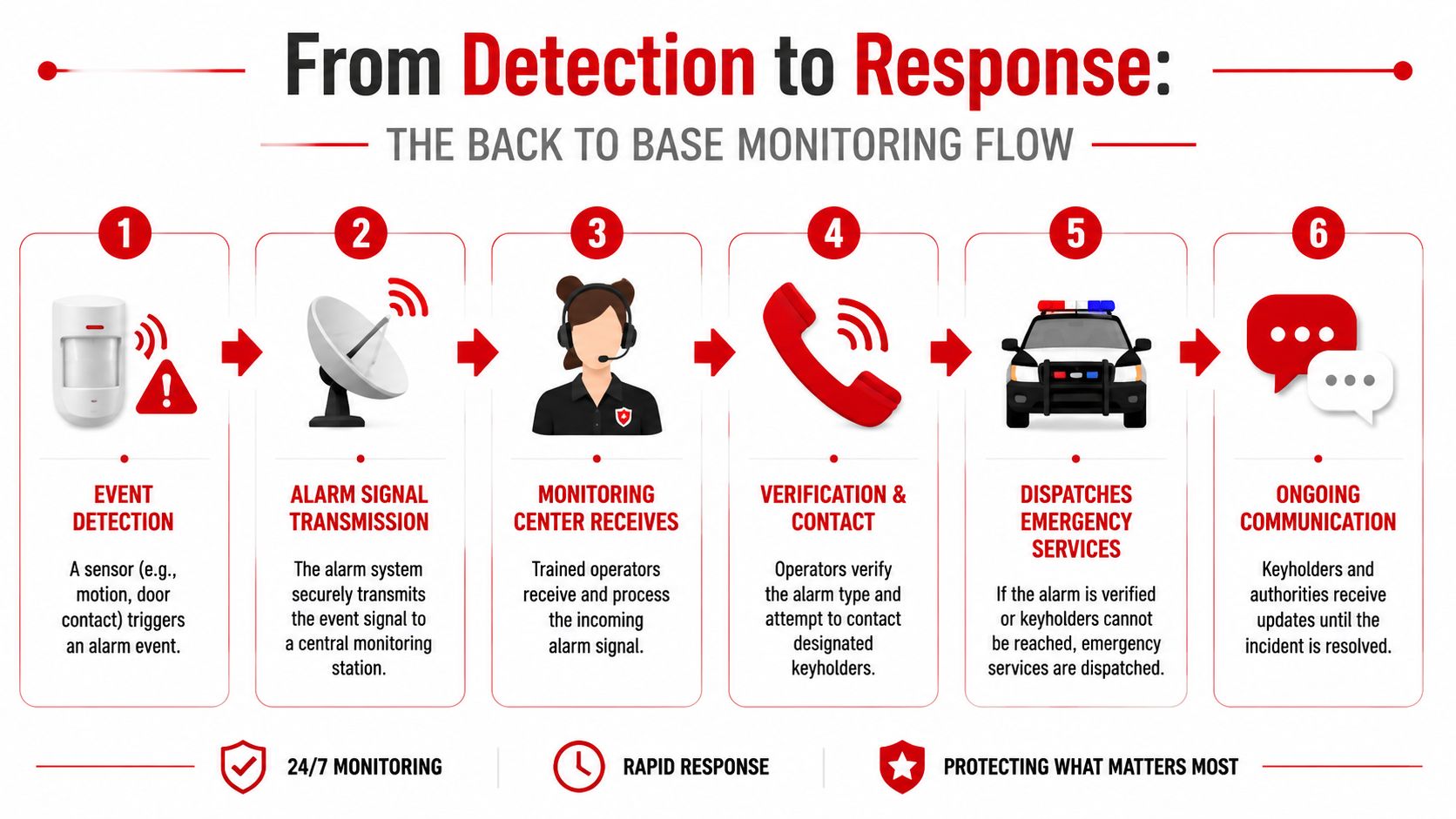
Self-monitoring versus monitored response
Self-monitoring can suit a low-risk site where a responsible person is always available and the consequence of delay is minor. That is not how many commercial sites operate. Hospitality venues, event sites, depots, schools, and multi-tenant buildings often have shifting staff coverage, contractor access, and periods where no competent person can assess an alarm properly.
The key comparison is operational, not technical.
| Model | What happens after an alarm | Where it tends to fall short |
|---|---|---|
| Self-monitoring | App, SMS, or owner notification | Alerts can be missed, delayed, or assessed without enough site context |
| Back-to-base monitoring | Monitoring centre receives event and follows response protocol | Only works well if contact lists, response rules, and signalling paths are set up properly |
A monitored service is not a substitute for planning. It is a framework for disciplined action.
What happens after the alarm activates
On a well-configured site, the sequence is clear and repeatable:
- A device triggers through motion, contact, duress, or another programmed event.
- The panel sends the event to the monitoring centre through its configured communication path.
- The operator checks the alarm type and site instructions against the account profile.
- Verification starts using the agreed method, which can include calling the site, contacting a keyholder, reviewing linked video, or checking recent activity.
- The response is escalated to the nominated party, such as a mobile patrol, on-site guard, supervisor, keyholder, or emergency services where the protocol supports that action.
The quality of that response depends on the setup behind it. If the monitoring centre has poor contact data, vague site notes, or no clear rule for duress, out-of-hours entry, or repeated activations, even a good alarm signal can lead to delay and confusion.
This is where business owners often get caught. They spend time comparing detector models and siren output, then treat monitoring instructions as paperwork. In practice, the response matrix carries just as much weight as the hardware. A loading dock alarm at a distribution site should not be handled the same way as a panic activation at a licensed venue or an intrusion event at a construction compound.
For sites with regular contractors, deliveries, or rotating managers, I recommend setting response rules that reflect actual operations. That includes who can verify attendance, who can authorise guard dispatch, when to treat an alarm as high priority, and when linked systems such as access control should be checked first. This guide for facility managers is useful if you are aligning alarms with doors, credentials, and site access rules.
A siren may alert people nearby. Monitoring assigns the event to a process.
That distinction reduces wasted call-outs and helps meet compliance expectations. It also gives manned guarding teams something far more useful than a vague alert. They get a zone, an event type, a time stamp, and a pre-agreed instruction set. On Australian commercial sites, that is the difference between hearing that something happened and knowing what to do next.
Integrating Security Alarms Systems with Manned Guarding
Businesses often frame the decision the wrong way. They ask whether they need alarms or guards. On most commercial sites, especially in events, hospitality, and construction, the answer is both. The key question is how the two will work together.
Recent market commentary points toward integrated physical-security stacks, with Australian multi-site operators getting better outcomes when monitored alarms work alongside access control, CCTV, and perimeter sensors rather than isolated consumer-style alerts, as discussed in this piece on integrated perimeter security best practices.
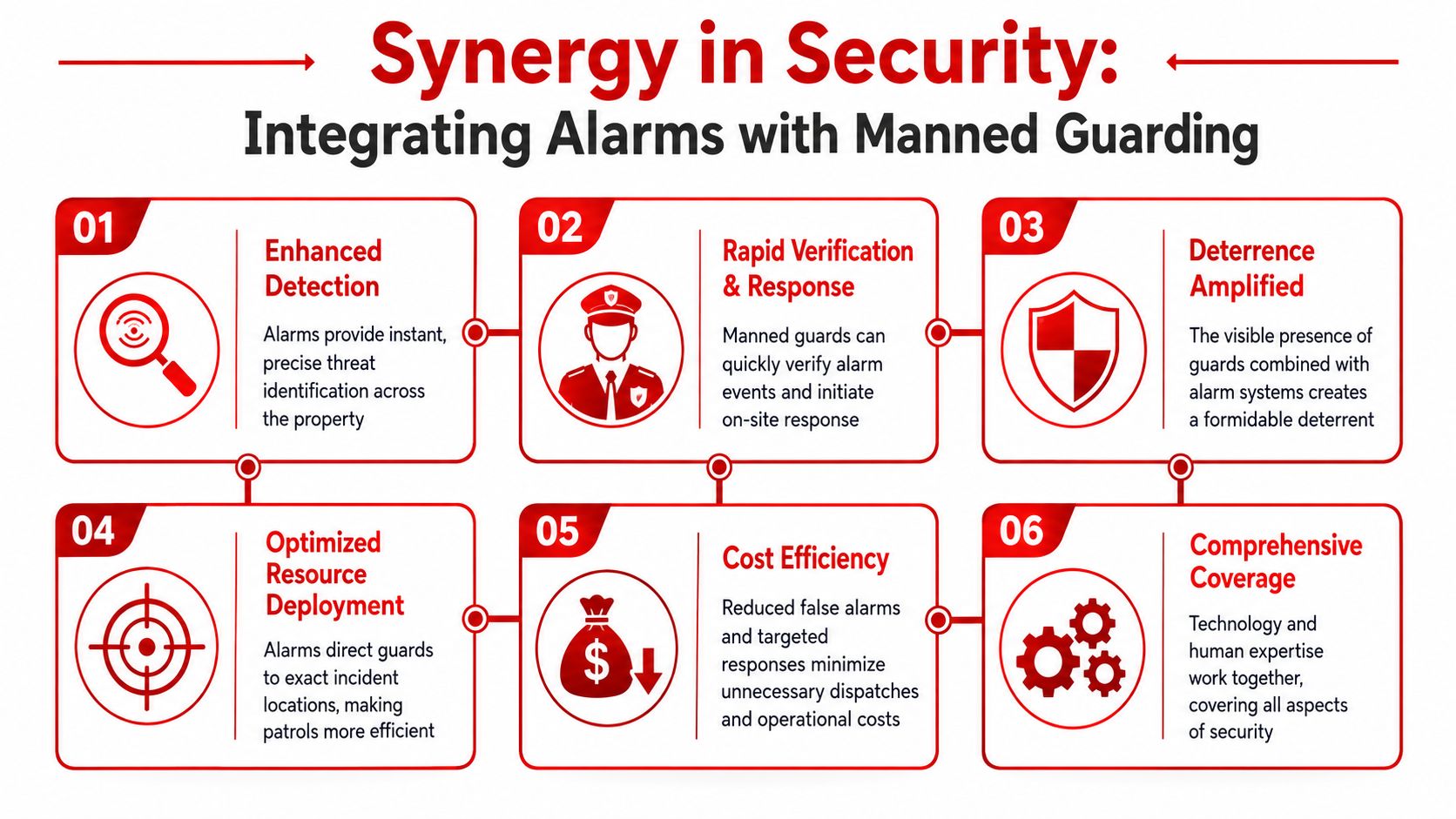
Where alarms outperform people
Electronic detection doesn't get tired, distracted, or pulled into another task. It can watch multiple doors, internal zones, plant rooms, compounds, and boundaries at once.
That makes alarms strong at:
- Continuous coverage: Especially after hours or across large sites.
- Precise detection: The system can identify the zone or device that triggered.
- Fast signalling: The event can move to monitoring or supervisors immediately.
Where guards outperform alarms
People still matter because incidents don't stop at detection. Someone needs to assess context, intervene, protect staff, manage crowds, secure evidence, or direct emergency services on arrival.
Guards bring value where you need:
- Immediate on-site verification
- Visible deterrence
- Controlled interaction with staff, patrons, contractors, or trespassers
- Judgement in dynamic conditions
This is especially relevant for festivals, licensed venues, and active worksites where the issue may shift quickly from simple intrusion to safety management.
The strongest model is targeted response
When security alarms systems and guarding are integrated properly, the alarm becomes a force multiplier. It narrows the problem and sends human resources where they're needed.
A practical example is a temporary event perimeter. If a beam or fence-line sensor activates in a restricted zone, control can direct the nearest guard team to that point rather than increasing random patrols across the whole site. On a commercial premise, a verified after-hours internal alarm can send a patrol to one building edge, one entry point, or one warehouse bay instead of creating a broad, slow search.
For operators reviewing wider site controls, this guide for facility managers is useful because alarm performance improves when access control and movement rules are planned together rather than added as separate projects.
One practical option in this model is GM GROUP Services, which provides back-to-base monitoring, mobile patrols, static guards, K9 units, gatehouse control, and response support across business, venue, event, and construction environments in parts of Australia. What matters more than the provider name, though, is the operating model. Detection, verification, communication, and attendance must be linked from the start.
Managing Compliance and False Alarms Across Australian States
A poorly managed alarm doesn't just annoy staff. It can damage your relationship with responders, waste patrol resources, and expose the business to avoidable compliance problems.
This is why false alarms deserve serious attention. A major security reference citing a U.S. Department of Justice estimate states that between 94% and 98% of alarm calls to law enforcement are false alarms, that police respond to at least 36 million alarm activations each year, and that the estimated annual cost is $1.8 billion, according to this summary on security alarm false alarm impacts. Those figures aren't Australia-specific, but the operational lesson absolutely applies here. Poor alarm fidelity creates noise, and noise degrades response.
Why alarm fidelity matters
For commercial deployments, the practical benchmark isn't just whether a device detects something. It's whether the overall system produces credible alarm events.
That means reducing activations caused by:
- benign movement
- weather exposure
- poor device placement
- unstable doors or windows
- staff misuse
- uncontrolled arm and disarm habits
When systems are built with layered detection and intelligent analytics, operators get cleaner signals and less response fatigue. That's the difference between an alarm estate that supports operations and one that keeps creating avoidable friction.
The fastest way to make a monitored system ineffective is to train everyone around it to assume the next activation is probably nothing.
What businesses should do before compliance becomes a problem
State-specific police and response settings vary, so the practical move is to confirm local requirements early and design your procedures around them. Don't wait until nuisance activations have already become a pattern.
Use this short checklist:
- Get professional design right first: Sensor type and placement matter more than most clients expect.
- Train users properly: Most accidental activations come from people, not hardware.
- Control permissions: Limit who can arm, disarm, bypass, and alter schedules.
- Test on schedule: A system that's never tested only looks compliant.
- Use verified response where possible: Verification protects resources and improves decision-making.
There's also a governance angle. If your alarm system feeds into broader business risk, access control, incident handling, and information protection, it helps to understand how security processes are documented and reviewed. This overview of the understanding ISO 27001 process is useful for teams aligning physical and organisational controls more formally.
Deployment Checklist and Frequently Asked Questions
A break-in at 2:10 am is only half the problem. The other half is what happens next, who gets the signal, how quickly they can verify it, and whether your site instructions lead to the right response. That is why alarm deployment should be treated as an operational security decision tied to guarding, monitoring, and escalation, not as a box-ticking equipment purchase.
For Australian businesses, a commercial alarm system often supports more than intrusion detection. It may also carry duress, fire interface, temperature alerts, water ingress, power failure, and plant fault reporting. That broader scope matters because the alarm panel is often feeding multiple workflows at once, including after-hours patrols, control room triage, and keyholder or guard dispatch.
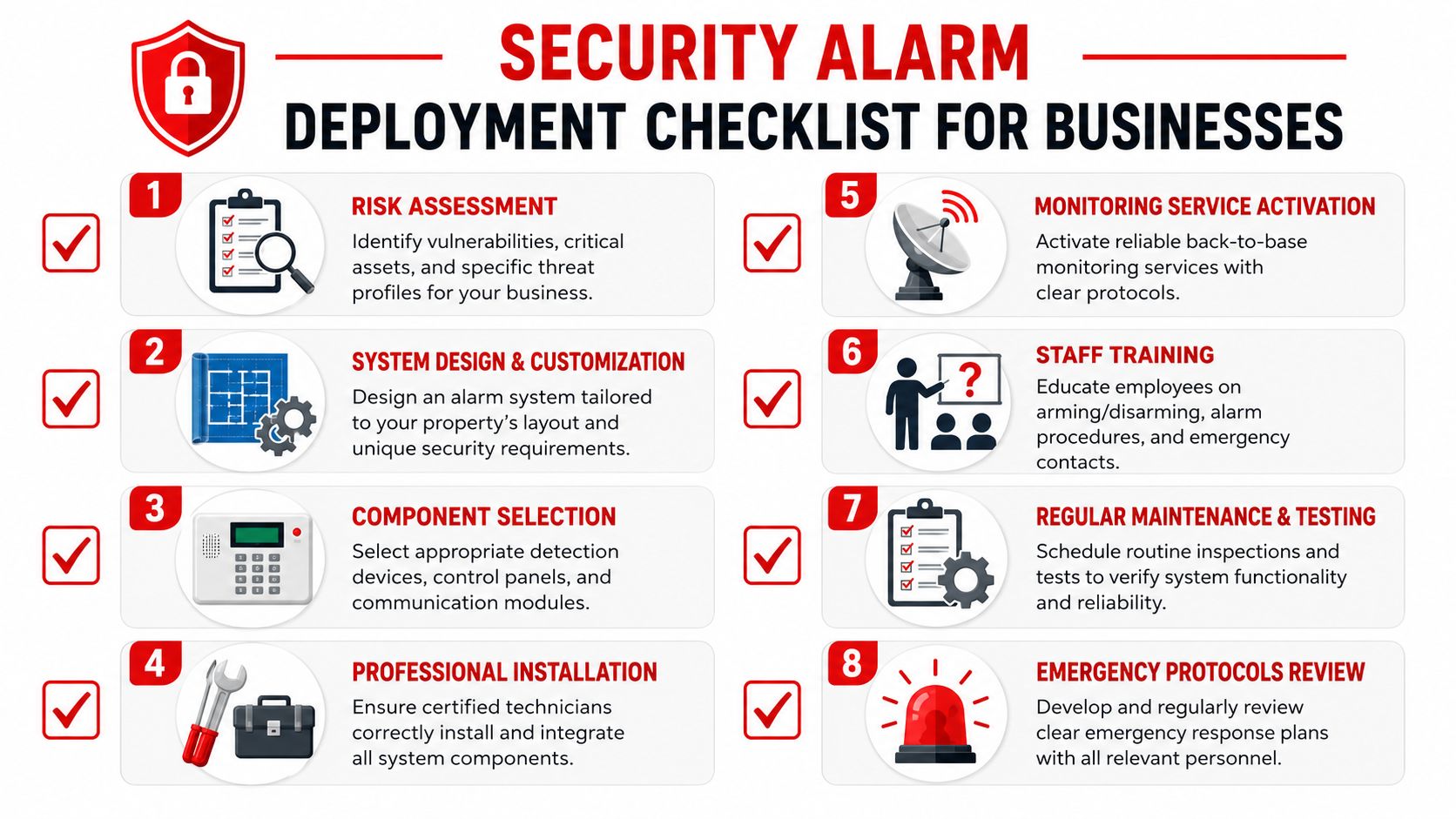
Security alarms systems deployment checklist
Use this before signing off on any proposal:
- Start with the site risk profile: Identify what needs protection, when exposure is highest, and which incidents are realistic for that location.
- Define the response path early: Set out whether each alarm event should trigger monitoring only, a keyholder call, mobile patrol attendance, on-site guard action, or emergency services escalation.
- Match devices to the operating environment: Intrusion, perimeter, duress, and environmental detection each solve different problems. Warehouses, offices, retail sites, and event venues rarely need the same mix.
- Check communication failover: Confirm how signals transmit if the primary path drops out, and who is alerted when communications are lost.
- Set user permissions properly: Restrict arming, disarming, bypasses, and schedule changes to the people who need them.
- Link the system to other controls: CCTV, access control, intercoms, and guarding should support a single response procedure, not separate ones.
- Train for normal use and incidents: Include managers, cleaners, contractors, after-hours staff, and event supervisors if they interact with the system.
- Document testing and site instructions: Keep zone lists, contacts, passwords, and response notes current so monitoring operators and guards are not working from outdated information.
Poor deployment usually shows up in the handoff points. The panel works, but the monitoring notes are vague. The cameras exist, but no one knows which view confirms an activation. The guard attends, but the access instructions are wrong. Those are the failures that create delay, false alarms, and unnecessary callouts.
Frequently asked questions
Are security alarms systems still worth it if I already have CCTV
Yes, if you need an active response process. CCTV records and helps verify. An alarm starts the workflow while the incident is still developing. In practice, the strongest setup is usually alarm activation paired with camera review and a clear dispatch decision.
Can an older business site be upgraded without replacing everything
Often, yes. Start by checking the panel, detectors, communications path, standby power, and monitoring compatibility. Some sites only need staged replacement. Others have legacy hardware that increases fault risk and should be retired sooner, especially where compliance obligations or after-hours response are involved.
What changes between a small business and a large event site
The core purpose stays the same. The response model changes. A small business may rely on back-to-base monitoring and mobile patrol attendance. A large event site may need temporary perimeter coverage, multiple duress points, restricted access zones, and direct coordination between alarm signals, supervisors, and licensed security personnel on the ground.
How do I reduce false alarms without weakening coverage
Start with detector selection, placement, and user training. Then review entry and exit timing, area partitioning, cleaning schedules, and who has permission to bypass zones. Where practical, use verification procedures so monitoring operators or on-site teams can assess an activation before committing resources.
Do I need different procedures in different Australian states
Often, yes. Police attendance policies, licensing settings, and response expectations can vary by state and territory. The practical approach is to confirm local requirements during design, then align monitoring instructions, guard attendance protocols, and site documentation to that jurisdiction.
If you're reviewing security alarms systems for a venue, project, event, or multi-site operation, the right next step is a proper site-based assessment. GM GROUP Services works with Australian businesses and organisers on monitored alarms, mobile response, guarding, and integrated site protection, with solutions designed to address operational risk rather than generic equipment lists. You can review their services at GM GROUP Services.
Discover more from GM Group Services
Subscribe to get the latest posts sent to your email.