
Effective security alarm monitoring is the critical communication link that transforms your business's alarm from a simple noisemaker into a sophisticated, active defence mechanism. It connects your premises to a dedicated team of security professionals, on standby 24/7, ready to turn a potential crisis into a managed, professional response. This service is the fundamental difference between an alarm that merely makes a noise and one that summons immediate, expert assistance when it matters most.
What Is Security Alarm Monitoring and How Does It Work?
Imagine a standard, unmonitored alarm. When it triggers, it creates a loud noise, but its effectiveness relies entirely on the chance that a neighbour or a passerby will notice and decide to act. Professional security alarm monitoring removes this uncertainty from your security equation.
When a monitored alarm is triggered, it does more than just sound a siren. It instantly transmits a secure, encrypted signal to a specialized monitoring centre. At this centre, a team of highly trained security experts is ready to verify the threat and dispatch the appropriate response—whether that's a mobile security patrol or emergency services. This continuous professional oversight provides a level of protection that a standalone alarm system simply cannot match.
The Core Function of Monitoring Your Security Alarm
The process is straightforward but incredibly effective. When a sensor at your business—such as a door contact, motion detector, or glass-break sensor—is tripped, it sends an immediate alert to the remote monitoring station.
Within seconds, an operator receives this signal and follows a strict, pre-agreed protocol to confirm whether the threat is genuine.
Actionable Insight: This verification step is absolutely crucial. It helps filter out the 94% to 98% of alarm activations that are false, preventing costly call-out fees and ensuring that police or security resources are dispatched only to real emergencies.
This rapid, professional assessment is the core strength of security alarm monitoring. The reliability of this connection is paramount, which is why advanced remote monitoring systems often use multiple communication paths, like an internet connection with a cellular backup, to guarantee the signal always gets through.
Why It Matters for Australian Businesses
The demand for intelligent security solutions is growing rapidly across Australia. The broader security market, which includes the intrusion detection systems central to alarm monitoring, was recently valued at AUD 4.38 billion. With projections indicating an 8.2% compound annual growth rate over the next decade, it is clear that businesses are increasingly prioritizing professional protection.
For hospitality venues, construction sites, and retail operators across VIC, NSW, QLD, and the ACT, having a monitored system is becoming an essential component of their risk management strategy.
Monitored vs Unmonitored Alarms at a Glance
When choosing a security system, the most significant decision is whether to opt for professional monitoring. This table highlights the key differences to help you make an informed choice.
| Feature | Monitored Alarm System | Unmonitored (Local) Alarm |
|---|---|---|
| Primary Response | Immediate alert sent to a 24/7 monitoring centre for professional verification and dispatch. | Loud siren and/or strobe lights activate on-site. Relies on self-response or neighbours. |
| Emergency Contact | Trained operators contact police, fire, or ambulance services on your behalf after verification. | You or your listed contacts receive a push notification/SMS. You must assess and call for help. |
| False Alarm Management | Operators follow protocols to verify alarms, drastically reducing false dispatches and fines. | High potential for false alarms to be ignored (the "boy who cried wolf" effect). |
| Reliability | System health (power, connectivity) is constantly supervised. Faults are reported immediately. | You may not know the system is offline or faulty until it fails to activate during a break-in. |
| Insurance Premiums | Often qualifies for significant discounts on business or property insurance premiums. | Little to no impact on insurance costs. |
| Peace of Mind | Complete confidence that any event is being handled by experts, whether you are on-site or not. | Responsibility falls entirely on you to manage any alert, day or night. |
As you can see, a monitored alarm is an active security partner. It's a system that doesn't just report a problem—it actively starts the solution.
The Journey of an Alarm Signal from Trigger to Response
Have you ever wondered what happens in the crucial moments after an alarm is triggered? It’s much more than just a loud siren. The journey from a sensor activation to a security professional taking action is a rapid, highly coordinated process that forms the backbone of security alarm monitoring.
It all begins with detection. A door sensor flags an unauthorized entry, a motion detector spots movement in a restricted area, or a glass-break sensor picks up the distinct sound of a smashed window. The instant this happens, the alarm panel initiates its critical task.
From Your Site to the Monitoring Centre
The moment it's triggered, the alarm panel's primary function is not just to make noise, but to transmit a secure, encrypted signal to our remote monitoring centre. This communication is far more robust than a standard phone call. We use reliable communication paths, often employing dual-path technology—such as a primary internet connection backed up by a 4G cellular link. This ensures the message gets through, even if an intruder attempts to cut a line.
Within seconds, that signal arrives at the console of a highly trained operator at the back-to-base monitoring centre. Their screen displays all vital details: your business name, the site address, which specific sensor was triggered, and the pre-agreed response plan. From that moment, their training takes over.
This rapid flow from detection to professional oversight is what makes monitoring so effective. The infographic below illustrates this essential three-step sequence.
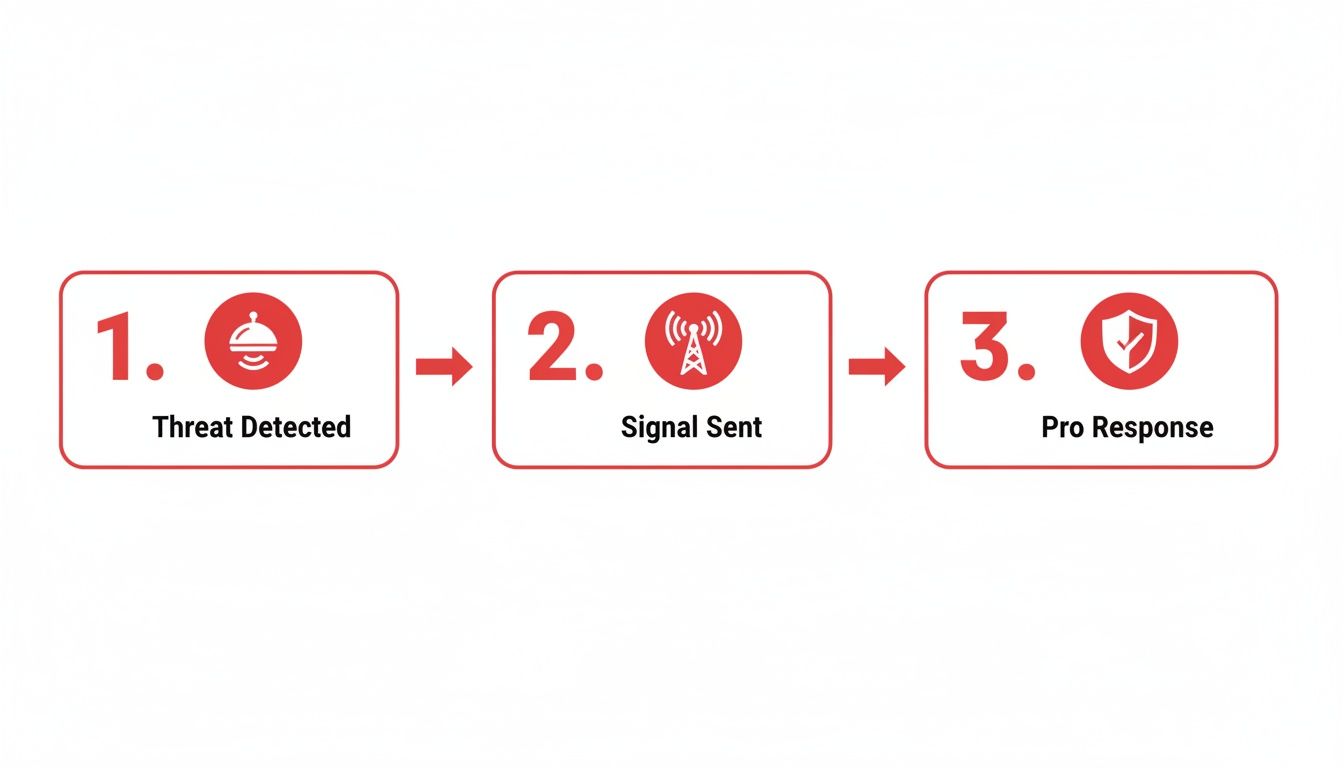
As shown, professional monitoring closes the loop, ensuring that a simple alert is never ignored and always results in a verified, appropriate response.
The All-Important Verification and Dispatch
Now comes the most critical part: verification. False alarms can happen—a staff member might forget the code, or a falling box could trigger a sensor. Dispatching emergency services unnecessarily is a waste of their resources and can lead to significant fines for your business. That's why our operators follow a strict protocol to determine if the threat is real.
Practical Example: An employee accidentally trips the alarm after hours. Instead of police being dispatched, our operator calls the employee from the contact list. The employee provides the secure password, the alarm is confirmed as false, and a costly call-out is avoided. This simple process saves businesses thousands of dollars.
Our verification process is methodical and fast:
- Contacting Keyholders: The operator's first action is to call the primary contacts on your list, using a secure password to verify identity before inquiring about the alarm.
- Audio or Video Verification: For sites with integrated cameras, our operators can view live footage. Seeing an intruder on camera provides immediate confirmation to dispatch a priority response.
Once an alarm is confirmed as genuine—or if a keyholder cannot be reached—the operator proceeds to the final step: dispatch. Following your pre-agreed instructions, they take decisive action, which could involve sending one of our mobile security patrols, notifying the police or fire brigade, or alerting a specific on-site manager.
This systematic approach transforms a simple electronic alert into a powerful, managed security response, demonstrating the real value of professional security alarm monitoring.
Choosing the Right Type of Security Alarm Monitoring
Selecting the right type of security alarm monitoring is a critical decision that forms the foundation of your security strategy. Not all monitoring services are the same; what is suitable for a retail store may not be the right fit for a large construction site. The best choice depends on your specific business, risk profile, and daily operations.
Each monitoring type offers a different level of engagement. Some provide a passive safety net, while others offer active, real-time intervention. Making an informed choice means matching the service's capabilities to the real-world threats your business faces.
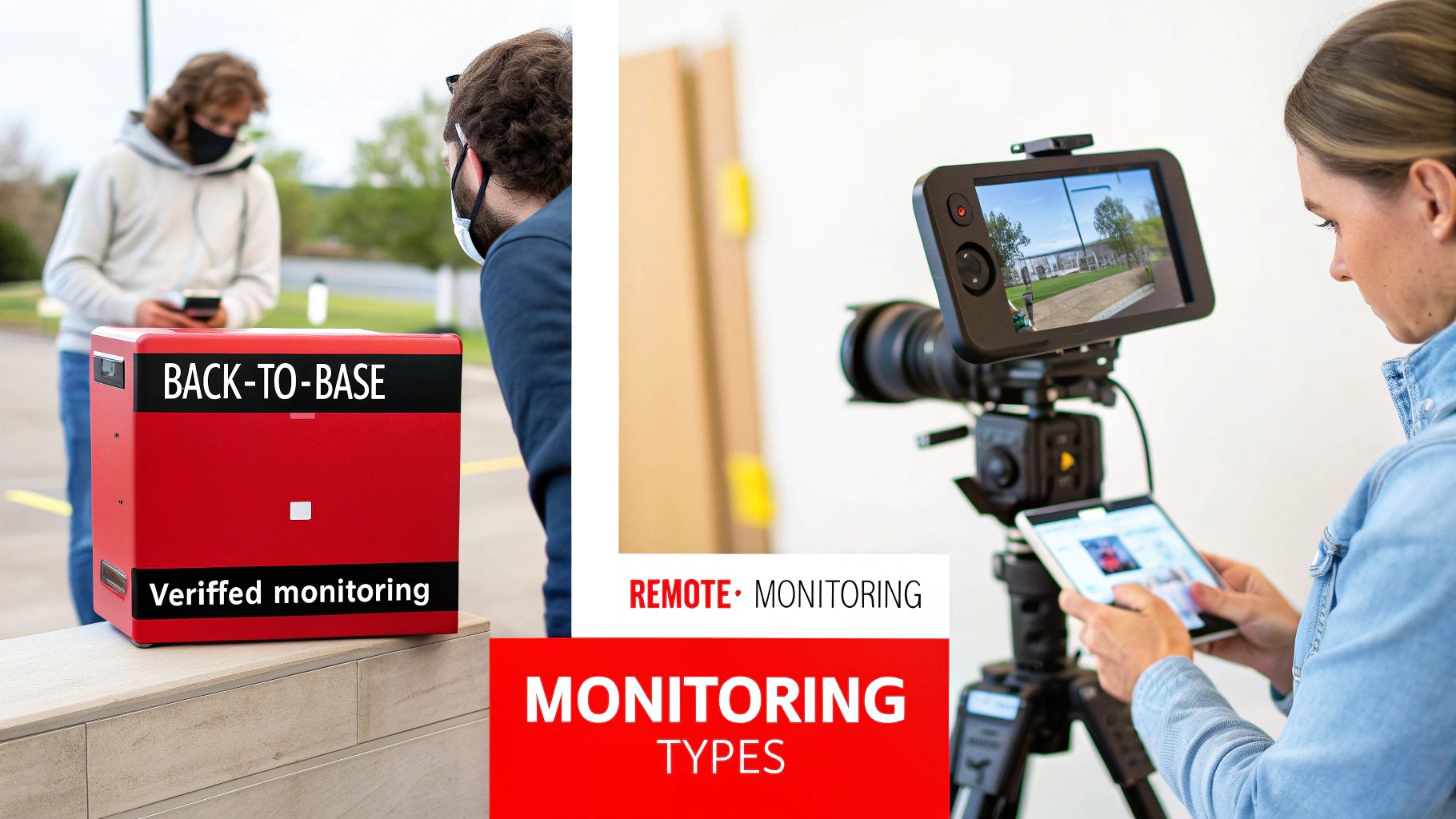
Back-to-Base Security Alarm Monitoring: The Gold Standard
Back-to-base monitoring is the classic professional security setup for good reason. It establishes a direct, supervised connection from your alarm system to a 24/7 monitoring centre staffed by trained operators. When an alarm is triggered, a signal is sent instantly to these experts, who initiate a pre-agreed response plan.
This is the gold standard for reliable, round-the-clock protection. It removes the pressure from you and your staff, ensuring a professional is always ready to act. This reliable service is a key driver of the rapid growth in Australia’s security market.
In fact, the market generated USD 4,591.7 million in revenue and is projected to reach USD 7,713.7 million by 2030. Alarm monitoring systems are the largest segment of this market, and services like back-to-base are the fastest-growing component, indicating a clear trend toward fully managed security. You can discover more insights about this growing security market and its trends.
Verified Alarm Monitoring: Cutting Through the Noise
Verified alarm monitoring is an intelligent evolution of the standard back-to-base model. Instead of just receiving a simple alert, the monitoring centre also gets audio or video evidence to confirm a genuine threat before dispatching a response. When a sensor is tripped, a short video clip or audio snippet of the cause is sent along with the alarm.
Actionable Insight: The primary benefit here is a prioritized police response. When you can provide visual proof of a crime in progress, emergency services treat the call with much greater urgency. This can reduce response times by precious minutes when every second counts.
This verification process also dramatically reduces the risk of expensive false alarm fines and ensures that police and patrol resources are directed only to genuine emergencies.
Remote Security Alarm Monitoring: Your Eyes on Site
Remote monitoring, also known as interactive monitoring, places control directly in your hands. It connects your security cameras and smart devices to an app, allowing you to view live video, arm or disarm your system, and receive real-time alerts on your phone or computer from anywhere.
While it offers direct oversight, its real strength is realized when combined with professional back-to-base services.
- Practical Example: A warehouse manager receives a motion alert at 2 AM. They can immediately access the live camera feed on their phone, confirm an intruder is present, and authorize the monitoring centre to dispatch a mobile patrol unit.
This hybrid approach provides the best of both worlds:
- Empowerment: You can check on your property whenever you need to.
- Professional Backup: You have the peace of mind that a dedicated team is watching over your site 24/7.
Ultimately, the most effective security alarm monitoring strategy often blends elements from each type to create layers of defence tailored to your business's unique vulnerabilities.
How Monitoring Solves Real-World Problems on the Ground
Theory is useful, but what does security alarm monitoring actually achieve for a business? It's more than just a box on the wall and a monthly fee. When implemented correctly, it's a strategic tool that directly addresses the expensive, frustrating, and dangerous problems that businesses face.
The true value of monitoring lies not in the hardware itself, but in how it is customized to a specific environment. The risks for a busy retail store are different from those of a construction site at night. A generic approach is insufficient. A smart, tailored monitoring strategy protects your bottom line and delivers genuine peace of mind.
Protecting High-Value Assets on Construction Sites
Construction sites are prime targets for theft. They are often open, poorly lit, and filled with expensive equipment and materials. The cost of a stolen generator or copper wiring extends beyond replacement value to project delays, client dissatisfaction, and increased insurance premiums.
A robust security alarm monitoring system is designed to prevent these issues.
- Securing the Perimeter: Infrared beams, motion detectors, and thermal cameras can create an invisible fence. The moment someone crosses this boundary, our monitoring centre is alerted.
- Keeping Tabs on Machinery: High-value assets like excavators can be fitted with GPS trackers. If equipment moves outside of work hours, it triggers an immediate alarm.
- Eyes on the Ground, Instantly: When an alarm is triggered, our operators can access live camera feeds to verify the threat and dispatch a mobile patrol or the police to the precise location, often leading to the apprehension of thieves.
Securing Events and Venues in Real Time
Managing a music festival, conference, or nightclub presents a different set of challenges, focusing on people management—preventing unauthorized access, controlling crowd flow, and ensuring safety.
For an event organiser, reputation is everything. A security incident doesn't just pose a physical risk; it can damage your brand, deter sponsors, and impact future ticket sales.
Professional monitoring adds a layer of intelligent oversight that on-site guards alone cannot provide.
- Practical Example: At a music festival, integrated cameras with analytical software can detect overcrowding in a specific area before it becomes dangerous, alerting staff via the monitoring centre to redirect people and prevent a potential crush.
Loss Prevention and Staff Safety in Retail
In retail, businesses face threats from both external shoplifters and internal theft. Staff safety, especially during opening and closing, is also a concern. Security alarm monitoring addresses these issues directly.
The Fire and Security Alarm Installation Services market in Australia has grown to $5.2 billion, underscoring the value businesses place on these systems. You can learn more about the market size for security alarm installation and see why so many businesses invest in it.
Here’s how it works in a typical retail setting:
- Opening and Closing Checks: The system is programmed with your business hours. If the alarm isn't disarmed or armed on schedule, the monitoring centre receives an alert to verify that everything is okay.
- Silent Alarms: Discreet panic buttons allow staff to signal for help during a robbery without alerting the offender, enabling an immediate and silent call to the police.
- Protecting High-Value Stock: Sensors on stockroom doors or high-value display cases can be armed separately, protecting valuable goods even when the store is open.
Integrating Monitoring with a Physical Security Response
Technology alone is powerful, but it becomes a complete security solution when paired with a rapid, professional human response. Effective security alarm monitoring does not end with a notification; it is the first step in deploying trained personnel to your site. This synergy between electronic surveillance and physical security turns a passive digital alert into decisive, real-world action.
When an alarm triggers at the monitoring centre, it initiates a coordinated response. The operator's first task is to verify the threat. Once confirmed, the system shifts from a detection tool to a dispatch command centre, directing trained professionals to the breach.
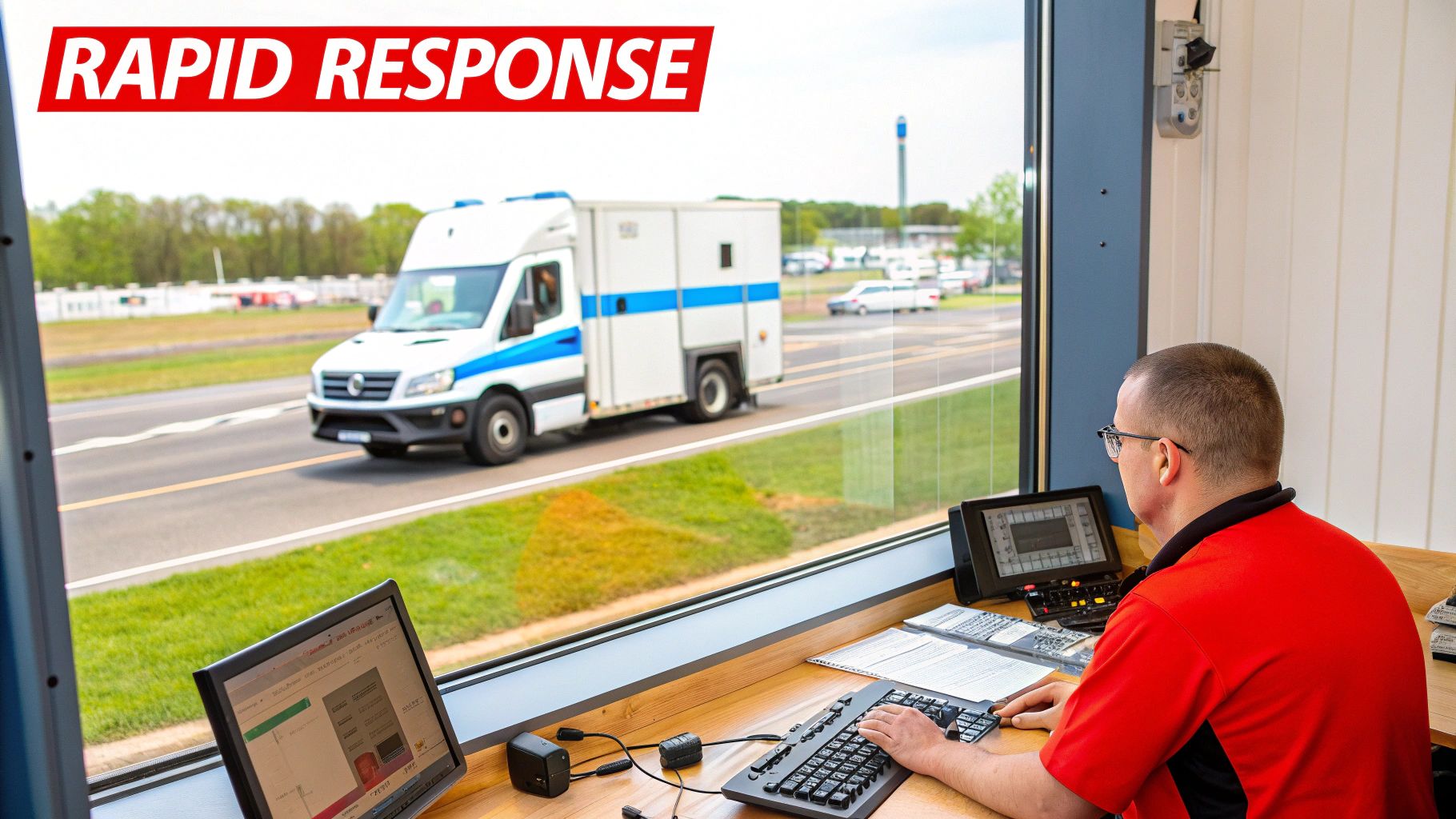
From Digital Alert to Eyes on Site
Imagine a sensor is tripped on your construction site's perimeter fence at 2 AM. An integrated service dispatches the nearest mobile patrol unit immediately. The driver receives real-time updates from the monitoring operator, who may be watching live camera feeds.
This means the patrol arrives with tactical awareness, knowing the breach location and the situation. This integrated approach drastically reduces incident resolution times and increases the chances of apprehending intruders. Modern security alarm monitoring systems can also connect with devices like a Homeboy security camera to enhance visibility for response teams.
The Power of On-Site Coordination
For businesses with static guards, such as a retail centre, the integration is even more seamless. An alarm sends a precise alert to the on-site guard’s device, pinpointing the disturbance.
Actionable Insight: An integrated response acts as a powerful deterrent. When potential criminals know that an electronic alert is backed by a guaranteed, swift physical presence, your site becomes a much harder and less appealing target.
This allows the guard to move directly to the problem area while the monitoring centre provides support, acting as a second set of eyes and a direct line to emergency services. This layered defence ensures every alert is met with an immediate, intelligent, and effective physical response.
Integrated Security vs Monitoring Only Response
| Event Stage | Monitoring-Only Response | Integrated Security Response |
|---|---|---|
| Intrusion Detected | Alarm signal received at monitoring centre. | Alarm signal received at monitoring centre. |
| Verification | Operator attempts to verify via audio/video or calls site contacts. (Typically 2-5 mins) | Operator verifies via live video/audio and immediately dispatches the nearest patrol unit. (Typically <60 seconds) |
| Dispatch | After verification, operator contacts police or a third-party patrol. (Adds 2-10 mins) | In-house mobile patrol is already en route, receiving live updates from the control room. |
| On-Site Arrival | External response arrives; may have limited info on the situation. (Typical ETA: 15-30+ mins) | GM GROUP patrol arrives on-site with full situational awareness. (Typical ETA: 5-15 mins) |
| Resolution | Intruder has likely fled. Incident report is filed based on available data. | Patrol can often apprehend intruders or deter theft. A detailed incident report is compiled with on-the-ground facts. |
As the table shows, an integrated model delivers a faster, more informed response that makes all the difference when seconds count.
Your Guide to Selecting the Best Security Alarm Monitoring Provider
Choosing a partner for your security alarm monitoring is one of the most critical decisions for your business's safety. It’s about trusting a company with your assets, people, and peace of mind. To make the right choice, you need to look beyond the price and examine a provider’s credentials, operational procedures, and service guarantees.
The right provider acts as an extension of your team, ready to respond quickly and intelligently. The wrong one can lead to slow responses, false alarms, and a dangerous sense of false security.
Licensing and Compliance Are Non-Negotiable
First, check for licenses and compliance. Security is a regulated industry in Australia. A legitimate provider must hold the proper master licenses for every state they operate in, such as NSW, VIC, QLD, or the ACT.
Next, verify the grade of their monitoring centre. An A1-graded monitoring centre is the highest rating in Australia, indicating that the facility meets strict standards for construction, power redundancy, and operational procedures.
Actionable Insight: An A1-graded centre is built for resilience, with backup generators, multiple secure communication lines, and robust physical defences. This ensures your security alarm monitoring service remains operational even during a city-wide blackout.
Choosing a provider without these credentials is a significant risk.
Understanding the Service Level Agreement
The Service Level Agreement (SLA) is where a provider outlines their promises in writing. Scrutinize it carefully to understand what you're paying for.
Key points to check in an SLA:
- Guaranteed Response Times: The SLA should specify how quickly an operator will act on an alarm.
- Included vs. Extra Charges: Clarify what your monthly fee covers. Are mobile patrol call-outs included or extra?
- Communication Protocols: The agreement should detail the alarm verification procedure.
- Reporting Procedures: Understand what kind of incident reports you will receive and when.
A transparent, detailed SLA is the mark of a professional company.
A Practical Checklist for Vetting Providers
When meeting with potential providers, ask the right questions to gauge their expertise.
Essential questions to ask:
- Operator Training: What specific training and certifications do your monitoring centre operators have?
- Average Response Metrics: Can you provide data on your average alarm response time over the last six months?
- Technology and Redundancy: What communication paths do your systems use (e.g., 4G, NBN), and what is the backup plan if one fails?
- Client References: Can you connect me with businesses in my industry that use your services?
A quality provider will welcome this level of scrutiny and provide clear, confident answers.
Frequently Asked Questions About Security Alarm Monitoring
Here are answers to some of the most common questions about security alarm monitoring to help you make an informed decision.
What happens if my internet or phone line goes down?
Modern security alarm monitoring systems use dual-path communication. The system uses your primary internet connection but has a secondary cellular (4G) backup. If your NBN goes down or a line is cut, the system automatically switches to the backup path, ensuring the alarm signal always reaches the monitoring centre.
How do you handle false alarms and are there penalties?
We minimize false alarms through strict verification protocols. When an alarm is triggered, our operators first contact you or your nominated keyholders. If your system includes cameras, they use video verification to confirm the threat. This process is highly effective at preventing unnecessary call-out fees and potential fines, ensuring emergency services are reserved for genuine threats.
Can I integrate my existing security cameras?
In most cases, yes. The compatibility of your existing CCTV system depends on its model, age, and technology. A site assessment by a security expert can determine if integration is possible. Connecting your cameras to our security alarm monitoring service enables powerful video verification, leading to a faster and higher-priority response.
Is security alarm monitoring too expensive for a small business?
It's more accurate to view professional monitoring as a scalable investment in risk management rather than just a cost. When you compare the modest monthly fee to the potential financial impact of a break-in, theft, or vandalism, the value becomes clear. We offer monitoring packages tailored to various budgets and needs, making professional-grade protection accessible for any business.
Ready to secure your business with a reliable, professional security partner? The team at GM GROUP Services provides multi-award-winning protection tailored for events, venues, and commercial sites across Australia. Learn more about our advanced security alarm monitoring and rapid response solutions today.
Discover more from GM Group Services
Subscribe to get the latest posts sent to your email.