
At its heart, risk security management is the formal process of figuring out what could go wrong, how likely it is to happen, and what you’re going to do about it. It’s a continuous loop of identifying, assessing, and controlling threats to your business’s assets and bottom line. Done right, it transforms security from a reactive expense into a genuine strategic advantage.
Understanding Risk Security Management and Why It Matters
Think of your business as a castle. Without a solid plan, you might build a huge, impressive wall on one side while completely forgetting to lock the back gate. Risk security management is the blueprint for that castle. It helps you map out where to put the walls, where to post the guards, and even anticipate where an attacker might try to dig a tunnel.
This isn’t about just responding when something bad happens; it’s about creating a proactive system to protect what matters most. In Australia’s increasingly complex threat environment, this kind of structured approach is non-negotiable. A truly effective plan looks beyond just digital threats, weaving together physical and operational security to create a complete protective shield.
The Scope of Modern Security Risks
These days, risks are coming from every direction, and they’re much more varied than just a computer virus. A comprehensive risk management strategy acknowledges that a threat can pop up from almost anywhere.
- Physical Threats: This could be anything from someone gaining unauthorised access to a construction site, to shoplifting in a retail store, or managing crowd safety at a massive music festival. A practical example: A construction site leaves its main gate unlocked overnight, leading to the theft of expensive copper wiring and tools.
- Operational Risks: These are the vulnerabilities hiding inside your own processes. Think inadequate staff training on security protocols, sloppy cash handling procedures, or the complete absence of an emergency response plan. A practical example: A retail store with no formal cash-out procedure at the end of the day is vulnerable to internal theft and accounting errors.
- Cybersecurity Threats: This is the digital battlefield, covering everything from phishing emails and malware to full-blown data breaches that can grind your operations to a halt and wreck your reputation. A practical example: An employee clicks on a link in a fake “invoice” email, accidentally installing ransomware that locks up the company’s entire network.
The Australian business landscape is a prime target. In recent years, the country has faced a staggering 47 million data breaches, a number that screams widespread vulnerability. With cyber-attacks on critical infrastructure making up 11% of all incidents, the threat is both real and growing. On top of that, an average of 1.2% of Australian employees clicked on phishing links every month—a 140% increase from the previous year. You can explore more about Australia’s evolving threat landscape to get the full picture.
A robust risk security management plan doesn’t just prevent losses; it builds trust. It shows your employees, customers, and partners that you are serious about protecting their safety and data, which is a powerful asset for your brand’s reputation.
Shifting from Reaction to Prevention
Without a formal process for managing risk, security often becomes a frantic game of whack-a-mole. An incident occurs, and you scramble to fix the immediate damage. This reactive approach is not only expensive and inefficient, but it also guarantees you’ll always be one step behind the next threat.
A proactive strategy, on the other hand, is all about spotting potential problems before they ever happen. A retail store, for instance, might identify a blind spot in its CCTV coverage as a key vulnerability and decide to install a new camera. This simple move prevents theft before it occurs, saving the business money and avoiding disruption. It’s this preventative mindset that sits at the very core of effective risk security management.
Actionable Insight: Conduct a simple “walk-through” audit of your premises from an outsider’s perspective. Look for unlocked doors, unmonitored access points, or valuable assets left in plain sight. This quick exercise can reveal obvious vulnerabilities you miss during day-to-day operations.
Understanding the Core Components of a Security Framework
A strong security plan isn’t something you can just guess at. It needs a solid foundation, and that’s where a security framework comes in. Think of it like the architectural blueprint for a building; it provides the structure, ensures every part works together, and prevents you from ending up with a lopsided, vulnerable mess. A good framework transforms your security from a series of random, reactive tasks into a cohesive, proactive system for managing risk.
At the heart of this approach are three interconnected pillars known as Governance, Risk, and Compliance (GRC). These aren’t just corporate buzzwords; they represent the command centre, the intelligence unit, and the rulebook for your entire security operation. When they work in harmony, you get a unified and effective strategy.
The Three Pillars Governance Risk and Compliance
So, what do these pillars actually do? GRC provides a structured method for aligning your security efforts directly with your business objectives. It’s about making sure you’re not just putting out fires but actively managing risks in a way that helps your organisation succeed.
Let’s break them down with some real-world examples:
- Governance is your command centre. It sets the overall direction, policies, and internal rules for how security is managed. For a massive music festival, governance would mean establishing a clear chain of command for the security team and defining exactly how to respond to different emergencies, from medical incidents to crowd control issues.
- Risk Management is your intelligence unit. This is the hands-on process of finding, analysing, and dealing with potential threats. A construction site manager, for instance, is constantly performing risk assessments—identifying vulnerabilities like unlocked tool sheds or surveillance blind spots, and then putting controls in place to fix them.
- Compliance is the rulebook. It’s all about making sure your security practices meet external laws, regulations, and industry standards. For any pub or nightclub, this means strictly following Responsible Service of Alcohol (RSA) laws and ensuring all security staff hold the correct state-specific licences.
Getting the GRC model right is more critical than ever. In Australia, data breach reporting has skyrocketed. The Office of the Australian Information Commissioner (OAIC) recently recorded over 1,100 data breaches in a single year—that’s a staggering 25% jump from the year before. This isn’t just an IT problem; it highlights a widespread failure in managing security risks.
The flow chart below gives a great visual of how this all comes together in a continuous cycle.
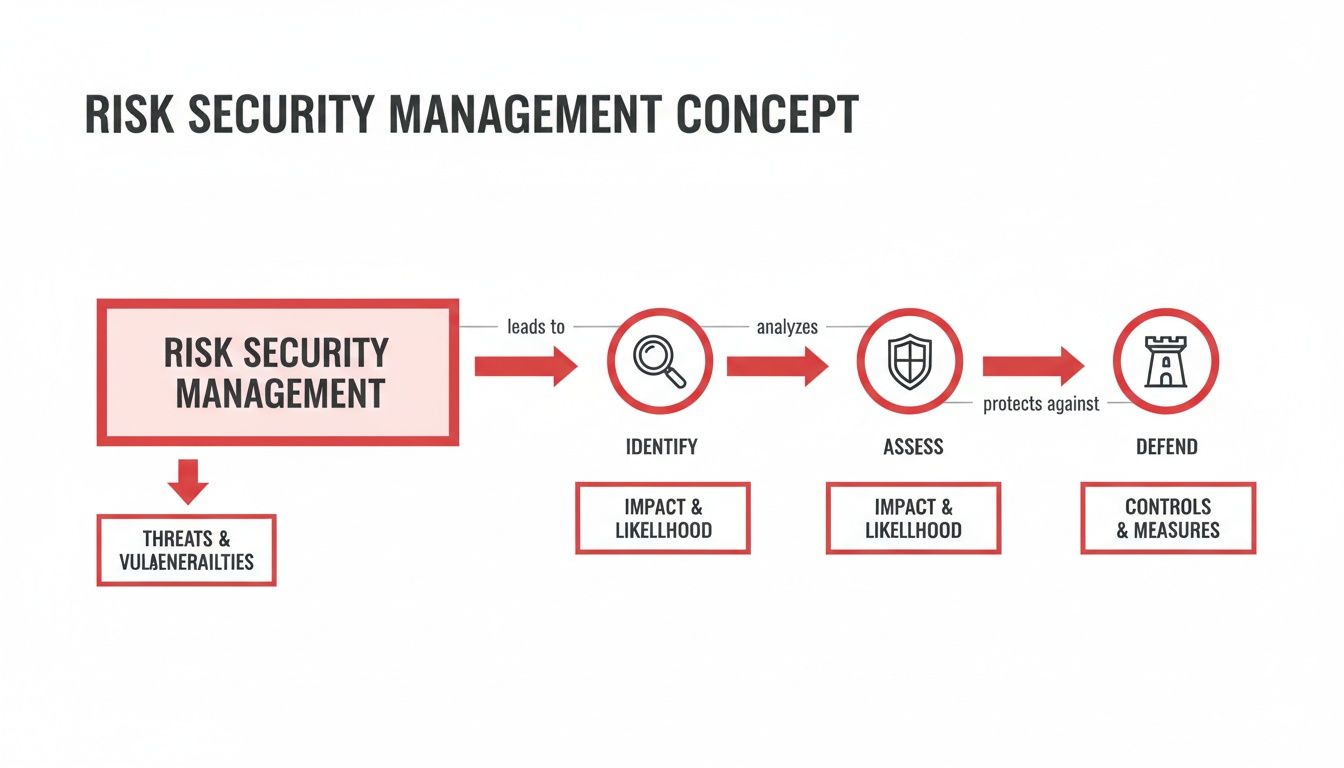
As you can see, security isn’t a “set and forget” task. It’s a loop that starts with identifying threats, moves to assessing their potential impact, and then involves implementing robust defences to protect your assets.
Choosing the Right Security Framework
You don’t have to invent your security blueprint from scratch. Several well-established frameworks can guide your risk management program, with two of the most respected being ISO 31000 and the NIST Cybersecurity Framework. While they share the same goal—keeping you safe—they take slightly different paths to get there.
The table below breaks down two of the leading frameworks to help organisations understand which approach might be the right fit for their specific needs.
Comparing Popular Risk Management Frameworks
| Feature | ISO 31000 | NIST Cybersecurity Framework |
|---|---|---|
| Primary Focus | General risk management, applicable to any type of risk (financial, operational, security, etc.). | Specifically focused on cybersecurity risks and resilience. |
| Approach | Principles-based and flexible. It provides guidelines rather than strict rules. | Control-focused and structured around five core functions: Identify, Protect, Detect, Respond, Recover. |
| Best For | Organisations needing a high-level, integrated approach across all departments. Ideal for complex physical environments like events or construction. | Organisations where digital threats are the primary concern, such as corporate offices managing sensitive data. |
| Origin | An international standard developed by the International Organization for Standardization. | Developed by the U.S. National Institute of Standards and Technology. |
While ISO 31000 is a fantastic, flexible standard for any organisation, the NIST Cybersecurity Framework offers a much more detailed roadmap for tackling digital threats. Of course, choosing the right framework also goes hand-in-hand with selecting the best enterprise security software solutions to support your strategy.
Actionable Insight: If you’re managing a business with a mix of complex physical and operational risks—like a large-scale event or a multi-site construction project—the adaptable, principles-based approach of ISO 31000 is a great choice. But if your main concern is protecting sensitive client data in a corporate setting, the granular controls of the NIST framework might be a more suitable starting point.
Ultimately, the smartest approach is often a hybrid one. You can borrow principles from different frameworks to build a customised plan that truly fits your unique risk profile. A good security partner can help you navigate this, assessing your specific needs to determine which framework—or combination of frameworks—will give you the strongest possible foundation for your security strategy.
Practical Risk Mitigation Strategies for Key Industries
Theory and frameworks are great, but risk security management only proves its worth when you put it into practice. A generic plan just won’t cut it. The risks you face at a music festival are worlds away from those on a construction site, so your strategy has to be just as unique.
This is where we move from the ‘what’ to the ‘how’. It’s all about turning your risk assessment into tangible actions on the ground. Think trained security officers, smart camera placement, and crystal-clear emergency plans—all designed to protect your specific environment. This is how a document becomes real protection for your people, assets, and reputation.
Events and Venues
There’s nothing quite like the energy of a large crowd, but that energy can turn chaotic in an instant. For anyone running festivals, concerts, or major corporate events, the core challenge is keeping people safe without killing the vibe.
Common headaches include overcrowding, gatecrashers, and medical incidents. Your mitigation plan needs to be alive and breathing, not just a few guards standing by the door.
- Crowd Management: You need boots on the ground who understand crowd dynamics. Experienced staff can manage entry points, keep an eye on density in hotspots, and guide people smoothly. It’s the difference between a controlled flow and a dangerous crush. Practical Example: Using portable barriers and dedicated security staff to create clear one-way “flow lanes” near stages and exits prevents bottlenecks and crushing.
- Access Control: A solid ticketing system is your first line of defence. Pair that with thorough bag checks to stop unauthorised people and prohibited items from getting inside.
- Emergency Response: Don’t wait for something to happen. Drill your emergency action plan so that security, medics, and event staff know exactly what to do and who’s in charge. An organised response is a fast response.
Construction and Industrial Sites
Construction sites are a magnet for trouble. They’re full of expensive gear and materials, making them a prime target for theft. The risks are twofold: you need to protect your assets and keep your own people safe in what can be a dangerous environment.
The key is to create a secure bubble around your site and stay vigilant. A visible and professional security presence is one of the most powerful deterrents you can have against both opportunists and organised criminals.
Actionable Insight: For construction sites, the best defence is a layered one. Station static guards at your main access points during work hours and supplement them with regular mobile patrols after hours. This combination controls access when you’re busy and prevents theft and vandalism when the site is empty, protecting millions in assets.
Here are a few key strategies:
- Asset Protection: Lock down valuable equipment in secure compounds and keep a running inventory. Use a mix of obvious and hidden cameras to watch over vulnerable spots. Practical Example: Install GPS trackers on high-value machinery like excavators. If a piece of equipment is moved after hours, it sends an immediate alert to the site manager and security team.
- Gatehouse Control: A trained guard at the main gate is essential. They should log all vehicles, visitors, and deliveries, ensuring no one gets on-site without authorisation.
- Site Safety Protocols: Your security team should have basic WHS training. They can be an extra set of eyes, helping enforce safety rules like wearing correct PPE and reducing the risk of workplace accidents.
Retail and Hospitality
In retail and hospitality, security is a balancing act. You need to be welcoming to customers while staying watchful for threats. The big risks here are all about loss prevention—from shoplifters and even dishonest staff—and keeping everyone safe, especially in licensed venues.
Your guards in these settings need to be more than just a uniform; they need top-notch people skills. It’s a huge part of why Australia’s private security industry is valued at over $13 billion, with much of that work supporting sectors covered by the Security of Critical Infrastructure Act 2018. You can see the full industry scope over at ibisworld.com/australia.
- Loss Prevention: Place uniformed guards near entrances and high-value displays to deter thieves. For a more subtle approach, plain-clothes officers can blend in to spot and handle shoplifters without causing a scene.
- Staff Security: Implement strict cash handling rules, run background checks on new staff, and train your team to spot suspicious behaviour before it escalates. Practical Example: Implement a “buddy system” for end-of-day cash counting and bank deposits to reduce the risk of internal theft.
- Conflict De-escalation: In pubs and clubs, RSA-trained guards are non-negotiable. Their ability to talk people down and de-escalate situations is what prevents a disagreement from turning into a brawl.
Ultimately, there’s no off-the-shelf solution for risk mitigation. It starts with a genuine understanding of your industry’s weak points and then building a security plan that hits them head-on. While we’ve focused on physical security, it’s also worth exploring strategies for identifying and mitigating network security risks, as the two often go hand-in-hand.
Navigating Australian Compliance and Regulatory Requirements
In Australia, solid security isn’t just a smart move—it’s the law. Thinking about risk security management purely in terms of protecting your property is only half the story. You also have to navigate a maze of legal and regulatory requirements. Getting this wrong doesn’t just leave you vulnerable; it can land your business in some serious legal and financial hot water.
At first glance, compliance can feel like a tangled web of rules and acronyms. But when you boil it all down, it comes back to a single, powerful idea: you have a legal duty of care to keep your people and the public safe. This isn’t optional. Whether you’re running a construction site, a retail store, or a bustling nightclub, getting a firm grip on these rules is the bedrock of a truly resilient security plan.
Core Compliance Areas for Australian Businesses
A few key pieces of legislation form the backbone of security compliance in Australia. While the specifics can shift a bit between states like New South Wales (NSW), Victoria (VIC), and Queensland (QLD), the core principles—safety, responsibility, and accountability—are the same everywhere.
Two of the biggest areas you need to get right are Work Health and Safety (WHS) and the Responsible Service of Alcohol (RSA).
- Work Health and Safety (WHS) Act: This is a big one. The WHS Act puts the onus squarely on businesses to create a safe environment for everyone who steps onto your property—employees, contractors, and customers alike. In security terms, this means hunting down and fixing risks that could cause physical harm. Think poor lighting in a car park, a missing emergency evacuation plan, or anything else that could turn a minor issue into a major incident.
- Responsible Service of Alcohol (RSA): For any venue that serves alcohol, RSA isn’t just a suggestion; it’s non-negotiable. It means your team, including your security guards, must be trained to serve booze responsibly and handle intoxicated patrons safely to prevent fights and other harm. Failing to comply can lead to massive fines, and you could even lose your liquor licence.
These rules aren’t just bureaucratic red tape. They are fundamental to a proactive risk security management strategy, helping you meet your legal duties while making your space safer for everyone.
From Legal Jargon to Practical Action
This is where the rubber meets the road—and where many businesses get tripped up. It’s one thing to have the rulebook sitting on a shelf, but it’s another thing entirely to put it into practice every single day. This means checking that every security guard holds the right, state-specific licences and that their training is completely up to date.
For example, a security guard working the door at a pub in Sydney must hold a current NSW Security Licence and a valid RSA competency card. If they don’t have both, the guard and the venue are breaking the law. It’s a simple but critical detail to get right.
Think of your compliance as a direct reflection of your commitment to safety. Regulators and courts have very little patience for businesses that treat their legal duties as a simple tick-box exercise. Being able to show you’re proactive about compliance is your best defence against legal trouble and reputational damage.
Your Essential Compliance Self-Audit Checklist
Not sure where you stand? Run through this quick checklist to take the pulse of your compliance health. If you find yourself answering “no” to any of these questions, you’ve likely found a gap that needs your immediate attention.
- Licensing and Certification: Are all your security officers properly licensed for the state they’re working in (e.g., NSW, VIC, QLD)? Are their RSA certificates current?
- Incident Reporting: Do you have a clear, written process for logging every single security incident, from a minor argument to a full-blown emergency? Is this logbook easy to find and reviewed regularly?
- WHS Risk Assessment: When was the last time you did a WHS risk assessment specifically for your site? Have you spotted and dealt with hazards like poor visibility, trip risks, or potential conflict hotspots?
- Emergency Preparedness: Do you have a tested emergency response plan? Does everyone on your team, including security, know exactly what to do in a fire, medical emergency, or evacuation?
- Crowd Control Plan: For events and licensed venues, is there a documented crowd management plan that meets local council and police standards?
This list is a great starting point. Bringing in a security partner like GM GROUP Services can take this a step further, helping you conduct a thorough audit to ensure every part of your operation doesn’t just meet but actually exceeds Australian standards. This forward-thinking approach turns compliance from a headache into one of your business’s greatest strengths.
How to Measure and Report on Your Security Performance
You can’t fix what you can’t see. In the world of security, that’s gospel. Without solid data, your security plan is just a series of educated guesses. It’s impossible to prove its value, justify the budget, or pinpoint what needs to be better. Good measurement takes your security efforts from being seen as a cost centre and turns them into a genuine business asset.
The first step is figuring out what “a good job” actually looks like. This means getting past gut feelings and establishing clear Key Performance Indicators (KPIs). These are the hard numbers that show you exactly how your security strategy is tracking against your goals. They provide the evidence you need to have a real conversation with stakeholders about what’s working and what’s not.
Choosing the Right Security KPIs
The best KPIs are always linked directly to what you’re trying to achieve on the ground. A useful metric for a retail environment will look very different from one for a major construction site. The trick is to pick metrics that are specific, measurable, and truly relevant to the risks you’re actually facing.
For example, just counting the number of guards on a roster doesn’t tell you much. A much more powerful KPI would be the Reduction in Reported Theft Incidents or the Average Incident Response Time. These metrics measure the impact of your security, not just its presence.
Actionable Insight: Start small. Identify your top three security headaches—maybe it’s shoplifting, unauthorised site access, or crowd safety at an event. Then, create one or two KPIs for each one. This keeps you focused on tracking what genuinely matters, rather than drowning in a sea of meaningless data.
Let’s break down how you can tie different KPIs to specific business goals.
Sample Security KPIs for Different Business Goals
Tracking the right metrics gives you a clear picture of your security program’s effectiveness. Here are a few examples of how you can align KPIs with broader business objectives.
| Business Goal | Relevant Security KPI | How to Measure It |
|---|---|---|
| Reduce Financial Loss | Percentage Reduction in Theft and Vandalism | Compare inventory or asset loss reports from before and after implementing new security measures. |
| Improve Patron Safety | Number of Security Incidents per Event | Track and log all reported incidents (e.g., altercations, medical assists) and analyse trends over time. |
| Increase Operational Efficiency | Average Incident Response Time | Use incident logs to measure the time from when an incident is reported to when security arrives and resolves it. |
| Ensure Compliance | Number of Compliance Breaches Identified in Audits | Maintain a log of internal and external audit findings related to security, WHS, or RSA compliance. |
This table shows how you can move from a general goal to a concrete, measurable outcome.
Transforming Data into Compelling Reports
Collecting the numbers is just half the battle. To have any real impact, you need to present that data in a way that makes sense to your audience, whether that’s a venue manager, a board of directors, or a project lead. A great security report uses data to tell a story.
Don’t just throw a spreadsheet at them. The goal is to make the information easy to digest and act on.
- Use simple charts and graphs. A bar chart showing a steady decrease in theft incidents month-on-month is far more powerful than a list of numbers.
- Write a short executive summary. Start with the key takeaways in plain, simple language. What’s the main headline?
- Give the numbers context. If response times have dropped, explain why. Was it the result of a new patrol strategy you put in place?
- Provide clear recommendations. Based on what the data is telling you, what should be the next steps?
By consistently measuring your performance and reporting on it well, your risk security management program stops being static. It becomes a living, breathing tool for continuous improvement. This empowers you to make smart, data-driven decisions that don’t just protect the business, but actively help it succeed.
Building Your Risk Security Management Roadmap

Turning security principles into a real-world plan can seem like a massive job, but a structured roadmap breaks it down into manageable chunks. This is a clear, step-by-step path to getting your risk security management program off the ground or giving your existing one a much-needed tune-up. By following a logical sequence, you can build a truly resilient security posture from the ground up.
Think of it like building a house. You wouldn’t just start throwing up walls without surveying the land and finalising the blueprints. It’s the same with security—your plan has to start with a deep understanding of your unique environment before a single guard is deployed or a camera is installed.
Step 1: Conduct an Initial Risk Assessment
First things first: you need to know what you’re protecting and what you’re protecting it from. A comprehensive risk assessment is the bedrock of your entire security strategy. Without it, you’re flying blind and likely spending money on solutions that don’t even address your most critical vulnerabilities.
This means taking a hard look at your assets, potential threats, and existing weaknesses. Bringing in a professional partner like GM GROUP Services at this stage gives you an expert, objective set of eyes. They can help uncover risks you might have overlooked and prioritise them based on their potential impact.
Step 2: Develop a Customised Security Strategy
Once you have your assessment in hand, it’s time to build a security plan that actually fits your business. This is where you map out the specific mitigation tactics that will work best for your event, construction site, or retail store.
Your strategy should clearly outline:
- Preventative Measures: Things like visible security patrols and robust access control systems to stop threats before they even start.
- Detective Measures: This includes tools like CCTV monitoring and alarm systems that flag incidents the moment they happen.
- Responsive Measures: A clear, practical action plan for how your team will handle everything from a medical emergency to a security breach.
Step 3: Deploy Security Measures and Personnel
With a solid plan in place, it’s time to put it into action. This step is all about deploying the right mix of people and technology. That could mean positioning static guards at key entry points, using mobile patrols to cover a large site, or installing back-to-base alarm monitoring for 24/7 peace of mind.
The success of this stage really comes down to quality. It’s not just about having guards; it’s about having the right guards. You need professionals who are properly trained, licensed, and a good fit for your environment, ensuring they enhance safety without disrupting your day-to-day operations.
Step 4: Establish Ongoing Monitoring and Reporting
Finally, risk security management isn’t a “set and forget” task; it’s a continuous cycle. The last piece of the puzzle is to establish a system for ongoing monitoring, reporting, and refinement. This means regularly reviewing incident logs, tracking your key performance indicators (KPIs), and tweaking your strategy based on real-world data and new threats.
Working with a provider like GM GROUP Services makes this entire process much smoother. They bring the expertise and resources needed for every stage—from that first assessment to daily operations and reporting—helping you build and maintain a security program that actually works.
Frequently Asked Questions
Diving into the world of risk security management can feel a bit overwhelming, and it’s natural to have questions. To help clear things up, we’ve answered some of the queries we hear most often from business owners and managers on the ground.
What Is the First Step in Creating a Security Plan?
It all starts with a thorough security risk assessment. Honestly, you can’t protect your business properly until you know exactly what you’re protecting, what genuine threats you’re up against, and where your weak spots are.
Think of it this way: a doctor would never prescribe medication without diagnosing the patient first. A security plan without an initial assessment is just a shot in the dark. This first, crucial step maps out your most critical assets and shows you exactly where you’re exposed, making sure every dollar and every decision that follows is smart and targeted.
The point of a risk assessment isn’t to get rid of every single risk—that’s just not possible. The real goal is to understand your risks so deeply that you can make intelligent calls on which ones to accept, which to tackle, and where to spend your security budget to get the biggest bang for your buck.
How Often Should We Review Our Security Risk Assessment?
A common mistake is treating a security risk assessment as a one-and-done task. For it to actually work, it needs to be a living document that changes as your business does.
As a rule of thumb, you should be dusting it off and updating it at least once a year. But that’s just the minimum. You really need to revisit it any time your business goes through a significant change.
Here are a few triggers that should prompt an immediate review:
- Opening a new location: A new site brings a whole new world of physical and operational risks into the picture.
- Hosting a major event: A large public gathering completely alters your risk profile, even if it’s only for a weekend.
- After a security incident: If something goes wrong, the first thing you should do is figure out how it happened so you can make sure it never happens again.
Is Professional Security Management Affordable for a Small Business?
Yes, absolutely. One of the biggest myths out there is that professional risk security management is a luxury reserved for massive corporations. That’s just not the case anymore. Modern security services are built to be scalable, which means they can be shaped to fit your exact needs and budget.
A good provider will sit down with you to identify your biggest risks and focus your resources where they’ll make a real difference. When you weigh it up, the cost of proactive management is almost always a fraction of the financial and reputational damage that comes from cleaning up after a single major incident, like a break-in on a construction site or a serious data breach.
What Is the Difference Between a Threat and a Vulnerability?
Getting this right is key to solid security planning. People often use these terms interchangeably, but they mean two very different things.
A threat is an external danger—something out there that could cause harm. For example, a gang of organised thieves known for hitting retail stores in your area is a threat.
A vulnerability, on the other hand, is an internal weakness—a gap in your defences that a threat could take advantage of. An unlocked back door, a blind spot in your CCTV system, or staff who haven’t been trained on security protocols are all vulnerabilities.
Good security management is all about identifying the external threats and then systematically closing the internal gaps they could exploit. You can’t stop the threats from existing, but you have complete control over how vulnerable you are to them.
Ready to build a security plan that protects your people, assets, and reputation? The team at GM GROUP Services provides expert risk assessments and tailored security solutions for businesses across Australia. Contact us today to discuss your security needs.
Discover more from GM Group Services
Subscribe to get the latest posts sent to your email.