
Risk assessment services become most valuable when the site is busy, conditions are changing and nobody has time to search through a forgotten binder. A Sydney venue manager might be preparing for a sold-out event, coordinating a kitchen fire system test and responding to a council inspection in the same week. A structured assessment turns those competing demands into a prioritised action list, with each hazard linked to a control, an owner and a review point.
Australia has a mature framework behind that practical work. Standards Australia and Standards New Zealand first published AS/NZS 4360 in 1995, establishing a formal process covering context, identification, analysis, evaluation, treatment, monitoring, review, consultation and communication, as described by the Productivity Commission's standards report. Standards Australia now lists AS ISO 31000:2018 as current, while AS/NZS ISO 31000:2009 is superseded.
For operators in NSW, VIC, QLD and the ACT, the assessment also sits alongside state WHS duties, licensing conditions, event requirements and insurer expectations. In NSW, SafeWork guidance says a risk assessment is mandatory for certain high-risk activities, while NSW Health guidance requires a documented assessment before work starts where hazards may interact, controls may be affected by workplace changes or high-risk work is involved, as set out in the NSW Work Health and Safety Regulation.
Why Risk Assessment Services Matter More Than Ever
A professional assessment isn't a paperwork exercise completed after something goes wrong. It gives the duty manager, project manager or security coordinator a defensible way to decide what needs attention first, what can be accepted temporarily and what requires immediate escalation.
The difference is visible during a difficult operating week. A venue may have a contractor working near a public access route, a temporary bar changing crowd movement, a delivery vehicle arriving during patron ingress and a fire system test affecting normal procedures. A checklist can record each item. A working risk assessment connects them, tests how they interact and assigns responsibility before the event opens.
Compliance starts with documented decisions
The Australian framework provides a consistent foundation, but the assessment still needs to reflect the actual site. An event risk process should identify hazards, assess likelihood and consequence, assign a rating, document controls and name the person responsible. The NSW Government event risk assessment guidance also makes clear that the assessment needs to be revisited when the event scope changes.
That matters because a signed report can show more than awareness. It can show how management considered the hazard, why a control was selected and who was expected to implement it. If an incident reaches a regulator, council, insurer or legal adviser, those records may help demonstrate that the organisation used a reasoned process rather than reacting after harm occurred.
The practical cost of a reactive approach
A reactive response often produces the wrong priorities. Managers spend time on visible defects while missing vehicle movements, working at height, slips and trips, moving objects or psychosocial hazards. Safe Work Australia recorded 188 traumatic injury fatalities in 2024 and 146,700 serious workers' compensation claims in 2023-24. Vehicle incidents caused 42% of fatalities, while falls from height caused 13%, according to Safe Work Australia's latest key WHS statistics.
The assessment fee is only one part of the decision. Delayed controls can affect operations, insurance discussions, licence renewals, contractor coordination and public confidence. The useful question isn't whether a report can be filed. It's whether the assessment changes what people do on the ground.
What Risk Assessment Services Actually Cover
Risk assessment services are a paid, structured engagement in which a qualified assessor examines a site or operation, identifies threats and hazards, evaluates them using likelihood and consequence, then produces actions that reduce risk to an acceptable level.
The assessor might walk a venue before a concert, review a construction site during a changing work phase or examine a retail store after repeated security incidents. The method should remain consistent, but the hazards and controls must be site-specific. Australian event guidance commonly uses a likelihood-versus-consequence approach, with a risk rating, documented controls and a nominated responsible person.
A matrix can make priority visible. For example, a hazard assessed as likelihood 3 and consequence 4 may receive a High rating under the organisation's chosen matrix. The exact banding must be disclosed by the provider, because different organisations use different descriptors and thresholds.
Four deliverables worth paying for
A sound engagement normally produces more than a list of hazards.
- Current-state risk register: Each risk should identify the hazard, affected people, existing controls, initial rating and residual rating after treatment.
- Treatment plan: Actions need an owner, priority and target timeframe. “Improve security” isn't a treatment. “Relocate the guard position to cover the blind approach to the service entrance” is operational.
- Compliance map: The report should identify relevant WHS duties, event requirements, licensing conditions and the applicable AS ISO 31000 framework.
- Review schedule: The provider should state when the assessment must be revisited, including after a significant operational change, incident or new contractor arrangement.
Assessment is not the same as an audit
A safety audit generally checks whether required controls exist and whether procedures are being followed. A guard quotation focuses on staffing, hours and deployment. Risk assessment services make the decision layer explicit by showing which hazards deserve priority and which controls should be changed.
That same framework can be reused across sites and events, provided the assessor doesn't copy the previous register without testing current conditions. Where workforce capability is part of the exposure, a separate resource such as Synopsix's guide to quantify skill gaps effectively can help connect operational risk with training and competency decisions.
The End-to-End Risk Assessment Process
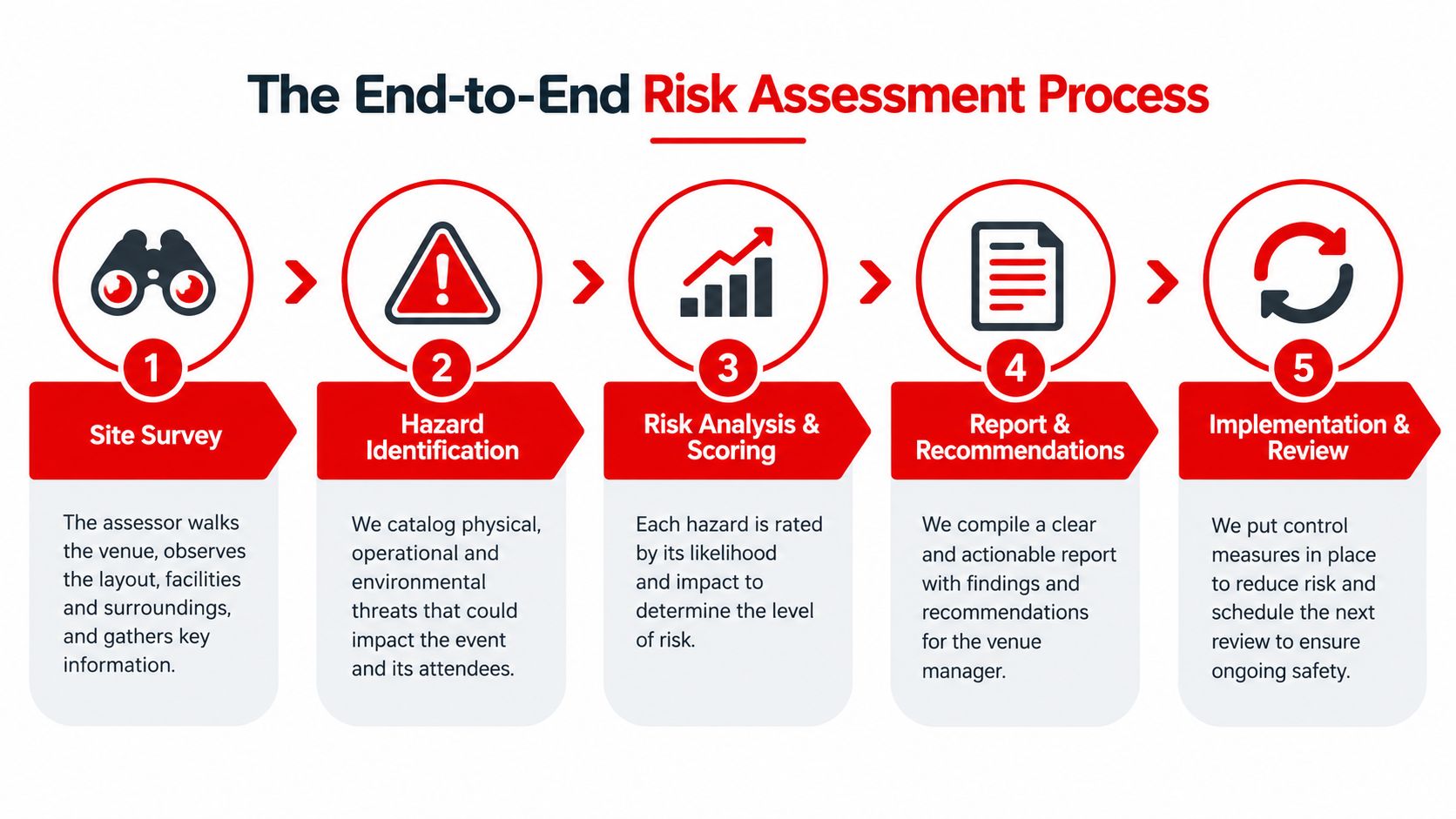
Effective assessments follow the operation from setup to close. The assessor observes how people, vehicles, contractors, staff and controls interact, rather than reviewing only finished public areas. The five stages below provide a repeatable method that can be applied under the AS/NZS ISO 31000 line of standards and adjusted for state WHS duties.
1. Survey the site and define the scope
The engagement begins with a scoping call and a site walk involving the duty manager or event lead. The assessor checks entry points, queue locations, crowd-flow lines, CCTV coverage, emergency egress, loading areas, staff-only doors and contractor interfaces.
The scope should cover bump-in, event delivery and bump-out. The Harbour Trust's events and venues WHS guide describes an event risk assessment as venue-specific and event-specific. It also addresses each operating phase, likelihood and consequence ratings, and the person responsible for implementing controls.
2. Identify hazards and threats
The assessor records realistic failure points. In an event venue, these may include crowd surges, slips near a bar, aggression, fire, a vehicle entering a pedestrian zone, contractor interface issues and liquor service.
Ask four practical questions: Who could be harmed? What conditions make the event more likely? What existing control would fail first? What would staff do in the first few minutes? The answers should come from current site conditions, operating plans and staff consultation, not from a copied risk register.
3. Score and rank the exposure
Each hazard is plotted against the agreed likelihood-versus-consequence matrix. The assessor explains the basis for each rating, including the evidence reviewed, the effectiveness of current controls and the consequence if those controls fail.
A high score is one input, not the whole decision. A lower-rated hazard connected to a legal duty, vulnerable person or critical emergency system may need attention first. The matrix supports consistent judgement while the responsible manager decides which controls to fund, assign and monitor.
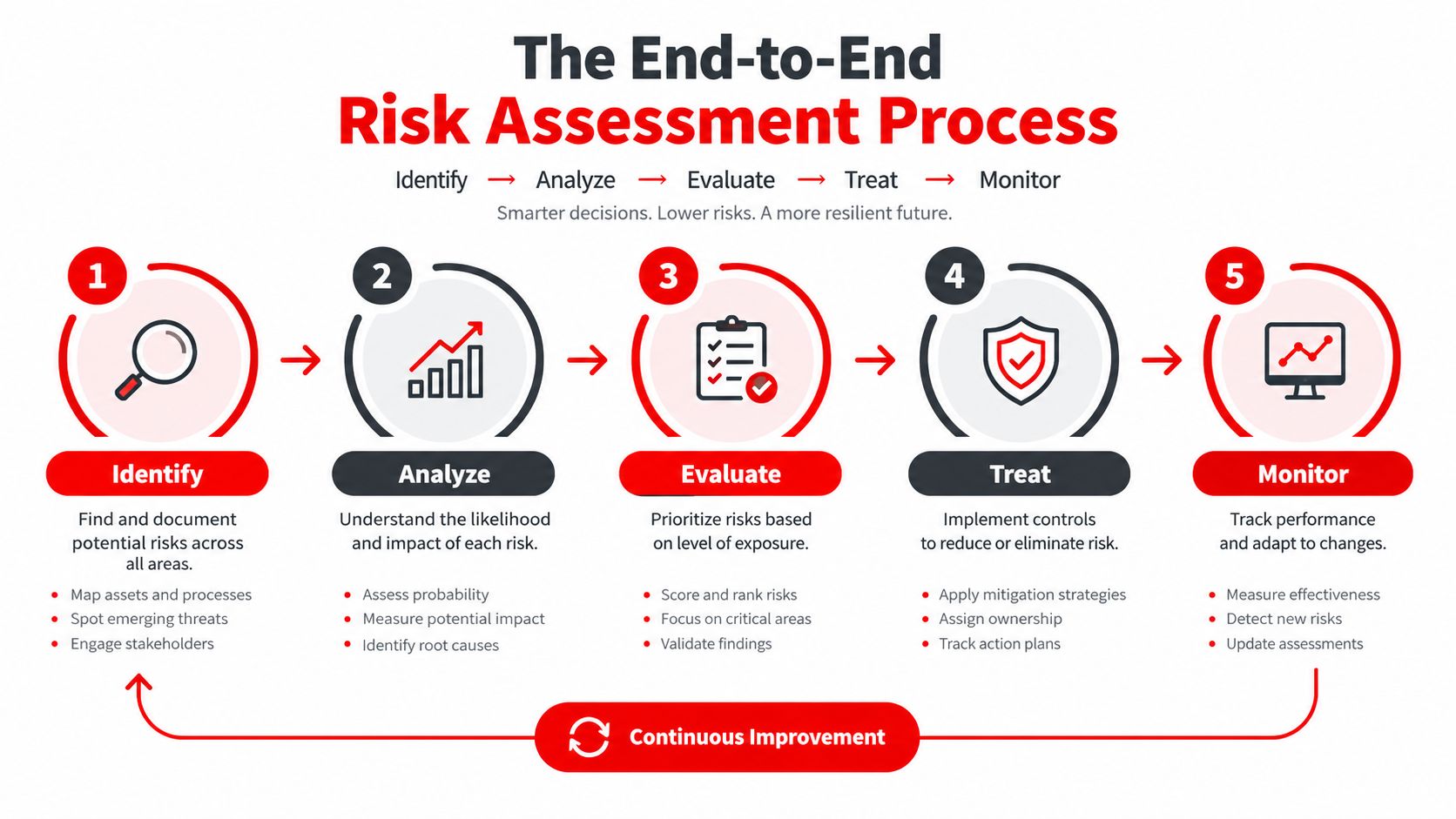
4. Assign treatment actions
Recommendations should be grouped by urgency and linked to a duty holder. Immediate fixes may include clearing an egress route or changing a guard position. Short-term controls could involve revised contractor induction, queue barriers or supervisor checks. Longer-term work may include improved lighting, access control or CCTV coverage.
Recommendations that name the post, coverage area, briefing requirement and review owner can be acted on immediately. Each action should also state its target timeframe and the evidence required to confirm completion.
5. Report, debrief and review
The final stage includes the written report, management debrief and review date. The provider should explain the highest-priority risks in plain language, confirm accepted residual risks and record open actions.
For a straightforward venue, the site walk and interviews may fit into one operational visit. Larger sites, complex events and construction projects require more time for access, consultation, document review and reporting. The provider should state the expected effort and dependencies before work begins. Safety managers comparing methods can also review the Safety Space process for safety managers as a reference point.
Risk Assessment Services Across Key Industries
The framework stays stable across industries, but the consequence model changes. An event organiser may place brand damage and crowd safety at the centre of the assessment. A construction manager must concentrate on life safety, plant and work interfaces. A retailer may give greater weight to loss, worker exposure and repeat offending.
| Sector | Primary Risk Drivers | Dominant Risk Type | Key Compliance Trigger |
|---|---|---|---|
| Events | Crowd density, ingress and egress, liquor service, weather and temporary infrastructure | Crowd safety and reputational harm | Event scope changes, council requirements and emergency planning duties |
| Hospitality | Patron behaviour, late-night trading, cash handling and licensing conditions | Patron, worker and operational safety | WHS duties, RSA obligations and changes to trading conditions |
| Construction | Plant, machinery, contractors, working at height and site movement | Life safety and serious injury | WHS requirements, high-risk work and regulator expectations |
| Retail | Shoplifting, robbery, shrinkage, lone work, lighting and sightlines | Financial loss and worker safety | WHS duties, incident patterns and changes to store layout |
Events and hospitality
For an event, the assessor should model how people arrive, queue, move between areas and leave. Weather contingencies, temporary fencing, liquor service and emergency communications can change the risk profile quickly. Western Australia's public-events guidance requires a risk management plan for events of more than 1,000 people, with a process aligned to AS/NZS 31000 and ISO 31000:2018, including stakeholders, likelihood and consequence descriptors, matrix analysis and action responses, as set out in the WA events guideline.
Hospitality assessments need a different emphasis. A late-night venue may need controls for patron aggression, intoxication, cash movement, staff welfare and interaction between security and responsible service procedures. The control can't be limited to “add more guards”. It may involve lighting, entry rules, incident recording, escalation procedures and manager presence.
Construction and retail
Construction assessments must follow the work sequence. A hazard can change when plant moves, a subcontractor starts, a temporary edge protection system is altered or a delivery route crosses a work area. Working at height, vehicle separation and contractor communication deserve close attention because controls can degrade as the project advances.
Retail requires an equally practical lens. The assessor should review concealment points, sightlines, lighting, staff-only access, cash handling, lone-worker arrangements and the placement of high-value stock. CPTED principles can inform the design, but the recommendations must match how staff operate. If vehicles are part of the exposure, a separate resource on telematics-based risk evaluation can help assess driving behaviour alongside the physical site review.
Benefits of Hiring a Specialist Risk Assessment Provider
Internal teams know the business, its people and its operating pressures. That knowledge can also make familiar weaknesses easy to accept, including a blocked sightline, noisy plant route or informal access practice. A specialist brings independence and tests how arrangements perform under pressure, rather than reviewing whether a policy exists on paper.
Independent benchmarking exposes blind spots
An external assessor compares the site with relevant operating experience and challenges assumptions that have become normal. Fresh observation can identify small failures with serious consequences, such as a CCTV camera facing away from the relevant approach, a guard post without a clear view of the queue or a contractor process dependent on one person remembering a verbal instruction.
Specialists also track changes in threat patterns, incident types and control methods across comparable environments. Internal managers rarely have the same time to maintain that wider view while running daily operations.
The benefit is practical when findings are tied to decisions. Recommendations may involve changing guard deployment, repositioning cameras, amending an access rule, rewriting an induction or separating vehicle and pedestrian movement. Generic wording leaves the client to complete the difficult analysis after the engagement ends.
Practical rule: If the recommendation doesn't identify the control, the owner and the implementation condition, it isn't ready for the operations plan.
A third-party report supports discussions with councils, regulators, insurers and legal advisers by recording the method, observations and treatment decisions. Management retains responsibility for deciding, funding and implementing controls, while the report strengthens the evidential record for regulators and insurers. It documents how the organisation identified and managed exposure, without promising a particular outcome.
Management also gets time back. The specialist can conduct interviews, inspect the site, review documents, write the register and lead follow-up while the venue, project or store continues operating. The value is realised when findings are implemented, checked and incorporated into the next operational cycle.
How to Choose the Right Risk Assessment Services Provider
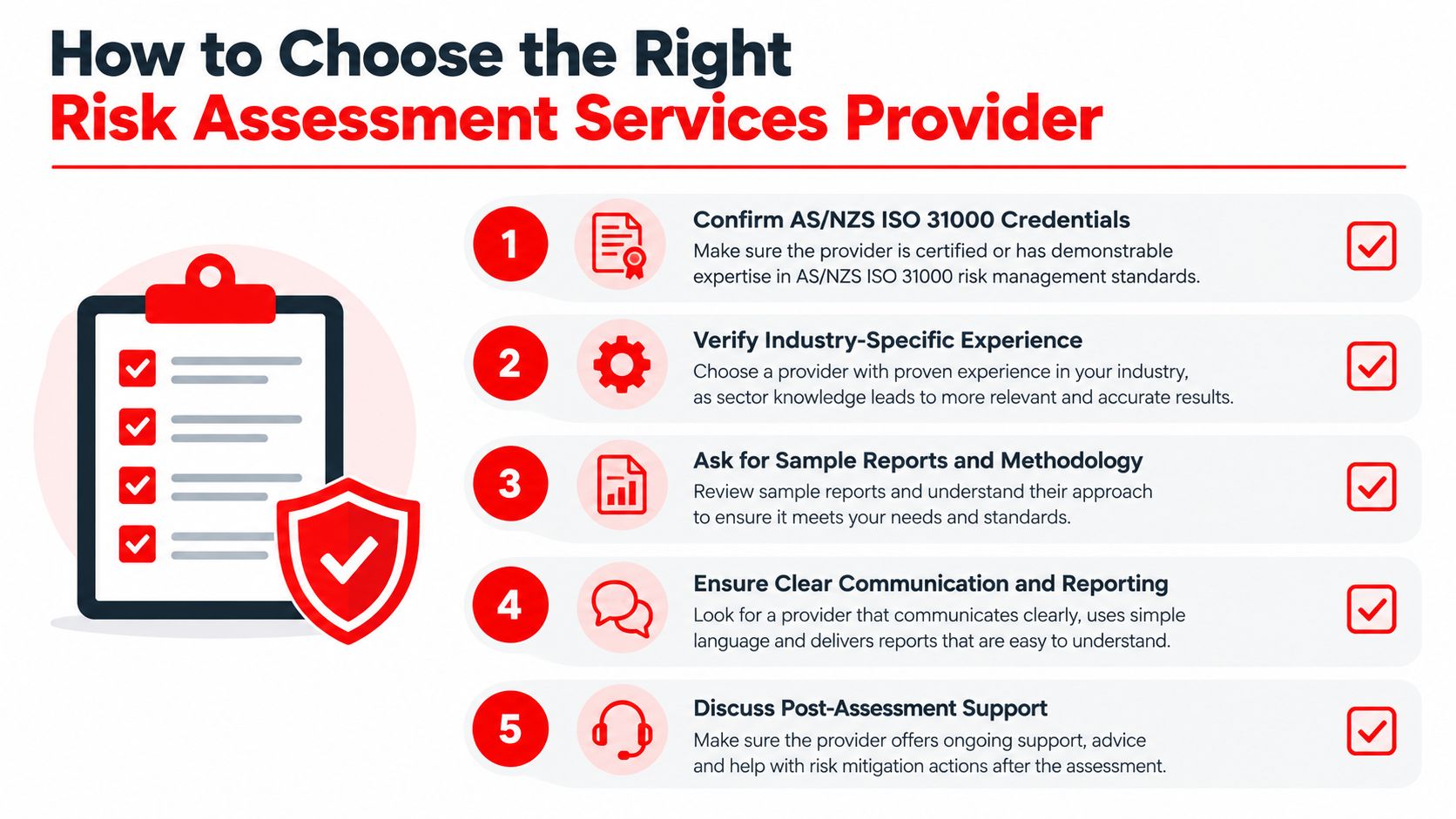
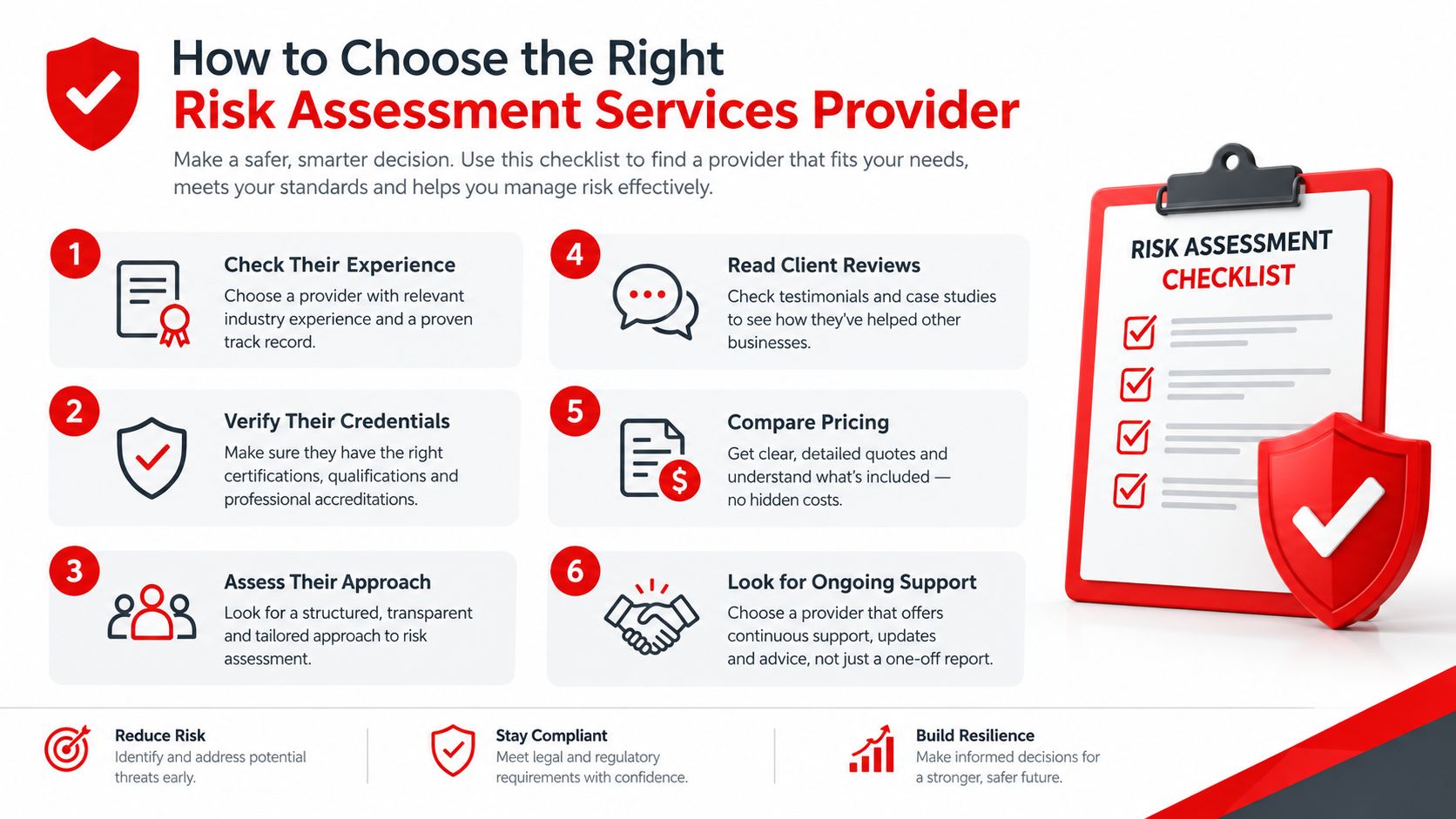
Start with method, not presentation. A polished report isn't evidence that the assessor understands your venue, construction phase or retail operation.
Test the provider before signing
Ask these questions directly:
Which framework do you use? Confirm that the provider works against the AS/NZS ISO 31000 line of standards and understands the WHS requirements in the state where the site operates. Check relevant security licensing where the engagement includes security advice or licensed security activity.
What comparable work have you completed? Ask for references from similar venues, projects, stores or event formats. A construction assessment and a nightclub assessment may use the same matrix, but they don't require the same field experience.
How do you score risk? The provider should explain likelihood, consequence, control effectiveness and residual risk before the site visit. Ask how the assessor handles a high-consequence event that has a low frequency but severe outcome.
What does the site survey involve? Confirm access requirements, interviews, operational phases, document review and the people who need to attend. A short walk-through may be suitable for a narrow scope, but the provider must explain what it cannot test.
Inspect the report, scope and follow-up
Request a sample report with sensitive details removed. It should contain a risk register, scored heatmap, prioritised treatment plan and triggers for reassessment. A glossy summary without evidence, owners or implementation detail won't help an operations team.
Ask how the provider will respond if a regulator or insurer challenges the findings. If legal proceedings are a possibility, clarify whether the assessor may provide expert evidence and under what separate engagement terms.
Finally, protect the scope. Use a fixed-fee structure where possible, define deliverables, list assumptions and agree the reassessment cadence around the operating calendar. A provider such as GM GROUP Services offers site-specific security risk assessments that identify threats, test existing controls, rank residual risk and produce mitigation plans for venues, events, retail sites and construction projects.
Risk Assessment Services Questions Buyers Ask Most
How long does an assessment take?
The answer depends on the number of sites, operating phases, access requirements and document review. A small site with a defined scope may be assessed through a focused visit and report. A complex event, active construction project or multi-area venue needs time for interviews, observation, consultation and management debriefing. Ask the provider to separate site time, analysis time and reporting time in the proposal.
What should the final documents include?
Request a risk register, a likelihood-versus-consequence matrix or heatmap, a treatment plan with owners and dates, a compliance map, accepted residual risks and review triggers. For events, the document should connect with the event management and emergency plans. For construction, it should align with existing WHS processes and escalate high-risk work into the relevant SWMS pathway where required.
When is a review triggered?
Review the assessment after a significant change in scope, layout, staffing, contractor activity, equipment, crowd profile or control effectiveness. NSW guidance requires documented assessment in specified high-risk situations and where workplace changes can affect controls, as outlined in the earlier NSW regulatory reference. Victoria's public-events guidance requires the risk process to include identification, assessment, control, monitoring, review and revision, and an emergency management plan for every event with more than 5,000 patrons, according to the Victoria Police public-events guidelines.
What affects the fee and liability scope?
Site complexity, operating hours, number of stakeholders, travel, document review, specialist expertise and follow-up support all affect scope. Confirm whether the provider is assessing security risks, WHS risks, event readiness or a defined combination. The provider gives professional advice, but management remains responsible for deciding, funding and implementing controls.
Brief your next assessment around the hazards that affect your people, patrons, contractors, property and reputation, not a generic checklist. For site-specific security risk assessments and operational controls across events, venues, retail and construction, visit GM GROUP Services and discuss the scope with their team.
Discover more from GM Group Services
Subscribe to get the latest posts sent to your email.