
Retail Security Service planning starts with a number retailers can't ignore. The Australian Bureau of Statistics recorded 595,660 victims of theft in 2024, the highest level in 21 years, with theft up 6% from 2023. Retail locations accounted for 268,666 incidents, or 45% of the total, compared with 32% in 2010. The ABS data shows that retail isn't just one setting affected by theft. It has become the dominant recorded setting.
That changes the buying decision. Retailers in NSW, VIC, QLD and the ACT shouldn't ask only, “How many guards can we afford?” They should ask, “Which combination of people, technology and procedures will reduce loss at our sites, during our highest-risk periods, without creating unnecessary confrontation?”
What a Retail Security Service Actually Does in Australia
A retail security service is a contracted combination of licensed personnel, surveillance technology and operating procedures designed to protect customers, staff, stock, property and brand reputation. It can cover a single storefront, a shopping centre, a supermarket, a licensed venue or a multi-site retail network.
The need is commercial as well as operational. Industry reporting has estimated that retail crime costs Australian businesses up to $9 billion each year. In NSW, retail theft offences rose 47.5% year-on-year to June 2023, while NSW Police recorded 25,478 retail theft incidents during that year. The average value of items stolen reached $440 in 2022/23. National Retail Association reporting connects incident volume with the direct cost retailers carry.
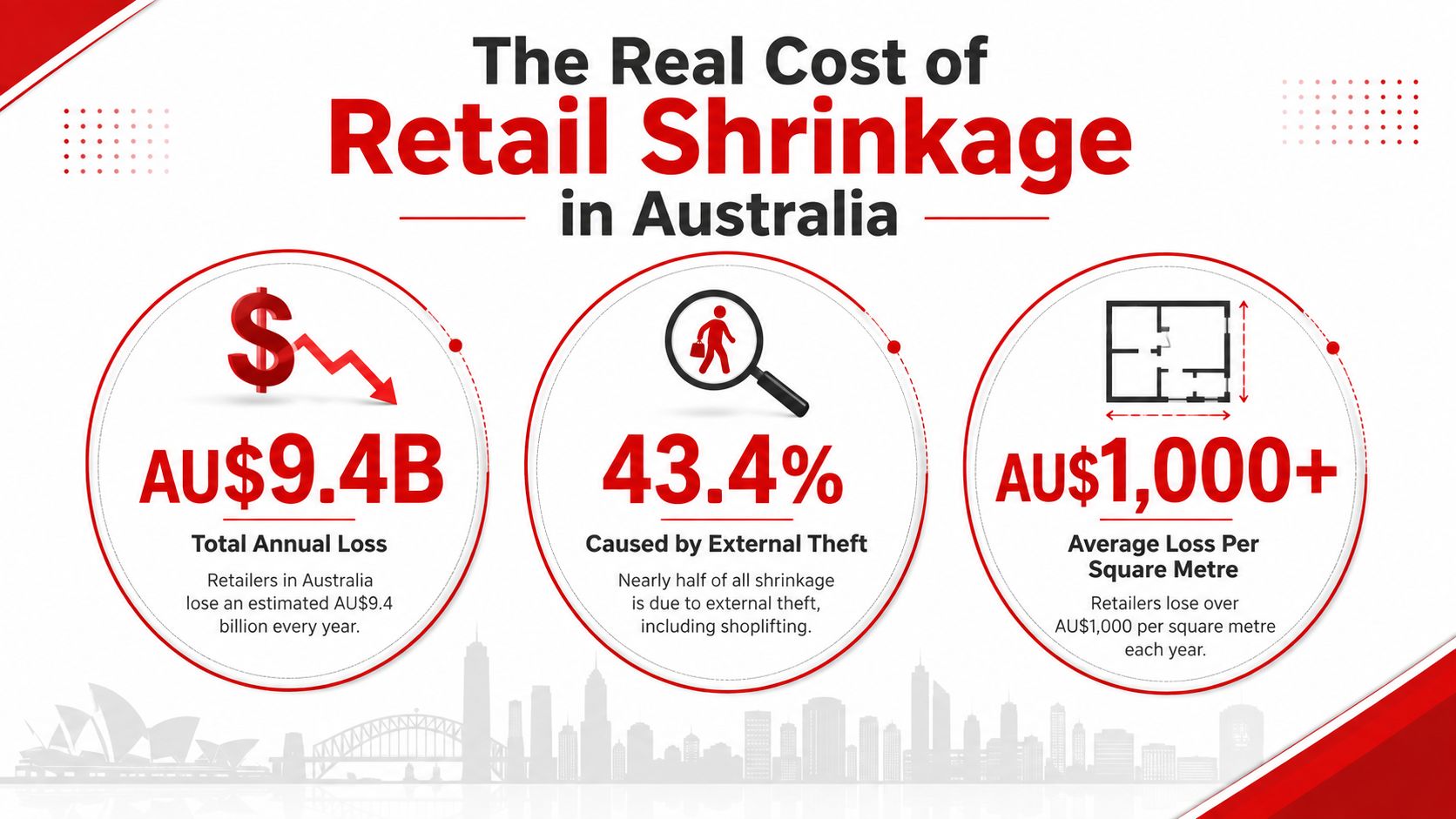
The right service starts with a baseline, not a uniform. Record where incidents happen, which products disappear, when staff feel unsafe, how alarms are handled and whether internal process failures are contributing to shrinkage. Then match the response to the actual exposure.
Seven deployment choices
Retailers generally choose from seven overlapping options:
- Always-on static guards, useful for visible deterrence, customer reassurance, access control and immediate response.
- Loss prevention officers, often covert, who identify suspicious behaviour, internal theft patterns and repeat offenders.
- K9 units, suited to car parks, bulk retail environments, loading areas and large centres where a visible deterrent covers broad space.
- CCTV and alarm monitoring, which supports evidence capture, after-hours detection and coordinated escalation.
- Mobile patrols, marked or unmarked, for strip retail, multiple sites and scheduled or alarm-triggered checks.
- Intelligence-led peak-hour coverage, which places staff around known hotspots, trading periods and transaction risks.
- Integrated mixed models, combining guards, monitoring, patrols, reporting and management oversight.
A static guard may be the right choice at a busy centre entrance, but the wrong answer for concealed internal theft. CCTV can document an incident, but it won't calm an aggressive customer on the floor. A mixed model usually works best where risk changes by site, time and behaviour.
The key is to treat security as an operating function. National reporting says one in four retail crime events involved violence, intimidation, harassment, threats or physical or verbal abuse, supporting a layered model with surveillance, trained staff and non-confrontational intervention procedures. Retail crime reporting makes the operational point clearly: reducing shrinkage and protecting people have to be designed together.
Core Service Types Every Retailer Should Understand
Buying a retail security service without understanding the deployment model leads to wasted hours. Each option solves a different problem, and each has a cost that should be measured against the retailer's loss profile.
Service comparison
| Service Type | Primary Function | Best-Fit Retail Setting | Primary Loss Category | Key Trade-off |
|---|---|---|---|---|
| Static guards | Visible deterrence, customer assistance, access control and immediate response | Shopping centres, supermarkets, high-foot-traffic stores and licensed retail precincts | Opportunistic theft, aggression and disorder | Strong presence, but limited covert detection |
| Loss prevention officers | Covert observation, investigation and targeted intervention | Fashion, electronics, department and high-shrinkage stores | Internal and organised or opportunistic theft | Better intelligence, less visible deterrence |
| K9 units | Deterrence, patrol support and detection across broad areas | Car parks, bulk retail, large-format centres and loading zones | External theft, trespass and vehicle-related incidents | High impact in suitable environments, but requires specialist deployment |
| CCTV and alarm monitoring | Detection, verification, evidence capture and escalation | Multi-site retailers, after-hours operations and centres | Break-ins, repeated incidents and audit failures | Depends on camera placement, image quality and response procedures |
| Mobile patrols | Scheduled checks, alarm response and perimeter visibility | Strip retail, dispersed stores and mixed-use sites | Trespass, vandalism and after-hours loss | Efficient across sites, but not continuously present |
| Peak-hour cover | Concentrated protection during known risk windows | CBD stores, Friday trade, promotions and event-linked retail | Grab-and-run theft, crowd disorder and staff safety risks | Efficient when intelligence is accurate, weaker outside coverage periods |
| Mixed model | Combines personnel, technology and reporting | Centres, multi-site portfolios and complex venues | Combined shrinkage, safety and compliance exposure | Requires strong coordination and clear accountability |
Static guards pay back where people need to see an active presence. Their value includes more than watching shelves. A well-briefed guard can control queues, identify escalating behaviour, support staff and create a clear response point when a situation changes.
Covert loss prevention is different. These officers review behaviour across departments, examine stock movement and help separate genuine customer service from deliberate concealment. They're particularly useful where internal fraud and repeat offending make uniformed presence easy to avoid.
K9 teams can change the feel of a car park or large site quickly. They're not a substitute for investigation or CCTV, but they can provide a mobile deterrent where a single officer can't cover multiple access points.
Monitoring becomes valuable when it connects to action. Cameras should cover entrances, point-of-sale areas, high-value displays, staff access points and loading areas, while alarms need a documented verification and escalation process. Mobile patrols then fill the gap between remote detection and on-site response.
Operational rule: Choose the service around the loss category first, then choose the roster. A visible guard is not a solution for every form of shrinkage.
Licensing, RSA and Compliance Across NSW, VIC, QLD and the ACT
A retailer is responsible for checking that the people and companies working on site are properly authorised. Don't accept a uniform, a business card or a verbal assurance as proof of compliance.
In NSW, retailers should verify the relevant individual security licence classes through the Security Licensing & Enforcement Directorate, and confirm that the contracted provider holds the required master licence arrangements. Class 1 and Class 2 work can involve different duties, so the role description must match the licence authority.
Victoria uses individual and business security registrations administered through Victoria Police Licensing Services. Crowd controller duties require the appropriate endorsement, particularly in shopping centres connected to licensed premises, entertainment precincts or event activity.
Queensland retailers should check both the security provider's authority and each officer's security licence through the Queensland Office of Fair Trading. The ACT has its own registration requirements, and businesses operating across borders shouldn't assume a licence in one jurisdiction automatically covers work in another.
Compliance comparison
| State/Territory | Licensing Authority | Key Licence Classes | RSA Crossover | Common Retailer Pitfall |
|---|---|---|---|---|
| NSW | SLED | Class 1 and Class 2 security roles, plus provider and master licence requirements | Relevant for licensed retail and venue-linked duties | Failing to verify the provider's master licence and role-specific authority |
| VIC | Victoria Police Licensing Services | Individual and business registrations, including crowd controller endorsement | Important around licensed premises and crowd management | Using an officer without the required endorsement |
| QLD | Office of Fair Trading | Security provider and security officer licensing | Critical for licensed venues and refusal or removal decisions | Treating general guarding authority as a substitute for venue capability |
| ACT | Territory registration regime | Registration depends on the security activity and role | Applies where retail operations connect with licensed venues | Assuming interstate licensing automatically transfers |
RSA matters because retail security officers often deal with intoxicated or aggressive people in bottle shops, shopping centre venues and mixed-use precincts. Officers need clear procedures for refusals, removals, recording incidents and escalating serious behaviour. Work Health and Safety duties also require retailers to manage foreseeable risks to workers, customers and contractors.
CCTV brings separate obligations. Tell staff and customers where surveillance operates, restrict access to footage, control retention and preserve evidence properly. A provider should explain who owns footage, who can retrieve it and how a police request is handled.
Pricing Models and the Real ROI of Retail Security
Retail security pricing only makes sense against the loss being addressed. The Australian Retailers Association and Griffith University analysis estimated total retail crime-related loss at $7.79 billion in FY24, equal to nearly 2% of turnover. Earlier ANZ estimates placed external theft at $2.29 billion and total crime-related loss at $4.30 billion, reinforcing the point that internal fraud and customer theft both require attention.
The basic calculation is straightforward:
Monthly security spend ÷ estimated monthly loss reduction = payback period.
That reduction shouldn't be guessed. Use stocktake variance, incident reports, refund anomalies, alarm activity, staff feedback and hotspot observations. If a retailer can't identify the loss being targeted, it's probably buying presence rather than prevention.
Four common pricing structures
| Pricing Model | Typical Rate (AUD) | Best Fit Retail Format | Payback Window |
|---|---|---|---|
| Hourly guards | Rates vary by role, location, shift and licence requirements | Stores needing targeted or recurring floor coverage | Depends on verified loss reduction |
| Fixed monthly retainer | Agreed recurring fee for ongoing coverage and management | Centres, portfolios and sites needing consistent oversight | Suits sustained operational risk |
| Event-based rates | Quoted per event, venue or trading period | Promotions, launches, seasonal activity and major events | Measured against event-specific incidents |
| Managed-service bundle | Combined monitoring, patrols, reporting and response | Multi-site retailers and centres | Stronger where several controls share one operating plan |
A suburban shopping centre kiosk may need peak-hour guarding, camera review and patrol response rather than a permanent post. A CBD fashion store may gain more from covert loss prevention during busy trading than from an empty uniform at the door. A Queensland bottle shop connected to a licensed precinct may require RSA-capable officers during high-risk periods, supported by CCTV and a documented refusal process.
Ask for the full cost, not just the hourly figure. Minimum shift blocks, weekend loadings, alarm-response travel, reporting fees and specialist licence requirements can change the economics. A cheaper roster that misses the main incident window won't outperform a targeted service just because it uses fewer hours.
Commercial test: If the provider can't show which incidents, products, times and behaviours the roster is designed to change, don't approve the roster.
How to Choose the Right Retail Security Service Provider
Shortlist providers in a fixed order. Start with legal authority, then operational capability, then evidence that the company can manage your type of site.
Request licence details for the business and proposed officers. In NSW, verify master licence arrangements and individual Class 1 or Class 2 authority where relevant. In VIC, check registrations and crowd controller endorsements. In QLD, verify provider and officer licensing. For the ACT, confirm the applicable territory registration.
Then request certificates of currency, public liability cover, workers compensation arrangements, training records and references from comparable stores or centres. If the provider uses a GuardCheck-equivalent training process, ask what it covers and how supervisors confirm competency in practice.
A practical vetting checklist
- Licence verification: Confirm the legal entity, provider authority and individual officer permissions.
- Role matching: Make sure the licence and training match guarding, crowd control, loss prevention or monitoring duties.
- RSA capability: Ask whether suitably trained officers are available when licensed-premises work is involved.
- Insurance: Require documented public liability protection appropriate to your site, contract and risk profile.
- Retail references: Speak with operators managing a comparable store format, centre or precinct.
- Supervision: Confirm who visits the site, how often they review performance and who handles escalation.
- Reporting platform: Require timely incident reports, trend summaries and access to relevant records.
- Replacement SLA: Put sick-leave and no-show replacement obligations in writing.
- CCTV ownership: Define who owns footage, who can access it and how evidence is released.
- Alarm response: Confirm the response process, travel assumptions and escalation chain.
- Multi-site coverage: Test whether regional operations can support every location in your portfolio.
- Exit terms: Include practical termination and transition provisions if performance falls short.
Ask these eight tender questions word for word:
- What shrinkage reduction targets will you propose, and how will you measure them?
- What is your replacement guard service level if an officer doesn't attend?
- What alarm-response time can you commit to under normal operating conditions?
- How often will you provide KPI reporting?
- Who owns and controls access to CCTV data?
- What exit and transition clauses will apply if the service isn't suitable?
- How will you cover regional sites across NSW, VIC, QLD or the ACT?
- How do your officers handle RSA-related refusals and removals?
Hard-wire monthly shrinkage reporting, incident-to-report turnaround under 24 hours, alarm response under 20 minutes where operationally achievable, and quarterly service reviews into the contract. GM GROUP Services offers retail loss prevention, K9 units, static guarding, vehicle patrols, monitoring, risk assessments and emergency response across the four jurisdictions, so it's one provider option to assess against the same criteria as any other tenderer.
Real-World Examples of Retail Security Service in Action
A Western Sydney shopping centre facing repeat fuel drive-offs and grab-and-run incidents needs more than a guard standing at the main doors. A mixed deployment using K9 support and loss prevention officers can cover car park movement, observe repeat behaviour and connect incidents to specific hotspots. Weekly shrinkage reporting then gives centre management a practical basis for moving coverage rather than leaving the roster static.
The important outcome isn't the presence of the dog or the uniform. It's the operating loop: identify the hotspot, brief the team, record the incident, review the pattern and adjust the next deployment.
A Melbourne CBD fashion retailer has a different problem. Friday trade creates crowding, quick movement and opportunities for internal theft. Intelligence-led peak-hour guards supported by CCTV analytics can focus on entrances, fitting rooms, stockrooms and high-value displays. Adding covert plain-clothes loss prevention coverage gives management a way to investigate internal referrals without turning the shop floor into a visibly hostile environment.
The compliance pressure is customer treatment. Staff and officers must distinguish suspicion from evidence, record decisions and avoid unnecessary confrontation.
A Brisbane licensed precinct venue connected to retail activity faces another set of demands during State of Origin events. RSA-trained crowd controllers, supported by CCTV monitoring across multiple entry points, can manage refusals and evictions with clearer documentation under Queensland liquor requirements. The team needs a consistent briefing, an escalation route and footage that supports the incident record.
These examples point to one conclusion. A retail security service should be assembled around the site's actual behaviour, not copied from another property. GM GROUP Services' stated capabilities include K9 handlers, loss prevention, event and venue cover, CCTV-related monitoring and risk assessment, which makes that type of mixed deployment available for consideration where the site profile supports it.
Your 30-Day Action Plan and Quick FAQ
Use the first month to replace assumptions with evidence.
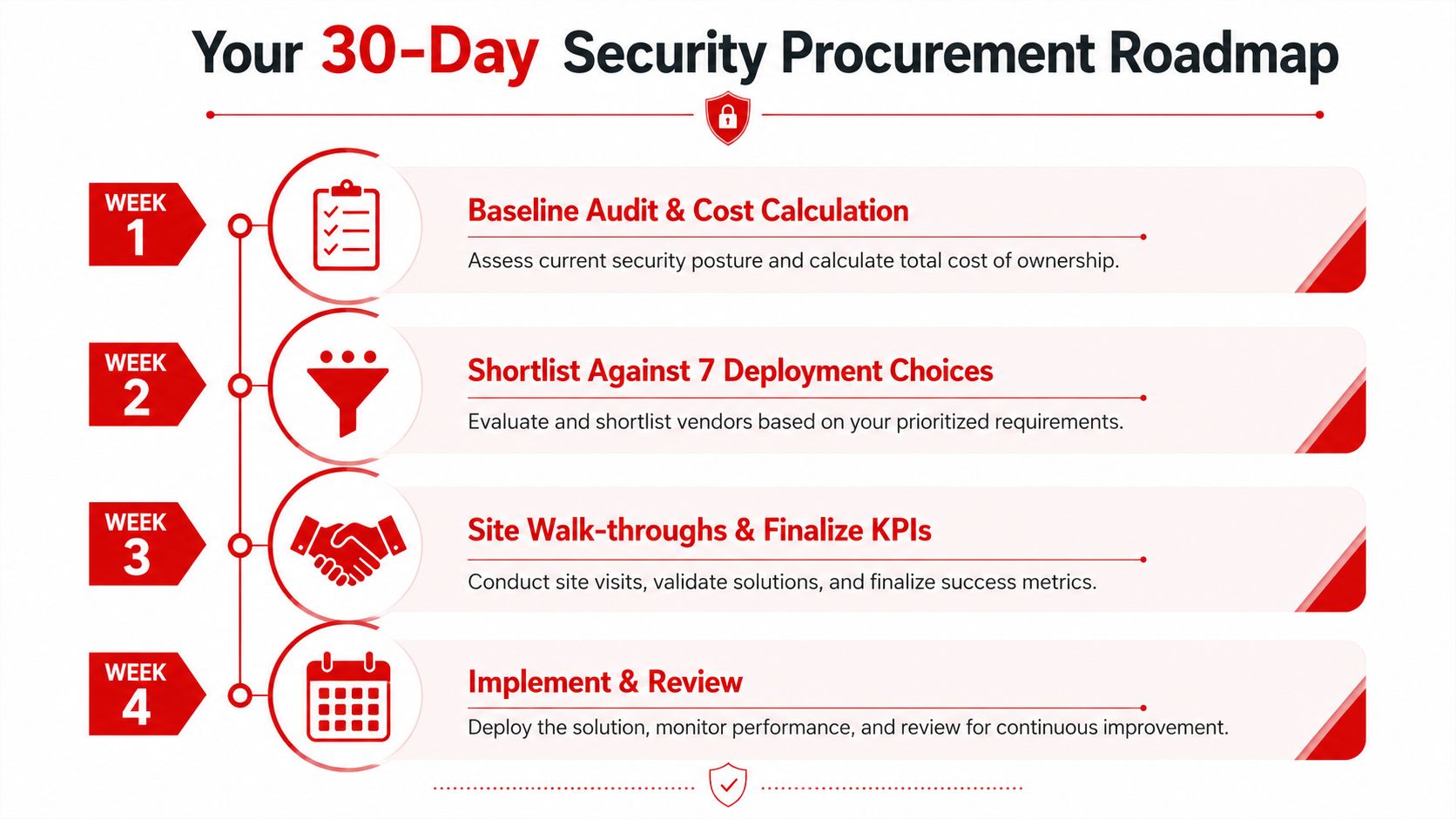
Week 1: Complete a baseline audit. Cost stock discrepancies, list aggressive or threatening incidents, map alarm activity and identify the products, entrances, shifts and transaction types creating the greatest exposure.
Week 2: Shortlist providers against the seven deployment choices. Decide whether the site needs static guarding, covert loss prevention, K9 support, monitoring, patrols, peak-hour coverage or a mixed model.
Week 3: Walk the site with each shortlisted provider. Require a written deployment plan, post orders, escalation procedure and KPI targets before discussing final price.
Week 4: Sign the contract, onboard staff, brief store teams and set the first 90-day performance review. Don't wait for an annual renewal to discover that the roster protects the wrong area.
Quick FAQ
How quickly can a provider mobilise cover after an incident?
It depends on officer availability, site complexity, licensing and the provider's escalation network. Ask for an emergency mobilisation process, named contacts and a written arrival target before an incident occurs. Temporary cover may be available faster than a fully designed recurring roster, but the provider still needs a safe briefing and lawful role assignment.
What insurance and public liability limits should a retailer demand?
Require a current certificate of currency and cover appropriate to the site's people, property, customer traffic and contract obligations. Don't rely on a generic certificate. Your broker, landlord and risk adviser should confirm the required limit, exclusions and workers compensation arrangements.
Must loss prevention officers hold the same licence class as static guards?
Not automatically. The correct authority depends on the duties performed and the jurisdiction. Verify the role against NSW SLED requirements, Victorian registration and endorsements, Queensland Office of Fair Trading licensing, or ACT registration before deployment. A covert uniform doesn't remove licensing obligations.
GM GROUP Services can assess your stores, centres and licensed retail environments, then combine licensed guards, loss prevention, K9, patrols, monitoring and risk reporting around the incidents you face. Visit GM GROUP Services to discuss a site-specific retail security service plan across NSW, VIC, QLD or the ACT.
Discover more from GM Group Services
Subscribe to get the latest posts sent to your email.