
Regulatory requirements can derail an event long before the first patron walks through the gate. A festival can have the right artist, the right venue, and the right ticket sales, then still end up exposed because one guard is licensed in the wrong class, one subcontractor can't prove current credentials, or one council condition wasn't built into the security plan.
That's the reality for event directors working across NSW, Victoria, Queensland and the ACT. The mistake isn't usually bad intent. It's assuming compliance is one document, one licence, or one pre-event sign-off. It isn't. It's a chain. If one link fails, the whole operation becomes fragile.
For venues, promoters, retailers and site managers, regulatory requirements matter for three reasons. They protect people, they protect your insurance position, and they protect your ability to keep operating when an incident, inspection or complaint lands on your desk.
Navigating Australia's Complex Security Regulatory Requirements
A common failure point looks simple on paper. An organiser books a security team for a multi-day event, assumes the provider has “all the right licences”, and only checks staffing numbers. Then a late-stage review shows a role mismatch, a state-specific paperwork gap, or a permit condition the security plan didn't properly address. At that point, you're not just fixing admin. You're scrambling to protect opening time, public safety, and your brand.
That's why regulatory requirements need to be treated as an operational system, not a box-ticking exercise.
The scale of the sector shows why this matters. The Australian Private Security industry generates over $11 billion in annual revenue and employs more than 180,000 people, with market growth projected to reach $4.3 billion by 2033, driven largely by expanding regulatory requirements according to the ASIAL Security 2025 summary.
Why event operators get caught out
Most organisers don't struggle with the idea of compliance. They struggle with overlap. Security licensing sits beside venue conditions, WHS duties, alcohol service controls, council approvals, contractor management, reporting obligations and, in many operations, device and data security as well.
If you're newer to compliance language generally, this broader compliance guide for small businesses is useful because it explains the business logic behind compliance before you apply it to event operations.
Practical rule: If a requirement affects who can work, how the site runs, or what happens after an incident, treat it as a live operational control, not back-office admin.
What good compliance looks like on the ground
Strong operators do three things early:
- They verify credentials before rostering: Not after bump-in has started.
- They align the security plan with venue and permit conditions: Not as a separate document stream.
- They brief supervisors on state-specific differences: Especially when staff, venues or contractors move across borders.
What doesn't work is assuming one state's standard will satisfy another, or that a provider's business licence automatically covers every individual deployed on site.
Understanding Core Security Licensing Requirements
Licensing is the foundation. If the licensing is wrong, everything built on top of it becomes shaky, including your liability position.
In Australia, security operates on a dual-licensing framework. The business needs its own licence, and each person performing security duties needs an individual licence. The simplest analogy is this: a company can be legally registered to trade, but that doesn't mean every employee is automatically qualified to perform a regulated role. Security works the same way.
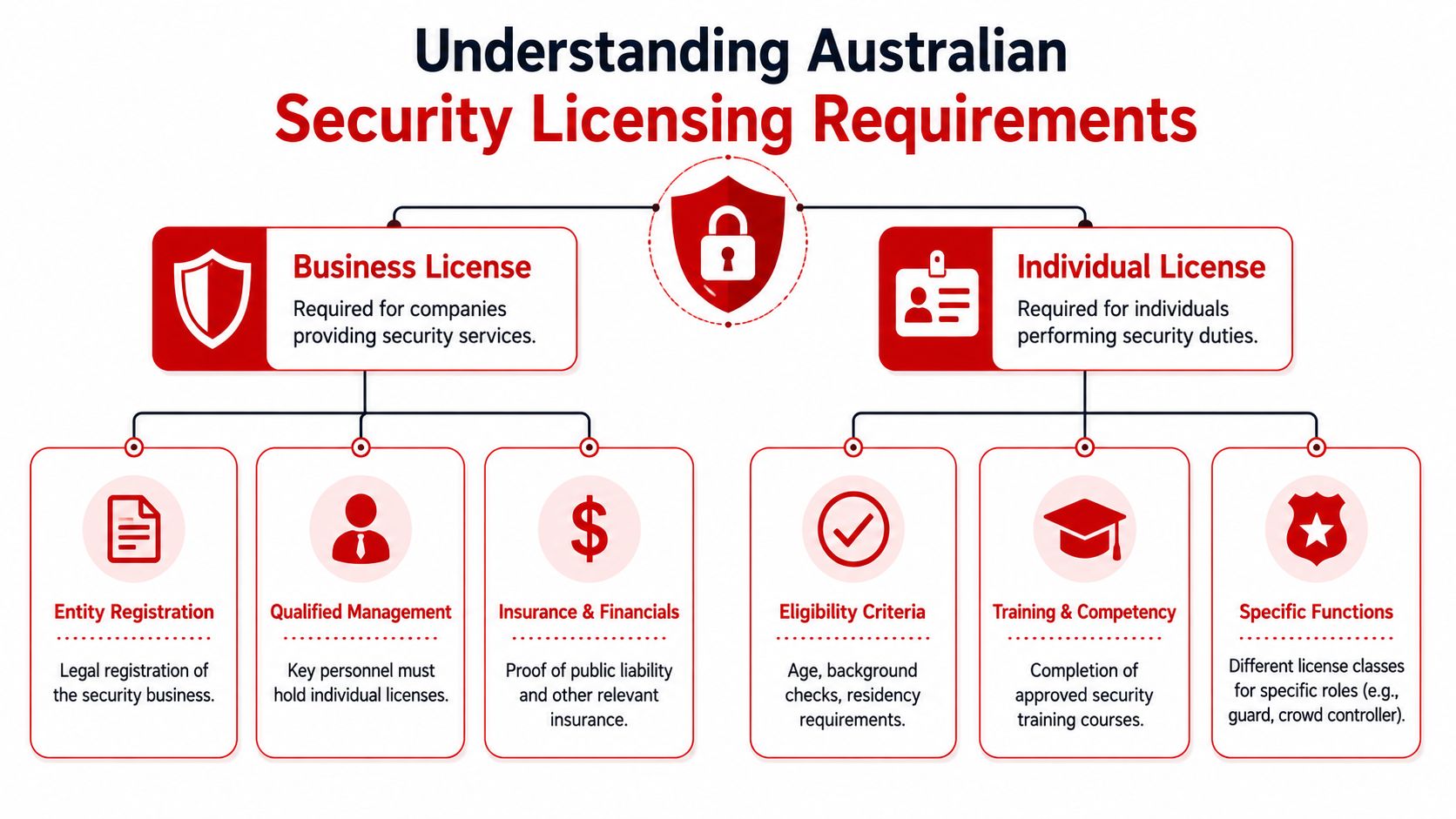
The two licences you need to check
The business side matters because the entity itself must be authorised to provide security services. The individual side matters because the person at your entry gate, backstage corridor or cash-handling point must hold the right authority for that role.
When organisers check only the company and not the staff roster, they leave a gap. When they check only an individual guard and ignore the business licence, they leave another gap.
A practical review should confirm:
- Business authority: The provider is licensed to deliver the service in that jurisdiction.
- Individual authority: Every deployed worker holds a current licence for the tasks they will perform.
- Role match: The licence class fits the assignment, not just general security work.
A roster isn't a compliance document unless every name on it can be tied to a current, correct licence.
Licence classes aren't interchangeable
Many event teams often make expensive assumptions. In NSW, specific licence classes apply to specific roles. Class 1A covers Unarmed Guard, 1B covers Bodyguard, 1D covers Guard Dog Handler, and 1F covers Armed Guard, each with distinct training and experience prerequisites as outlined in this overview of NSW security guard licences.
That matters because a person suitable for front-of-house access control isn't automatically licensed for close personal protection or K9 deployment.
What to ask before signing a provider
Use plain questions. Don't ask, “Are you compliant?” Ask these instead:
- Which business licence covers this site and state?
- Which individual licence class will each role require?
- Who verifies expiry dates before roster release?
- How do you handle substitutions if a licensed staff member drops out?
- Can supervisors produce licence evidence during an inspection?
What works is matching licence class to site risk and job design. What doesn't work is broad wording like “security personnel supplied as required” with no class breakdown.
For event directors, that's the practical takeaway. You're not buying a generic security presence. You're engaging licensed people for defined legal functions.
Key Differences in Regulatory Requirements by State
Multi-state work is where otherwise capable teams come unstuck. A process that runs cleanly in NSW can fail in Queensland. A staffing assumption that works for a city venue can collapse when a regional event, council permit and interstate roster all intersect.
The issue isn't only licensing. It's the different combinations of regulator expectations, evidence requirements and application hurdles in each jurisdiction.
The state-by-state problem in real operations
Queensland is a good example of why one national process doesn't hold together on its own. The Security Providers Act 1993 in Queensland mandates fingerprinting for all new licence applicants, a requirement not universal across all states, as noted in this Queensland security licence eligibility guide.
That single difference changes workforce planning. If you're scaling for a festival season, you can't assume candidate mobilisation timelines will look the same across your footprint.
NSW adds its own practical demands. The regulatory settings there require applicants to provide evidence of the training, assessment and instruction relevant to the licence sought, along with proof of identity that satisfies the Commissioner, under the NSW Security Industry Regulation 2016. For operators, that means document control matters early, not after recruitment.
State-by-State Security Regulation Snapshot 2026
| State | Regulatory Body | Governing Act | Unique Requirement Example |
|---|---|---|---|
| NSW | NSW Fair Trading | Security Industry Act 1997 and Security Industry Regulation 2016 | Applicants must provide evidence of required training and proof of identity that satisfies the Commissioner |
| VIC | State regulator under Victoria's security industry framework | State-specific security industry legislation | Licence checks and role matching must be handled under Victoria's own framework rather than assumed from another state |
| QLD | Queensland regulator under the Security Providers framework | Security Providers Act 1993 | New applicants must complete fingerprinting |
| ACT | ACT regulator under territory-specific security legislation | Territory-specific security industry legislation | Cross-border staffing still requires local legal fit, not a NSW-first assumption |
Where multi-state event plans usually fail
The biggest mistakes are usually process mistakes:
- Copy-paste staffing models: A roster template built for one state gets reused everywhere.
- Late credential review: Licences are checked too close to event day.
- Wrong role assumptions: Teams assume “security guard” is a universal category across all deployments.
- Poor contractor integration: Subcontractors are brought in without the same verification standard as core staff.
The practical answer is to build compliance by jurisdiction, then merge it into one event plan. Start with the host state's licensing rules. Add the venue conditions. Add alcohol-related obligations. Add local authority permit conditions. Then lock your roster against those requirements, not the other way around.
If you're operating across four jurisdictions, don't aim for one process. Aim for one control system with four compliant versions.
That's also why multi-state event security needs active licence portability planning, especially when rosters change at short notice. The legal question isn't whether a guard is good at the work. It's whether that person is authorised for that work, in that place, on that day.
Managing On-Site Safety and Responsible Service
Once the gates open, regulatory requirements become behaviour, supervision and decision-making. Many organisers then realise compliance isn't only about licences in a folder. It's about how the site is run.
A busy festival gives the clearest example. Mid-evening, entry pressure builds, one patron group is already intoxicated, a delivery vehicle needs access through a service lane, and the bar manager is worried about escalating behaviour near the drinks queue. If the security team is properly briefed, they don't treat those as separate problems. They manage them as one safety picture.
How security supports RSA and WHS in practice
Security teams often become the frontline support for Responsible Service of Alcohol controls. They identify intoxication indicators, manage refusals, separate agitated patrons from crowd pressure, and keep bar staff from being left to handle conflict alone.
At the same time, they are part of the venue's Work Health and Safety control system. That includes access control, crowd movement, emergency response, incident isolation and evacuation support. A good team doesn't wait for a crisis to act. Supervisors position staff where pinch points, queuing pressure and conflict are most likely to emerge.
Private security providers must also operate under the dual-licensing model discussed earlier, holding both a Security Business Licence for the entity and an Individual Operator Licence for each employee, a framework designed to reduce liability for venue operators according to the Security Providers Association of Australia licensing resource.
What works on a live site
The best on-site systems are simple enough to execute under pressure:
- Pre-opening briefings: Include intoxication response, ejection authority, escalation paths and emergency roles.
- Zone ownership: Give each supervisor clear responsibility for entry, bar areas, stage fronts, back-of-house and egress.
- Fast radio escalation: Minor issues should move quickly before they become reportable incidents.
- Shared language with venue staff: Security, bar managers and event control need the same threshold for intervention.
What doesn't work is treating RSA as the bar team's issue and crowd safety as the security team's issue. Those two functions overlap all night.
A practical site discipline
One of the strongest habits on a compliant site is contemporaneous decision-making. If a patron is refused entry, moved on, ejected or referred for medical support, the supervisor records the reason while the facts are fresh. That protects staff, supports management review and helps if a complaint comes later.
The cleanest operations aren't the ones with no incidents. They're the ones where staff recognise risk early, act lawfully, and document the decision properly.
Securing Event Permits Insurance and Liability
A common failure point shows up a week before bump-in. Council has approved the event subject to crowd controls, the venue has its own house rules, the insurer wants clear contractor details, and the security plan on file does not match the actual deployment. That is how approvals get delayed, conditions get tightened, and liability shifts back to the organiser.
In practice, permits, insurance, and liability are tied together by consistency. If your application says one thing, your contractor roster shows another, and the site runs a third way on the day, you have created exposure before the gates even open. This gets harder across NSW, VIC, QLD and the ACT because councils, venue operators, liquor conditions, and state licensing settings do not line up neatly. A plan that satisfies one authority can still leave a gap with another.
Permits usually turn on specifics. Capacity limits, ingress and egress, trading hours, traffic management, noise controls, emergency access, and neighbourhood impact all affect what security presence the event must show on paper. Insurance follows the same logic. Underwriters look for evidence that foreseeable risks were identified, allocated, and controlled by the right people under the right approvals.
For organisers comparing risk frameworks, this guide to understanding business security for contractors is useful because it explains how security practice and insurance exposure connect in commercial settings.
The expensive mistakes are usually basic. Hiring a properly licensed team in one state does not solve permit conditions in another. Public liability cover that looks adequate at contract stage may exclude parts of the actual activity, especially where alcohol service, crowd management, cash handling, temporary structures, or overnight asset protection are involved. I have also seen event directors assume the venue's policy covers contractor conduct. Often it does not, or it only responds after a dispute about control, supervision, or disclosure.
A provider such as GM GROUP Services can be one operational option where an organiser needs licensed coverage across NSW, Victoria, Queensland and the ACT, especially when the brief includes events, venues, gatehouse control, patrols or risk assessments. The test is whether the provider's licensing position, scope of work, reporting process, and supervision model match the liabilities the event is carrying.
Physical security can also create privacy exposure. CCTV, access control systems, visitor logs, radios, tablets, and contractor-held devices all generate records that may contain personal information. If footage is mishandled, devices are shared carelessly, or access logs are kept without proper controls, a crowd management issue can become a privacy issue as well, with obligations under the Privacy Act and the Notifiable Data Breaches scheme.
The practical rule is simple. Align the permit file, the insurer's assumptions, the venue conditions, and the live security deployment before the event opens. If those four versions of the job do not match, liability rarely lands where the organiser expected.
Essential Record-Keeping and Incident Reporting
Compliance lives or dies on paperwork after the fact. If an inspector attends, a patron complains, or a claim lands months later, memories won't save you. Records will.
The best sites keep documents in a form that can be produced fast and understood by someone who wasn't there. If it takes half a day to work out who worked, who supervised, what happened and what action was taken, your record system is already underperforming.
What records should be easy to produce
A venue or event operator should be able to retrieve:
- Current licence records: Business and individual credentials relevant to the deployment
- Rosters and deployment maps: Who worked, where they worked, and who supervised them
- Site briefings: Shift instructions, escalation pathways, emergency roles and patron management expectations
- Training evidence: Role-relevant training and any venue-specific induction material
- Incident logs: Time-stamped records tied to actual decisions and actions
If your provider handles these well, audits become manageable. If they don't, even a minor incident can become messy.
What makes an incident report legally useful
A useful report is factual, chronological and specific. It identifies who observed the issue, what was seen or heard, what action was taken, who was notified, and what happened next. It avoids opinion, sarcasm and hindsight language.
A sound report should cover:
- Date, time and exact location
- Names or identifiers of staff involved
- Names or descriptors of other parties involved
- Objective observations
- Actions taken
- Escalations made
- Outcome at handover or close
- Any supporting CCTV, witness or body-worn references if applicable
Write what staff observed, what staff did, and what happened next. Leave out conclusions you can't prove.
Common reporting mistakes
Three mistakes show up repeatedly:
- Delay: Reports written too long after the event lose detail.
- Opinion: Staff write what they believe someone intended instead of what they observed.
- Gaps: The report says force was used, entry was refused, or police were called, but doesn't explain why.
Those gaps create risk because they weaken your ability to justify action later. Strong reporting is boring by design. That's exactly why it holds up.
A 10-Point Checklist for Flawless Security Compliance
Treat this as a pre-event flight check. You're not trying to create paperwork for its own sake. You're looking for the points where an operational plan can fail under inspection, stress or complaint.
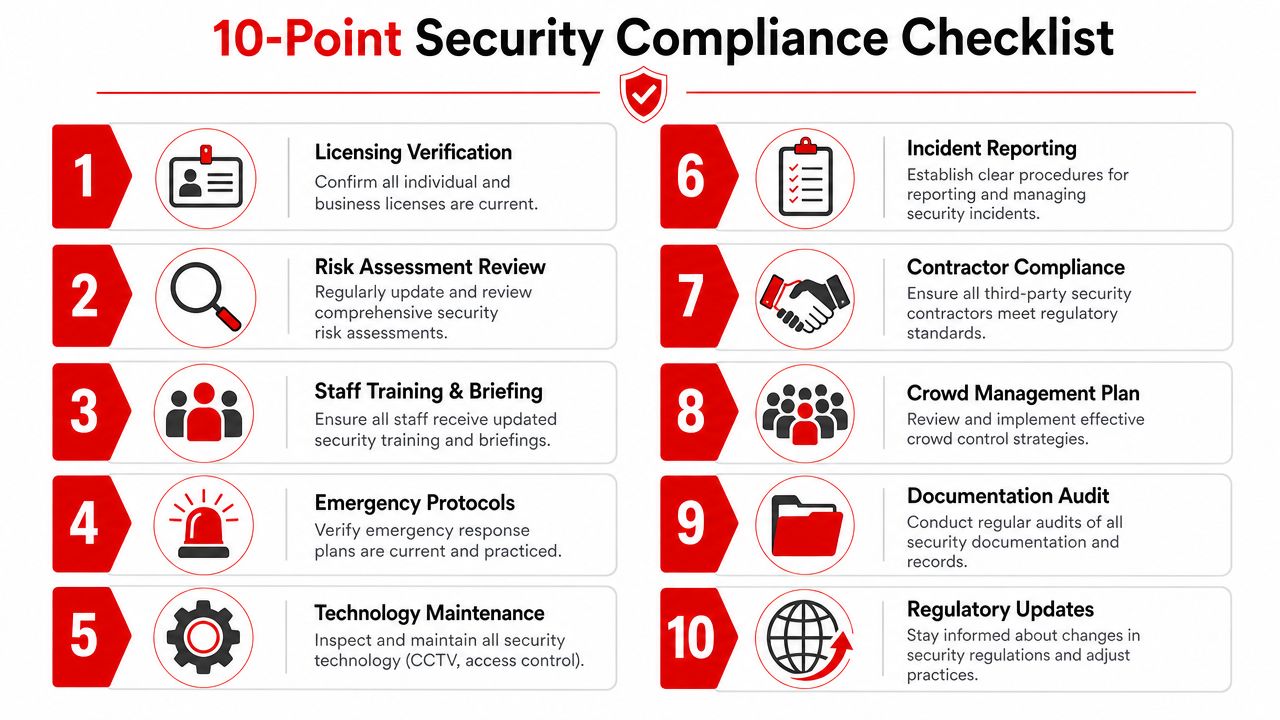
The pre-event regulatory requirements check
Verify the provider entity
Confirm the business licence is current and valid for the jurisdiction where the event will run.Verify every deployed individual
Don't accept “all staff are licensed” as a blanket statement. Ask for role-specific verification.Match licence class to task
Unarmed guarding, bodyguard work, K9 handling and higher-risk roles aren't interchangeable.Review permit conditions against the security plan
Hours, capacity, traffic, noise, access and emergency conditions should appear in the live operating plan.Check RSA support controls
Make sure venue staff and security supervisors share the same refusal, ejection and escalation process.Test emergency procedures
Confirm who controls evacuation decisions, who opens routes, who manages back-of-house, and who liaises with emergency services.Audit contractor alignment
Subcontracted guards, patrol units and specialist operators must meet the same standard as core staff.Review device and privacy exposure
CCTV, access control, visitor records and connected security equipment should be handled under clear procedures.Inspect records before the event, not after it
Use the same discipline you'd use for a financial audit. For a broader admin framework, this expert guide for small businesses is a practical reference for record-keeping structure.Assign one compliance owner on the day
Someone needs clear authority to verify documents, handle regulator enquiries and approve corrective action fast.
What separates clean events from exposed ones
It usually isn't budget. It's control. Clean events have one verified document path, one escalation chain and one standard for evidence. Exposed events rely on assumptions, last-minute substitutions and verbal assurances.
If you use this checklist before contract signing, before bump-in and again before doors open, you'll catch most of the failures that cause real trouble.
Frequently Asked Questions About Security Regulations
Can I use interstate guards for a multi-day festival
Only if they hold the right authority for the state or territory where they will work, and for the specific duties you are assigning. Multi-state events often go wrong precisely for this reason. A guard cleared for one role in NSW is not automatically cleared for the same role in Victoria, Queensland or the ACT.
Check this before contracts are final, not the night before gates open.
Is a crowd controller the same as a security guard
No. Event teams often use those terms loosely, but regulators do not. The licence category, permitted functions and training requirements can differ by jurisdiction, so rostering by job title alone creates avoidable exposure.
Who is liable if an unlicensed person is found on site
Liability can extend beyond the individual guard. It can reach the security provider and the organiser or venue if verification was weak or ignored. From an event director's side, saying a contractor sent the person will not help much if nobody checked credentials before deployment.
How early should licence checks happen
Before final rostering. Then check again before the shift if there have been substitutions, role changes or interstate transfers.
Late checks create pressure. Pressure leads to shortcuts, and shortcuts are how unlicensed staff end up on a live site.
Do permits, WHS and RSA really need to be integrated into one security plan
Yes, because they affect the same decisions on the ground. A council permit may limit entry points or trading areas. WHS controls change crowd flow, vehicle access and emergency routes. RSA obligations affect screening, refusals and how security works with bar staff. If those controls sit in separate documents with different assumptions, the site team will eventually miss something.
What's the biggest compliance mistake event directors make
Treating compliance as a contractor problem instead of an event control issue. The expensive failures usually happen at the overlap points: a licensed team rostered into the wrong role class, a compliant security plan that conflicts with permit conditions, or RSA procedures that do not match actual queue and bar layouts.
If you run events across NSW, Victoria, Queensland or the ACT, get one person to compare the licensing position, WHS controls, RSA process and permit conditions against the actual site plan before the event goes live. That review catches the mistakes that trigger regulator attention.
GM GROUP Services can help event organisers assess how security operations line up with the regulatory requirements for the venue, state and operating model. The value is practical. You get a clearer view of licensing fit, site controls, reporting expectations and the gaps that tend to appear when multiple jurisdictions and frameworks intersect.
Discover more from GM Group Services
Subscribe to get the latest posts sent to your email.