
Hiring private security bodyguards in Australia is about much more than just having a physical presence; it’s a strategic decision to protect your people, property, and assets with specialised expertise. It's not just for celebrities. From managing crowds at major events to securing high-value construction sites, these trained professionals are skilled in risk assessment, conflict de-escalation, and decisive emergency response.
At its core, private security provides peace of mind. But the benefits run much deeper. A professional team proactively identifies and neutralises threats before they escalate, ensuring your operations run smoothly and your reputation remains intact.
The Surprising Reasons You Might Need a Private Security Team
Across Australia, the demand for professional security isn't just growing; it's changing. It's no longer a luxury for the rich and famous. For many businesses, it’s a fundamental part of running a safe and successful operation.
We see it everywhere: managing crowds at major sporting events, protecting high-value equipment on construction sites overnight, or simply making sure a busy pub or restaurant remains a safe, enjoyable place for everyone.
The real value of modern security lies in being proactive, not just reactive. It’s all about sharp planning, identifying potential threats, and creating a secure environment from the ground up. A great security team protects your reputation, keeps your operations running without a hitch, and gives staff and customers that all-important peace of mind.
The Growing Need For Private Security Bodyguards
Gone are the days when you'd only see a bodyguard flanking a movie star on the red carpet. Today, professional security has become a core part of running a smart business or event anywhere in Australia. The whole mindset has shifted. We've moved away from just reacting to problems and towards proactively building safe, controlled environments.
It's all about stopping issues before they ever get a chance to start—whether that's disrupting a major function, putting people at risk, or tarnishing a company's good name.
Think about a major tech product launch in downtown Sydney. You've got top executives, media, and a crowd of excited fans all in one space. That kind of high-energy environment is a recipe for potential trouble if left unmanaged. Unwanted guests could slip in, crowd control could break down, expensive demo products could go missing, or a key speaker could even face a direct threat. It's in scenarios like this that the real worth of hiring professional private security bodyguards becomes crystal clear.
Redefining The Modern Bodyguard's Role
The old stereotype of a burly guard just standing at a door is completely outdated. A modern security professional is a specialist trained in assessing threats, de-escalating conflict before it boils over, and coordinating emergency responses with calm efficiency.
Let's go back to that product launch. A professional team's work begins long before the first guest arrives:
- Threat Assessment: Weeks ahead, they're poring over venue blueprints, flagging weak spots, and researching any potential risks tied to the event or its VIPs.
- Access Control: They'll map out a check-in process that feels smooth for guests but is a brick wall for anyone who isn't supposed to be there.
- Crowd Dynamics: During the event, their eyes are constantly scanning the crowd, spotting subtle shifts in behaviour and quietly managing anyone who might cause trouble.
- Emergency Coordination: If something does go wrong—a medical issue or the need to evacuate—they have a well-rehearsed plan ready to go, working seamlessly with venue staff and first responders.
This quiet, behind-the-scenes work is what turns a potentially chaotic situation into a seamless, secure event. The goal is always prevention, creating a space where guests feel completely safe without ever feeling watched or restricted.
The core principle of modern security is not just to react to incidents but to create an environment where incidents are far less likely to happen. It's about proactive control and quiet confidence.
The industry's growth tells the story. Across Australia, particularly in New South Wales (NSW), Victoria (VIC), and Queensland (QLD), the demand for private security has skyrocketed. As of 2023, there were over 150,000 licensed security personnel in the country. NSW alone has around 45,000 licence holders, a number largely driven by the need for expert protection at corporate events and major public gatherings. You can explore further insights into the booming private security industry to see the trend.
It all points to a critical shift in thinking for Australian businesses: investing in professional private security bodyguards isn't just an expense; it's a direct investment in safety, asset protection, and the integrity of your brand.
Matching Private Security Bodyguards to Your Specific Needs
Hiring a private security team isn't a simple, one-size-fits-all decision. Think of it like a doctor's visit: you wouldn't get the same treatment for a broken arm as you would for the flu. In the security world, different challenges call for different, specialised solutions. Getting your head around these options is the first crucial step to building a security plan that actually works for your business, venue, or event.
When people hear 'bodyguard', they usually picture a close protection officer shadowing a VIP. But that’s just one piece of the puzzle. The industry offers a whole spectrum of services, from a highly visible, uniformed guard deterring trouble before it starts, to a plain-clothed operative quietly gathering intelligence in a crowd. The right choice always comes down to your specific goals and the unique risks you're facing.
This diagram gives a great overview of how broad security needs are broken down into specific roles.
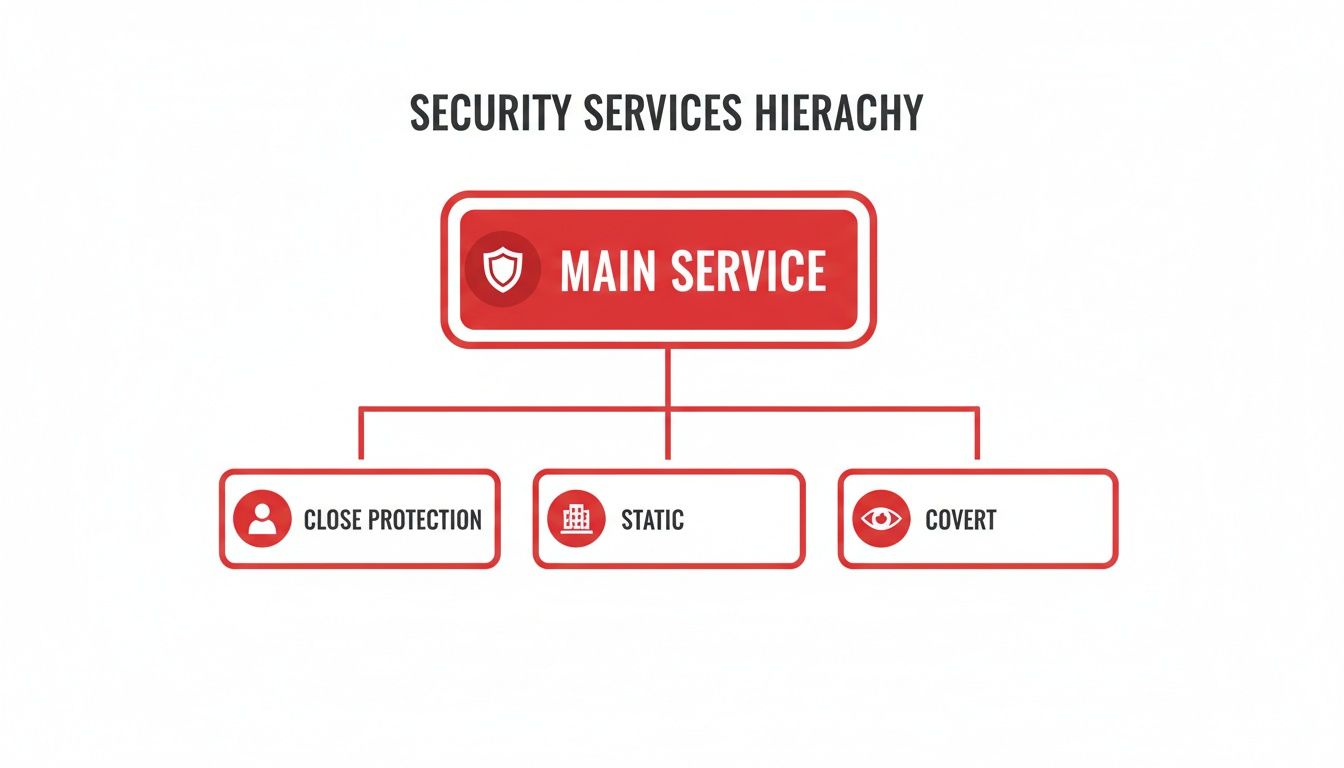
As you can see, it’s all about layering different functions to create a complete security posture. Let's dig into what these services look like in the real world.
Close Protection for High-Profile Individuals
This is the service that most people immediately think of when they hear private security bodyguards. Known in the industry as Close Protection (CP) or VIP protection, it’s all about providing direct, personal security for a specific person or a small group. But it's so much more than just being a physical presence; it's a highly strategic discipline.
Practical Example: A high-profile CEO is flying into Melbourne for a major conference. Her CP team would have started their work weeks ago, mapping out every detail. They’d have surveyed the conference centre, planned secure travel routes from the airport to the hotel, and even identified emergency safe rooms. On the day, they manage her movements, discreetly vet anyone who approaches, and maintain constant communication to shut down potential threats before they even get a chance to develop. Their presence is often low-key but their awareness is always at its peak.
Static Security for Venues and Properties
Moving away from the personal focus of close protection, static security is about locking down a fixed location. This means placing guards at specific points to protect a site, a building, or valuable assets. It’s all about creating a strong, visible presence to control who comes and goes and to discourage any unwanted behaviour.
Practical Example: Picture a high-end retail store on a busy Brisbane street. Overnight, a static guard is the first line of defence, patrolling the perimeter, monitoring CCTV, and ensuring every door and window is secure against break-ins. During business hours, a guard at the entrance provides a powerful visual deterrent to shoplifters, while also making customers and staff feel safe.
Static security is the bedrock of asset protection. The whole point is to establish a secure perimeter and keep a constant watch over a designated area, turning your property into a hard target for would-be criminals.
Covert Security for Discreet Operations
Sometimes, the best security is the kind no one even notices. That’s where covert security comes in. This involves deploying plain-clothed operatives who can blend into any environment to observe situations, gather intelligence, and identify problems without raising any alarms.
Practical Example: Imagine a large warehouse in Western Sydney is dealing with a serious internal theft problem. Putting uniformed guards on the floor would likely just tip off the culprits, who would then change their tactics. A much smarter move is to place a covert operative on the team, posing as a regular employee. From the inside, they can quietly identify who is involved, figure out their methods, and gather the hard evidence needed for management or the police to act.
Matching Security Services to Your Business Needs
To help you figure out what might work for you, this table breaks down how each service aligns with different business needs and scenarios. It’s a great starting point for seeing where your requirements fit.
| Service Type | Primary Function | Ideal for (Examples) | Key Benefit |
|---|---|---|---|
| Close Protection | Safeguarding specific individuals from harm or harassment. | CEOs, celebrities, diplomats, high-profile event speakers. | Personalised, mobile protection that adapts to a dynamic schedule. |
| Static Security | Protecting a fixed location, asset, or venue. | Construction sites, retail stores, corporate lobbies, event entry points. | A strong, visible deterrent that controls access and prevents incidents. |
| Covert Security | Discreetly observing and gathering intelligence to address specific issues. | Loss prevention in retail, investigating internal theft, monitoring crowd behaviour. | Gathers unbiased information without alerting potential offenders. |
Ultimately, the most robust security plans often use a blend of these services. You might have static guards at the doors, a dedicated CP team for your headline performer, and a few covert operatives mingling in the crowd. It all comes back to matching the method to the mission.
Navigating The Legal Side Of Australian Security
Hiring private security bodyguards without understanding the legal requirements is a massive gamble. The security industry in Australia is tightly regulated to ensure the people you trust with your safety are properly trained, vetted, and held to a high professional standard. If you hire a provider that isn't fully compliant, you’re not just risking your assets; you're opening your business up to serious legal and financial penalties.
Think of a security licence like a builder's licence. You wouldn't let an unlicensed builder construct your office, right? It’s the non-negotiable proof that both the individual and the company have passed strict government checks, including deep-dive background checks and specialised training. Understanding compliance is crucial for any business, and while security is its own beast, you can draw parallels from the legal and regulatory risks when operating services in Australia in other sectors. The core lesson is always the same: do your due diligence.
Understanding Australian Security Licensing
Here in Australia, security licensing is handled at the state and territory level. That means the rules can vary a bit depending on where your business operates, but the fundamental principles are consistent across the board.
For businesses on the east coast, these are the key regulatory bodies you’ll be dealing with:
- New South Wales (NSW): Security Licensing & Enforcement Directorate (SLED)
- Victoria (VIC): Licensing and Regulation Division (LRD) of Victoria Police
- Queensland (QLD): Office of Fair Trading (OFT)
- Australian Capital Territory (ACT): Access Canberra
These government bodies are the gatekeepers. They’re responsible for issuing licences, enforcing the rules, and making sure every security operator has the right skills and a clean record.
What To Look For: The Two Tiers Of Licensing
When you’re checking out a potential security provider, you need to verify two different types of licences. Both are non-negotiable, and any professional company will have them ready for you to see.
The first rule of hiring security is simple: No licence, no contract. This isn't just a "best practice" tip; it's a legal line in the sand that protects your business from unqualified and potentially dangerous operators.
1. The Master Licence (The Company's Licence)
This is the licence held by the security business itself. It’s the official tick from the government saying the company is legally allowed to provide security services, like supplying private security bodyguards. It also confirms the business owners have been properly vetted and meet all their corporate responsibilities.
Actionable Insight: Always ask for the provider's Master Licence number. Then, perform a quick online search for your state's public register (e.g., "SLED public register NSW") and verify the licence is current and valid. This five-minute check provides crucial peace of mind.
2. The Individual Licence (The Guard's Licence)
This is just as important. Every single guard who sets foot on your property must hold their own individual security licence. This is their personal proof that they’ve done the required training, passed a national criminal history check, and are qualified for the specific job they're doing—whether that’s as an unarmed guard, a bodyguard, or a crowd controller.
Actionable Insight: When the security team arrives on-site, don't hesitate to ask the supervisor to confirm that all personnel are carrying their individual licences. A professional team will expect this and be prepared to show their credentials.
Why Compliance Is Your Responsibility, Too
While it's the security firm's job to stay licensed, a slice of the responsibility also falls on you, the client. Hiring an unlicensed operator—whether you knew about it or not—can lead to hefty fines and legal dramas, especially if something goes wrong.
Checking a provider's credentials is a fundamental part of your due diligence. A truly professional company will be completely transparent about their licensing and insurance because they know it’s the foundation of the trust you place in them. By making sure your security partner is fully licensed, you’re not just hiring guards; you’re investing in legitimate, accountable, and professional protection.
Putting Security to the Test: Real-World Results
It’s one thing to talk about security in theory, but what does it actually look like on the ground? A professional security team is more than just a uniform; they're a strategic asset. Their real value shines through in the problems they solve, the assets they protect, and the continuity they ensure for your business.
Think of it this way: good security isn't an expense, it's an investment with a tangible return. Whether it's a packed music festival or a high-value construction site, the right strategy is about getting ahead of problems. It’s about creating a controlled environment where risks are managed so you can focus on what you do best.
Case Study 1: The Sold-Out Music Festival
The Challenge: A major music festival in regional NSW was bracing for over 20,000 attendees. The organisers were juggling several high-stakes risks: controlling a massive crowd, securing a huge perimeter against trespassers, and guaranteeing the safety of their headline artists from the moment they arrived to the moment they left.
The Solution: A comprehensive, multi-layered security plan was rolled out.
- Access Control: Static guards were stationed at every entry point to meticulously handle bag checks and ticket scanning, keeping prohibited items out.
- Crowd Management: Roaming teams of seasoned crowd controllers moved through the festival grounds. Their job was to spot potential issues early—from over-intoxication to minor scuffles—and use de-escalation tactics to defuse them before they blew up.
- Close Protection: A specialised close protection team was assigned to the headline artists, providing discreet but constant security. They managed every movement, from their vehicles to backstage and onto the stage itself.
The Result: The festival went off without a hitch. A post-event review revealed a massive 95% drop in security-related disruptions when compared to similar events that had skimped on strategic planning. The artists felt safe, the audience had a great time, and the festival's reputation got a serious boost.
Strategic security at large events isn’t just about stopping trouble; it’s about fostering a safe atmosphere where everyone feels comfortable and can enjoy the experience as intended.
Case Study 2: The CBD Construction Site
The Challenge: A multi-million dollar high-rise project in Melbourne’s CBD was bleeding money. Night after night, thieves were hitting the site, making off with expensive tools, copper wiring, and even heavy machinery. The financial losses and project delays were starting to pile up.
The Solution: The developer brought in a security firm that knew the construction industry inside and out. They deployed a two-pronged strategy: static guards at the main gatehouse to log every person and vehicle, combined with mobile patrols that conducted random, unpredictable laps of the entire perimeter all night long.
The Result: The impact was immediate. Within the first two weeks, theft attempts dropped to zero. The constant, visible security presence was the ultimate deterrent. The project got back on schedule and on budget, with the company saving an estimated $150,000 in potential losses. This proactive approach from private security bodyguards transformed a chaotic, reactive problem into a tightly controlled, secure worksite.
The Numbers Don't Lie
These examples aren't just one-offs; they reflect a much bigger picture. The demand for skilled private security in Australia's event and hospitality scenes has exploded.
In 2023 alone, official data showed that assaults in pubs, clubs, hotels, and restaurants across NSW, VIC, QLD, and ACT topped 35,000 cases. That's a staggering 15% jump from pre-pandemic levels in 2019. This has forced event organisers to hire bodyguards at rates 40% higher than just five years ago. Digging deeper into the NSW figures, Liquor & Gaming NSW reported that 62% of licensed venues had experienced security incidents serious enough to require external help. If you're interested, you can read more about the forces shaping the global physical security market.
These statistics paint a clear picture: in today's climate, professional security isn't a luxury—it's essential for managing risk.
Your Checklist For Choosing The Right Security Partner
Picking the right security provider is one of the most critical decisions you’ll make. This isn't just about hiring a person in a uniform; it's about finding a genuine partner you can trust to protect your people, your assets, and your hard-earned reputation. It’s crucial to look past the sales pitch and properly vet who you’re bringing into your business.
This checklist will give you a straightforward way to evaluate potential security partners. By asking the right questions and knowing what to look for, you can feel confident that your safety is in truly capable hands.
Step 1: Check Their Licences and Insurance First
This is the first hurdle, and it’s non-negotiable. Before you even start talking about services or pricing, you absolutely must confirm the company is fully licensed and insured to operate in your state. Any professional firm will have this paperwork ready to show you without any hesitation.
- Company Master Licence: Ask for their Master Licence number. Then, double-check it yourself on the relevant state authority's public register (like SLED in NSW or LRD in VIC).
- Individual Guard Licences: Make sure every guard they send to your site holds a valid individual security licence with the right sub-classes for the job they'll be doing.
- Public Liability Insurance: Always ask for a copy of their Certificate of Currency for Public Liability Insurance. This is your safety net, protecting you from huge financial risks if something goes wrong.
Step 2: Look for Experience in Your World
Security isn't a one-size-fits-all game. The skillset needed to manage a busy construction site is a world away from what’s required for a high-end corporate event. You need a team that has already proven they can handle your specific environment.
Actionable Insight: Ask for specific case studies or references from clients in your industry. For example, if you run a hotel, ask: "Can you describe a situation where you successfully de-escalated a conflict between guests at a similar property?"
A security partner with relevant industry experience won't just react to problems; they'll anticipate them. They know your environment's specific vulnerabilities and have proven strategies to manage them effectively.
Step 3: Dig Into Their Training Standards
A security guard is only as good as their training. A top-tier company invests heavily in its people, going well beyond the bare minimum required for a licence. Don't be shy about asking for the details of their training programs.
You should be asking about:
- Their Onboarding Process: What's involved when they bring on a new hire?
- Site-Specific Training: How do they get their guards up to speed on your specific venue or event before their first shift even starts?
- Ongoing Development: Do they run regular training on vital skills like de-escalation, first aid, emergency response, and even customer service?
A real commitment to ongoing training is the mark of a truly professional outfit. It shows they’re serious about maintaining high standards and equipping their team for anything.
Step 4: Ask How They Match Guards to Your Site
The final piece of the puzzle is getting the right person for the job. A great security firm doesn’t just send the next available body; they have a deliberate strategy for matching a guard's skills, experience, and temperament to your specific needs. This "fit-for-purpose" approach makes all the difference.
Actionable Insight: Clearly define the 'soft skills' you need. Tell the provider: "We need guards who are not only vigilant but also approachable and can provide directions to guests." This helps them select the right personnel for your specific culture.
The Australian private security sector is a major economic player. A 2023 Deloitte report valued its annual contribution at $15 billion, with bodyguard and VIP protection services making up $2.1 billion of that. In industries like construction and retail, Master Builders Australia reported 4,500 site break-ins across key states in 2022, prompting a 50% increase in bodyguard-led patrols. These proactive patrols have saved retailers an average of $250,000 for each theft ring they help dismantle. To get a sense of the industry's global scale, you can read more about the global private bodyguard service market. This data really highlights the value a well-chosen security partner brings, making your selection process all the more important.
Frequently Asked Questions About Private Security Bodyguards
Thinking about hiring private security for the first time? It’s natural to have questions. To help you feel confident and make the right decision, here are answers to the most common queries we hear from business owners and event managers across Australia.
How Much Does It Cost To Hire Private Security Bodyguards?
The cost varies based on several factors, so there is no one-size-fits-all price. Key determinants include:
- Risk Level: High-threat assignments (like VIP protection) cost more than low-risk ones (like overnight static guarding).
- Service Type: Specialised services like covert surveillance or K9 units have different rates than standard crowd control.
- Duration and Manpower: The total number of hours and guards required directly impacts the final quote.
A reputable provider will offer a custom quote based on a thorough risk assessment.
What Does a Security Assessment Involve?
A professional security assessment is a multi-step process:
- Initial Consultation: A discussion to understand your operations, concerns, and objectives.
- On-Site Analysis: A physical walkthrough of your property or venue to identify vulnerabilities like weak access points, poor lighting, or crowd flow issues.
- Strategy Development: The creation of a tailored security plan that outlines recommended services, deployment strategies, and operational procedures to meet your specific needs and budget.
What Legal Authority Do Your Security Guards Have?
In Australia, licensed private security bodyguards operate under specific legal guidelines. They can:
- Control access to private property and ask trespassers to leave.
- Enforce venue rules (e.g., checking IDs, managing RSA).
- Perform a citizen's arrest under legally defined circumstances, such as witnessing a serious crime.
However, their primary role is always deterrence, observation, and de-escalation to prevent incidents before they happen.
How Do You Ensure Guards Are the Right Fit for My Event?
A 'fit-for-purpose' approach is essential. This means matching a guard's skills, experience, and temperament to the event's unique environment. For example, a black-tie corporate gala requires discreet, well-spoken guards with strong customer service skills, whereas a music festival demands a team experienced in crowd management and maintaining a calm, authoritative presence.
At GM GROUP Services, we believe the right security partner does more than just protect your assets—they become part of your team, enhance your event, and safeguard your brand. If you're looking for a dependable, professional, and approachable security team in NSW, VIC, QLD, or the ACT, we’re here to help. Contact us today for a detailed consultation and a security plan built just for you.
Discover more from GM Group Services
Subscribe to get the latest posts sent to your email.