
Private event security guards can be the difference between a guest queue that moves smoothly and an event that loses control before the headline act begins. A corporate cocktail function may need discreet access control and a calm response near the bar, while a festival needs coordinated crowd controllers at gates, patrols around circulation areas, and clear escalation procedures. The right plan makes security feel professional and reassuring, not intrusive.
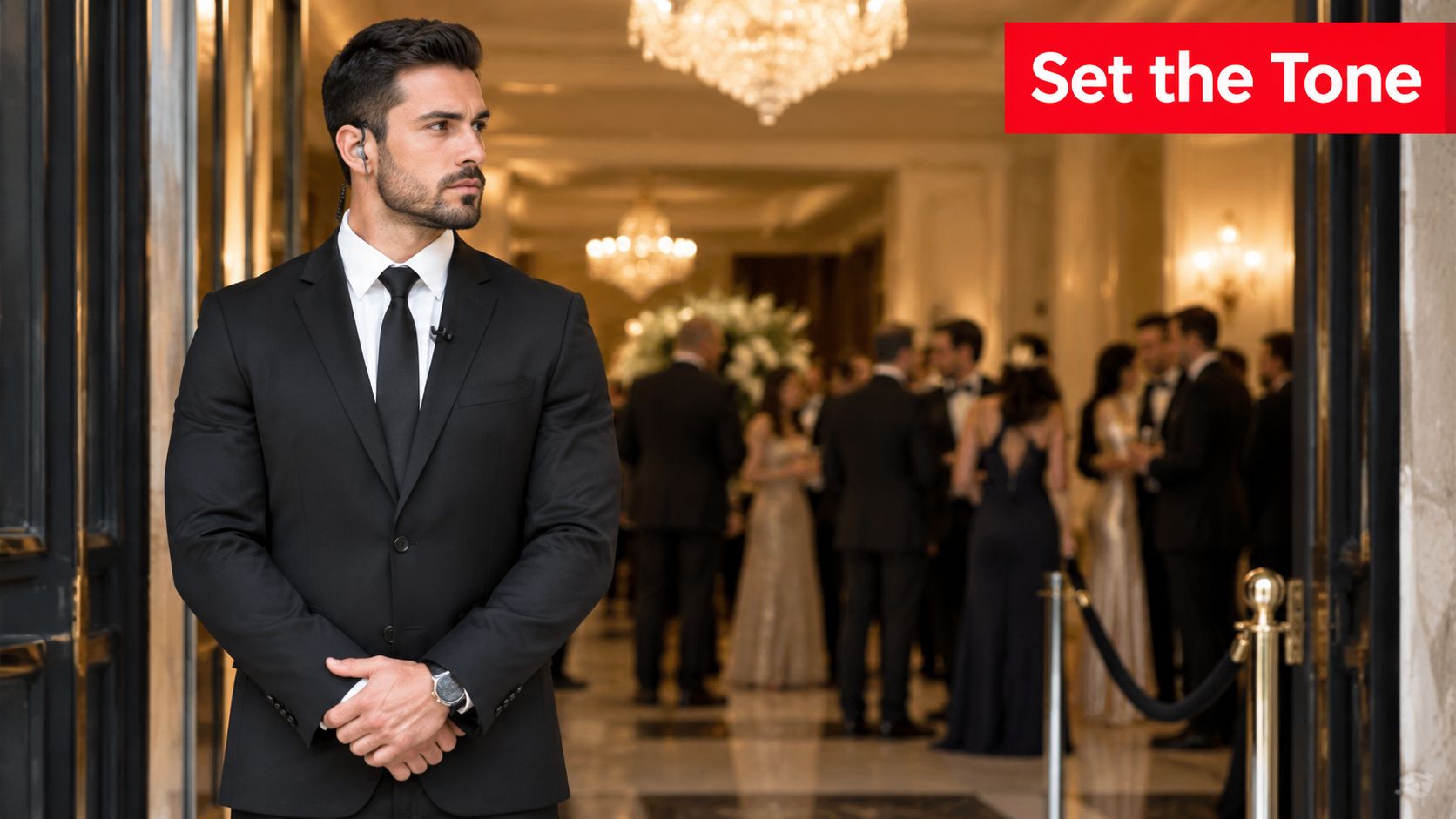
Why Private Event Security Guards Set the Tone for Your Event
At a well-run function, guests rarely notice every security decision. They notice that the guest list is checked without arguments, the entry line keeps moving, staff know who to call, and a disagreement near the bar doesn't become a public scene. That experience comes from role clarity, visible supervision and early risk planning, not from placing generic guards around the venue at the last minute.
Australia's private security workforce is substantial. The Australian Strategic Policy Institute's overview of Australia's security workforce reported in 2025 that Australia had more than 120,000 licensed security guards. ASIAL's 2025 security report described a broader industry employing over 180,000 people, including more than 153,000 licensed security personnel. For event organisers, that scale demonstrates why licensed guards are central to access management, crowd control and incident response at concerts, festivals and hospitality venues.
The industry also has long regulatory roots. The ACT's Major Events Security Act 2000 was notified on 4 September 2000 and commenced on 5 September 2000, establishing a dedicated framework for major-event security. Earlier research from the Australian Institute of Criminology recorded 52,768 full-time security personnel in Australia in 2006, compared with 44,898 police. The practical lesson is straightforward. Private event security guards aren't an informal add-on to public services. They're a regulated operational workforce with a defined role in event safety.
What good security feels like
Good coverage is proportionate to the atmosphere. At a wedding, guards may dress discreetly, protect access points and support venue staff without dominating the room. At a music venue, crowd controllers need to manage queues, patron behaviour and alcohol-related issues with authority and a service-minded tone.
Practical rule: Guests should experience a controlled event, not a constant security performance.
The process starts by assessing the crowd, venue, alcohol environment and access points. From there, the organiser can select crowd controllers, static guards, roving patrols, K9 teams or VIP protection according to actual duties. That fit-for-purpose approach avoids two common failures: paying for capabilities the event doesn't need, or discovering at the gate that assigned guards aren't authorised for the work.
How to Assess Risk Before You Hire Private Event Security Guards
Don't begin with a headcount. Begin with the event's exposure. A useful pre-hire assessment can be completed around the venue plan and event brief before contacting providers, then refined during a site walk-through.
Build the risk picture
Record the following factors in plain language:
- Crowd profile: Note whether guests are invited corporate attendees, ticketed patrons, families, nightlife customers, students, performers or mixed groups.
- Venue layout: Mark public entrances, staff entrances, emergency exits, loading areas, toilets, bars, stages, backstage zones, car parks and narrow circulation points.
- Alcohol service: Identify every bar, service area, licensed boundary and location where intoxication could affect entry, movement or removal decisions.
- Access exposure: List guest-list checkpoints, ticket scanners, credential points, delivery gates and areas containing cash, equipment or restricted material.
- People requiring additional protection: Identify artists, executives, speakers, high-profile guests and anyone with a specific arrival or departure plan.
- Local conditions: Consider neighbouring venues, transport hubs, public footpaths, weather exposure, lighting, construction and any shared access routes across NSW, Victoria, Queensland or the ACT.
This isn't a prediction exercise. It gives the provider enough detail to match duties to personnel and position posts where they can prevent problems rather than react to them.
Use a simple working matrix
Rate each area as low, moderate or high for likelihood and consequence. A single low-risk entrance may need only controlled access and a supervisor check. A crowded alcohol area with restricted backstage access may need dedicated crowd-control authority, a nearby roving response and a clear escalation path.
A 200-person corporate cocktail event might present moderate access risk, moderate alcohol risk and low crowd-density risk. Its roster could centre on entrance control, a discreet floor presence and a supervisor who coordinates with venue management. A 5,000-person outdoor festival presents a different operating problem. Multiple gates, stage-front pressure, dispersed amenities, alcohol service and egress congestion may require separate gate teams, crowd controllers, patrol coverage, supervisor oversight and specialist roles.
Turn the assessment into a deployment brief
Write down the consequence of each risk, the post required and the person responsible for escalation. For example:
- Unauthorised entry: Assign an access-control post with a guest-list or credential procedure.
- Intoxicated patron: Assign a crowd controller with authority appropriate to the event state and a documented removal escalation.
- Backstage intrusion: Use credential checks, a static post and a supervisor-controlled access list.
- Vehicle and delivery conflict: Separate loading access from guest movement and schedule patrol checks.
- VIP exposure: Decide whether discreet close protection is required or whether controlled arrival and static access coverage are sufficient.
The output should be a risk tier and a role list, not a number. Headcount becomes meaningful only after the organiser knows which entrances, bars, stages, VIP spaces and exit routes need coverage.
Choosing the Right Types of Private Event Security Guards for Your Crowd
A static guard watching equipment isn't interchangeable with a crowd controller managing a queue. A K9 team isn't a substitute for a supervisor, and a VIP protection officer shouldn't be assigned as general gate coverage. Start with the duty, then verify the licence class and training that support it.
| Guard Type | Best For | Licence Note | When Not Needed |
|---|---|---|---|
| Static guard | Equipment, property, backstage or fixed access posts | Confirm the individual authority for the assigned security function and event state | Not suitable as a substitute for crowd-control duties |
| Roving patrol | Large footprints, car parks, perimeter checks and mobile incident response | Match the licence to the actual tasks, particularly where staff interact with patrons | Unnecessary where the venue is compact and risks are concentrated at one controlled point |
| Crowd controller | Entry screening, queue management, keeping order, patron behaviour and removal | Individual licensing is critical. Queensland defines a crowd controller as a person at a public place for reward, principally to keep order, and only an individual may hold the relevant licence under the Queensland Security Providers Act 1993 | Not the right choice for a purely property-watch post if no crowd-control function is involved |
| K9 unit and handler | Perimeter support, deterrence and specialist detection tasks where appropriately planned | Verify the provider's capability, handler credentials and task scope before deployment | Poor fit for a small indoor function where the team would disrupt guest flow without addressing a defined risk |
| VIP close protection | High-profile guests, sensitive arrivals, controlled movement and discreet protection | Confirm the role, state requirements and any separate client instructions | Not needed for ordinary guest reception or general venue monitoring |
| RSA-aligned event role | Licensed-premises support, responsible service coordination and alcohol-area observation | Define the RSA-related duty separately from general security work and confirm venue conditions | Not appropriate to assume every guard can perform venue or alcohol-service obligations |
Crowd controllers are a distinct role
Western Australia's security licence guidance defines crowd controllers as people working at licensed premises, entertainment venues or public and private events who monitor or control behaviour, screen entrants or remove people for behavioural reasons. The same guidance states that a person must not act as a crowd-control agent without the correct licence.
That distinction matters at a festival gate. Staff checking bags, screening guests, managing intoxication or removing disruptive patrons are performing crowd-control functions. Staff watching an equipment compound may be performing a different security duty. Assigning the wrong role because everyone is called a “guard” creates a compliance gap before the event opens.
Match the roster to the alcohol environment
RSA requirements and venue conditions change the brief. A bar-heavy nightclub event needs crowd controllers who can manage patron behaviour and escalation, while venue management retains responsibility for its own licensed-premises obligations. A corporate function with limited alcohol service may need fewer specialised posts, but the organiser still needs to define who handles refusal of entry, intoxication concerns and removal requests.
Queensland's training pathway reinforces the point. The Queensland Government's crowd-controller training guidance requires crowd controllers to complete all modules of Certificate II in Security Operations through a registered training organisation before applying for a licence. A national industry snapshot cited in the same verified material identified over 22,000 crowd-controller licences out of 31,000 approved individual security licences in one jurisdictional view. Crowd control is a specialised subset, not a generic label.
How to Hire and Contract Private Event Security Guards Without Compliance Gaps
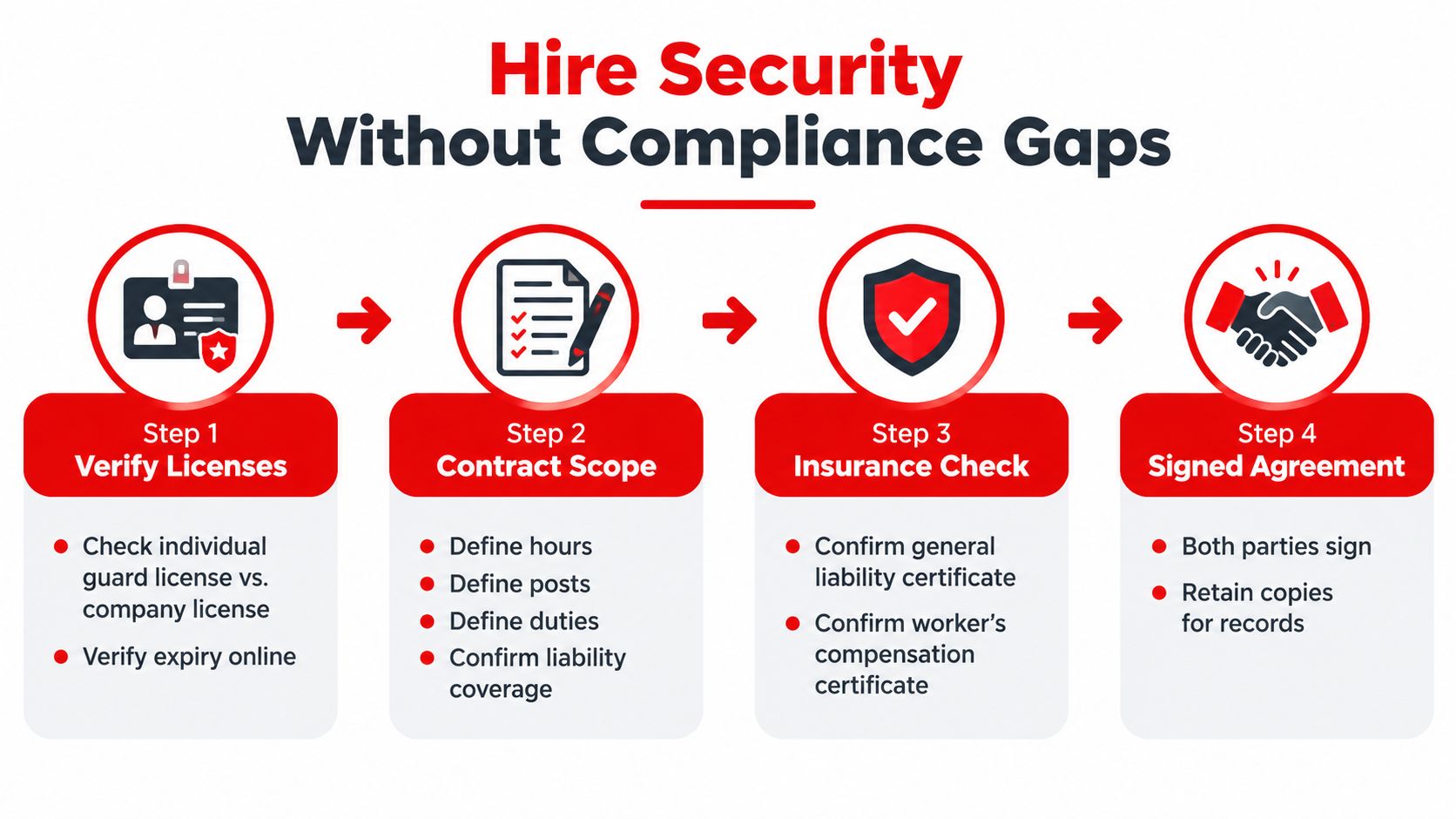
A provider's company licence doesn't replace the individual guard's licence. This is the procurement point that causes the most preventable last-minute changes, particularly when an organiser brings staff across state borders.
Verify the people and the provider
Ask for a named roster, not only a company profile. For each proposed worker, confirm:
- Individual licence: Check the licence is current in the state where the event occurs and matches the assigned function.
- Crowd-control authority: Confirm it where the post involves entry screening, patron management, keeping order or removal.
- Provider licence: Ask for the relevant business or master licence. Victorian local government guidance explains that a security guard licence alone doesn't authorise crowd-control work and advises venues to request the provider's private business security licence. See the Yarra City event security guidance.
- Training records: Confirm event-relevant training, supervisor capability and any first-aid or RSA requirements attached to the venue or state.
- Availability: Treat the national workforce as a pool, not a guarantee. A licensed person may be unavailable, located far from the venue or authorised for a different role.
Queensland provides a practical verification tool. Organisers can use the Queensland security licensing register guidance to check providers through a free online register before gates open.
Allow for state-specific changes
Victoria requires particular attention during 2026. Under the Victoria Police changes to private security licences and registrations, registration holders must transition to a full individual operator licence by 19 June 2026. Certain licence holders must also complete approved first aid and refresher training before renewal from 5 October 2026.
Queensland's Certificate II sequencing is another control point. Verify the licence class, confirm the crowd-control endorsement and then map the person to the event's risk and alcohol environment. Don't assume that a guard licensed in NSW, Victoria, Queensland or the ACT can automatically perform the same function in another state.
ASIAL reported 162,535 individual security licence numbers nationally at the end of December 2023, an increase of 10,145 year-on-year, with growth of 4,087 in Victoria and 2,815 in Queensland. The same report recorded an earlier contraction of 5,682 licences in a prior year, illustrating why availability can shift. See the ASIAL Australian Security Industry Licensing Report 2024 for the licensing context.
Put the operating detail in writing
The contract should identify posts, start and finish times, break arrangements, uniform expectations, supervisor authority, incident reporting, replacement cover and escalation contacts. It should also state whether the provider supplies crowd controllers, static guards, K9 teams, VIP protection or separate RSA-aligned support.
Avoid vague wording such as “provide event security”. A usable scope says who controls each gate, who monitors the stage perimeter, who reports bar incidents, who can authorise a removal and who contacts emergency services when escalation exceeds the private team's role.
Briefing and Managing Private Event Security Guards on Site
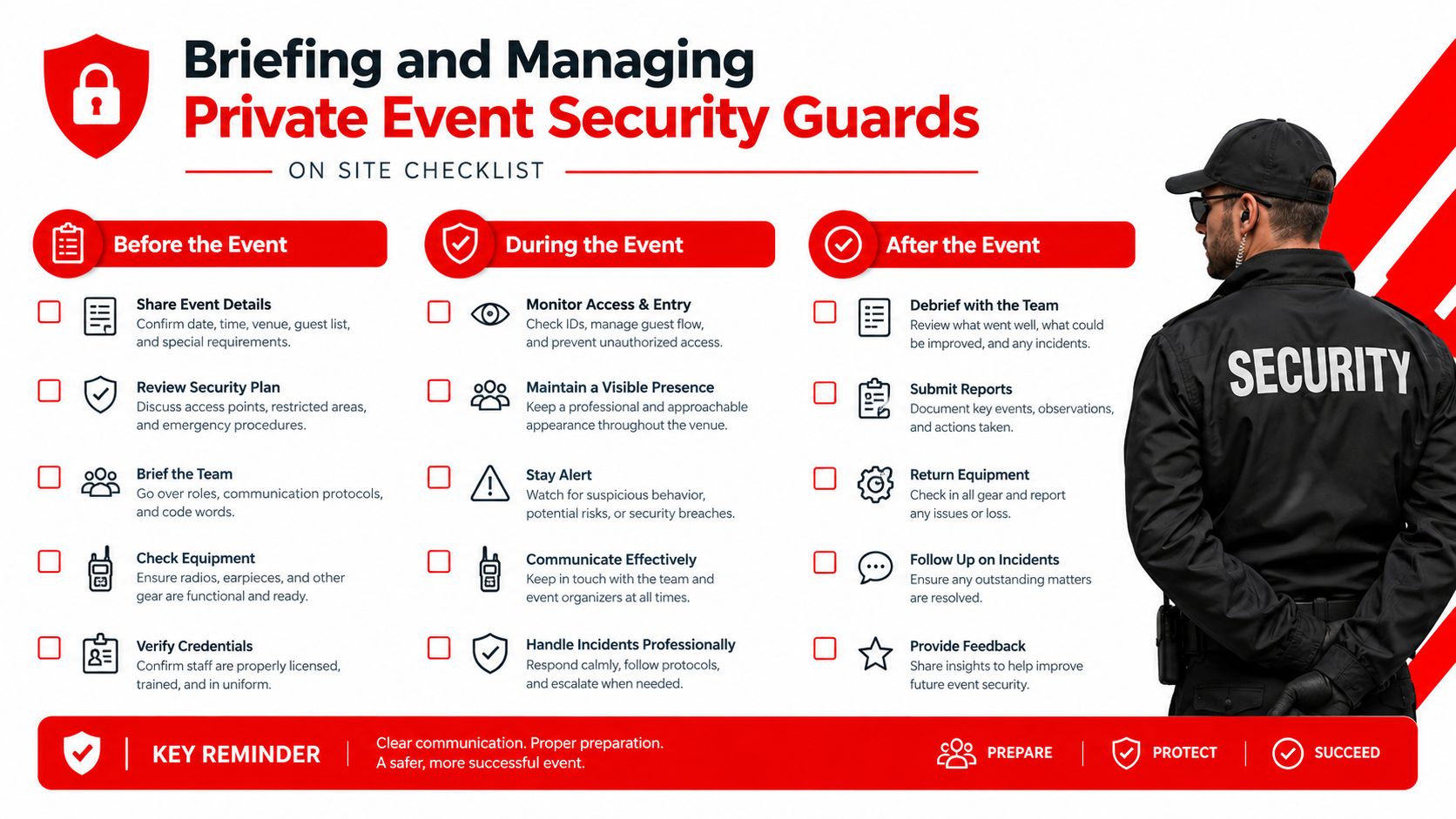
A strong roster can still fail if the briefing is rushed. Every guard should know the site, post, authority, communication channel and escalation limit before guests arrive.
Run a practical pre-opening briefing
Use the venue map and walk the actual route. Cover:
- Event purpose and tone: Explain whether the function is a formal dinner, festival, concert, nightlife event or corporate gathering.
- Post orders: Show each guard their exact location, duties, relief process and movement boundaries.
- Entry procedure: Confirm tickets, guest lists, credentials, prohibited items, refusal protocols and who can approve exceptions.
- Alcohol areas: Identify bars, licensed boundaries, intoxication concerns and the venue contact responsible for RSA decisions.
- Emergency actions: Point out exits, assembly areas, first-aid resources, fire equipment and the person who leads escalation.
- Radio discipline: Set the channel, call signs, priority wording and the rule that urgent incidents receive clear air.
- Reporting: Require factual notes with time, location, people involved, action taken and outcome.
The supervisor should check that guards understand the difference between observing, intervening and escalating. A calm instruction at the first sign of queue friction is usually more effective than waiting until patrons push through a barrier.
Position people where behaviour changes
Put crowd controllers at decision points, such as entrances, queue turns, bar approaches and restricted transitions. Keep static guards on assets or controlled posts. Use roving patrols to connect zones, not to wander without a defined route. A supervisor should remain mobile enough to reach a developing issue while maintaining contact with venue management.
At a VIP function, close protection should have a discreet movement plan and a defined handover with reception, transport and venue management. A K9 team needs its own operating boundary and timing so it supports the event without creating unnecessary concern among guests.
The best visible presence is approachable, observant and ready before the crowd notices a problem.
Supervise throughout the shift
The supervisor's checklist should include entry flow, queue pressure, bar activity, backstage access, radio function, post coverage, breaks, incident logs and egress preparation. After an incident, the supervisor should preserve the facts, notify the organiser through the agreed channel and ensure the affected post is still covered.
Customer service matters because guards represent the event brand. Short explanations, respectful language and consistent decisions reduce arguments. Force should never become the default response to a problem that can be resolved through communication and controlled access.
Budgeting Staffing Ratios and Final Checks for Private Event Security Guards
Simple ratios are a weak budgeting tool for mixed-risk events. Two events with the same attendance can require different rosters because one has a single controlled entrance and the other has multiple gates, alcohol service, a stage perimeter, dispersed facilities and VIP movement.
Price the work by posts and functions first. Count entry points, restricted areas, bars, patrol zones, stage or backstage boundaries and egress routes. Then add supervision and any specialist coverage. Night work, extended operating hours, K9 teams, close protection, travel, state-specific licensing and contingency cover can all change the quote without changing the guest count.
Complete the final checks
At least before opening, confirm:
- Roster: Named guards match the agreed roles and state licence requirements.
- Documents: Individual and provider licences have been checked and recorded.
- Briefing: Every post has written instructions and an escalation contact.
- Communications: Radios, call signs and priority procedures work.
- Venue coordination: Management, bar staff, production and emergency contacts know the security chain.
- Coverage: Breaks, late arrivals and replacement arrangements won't leave a gate or restricted area uncovered.
- Close-down: Egress, asset protection and final incident reporting are assigned.
FAQ
Does a company security licence cover every guard?
No. Each guard still needs a current personal licence for the event state and the correct authority for the assigned duty. Check both the individual and provider credentials.
Can a static security guard manage a queue?
Not automatically. Queue management, entry screening, keeping order and removing patrons may require crowd-control authority. Match the licence to the actual task.
Can I use a national headcount to fill a local event roster?
No. Workforce totals don't guarantee availability in the venue city or the correct licence mix for the event date. Build redundancy into the roster.
What should organisers in Victoria check in 2026?
Check the transition from registration to full individual operator licensing by 19 June 2026, and review first-aid and refresher requirements that apply before renewal from 5 October 2026, using the Victoria Police licensing update.
The reliable approach is to plan around duties, not a headline guard count. Select licensed private event security guards for the crowd, venue, alcohol environment and state requirements, then brief and supervise them as one operating team.
GM GROUP Services provides custom event security across NSW, Victoria, Queensland and the ACT, including crowd control, static guards, K9 units, VIP protection, risk assessments and site supervision. Visit GM GROUP Services to discuss your event layout, licensing requirements and the right role-based roster before your next function.
Discover more from GM Group Services
Subscribe to get the latest posts sent to your email.