
Hiring personal security guards is one of the most critical decisions for ensuring the safety of your event, assets, or key personnel. A professional guard is more than just a uniform; they are a highly visible deterrent and an active risk manager, providing a crucial layer of protection to keep your operations running smoothly and securely. Investing in the right security team is a direct investment in peace of mind.
This guide will walk you through what these professionals actually do, the different types of security available, and everything you need to consider to find the right protection for your specific needs here in Australia.
Understanding the Role of Personal Security Guards
In any situation where you have a large gathering of people or high-value assets, safety instantly becomes your number one priority. This is where professional personal security guards step in. They are your first line of defence, but their job goes far beyond simply being present. Think of them as highly trained risk managers, tasked with securing everything from a sprawling music festival to a high-rise corporate building.
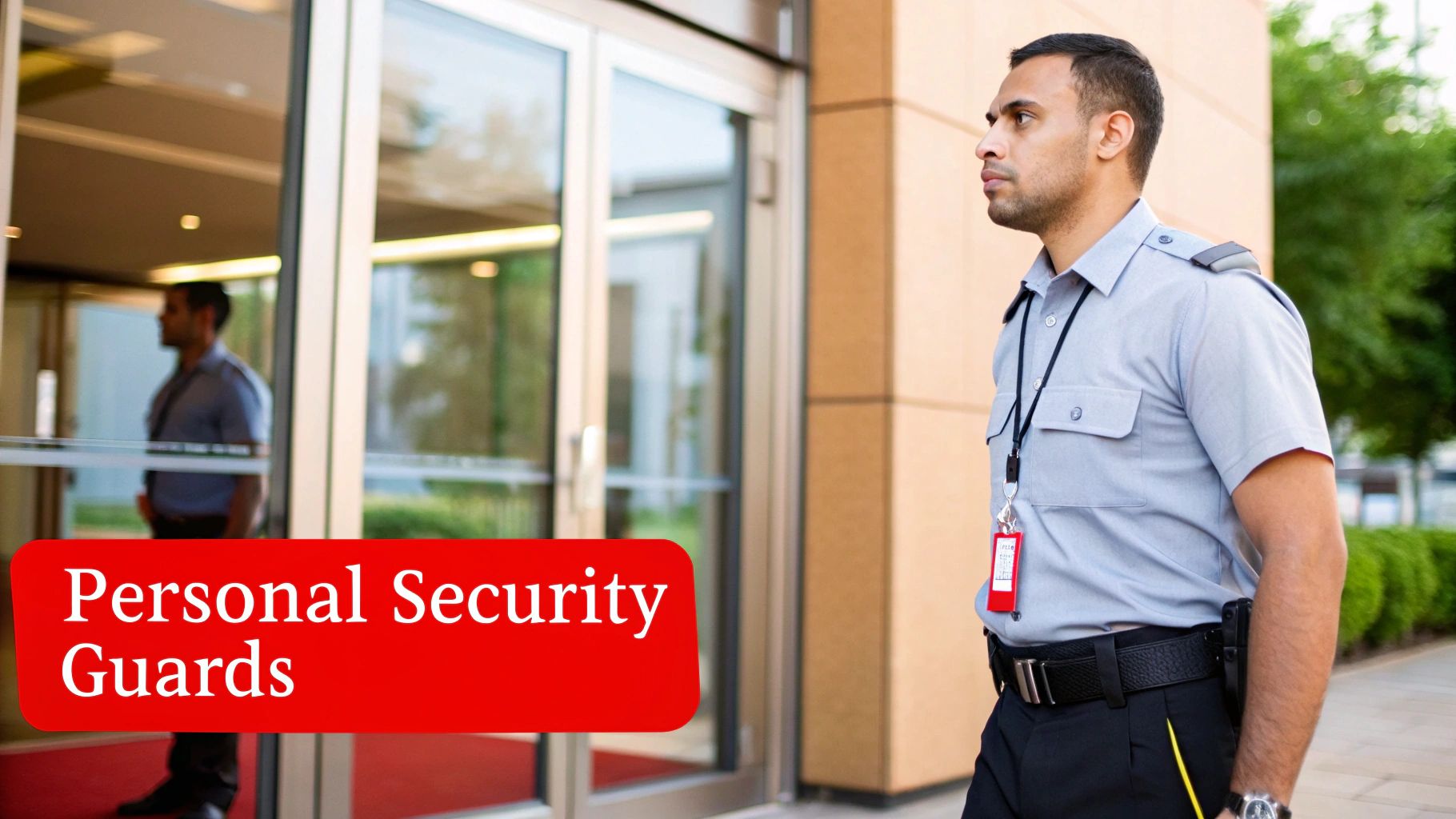
What Do Personal Security Guards Actually Do?
Forget the old-school image of a bouncer standing by a door. Today’s professional security guard is a dynamic risk manager, a crucial part of keeping your event, venue, or business running smoothly and safely. Their main job is to create a secure, controlled environment—and that looks very different depending on the situation.
For example, their role could be managing the energy of a huge crowd at a Sydney music festival, or it might be protecting millions of dollars in equipment on a Brisbane construction site overnight. In every case, their presence alone is a powerful deterrent, warding off potential troublemakers and preventing issues like theft, vandalism, or fights before they even start. This isn't just about stopping bad things from happening; it's about protecting your business's continuity and its reputation.
The private security industry in Australia is a massive, highly professionalised sector for a reason. We're talking over $11 billion in annual revenue and more than 180,000 people employed, with 153,000 of them holding active security licences. These aren't just numbers; they show just how vital this work is. If you're interested in the data, IBISWorld reports on the security industry offer a deeper dive.
A Guard's Role Changes With The Job
The day-to-day duties of a security guard are tailored completely to the environment they’re in. For a big public event, the focus is all on access control, screening attendees, and keeping a close eye on crowd behaviour to spot trouble early. But put that same guard in a corporate high-rise in Melbourne, and their role shifts entirely. They might be focused on verifying visitor credentials, monitoring surveillance systems, and providing a subtle but firm protective bubble for executives.
Actionable Insight: At the end of the day, a guard’s primary goal is always prevention. A great shift is often a quiet one, where their professionalism and visibility meant no incidents happened in the first place. When hiring, ask potential providers how they train for proactive deterrence, not just reactive responses.
Key Roles of Personal Security Guards At A Glance
To give you a clearer picture, it helps to see how a guard's responsibilities change from one industry to another. The core principle of safety remains, but the application is unique to each setting. This table breaks down their primary roles and the direct benefits you can expect.
| Business Sector | Primary Role | Key Benefit |
|---|---|---|
| Events & Festivals | Crowd control, access management, VIP protection | Ensures guest safety and smooth event flow |
| Hospitality (Bars, Clubs) | Conflict de-escalation, RSA compliance, patron safety | Maintains a safe and welcoming atmosphere |
| Corporate & VIP | Close personal protection, threat assessment | Provides discreet and high-level personal safety |
| Construction & Retail | Asset protection, loss prevention, site access control | Reduces theft and secures valuable property |
As you can see, whether it's managing thousands of festival-goers or protecting a single high-value asset, the role of personal security guards is always about proactive, preventative security.
Matching the Right Guard to Your Specific Needs
Hiring security isn't a one-size-fits-all deal. Think of it like hiring any specialist – the person you need depends entirely on the job at hand. Picking the wrong type of security can be as good as having none at all, so getting this first step right is absolutely critical.
For example, a black-tie corporate event in a Sydney high-rise needs a completely different touch than a sprawling construction site in Brisbane. The gala calls for discreet, plain-clothed bodyguards who can blend in seamlessly, while the building site needs highly visible, uniformed static guards to deter theft and manage who comes and goes. Understanding these distinctions is key to making sure your investment actually keeps you safe.
This decision tree gives you a good visual breakdown of how to think through your needs, whether you're securing a one-off event or a permanent site.
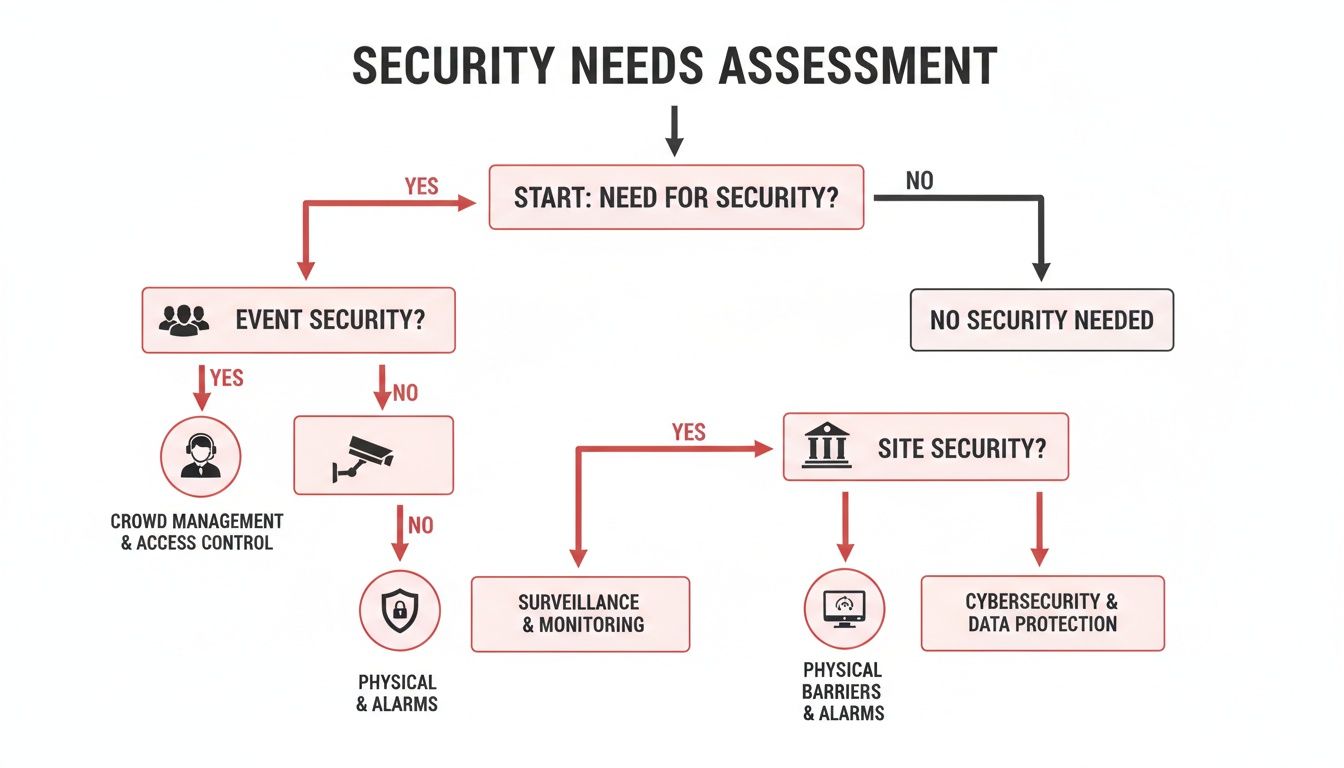
As you can see, every solid security plan starts with one question: what’s the core problem I’m trying to solve? From there, you can drill down into the right specialist solutions.
The Strategic Choice: Overt vs. Covert Security
One of your first big decisions is whether you want security that’s seen or unseen. Do you need a visible presence (overt security) or a more discreet one (covert security)? Both approaches work, but they solve different problems.
- Overt Guards: These are your uniformed professionals. Their visibility is their most powerful tool. They’re a brilliant deterrent at event entrances, patrolling retail stores, or manning the gate at a construction site. Just seeing the uniform sends a clear message that the area is protected.
- Covert Operatives: You might know them as plain-clothes security or loss prevention officers. Their whole job is to blend in. This is the perfect choice for situations where a uniform would be out of place or where the goal is to catch someone in the act without tipping them off—think identifying shoplifters in a retail store.
Ultimately, the choice comes down to your primary goal: do you want to prevent incidents from happening through deterrence, or do you need to catch someone breaking the rules?
Armed vs. Unarmed Personal Security Guards
The next major consideration is whether you need an armed or unarmed guard, a decision that should always be driven by a proper risk assessment. Here in Australia, armed guards are far less common in public-facing roles and are generally reserved for protecting high-value assets or responding to severe, credible threats.
Actionable Insight: An unarmed guard is almost always the most effective choice. Their training is laser-focused on de-escalation, sharp communication, and physical intervention skills, which are more than enough to handle over 95% of security incidents without the added risk and liability of a firearm.
Unarmed guards are specialists in managing crowds, controlling access points, and talking down heated situations. For the vast majority of events, pubs, clubs, and general site security, their skillset is exactly what you need to keep things safe. An armed response is a highly specialised service, deployed only when a threat assessment shows a genuine, calculated risk of lethal force.
Why Licensing and Vetting Are Non-Negotiable
Hiring a personal security guard is a huge act of trust. You're not just paying for a uniform to stand at the door; you’re placing the safety of your people, your property, and your reputation in someone else's hands. This is exactly why rigorous licensing, thorough training, and relentless vetting aren't just 'nice-to-haves'—they're the absolute bedrock of professional security.
Think about it. You wouldn't let an unlicensed surgeon operate on you, or an uncertified sparky rewire your building. The exact same logic applies here. An unlicensed or poorly vetted guard isn't just a waste of money; they're a massive liability waiting to happen.
The Importance of State-Specific Licensing
For very good reasons, the security industry is tightly regulated right across Australia. Every state and territory has its own set of mandatory licensing rules designed to guarantee a minimum standard of competence and integrity. In NSW, for instance, a guard must hold a valid Security Licence Class 1A, which means they've passed strict background checks and completed specific, certified training courses.
These licences are far more than just bits of paper. They are official confirmation that the individual has been cleared by law enforcement. Your first and most crucial step is to work with a firm that guarantees every single one of its guards is fully licensed.
Beyond the Licence: Advanced Training and Vetting
A licence is the bare minimum, the starting line. The best security providers go much, much further. Top-tier firms invest heavily in continuous training that prepares their guards to handle real-world situations with a cool head and professional skill.
This advanced training often covers:
- Conflict De-escalation: Practical techniques to verbally calm tense situations before they ever have a chance to turn physical.
- Advanced First Aid and CPR: This ensures guards aren't just protectors but are also capable first responders if a medical emergency unfolds.
- Emergency Response Protocols: Drills for scenarios like fires, crowd surges, or medical incidents, ensuring a calm, organised response when it matters most.
A professional guard is more than a deterrent; they are a competent, reliable, and legally compliant asset. Their training ensures they can manage risk effectively while acting as a positive ambassador for your business or event.
A reputable provider's vetting process is relentless. It goes deep, including multiple reference checks, verification of employment history, and behavioural interviews designed to pinpoint individuals with the right temperament for security work: calm under pressure, highly observant, and decisive. This is how you ensure the personal security guards you hire are not only qualified on paper but are genuinely trustworthy.
How to Choose the Right Security Provider for Personal Security Guards
Picking a security partner is one of the most important decisions you'll make. Get it right, and you gain priceless peace of mind. Get it wrong, and you're not just hiring a problem; you're inviting risk onto your premises. You need to look past the sales pitch and ask the hard questions that separate the true professionals from the rest.
A great security company is more than just a contractor—they’re a genuine partner. They should be invested in your success, offering well-thought-out solutions. Your goal is to find a team that provides not just highly trained personal security guards, but also professional ambassadors for your brand who can maintain a safe and welcoming environment.
Your Vetting Checklist
To really size up a potential security provider, you need a system. Treat it like a job interview for a crucial role, because that's exactly what this is. The first step is to confirm their legitimacy by requesting the foundational documents that protect you from any potential liability.
Here’s what you need to see upfront:
- A valid Master Licence: This proves the company is legally allowed to provide security services in your state. No licence, no deal.
- Public Liability Insurance: Always ask for their Certificate of Currency. This is your financial safety net. Anything less than $20 million in coverage should be a deal-breaker.
- Individual Guard Licences: The provider must be able to prove that every single guard they send to your site holds a current, valid individual licence.
Think of these three documents as the absolute bare minimum. Any professional outfit will have them ready to share.
Digging Deeper with Critical Questions
Once you’ve confirmed they’re legitimate, it’s time to get a feel for how they actually operate. The answers to the following questions will tell you everything you need to know.
Actionable Insight: The quality of a security provider isn’t in their sales pitch; it’s in the nitty-gritty of their operational planning. A firm that obsesses over risk assessments, proper supervision, and clear reporting is a firm that actually takes your safety seriously.
This process is your chance to find a partner who gets that security is far more about preparation than just presence.
Use this checklist to evaluate potential providers and ensure they meet essential standards of quality and compliance.
Provider Vetting Checklist: Key Questions to Ask
| Evaluation Area | Key Question | Why It Matters |
|---|---|---|
| Experience & Reputation | "Can you provide references from clients with similar needs to mine?" | This confirms they have relevant experience in your industry (e.g., festivals, corporate) and a track record of success. |
| Guard Training & Vetting | "What does your recruitment, vetting, and ongoing training process look like for your guards?" | You need to know their guards are not only licensed but also properly vetted (background checks) and receive continuous training. |
| Operational Planning | "What is your process for conducting a site-specific risk assessment and developing security protocols?" | A generic plan won’t cut it. This shows if they're proactive and tailor their approach to your unique venue and risks. |
| Supervision & Management | "How are your guards supervised on-site, and who is my direct point of contact during an operation or emergency?" | This reveals their command structure. You need to know there’s active supervision and a clear contact for urgent issues. |
| Reporting & Communication | "What kind of incident reporting and daily activity logs can I expect to receive?" | Professional providers use clear, timely reporting. This ensures transparency, accountability, and a documented record. |
| Technology & Equipment | "What kind of technology do your guards use (e.g., communication devices, reporting software)?" | Modern equipment and software can significantly improve efficiency, communication, and response times. |
By asking these questions, you empower yourself to choose a provider that will be a genuine asset. It ensures the personal security guards you bring on board are backed by a solid, professional organisation that truly protects your people, property, and reputation.
Personal Security Guards in Action
The real value of professional security isn't just about having a uniform on-site; it’s about actively managing risk and getting tangible results. Theory is one thing, but seeing how a sharp security team operates in the real world makes all the difference. Let's look at a few practical examples from different Australian settings.
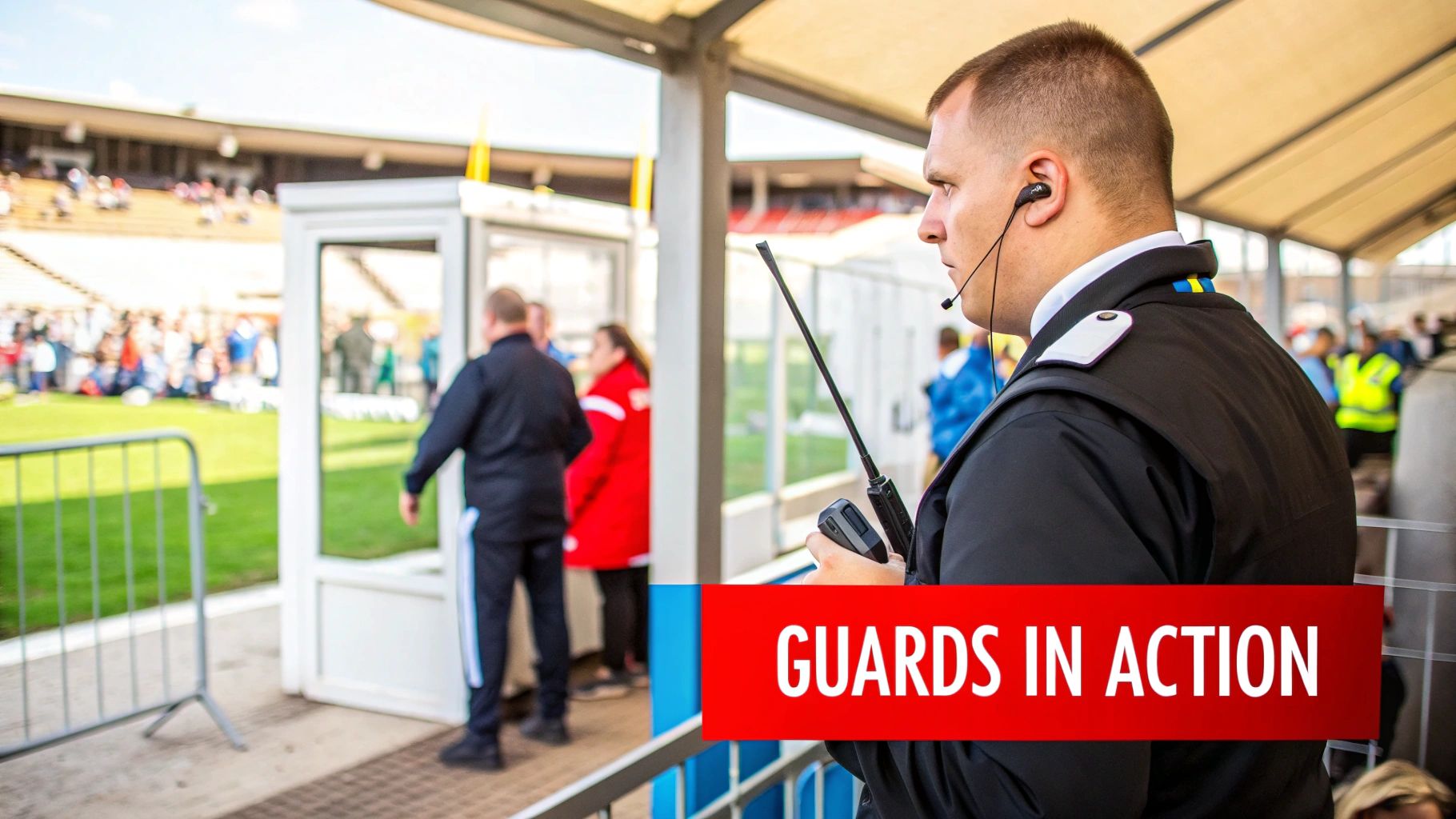
From the organised chaos of a music festival to the quiet precision of a corporate summit, every situation demands a unique strategy.
Case Study 1: The Regional Music Festival
A multi-day music festival in regional NSW was gearing up for 15,000 attendees. The challenge was immense: securing a huge, open-air venue with multiple stages and entry points.
- The Challenge: Key risks were unauthorised entry, crowd surges, and alcohol-fuelled conflicts.
- The Solution: A team of 50 personal security guards was deployed. Static guards handled gates and bag checks, roving patrols monitored crowd behaviour, and a rapid-response team was on standby.
- The Outcome: Unauthorised entries were minimized, potential scuffles were de-escalated quickly, and medical responses were efficient. The event ran smoothly, with attendees praising the professional and approachable security team.
Case Study 2: The Brisbane Construction Site
A major construction project in Brisbane was losing money to after-hours theft of expensive materials and machinery.
- The Challenge: The mission was to protect assets and deter theft on a large, poorly lit site.
- The Solution: A mix of static and mobile security was implemented. Two guards controlled the main gatehouse, while a mobile patrol conducted random, unpredictable laps of the fenceline all night.
- The Outcome: The results were immediate. Two attempted break-ins were stopped in the first week. After a month, theft dropped to zero, saving the project an estimated $150,000 in potential losses.
These examples show that effective security isn't just about having guards on site; it's about deploying the right guards with the right strategy based on a proper risk assessment. The goal is always to prevent incidents, not just react to them.
Case Study 3: The Canberra Corporate Summit
A high-profile corporate summit in Canberra required absolute security that felt completely invisible to maintain a professional atmosphere.
- The Challenge: Security had to be felt, not seen, protecting sensitive meetings and VIPs without being intrusive.
- The Solution: A small, elite team of covert, plain-clothed personal security guards blended in with attendees, creating a discreet protective bubble around key individuals and monitoring access points.
- The Outcome: The summit was a complete success with zero security incidents. The executives felt safe but not smothered, allowing for free networking.
Frequently Asked Questions About Personal Security Guards
Bringing in professional security is a big decision, and it’s smart to have questions. Getting the right information upfront is the difference between a seamless operation and a security nightmare. We’ve put together some straight answers to common questions to help you out.
Let's dive into the details that make for a security plan that actually works.
How much does it cost to hire a personal security guard?
The cost varies based on risk level, required skills (e.g., armed vs. unarmed), location, and duration. For example, a high-threat VIP detail will cost more than a standard overnight patrol. Think of security as an investment in risk management; a cheap quote often reflects a corner-cutting provider, which can be a huge liability.
How many guards do I need for my event?
This is determined by a professional risk assessment, not a guess. A reputable provider will analyse factors like venue size, layout, expected crowd size, and whether alcohol will be served. For example, a 500-person wedding reception with an open bar requires more coverage than a 500-person corporate seminar. This ensures you meet both safety and legal obligations.
How far in advance should I book personal security guards?
The sooner, the better. We recommend at least 4-6 weeks in advance, especially for large events or during peak seasons. This lead time allows the security team to conduct site visits, develop a comprehensive operational plan, and assign the best personnel for your specific needs, ensuring a smooth operation.
What information do you need to give me an accurate quote?
To get a fast and accurate quote, have these details ready:
- Full Address: The exact location of the site or venue.
- Dates and Times: Specific start and finish times for coverage.
- Number of Guests: Your best estimate of the crowd size.
- Event Details: A clear description of the event (e.g., concert, construction site).
- Known Risks: Any specific concerns or past incidents.
Providing this information helps ensure the quote for your personal security guards accurately reflects your needs.
At GM GROUP Services, we provide fully licensed and highly trained security professionals tailored to your specific needs across NSW, VIC, QLD, and the ACT. Secure your peace of mind by partnering with a team dedicated to protecting your people and property. Contact us today for a comprehensive quote.
Discover more from GM Group Services
Subscribe to get the latest posts sent to your email.