
A personal security bodyguard is your first line of defense in an unpredictable world. When you think of a personal security bodyguard, what comes to mind? For many, it’s the Hollywood image: a towering figure in a dark suit, sunglasses on, reacting to dramatic threats. The reality is far more subtle, strategic, and frankly, a lot more effective.
A professional bodyguard provides proactive, specialised protection for an individual or group. Their entire focus is on preventing incidents before they ever have a chance to happen. This isn’t about waiting for trouble; it’s about meticulous planning, sharp-eyed threat assessment, and discreetly controlling the environment to ensure nothing goes wrong in the first place.
What a Personal Security Bodyguard Actually Does
Hiring a personal bodyguard isn't just about adding a physical presence; it's about bringing in a strategic safety expert. For anyone managing an event or a venue, understanding this difference is key. You're not just getting a reactive guard; you're getting a partner dedicated to actively shaping a secure environment for your key people.
Think of them less like a shield and more like an architect of safety. They build layers of security through careful, often unseen, preparation. The goal is to allow your principal—whether that’s a VIP guest, a keynote speaker, or a performing artist—to navigate your event smoothly and without a single worry.
Beyond the Hollywood Stereotype
A bodyguard's success is measured by the incidents that don't happen. It’s about creating a boring, uneventful experience for the person they’re protecting, and that’s a good thing.
A typical assignment is a blend of quiet vigilance and detailed preparation:
- Advance Work and Planning: Long before your VIP arrives, their protection officer has been on-site. They’ve walked your venue, identified the best entry and exit points, mapped out secure travel routes, and even located potential safe rooms.
- Proactive Threat Assessment: On the day, they are constantly scanning. This isn't just about spotting obvious dangers. It’s a practiced skill of reading crowd dynamics, noticing behaviour that’s out of place, and identifying subtle risks before they can grow.
- Secure Transportation: Getting to and from the venue is often the most vulnerable part of any journey. Bodyguards manage this entire process, coordinating with drivers and planning for contingencies like unexpected traffic or road closures.
- Discreet De-escalation: If a situation starts to develop—perhaps an overly aggressive fan or a disruptive individual—a true professional will de-escalate it quietly. Their communication skills are just as crucial as their physical ones, often resolving issues before anyone else, including the principal, is even aware.
The core principle of modern close protection is prevention. Success is a non-event, where all potential threats are identified and neutralised long before they can escalate, ensuring the client's safety and the event's integrity.
A professional personal security bodyguard doesn’t work in a silo. They slot right into your existing event operations, liaising with venue staff and your broader security team to create a single, cohesive safety plan. Their specialised focus on an individual means your general security can concentrate on the crowd, confident that your most important assets are completely secure.
Choosing the Right Personal Security Bodyguard Service
Picking the right personal security isn't about simply hiring a guard; it's a strategic decision. The best fit hinges entirely on your event's unique risks, the specific people needing protection, and the overall atmosphere you want to cultivate.
Ultimately, it boils down to two main approaches: a low-key, covert presence or a highly visible, overt team. Getting this choice right is crucial. One approach seamlessly integrates into your event, while the other acts as a very clear and upfront deterrent.
High-Visibility Uniformed Security
Sometimes, you need to make a statement. That's where uniformed guards come in. Their very presence is a powerful deterrent, often stopping potential issues like gate-crashers or unruly behaviour before they even start. A uniformed personal security bodyguard signals to everyone that your event is professionally protected.
This approach is the go-to for:
- Large Public Events: Think festivals, concerts, or big community gatherings. When you need to manage large crowds and establish clear authority, uniforms are essential.
- Access Control Points: Uniformed guards are perfect for ticketing gates, VIP entrances, and backstage areas, as their visibility naturally enforces the rules.
- Licensed Venues: For pubs and clubs, a visible security team is key to managing patron behaviour and upholding liquor licensing regulations.
Covert Plain-Clothed Operators
When discretion is the top priority, you need operators who can blend in. These professionals look just like any other guest, staff member, or corporate executive. Their job is to provide tight, close protection without making a scene, disrupting the event, or drawing unwanted attention.
Consider this style of protection for:
- Corporate Galas and Conferences: You can protect a CEO or keynote speaker without making other attendees feel uncomfortable or on edge.
- Private Functions and Weddings: This allows you to ensure the safety of high-profile hosts or guests while keeping the atmosphere relaxed and celebratory.
- VIP Green Rooms: Provides dedicated, low-key protection backstage, letting performers or speakers prepare in a comfortable, secure space.
The choice between an overt or covert team is all about strategy. You're balancing visible deterrence against the need for a welcoming, unobtrusive atmosphere. Often, the most effective security plan is a smart mix of both.
This decision tree helps map out the process, from your initial risk assessment all the way to preventing incidents on the day.
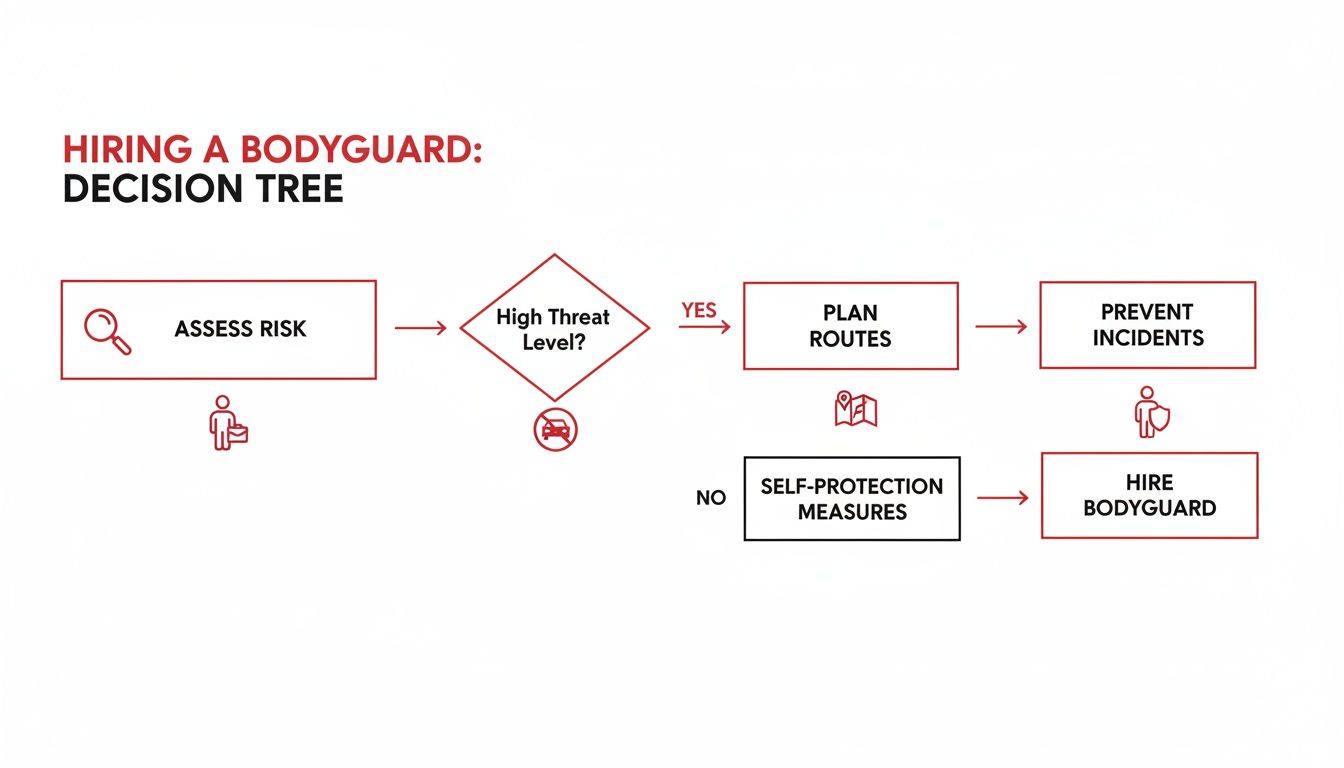
As the flowchart shows, great protection starts long before the event. A thorough risk assessment is the first step to figuring out what kind of security you actually need.
In the end, it’s about creating a secure environment that’s built for your specific situation. Here in Australia, having a physical security presence is still the most trusted way to manage risk. It's a massive part of the economy, with the industry projected to generate around AU$13.9 billion in revenue in 2025. Mobile guards and patrol services make up the biggest slice of that pie, which tells you just how much value businesses place on having trained professionals on the ground. Discover more insights about the Australian security industry on ibisworld.com. This all confirms that investing in the right type of physical security is a sound, proven strategy.
Verifying Licensing and Legal Compliance
A professional personal security bodyguard is far more than just a physical presence. They are a licensed, regulated, and accountable expert. Hiring someone without the right credentials isn't just a simple mistake—it opens your event, your guests, and your entire organisation up to massive legal liabilities and the kind of reputational damage that’s hard to come back from.
Think of licensing as the bedrock of trust in the security world. It’s your guarantee that the individuals protecting your people have passed mandatory background checks, completed certified training, and are legally authorised to operate in your state. This is how you know you’re getting a true professional, not just someone in a security-style jacket.
State-Specific Licensing Requirements
In Australia, security licensing is handled at the state and territory level, which means the rules and licence classes can change quite a bit when you cross a border. If you’re an event manager running shows in different cities, getting a handle on these local nuances is absolutely critical.
Here’s a quick rundown of what to look for:
- New South Wales (NSW): Operatives need a Class 1 Security Licence. Specifically for bodyguard duties, they must hold the 1A (Unarmed Guard) and 1C (Crowd Controller) subclasses.
- Victoria (VIC): Individuals must be registered with the Victoria Police's Licensing and Regulation Division. You need to see that the Bodyguard and Crowd Controller activities are approved on their licence.
- Queensland (QLD): A Security Officer Licence is required, but you need to check the endorsed functions. For events, you'll want people with Bodyguard and Crowd Controller functions approved.
- Australian Capital Territory (ACT): Guards must hold a Security Employee Licence from Access Canberra. The necessary sub-classes are Patrol, Guard, or Crowd Control, which cover the duties at most events and venues.
When you engage a security provider, always ask for two things: proof of the individual guard's licence AND the company's Master Licence for the state you're operating in. Having one without the other is a major compliance red flag.
Australia's close-protection and bodyguard workforce is part of a large, heavily regulated private security industry. We're talking about a mature profession with nearly 150,000 individual licence holders and over 11,000 licensed firms. Recent stats even show a 6.10% growth in individual licences over the past year, which points to an expanding talent pool. If you're interested in the trends, you can learn more about the future of the security industry and its growth.
The Importance of RSA Certification
There’s another layer of compliance you can't ignore for any event or venue serving alcohol. Every single security guard, from the person on the front door to the one in the VIP green room, must have a current Responsible Service of Alcohol (RSA) certificate for that specific state.
This goes way beyond just checking IDs. RSA training gives security personnel the skills to spot intoxicated patrons, de-escalate alcohol-fuelled conflict, and refuse service lawfully and safely. It’s a non-negotiable legal requirement that helps create a safer atmosphere and, just as importantly, protects your venue’s liquor licence.
Security Compliance Checklist for Hiring Bodyguards
Before you sign any contract, it's smart to have a clear checklist to make sure your provider is ticking all the right boxes. This simple table can help you verify that everything is above board, protecting your event from every angle.
| Compliance Check | What to Ask For | Why It Matters |
|---|---|---|
| Individual Security Licence | A copy of the current, valid state-issued security licence for each guard (e.g., NSW Class 1A/1C). | This proves the individual is legally authorised, has passed background checks, and has the required training. |
| Master Security Licence | The provider's company-level Master Licence for your state of operation. | This confirms the business is legally allowed to supply security personnel and is accountable to state regulators. |
| Public Liability Insurance | A current Certificate of Currency for Public Liability Insurance (a minimum of $20 million is recommended). | This protects your organisation from financial ruin if an incident caused by security staff occurs. |
| RSA Certification | Proof of a current RSA certificate for every guard who will be working in a licensed area. | This is a legal must-have for managing alcohol-related risks and complying with state liquor laws. |
Running through these quick checks is one of the easiest and most effective ways to ensure your chosen personal security bodyguard provider is not just good at their job, but fully compliant. It’s a fundamental step in safeguarding your event, your reputation, and your peace of mind.
What Goes Into the Cost of a Bodyguard?
When you start budgeting for a personal security bodyguard, it's easy to get fixated on a simple hourly rate. But the reality is a little more complex. The final quote isn't just a number pulled out of thin air; it’s a direct reflection of the risk, expertise, and resources needed to do the job right and keep everyone safe. It's best to think of it as an investment in a guaranteed outcome, not just another line item expense.
What you're really paying for is a safety solution built specifically for your situation. A low-risk, one-off event with a single guard is a world away from a multi-day international tour needing a full protection team. Understanding what drives the cost helps you see exactly where the value is in professional protection.
It All Starts With the Risk Level
The single biggest influence on the price is the assessed threat level. Before quoting, any good security provider will run a thorough risk assessment to figure out the potential dangers to the person they’re protecting (known as the principal). This isn't just about obvious, known threats; it involves a deep dive into the venue, the type of event, and the principal's public profile.
For example, looking after a controversial speaker at a public forum is a much higher-risk job than escorting a CEO at a private corporate dinner. The higher the risk, the more experienced and highly trained the personnel need to be, and that's naturally reflected in the cost.
The price of a personal security bodyguard is a direct function of the risk they are being asked to manage. Higher stakes demand a higher calibre of professional, advanced planning, and more intensive resources—all of which contribute to the final price.
The Core Parts of a Quote
Beyond the overarching risk level, a few key variables will shape the final number on your quote. Getting your head around these helps you see where the money is going and ensures you get the right level of protection without paying for things you don’t need.
Here’s what typically makes up the cost:
- How long you need them: A simple four-hour gig for an event arrival and departure will cost far less than providing round-the-clock protection over several days. Longer assignments mean bringing in multiple operators to work in shifts and avoid fatigue, which adds to the total cost.
- How many people you need: One bodyguard might be perfectly fine for a low-profile individual. But if you’re moving a high-profile celebrity through a big crowd, you might need a four-person team to create a secure bubble, manage access, and coordinate everything seamlessly.
- Any special skills required: The specific skillset you need has a direct impact on the rate. If the job involves more than standard protection—say, you need a bodyguard who is also a certified advanced driver or has specific medical trauma training—the price will be higher to reflect that specialised expertise.
- Location and logistics: Running an operation in a busy city centre like Sydney or Melbourne is often more complex and costly than a regional event. Things like travel time, accommodation for guards on multi-day jobs, and vehicle requirements all get factored into the budget.
Common Questions About Bodyguard Costs
To clear things up even further, here are a few answers to the questions we hear all the time.
Is an armed bodyguard more expensive?
In Australia, you'll almost never see an armed bodyguard at an event or protecting an individual due to our strict laws. It's an exceptionally rare situation. The industry standard is highly-trained unarmed professionals who rely on sharp de-escalation skills and physical intervention techniques. The cost is based on their expertise and experience, not on whether they carry a weapon.Are there minimum booking times?
Yes, most professional security firms have a minimum booking period, which is often around four hours. This simply ensures it’s commercially viable to assign a top-tier professional to your task, covering their time for travel, briefing, and preparation.Do I have to pay for travel and other expenses?
Usually, yes. If a job requires our team to travel outside their standard service area or stay overnight, the costs for transport, meals, and accommodation are typically built into the final quote. It’s always best to ask for a clear breakdown so there are no surprises.
How to Brief Your Security Provider for Success
A personal security operation lives and dies by the quality of its brief. Handing your provider a vague, half-baked plan is like sending a pilot into the sky without a flight path—it introduces dangerous unknowns and leaves everyone exposed. A truly world-class brief is the single most important tool you have for ensuring a smooth, secure event.
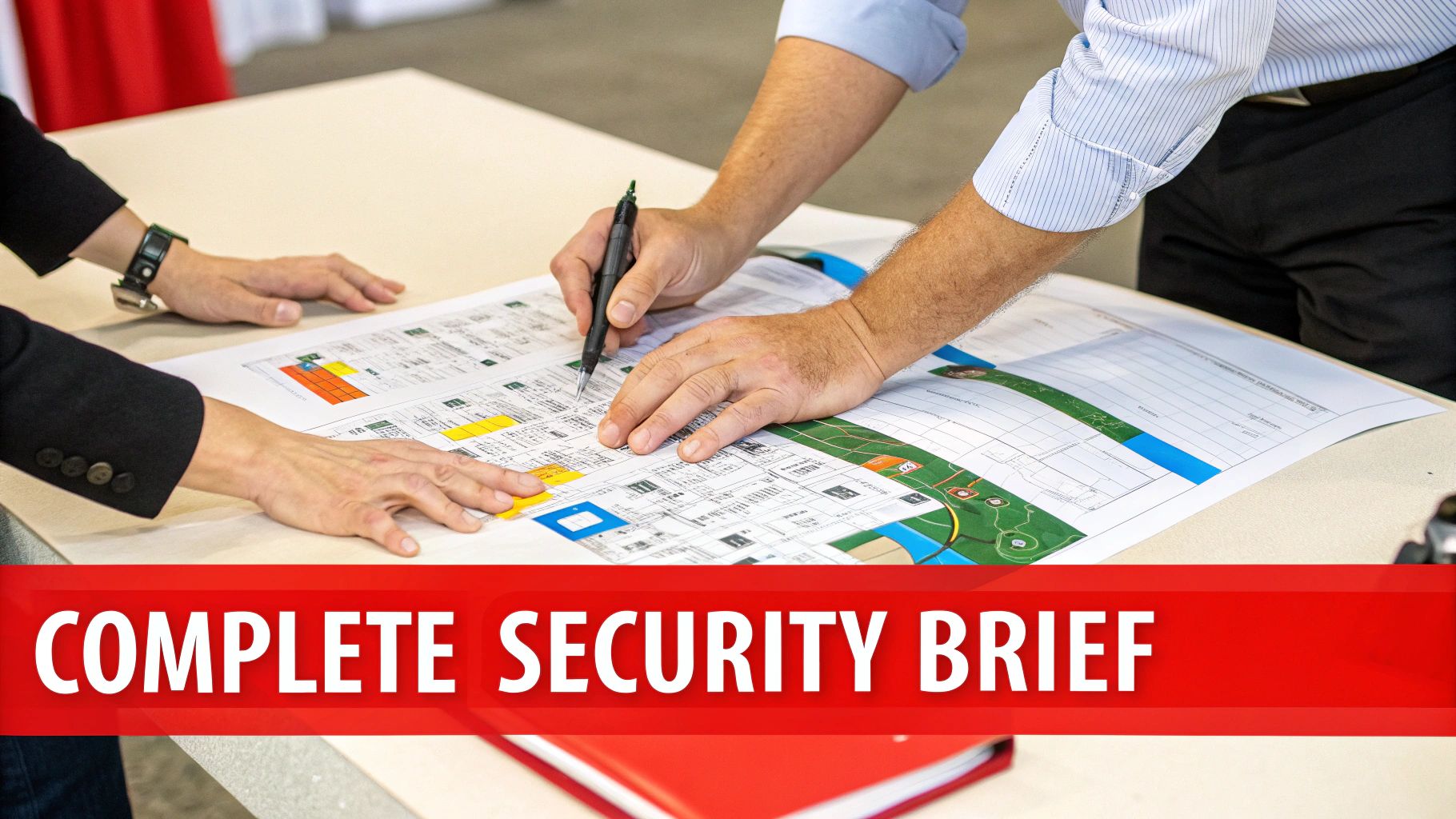
Think of it less as a list of instructions and more as a shared operational blueprint. It's the one document that gets everyone on the same page, aligning your specific needs with their professional expertise. When your security partner has total clarity on the mission, they can stop just reacting to problems and start proactively managing the entire environment.
The Non-Negotiable Elements of a Security Brief
To get the best out of your security team, your brief needs to be watertight. Ambiguity is the enemy of safety. Start by pulling together all the core operational details that will form the backbone of their protection plan.
Your brief absolutely must include:
- Detailed Itineraries: This means minute-by-minute schedules for every key person. Think arrival times, media calls, onstage appearances, private meetings, and departure plans. The more detail, the better.
- Venue Blueprints and Layouts: Don't just send a map. Supply detailed floor plans that clearly mark every entry and exit point, backstage area, green room, sterile zone, and public-facing space.
- Key Personnel Roster: Who exactly needs protection? Create a list with names, photos, and their specific roles. You should also include a clear contact list for your event management team and the venue's key staff.
- Established Chain of Command: In a crisis, confusion is costly. Clearly outline who the security team reports to and, crucially, who has the final say to make critical decisions during an incident.
The Critical First Step: Pre-Brief Risk Assessment
Before you even type a single word of the brief, you need to conduct a risk assessment with your provider. This is a collaborative process where you sit down and identify every potential threat—from the highly unlikely to the annoyingly common. It’s all about asking, "What could realistically go wrong here?"
A solid risk assessment will cover:
- Known Threats: Is there any specific intelligence about threats towards a guest speaker, performer, or the event itself?
- Crowd Dynamics: What's the vibe of the audience? Are we talking a relaxed corporate luncheon or a high-energy music festival with mosh pits?
- Medical Emergencies: Where are the first aid stations located? What's the exact procedure for a medical event in the crowd versus backstage?
- Venue Vulnerabilities: Are there unlocked service doors, poorly lit car parks, or nearby public spaces that could be exploited?
A great security brief isn't just about what you want to happen; it's about planning for what you don't want to happen. By addressing potential risks on paper first, you empower your team to prevent them in reality.
The need for this level of detail isn't theoretical. In 2023–24, an estimated 50,700 people in Australia aged 15 and over experienced a robbery. While that might seem like a small percentage of the population, these incidents are heavily concentrated in the urban and entertainment precincts where events happen. For organisers, these statistics represent a very real risk that a detailed security brief is designed to mitigate. You can explore more Australian physical security market insights on imarcgroup.com.
Defining Clear Rules of Engagement
The final piece of the puzzle is setting the 'rules of engagement'. This is where you ensure the personal security bodyguard team operates in a way that reflects your event’s tone and your organisation’s values. It's about how they represent you on the ground.
Get specific about your expectations:
- Interaction Style: How should the team engage with guests? Do you want a firm, authoritative presence or a more discreet, customer-service-oriented approach? Be clear.
- Use of Force Policy: Make sure everyone is aligned on the protocols for physical intervention and removing disruptive people. This must be in line with state laws and venue policies.
- Emergency Protocols: Detail the exact procedures for fires, medical emergencies, or active threats. Who makes the call to evacuate? Are there communication codewords?
- Reporting Requirements: How and when do you want to receive updates? Do you need a formal post-event report detailing any and all incidents?
By putting in the time to create a truly comprehensive brief, you’re doing more than just hiring a contractor. You’re empowering a strategic partner, giving them everything they need to deliver the safe, successful event you've worked so hard to create.
Seeing Effective Bodyguard Strategies in Action
The best work a personal security bodyguard does is often the work you never see. True success isn't about dramatic interventions; it's a perfectly smooth, uneventful day where your guests, artists, and speakers are kept safe without a hint of fuss or drama.
So, how does that look on the ground? Let's bridge the gap between planning and execution by walking through a few real-world scenarios. These examples show just how a professional protection team does more than just stand by a door—they actively manage the environment to guarantee a secure and positive experience for everyone.
Case Study 1: The High-Energy Music Festival
The Scenario: A headline DJ is on the bill for a major outdoor music festival in NSW, with a roaring crowd of over 20,000. The artist has to get from their transport to a private backstage green room and then to the main stage, all through chaotic, high-energy areas packed with crew and staff.
The Strategy: A four-person, plain-clothed team was brought in. Their approach was all about layers and foresight:
- Advance Work: Days before the show, the team leader meticulously walked every single route the artist would take. They timed the movements and pinpointed potential chokepoints, like narrow backstage corridors or crowded access ways.
- Covert Bubble: On the day, the team formed a discreet diamond formation around the artist whenever they were on the move. This created a low-profile buffer that was just enough to allow for some fan interaction but prevented anyone from getting uncomfortably close.
- Seamless Communication: The team was in constant, silent contact with the event’s central security control. They coordinated their movements with the stage manager’s schedule, ensuring every transition was perfectly timed and utterly seamless.
The Outcome: The artist moved around the festival site freely and securely, without a single incident. Because the team was so unobtrusive, the electric atmosphere of the festival was never compromised, and the performance went off without a hitch.
Case Study 2: The Corporate Conference VIP
The Scenario: The CEO of a major publicly listed company is set to deliver the keynote address at a corporate conference in Melbourne. The risk here isn't from adoring fans, but from potentially disgruntled former employees or activist groups looking to make a scene. Discretion is everything.
The Strategy: A single, covert personal security bodyguard was assigned to the CEO.
- Low-Profile Integration: Dressed in sharp business attire, the operative posed as a corporate aide, blending in perfectly. They carried the CEO's briefing notes and laptop, which gave them a natural reason to stay close without drawing any attention.
- Secure Transport: They worked directly with a pre-vetted driver, performing a final check of the vehicle each morning. All routes from the hotel to the conference centre were mapped out with multiple backup options, just in case.
- Venue Control: Just before the big speech, the operative swept the stage and all backstage areas, coordinating with venue staff to lock down access points and ensure the area was secure.
The Outcome: The CEO was able to network, prepare, and present with complete confidence. The protection was so subtle it was invisible to the hundreds of attendees, maintaining a professional corporate atmosphere while quietly neutralising any potential threats before they could ever become an issue.
"A bodyguard's role is to control crowd dynamics, establish buffer zones, and secure safe exits. Their primary function is proactive risk mitigation, moving far beyond reactive guarding to ensure safety."
Case Study 3: The High-End Hospitality Venue
The Scenario: A high-end restaurant in a bustling QLD tourist hotspot is hosting a private dinner for an international celebrity. The main challenge? Managing the inevitable paparazzi and overly curious public without ruining the exclusive dining experience for other patrons.
The Strategy: A two-person team was the perfect fit. One operative stayed with the celebrity's group inside the restaurant, while the second managed the exterior perimeter and acted as the point of contact for the restaurant's management. They orchestrated a discreet arrival through a private service entrance, completely bypassing the main foyer.
The Outcome: The celebrity and their guests enjoyed an uninterrupted dinner. The external operative skillfully managed the photographers, preventing them from harassing other diners and ensuring the venue's hard-earned reputation for privacy and exclusivity remained intact. It’s a perfect example of how a skilled personal security bodyguard protects not just the individual, but the client's brand as well.
Frequently Asked Questions about Hiring a Personal Security Bodyguard
Bringing a personal security bodyguard onto your team for an event or at your venue is a significant decision, so it's only natural to have a few questions. For event organisers and venue managers, getting straight, clear answers is the key to making a confident choice. This FAQ is designed to cut through the noise and tackle the most common things we get asked about.
A bodyguard is a massive asset when deployed correctly. Understanding exactly what they do, what their limitations are, and where they stand legally is crucial for slotting them into your operations seamlessly.
Are Personal Security Bodyguards Armed in Australia?
The short answer is no. The overwhelming majority of personal security bodyguards working in Australia are unarmed. Our state and federal firearms laws are incredibly strict, which means armed security is extremely rare and usually limited to high-risk government details or cash-in-transit guards.
For private events, venues, and personal protection, a bodyguard’s toolkit is their training. They rely on sharp communication skills, situational awareness, proven de-escalation tactics, and, only when necessary, physical intervention techniques. Their job is all about stopping threats before they happen, not using weaponry. When you're hiring, you can and should assume you're getting an unarmed professional—that’s the industry standard here.
What’s the Difference Between a Bodyguard and a Crowd Controller?
While both are licensed security professionals, they have very different jobs on the day. The easiest way to think about it is like the difference between a wide-angle lens and a zoom lens.
- Crowd Controller: Their focus is broad. They’re managing the safety, behaviour, and flow of large groups of people at a pub, festival, or stadium. Their responsibility is the overall environment and everyone in it.
- Personal Security Bodyguard: Their focus is laser-sharp and specific. Their one and only mission is to ensure the safety of a designated person (known as the principal) or a small, pre-defined group. Their work is all about detailed risk assessments, planning secure routes, and maintaining a protective "bubble" around their principal at all times.
These two roles aren't an either/or; they often work hand-in-glove at big events. A VIP’s bodyguard detail will liaise constantly with the general crowd control team to make sure protection is seamless, from the moment they arrive to the second they're safely in the green room.
How Far in Advance Should I Book a Personal Security Bodyguard?
Honestly, the earlier, the better. Great security isn't reactive; it's planned. Giving your provider enough lead time is absolutely critical for a smooth and successful operation.
The best security providers aren't just last-minute hires; they're strategic partners. Engaging them early gives them the time to do a proper risk assessment, map everything out, and assign the perfect personnel for your specific needs.
As a general rule of thumb:
- Major Events or Tours: Give it 2-3 months' notice. This provides plenty of time for deep-dive risk assessments, coordinating across multiple venues, and putting the right team together.
- Standard Corporate or Private Events: Booking 2-4 weeks out is usually a safe bet.
- Last-Minute Requests: We get it, sometimes things happen fast. But last-minute bookings are tough. They prevent the detailed prep work that real protection requires and will likely come with a higher price tag.
Can a Bodyguard Legally Remove Someone From My Event?
Yes, they absolutely can. A licensed personal security bodyguard or crowd controller is acting as your agent—the agent of the property owner or event organiser. This gives them the legal authority to remove someone from your private property. It's a fundamental part of keeping the environment safe for everyone.
This action is justified if someone is being disorderly, is clearly intoxicated, is trespassing in a restricted area, or is posing a threat to other guests or your staff. A professional is trained to use only the minimal and most reasonable force needed to safely escort the person out, always following state laws and your venue’s specific policies. Any time this happens, it should be meticulously recorded in an incident report.
Ready to make sure your next event is safe, secure, and successful? The team at GM GROUP Services provides licensed, professional, and dependable personal security solutions across NSW, VIC, QLD, and the ACT. We work with you to build a security plan that protects your people, your property, and your reputation. Contact us today for a comprehensive risk assessment and quote.
Discover more from GM Group Services
Subscribe to get the latest posts sent to your email.