
Monitored burglar alarm systems are your dedicated, 24/7 digital security team, standing guard when you can't. Far more than a simple siren that just makes noise, this is about active protection that triggers an immediate, professional response the second a threat is confirmed, ensuring your site is never truly left vulnerable. From deterring would-be thieves to providing crucial evidence, a monitored setup is a cornerstone of modern security.
What Makes Monitored Burglar Alarm Systems a Game-Changer
We’ve all heard a car alarm blaring in a crowded car park. What do most of us do? We ignore it, assuming it’s just another false alarm. That’s the critical flaw in a standard, 'bells-only' system. It creates a racket but ultimately relies on the goodwill of neighbours or passersby to actually do something—a huge gamble most businesses simply can't afford to take.
A monitored burglar alarm system, on the other hand, is your direct line to a team of security professionals. When a sensor trips, it does more than just set off a local siren. It sends an instant signal to a dedicated monitoring centre where a team is on standby around the clock. Their job is to verify the threat and immediately dispatch the right response, whether that’s a mobile security patrol or the police.
The difference is simple but profound: an unmonitored alarm is like shouting for help in a crowd and hoping someone pays attention. A monitored system is like having a dedicated professional on speed dial, ready to send help the moment you need it.
Monitored vs. Unmonitored Alarms At a Glance
To really understand the value, it helps to see the two systems side-by-side. The differences in response and outcome are stark.
| Feature | Unmonitored Alarm System | Monitored Burglar Alarm System |
|---|---|---|
| Response Activation | Local siren and flashing lights only. | Signal sent to a 24/7 professional monitoring centre. |
| Who Takes Action? | Relies on neighbours or passersby to notice and call for help. | Trained security professionals verify the alarm and dispatch help. |
| Response Time | Unpredictable and often very slow. | Immediate and coordinated response process begins in seconds. |
| False Alarm Handling | Often ignored, leading to 'alarm fatigue' in the area. | Professionals verify the alarm to reduce false dispatches. |
| Deterrent Effect | Moderate. Deters opportunistic, amateur thieves. | High. Deters organised criminals who know a response is guaranteed. |
| Ideal For | Low-risk residential properties. | Businesses, high-value sites, and unoccupied properties. |
As you can see, choosing a monitored system moves your security from a passive hope into an active, managed strategy.
The Essential Value of Professional Intervention
It’s this rapid, professional intervention that makes monitored alarms indispensable for any high-value environment. For a business, a standalone siren just isn't enough to stop determined criminals. They know that without professional verification, any response is likely to be slow.
Just think about these high-risk scenarios where a monitored system is a must:
- Construction Sites: With valuable tools, copper, and equipment left out overnight, these sites are prime targets. A monitored alarm can pick up a perimeter breach and trigger an immediate mobile patrol dispatch before thieves can make off with thousands of dollars in assets.
- Retail Stores: Protecting your inventory from after-hours break-ins is non-negotiable. Professional monitoring means any forced entry is met with a swift, organised response, safeguarding your stock and preventing costly damage.
- Event Venues and Festivals: Temporary sites are loaded with expensive sound, lighting, and AV equipment. A monitored system provides a reliable security layer, ensuring any intrusion is dealt with immediately by on-site or dispatched security personnel.
Why Every Second Counts in a Security Breach
During a security incident, time is the criminal's best friend. The more time they have, the more they can steal and the more damage they can cause. Unmonitored systems hand them this time on a silver platter, giving them a crucial window to work uninterrupted until someone eventually decides to call for help.
A monitored system slams that window shut. The moment an alarm is triggered, the response process kicks into gear. This immediate action dramatically increases the chances of catching intruders red-handed and also acts as a powerful deterrent. After all, criminals are far less likely to hit a property when they know it's under constant, professional surveillance.
By focusing on an immediate, guaranteed response, monitored security shifts your protection from a passive hope to active, real-time defence.
The Core Components of Your Security Shield
To really get your head around monitored burglar alarm systems, you need to understand the tech that’s working behind the scenes. These systems aren't just a loud siren; they're a smart network of components that act as a cohesive shield for your property. Each piece of hardware has a specific job, and together, they create a truly robust defence.
It helps to think of it like your body's nervous system. You've got a central brain making all the decisions, and sensors—your eyes and ears—constantly feeding it information from the environment. The moment one sensor picks up a problem, it sends an urgent signal to the brain, which then kicks off a coordinated response. It’s this seamless teamwork that makes the whole system so effective.
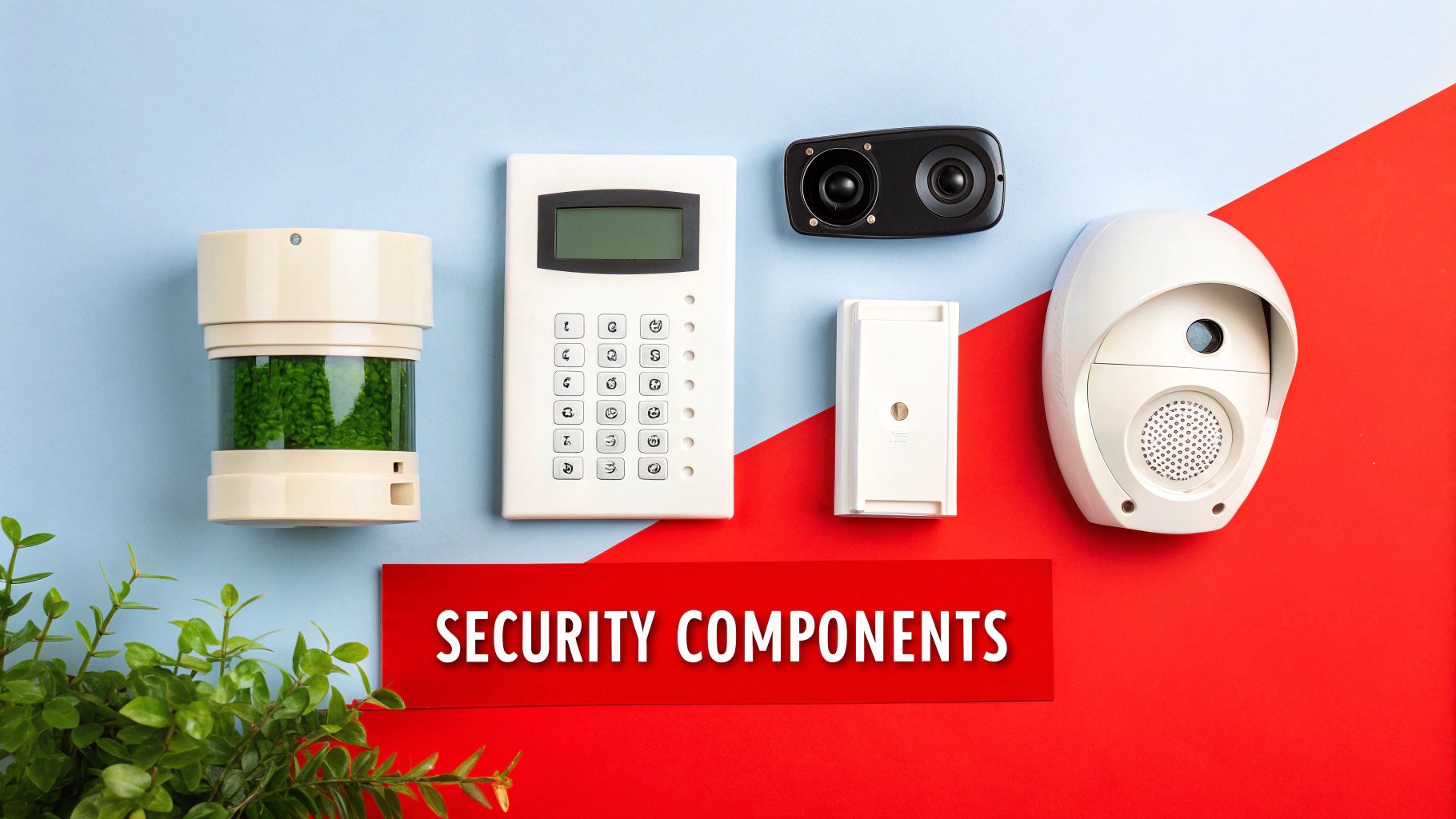
The Brain of the Operation: The Control Panel
At the very heart of every monitored alarm system is the control panel. This is the central hub, the 'brain' that takes in all the signals from your sensors and talks directly to the professional monitoring centre. It’s the keypad you use to arm and disarm the system, and it’s the device that fires off that critical alert when a breach happens.
Today's control panels are seriously powerful. They can manage dozens of different sensors, link up with other security gear like your CCTV, and even use multiple ways to communicate (like the mobile network and your internet connection). This redundancy ensures the alert always gets through, even if a would-be thief tries to cut a line.
Your First Line of Defence: Sensors and Detectors
If the control panel is the brain, then the sensors are your frontline soldiers. We place them strategically around your property to pick up on specific types of unauthorised activity. Because different sensors are built for different threats, you end up with multiple layers of protection.
Here are the most common bits of kit you'll come across:
- Door and Window Contacts: These are brilliantly simple but incredibly effective. They come in two parts—a magnet and a sensor—which sit on a door or window and its frame. When that entry point is opened, the connection between the two is broken, and the alarm is triggered. Simple as that.
- Practical Example: A retail shop would put these on the main entrance, the back delivery door, and any stockroom doors. This gives an instant alert if any of them are opened after hours.
- Motion Sensors: These detectors use clever tech like passive infrared (PIR) to sense movement and body heat within a set area. They're perfect for covering big open spaces, long hallways, or entire rooms with a single device.
- Practical Example: On a construction site, you could position PIR sensors along the perimeter fence. They’ll detect any trespassers after the crew has clocked off, protecting valuable machinery and materials from theft.
- Glass-Break Detectors: As the name suggests, these are specialised sensors that listen for the very specific sound frequency of shattering glass. They add another crucial layer of security for any property with large windows or glass storefronts.
- Practical Example: A pub or restaurant with large street-facing windows can use glass-break detectors to ensure that even if a burglar smashes the glass instead of forcing a door, the alarm still goes off immediately.
The Power of Wireless Technology
One of the biggest leaps forward in monitored burglar alarm systems has been the incredible reliability of wireless technology. Wireless components do away with the need for disruptive and time-consuming wiring, which makes installation much faster, cleaner, and a whole lot more flexible.
The real game-changer with wireless systems is their adaptability. You can install, move, or expand them with minimal fuss, making them perfect for environments where traditional wired systems just aren't practical.
This flexibility is a lifesaver for temporary or evolving sites. Think of a weekend music festival; wireless sensors can be deployed in minutes to secure entry gates, equipment tents, and cash-handling areas. The same goes for a pop-up retail shop—you get professional-grade protection without the commitment of a permanent installation. It gives any business or event the power to set up a serious security presence, anytime and anywhere.
How Professional Monitored Burglar Alarm Systems Work
When it comes to monitored alarms, not all systems are built the same. The kind of monitoring you choose is what really dictates how fast—and how effectively—help arrives when something goes wrong. In the security world, the undisputed benchmark for quality and reliability is professional back-to-base monitoring. This isn't just an app on your phone; it's a dedicated, secure link from your property straight to a specialised facility manned 24/7 by trained security professionals.
Think of it this way: a basic alarm is like a smoke detector that just makes a lot of noise and hopes a neighbour calls for help. A back-to-base system is a direct line to the fire brigade. It guarantees an expert is on the case in seconds, assessing the situation and getting the right people on their way. For any business, that distinction is everything, because every second of delay can mean the difference between a close call and a catastrophic loss.
The Problem with Self-Monitoring
Many off-the-shelf security systems you see today are self-monitored. When a sensor goes off, it just pings your smartphone and puts the responsibility squarely on your shoulders. You have to see the alert, figure out if it's real, and then make the call to the police yourself.
While it might sound simple enough, this approach has some serious blind spots for a business:
- You're Not Always Available: What happens if an alert comes through at 3 AM? Or when you're driving, in a meeting, or somewhere with patchy mobile reception? Any delay gives an intruder a golden opportunity.
- The Credibility Gap: Police services are stretched thin. A call from a private citizen about a potential break-in is often prioritised lower than a verified alarm from a licensed monitoring centre. Without that professional confirmation, your call might not get the urgent response it needs.
- Don't Put Yourself at Risk: Heading down to your premises in the middle of the night to check on an alarm is a genuinely dangerous idea. Confronting a potential intruder is a job for trained security personnel, not business owners.
A Real-World Look at How Back-to-Base Monitoring Works
Let’s walk through a typical scenario to see how this plays out in the real world. Imagine a pub, closed for the night, is targeted by a burglar.
- 2:15 AM – The Alarm Triggers: An intruder smashes a window at the back of the building. A glass-break detector is instantly triggered, sending a silent signal from the alarm panel to the 24/7 monitoring centre.
- Instant Verification: Within seconds, a trained operator receives the alert. Their screen immediately shows the live CCTV feed from the pub's cameras. They can see the intruder inside—this is video verification, and it's the key to confirming a genuine threat.
- A Coordinated Dispatch: With visual proof of a break-in, the operator doesn't waste a second. They make a high-priority call to the local police, reporting a verified crime in progress. At the same time, they dispatch a GM GROUP mobile security patrol to the location.
- On-the-Ground Response: Our mobile patrol often arrives within minutes, sometimes even before the police. Just the sight of a security vehicle pulling up is often enough to send an intruder running. Our officers are trained to secure the perimeter and provide vital intelligence to the police when they arrive.
This swift, layered response shuts down the threat, minimises the damage, and ensures the property is secured right away. It's a level of protection that more and more Australian businesses are demanding.
In fact, the Australian security systems market hit USD 2.03 billion in 2024 and is expected to surge to USD 5.16 billion by 2033. This massive growth is driven by businesses in high-risk sectors realising the value of professional monitoring and video verification. You can explore more data on Australian security market trends to see how seriously companies are now taking proactive protection.
Integrating Monitored Alarms with On-Site Security
A monitored burglar alarm system is a fantastic security tool on its own, but its real power is unleashed when you pair it with professional on-site security. Think of it as combining the instant, vigilant eyes of technology with the decisive action of highly trained people. It's this one-two punch that creates a truly formidable, layered security strategy.
This integration transforms your security from a passive 'wait-and-see' setup into a proactive force. An alarm is no longer just a loud noise; it becomes the starting gun for a coordinated, boots-on-the-ground response that can stop a threat dead in its tracks.
From Digital Alert to Physical Response
The single biggest advantage of this approach is the ability to turn a verified alarm into an immediate dispatch. When our back-to-base monitoring centre gets a signal and confirms it's a genuine threat, they don't just call the police. They can simultaneously send one of our mobile patrol units straight to your site.
This gives you several crucial benefits:
- Faster Response Times: A dedicated mobile patrol can often get to your location much faster than law enforcement, who have to prioritise calls across a whole area. Those minutes are absolutely critical when a crime is in progress.
- Expert Assessment: Our security officers are trained to walk into a situation and assess it safely and effectively. They can confirm how a breach happened, identify entry points, and feed vital, real-time intelligence to the police when they arrive.
- Fewer False Alarm Headaches: A patrol can physically verify what triggered an alarm. If it turns out to be a stray animal or a weather-related sensor trip, they can stand down the response without wasting valuable police resources.
The process is simple but incredibly effective, moving from trigger to dispatch in a matter of moments.
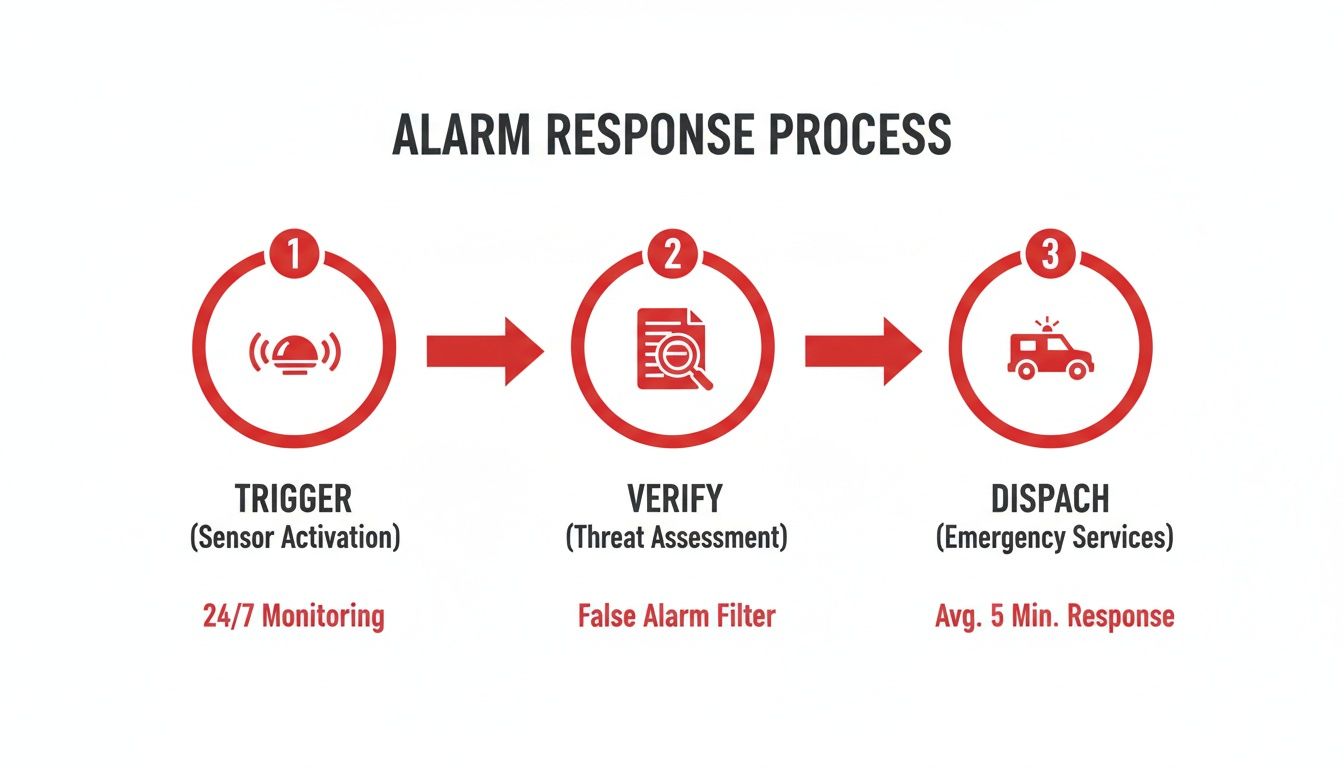
This streamlined workflow ensures every second counts. For any business, integrating comprehensive security means looking at how different pieces, like specialised commercial alarm systems, fit together to cover all the bases.
How On-Site Guards and K9 Units Leverage Monitored Alarms
The integration gets even more powerful if you already have static guards or K9 units on your property. The monitored burglar alarm system essentially becomes their digital partner, acting as a network of eyes and ears that extends their awareness far beyond what they can physically see.
By linking technology directly to manpower, you create a security ecosystem where every component makes the others more effective. The alarm provides the alert, and the guards provide the immediate, intelligent response.
Here's how this plays out in the real world:
- Large Music Festivals: It's physically impossible for guards to watch every single metre of a sprawling event perimeter. But, with motion sensors placed along the fence line, an alert is sent directly to the on-site command post the second someone tries to climb over. Guards can then be sent to that exact spot to prevent a breach.
- Sprawling Warehouses: An after-hours alarm in a massive logistics centre could mean an intruder is hiding somewhere among thousands of pallets. Our monitoring centre can use CCTV to verify the breach and alert your on-site team, who could then deploy a K9 unit. A trained dog can sweep the warehouse and locate a hidden person far more quickly and safely than guards alone.
This dynamic, integrated approach is fast becoming the industry standard. In fact, Australia's Investigation and Security Services industry is projected to hit $13.9 billion in revenue by 2025, largely because businesses are embracing these blended solutions. It shows a clear shift towards viewing technology and on-site personnel not as separate options, but as two essential halves of a complete security plan.
Meeting Your Insurance and Legal Obligations
Let's be frank: installing a monitored burglar alarm system isn't just about stopping thieves. It's a fundamental part of managing your business's financial and legal responsibilities. When insurers and regulators see a professionally installed and monitored system, they see a business that's serious about managing risk. It’s a move that can save you a lot of money and protect you from some serious legal headaches down the track.
Think of it less as an expense and more as a savvy business decision. For an insurer, a monitored system is a powerful risk-reduction tool. A fast, verified response to a break-in drastically cuts down the window for theft and damage, meaning a smaller potential insurance claim.
A professionally monitored alarm is tangible proof for your insurer that you're taking every reasonable step to secure your assets. This commitment is often rewarded with lower premiums, which means your security investment starts delivering a financial return.
Taking the Sting Out of Insurance Premiums
Insurance premiums all boil down to one thing: risk. The more likely your property is to be hit by a break-in, vandalism, or theft, the more you'll pay for cover. By getting a monitored alarm installed, you actively change that calculation in your favour.
This isn't just a hypothetical benefit. Insurers know that a property with a 24/7 watch is a much tougher target for criminals. The presence of a monitored burglar alarm system signals that any incident will be handled immediately, keeping potential losses to a minimum. The upshot for you is often a very welcome drop in your annual insurance costs, helping the system to pay for itself over time.
Staying on the Right Side of the Law
Beyond just satisfying your insurer, many industries have specific legal requirements for security. This is especially true for highly regulated businesses across NSW, VIC, QLD, and the ACT.
- Licensed Venues: Pubs, clubs, and bars often need a compliant alarm system to even hold a liquor license. Authorities need to see that you have solid measures in place to prevent after-hours break-ins.
- Construction Sites: It’s common for local councils to demand security management plans for major projects, and these plans almost always include monitored alarms to stop theft and trespassing.
- High-Value Retail: If you're selling jewellery, electronics, or other high-ticket items, both your insurer and sometimes local by-laws will mandate top-tier, monitored security.
Partnering with a licensed expert like GM GROUP Services guarantees your system is installed according to Australian Standards and meets specific state rules. This isn't just about ticking a box; it's crucial if you ever need to make a claim. If the worst happens, being able to prove your system was compliant and properly managed is what gets your claim paid, no questions asked.
The ever-present threat of burglary makes this level of protection non-negotiable. To put it in perspective, in 2024, Perth alone saw 679 reported burglary cases. On the flip side, research shows that up to 60% of convicted burglars will steer clear of a property if they know it has a monitored alarm. For any business, this is a clear sign that investing in security is vital for deterrence, rapid response, and staying compliant. You can read more about trends in Australia's security industry to see why professional security is more important than ever.
By meeting these requirements, you’re doing more than just following the rules. You’re building a more resilient business, one that’s properly shielded from financial penalties, legal drama, and the crippling costs of a security breach.
A Practical Checklist for Choosing Your Monitored Burglar Alarm System
Trying to pick the right monitored burglar alarm system can feel like a mammoth task. There are so many options out there. This checklist cuts through the noise and walks you through the essentials, helping you find a system that actually protects your assets and gives you proper peace of mind.
The first step? Realising that there's no one-size-fits-all solution. What works for a bustling retail store is completely different from what’s needed for a temporary festival or a raw construction site.
Assess Your Core Security Needs
Before you even think about sensors or keypads, you need to understand your own vulnerabilities. Take a walk around your property—inside and out—and think like a burglar. Where are the weak spots?
- Identify High-Risk Zones: Where's the good stuff? Pinpoint the areas that need the most protection, like your stockroom, server room, or the office where cash is handled. These are your top priorities.
- Analyse Entry Points: Count every single door, window, loading dock, and even skylights. Each one is a potential way in for an intruder, and you need to account for them all.
- Consider Your Environment: Is your setup temporary or permanent? A pop-up event needs a flexible, wireless system that can be set up and torn down in a flash. A permanent retail shop, on the other hand, can benefit from a more robust, hardwired installation.
Actionable Insight for Event Organisers: Always ask about portability and how fast the system can be deployed. You need a professional-grade solution that’s ready to go when you are, without a massive setup headache.
Scrutinise the Provider and Their Service
The technology is only half the battle; the company installing and monitoring it is just as crucial. A good security partner ensures everything is reliable, compliant with local laws, and that someone will actually respond when an alarm goes off.
Here are the non-negotiable questions you should be asking any provider:
- Licensing and Certification: Are you fully licensed to operate in NSW, VIC, QLD, or the ACT? Is your gear compliant with Australian Standards? If they can’t show you the paperwork, walk away. Your insurance company will thank you.
- Guaranteed Response Times: Ask them straight up: "What are your average and guaranteed response times for a verified alarm?" They should have clear data to back up their claims. Vague answers are a red flag.
- Total Cost of Ownership: Don't get caught out by hidden fees. Get a full breakdown of the monthly monitoring costs, any call-out charges, and what you’ll pay for maintenance or future upgrades.
Actionable Insight for Construction Site Managers: Your gear needs to be tough. Make sure all outdoor sensors and cameras are properly weatherproofed and built to handle the dust, debris, and general chaos of a building site. It’s the only way to avoid constant false alarms.
Verify Monitoring Centre Operations
Finally, get into the nitty-gritty of the monitoring service itself. The quality of their "back-to-base" control room is what makes or breaks the entire system.
Ask them about their operator training, how they verify alarms (video verification is the gold standard), and what happens if their centre loses power. You need to know they have solid backup plans. To get a feel for what’s out there, checking out a review of the best smart home security systems can provide a good baseline for comparing features, costs, and professional services, helping you nail down the right fit for your situation.
Frequently Asked Questions About Monitored Burglar Alarm Systems
It’s natural to have questions when you’re looking into monitored burglar alarm systems. Getting your head around how professional monitoring works is the first step. We’ve answered some of the most common queries to help you see exactly what this level of protection means for your business, event, or construction site.
Think of this as moving beyond a simple noisemaker to a fully managed security response.
How much faster is the response with a monitored alarm?
The difference is night and day. A monitored system sends an instant digital alert straight to a control room staffed by trained professionals. They don't just see a dot on a map; they can often use live video feeds to verify a real break-in is happening. This confirmation means your incident gets a higher priority when they call the police. Simultaneously, a private mobile patrol can be dispatched, often arriving on-site even before law enforcement to secure the area.
What happens during a false alarm with a monitored system?
This is where professional monitoring really shines. Control rooms have strict protocols to weed out false alarms. When a sensor is tripped, an operator runs through a verification checklist, starting with a call to your designated contacts. If they can't confirm a genuine emergency, they won’t just send the police racing over. Good security providers also work with you to adjust your system’s sensitivity, helping cut down on false triggers. Given that up to 98% of alarm calls can be false, having this human filter is crucial.
Can I integrate a monitored alarm with my existing CCTV?
Yes, and you absolutely should. Modern monitored burglar alarm systems are designed to integrate with other security hardware. Connecting them to your existing CCTV cameras enables video verification—the operator sees what triggered the alarm in real-time. This is the best way to confirm a threat is real, get an immediate and prioritised police response, and gather crucial evidence for any subsequent investigation.
Is a monitored burglar alarm system expensive?
While there is an initial investment and an ongoing monitoring fee, it's crucial to view it in terms of ROI. The potential savings from reduced insurance premiums, prevented theft, and minimized damage often outweigh the costs. For a business, the cost of one significant break-in can far exceed several years of monitoring fees. A professional provider can offer a tailored package that fits your budget and specific security needs.
How do I know if my business needs a monitored system?
If your premises contain valuable assets (stock, equipment, data), are located in a high-risk area, or are left unoccupied for long periods (e.g., overnight, weekends), you are a prime candidate for a monitored system. It's also a must-have if your insurance policy or local regulations require it. The core question to ask is: "If a break-in happened at 3 AM, how would I want it to be handled?" If the answer involves a guaranteed, immediate professional response, then you need a monitored system.
For a security solution that offers real protection and a rapid response for your business or event, trust the experts at GM GROUP Services. Discover how our security services can safeguard your assets by visiting https://www.gmgroupservices.com.au today.
Discover more from GM Group Services
Subscribe to get the latest posts sent to your email.