
Mobile patrolling security is a proactive, on-the-move security presence for your property, providing an incredible deterrent through scheduled and random checks. It’s where trained guards in clearly marked vehicles conduct both planned and unpredictable inspections. At its core, it’s like having a professional, strategic neighbourhood watch for your business, creating a powerful deterrent through its visible and ever-present nature. For any business looking to enhance its protection, understanding the nuances of mobile patrolling security is the first step towards a safer environment.
Understanding Mobile Patrolling Security
Mobile patrols break free from the limits of a traditional, fixed guard post. Instead of having one person stationed in a single spot, a highly trained security officer actively patrols a designated area or multiple sites in a dedicated vehicle. This makes it a brilliant solution for covering large areas efficiently—think construction sites, sprawling retail parks, large-scale event venues, and business complexes with several buildings.
The real power of this service is its unpredictability. Opportunistic criminals often watch a target to figure out its security routine, and a static guard’s fixed schedule can accidentally create the very windows of opportunity they’re looking for. But when patrol times are randomised, potential intruders are kept guessing. They can never be certain when a security vehicle will round the corner, which dramatically increases the risk of being caught.
This isn’t just about doing a quick drive-by, either. It's an active, intelligence-led operation. The whole point is to proactively spot threats and be ready to respond instantly, creating an environment of constant uncertainty for would-be criminals while giving you verifiable protection and total peace of mind.
What Happens During a Mobile Security Patrol
A professional mobile patrol is far more than a quick look from a car window. Each visit is guided by a detailed checklist of tasks, all designed to identify and deal with potential problems before they have a chance to blow up.
During a typical patrol, an officer will:
- Physically Check Access Points: They'll get out of the vehicle and manually check that all doors, gates, windows, and other potential entry points are locked up tight and haven't been tampered with.
- Inspect Perimeters: Guards will walk or drive the entire fence line, keeping a sharp eye out for any signs of damage, breaches, or weak spots that could be exploited.
- Scan for Hazards: They are also trained to spot general safety risks—things like water leaks, potential fire hazards, or tripping dangers that can be just as costly as a break-in.
- Look for Suspicious Activity: Officers are always on the lookout for red flags, like signs of forced entry, fresh vandalism, unauthorised vehicles, or people loitering where they shouldn’t be.
Actionable Insight: Request a copy of the patrol checklist from your provider. This ensures their tasks align with your specific property risks, like checking refrigerated units or verifying that construction equipment is immobilised.
The Role of Technology in Modern Patrols
Today, technology is what transforms mobile patrolling security from a simple service into a completely transparent and accountable operation. These digital tools give you, the client, undeniable proof that the job is being done right, and they give our guards the support they need to handle any situation.
The future of mobile security isn't just about physical presence—it's about intelligent coverage. Modern patrol officers are equipped with GPS-enabled devices and digital reporting tools that offer a real-time window into what's happening on-site.
This concept map helps visualise how deterrence, response, and technology come together as the three pillars of a truly effective mobile patrol strategy.
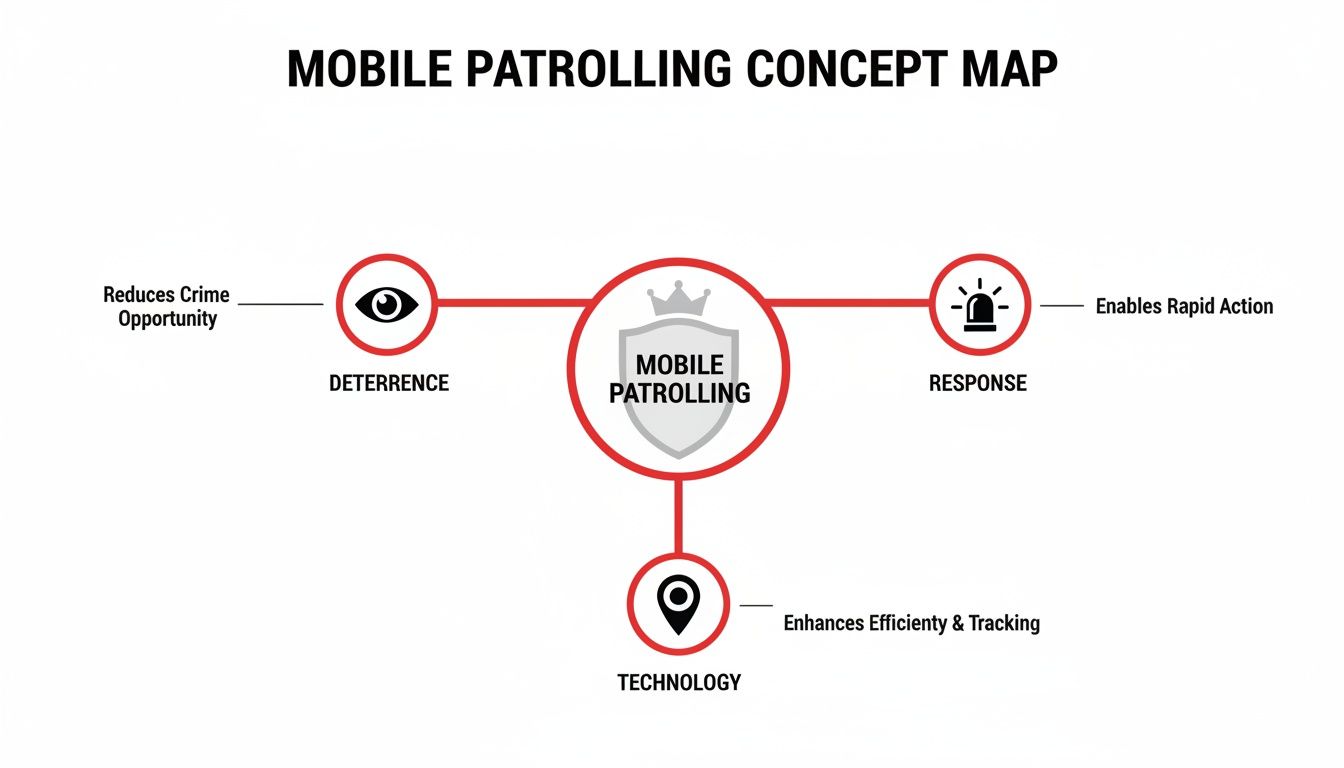
As the map shows, these elements don't work in isolation; they support each other to create a robust security solution that’s both proactive and reactive. Key technologies include GPS tracking on all patrol vehicles, which verifies not only that the officer was on-site but also that they followed the agreed-upon route. For an even more layered approach, businesses should consider integrating a reliable GPS car security system as part of their strategy. This is often paired with real-time reporting software, which allows guards to instantly upload photos, videos, and detailed notes from their patrol directly to a client portal. This digital trail leaves no room for doubt and ensures complete transparency and accountability.
Why Mobile Patrols Offer Superior Protection
When you’re trying to secure a business, especially one with a large footprint, you quickly run into a classic dilemma: budget constraints versus the need for comprehensive coverage. Sticking a single guard at the front gate feels safe, but what about the rest of your property? Mobile patrolling security is the smart answer to this problem, offering a flexible and genuinely formidable layer of protection. It’s built on three simple but powerful ideas: covering more ground, being unpredictable, and being incredibly cost-effective.
Think about securing a sprawling construction site or a multi-building retail park with static guards alone. To properly cover every weak point—from the back fences and loading docks to the equipment storage areas—you’d need a small army of guards working around the clock. The cost for that kind of setup would be astronomical and, for most businesses, completely out of reach. This is precisely where mobile patrols change the game, allowing a single, highly-trained officer in a vehicle to secure a huge area with real efficiency.
This isn’t just about saving money, though. The proactive nature of mobile patrols delivers proven results. With property crime being a constant headache for business owners, it’s worth noting what a difference they make. A key Australian study found that deploying private mobile security patrols led to a 16% reduction in overall crime rates at the sites they protected. Even more telling, it boosted incident reporting by a massive 49%, showing just how effective they are at both preventing crime and documenting what happens on the ground. You can get more insights from the full report on modern security technology.
Maximising Your Security Budget
Let's be honest, one of the biggest draws of a mobile patrol service is how much sense it makes financially. Think about the costs. Hiring just one static guard for 24/7 coverage means paying for three full-time shifts, seven days a week. That expense balloons quickly, and it's often a dealbreaker for businesses with large perimeters but only a handful of truly high-risk spots.
Mobile patrols flip that model on its head. Instead of footing the bill for a constant presence, you share the cost of an officer with other businesses in your area. You’re investing in a series of scheduled and randomised checks throughout the night, getting a powerful security presence and rapid response capability for a fraction of what a dedicated static guard would cost.
Actionable Insight: For maximum cost-efficiency, bundle mobile patrols with alarm response services. This often comes at a reduced rate and ensures a trained professional is the first on-site if an alarm is triggered, potentially avoiding false alarm fees.
The Strategic Power of Unpredictability
Predictable security is vulnerable security. It’s that simple. Any determined criminal will watch a property first to learn its rhythms. They look for patterns: when guards change shifts, where the camera blind spots are, and how long it takes for someone to walk the perimeter. A static guard, no matter how diligent, is an open book. Their routine creates the very windows of opportunity that criminals are looking for.
This is where mobile patrolling truly shines. By design, patrol schedules are randomised. This injects an element of pure uncertainty that messes with a criminal's plan.
An unpredictable patrol schedule is a powerful psychological deterrent. If potential offenders can't guess when security will appear next, the risk of getting caught becomes too high, forcing them to abandon their plans and move on.
This strategy slams those windows of opportunity shut. A patrol vehicle might swing by at 11 PM one night and then at 2:30 AM the next. This constant, random presence means there’s never a "safe" time for someone to try something. It turns your property from a passive, predictable target into an active, unpredictable risk for any would-be offender.
Mobile Patrolling Security in Action
It's one thing to talk about mobile patrols in theory, but where do they really make a difference on the ground? Let's walk through a few real-world scenarios. By connecting common business problems to specific mobile patrol solutions, you can start to see how this service can protect your own operations.
Securing Large-Scale Events and Venues
Practical Example: You're managing a massive music festival. Your focus is on the main stage, but your responsibility extends to the vast, dimly-lit car parks and kilometres of temporary fencing. You’ve got static guards at the gates, but they can't be everywhere at once. This is where mobile patrols become the unsung heroes of event security.
A marked vehicle can cruise the entire perimeter multiple times an hour, checking for fence breaches. It can perform randomised sweeps through parking areas, scaring off potential car thieves and giving guests peace of mind as they walk back to their vehicles late at night. It’s a dynamic layer of security that a fixed guard post simply can’t match.
Mobile patrolling security is the perfect fit for these wide-open spaces.
- A Show of Force: The constant movement of a high-vis security vehicle is a powerful deterrent across the entire venue.
- Quick on the Scene: If there's an issue in a distant car park, a mobile unit can be there in minutes, much faster than a guard sprinting from a central post.
- Smarter Budgeting: You can secure a huge area with fewer personnel, stretching your security budget further without compromising safety.
Protecting High-Value Construction Sites
Practical Example: Step into the boots of a construction site supervisor. The moment your crew clocks off, your site becomes a magnet for thieves and vandals. We’re talking about expensive machinery, copper wiring, and tools that are critical to your project timeline. A single break-in can cause devastating delays and financial losses.
A static guard at the main gate is a solid first step, but a determined thief will just find another way in. This is why nightly mobile patrolling security is so crucial. Patrols can physically check the entire fence line, inspect storage containers, and confirm that heavy equipment hasn't been tampered with. Their unpredictable timing is the key. Thieves can't just watch a guard do a walking lap and then make their move. The ever-present risk of a patrol vehicle appearing at any moment is often all it takes to send them looking for an easier target.
For construction and industrial site managers, mobile patrols are a game-changer. High-risk warehouses and build sites often require three to five visits per night, mixing scheduled and random checks to keep would-be intruders guessing. You can find more insights on these security industry standards at ibisworld.com.
Safeguarding Retail and Hospitality Properties
Practical Example: Imagine you own a retail business or manage a hotel. After you lock up for the night, your property is empty and exposed. The threat of a smashed window, graffiti, or a full-blown break-in is a constant worry that affects not just your bottom line, but your brand’s reputation. After-hours mobile patrolling security acts as your eyes and ears when you’re not there.
These patrols are absolutely essential for:
- Deterring Break-Ins: Regular, random checks of all storefronts, loading docks, and entry points make your property a much less attractive target.
- Verified Alarm Response: If an alarm goes off, a mobile patrol can respond instantly to see what's happening. They can confirm a genuine threat, potentially saving you from expensive false alarm fees and liaising directly with police if needed.
- Ensuring a Safe Morning: Patrols make sure the property is secure and undisturbed, giving you, your staff, and your customers confidence when you arrive to open up for the day.
How To Choose The Right Mobile Patrol Provider
Picking a security partner is one of the most important decisions you'll make for your business. Let's be frank: not all providers are created equal, and the wrong choice can leave you with a false sense of security and serious liability risks. This isn't just about hiring a car to drive by; it's about finding a partner who offers genuine accountability.
So, how do you see through the sales pitch? It all comes down to asking the right questions. A truly professional outfit will deliver transparency, accountability, and a smart strategy designed for your specific property. Knowing what to look for is the key to finding a company that delivers real, measurable value.
Verifying Credentials And Insurance
Before you even start talking about patrol routes or prices, your first job is to check their licence and insurance. This isn't just ticking a box; it's your frontline defence against massive legal and financial headaches if something goes wrong on your site.
Ask for their master security licence for your state (whether it's NSW, VIC, QLD, or ACT). At the same time, request a certificate of currency for their public liability insurance. Any reputable company, like GM GROUP Services, will have these documents ready to go—it’s a basic sign of their professionalism and commitment to operating by the book.
Actionable Insight: Don't just ask for the documents, verify them. Check the licence number against the relevant state authority's online register to confirm it's current and valid.
Evaluating Reporting And Transparency
The real difference between a great security service and a mediocre one often boils down to one thing: reporting. Vague, handwritten logbooks are a thing of the past. Modern mobile patrolling security uses technology to give you undeniable proof that the job is being done right.
You should always ask a potential provider for a sample of their digital reports. A quality report isn't just a summary; it's a data-rich breakdown that should include:
- GPS Verification: A map showing the patrol vehicle's exact route with timestamps for every checkpoint.
- Photographic Evidence: Time-stamped photos of secured doors, clear fences, or any issues they’ve spotted.
- Detailed Officer Notes: Clear, jargon-free descriptions of what they observed and any actions they took.
- Real-Time Access: A client portal where you can log in and see these reports as they’re filed.
This level of transparency means you know exactly what you’re paying for. It replaces guesswork with hard data, giving you genuine peace of mind that your property is being watched over properly.
A provider’s reporting system is a direct reflection of their accountability. If they can’t show you precisely when and where their guards were, how can you be sure your property is actually protected?
A Practical Vetting Checklist
When you're meeting with potential security providers, it’s easy to get lost in the details. Use this checklist to stay focused on what truly matters and to evaluate whether they are a professional, reliable, and compliant partner.
Provider Vetting Checklist
| Evaluation Area | Key Questions to Ask | Why This Is Critical |
|---|---|---|
| Licensing and Compliance | Are your company and all your guards fully licensed in our state? Can you show me proof? | This confirms they operate legally and, most importantly, protects you from liability. |
| Technology and Reporting | What reporting software do you use? Can I see real-time updates and GPS-verified data? | Modern tech is non-negotiable. It guarantees transparency and provides you with verifiable proof of service. |
| Guard Training & Supervision | What kind of ongoing training do your patrol guards receive? How are they supervised in the field? | This tells you if their guards are true professionals who are equipped to handle incidents, not just drive a route. |
| Customisation and Strategy | How will you develop a patrol plan specifically for my property’s unique risks? | This separates the pros from the rest. It shows they offer a tailored security strategy, not a generic, one-size-fits-all service. |
Armed with these questions, you can cut through the noise and make a properly informed decision. Taking the time to follow this framework will help you find a mobile patrolling security partner who will genuinely protect your assets.
Measuring the Success of Your Mobile Patrolling Security
So, you’ve invested in mobile patrols. That’s a smart move, but how do you actually know if it's working? It’s time to stop thinking of security as just another line item on your budget and start seeing it as a strategic investment with a real, measurable return. The success of a mobile patrolling security service goes beyond just a feeling of safety; it’s about seeing tangible results that protect your bottom line.
A good security partner will sit down with you from day one to set clear goals. What are your biggest headaches right now? Vandalism? After-hours break-ins? Defining what a "win" looks like for your specific property is the crucial first step. From there, it's all about tracking progress with regular, data-driven reports that show you exactly the value you're getting.
Key Performance Indicators You Should Track
To really get a grip on how effective your patrols are, you need to look at specific Key Performance Indicators (KPIs). These are the hard numbers that cut through the fluff and tell you what’s actually happening on the ground.
Here are the essential metrics we always focus on:
- Incident Reduction Rate: This is the big one. We're talking about a straight comparison of incidents—like theft, vandalism, or trespassing—before and after the patrols started. Seeing a 50% drop in graffiti incidents in the first six months isn't just a win; it's a clear return on your investment.
- Alarm Response Time: When an alarm goes off, the clock is ticking. You need to know the average time it takes for a patrol car to arrive on-site. A consistently fast response, say under 15 minutes, shows you have an efficient team that can stop a problem in its tracks, not just report on it later.
- Patrol Completion and Verification: This KPI is all about accountability. Are the patrols actually happening when and where they're supposed to? Modern GPS tracking and digital reports should confirm that 100% of scheduled patrols are completed. This isn't negotiable—it's the proof that you're getting the coverage you paid for.
- Safety Hazard Reporting: A great patrol officer does more than just look for trouble. They’re your eyes on the ground, spotting safety risks before they become expensive problems. Tracking how many hazards are reported—a broken fence, a water leak, a fire risk—shows the proactive value your security service is adding every single shift.
Case Study: A Secured Music Festival
Let's put this into a real-world context. A major multi-day music festival was getting a bad rap. People were constantly sneaking over the fences without tickets, and the massive, poorly-lit car parks were a hotbed for vehicle break-ins. The issues were damaging their reputation and costing them a fortune.
The festival organisers brought in GM GROUP Services to develop a mobile patrol plan with two clear objectives: lock down the perimeter and put a stop to car park crime.
Our strategy was simple but effective. We deployed two clearly-marked patrol vehicles. One vehicle did nothing but constantly circle the entire fence line, but at random intervals so its route was never predictable. The other car performed unpredictable sweeps through the various parking areas, keeping would-be thieves on their toes. This created a powerful, visible security blanket across the entire site.
The results after just one festival were staggering. Reports of fence-jumpers and perimeter breaches plummeted by over 90%. The constant presence of the patrol vehicle just made it too risky. Better yet, across the entire three-day event, there were zero reported vehicle thefts or break-ins. This data-backed success didn't just save the organisers thousands; it dramatically improved the experience for every paying guest, proving just how powerful a targeted mobile patrolling strategy can be.
Frequently Asked Questions About Mobile Patrolling Security
Thinking about mobile security patrols? It’s a smart move, but you probably have a few questions about how it all works. As experienced security professionals, we find business owners often want to get into the nitty-gritty details before committing. That’s perfectly understandable. Let's walk through some of the most common questions.
How is mobile patrolling security different from a static guard?
This is a great question because it gets right to the heart of security strategy. Think of a static guard as a permanent sentry, perfect for a single, high-risk location like a reception desk or a critical entry gate. Their job is to be a constant, unmoving presence. A mobile patrolling security team, on the other hand, is all about dynamic coverage. It’s designed to protect large areas efficiently through unpredictable, visible checks that create a strong deterrent across your entire property, not just one small part of it.
How many times will a patrol visit my property?
There’s no one-size-fits-all answer. The number of visits should be based entirely on a professional risk assessment of your property. For example, a quiet office park might only need one or two random patrols a night. However, a high-value construction site could warrant four to five visits at completely random times to mitigate the higher risk of theft. A good provider will tailor the frequency to your specific needs and budget.
What happens if a patrol finds an issue?
A professional officer follows a strict protocol. First, they assess the situation from a safe distance. Then, they secure the immediate area (if safe) and make an instant report to their 24/7 command centre. The command centre will then contact you and dispatch emergency services (like police or fire) based on your pre-agreed response plan. Every detail is documented with time-stamped photos and a comprehensive report, giving you a clear record of the incident and its resolution.
Can mobile patrolling security reduce my insurance premiums?
In many cases, yes. Insurance companies see a professionally managed mobile patrol service as a significant risk mitigation measure. By demonstrating that you are proactively protecting your property against theft, vandalism, and other hazards, you may be able to negotiate lower insurance premiums. Be sure to provide your insurer with details of your security plan and patrol reports.
Ready to secure your property with a proactive, reliable, and cost-effective solution? The team at GM GROUP Services is here to help. We create customised mobile patrolling security plans that address your unique risks. Contact us today for a comprehensive security assessment.
Discover more from GM Group Services
Subscribe to get the latest posts sent to your email.